
Life, 1889-06-27 · page 4 of 17
Life — June 27, 1889 — page 4: what you’re looking at
What you’re looking at
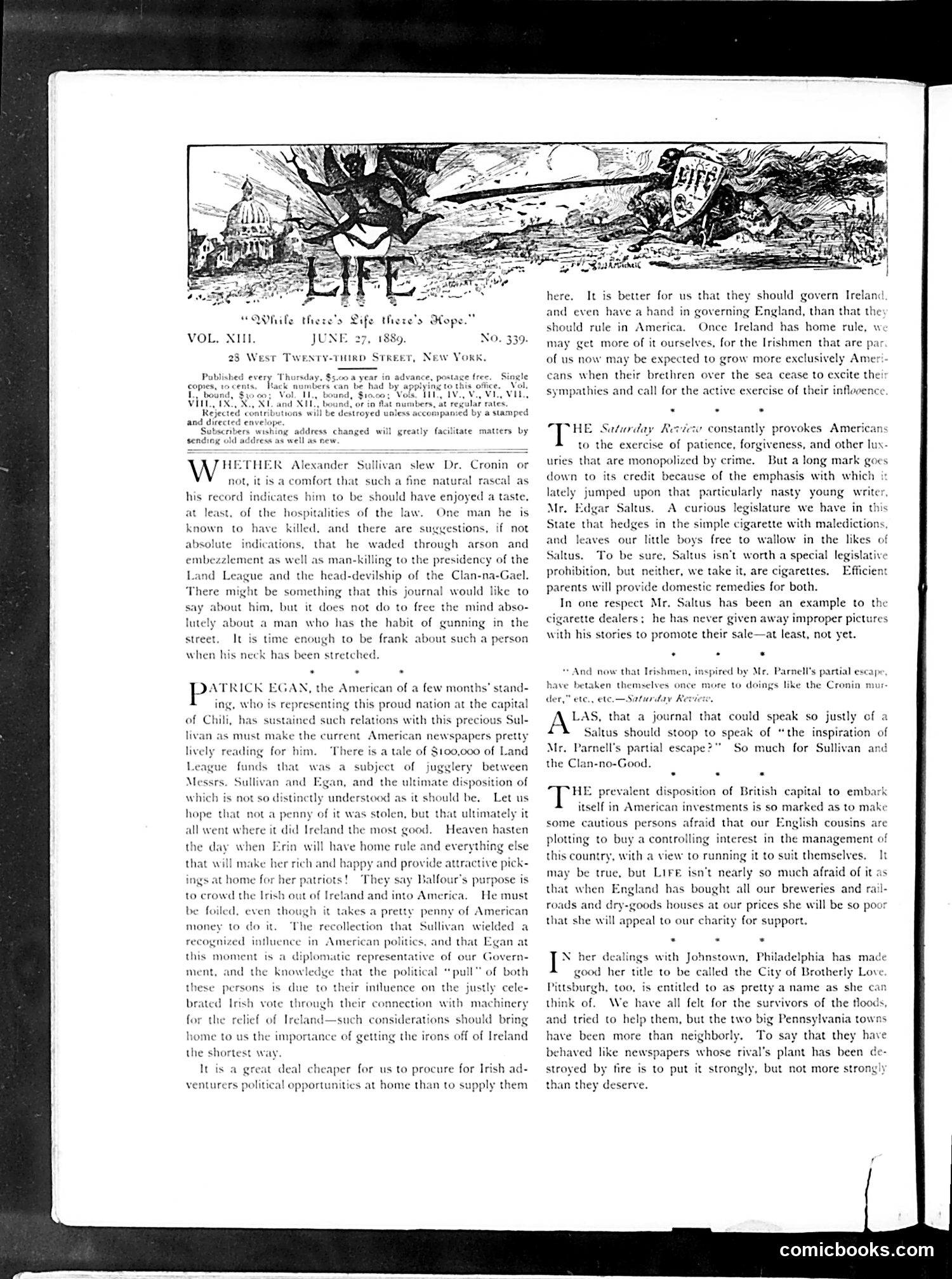
The masthead illustration shows allegorical figures representing "Life" with classical imagery. The main editorial discusses Irish-American political influence, specifically mentioning **Alexander Sullivan** and **Dr. Cronin**—an apparent reference to a murder case involving Irish nationalist figures in Chicago. The text critiques how Irish-American leaders like **Patrick Egan** leverage political connections between the U.S. and Ireland. It expresses concern about British interference in American affairs and debates whether Irish immigrants should focus on Ireland's independence or American interests. The satire mocks the competing political loyalties and financial schemes among Irish-American activists, suggesting they exploit American political opportunities while claiming to advance Irish causes—a commentary on ethnic political patronage networks of the Gilded Age.
📄 Transcribed text from this page (OCR, searchable)
Machine-transcribed from the original scan — historical spelling and the odd misread are preserved.
28 West Twenty-tTHirp Street, New York, $5.00 a year in advance, postage free. § rs can be had by applying to this office. « bound, $1o.co; Vols. IIL, IV. V., VI VE bound! of in flat numbers, at regular rates Catributions will be destroyed unless accompanied by a stamped and direct Subscribers wishing address c 1 greatly facilitate matters by Cronin or is a comfort that such a fine natural ras’ HETHER not, Alexander Sullivan slew Dr. ul as his record indicates him to be should have enjoyed a taste. at least, of the hospitalities of the law. One man he is have killed, and there are sugyestions, if not that embezzlement as well as man-killing to the presidency of the known to absolute indications, he waded through arson and Land League and the head-devilship of the Clan-na-Gael. There might be something that this journal would like to say about him, but it does not do to free the mind abso- y about a man who has the habit of gunning in the It is time enough to be frank about such a person s neck has been stretched. patec K EGAN, the American of a few months’ stand- ing, who is representing this proud nation at the capita of Chili, has sustained such relations with this precious Sul- livan as must make the current American newspapers pretty $100,000 of Land was a subject of jugglery lively reading for him. ‘There is at funds that Sullivan and Egan, and the ulin League between Messrs. te disposition of which is not so distinctly understood as it should be. Let us hope that not a penny of it was stolen, but that ultimately it all went where it did Ireland the most good. Heaven hasten the day when Erin will have home rule and everything else that will make her rich and happy and provide attractive pick- ings at home for her patriots! They say Balfour's purpose is to crowd the Irish out of Ireland and into America. He must be foiled, even though it takes a pretty penny of American money to do it. The recollection that Sullivan wielded a recognized influence in American polities, and that Egan a this moment is a diplomatic representative of our Govern- ment, and the knowledge that the political “pull of bot these persons is due to their influence on the justly cele- brated Irish vote through their connection with machinery for the relief of Ireland—such considerations should bring home to us the impc ¢ of getting the irons off of Ireland the shortest way It is a great deal cheaper for us to procure for Irish ad- venturers political opportunities at home than to supply them It is better for us that they should govern Ireland hand in governing England, than that th here, and even have 4 should rule in Americ: Once Ireland has home rule, w may get more of it ourselves, for the Irishmen that are par of us now may be expected to grow more exclusively Ame: cans when their brethren over the sea cease to excite the: sympathies and call for the active exercise of their inflocence TH Saturday Review constantly provokes Ameri to the exercise of patience, forgiveness, and other lux- But a long mark goes down to its credit because of the emphasis with which lately jumped upon that ly nasty young writer, Mr. ate that uries that are monopolized by crime. particu altus. A curious legislature we have in this Jges in the simple cigarette with maledictions, es our little boys free to wallow in the likes of To be sure, Saltus isn’t worth a special legislative her, we take it, are cigarett Efficie parents will provide domestic remedies for both. In one respect Mr, Saltus has been an example to the arette dealers; he has never given away improper pictures with his stories to promote their sale—at least, not yet. Edgar and lea Saltus prohibition, but ne * And now that Irishmen, inspired by Mr. Parnell’s partial eseay» have betaken themselves once more to doings like the C der,” ete., ete. —Satiaday Ki pnin mur y LAS, that a journal that could speak so justly of Saltus should stoop to speak of “the inspiration of So much for Sullivan a Mr. Parnell’s partial escape?” the Clan-no-Good. HE prevalent disposition of British capital to embark itself in American investments is so marked as to make me cautious persons afraid that our English cousii plotting to buy a controlling interest in the management of this country, with a view to running it to suit themselves, It may be true, but LiFe isn’t nearly so much afraid of it as England has bought all our breweries and rail- prices she will be so poor that when roads and dry-goods houses at ou arity for support. that she will appeal to our ¢ her dealings with Johnstown, Philadelphia has mace good her title to be called the City of Brotherly Love Pittsburgh, too, is entitled to as pretty a name as she can think of. We have all felt for the survivors of the floods, and tried to help them, but the two big Pennsylvania towns have been more than neighborly. To say that they have behaved like newspapers whose rival's plant has been ¢ stroyed by fire is to put it strongly, but not more strongly than they deserve. comicbooks.com