
Life, 1889-06-27 · page 6 of 17
Life — June 27, 1889 — page 6: what you’re looking at
What you’re looking at
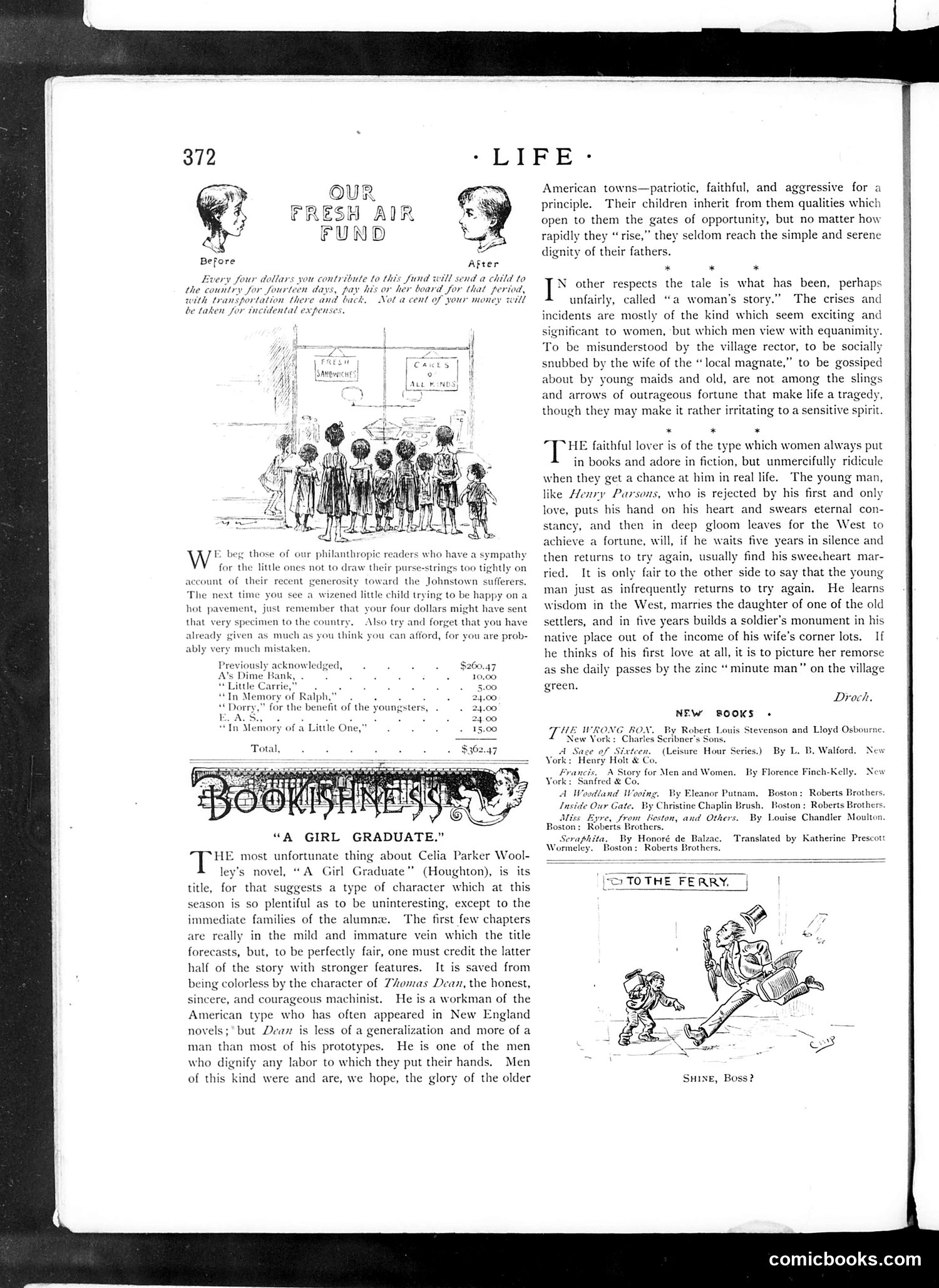
**The "Fresh Air Fund" Section:** This depicts a charitable program sending poor urban children to the countryside for health and moral improvement—a common Progressive Era initiative. The "before" and "after" illustrations show children's supposed transformation through rural exposure, reflecting period beliefs that fresh air and rural virtue could reform city children. **"A Girl Graduate" Review:** The text critiques Celia Parker Woolley's novel about an unconventional female character. The reviewer praises the honest working-class character Thomas Dean as embodying authentic American values—suggesting contemporary debates about class, gender roles, and what constituted "proper" American character. The discussion reflects turn-of-century tensions between traditional and progressive social values.
📄 Transcribed text from this page (OCR, searchable)
Machine-transcribed from the original scan — historical spelling and the odd misread are preserved.
-LIFE-: € Le, After Every four dollars you contribute to this fund will send a child to the country for fourtéen days, pay his or her board for that period, with transportation there and back, Not a cent of your money will be taken for incidental expenses. W beg those of our philanthropic readers who have a sympathy for the little ones not to draw their purse-str ightly on account of their The next time recent generosity toward the Johnstown suffer a wizened little child trying to be happy on a hot pavement, just remember that your four dollars might Also try and forget that already given as much as you think you can afford, for you are prob- much mistaken, you see ave sent that very specimen to the country, 1 have knowled 's Dime Bank Little Carri , “In Memory of Ralph “Dory,” for the bene In Memory of a Little On $260.47 5.00 24.00 tof the youngsters, Total, “A GIRL GRADUATE.” HE most unfortunate thing about Celia Parker Wool- y's novel, “A Girl Graduate” (Houghton), is its title, for that suggests a type of character which at this ‘on is so plentiful as to be uninteresting, except to the immediate families of the alumnze. The first few chapters are really in the mild and immature vein which the title forecasts, but, to be perfectly fair, one must credit the latter half of the story with stronger features. It is saved from being colorless by the character of Tomas Dean, the hone: and courageous machinist. sincere, He is a workman of the American type who has often appeared in New England but Dean is less of a generalization and more of a man than most of his prototypes. He is one of the men who dignify any labor to which they put their hands, Men of this kind were and are, we hope, the glory of the older American towns—patriotic, faithful, and aggressive for a principle. Their children inherit from them qualities which open to them the gates of opportunity, but no matter how rapidly they “rise,” they seldom reach the simple and serene dignity of their fathers. * * * N other respects the tale what has been, perhaps unfairly, called ” The crises and incidents are mostly of the kind which seem exciting and significant to women, but which men view with equanimity. To be misunderstood by the village rector, to be socially snubbed by the wife of the “local magnate,” to be gossiped about b: and old, are not among the slings and arrows of outrageous fortune that make life a tragedy, though they may make it rather irritating to a sensitive spirit. “a woman's story. young maid: * * * “TCHE faithful lover is of the type which women alwa in books and adore in fiction, but unmercifully ridicule when they get a chance at him in real life. The young man, like Henry Parsons, who is rejected by his first and only love, puts his hand on his heart and swears eternal con- stancy, and then in deep gloom leaves for the West to achieve a fortune, will, if he waits five years in silence and then returns to try again, usually find his sweecheart mar- It is only fair to the other side to say that the young man just as infrequently returns to try again. He learns st, marries the daughter of one of the old settlers, and in five years builds a soldier's monument in his native place out of the income of his wife’s corner lots. If he thinks of his first love at all, it is to picture her remorse as she daily passes by the zinc “ minute man” on the village green. ried. wisdom in the W. Droch. NEW BOOKS - y Robert Lonis Stevenson and Lloyd Osbourne Scribner's Sons. of Sixteen. (Leisure Hour Series.) ry Holt & Co. Francis, A Story for M York A Woodland Wooin B Jeanor Putnam, Boston: Roberts Brothers. Inside Our Gate. Vy Christine Chaplin Brush. Boston: Roberts Brothers Miss e, from Keston, and Others. Boston: Roberts Brother Seraphita, By Honoré de Balzac. Wormeley. Boston: Roberts Brothers. By L. B, Walford. New d Women, By Florence Finch-Kelly. New By Louise Chandler Moulton. Translated by Katherine Prescott TO THE FERRY. SuiNE, Boss? comicbooks.com