
A complete issue · 18 pages · 1889
Life — June 20, 1889
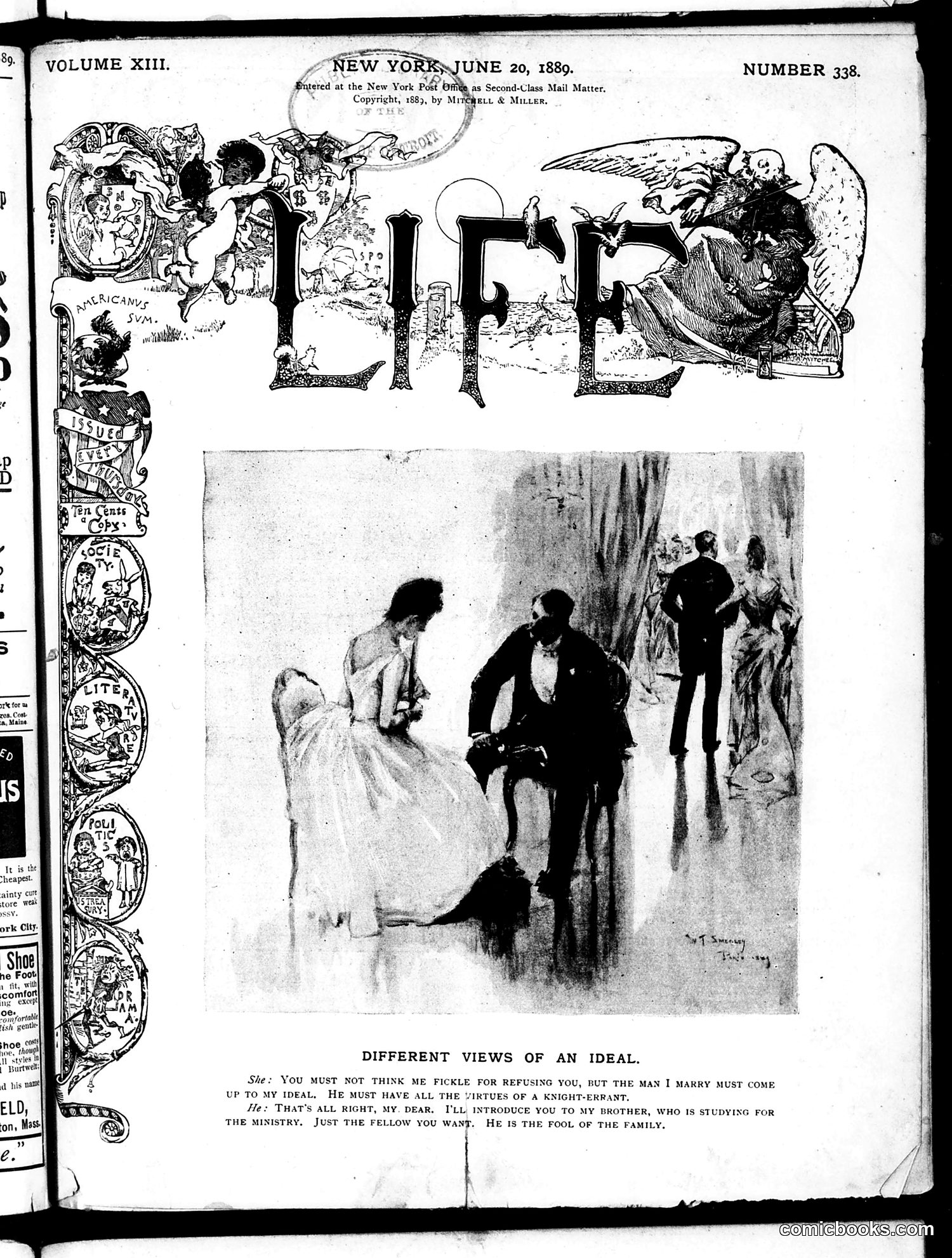
This satirical cartoon illustrates a gender conflict about marriage expectations. A woman (left) and man (center) discuss what qualities an ideal husband should possess. The woman insists her future husband must not refuse her and must embody knightly virtues—honor, courage, and moral excellence. The man counters dismissively: "That's all right, my dear. I'll introduce you to my brother, who is studying for the ministry. Just the fellow you want. He is the fool of the family." The joke targets late 19th-century courtship ideals, mocking both the woman's romantic expectations of masculine virtue and the man's cynical suggestion that only a naive, religious fool would meet such standards. It satirizes the gap between women's marriage hopes and men's practical skepticism.
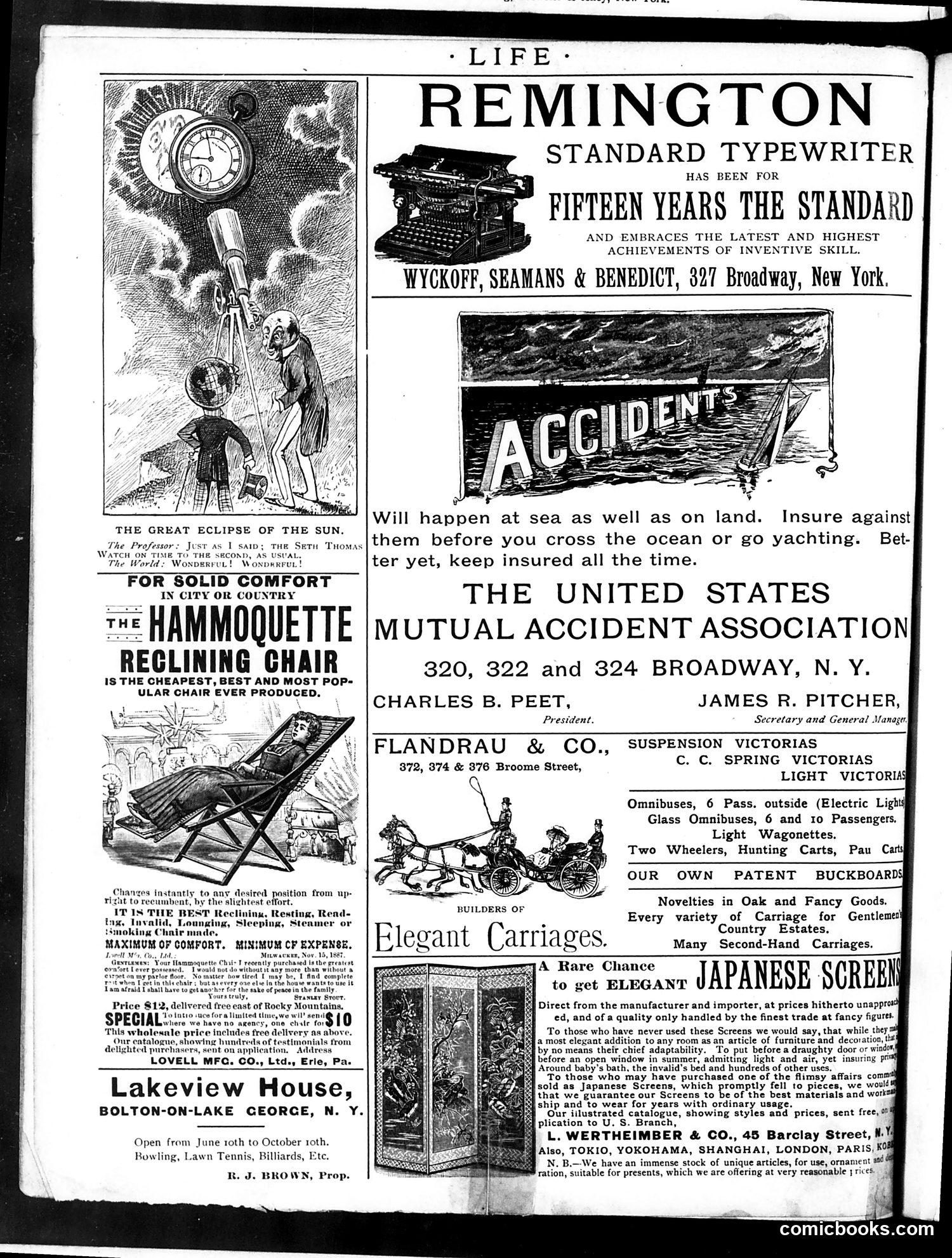
This political cartoon depicts the 1918 total solar eclipse. The image shows two figures gazing upward at a celestial phenomenon—one appears to be a child and the other an adult or possibly a allegorical figure. The caption references "The Great Eclipse of the Sun" and mentions "the Nineteenth Century" and "the World." The specific satirical intent is unclear from this reproduction, but eclipse imagery during this period sometimes carried metaphorical weight regarding global events or shifts in power. However, without additional context about Life magazine's editorial stance during 1918, the precise political meaning remains uncertain. The cartoon may simply commemorate the astronomical event as a moment of collective human wonder.
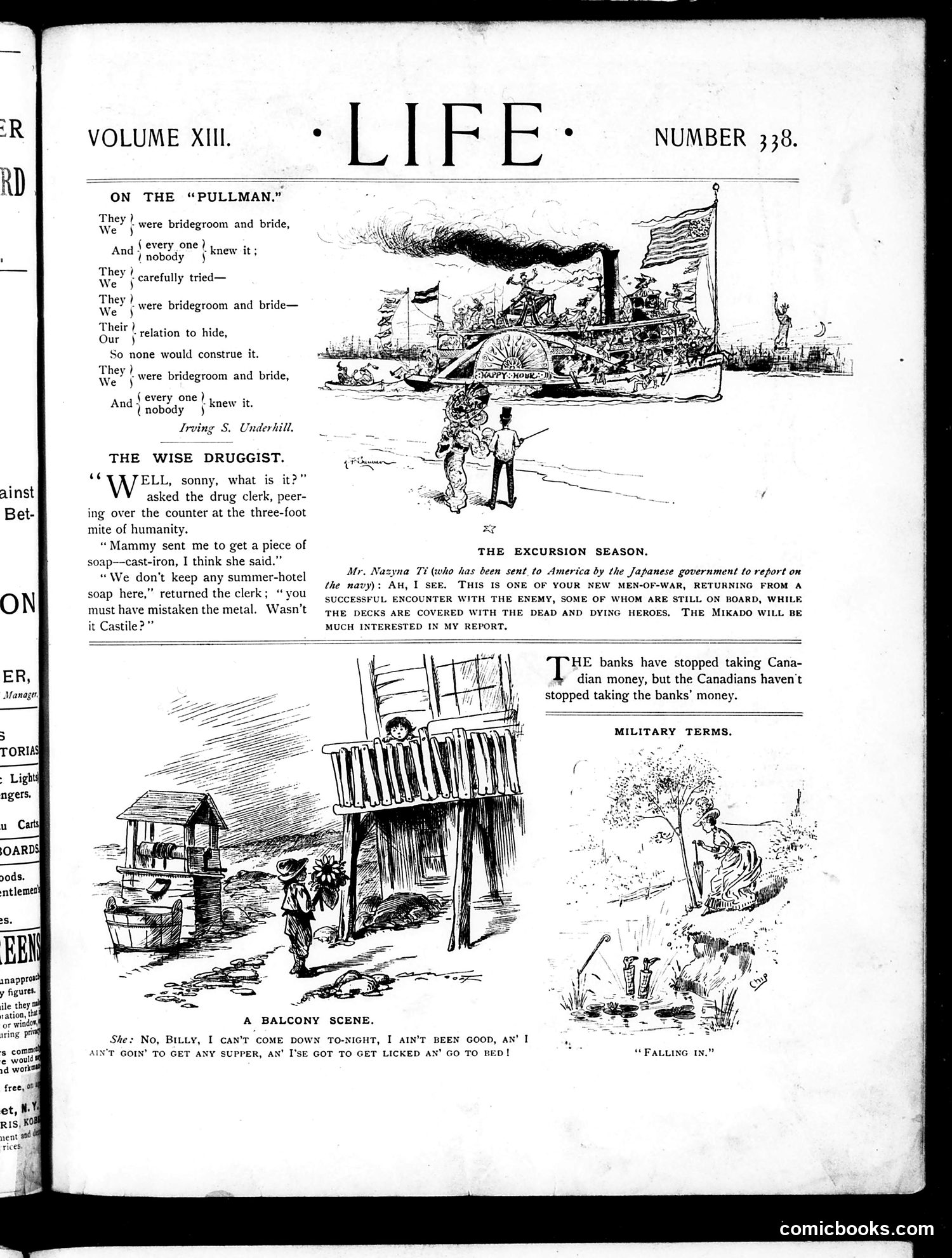
This page contains three separate pieces of satirical content: 1. **"On the Pullman"** - A poem by Irving S. Underbill about newlyweds hiding their relationship on a Pullman (railroad) car, with the joke being that everyone knew anyway. 2. **"The Wise Druggist"** - A comedic dialogue where a customer requests "soap—cast-iron" (likely a pun), and the clerk assumes she wants Castile soap but questions whether she's confused the metal. 3. **"The Excursion Season"** - References the Mikado (a Japanese warship) involved in unsuccessful encounters with enemies during what appears to be military conflict, with commentary about casualties. 4. **"Military Terms"** - A visual joke labeled "Falling in," depicting soldiers falling into a trench or ditch, playing on double meaning of the military phrase. The page reflects early 20th-century American humor and military/naval references.
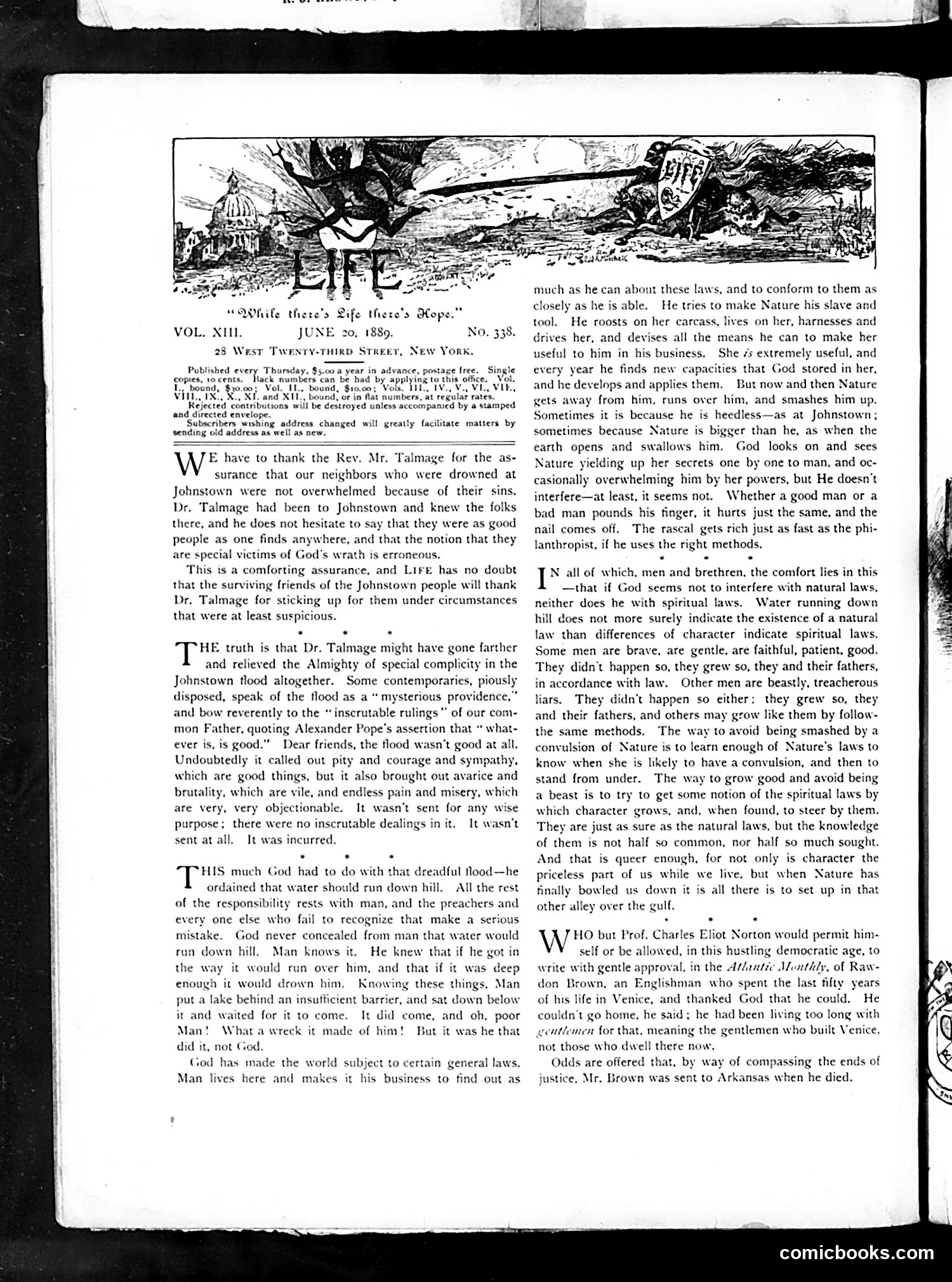
The masthead illustration depicts **Life as a winged figure** confronting larger forces—likely representing **Nature or Fate**—in a landscape with classical architecture. This visual metaphor introduces the editorial's theme: man's relationship to natural law. The article discusses the **Johnstown Flood** (May 1889), a catastrophic disaster killing over 2,000 people. Rather than attributing it to God's intervention, the writer argues that natural laws operate independently. The piece references **Rev. Talmage's claim** that divine providence saved some Johnstown residents, which the editor finds theologically problematic. The satire targets religious explanations for disasters: if God controls nature absolutely, why allow such suffering? The article advocates understanding character and morality through natural law rather than miraculous intervention.
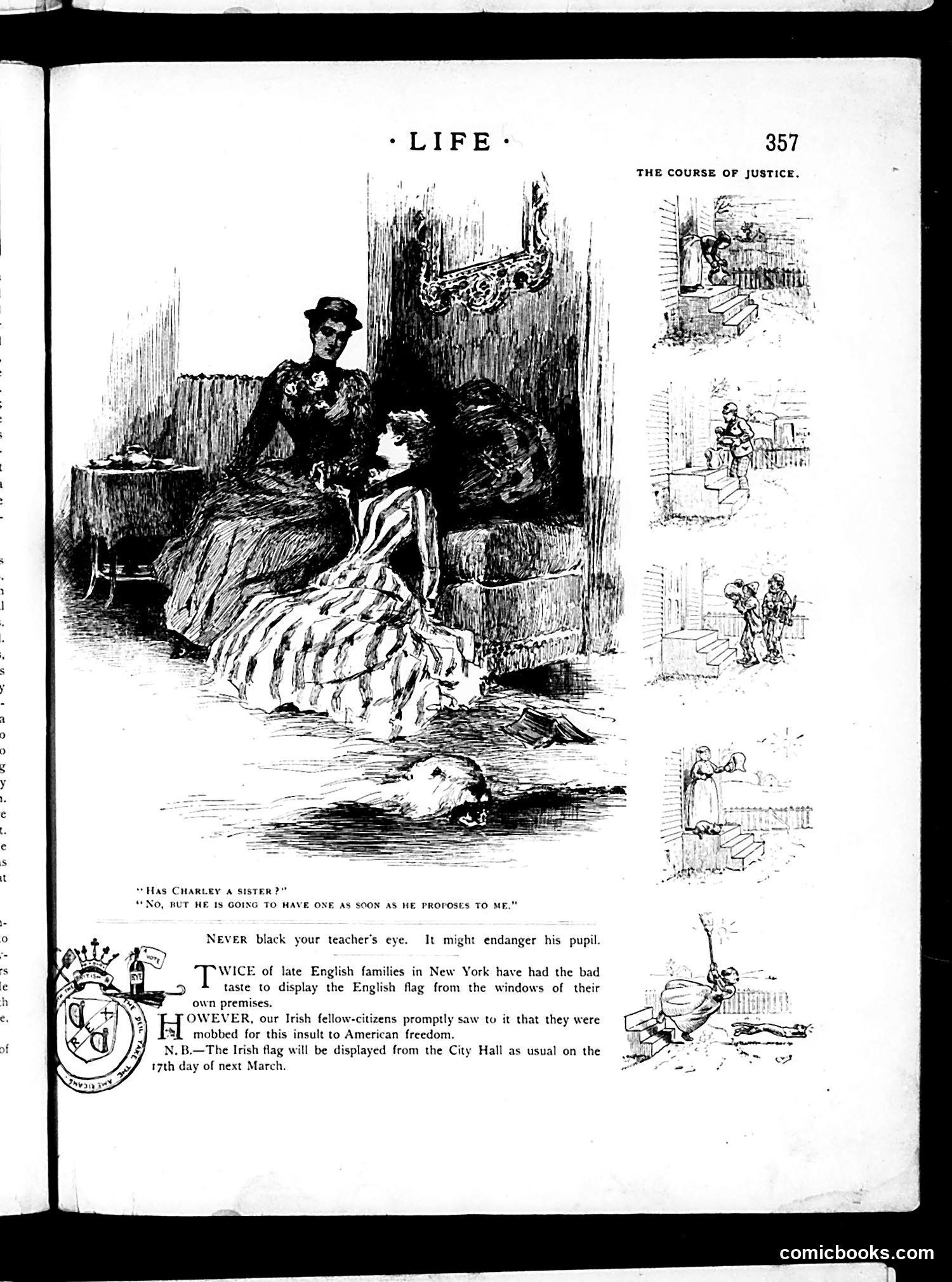
The main cartoon depicts a domestic scene titled "Has Charley a Sister?" with the response "No, but he is going to have one as soon as he proposes to me." This is a romantic/courtship joke playing on the double meaning of "sister"—the woman suggests that marrying her suitor will make her his sister-in-law. The smaller cartoons on the right appear to illustrate "The Course of Justice," though their specific narrative is unclear from this image. Below is text about English flags displayed in New York during what appears to be St. Patrick's Day tensions (March 17th), with Irish-Americans protesting English flag displays. The note warns against "blacking your teacher's eye" as it might endanger the pupil—likely a humorous reference to corporal punishment consequences.
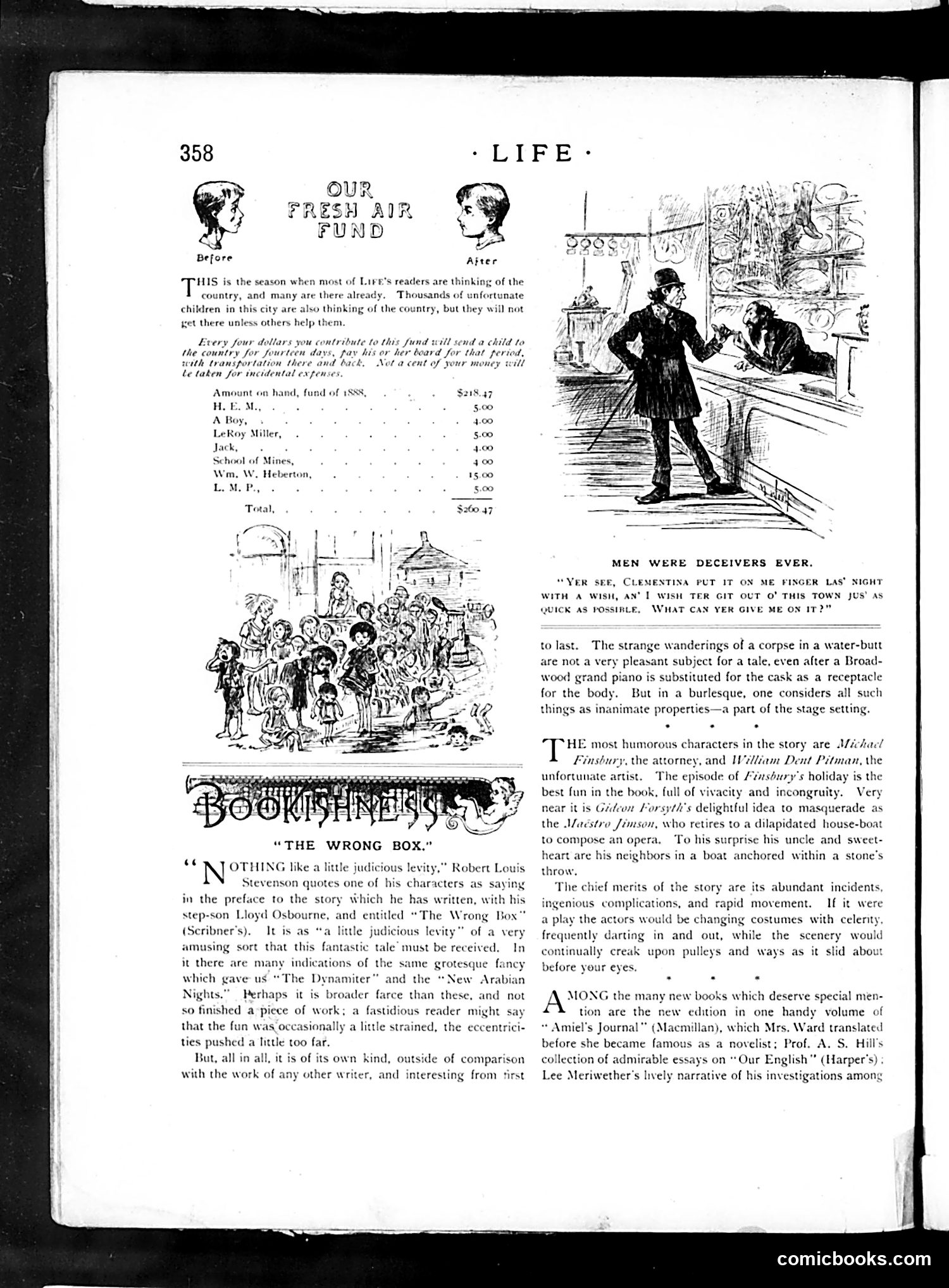
This page contains two distinct sections: **"Fresh Air Fund"** (top left): A fundraising appeal with before/after illustrations showing a sickly child transformed by country air. The text describes a charitable initiative sending urban children to the countryside for health benefits. Contributors' names and donation amounts are listed, totaling $260.47. **"The Wrong Box"** (bottom): A book review praising Robert Louis Stevenson's novel for its "judicious levity" and grotesque fancy. The reviewer compares it favorably to Stevenson's previous works like "The Dynamiter" and "New Arabian Nights," noting the story contains "abundant incidents, ingenious complications, and rapid movement." The review emphasizes the book's theatrical qualities and comedic merit. The illustrations are decorative line drawings typical of period magazines, supporting the text rather than conveying independent political commentary.
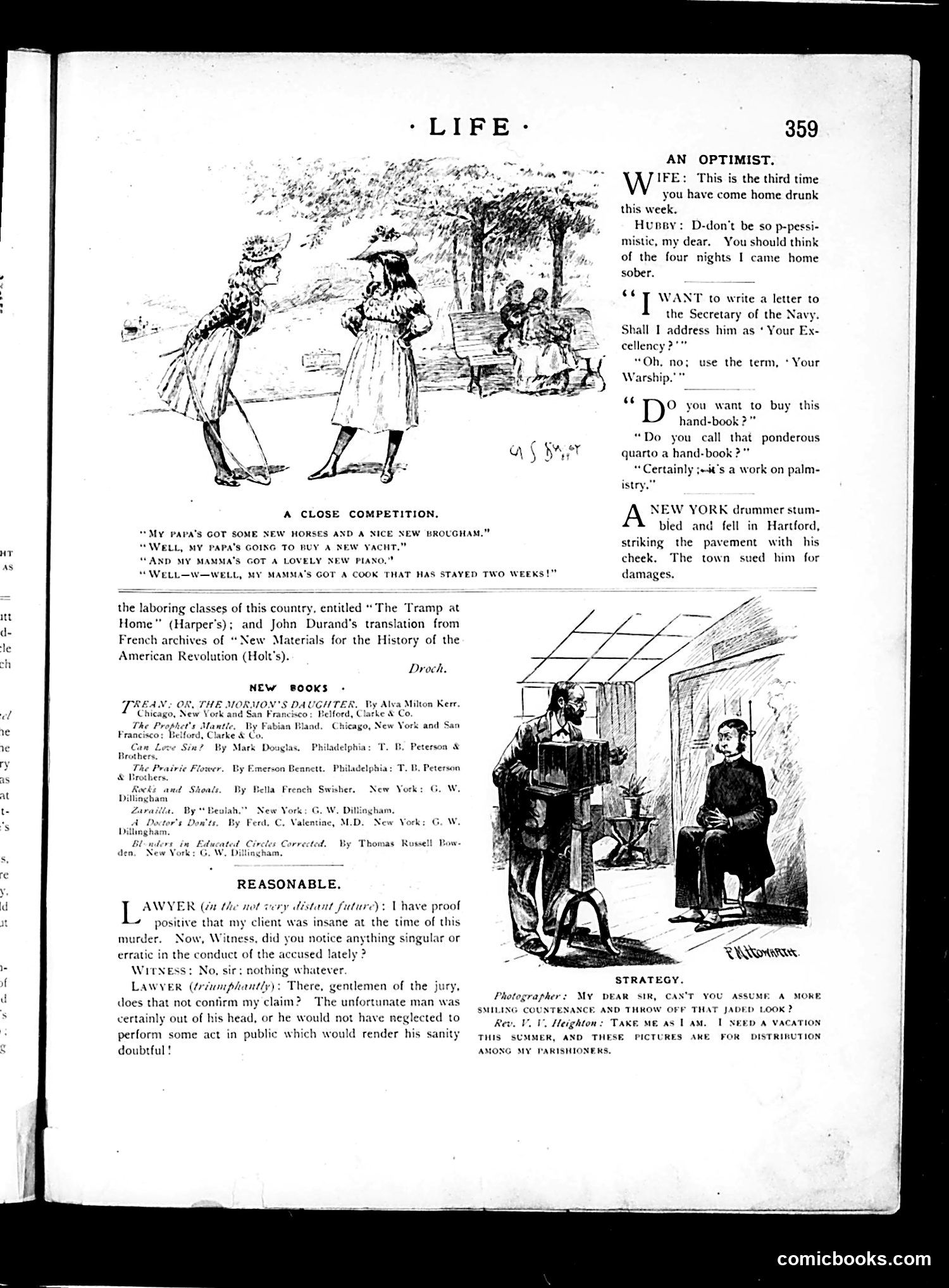
This page contains three separate satirical pieces: 1. **"A Close Competition"** (top): A cartoon depicting women boasting about their families' new possessions—horses, broughams, pianos, and cooks. The satire mocks upper-class women's competitive materialism and status-seeking through consumer goods. 2. **"An Optimist"** (right): A dialogue where a drunk husband claims he came home sober four of seven nights. The wife's pessimism contrasts with his self-deceptive optimism, satirizing both alcoholism and marital dynamics. 3. **"Reasonable"** (bottom): A lawyer's circular argument defending his client's sanity, suggesting the accused couldn't be insane because only a sane person would commit such a questionable act. The satire targets legal sophistry and absurd reasoning. The page also includes book reviews and advertisements typical of the period.
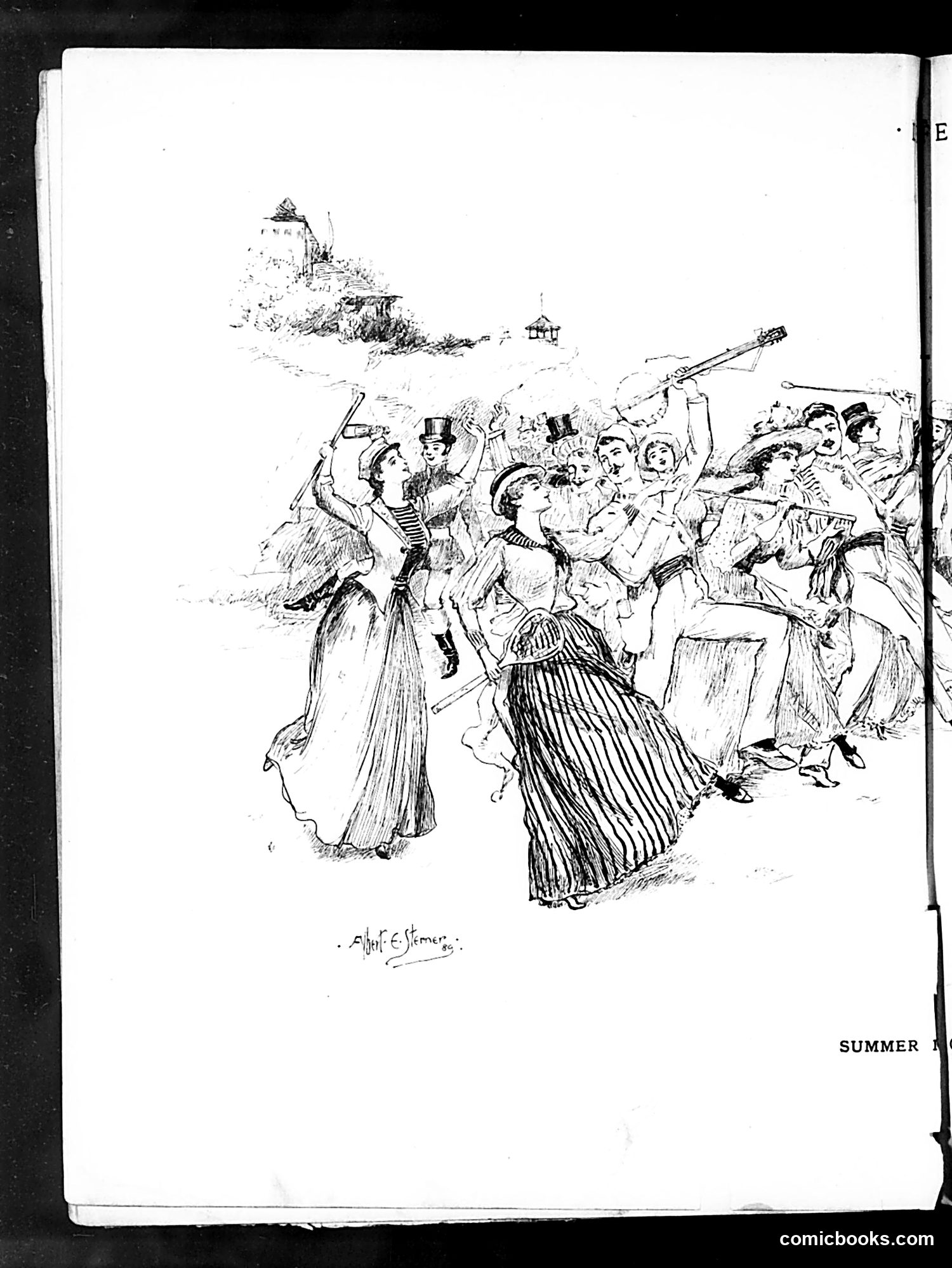
This sketch by Albert Sterner depicts a fashionable summer social gathering, likely from the early 1900s. The drawing shows well-dressed women and men in period costume engaged in leisure activities at what appears to be a seaside or resort location (note the structure in the background). The satire likely mocks the pretensions and social conventions of wealthy Americans' summer recreations—their elaborate dress, affected manners, and pursuit of fashionable entertainment. The crowded, animated composition suggests both the social climbing and sometimes ridiculous behaviors of the leisure class during the season. The signature "Albert Sterner" identifies the artist, a prominent illustrator of the era known for satirizing American high society.
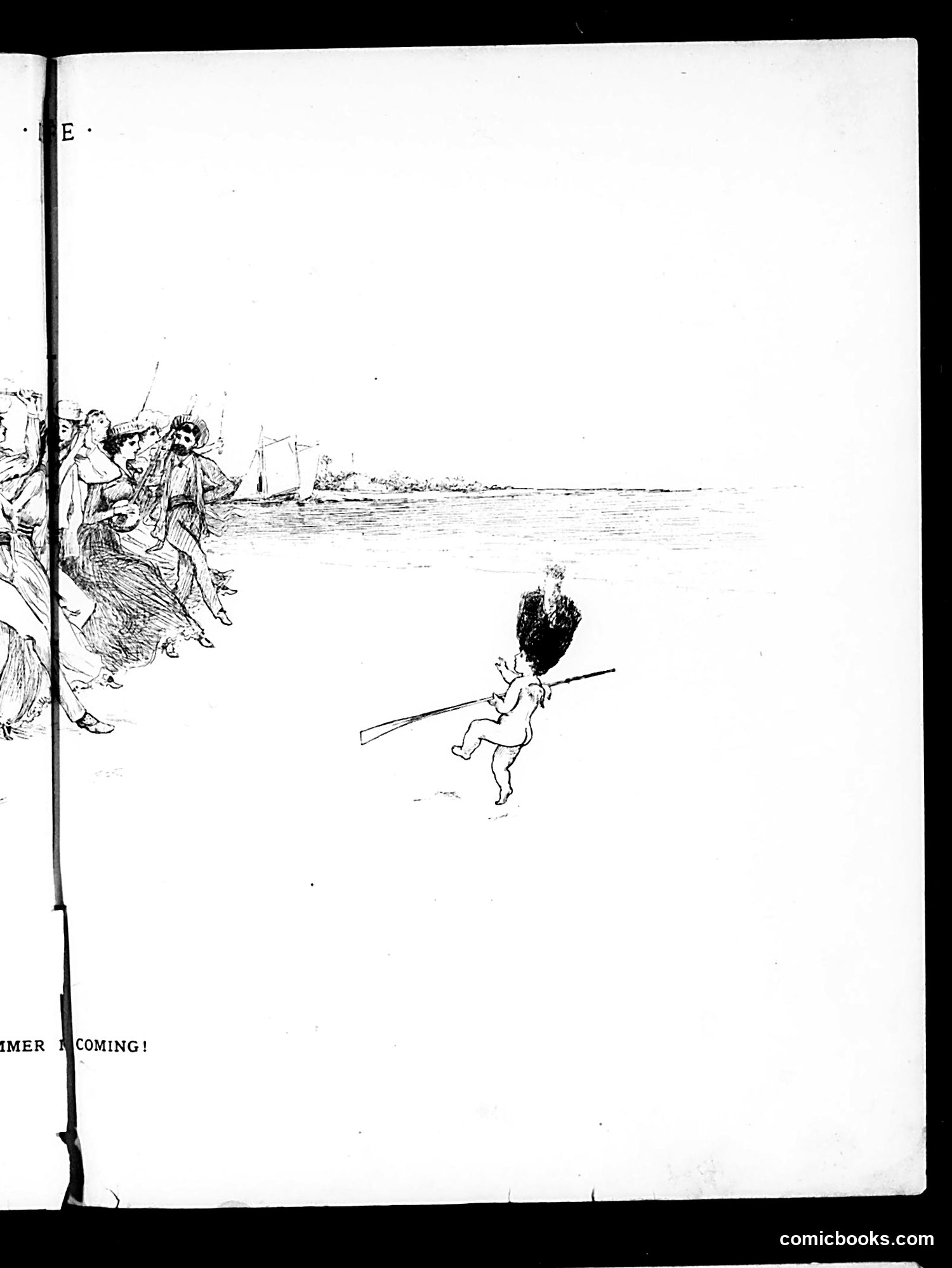
This page features a single cartoon depicting a child carrying a rifle, walking toward a group of formally dressed adults on a beach. The child has dark, somewhat wild hair and appears to be approaching the gathered figures with the gun. The caption "SUMMER IS COMING!" suggests social commentary on how summer leisure activities might be disrupted or threatened. The incongruous image of a child armed with a rifle approaching well-dressed beachgoers likely satirizes either a contemporary social anxiety or safety concern of the era. Without additional context about Life magazine's publication date and current events, the specific threat being referenced remains unclear, though the composition suggests parental or public concern about some summer-related danger or disruption to leisure pursuits.
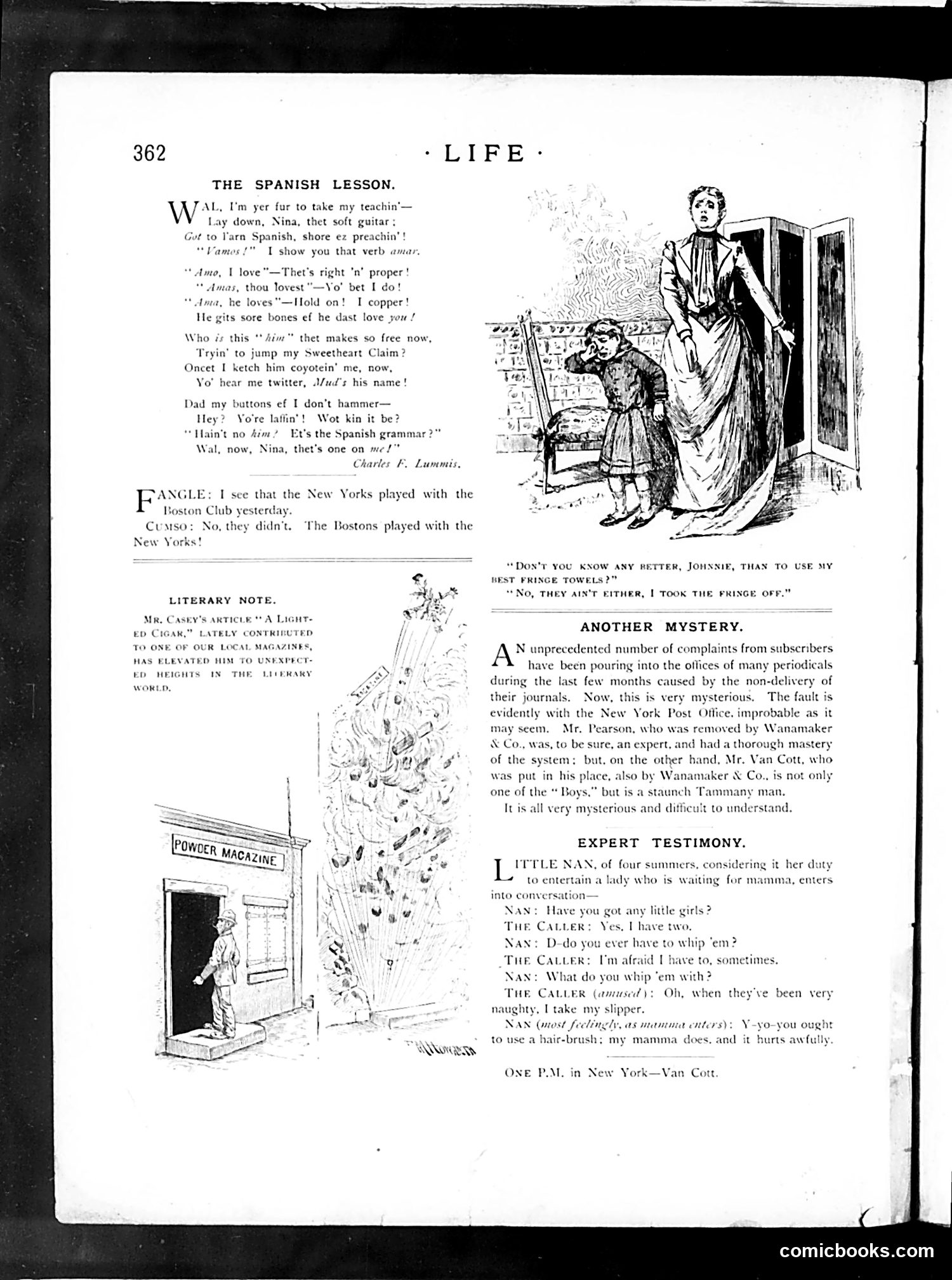
This page contains three distinct pieces of humor: **"The Spanish Lesson"** (top): A domestic comedy where a man attempts to learn Spanish from his girlfriend Nina, who repeatedly corrects his grammar while he makes crude jokes. The humor derives from the man's malapropisms and flirtation undermining any serious language study. **"Fangle/Cumso" exchange**: A brief joke about baseball—likely referencing contemporary New York teams (Bostons vs. New Yorks), with humor in the confused contradiction. **"Another Mystery"** and **"Expert Testimony"**: These mock issues with New York Post Office mail delivery and a conversation between a nanny and caller about disciplining children with hair-brushes. The satire targets bureaucratic incompetence and parenting practices of the era. The cartoons employ sketch illustrations typical of early 20th-century *Life* magazine's satirical style.
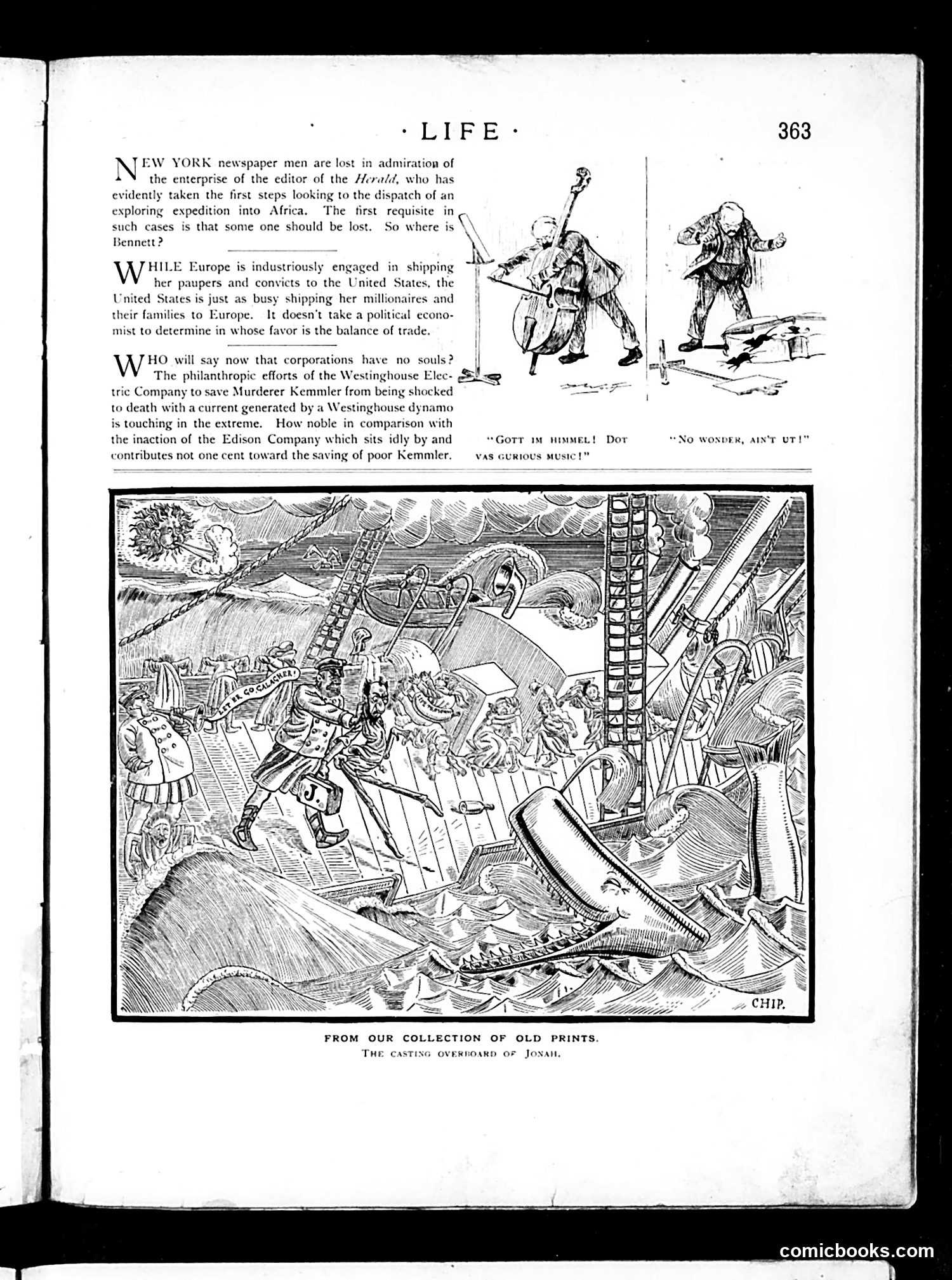
This page contains three separate editorial commentaries with illustrations. The top section discusses three contemporary issues: an Herald editor planning an African expedition (requiring sacrifice), Europe shipping convicts to America while America ships millionaires back (a trade imbalance joke), and a contrast between the Westinghouse Electric Company's efforts to save murderer Kemmler from execution versus the Edison Company's inaction regarding poor people—satirizing corporate priorities and the death penalty debate. The large engraving below, captioned "The Casting Overboard of Jonah," depicts a biblical scene used as historical satirical commentary. The two small sketches above show musical performers with German captions, likely commenting on contemporary entertainment or cultural figures, though the specific references are unclear without additional context.
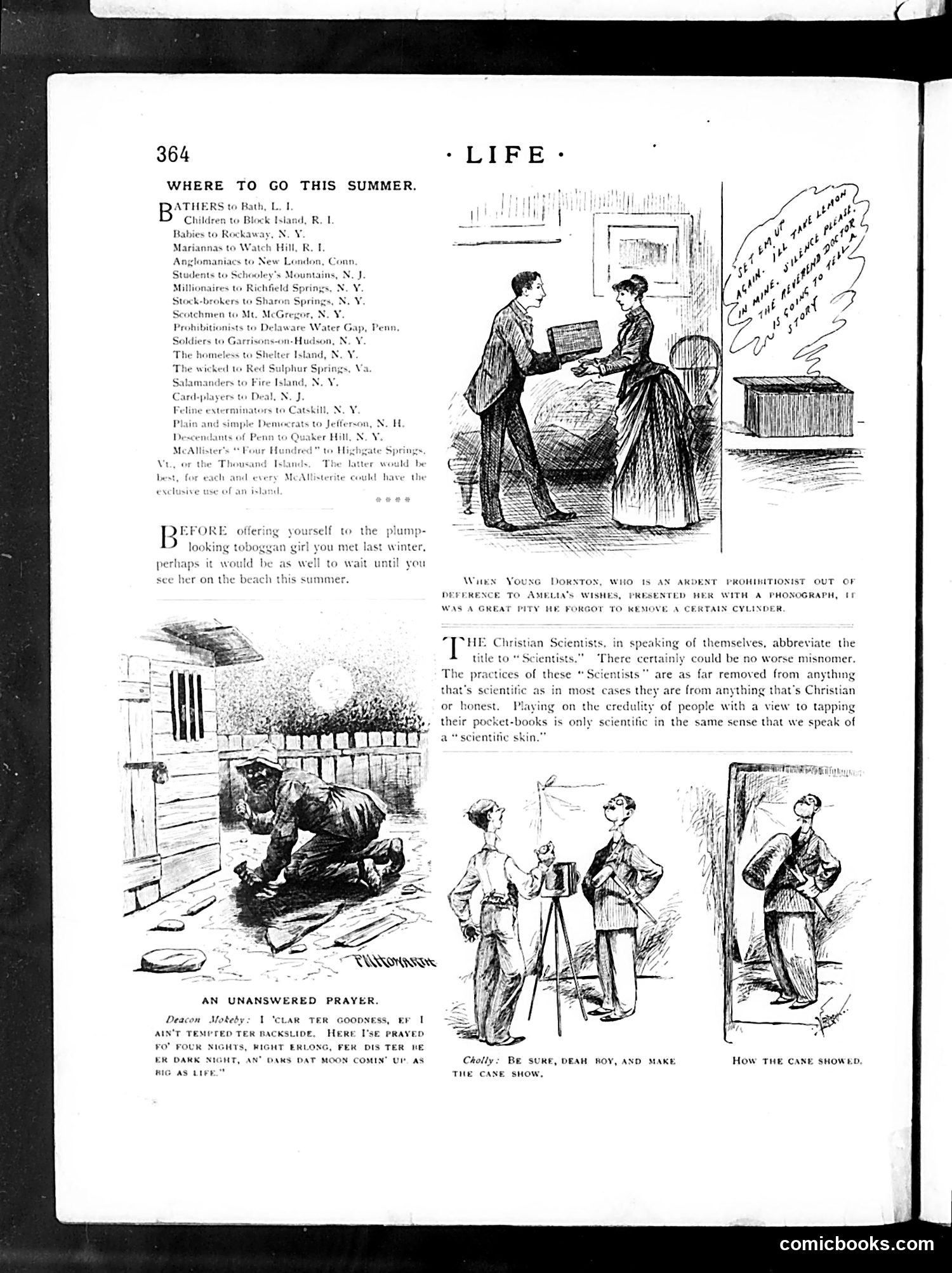
This page contains multiple satirical pieces targeting social hypocrisy and fraud of the era: **"An Unanswered Prayer"** mocks a rural deacon (Deacon Moberly, rendered in dialect) who prays for darkness to enable sinful behavior—apparently theft or assault—while claiming piety. The joke is the contradiction between his religious pretense and actual intentions. **The Christian Scientist section** attacks the emerging Christian Science movement, accusing practitioners of fraud. The satire suggests they exploit credulous people's trust by using pseudo-scientific language ("scientific skin") to con money from believers, comparing it to pickpocketing. **"How the Cane Showed"** appears to satirize a young man (Cholly) who gifted a phonograph to an ardent prohibitionist woman (Amelia), apparently containing inappropriate content she disapproved of—the "cane" likely refers to risqué behavior revealed by the gift. The common thread: exposing gaps between public morality and private behavior, and charlatanism dressed in respectable clothing.
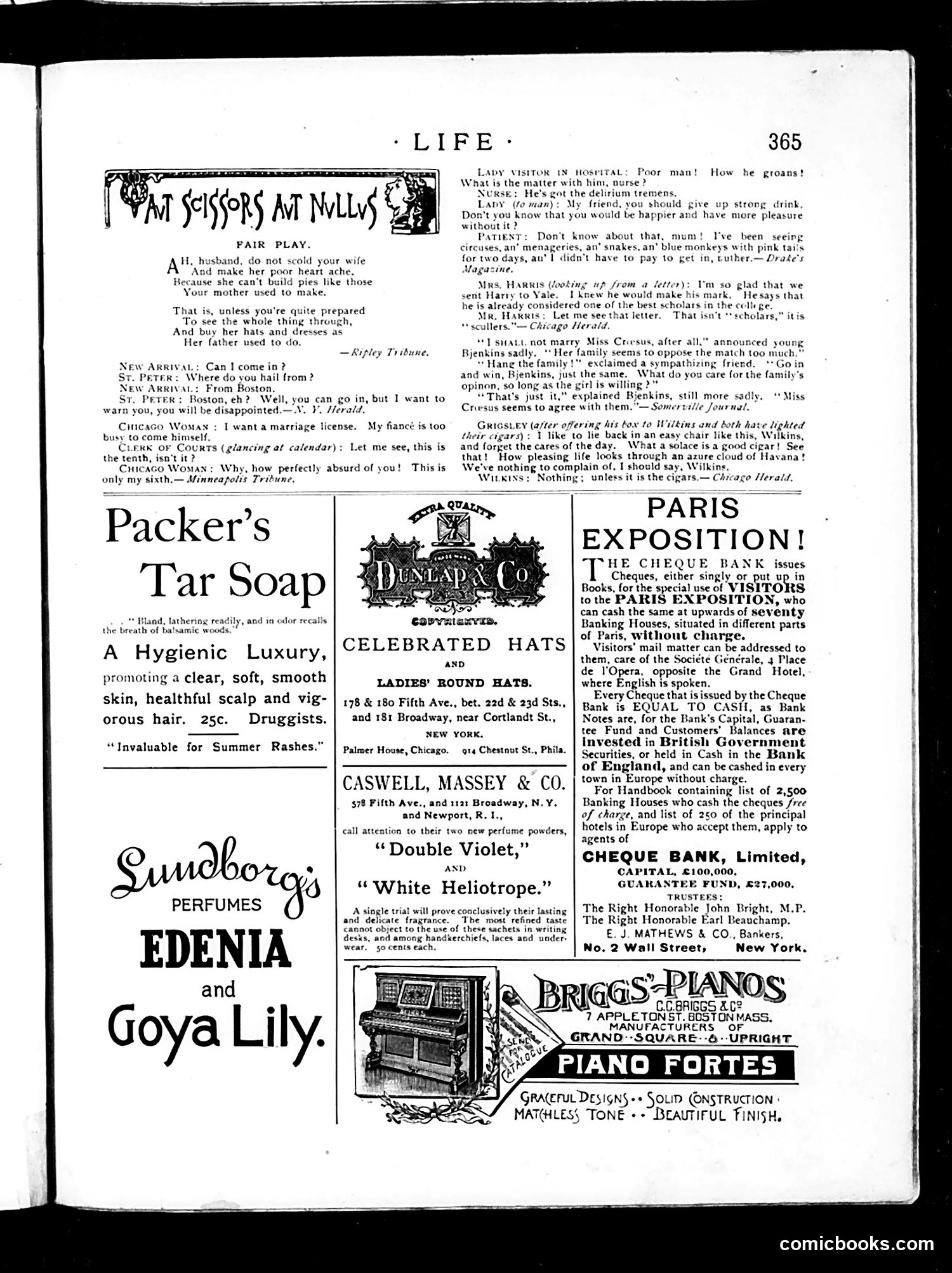
This page from *Life* magazine contains several short satirical jokes and extensive period advertisements. The humor targets domestic and social absurdities of the era: **"Fair Play"** presents comic vignettes about marriage, gender relations, and class expectations. One depicts a wife demanding her husband buy her fashionable hats and dresses—satirizing consumerism and marital obligations. Another shows a Boston arrival at heaven's gates, with St. Peter warning him of disappointment (likely poking fun at Boston's reputation or Puritan severity). The hospital scene mocks attitudes toward alcoholism: a visitor lectures a delirious patient about quitting drink, while the patient boasts he attended circuses and menageries cheaply during his binge. **The Bjenkins vignettes** satirize romantic melodrama—a young man pursues his wealthy fiancée despite family opposition, with exaggerated tragic-comic dialogue. The page is dominated by period advertisements for tar soap, perfumes, celebrated hats, pianos, and banking services for Paris Exposition visitors—reflecting contemporary consumer culture and international travel for the wealthy.
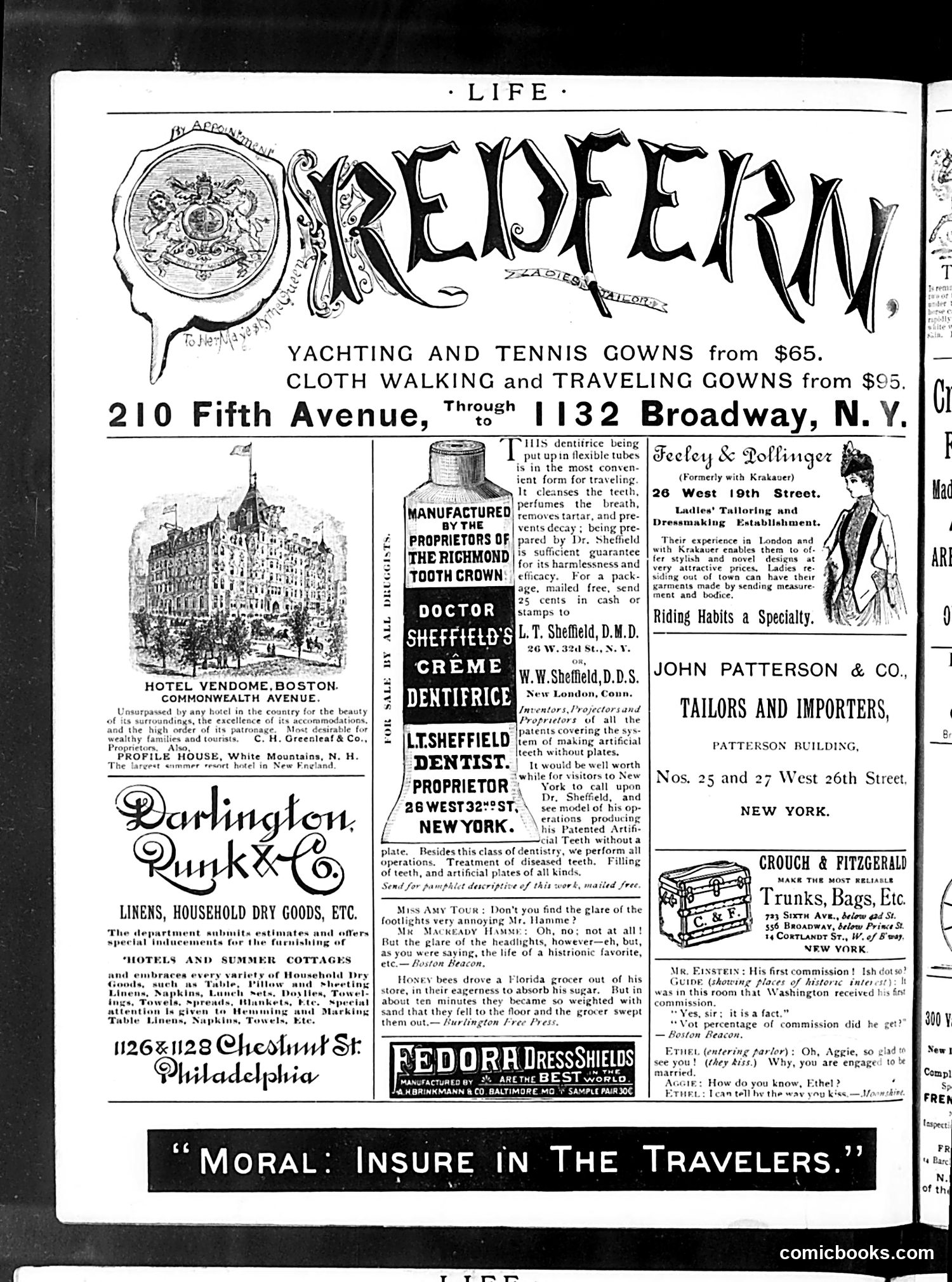
This is primarily an **advertising page** from Life magazine, not a political cartoon. The dominant content features commercial ads for clothing, dentistry, hotels, and travel goods targeting wealthy consumers of the era. The few cartoon elements are brief **humor pieces** at the bottom: 1. **Miss Amy Tour/Mr. Macready Hastie**: A joke about theater ("histrionic favorite") where an actress complains about footlight glare, but the male actor dismisses her concern while griping about automobile headlights—satirizing how people prioritize different annoyances. 2. **Washington's Commission joke**: A guide shows a historic room where Washington received his commission; a visitor asks what percentage commission he got—a pun playing on financial "commission" versus military rank. 3. **The Engagement joke**: A woman can tell her friend is engaged by "the way you kiss"—mild romantic humor. These are light, domestic gags typical of early 1900s magazine filler. The page reflects the magazine's dual role as both satirical publication and high-end advertising vehicle for affluent readers.
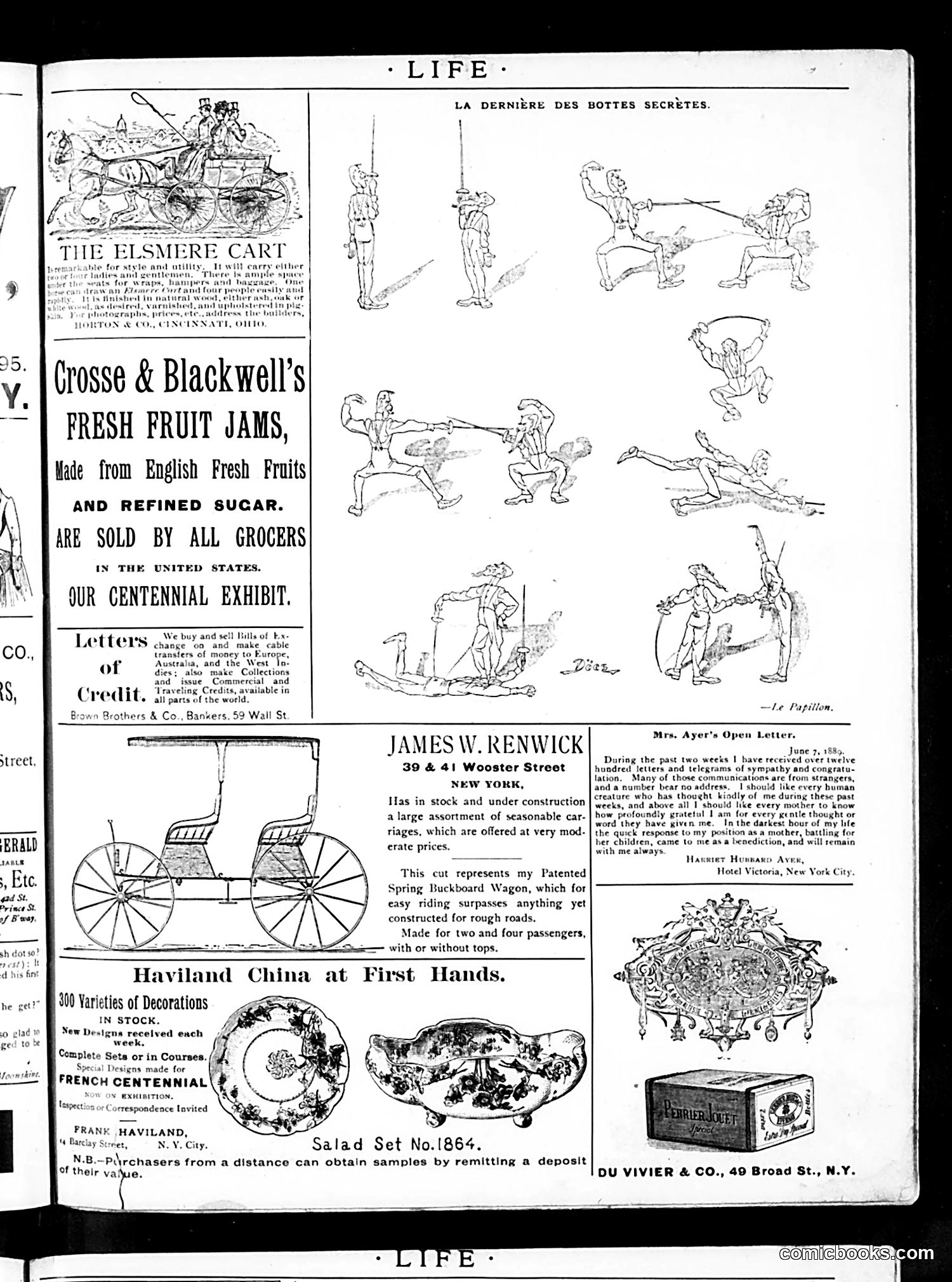
This page is primarily **advertisements and notices** rather than political satire. The main content includes: **"La Dernière des Bottes Secrètes"** (top right): A French-captioned illustration showing figures in acrobatic or gymnastic poses—likely a humorous sketch about secretive boots or footwear, though the specific reference is unclear without broader context. **Mrs. Ayer's Open Letter**: A prominent personal statement from a woman named Ayer thanking the public for sympathy and support during an unspecified crisis involving her role as a mother. The emotional tone suggests a significant personal or public controversy, but details aren't provided here. The remainder consists of typical late-19th-century advertisements: Grosse & Blackwell's jam, James Renwick's carriages, Haviland China, and other commercial goods. The page appears to be from Life's commercial section rather than its satirical editorial content. Without knowing the specific date or broader context of Mrs. Ayer's situation, the historical significance remains limited for modern readers.
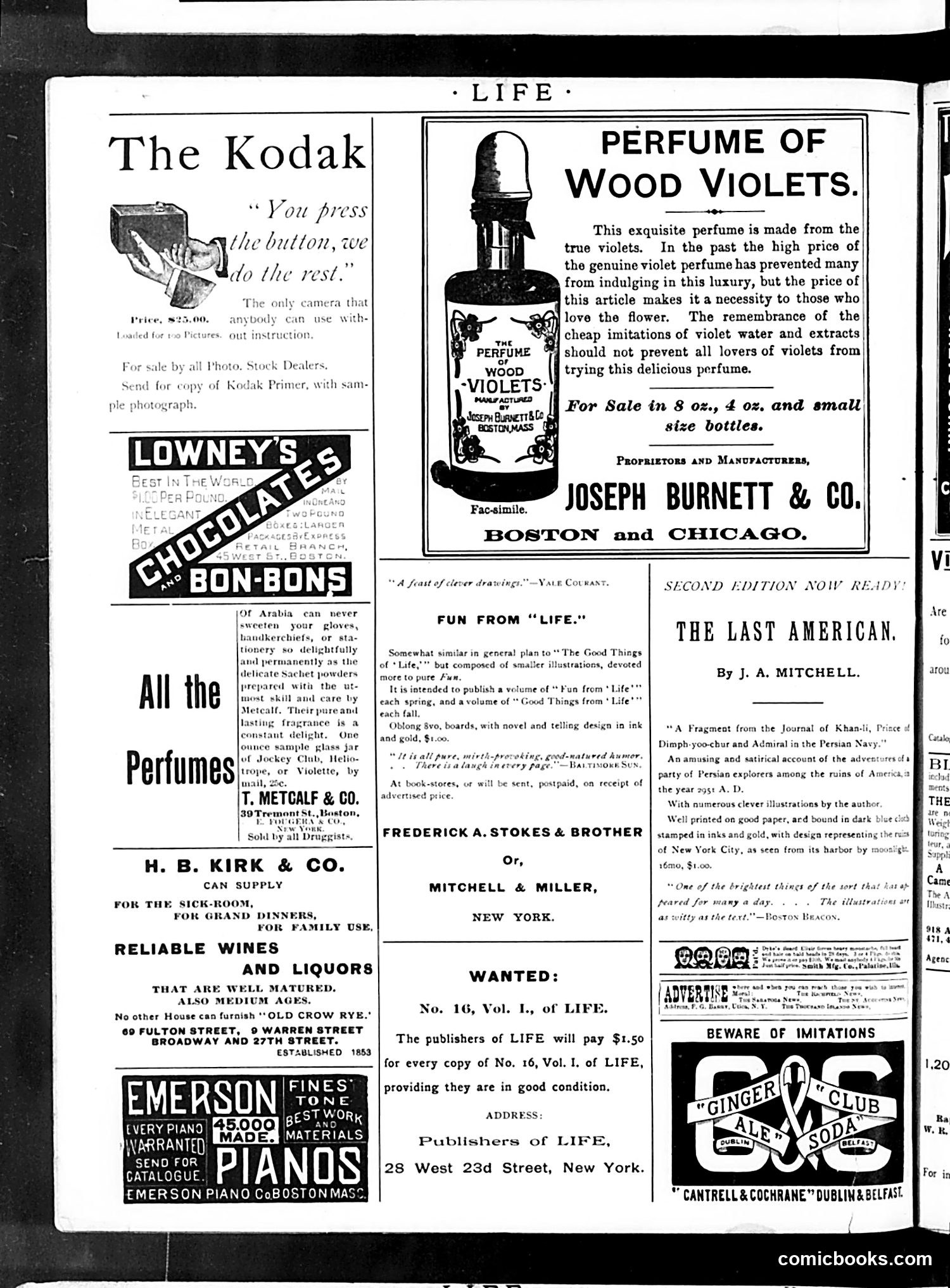
This is primarily an **advertising page** from *Life* magazine, not a satirical cartoon page. The advertisements showcase consumer products of the era (circa 1880s-90s), offering insights into period commercialism: **Key Ads:** - **Kodak camera** ($25.00) — advertises ease of use ("you press the button, we do the rest"), marking early consumer photography - **Perfume of Wood Violets** — emphasizes affordability of luxury goods previously expensive - **Emerson Pianos** — high-end domestic furnishings - **Wines and liquors** — including "Old Crow Rye," marketed for home consumption - **"The Last American"** book — a satirical novel by J.A. Mitchell **The Satire:** *Life* itself is being marketed here, with notices seeking back issues and advertising its upcoming humor collections. The page reflects the magazine's dual nature: satirical social commentary paired with advertisements targeting affluent readers who could afford these luxuries. The humor lies in *Life*'s self-promotion among consumer goods—positioning itself as a product alongside perfume and pianos.
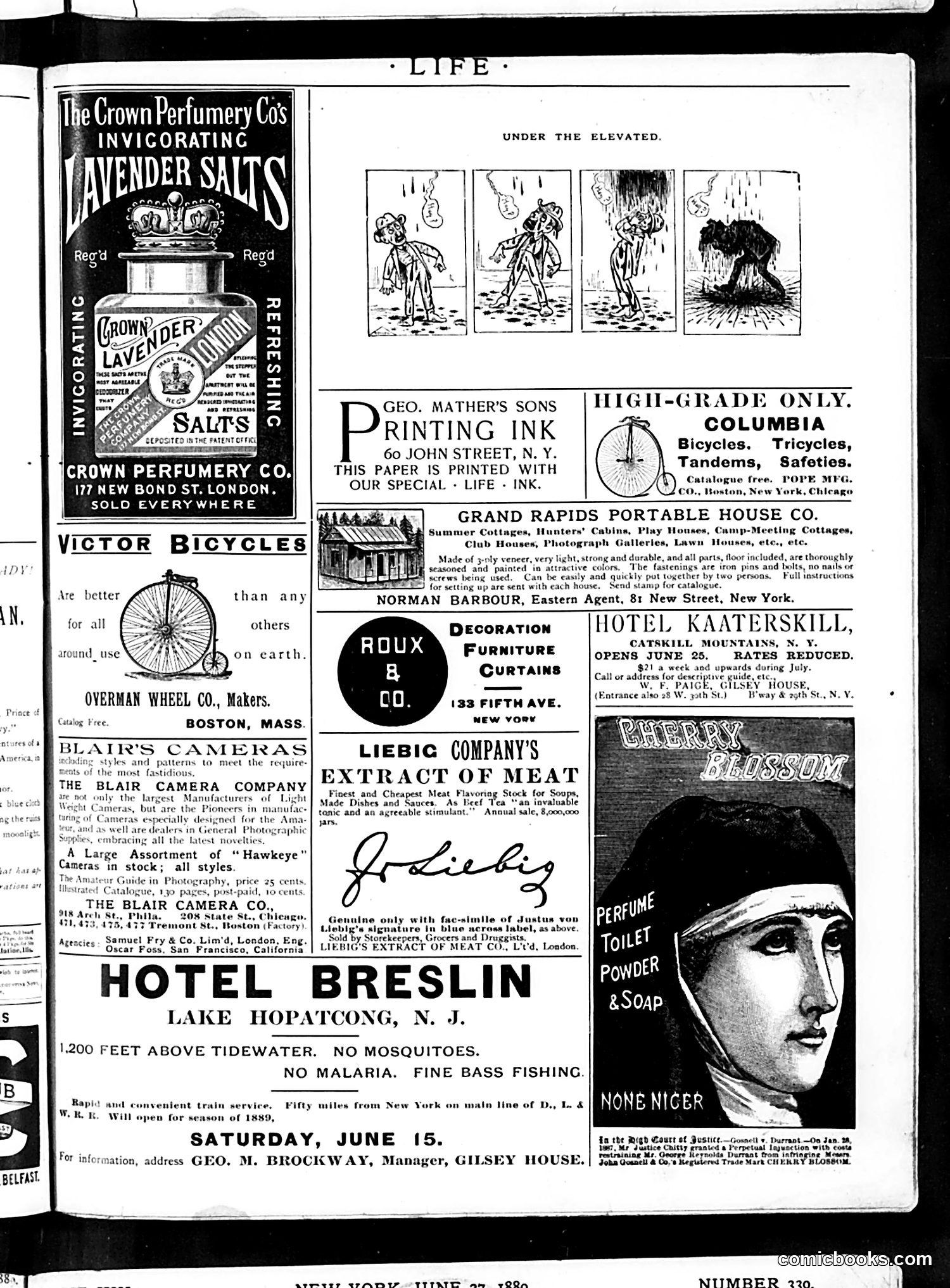
This four-panel comic strip depicts urban street life beneath New York's elevated railway infrastructure. The sequence shows a man being progressively soaked by water dripping from above—likely rainwater accumulating on the iron structure—until he's thoroughly drenched in the final panel. The satire targets the practical inconveniences of the elevated railway system, which was a modern marvel but created real problems for pedestrians below. The "elevated" (the El) was still relatively new infrastructure in the 1880s-90s when *Life* was published. The joke captures middle-class frustration with this new technology: it's impressive but actively makes street life worse for ordinary people trying to navigate the city. The humor is straightforward slapstick—the escalating misfortune—but the underlying point is social commentary on urban "progress" that benefits transit riders while punishing those on the street below.
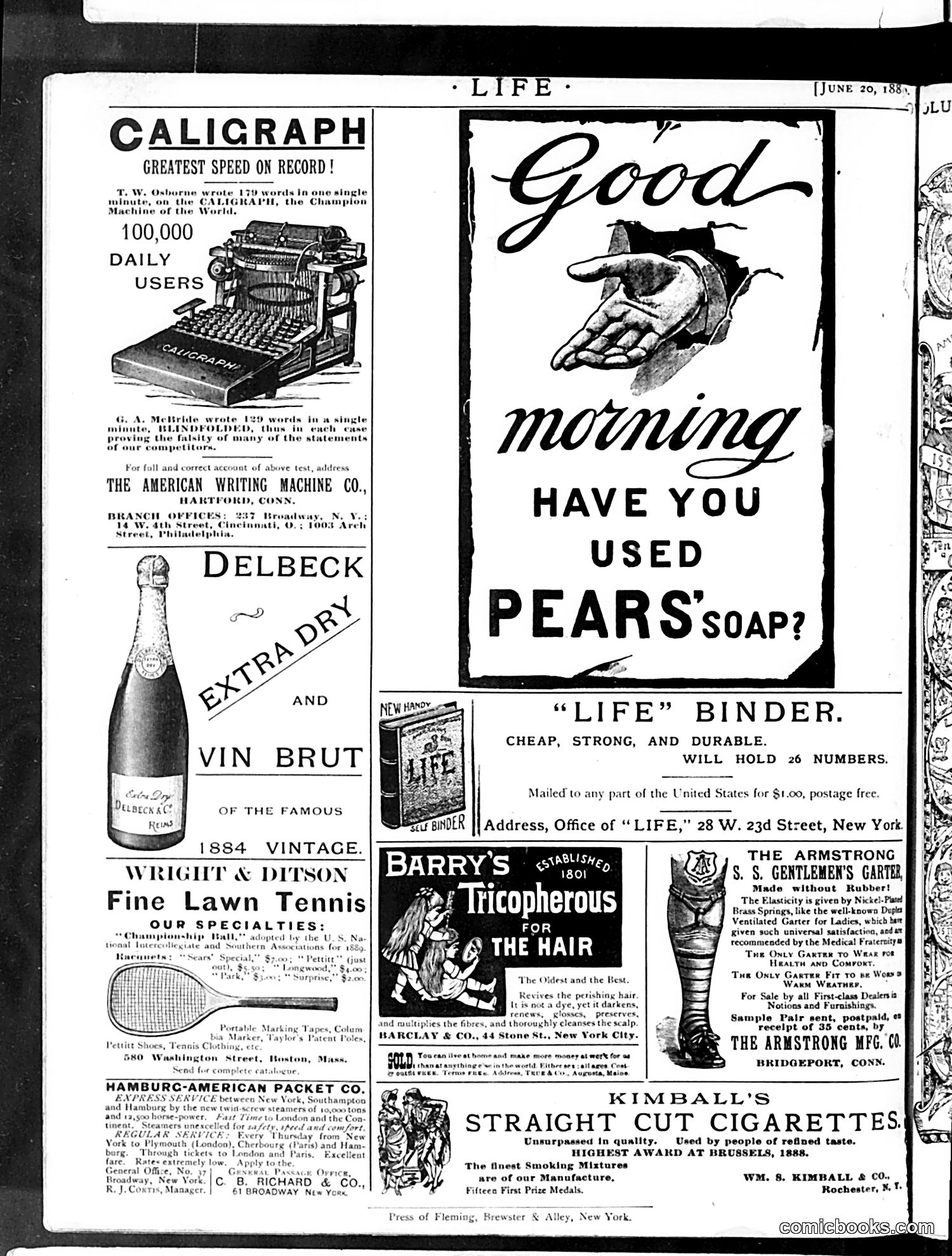
This page is primarily **advertisements**, not satirical content. The central cartoon—"Good morning / Have you used Pears' Soap?"—depicts a hand offering soap in a genteel, upper-class manner. It's a straightforward advertisement with no political satire; the phrase suggests Pears' was positioning itself as a refined, tasteful product for the well-to-do. The page features typical late-Victorian ads: typewriters (Caligraph), champagne (Delbeck), tennis equipment (Wright & Ditson), hair products (Barry's Tricopherous), gentlemen's garters, and cigarettes (Kimball's). These ads target middle and upper-class readers with luxury goods and personal-care items—the magazine's affluent audience. The only quasi-satirical element is the Life Binder advertisement itself, which uses Life's own branding to sell magazine storage products, a form of self-promotion common in period publications.