
Life, 1889-06-20 · page 4 of 18
Life — June 20, 1889 — page 4: what you’re looking at
What you’re looking at
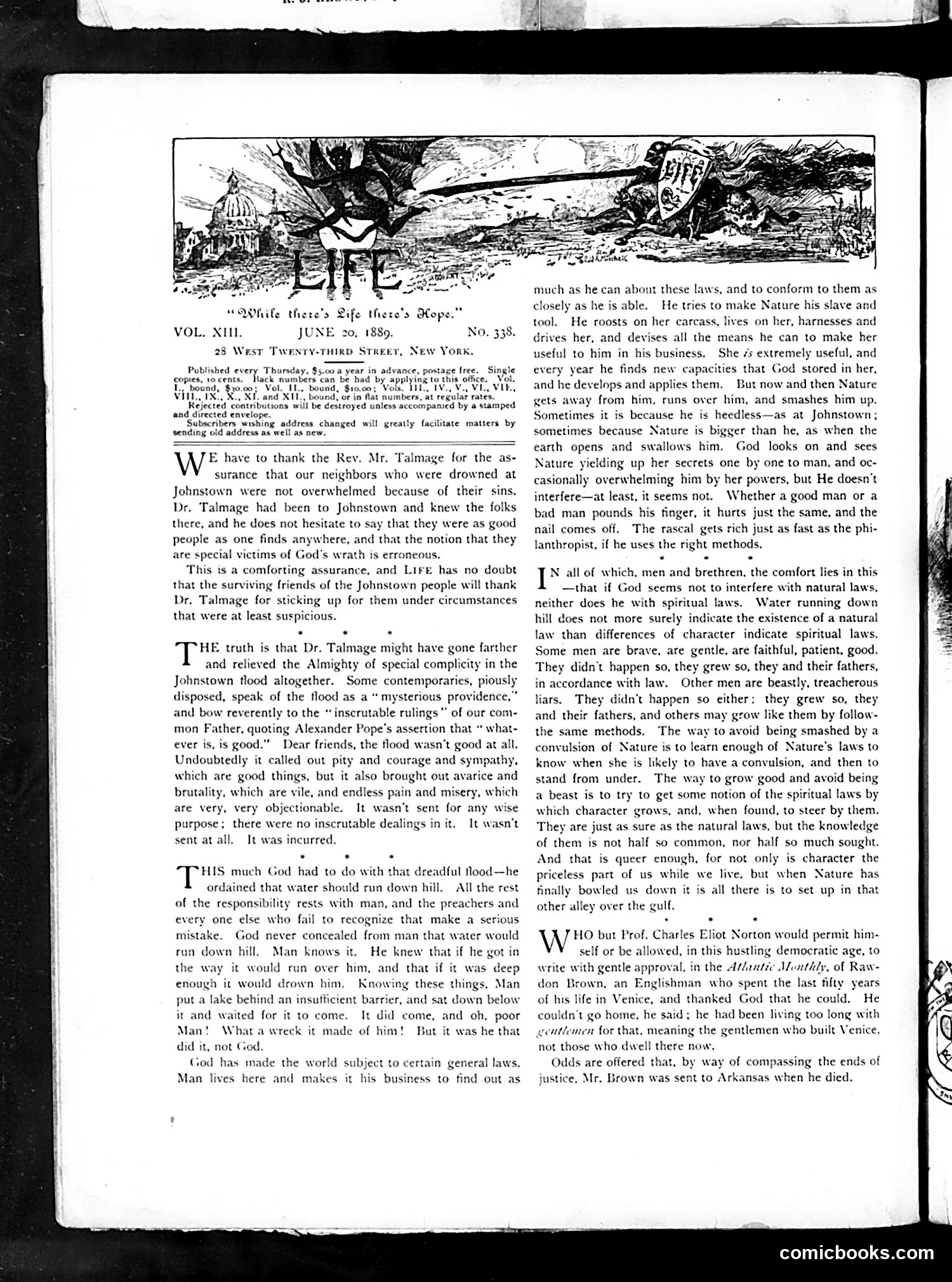
The masthead illustration depicts **Life as a winged figure** confronting larger forces—likely representing **Nature or Fate**—in a landscape with classical architecture. This visual metaphor introduces the editorial's theme: man's relationship to natural law. The article discusses the **Johnstown Flood** (May 1889), a catastrophic disaster killing over 2,000 people. Rather than attributing it to God's intervention, the writer argues that natural laws operate independently. The piece references **Rev. Talmage's claim** that divine providence saved some Johnstown residents, which the editor finds theologically problematic. The satire targets religious explanations for disasters: if God controls nature absolutely, why allow such suffering? The article advocates understanding character and morality through natural law rather than miraculous intervention.
📄 Transcribed text from this page (OCR, searchable)
Machine-transcribed from the original scan — historical spelling and the odd misread are preserved.
“While there's Life there’s Hope.” VOL. XII. JUNE 20, 1889. 23 West Twenty-THIkD Street, New York, $5.00 a year in advance, postage free. Sil scan be had by applying to this office. Jj bound, Gro.co; Vol. I. bound, $ioco; Vols: IL., 1V.. Via V X.. XT. and XII, or in flat numbers, at rege Rejected contributions will be destroyed unless accompamied by a stamped and directed envelope. Subscribers wishing address changed will greatly facilitate matters by sending old address as well as new. Published every Thursd copies, 10 cents. Hack num E have to thank the Rev. Mr. Talmage for the as- surance that our neighbors who were drowned at Johnstown were not overwhelmed because of their sins Dr. Talmage had been to Johnstown and knew the folks there, and he does not hesitate to say that they were as good people as one finds anywhere, and that the notion that they are special victims of God's wrath is erroneous. This is a comforting assurance, and Lire has no doubt that the surviving friends of the Johnstown people will thank Dr. Tal for sticking up for them under circumstances that were at least suspicious. HE truth is that Dr. Talmage might have gone farther and relieved the Almighty of special complicity in the Johnstown flood altogether. Some contemporaries, piously disposed, speak of the flood as a“ mysterious providence,” and bow reverently to the “inscrutable rulings” of our com- her, quoting Alexander Pope's assertion that “ what- s good.” Dear friends, the flood wasn't good at all. Undoubtedly it called out pity and courage and s which are good things, but it also brought out avarice and brutality, which are vile, and endless pain and misery, which are very, very objectionable. It wasn’t sent for any wise purpose; there were no inscrutable dealings in it, It wasn’t sent at all. It was incurred. HIS much God had to do with that dreadful flood—he ordained that water should run down hill. All the rest of the responsibility rests with man, and the preachers and every one else who fail to recognize that make a serious God never concealed from man that water would run down hill. Man knows it. He knew that if he got in the way it would run over him, and that if it was deep enough ic would drown him, Knowing these things, Man put a lake behind an insufficient barrier, and sat down below it and waited for it to come. It did come, and oh, poor Man! Whata wreck it made of him! But it was he that did it, not God. God has 1 mistake. de the world subject to certain general laws. Man lives here and makes it his business to find out as much as he can about these laws, and to conform to them as closely as he is able. He tries to make Nature his slave and tool. He roosts on her carcass, lives on her, harnesses and drives her, and devises all the means he can to make her useful to him in his business, She ¢s extremely useful, and year he finds new capacities that God stored in her, and he develops and applies them. But now and then Nature gets away from him, runs over him, and smashes him up. Sometimes it is because he is heedless—as at Johnstown; sometimes because Nature is bigger than he, as when the earth opens and swallows him. God looks on and sees Nature yielding up her secrets one by one to man, and oc- casionally overwhelming him by her powers, but He doesn’t interfere: least, it seems not. Whether a good man or a bad man pounds his finger, it hurts just the same, and the nail comes off. The rascal gets rich just as fast as the phi- lanthropist, if he uses the right methods. ] | of which, men and brethren, the comfort lies in this —that if God seems not to interfere with natural laws, neither does he with spiritual laws. Water running down hill does not more surely indicate the existence of a natural law than differences of character indicate spiritual laws. Some men are brave, are gentle, are faithful, patient, good. They didn’t happen so, they grew so, they and their father: in accordance with law. Other men are beastly, treacherous liars. They didn’t happen so either; they grew so, they and their fathers, and others may grow like them by follow- the same methods. The way to avoid being smashed by a convulsion of Nature is to learn enough of Nature's laws to know when she is likely to have a convulsion, and then to stand from under. The way to grow good and avoid being a beast is to try to get some notion of the spiritual laws by which character grows, and, when found, to steer by them. They are just as sure as the natural laws, but the knowledge of them is not half so common, nor half so much sought. And that is queer enough, for not only is character the priceless part of us while we live, but when Nature has finally bowled us down it is all there is to set up in that other alley over the gulf. V HO but Prof. Charles Eliot Norton would permit him- self or be allowed, in this hustling democratic age, to write with gentle approval, in the AM/antic Monthly, of Raw- don Brown, an Englishman who spent the last fifty years of his life in Venice, and thanked God that he could, He couldn't go home, he said; he had been living too long with yentlemen for that, meaning the gentlemen who built Venice, not those who dwell there now. Odds are offered that, by way of compassing the ends of justice, Mr. Brown was sent to Arkansas when he died. comicbooks.com