
A complete issue · 18 pages · 1889
Life — May 9, 1889
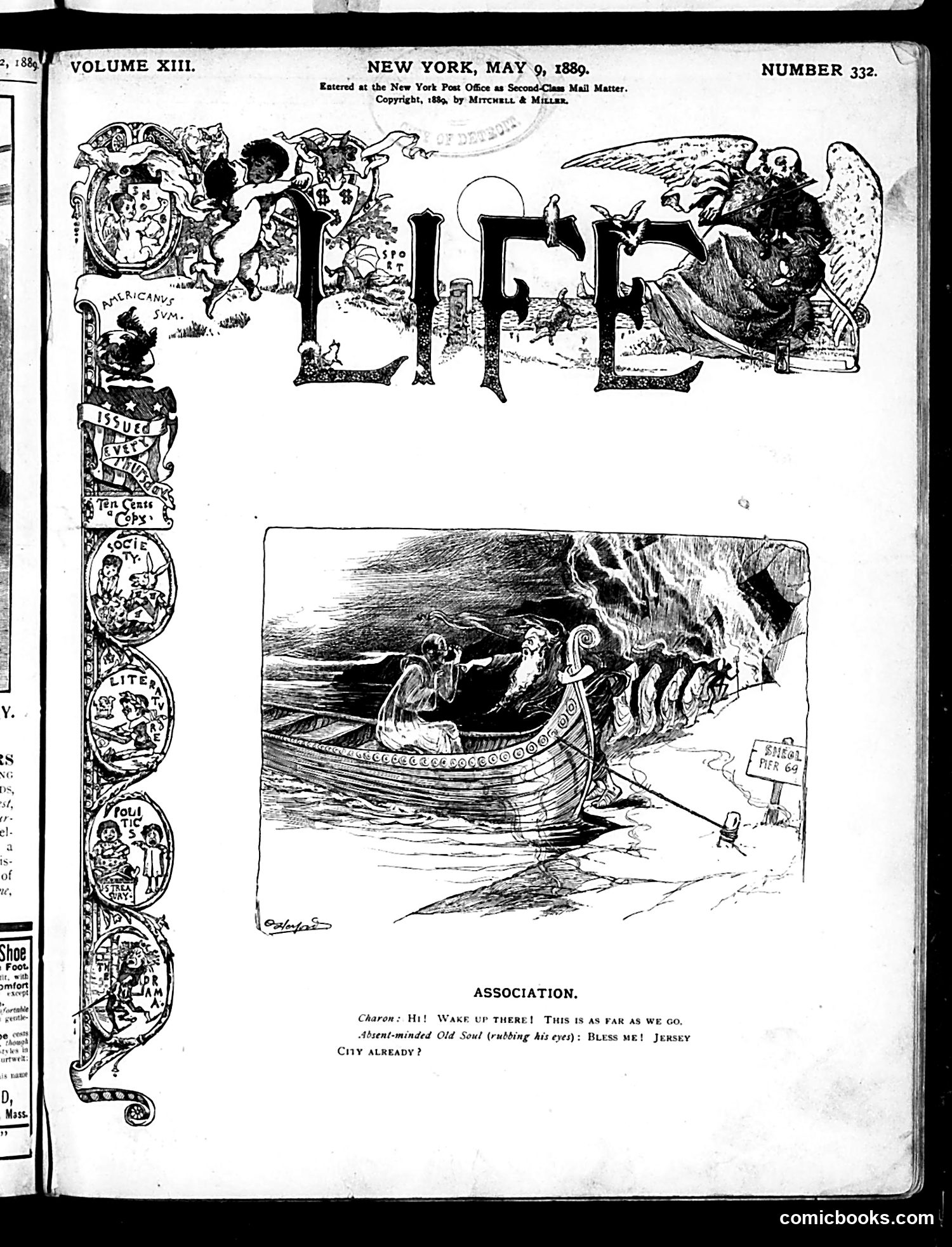
This page features a satirical cartoon titled "Association" depicting a mythological or allegorical boat scene. The caption presents a dialogue: Charon (the ferryman of the dead in Greek mythology) awakens an "absent-minded Old Soul," who upon seeing Jersey City already expresses dismay—"Bless me! Jersey City already?" The joke appears to satirize Jersey City as such an undesirable destination that even the dead would be distressed to arrive there. The cartoon uses classical mythology ironically; rather than Charon ferrying souls to the underworld, he's taking passengers to Jersey City, implying the city is hellish or deeply unpleasant. This reflects late-19th-century regional American humor, where cross-river rivals like Jersey City and New York exchanged mutual mockery in satirical publications.
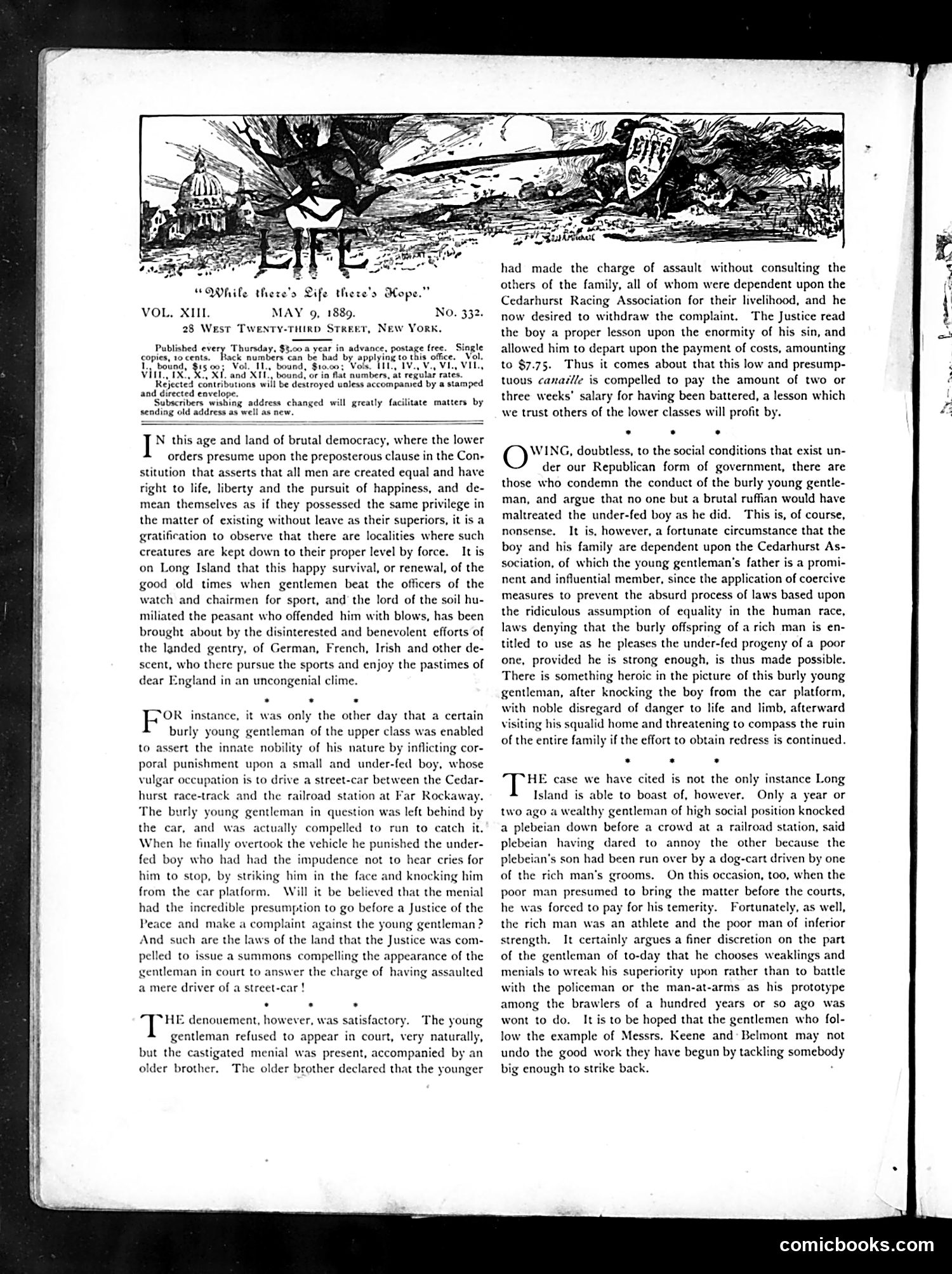
The masthead cartoon depicts a chaotic scene with the phrase "While there's Life there's Hope." The image appears to show social upheaval or disaster—possibly referencing contemporary anxieties about class conflict and social order in Gilded Age America. The article text discusses a case involving a "burly young gentleman" of the upper class who assaulted an underfed boy. The piece critiques the assumption that wealthy men have the right to physically punish the poor, while sarcastically noting it's "fortunate" the boy's family has social connections to seek justice. The satire targets class privilege and the legal system's bias toward the wealthy, using a specific incident to illustrate broader inequality in Gilded Age society.
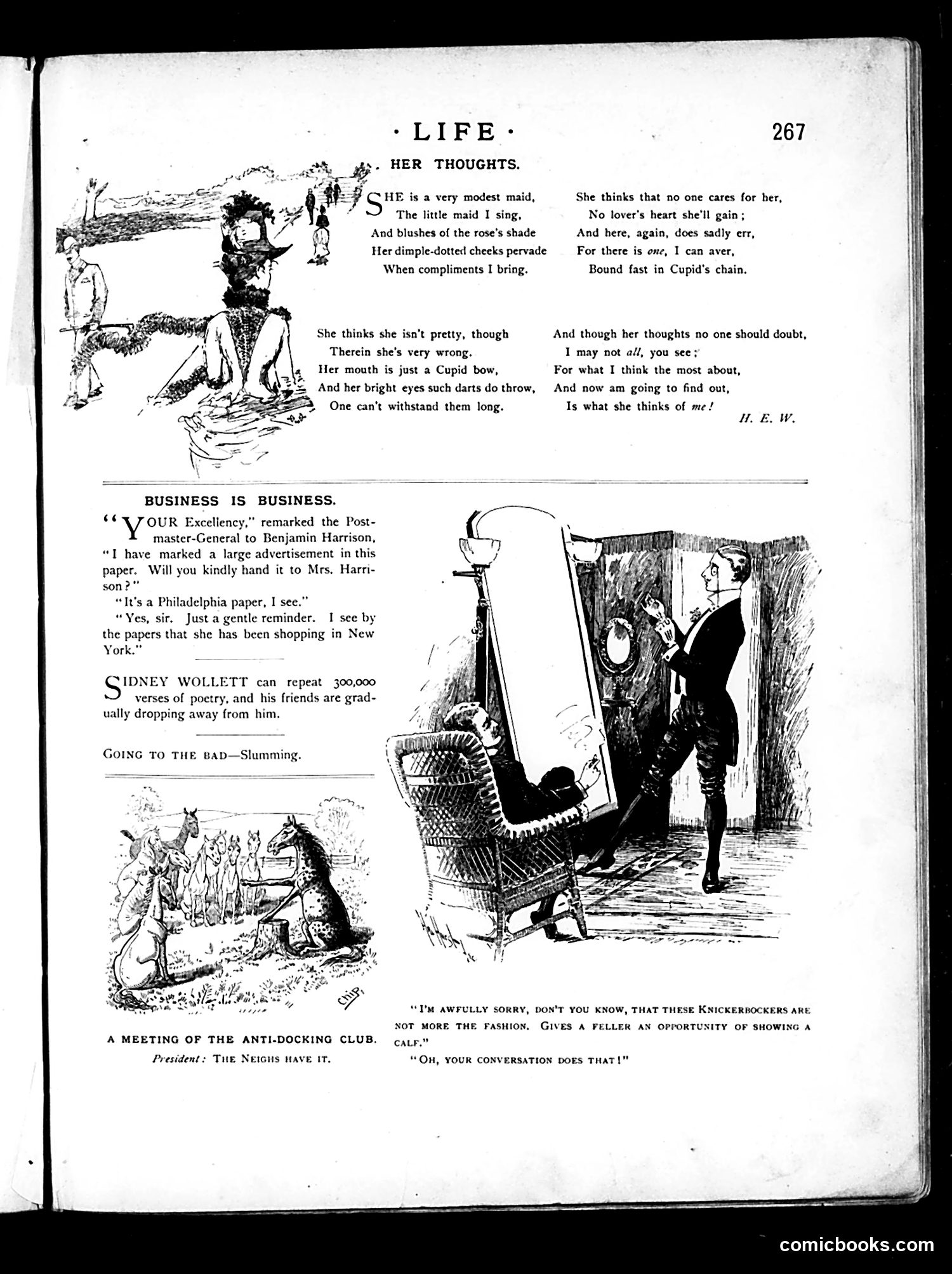
**"Her Thoughts"** (top): A romantic poem about a modest maid who believes herself plain and unloved, yet harbors secret romantic hopes. The illustration shows a young woman in Victorian dress. This appears to be sentimental verse rather than satire. **"Business is Business"** (middle): A Postmaster-General reminds Benjamin Harrison about a Philadelphia newspaper advertisement Mrs. Harrison placed while shopping in New York. The joke concerns the contradiction between conducting personal business while holding public office—a mild commentary on government officials' divided loyalties. **"Going to the Bad"** (bottom left): An anti-docking club meeting, captioned "The Neighs have it"—a pun on "neighs" (horses' sounds) versus "nays" (voting). **Bottom right**: A gentleman's awkward conversation about fashion and animals.
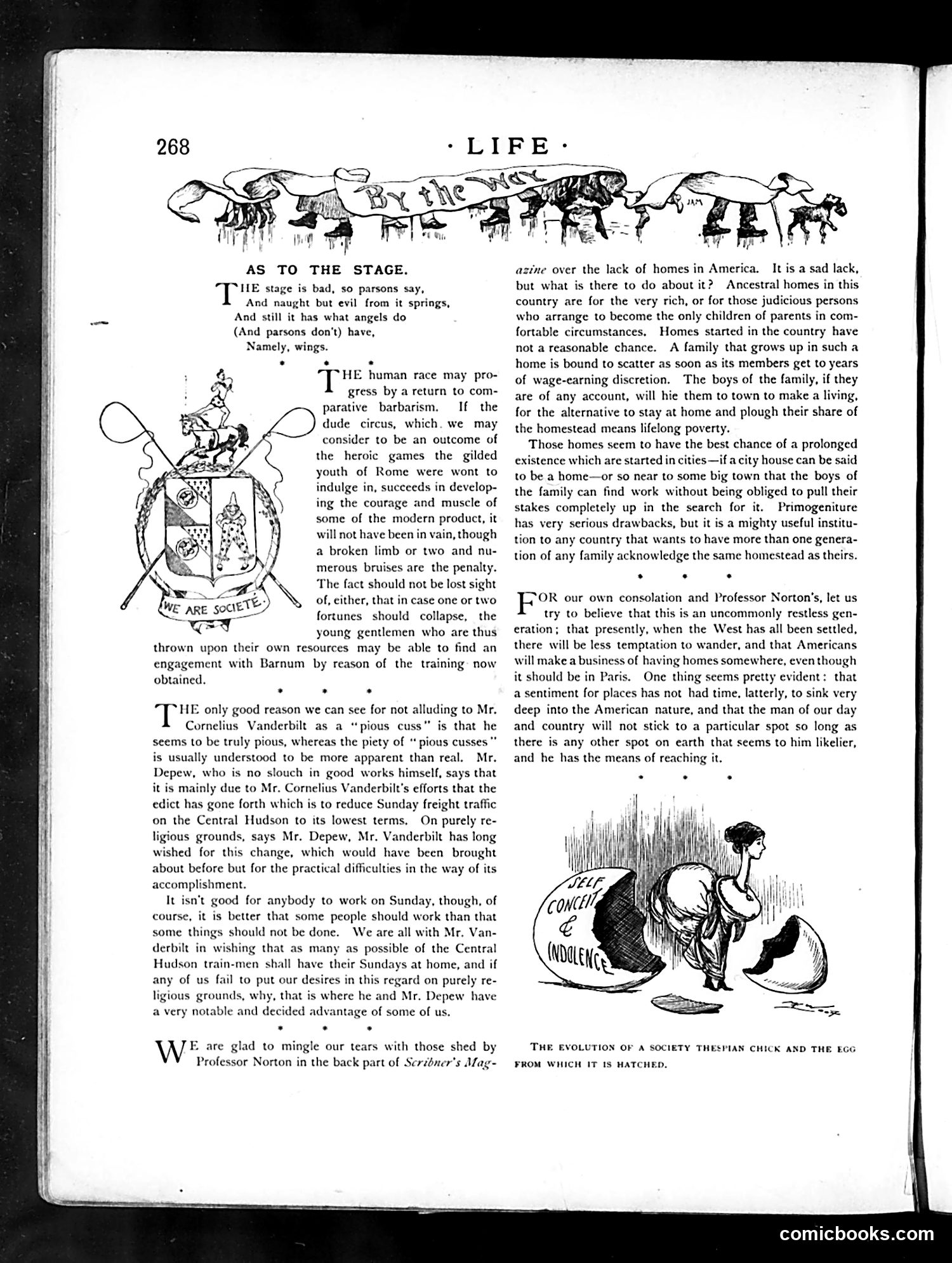
This page critiques the American lack of family homes and ancestral estates. The main text discusses how the stage (theatrical world) lacks "wings" (exits/support systems), using this as metaphor for America's failure to provide stable homesteads for families. The article references **Cornelius Vanderbilt** as a "pious cuss," crediting him with reducing Sunday freight traffic on the Central Hudson railroad—apparently a religious gesture that the author presents skeptically. The bottom illustration, captioned "The Evolution of a Society Thespian Chick and the Egg from Which It is Hatched," appears to satirize high society through theatrical metaphor, showing conceit and indulgence. The overall piece laments that American families scatter rather than maintain ancestral homes, unlike European traditions.
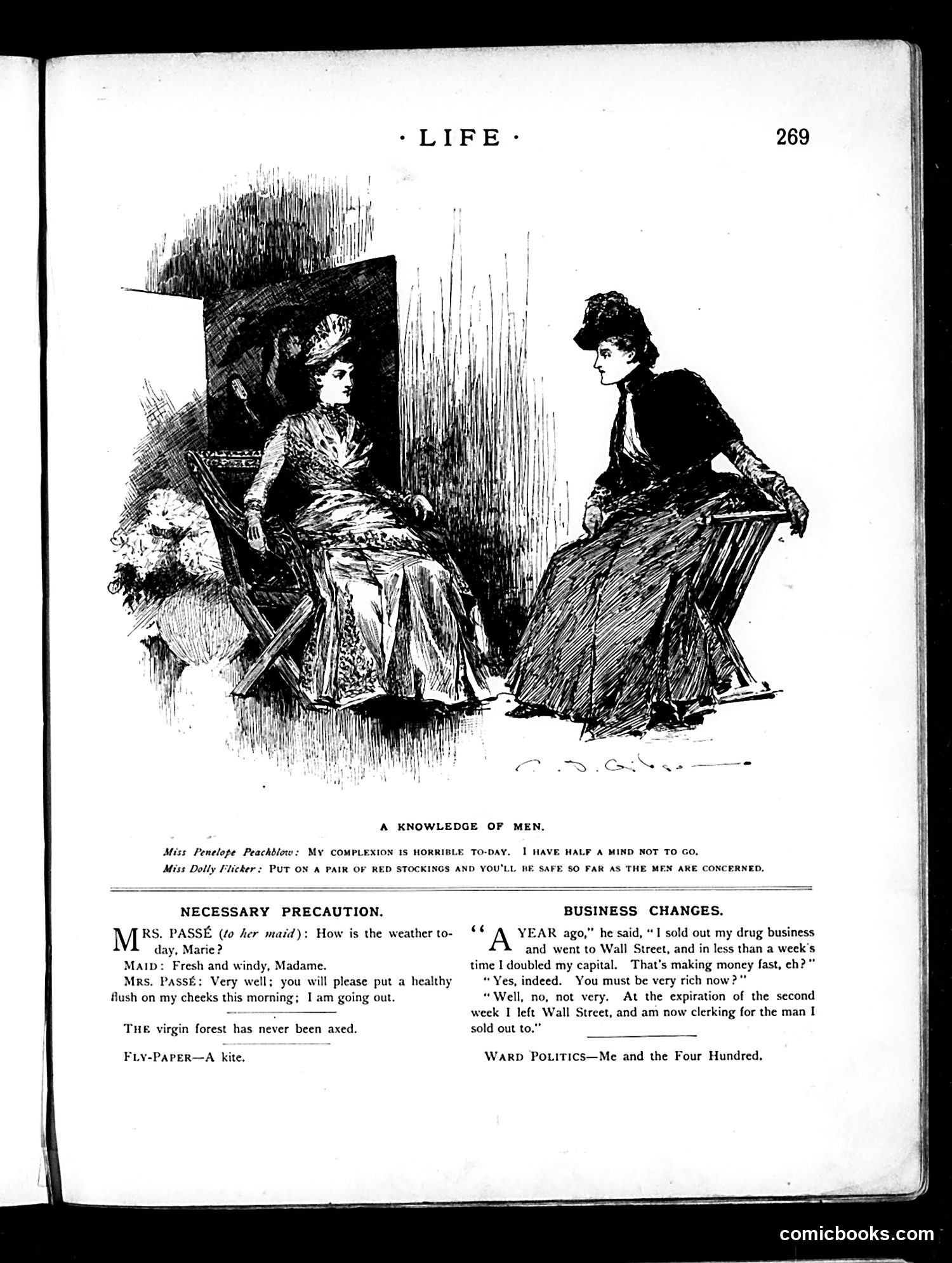
This satirical cartoon depicts two women in conversation, illustrating the section title's ironic premise. The dialogue reveals gender dynamics of the era: Miss Penelope Bracklowe complains about her poor complexion and considers skipping an outing. Miss Dolly Flicker offers advice: wear red stockings and "you'll be safe so far as the men are concerned"—implying men's attention is superficial and easily distracted by fashion rather than substance. The joke satirizes both female vanity (the beauty concern) and male shallowness (being fooled by clothing). Below are brief humorous items mocking various topics including weather gossip, marital concerns, and politics. The overall tone critiques social pretense and shallow masculine judgment in Edwardian-era society.
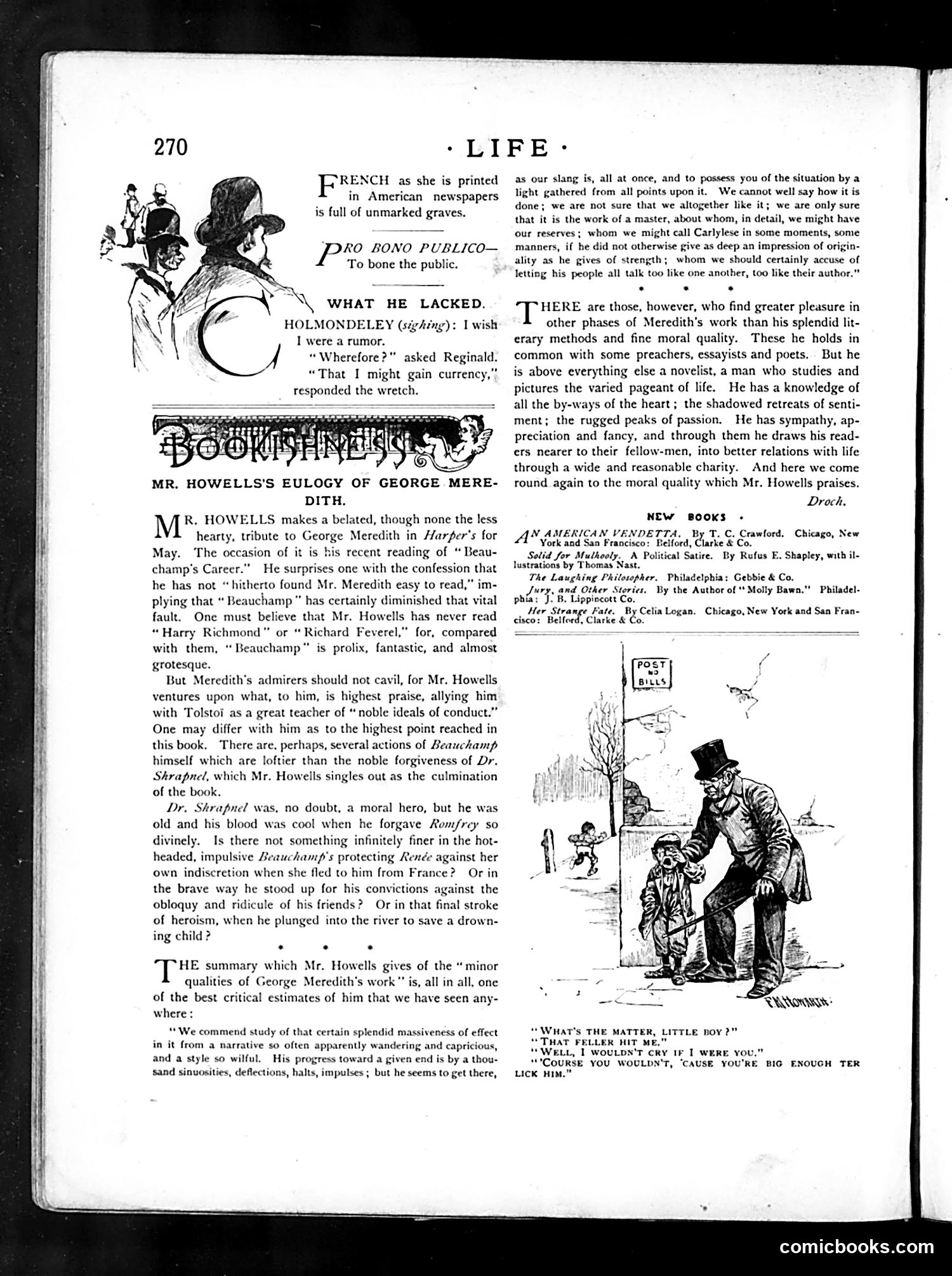
This page contains a literary review of George Meredith's work by Mr. Howells, discussing Meredith's novels and moral qualities as a writer. The cartoon at bottom shows a well-dressed man in a top hat speaking to street children near a "POST BILLS" sign. The caption reads: "What's the matter, little boy?" "That feller hit me." "Well, I wouldn't cry if I were you." "I wouldn't cry if I were you, 'cause you're big enough ter lick him." **The satire**: The cartoon mocks patronizing advice from the privileged to the poor. The well-dressed gentleman offers hollow sympathy and suggests the boy "wouldn't cry," but the child's retort—that the man could fight back because he's stronger—exposes the gentleman's comfortable detachment from actual hardship. It's social commentary on class indifference.
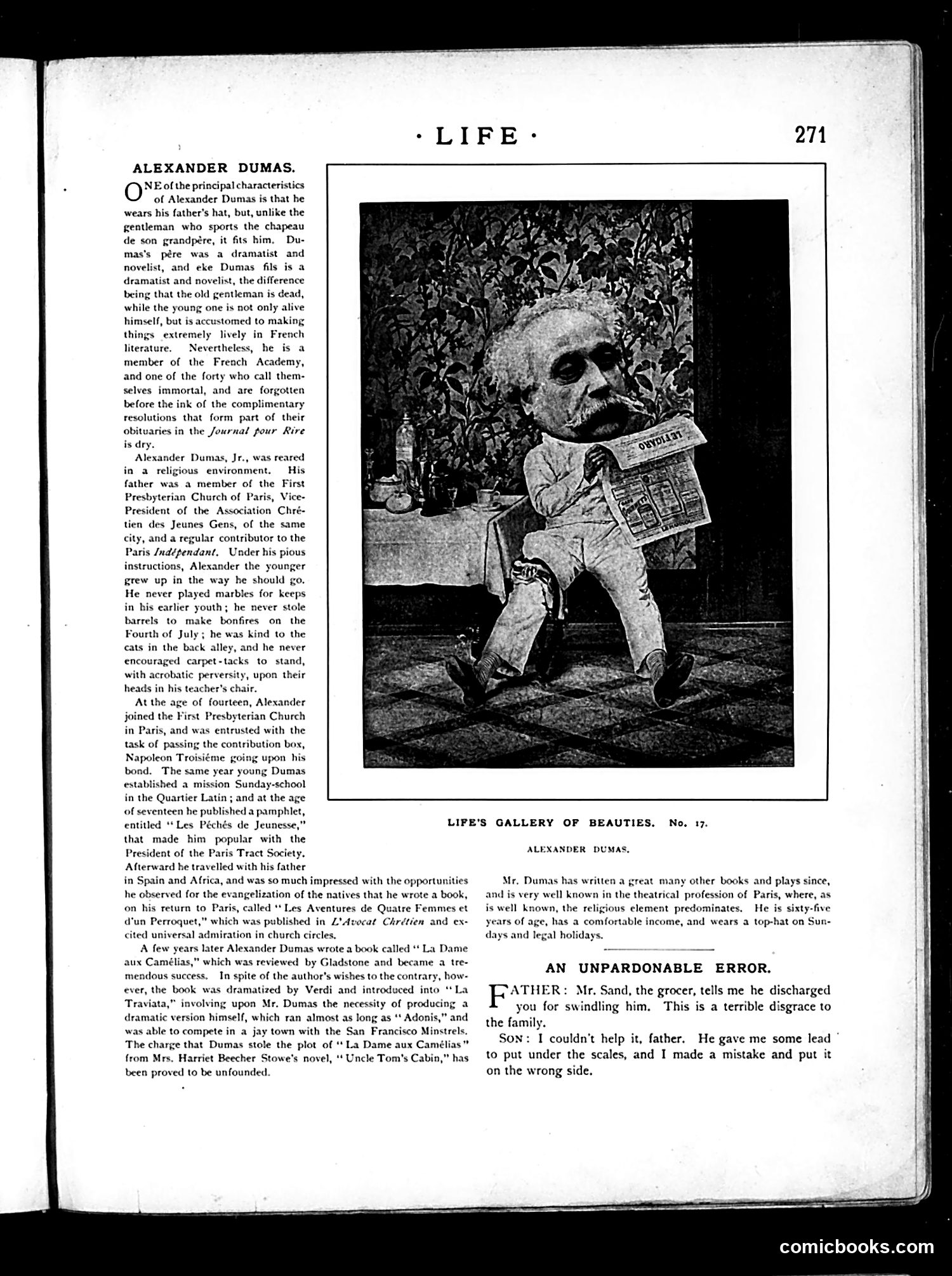
This page contains a biographical article about French author Alexander Dumas alongside a brief comedic sketch titled "An Unpardonable Error." The sketch depicts a grocery-store conflict: a father confronts Mr. Sand the grocer about being swindled. The son admits he made an error while using the scales—he placed lead weights on the wrong side, causing him to receive less product than paid for. The humor derives from the irony: the son inadvertently cheated *himself* rather than the grocer, making the father's complaint absurd and his accusation of dishonesty misdirected. The photograph shows what appears to be a statue or sculpture, likely of Dumas, accompanying the biographical text praising his literary achievements and character.
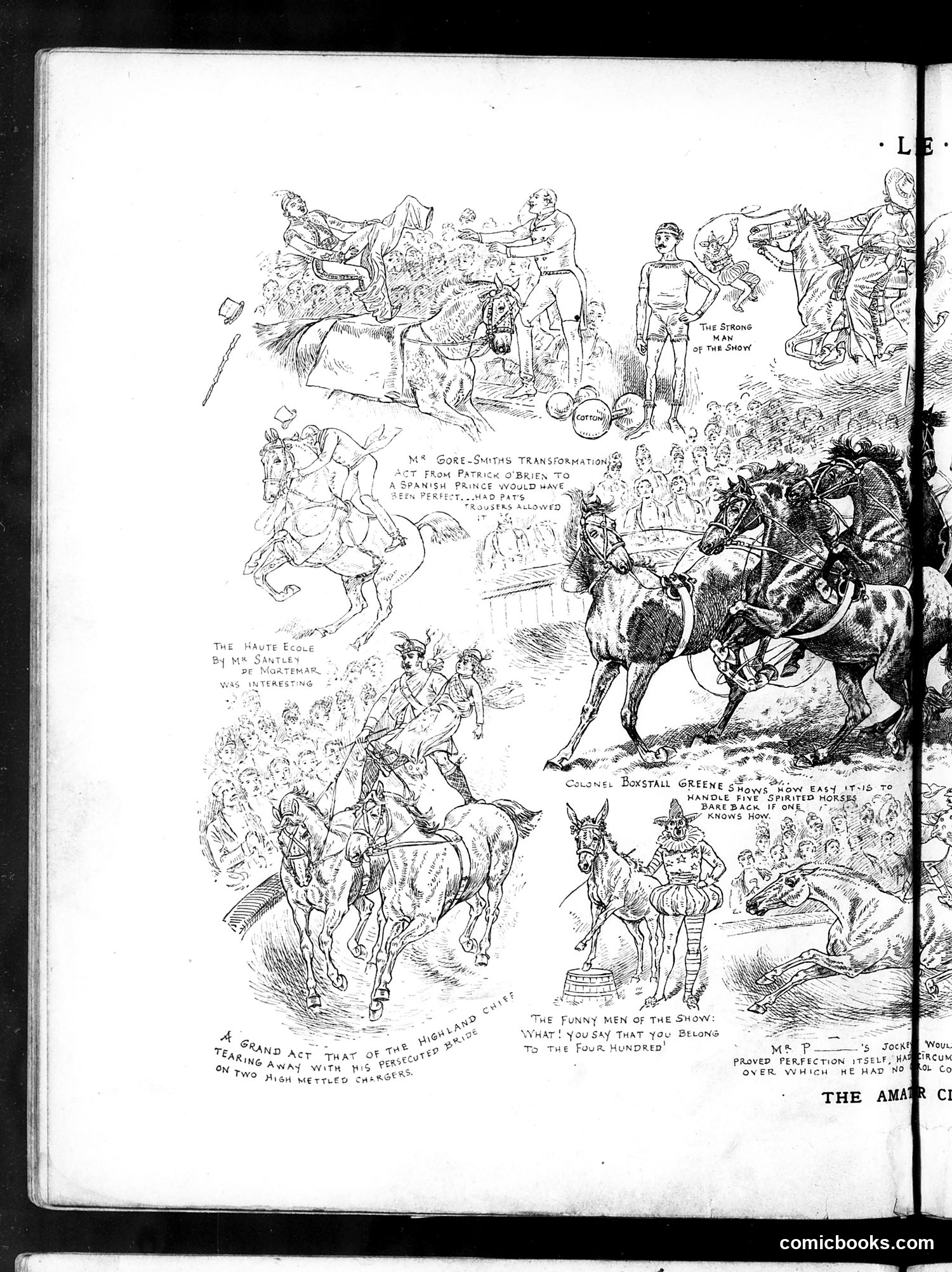
This page contains multiple satirical sketches about equestrian performance and horsemanship. The captions reference "M.S Gore-Shitas Transformation" (likely a specific performer or act), "The Haute École" (classical dressage), and "Colonel Borstall Greene" demonstrating horse-handling abilities. The sketches mock theatrical performances involving horses and riders, particularly military or aristocratic figures attempting complex equestrian feats. One caption references "The Funny Men of the Show," suggesting this satirizes a circus or exhibition. The central humor appears to target pretentious displays of horsemanship skill and the absurdity of elaborate cavalry performances. Without clearer text identification, the specific figures and events being mocked remain unclear, though the tone suggests satirizing both performers and their audiences' gullibility toward equestrian spectacle.
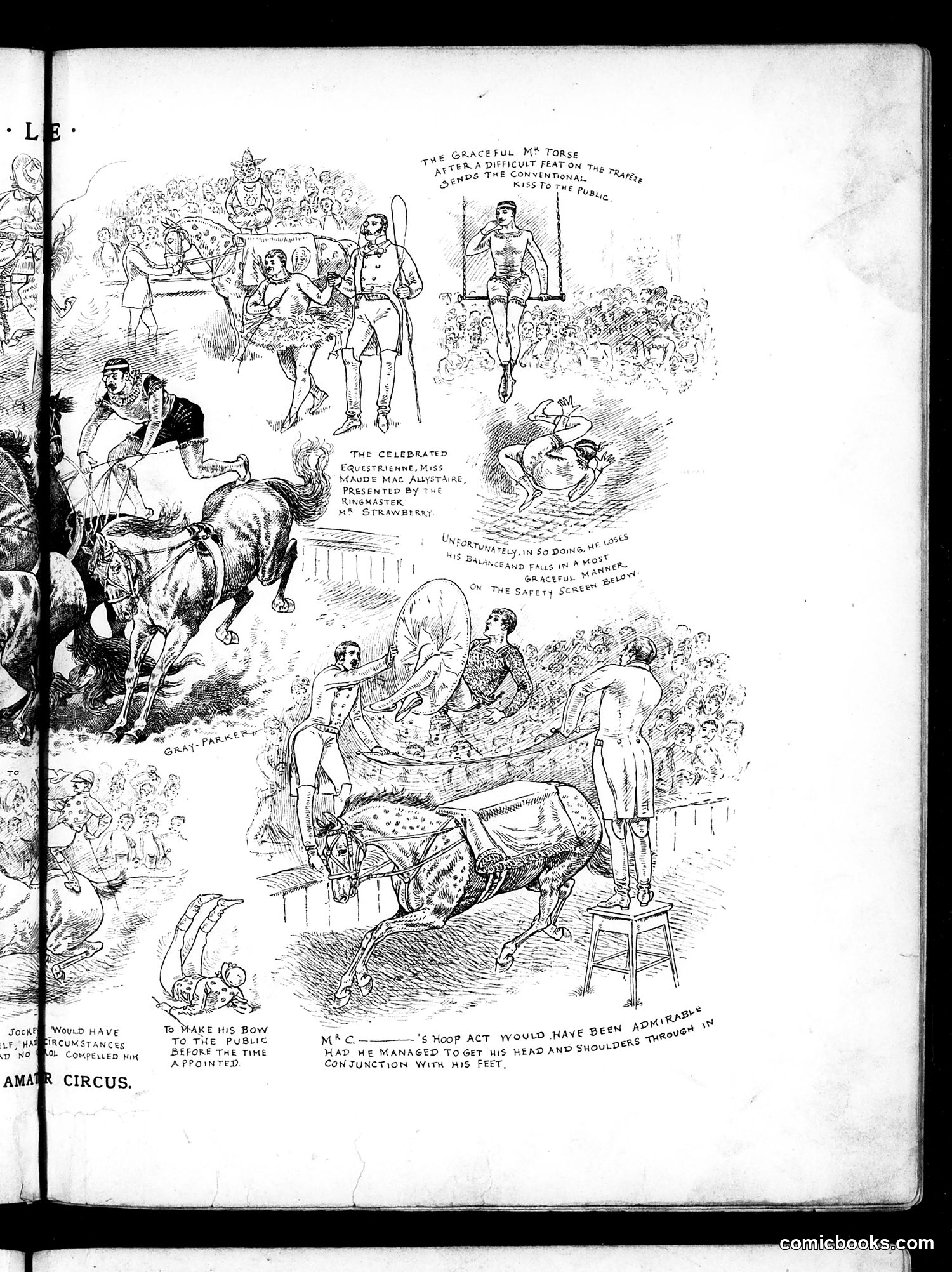
This page satirizes circus performances, particularly equestrian acts. The central figure is "Miss Maude Mac Allystaire," presented by manager "M. Strawberry" (labeled at left). The satire mocks her celebrated "difficult feat on the trapeze" and graceful horse act. The captions humorously suggest that performing these acrobatic feats while maintaining balance would be nearly impossible—she repeatedly "falls in a most graceful manner" onto a safety net. The bottom caption jokes that a "hoop act" performer ("M.C.") would be admirable if he could coordinate his head and shoulders through the hoop, implying he struggles with basic circus mechanics. The page ridicules both the performers' limited skills and the public's willingness to celebrate mediocre circus acts as impressive entertainment.
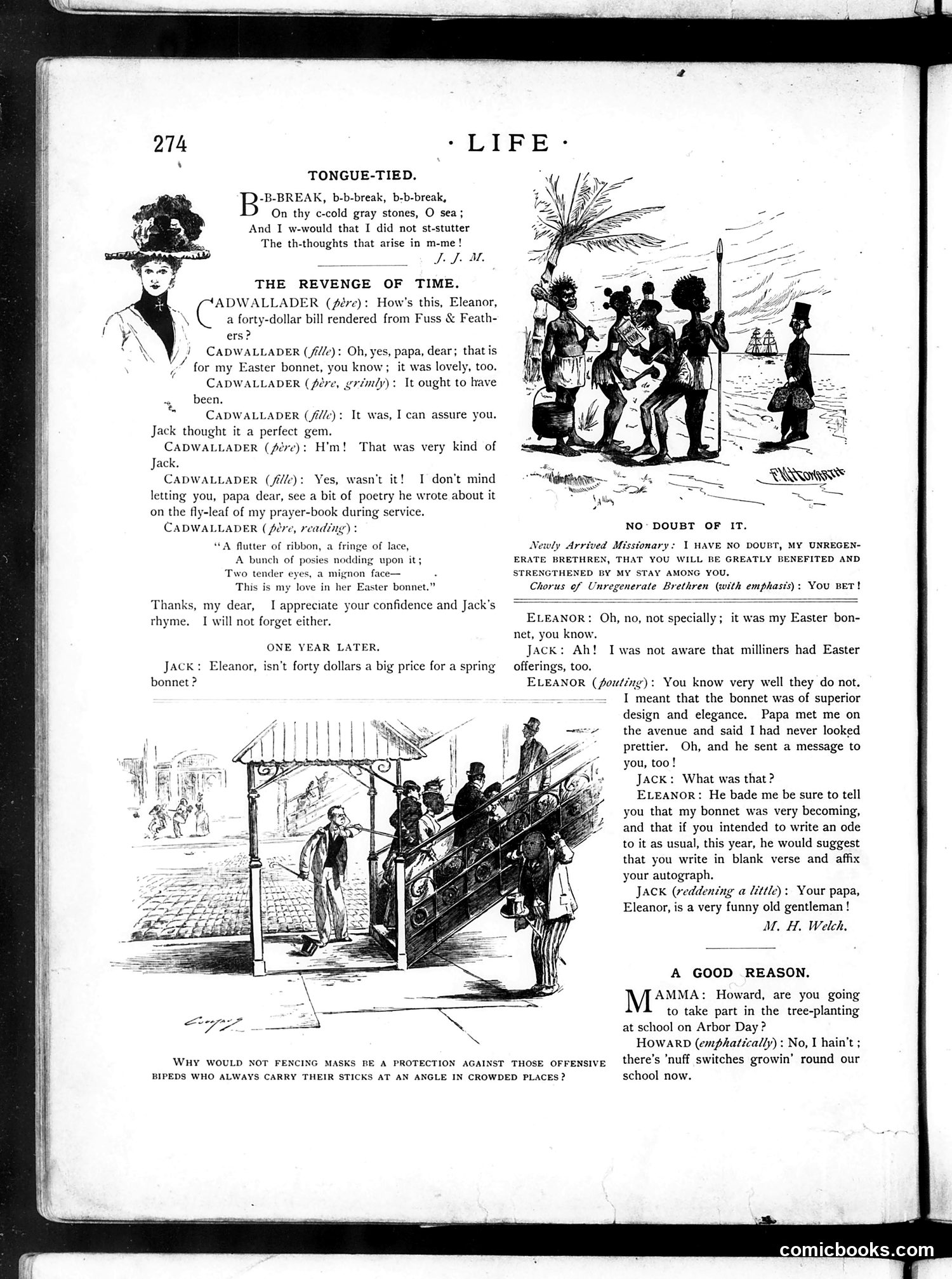
This page contains several satirical sketches and humorous dialogues rather than a single unified cartoon. **"Tongue-Tied"** mocks stammering through verse about breaking stones by the sea. **"The Revenge of Time"** satirizes a wealthy woman (Cadwallader) complaining that her Easter bonnet cost forty dollars—an enormous sum for the era. The joke centers on her vanity and expense, with her husband Jack humorously suggesting milliners charge extra for such items. **"No Doubt of It"** depicts newly arrived missionaries being welcomed; the satire appears to mock their earnest optimism about helping "unregenerate brethren." **"A Good Reason"** shows a child refusing tree-planting at school because "buff switches growin' round our school now"—humorous complaint about corporal punishment. The page exemplifies *Life*'s style: lighthearted domestic and social satire targeting consumer excess, pretension, and American institutions.
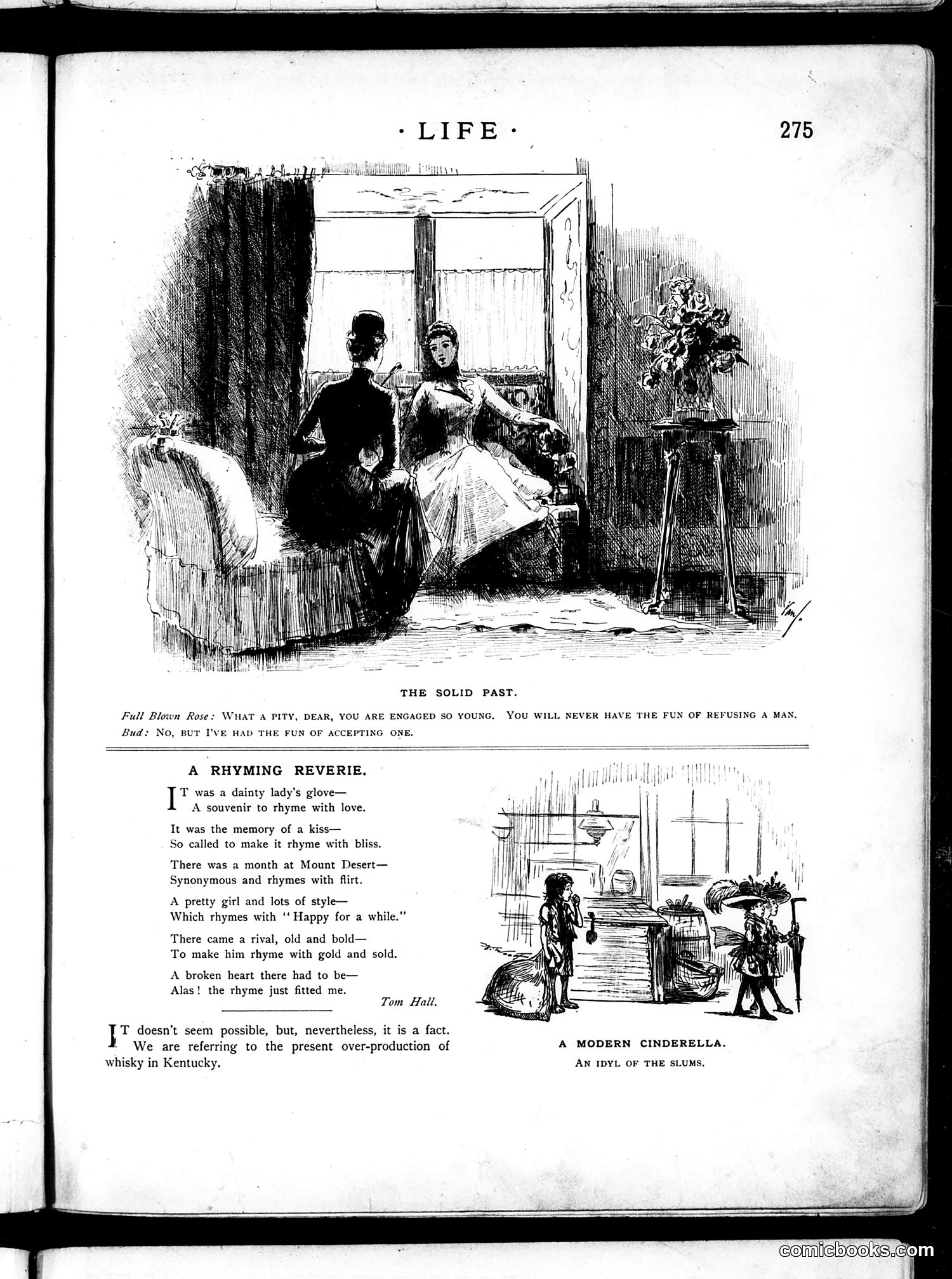
**"The Solid Past"** (top cartoon): Shows a woman rejecting a suitor's proposal, claiming she's had "fun of accepting one" rather than refusing men. This satirizes changing gender dynamics—the joke targets a "full blown rose" (wealthy suitor) by inverting traditional courtship where women supposedly enjoyed refusing proposals. **"A Rhyming Reverie"** (poem by Tom Hall): A sentimental piece about a lady's glove triggering memories of romantic encounters—from Mount Desert to a rival suitor. It parodies overwrought Victorian romantic poetry. **"A Modern Cinderella"** (lower illustration): Captioned "An Idyl of the Slums," this darkly juxtaposes the Cinderella fairy tale with urban poverty, satirizing the romantic notion that poor women might experience magical transformation—clearly they won't.
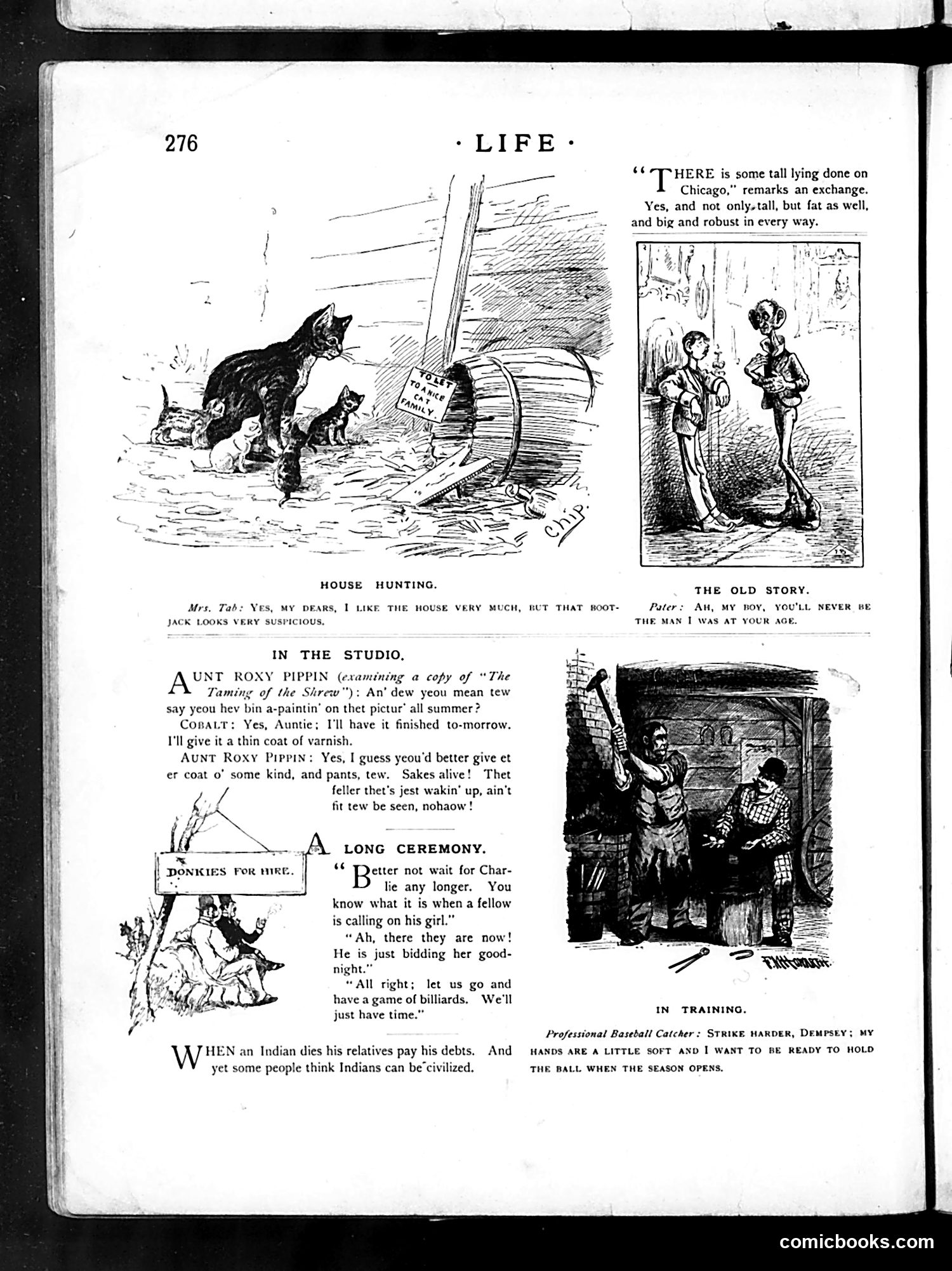
This page contains several satirical vignettes typical of early 20th-century American humor: **"House Hunting"**: A joke about a woman (Mrs. Tab) seeking to rent a house but suspicious of a bootlegger tenant ("that bootjack looks very suspicious"). **"In the Studio"**: Rural dialect humor where Aunt Roxy Pippin critiques her nephew's painting of *The Taming of the Shrew*, noting the male figure needs clothes ("pants") and is indecently exposed ("ain't fit tew be seen"). **"A Long Ceremony"**: A father complains about his daughter's suitor overstaying during a call, suggesting they play billiards while waiting. **"Indian Civilization"**: A brief editorial jab questioning whether Native Americans can be "civilized," contrasting their debt-paying customs with Euro-American standards. **"In Training"**: A baseball catcher requests softer hands-conditioning before the season. The humor relies on class commentary, dialect stereotyping, and mild social observation typical of period satire.
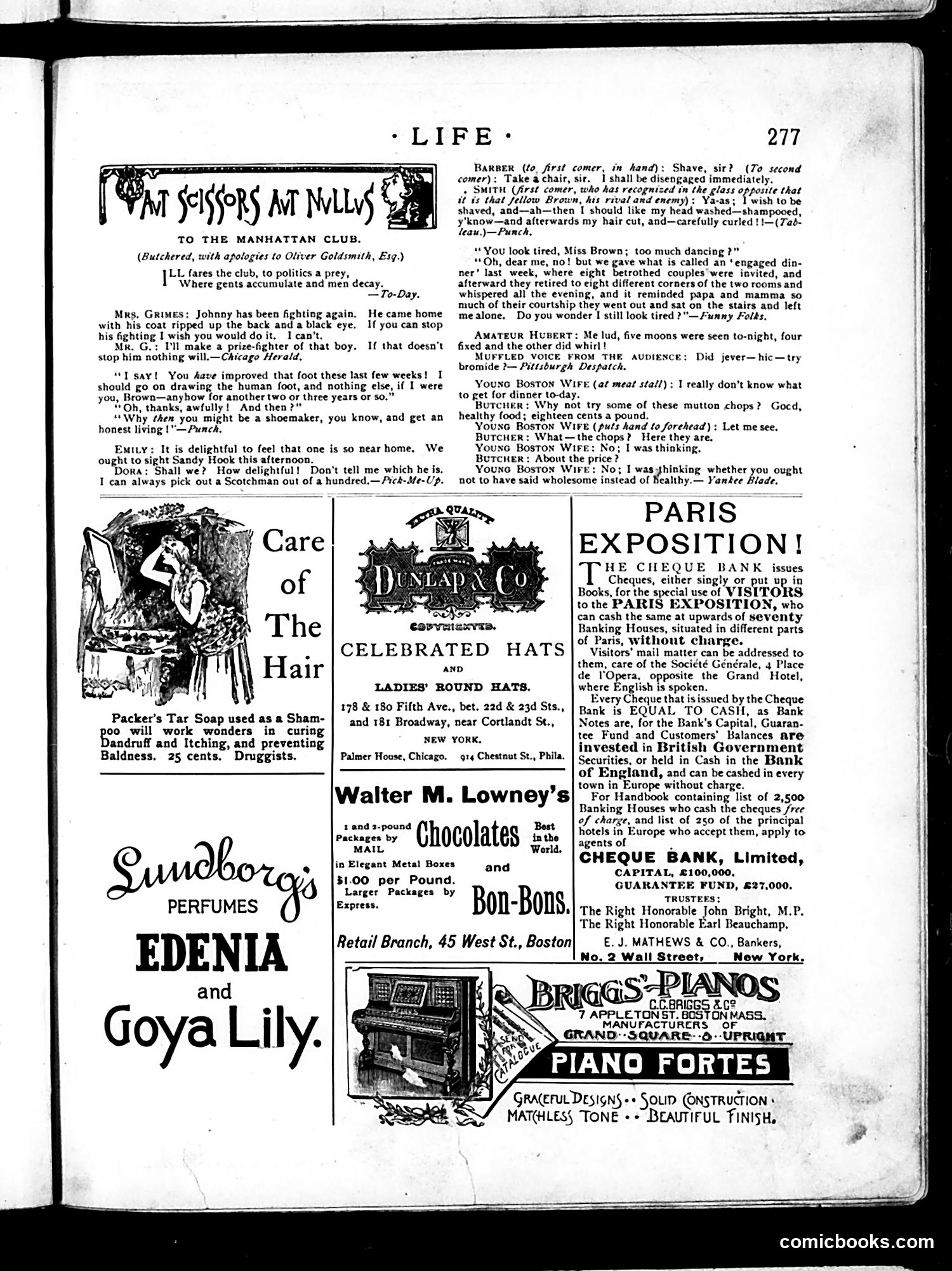
This page from *Life* magazine consists primarily of **short humorous anecdotes** reprinted from other publications (credited to *Punch*, *The Chicago Herald*, etc.), interspersed with period advertisements. The cartoons/jokes illustrate minor social observations rather than political satire: - A barber recognizes a rival and requests elaborate grooming to delay him - A young woman criticizes her butcher for saying "healthy" instead of "wholesome" food - A father threatens to make his fighting son a "prize-fighter" - Mild jokes about drawing feet, recognizing Scotsmen, and exhaustion from chaperoning engaged couples These are **genteel, domestic humor** typical of Victorian-era magazines—poking gentle fun at bourgeois manners, courtship customs, and professional vanity rather than addressing politics. The advertisements (hats, chocolates, pianos, perfume) indicate the magazine's affluent readership. This appears to be a **filler/advertising page** with no unified satirical theme.
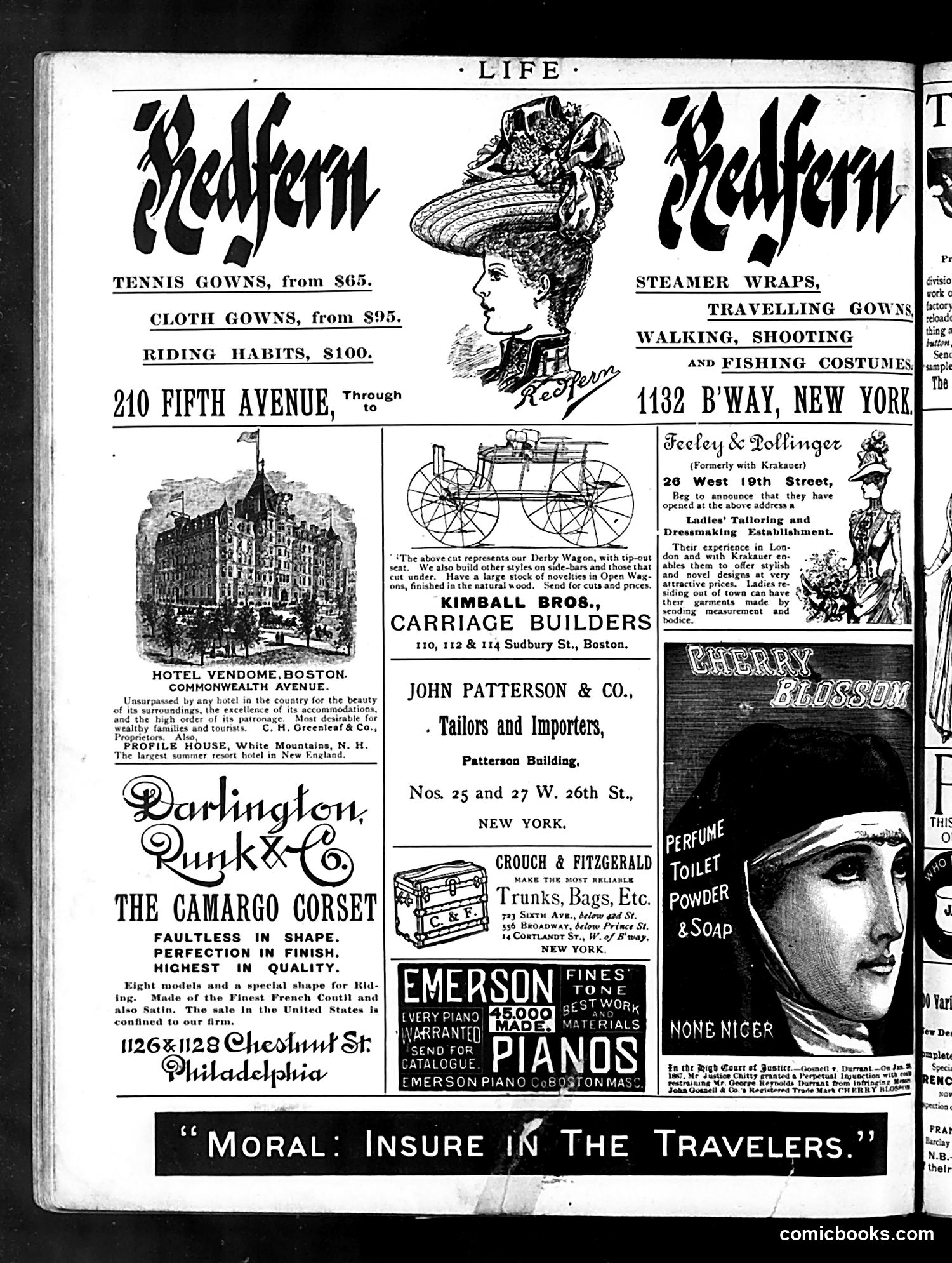
This page is **primarily advertising**, not editorial content or satire. It contains commercial advertisements from late 19th-century New York and Boston businesses targeting wealthy clientele: **Key advertisers include:** - Redfern (women's clothing): tennis gowns, riding habits, traveling wear - Kimball Bros. (carriage builders): custom wagons - Darlington, Runk & Co. (corsets): Philadelphia - John Patterson & Co. (tailors): Manhattan - Foeley & Bollinger (dressmaking): newly opened establishment - Hotels, trunk makers, piano manufacturers **Notable context:** The ads emphasize **luxury goods for the wealthy**, particularly women's specialized clothing (riding habits, shooting costumes, traveling gowns). Prices like $95-$100 were substantial for the era, reflecting an affluent target audience. The page's final line—**"MORAL: INSURE IN THE TRAVELERS"**—is the only satirical element, a cynical reminder that even the wealthy need insurance, appearing amid luxury advertisements.
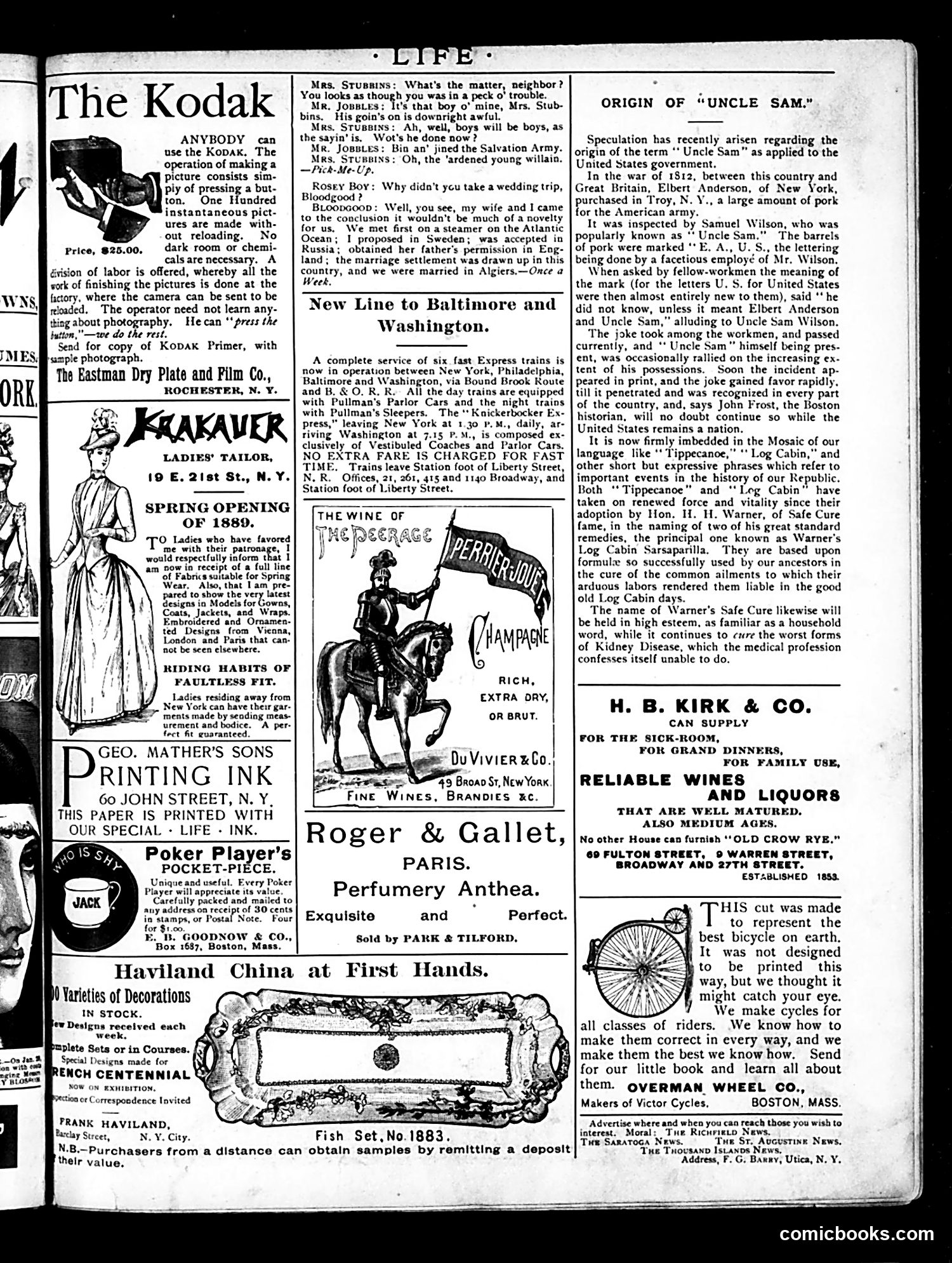
This is primarily a **commercial advertisement page** from 1889, not a political cartoon. The page contains multiple product advertisements typical of the era: The dominant content includes ads for the **Kodak camera** (emphasizing its simplicity—"press the button, we do the rest"), ladies' fashions, printing ink, china, wines, and cycles. There are **two brief comic dialogues** embedded as filler: 1. A domestic joke about a boy joining the Salvation Army (considered scandalous by his parents) 2. A newlywed couple's anecdote about meeting and marrying across multiple countries These are reprinted from other publications (*Pick-Me-Up* and *Once a Week*). The page also announces a **new railroad service** between New York, Philadelphia, Baltimore, and Washington. The material reflects **late-19th-century consumer culture**: new technologies (photography), fashion consciousness, and expanding transportation infrastructure. There is no significant political satire on this particular page.
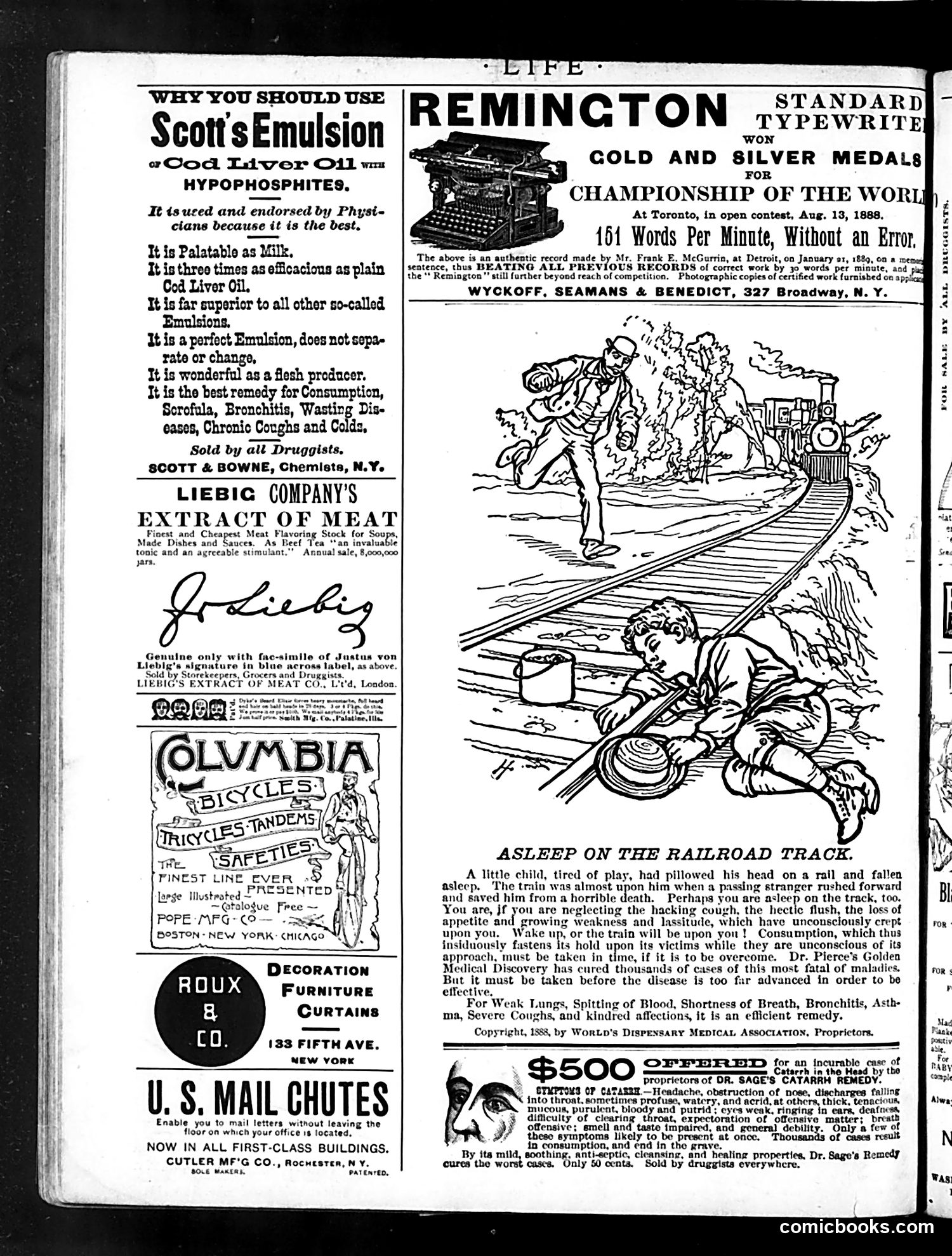
This is primarily an **advertising page** rather than a satirical cartoon page. The dominant content is product advertisements typical of late 19th-century magazines. The one narrative illustration—"Asleep on the Railroad Track"—is not political satire but **medical advertising** for Dr. Pierce's Golden Medical Discovery. It uses a melodramatic scene of a child nearly struck by a train as a metaphor: just as the sleeping child is in danger, so too are people who ignore early symptoms of consumption (tuberculosis). The "train" represents the disease advancing while victims remain unaware. This was common patent-medicine marketing of the era, exploiting health anxieties to sell remedies. Other ads promote typewriters (Remington), bicycles (Columbia), meat extract (Liebig), cod liver oil (Scott's Emulsion), and mail chutes—typical commercial products of the 1880s. There is **no political cartoon or social satire** on this page.
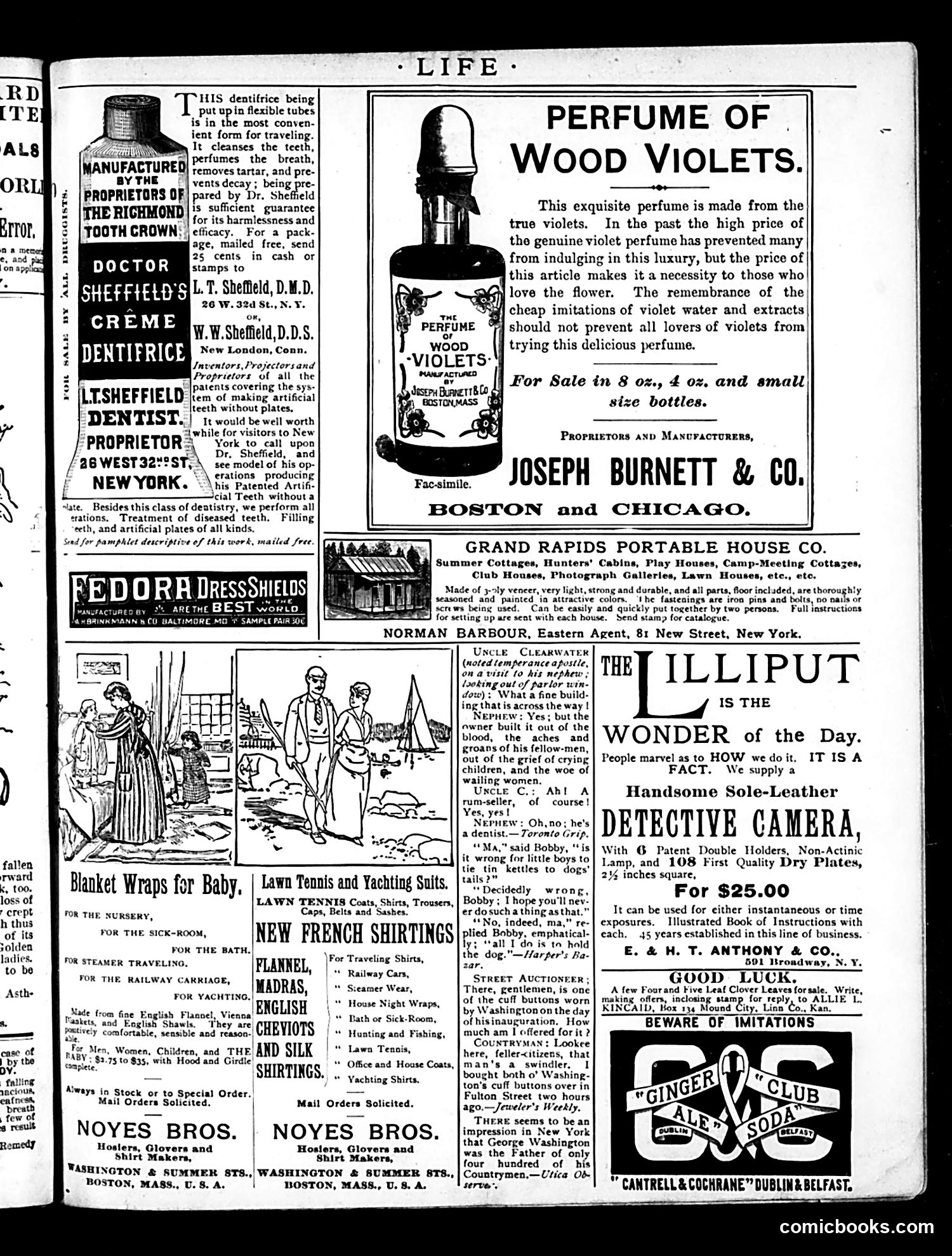
This cartoon satirizes temperance hypocrisy. Uncle Clearwater, identified as a "noted temperance apostle" (prohibitionist), assumes a fine building belongs to a rum-seller based on moral grounds—expecting his nephew to confirm it. The nephew deflates this assumption: the building was built through exploitation of workers (blood, aches, groans), grief of children, and suffering of women—but the owner is *not* a liquor dealer. The satire targets temperance advocates who focus morally on alcohol while ignoring industrial exploitation and capitalist abuses. It suggests temperance reformers are selective in their moral judgments, attacking one vice while overlooking others that cause equal human suffering. The joke exposes the blind spots of single-issue activism.
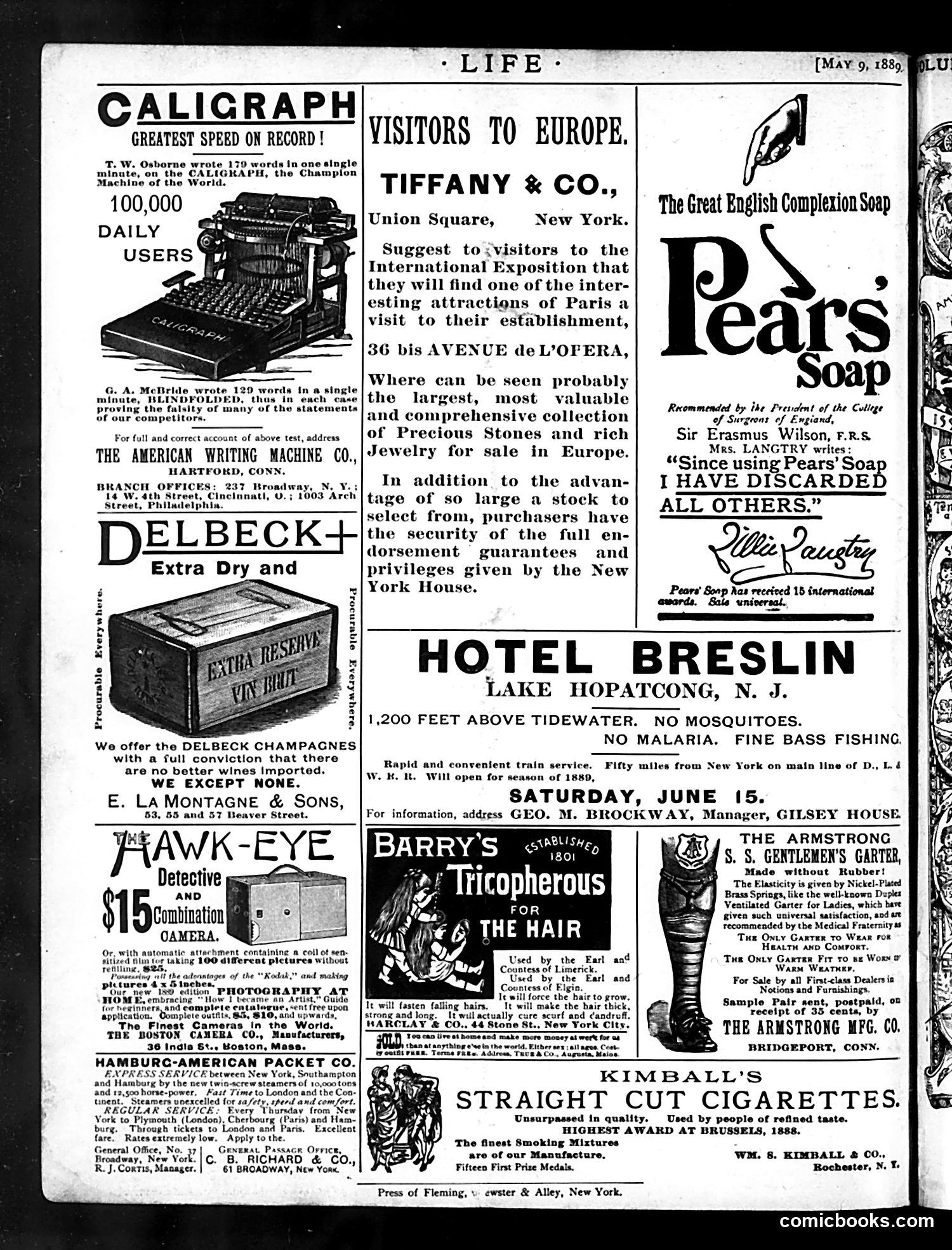
This page is **primarily advertising**, not a political cartoon. It's from Life magazine's May 9, 1889 issue and showcases commercial advertisements typical of the era. Key advertisements include: - **Caligraph typewriter**: Boasts speed records (179 words/minute), competing in the early typewriter market - **Tiffany & Co.**: Directs European travelers to their Paris jewelry showroom - **Pears' Soap**: Features an endorsement from actress Lillie Langtry, a celebrity testimonial marketing strategy - **Hotel Breslin**: Lake resort promising mosquito-free leisure 50 miles from New York - **Barry's Tricopherous**: Hair product claiming to cure baldness and dandruff - **Hawk-Eye Detective Camera**: Early photography equipment marketed as a novelty The satirical magazine Life here functions as a vehicle for consumer advertising. The page reflects late-19th-century commercial culture: product competition, celebrity endorsements, technological novelty, and leisure tourism marketing to affluent readers.