
Life, 1889-05-09 · page 2 of 18
Life — May 9, 1889 — page 2: what you’re looking at
What you’re looking at
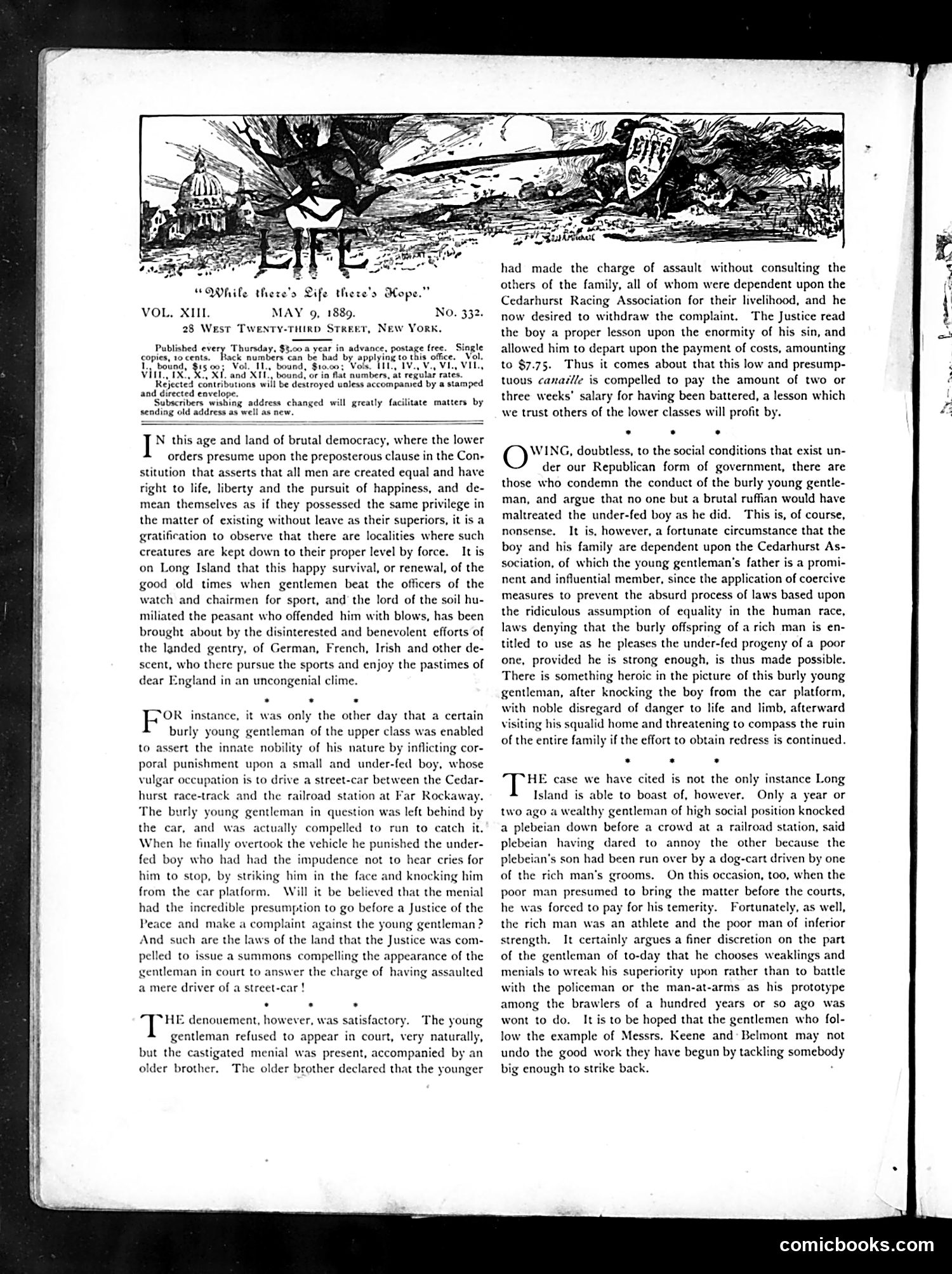
The masthead cartoon depicts a chaotic scene with the phrase "While there's Life there's Hope." The image appears to show social upheaval or disaster—possibly referencing contemporary anxieties about class conflict and social order in Gilded Age America. The article text discusses a case involving a "burly young gentleman" of the upper class who assaulted an underfed boy. The piece critiques the assumption that wealthy men have the right to physically punish the poor, while sarcastically noting it's "fortunate" the boy's family has social connections to seek justice. The satire targets class privilege and the legal system's bias toward the wealthy, using a specific incident to illustrate broader inequality in Gilded Age society.
📄 Transcribed text from this page (OCR, searchable)
Machine-transcribed from the original scan — historical spelling and the odd misread are preserved.
“QMhile there's Sif OL. XII. MAY 9, 1889. 28 West Twenty-rHtrp Street, New York, there's Published every Thursday, $$.co a year in advance, postage {ree copies, 10 cents. Rack numbers can be had by. applying to 1, bound, $15.00 I1., bound, Vint, 1X, X..X XII, bound, of ia flat numbers, at rex Rejecte utions will be destroyed unless accompanied by a stan and directed envelope. Subscribers wishing address changed will greatly facili sending old address as well as new. $10.00; te matters by I N this age and land of brutal democracy, where the lower orders presume upon the preposterous clause in the Cone stitution that asserts that all men are created equal and have right to life, liberty and the pursuit of happiness, and de- mean themselves as if they possessed the same privilege in the matter of existing without leave as their superiors, it is a gratification to observe that there are localities where such creatures are kept down to their proper level by force. It is on Long Island that this happy survival, or renewal, of the good old times when gentlemen beat the officers of the watch and chairmen for sport, and the lord of the soil hu- miliated the peasant who offended him with blows, has been brought about by the disinterested and benevolent efforts of the landed gentry, of German, French, Irish and other de- scent, who there pursue the sports and enjoy the pastimes of dear England in an uncongenial clime. OR instance, it was only the other day that a certain burly young gentleman of the upper class was enabled to assert the innate nobility of his nature by inflicting cor- poral punishment upon a small and under-fed boy, whose vulgar occupation is to drive a street-car between the Cedar- hurst race-track and the railroad station at I The burly young gentleman in question was left behind by the car, and was actually compelled to run to catch it. When he finally overtook the vehicle he punished the under- fed boy who had had the impudence not to hear cries for him to stop, by striking him in the face and knocking him from the car platform. Will it be believed that the menial had the incredible presumption to go before a Justice of the Peace and make a complaint against the young gentleman ? And such are the laws of the land that the Justice was com- pelled to issue a summons compelling the appearance of the gentleman in court to answer the charge of having assaulted a mere driver of a street-car ! Te denouement, however, was satisfactory. The young gentleman refused to appear in court, very naturally, but the castigated menial was present, accompanied by an older brother. The older brother declared that the younger had made the charge of assault without consulting the others of the family, all of whom were dependent upon the Cedarhurst Racing Association for their livelihood, and he now desired to withdraw the complaint. The Justice read the boy a proper lesson upon the enormity of his sin, and allowed him to depart upon the payment of costs, amounting to $7.75. Thus it comes about that this low and presump- tuous caxazile is compelled to pay the amount of two or three weeks’ salary for having been battered, a lesson which we trust others of the lower classes will profit by. . . . WING, doubtless, to the social conditions that exist un- der our Republican form of government, there are those who condemn the conduct of the burly young gentle- man, and argue that no one but a brutal ruffian would have maltreated the under-fed boy as he did. This is, of course, nonsense. It is, however, a fortunate circumstance that the boy and his family are dependent upon the Cedarhurst As- sociation, of which the young gentleman's father is a promi- nent and influential member, since the application of coercive measures to prevent the absurd process of laws based upon the ridiculous assumption of equality in the human race, laws denying that the burly offspring of a rich man is en- titled to use as he pleases the under-fed progeny of a poor one, provided he is strong enough, is thus made possible. There is something heroic in the picture of this burly young gentleman, after knocking the boy from the car platform, with noble disregard of danger to life and limb, afterward visiting his squalid home and threatening to compass the ruin of the entire family if the effort to obtain redress is continued. . . . HE case we have cited is not the only instance Long Island is able to boast of, however. Only a year or two ago a wealthy gentleman of high social position knocked a plebeian down before a crowd at a railroad station, said plebeian having dared to annoy the other because the plebeian’s son had been run over by a dog-cart driven by one of the rich man’s grooms. On this occasion, too, when the poor man presumed to bring the matter before the courts, he was forced to pay for his temerity. Fortunately, as well, the rich man was an athlete and the poor man of inferior strength. It certainly argues a finer discretion on the part of the gentleman of to-day that he chooses weaklin, id menials to wreak his superiority upon rather than to battle with the policeman or the man-at-arms as his prototype among the brawlers of a hundred years or so ago was wont to do. It is to be hoped that the gentlemen who fol- low the example of Messrs. Keene and: Belmont may not undo the good work they have begun by tackling somebody big enough to strike back. comicbooks.com