
Life, 1889-05-09 · page 6 of 18
Life — May 9, 1889 — page 6: what you’re looking at
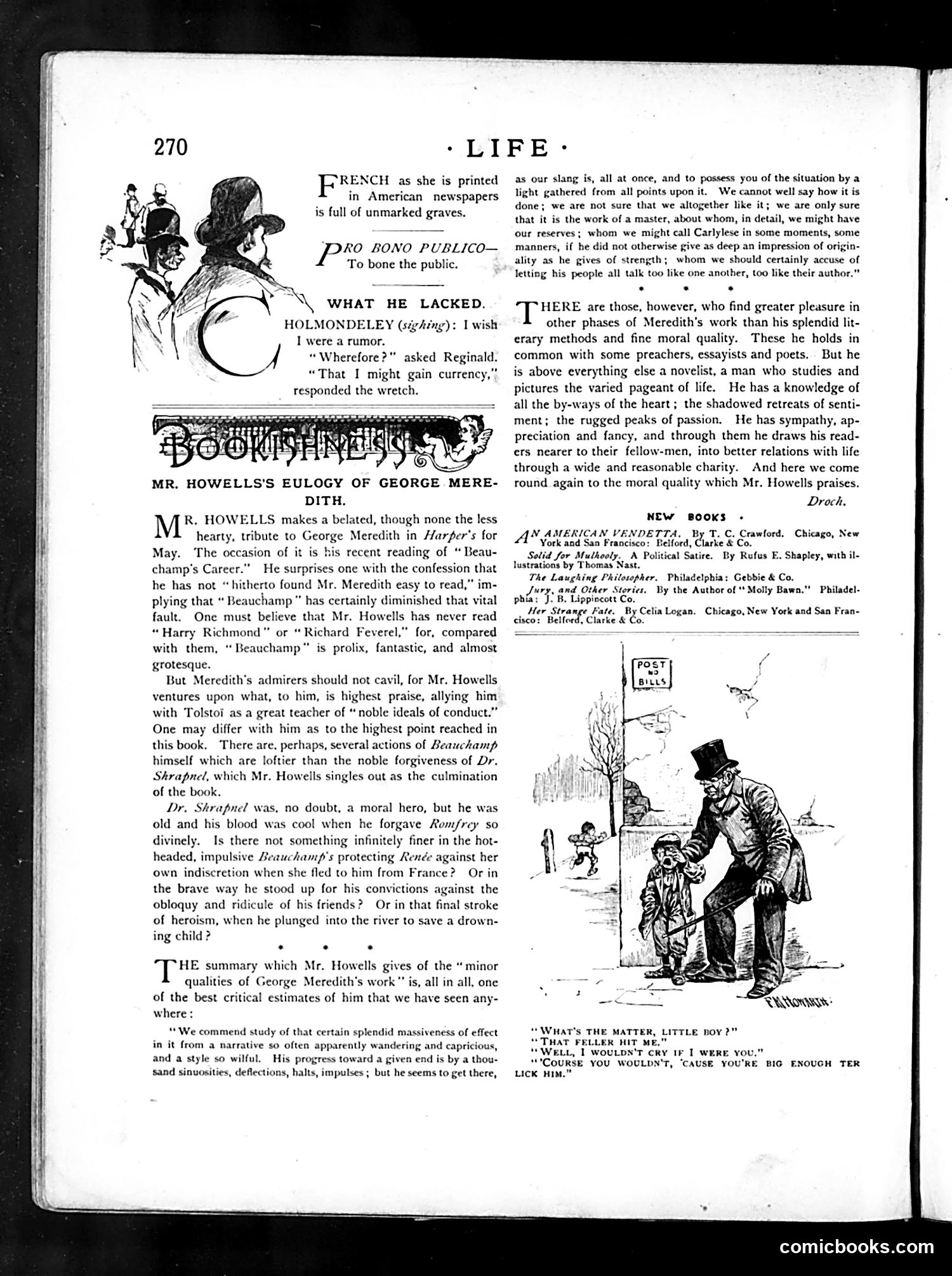
What you’re looking at
This page contains a literary review of George Meredith's work by Mr. Howells, discussing Meredith's novels and moral qualities as a writer. The cartoon at bottom shows a well-dressed man in a top hat speaking to street children near a "POST BILLS" sign. The caption reads: "What's the matter, little boy?" "That feller hit me." "Well, I wouldn't cry if I were you." "I wouldn't cry if I were you, 'cause you're big enough ter lick him." **The satire**: The cartoon mocks patronizing advice from the privileged to the poor. The well-dressed gentleman offers hollow sympathy and suggests the boy "wouldn't cry," but the child's retort—that the man could fight back because he's stronger—exposes the gentleman's comfortable detachment from actual hardship. It's social commentary on class indifference.
📄 Transcribed text from this page (OCR, searchable)
Machine-transcribed from the original scan — historical spelling and the odd misread are preserved.
- LIFE: RENCH as she is printed in American newspapers is full of unmarked graves. ‘RO BONO PUBLICO— To bone the public, \\ WHAT HE LACKED. HOLMONDELEY (sigAéng): I wish I were a rumor. “Wherefore?” asked Reginald. “That I might gain currency,” responded the wretch. BUS MR. HOWELLS'S EULOGY OF GEORGE MERE- DITH. M R. HOWELLS makes a belated, though none the less hearty, tribute to George Meredith in Harper's for May. The occasion of it is his recent reading of “ Beau- champ’s Career.” He surprises one with the confession that he has not “hitherto found Mr. Meredith easy to read,” im- plying that “ Beauchamp ” has certainly diminished that vital fault, One must believe that Mr. Howells has never read “Harry Richmond” or “ Richard Feverel,” for, compared with them, “Beauchamp” is prolix, fantastic, and almost grotesque. But Meredith's admirers should not cavil, for Mr. Howells ventures upon what, to him, is highest praise, allying him with Tolstoi as a great teacher of “noble ideals of conduct.” One may differ with him as to the highest point reached in this book. There are, perhaps, several actions of Beauchamp self which are loftier than the noble forgiveness of Dr. Shrapnel, which Mr. Howells singles out as the culmination of the book. Dr, Shrapnel was, no doubt, a moral hero, but he was old and his blood was cool when he forgave Rom/frey so divinely. Is there not something infinitely finer in the hot- headed, impulsive Beauchamf's protecting Renée against her own indiscretion when she fled to him from Franc the brave way he stood up for his convictions ag; obloquy and ridicule of his friends? Or in that final stroke of heroism, when he plunged into the river to save a drown- ing child ? . . . HE summary which Mr. Howells gives of the “minor qualities of George Meredith's work" is, all in all, one of the best critical estimates of him that we have seen any- where: “We commend study of that certain splendid massiveness of effect in it from a narrative so often apparently wandering and capricious, and a style so wilful. His progress toward a given end is by a thou- sand sinuosities, deflections, halts, impulses ; but he seems to get there, as our slang is, all at once, and to possess you of the situation by a light gathered from all points upon it. We cannot well say how it is done; we are not sure that we altogether like it; we are only sure that it is the work of a master, about whom, in detail, we might have our reserves; whom we might call Carlylese in some moments, some manners, if he did not otherwise give as deep an impression of origin- ality as he gives of strength; whom we should certainly accuse of letting his people all talk too like one another, too like their author.” . . . HERE are those, however, who find greater pleasure in other phases of Meredith's work than his splendid lit- erary methods and fine moral quality. These he holds in common with some preachers, essayists and poets. But he is above everything else a novelist, aman who studies and pictures the varied pageant of life. He has a knowledge of all the by-ways of the heart; the shadowed retreats of senti- ment; the rugged peaks of passion. He has sympathy, ap- preciation and fancy, and through them he draws his read- ers nearer to their fellow-men, into better relations with life through a wide and reasonable charity. And here we come round again to the moral quality which Mr. Howells praises. Droch, NEW BooKs - AN AMERICAN VENDETTA. By T. C. Crawford. Chicago, New York and San Francisco: Belford, Clarke & Co. Solid for Muthooly. Political Satire. lustrations by Thomas Nast. The Laughing Philosopher, Philadelphia: Gebbie & Co. Jury, and Other Stories, By the Author of “ Molly Bawa.” phia: J.B. Lippincott Co, Her Strange Fate. By Celia Logan. cisco: Belford, Clarke & Co. By Rufus E. Shapley, with il- Philadel- Chicago, New York and San Fran- “WELL, I WOULDN'T CRY IF I WERE YoU,” “COURSE YOU WOULDN'T, ‘CAUSE YOU'RE BIG ENOUGH TER Lick Him.” comicbooks.com