
Life, 1889-05-09 · page 7 of 18
Life — May 9, 1889 — page 7: what you’re looking at
What you’re looking at
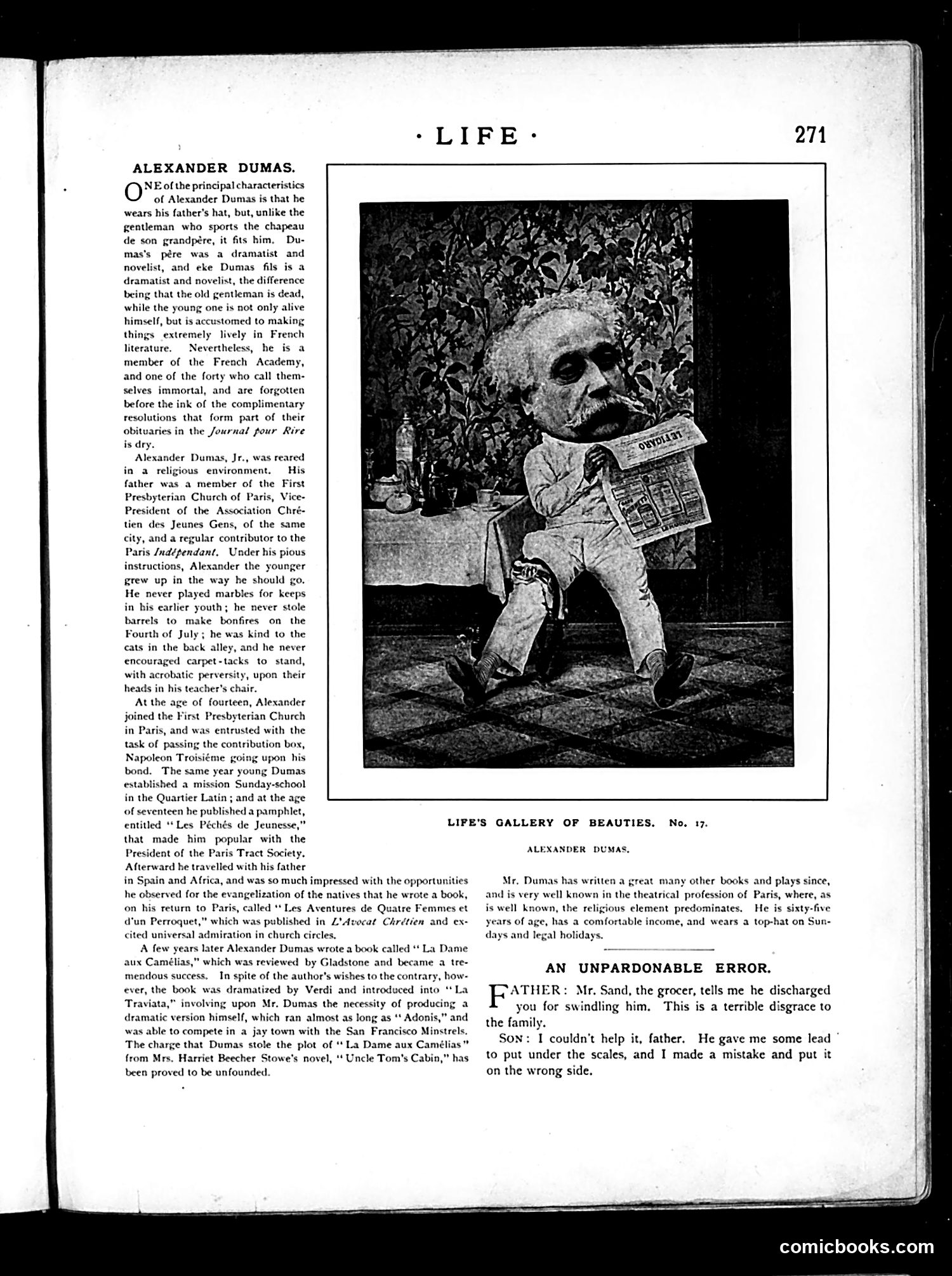
This page contains a biographical article about French author Alexander Dumas alongside a brief comedic sketch titled "An Unpardonable Error." The sketch depicts a grocery-store conflict: a father confronts Mr. Sand the grocer about being swindled. The son admits he made an error while using the scales—he placed lead weights on the wrong side, causing him to receive less product than paid for. The humor derives from the irony: the son inadvertently cheated *himself* rather than the grocer, making the father's complaint absurd and his accusation of dishonesty misdirected. The photograph shows what appears to be a statue or sculpture, likely of Dumas, accompanying the biographical text praising his literary achievements and character.
📄 Transcribed text from this page (OCR, searchable)
Machine-transcribed from the original scan — historical spelling and the odd misread are preserved.
ALEXANDER DUMAS. NE of the principal characteristics of Alexander Dumas is that he wears his father’s hat, but, unlike the gentleman who sports the chapeau de son grandpére, it fits him. Du- mas’s pére was a dramatist: and novelist, and eke Dumas fils is a dramatist and novelist, the difference being that the old gentleman is dead, while the young one is not only alive himself, but is accustomed to making things extremely lively in French literature. Nevertheless, he is a member of the French Academy, and one of the forty who call them- selves immortal, and are forgotten before the ink of the complimentary resolutions that form part of their obituaries in the Journal pour Rire is dry. Alexander Dumas, Jr., was reared i His father was a member of the First Presbyterian Church of Paris, V President of the Association Chr ien des Jeunes Gens, of the same city, and a regular contributor to the Paris /ndépendant, Under his pious instructions, Alexander the younger grew up in the way he should go. He never played marbles for keeps in bis earlier youth; he never stole barrels to make bonfires on the Fourth of July; he was kind to the cats in the back alley, and he never encouraged carpet-tacks to stand, with acrobatic perversity, upon their heads in his teacher's chair. At the age of fourteen, Alexander joined the First Presbyterian Church in Paris, and was entrusted with the task of passing the contribution box, Napoleon Troisiéme going upon his bond. The same year young Dumas established a mission Sunday-school in the Quartier Latin ; and at the age of seventeen he published a pamphlet, entitled “Les Péchés de Jeunesse,” that made him popular with the President of the Paris Tract Society. Afterward he travelled with his father in Spain and Africa, and was so much impressed with the opportunities he observed for the evangelization of the natives that he wrote a book, on his return to Paris, called ** Les Aventures de Quatre Femmes et d'un Perroquet," which was published in L’Avocat Chrétien and ex- cited universal admiration in church circles, A few years later Alexander Dumas wrote a book called “La Dame aux Camélias," which was reviewed by Gladstone and became a tre- mendous success. In spite of the author's wishes to the contrary, how- ever, the book was dramatized by Verdi and introduced into “La Traviata,” involving upon Mr. Dumas the necessity of producing a dramatic version himself, which ran almost as long as “* Adonis," and was able to compete in a jay town with the San Francisco Minstrels. The charge that Dumas stole the plot of ‘La Dame aux Camélias” from Mrs, Harriet Beecher Stowe’s novel, ‘ Uncle Tom's Cabin,” has been proved to be unfounded LIFE'S GALLERY OF BEAUTIES. No. 17. ALEXANDER DUMAS, Mr. Dumas has written a great many other books and plays since, and is very well known in the theatrical profession of Paris, where, as is well known, the religious element predominates, He is sixty: years of age, has a comfortable income, and wears a top-hat on $ days and legal holidays. AN UNPARDONABLE ERROR. ATHER: Mr. Sand, the grocer, tells me he discharged you for swindling him. This is a terrible disgrace to the family. Son: I couldn't help it, father. He gave me some lead ° to put under the scales, and I made a mistake and put it on the wrong side. comicbooks.com