
A complete issue · 21 pages · 1889
Life — April 18, 1889
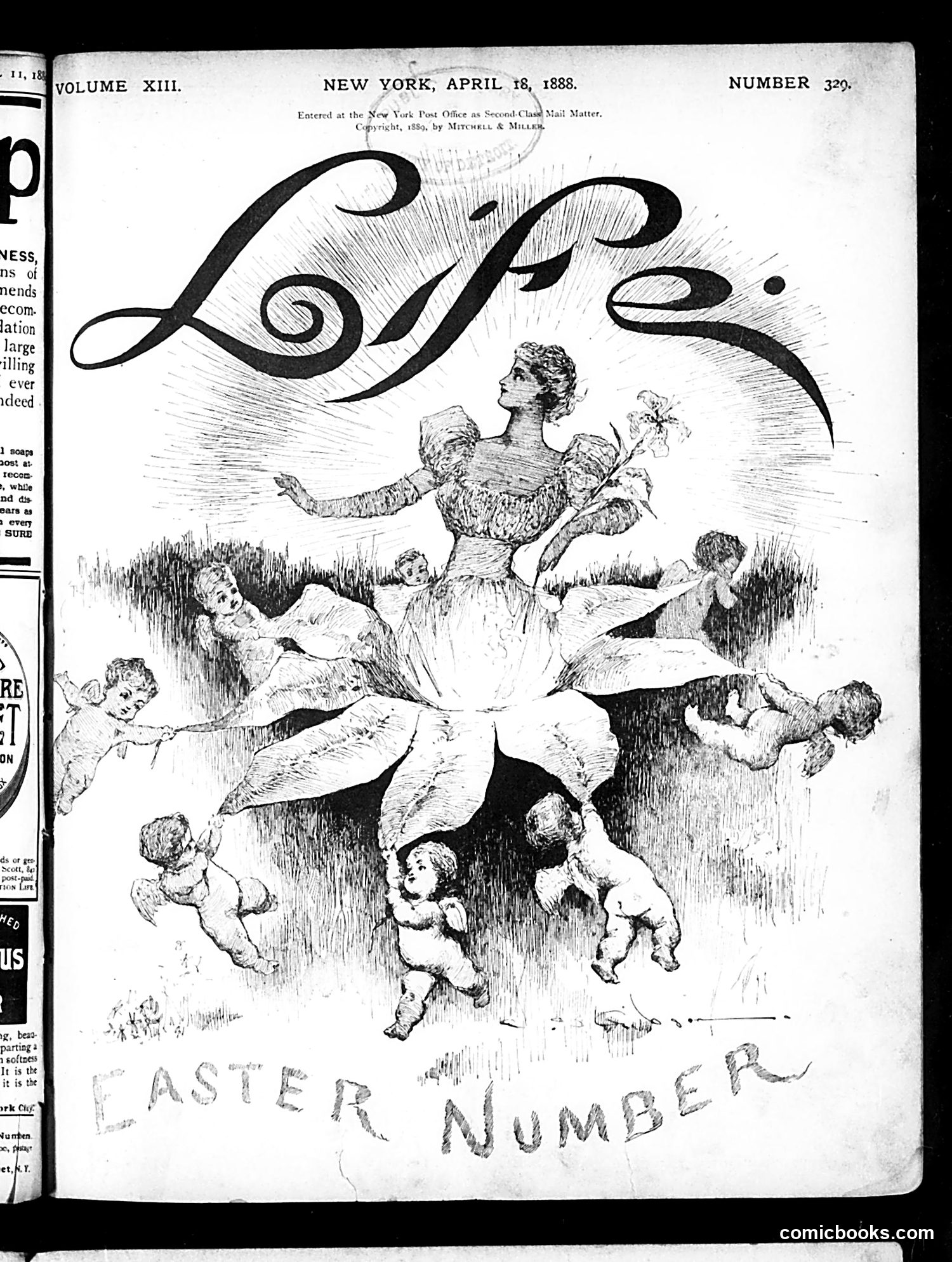
This is the cover illustration for Life's Easter issue. The central figure is a woman in Victorian dress surrounded by cherubs (baby angels), a traditional Easter iconography combining religious themes with spring renewal imagery. The decorative text reading "Life" at top and "Easter Number" at bottom frames the composition. The woman appears to represent Life itself or the spirit of Easter—a common allegorical approach in 19th-century magazine covers. The cherubs scattered around her suggest fertility, rebirth, and joy associated with both Easter and springtime. This is straightforward seasonal imagery rather than political satire, typical of holiday issues that prioritized decorative artistry over commentary.
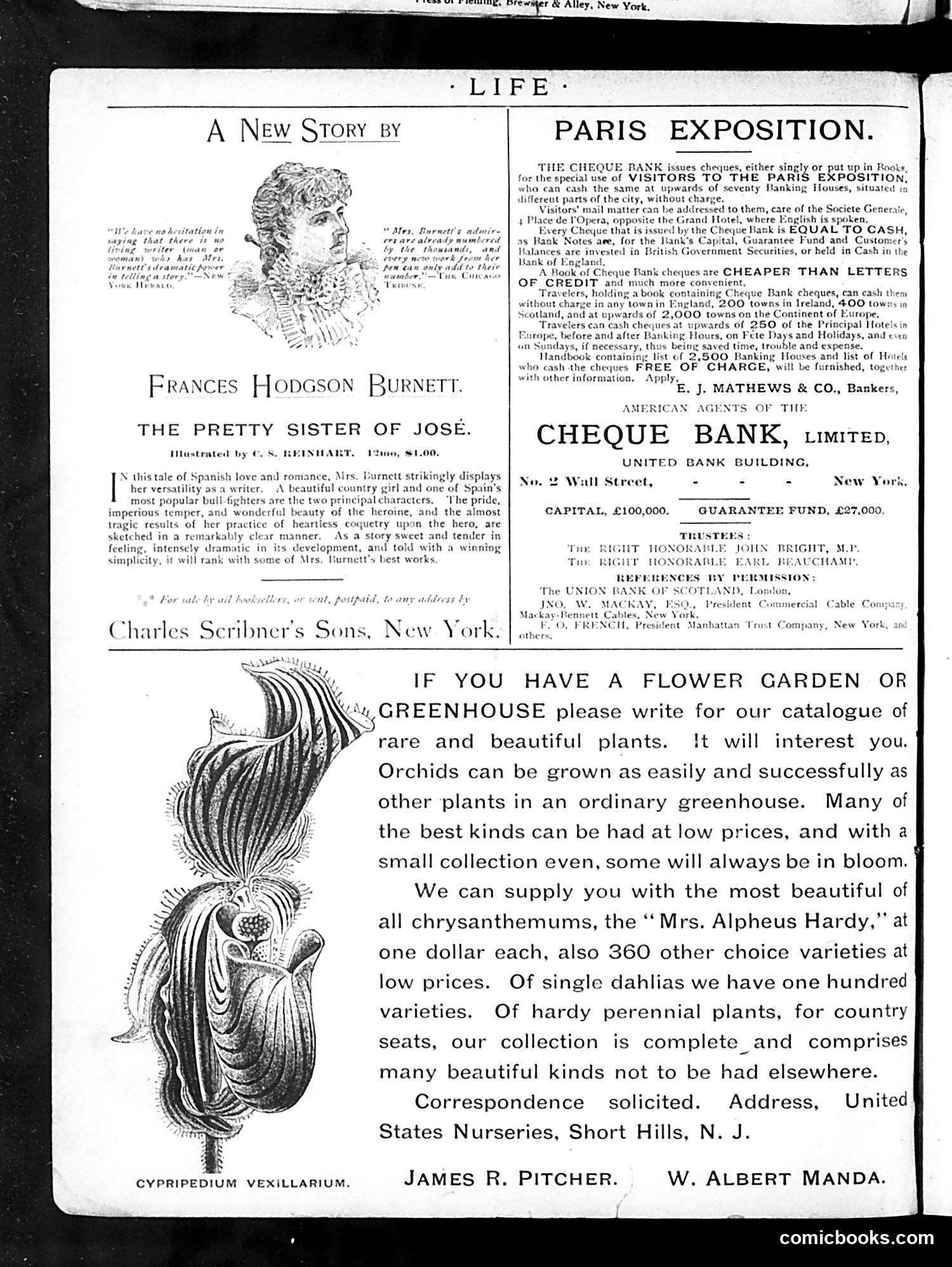
This page is primarily **advertising rather than political satire**. The main content features: 1. **"The Pretty Sister of José"** — a new story by Frances Hodson Burnett, illustrated by C.S. Reinhardt. The advertisement describes it as Spanish romance depicting "a beautiful country girl" and "the heroine's wonderful beauty." Published by Charles Scribner's Sons. 2. **Cheque Bank advertisement** — offering financial services for Paris Exposition visitors, emphasizing travelers can cash cheques at 250+ locations across Europe. 3. **United States Nurseries advertisement** — promoting plants, orchids, and chrysanthemums. The botanical illustration of *Cypripedium vexillarium* (a lady's slipper orchid) serves the nursery advertisement. No political cartoon or satirical commentary appears on this page.
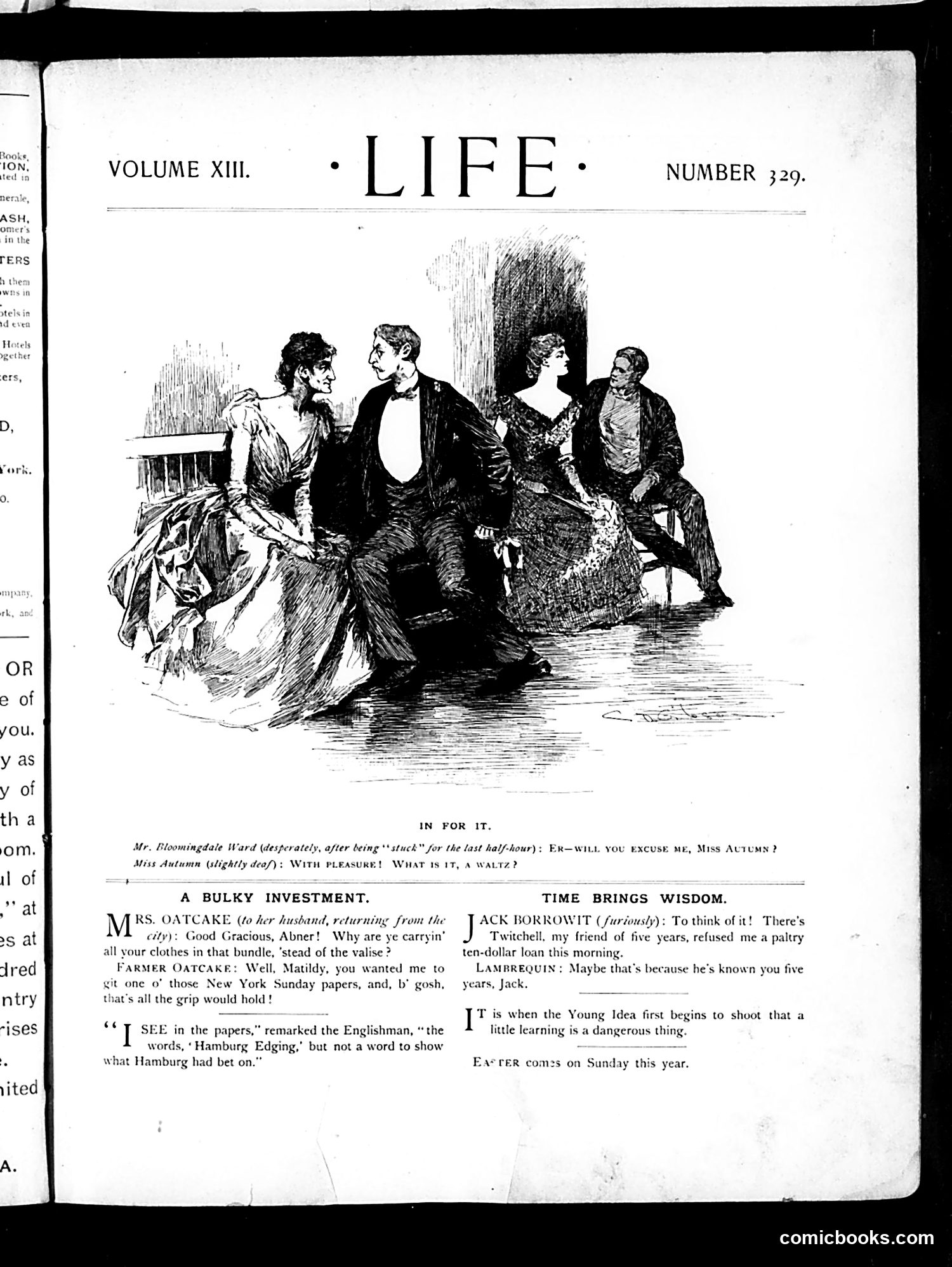
The main cartoon, titled "In For It," depicts a social scene where a man in formal dress has apparently asked Miss Autumn to dance. The caption reveals he's exhausted ("stuck" for the last half-hour) and seeks an excuse to rest. Below are three brief satirical pieces: **"A Bulky Investment"** mocks a farmer's wife for carrying excessive bundled clothing, questioning the practical value of such burdensome transport. **"Time Brings Wisdom"** presents a cynical exchange about a ten-dollar loan, suggesting that experience teaches distrust of borrowers. **"The Young Idea"** offers a philosophical observation that youthful learning can be dangerously incomplete. The page satirizes social pretense, financial relationships, and intellectual overconfidence common to the era.
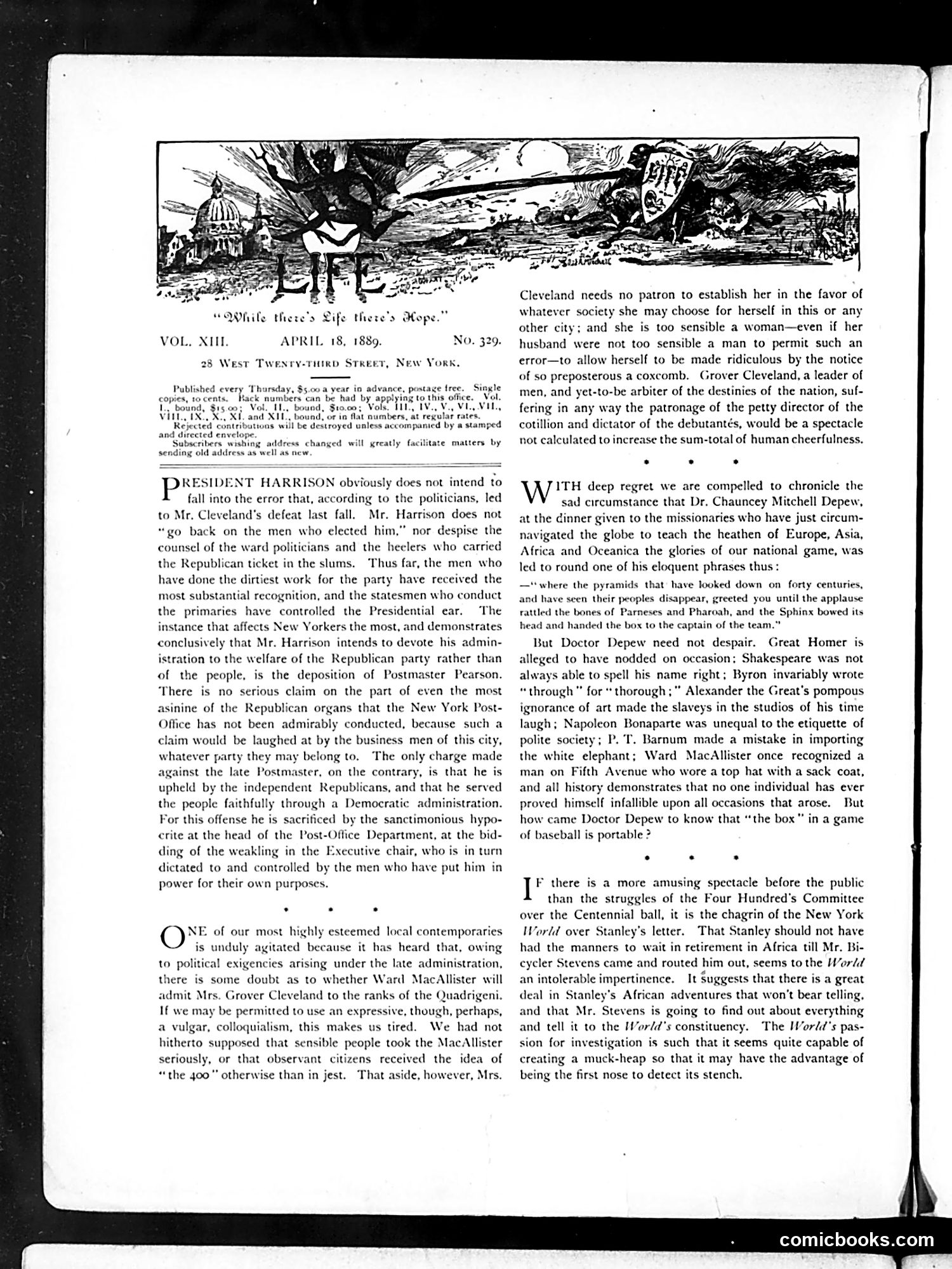
The masthead cartoon depicts **Lady Liberty** (the female figure with radiating crown) presiding over a chaotic landscape labeled "LIFE" with the motto "While there's Life there's Hope." The editorial content attacks **President Harrison** for failing to prevent Cleveland's electoral defeat, criticizing Republican Party leadership. It sarcastically praises Harrison's devotion to the Republican Party over the public interest, and condemns the PostMaster General's alleged misuse of office. The piece also mocks the **New York World** newspaper's coverage of explorer **Stanley** (likely Henry Morton Stanley) and Dr. Chauncey Depew's African travels. The satire suggests the World exaggerates trivialities while ignoring serious issues—particularly criticizing journalist **Isaac Stevens** for theatrical sensationalism masquerading as investigative journalism. This reflects late-19th-century partisan media warfare and editorial ridicule of competitor publications.
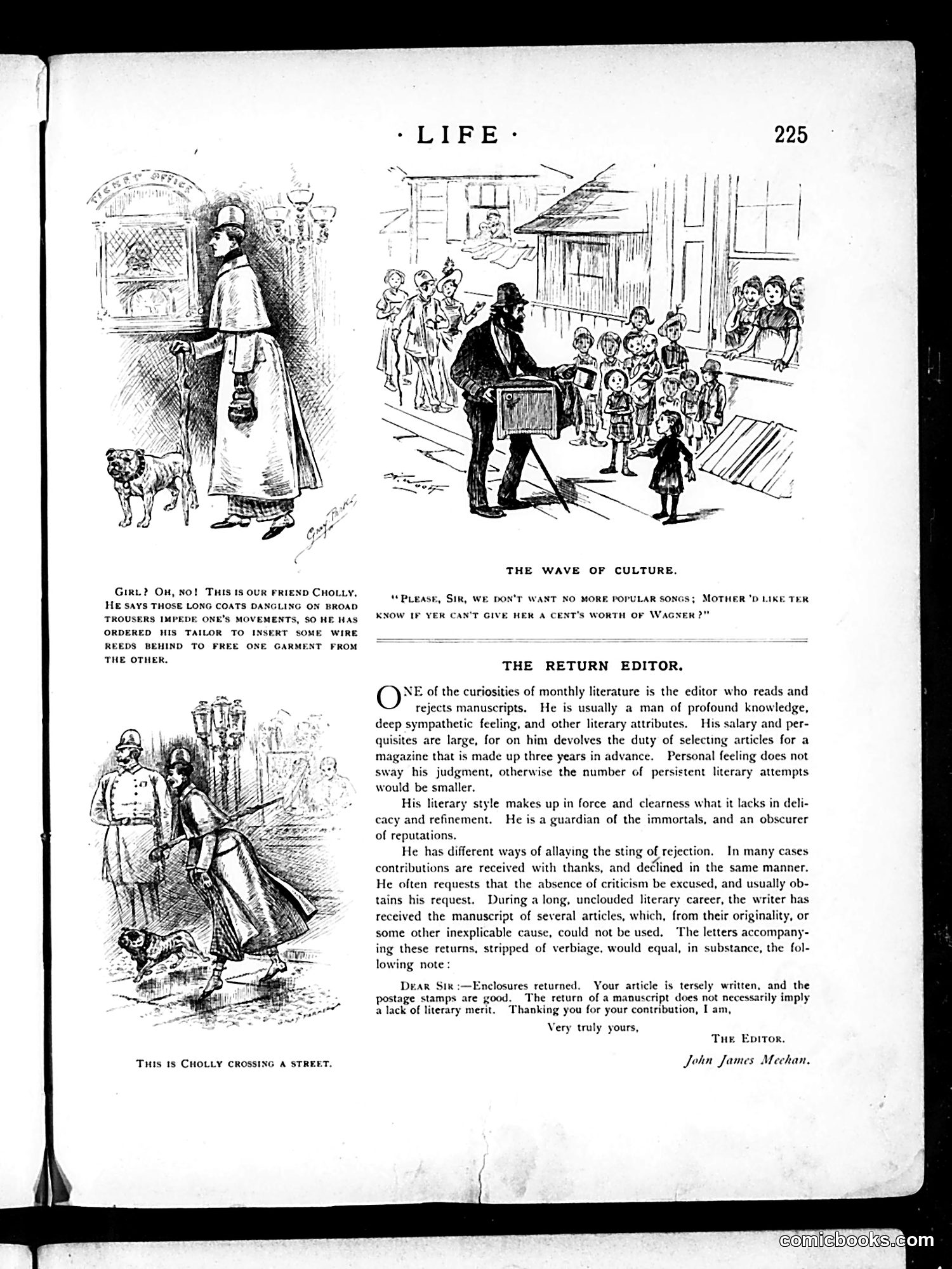
This page contains two distinct satirical pieces: **"The Wave of Culture"** (top right): Shows a man distributing sheet music to children in a street scene. The caption mocks contemporary cultural pretensions—a character complains that children now want only "popular songs" and Wagner, suggesting absurd class anxieties about working-class musical taste corrupting youth. **"The Return Editor"** (main article): A prose satire about magazine editors who reject submitted manuscripts. The piece humorously describes editors as gatekeepers of literary immortality, detailing their rejection methods. A sample rejection letter from "John James Mechan" (the editor) politely dismisses a poorly-written submission, illustrating the genteel rejection conventions of the era. Both pieces satirize contemporary cultural anxieties and publishing world pretensions.
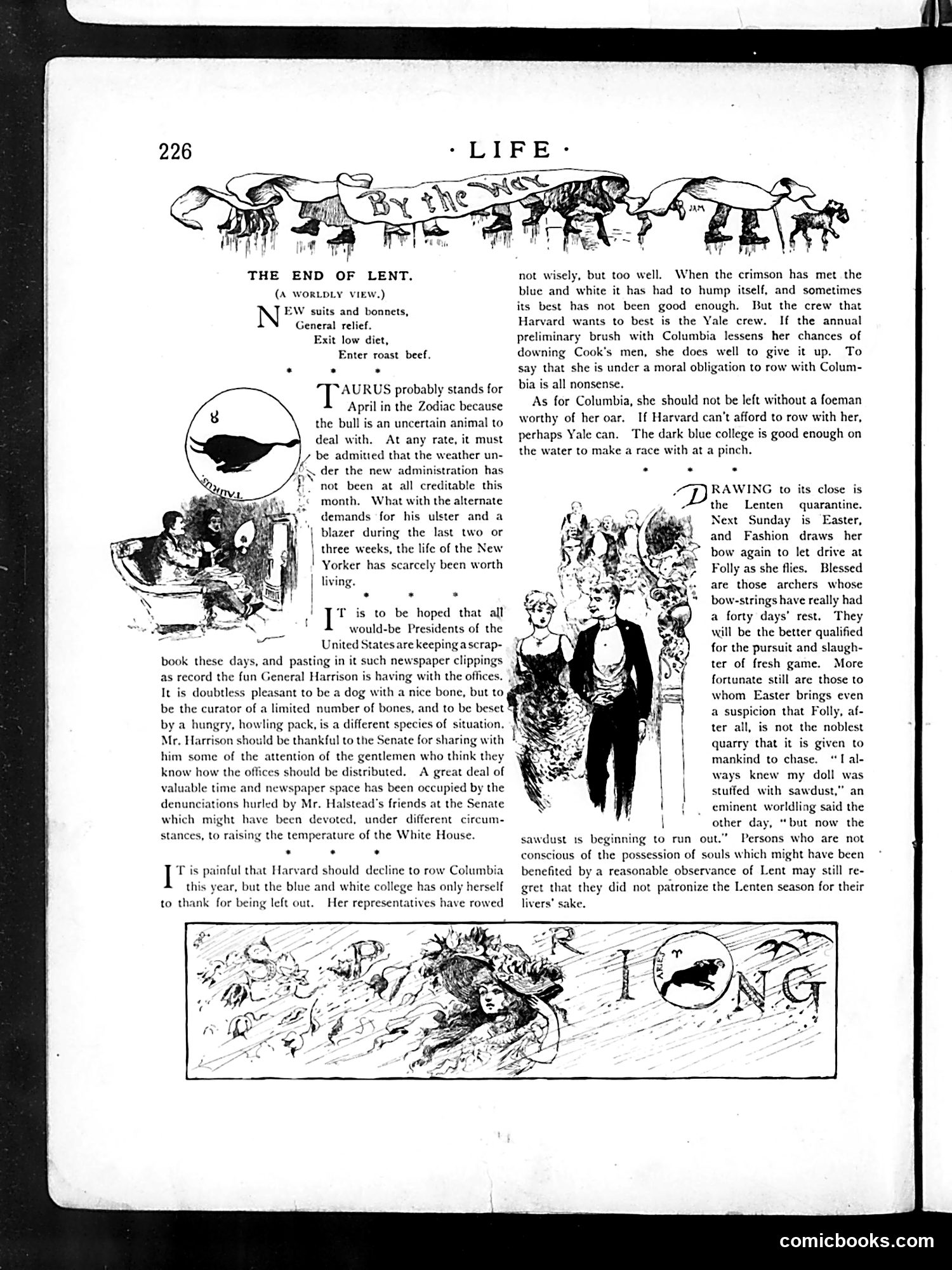
This page satirizes the end of the Lenten season and contains commentary on rowing competitions between Harvard and Columbia universities. The main cartoon mocks Harvard's decision to decline rowing Columbia that year, despite their traditional rivalry. The text criticizes Harvard for this withdrawal, suggesting they fear losing to Columbia's crew. There's also commentary on General Harrison and Senate activities, appearing to reference contemporary political news. The lower illustration depicts Easter and the return to social pleasures after Lenten abstinence—showing fashion and dining resuming. The Taurus zodiac reference connects April to the bull symbol. The satire targets both college athletic pride and the absurdity of maintaining Lenten restrictions while powerful figures ignore moral obligations. Without knowing the specific year, the exact political references remain unclear.
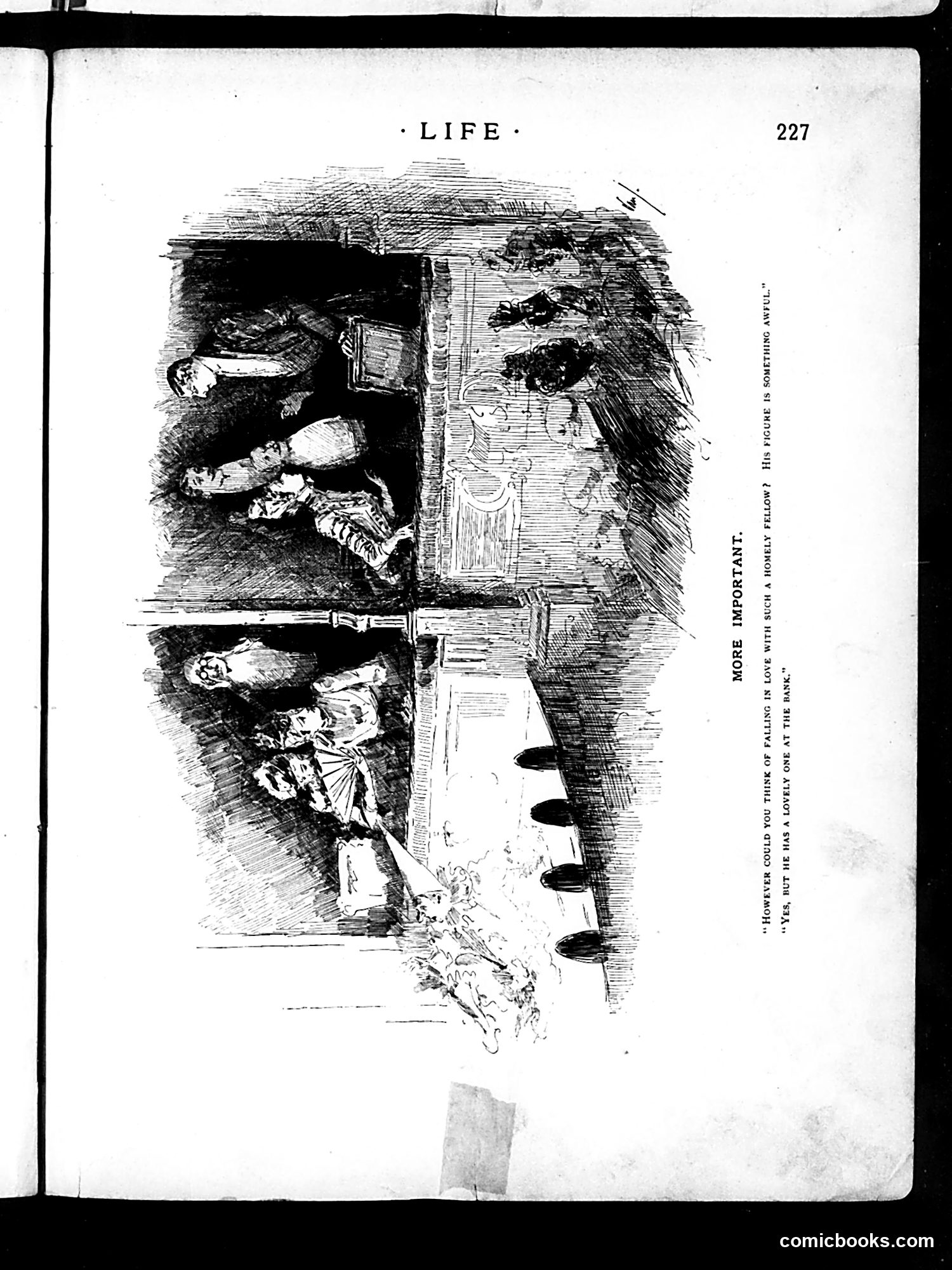
This satirical cartoon appears to depict a domestic scene with social commentary. The caption reads: "Whenever could you think of falsehoods? His posture is something awfully..." and continues with text about a visitor on at the same occasion. The illustration shows figures in what appears to be an interior setting, rendered in the characteristic sketch style of early 20th-century Life magazine. The composition suggests domestic drama or marital conflict—a common satirical subject. Without clearer visibility of specific identifying details or knowing the exact publication date, the precise political or social reference remains unclear. The satire likely concerns either gender relations, social propriety, or domestic dishonesty among the middle/upper classes—typical Life magazine targets of the era.
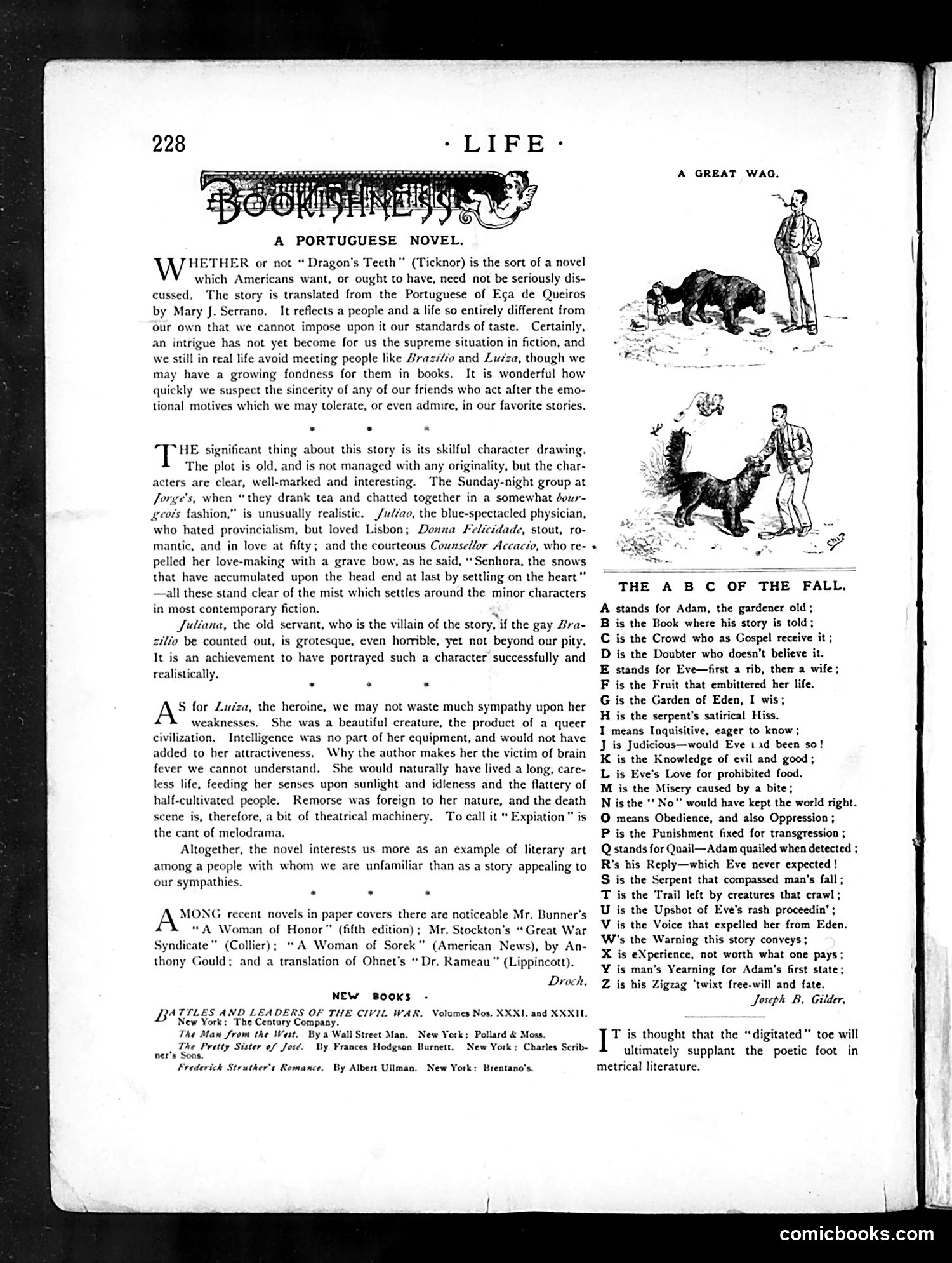
This is a Victorian-era moral alphabet, illustrating the Christian story of Adam and Eve's expulsion from Eden. Each letter represents a concept from Genesis: A is Adam (the gardener), B is the Book of Scripture, K is Knowledge of evil, S is the Serpent, and so on through Z (free will and fate). The accompanying sketches show figures acting out these biblical concepts—a man with dogs, another conversing with a woman. This was a common 19th-century educational device: teaching religious and moral lessons through alphabetical mnemonics paired with illustrations. The cartoons aren't political satire but rather a pious, allegorical meditation on sin and human nature—typical of Life magazine's occasional serious, moralistic content alongside its satirical pieces.
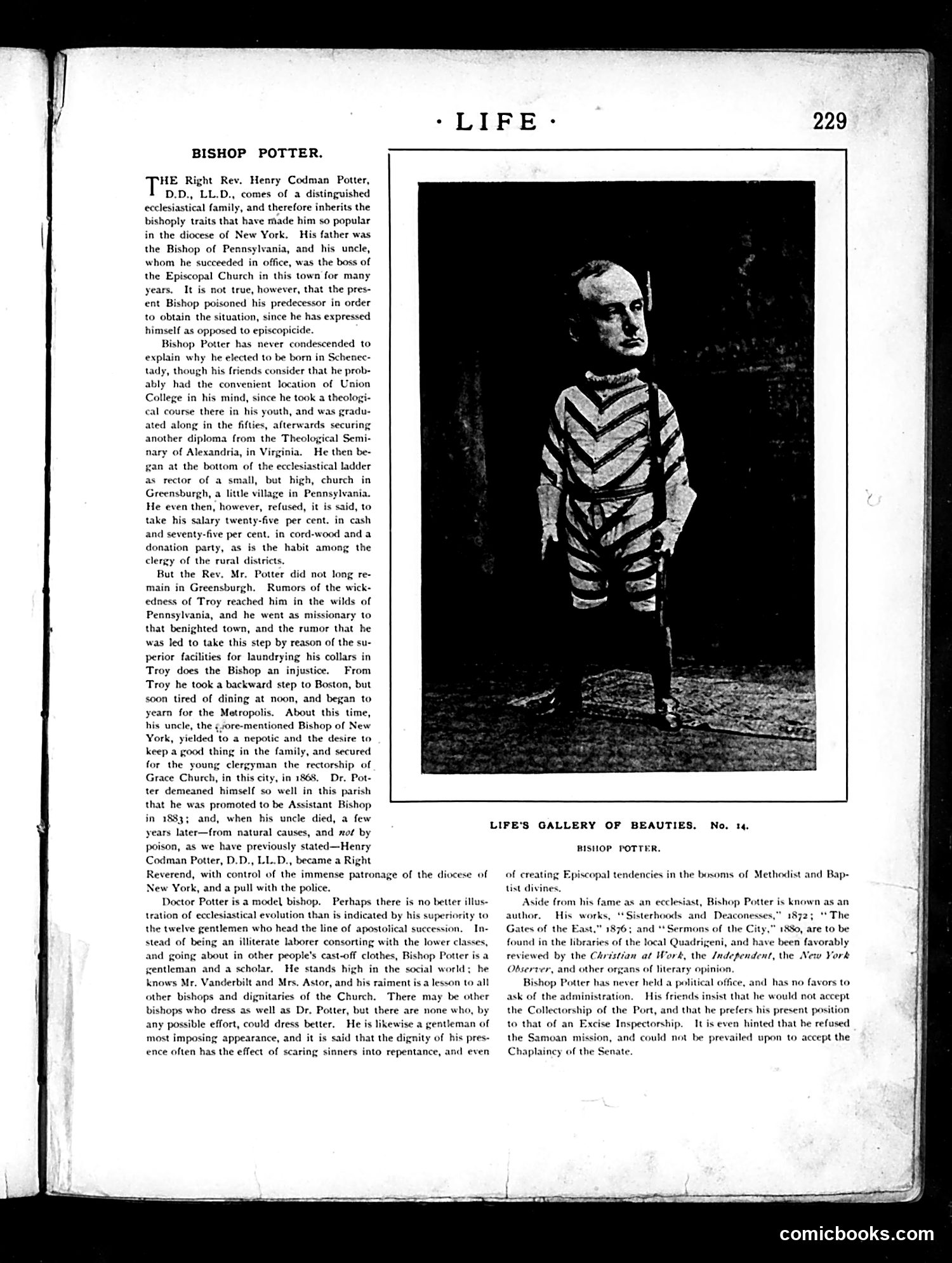
This page features a biographical article and portrait photograph of **Bishop Henry Codman Potter**, a prominent Episcopal Church leader in late 19th-century New York. The text traces his ecclesiastical career from Pennsylvania to his current position. The article emphasizes Potter's gentlemanly bearing and moral authority, noting he's known for refusing political positions and maintaining independence from secular influence. It describes him as a model bishop whose dignified presence commands respect—even "scaring sinners into repentance." The piece also mentions his published works on religious and social topics. Rather than satire, this appears to be a respectful profile celebrating Potter as an exemplar of ecclesiastical integrity and leadership during the Gilded Age, presented in *Life*'s "Gallery of Beauties" feature.
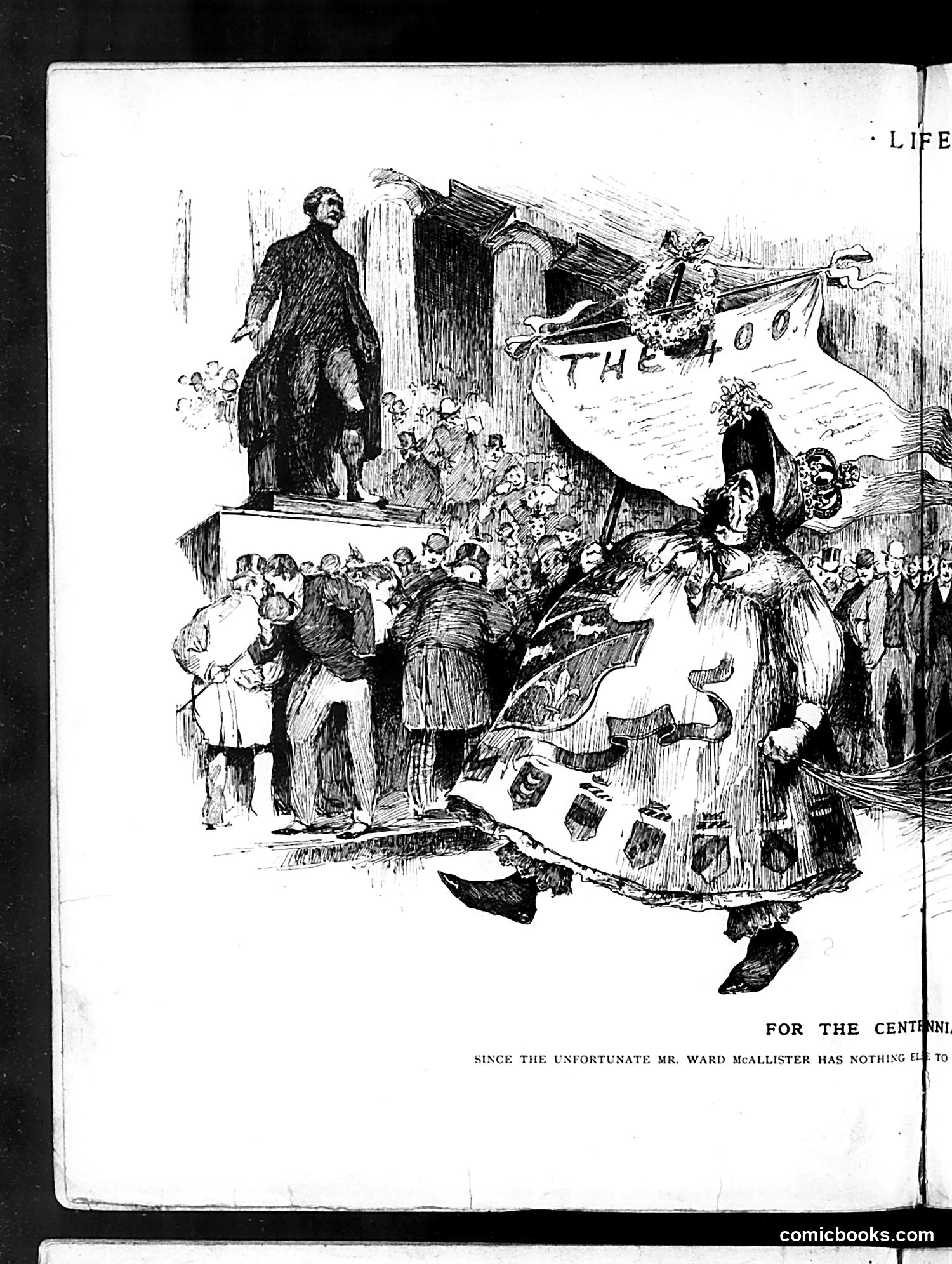
This satirical cartoon appears to reference a centennial celebration (likely the 1876 U.S. Centennial). The text mentions "Mr. Ward McAllister," a figure associated with high society. The cartoon depicts a statue of a dignitary on a pedestal overlooking a crowd of common people and what appears to be allegorical or personified figures (possibly representing concepts like Democracy or Liberty). The contrast between the elevated, honored figure above and the ordinary crowd below satirizes the gap between the wealthy elite and ordinary citizens. The drawing style and composition suggest mockery of how the wealthy commemorate national occasions while remaining disconnected from ordinary people's lives—a common critique in Gilded Age satire. The exact historical reference is unclear without seeing the complete text.
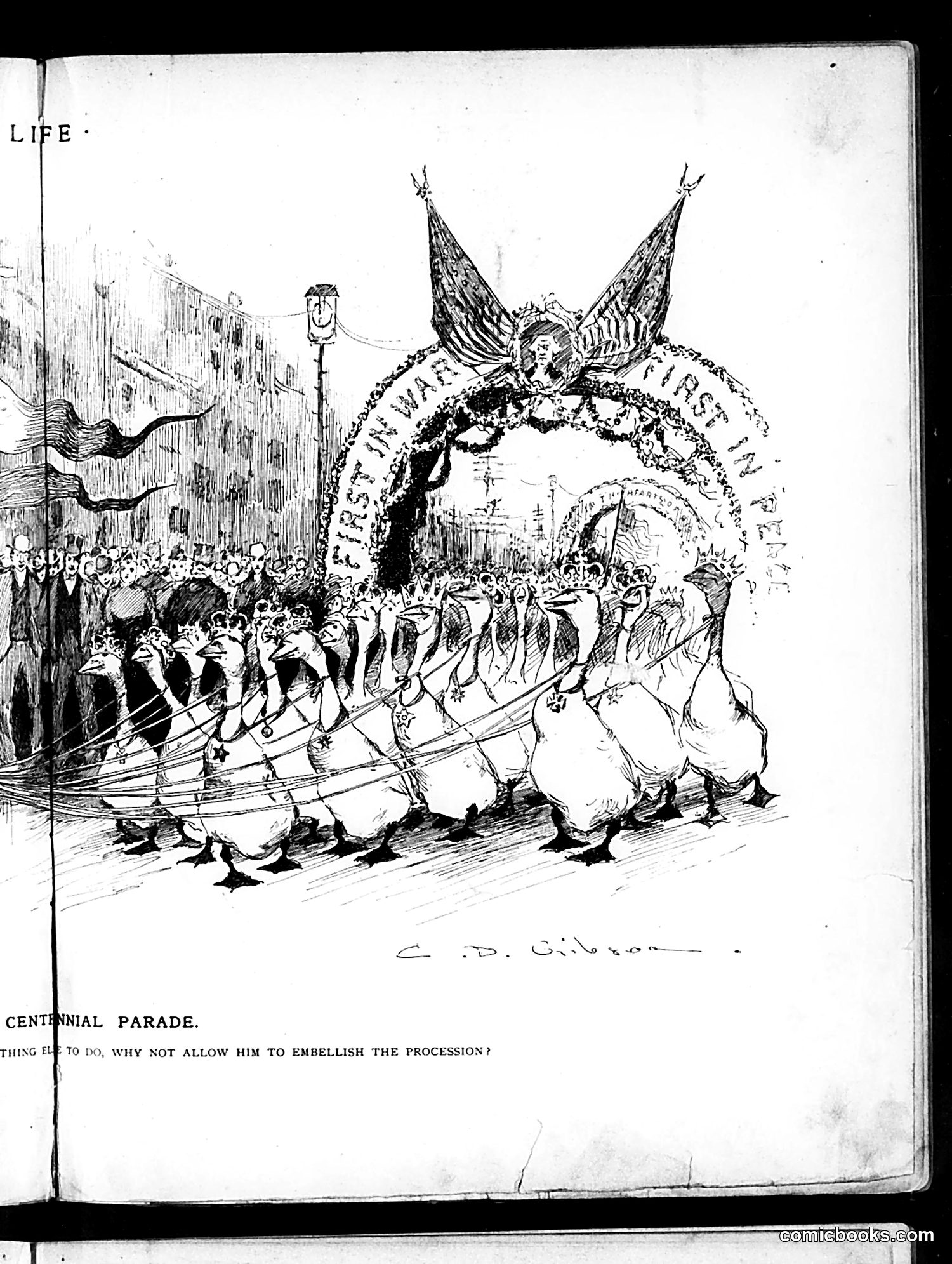
This satirical cartoon depicts a "Centennial Parade" with a caption asking: "If this is to do, why not allow him to embellish the procession?" The image shows a winged, demonic figure hovering above a parade of rotund figures pulling ropes. The demon appears to be directing or controlling the procession, while spectators watch from the left. The ornate arch frames text suggesting national celebration or commemoration. The satire likely critiques how political or social figures are permitted to "embellish" or corrupt public celebrations and national events for their own purposes. The demonic overseer suggests corruption or malevolent influence controlling what should be a dignified public occasion. Without knowing the specific centennial referenced, the cartoon's point appears to be that someone questionable is being allowed inappropriate influence over a major celebration.
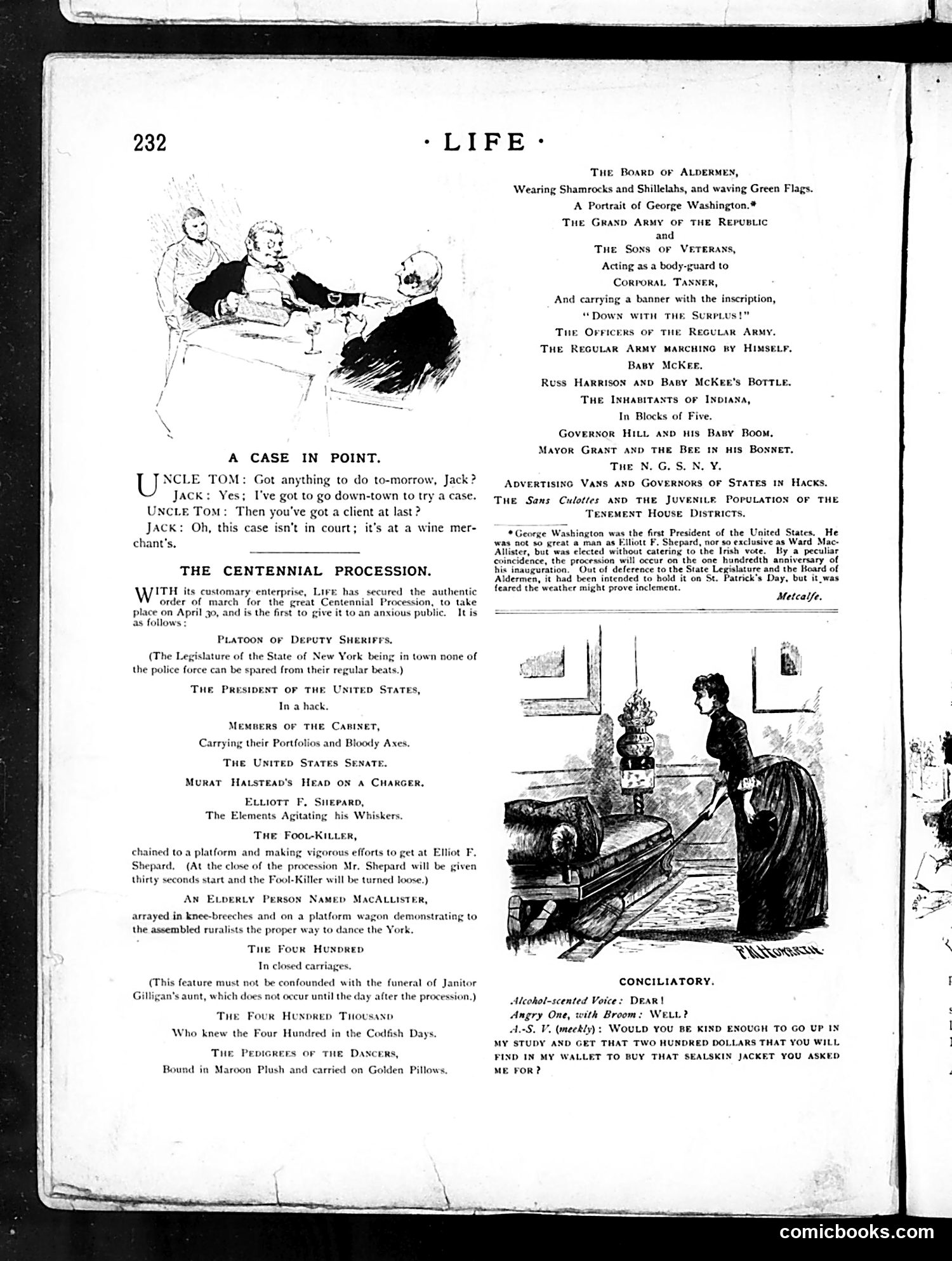
This page contains two satirical pieces mocking 1880s American politics and society: **"A Case in Point"** jokes that a lawyer's "case" at a wine merchant's (a bar) is his only client—mocking struggling lawyers. **"The Centennial Procession"** is a mock-serious list satirizing the April 30, 1889 centennial celebration of George Washington's inauguration. Life ridicules New York's political establishment by imagining a absurd parade order: incompetent sheriffs, politicians with "bloody axes," Elliott F. Shepard (a prominent reformer) chained while a "Fool-Killer" pursues him, corrupt aldermen wearing Irish stereotypes, and various minor politicians. The footnote sarcastically contrasts Washington's dignity with Ward McAllister's exclusivity and Elliott Shepard's pretension. **"Conciliatory"** shows a drunk husband meekly asking his angry wife for money from his wallet to buy her a sealskin jacket—satirizing both male weakness and female materialism. The overall tone: biting criticism of Gilded Age corruption, incompetence, and hypocrisy.
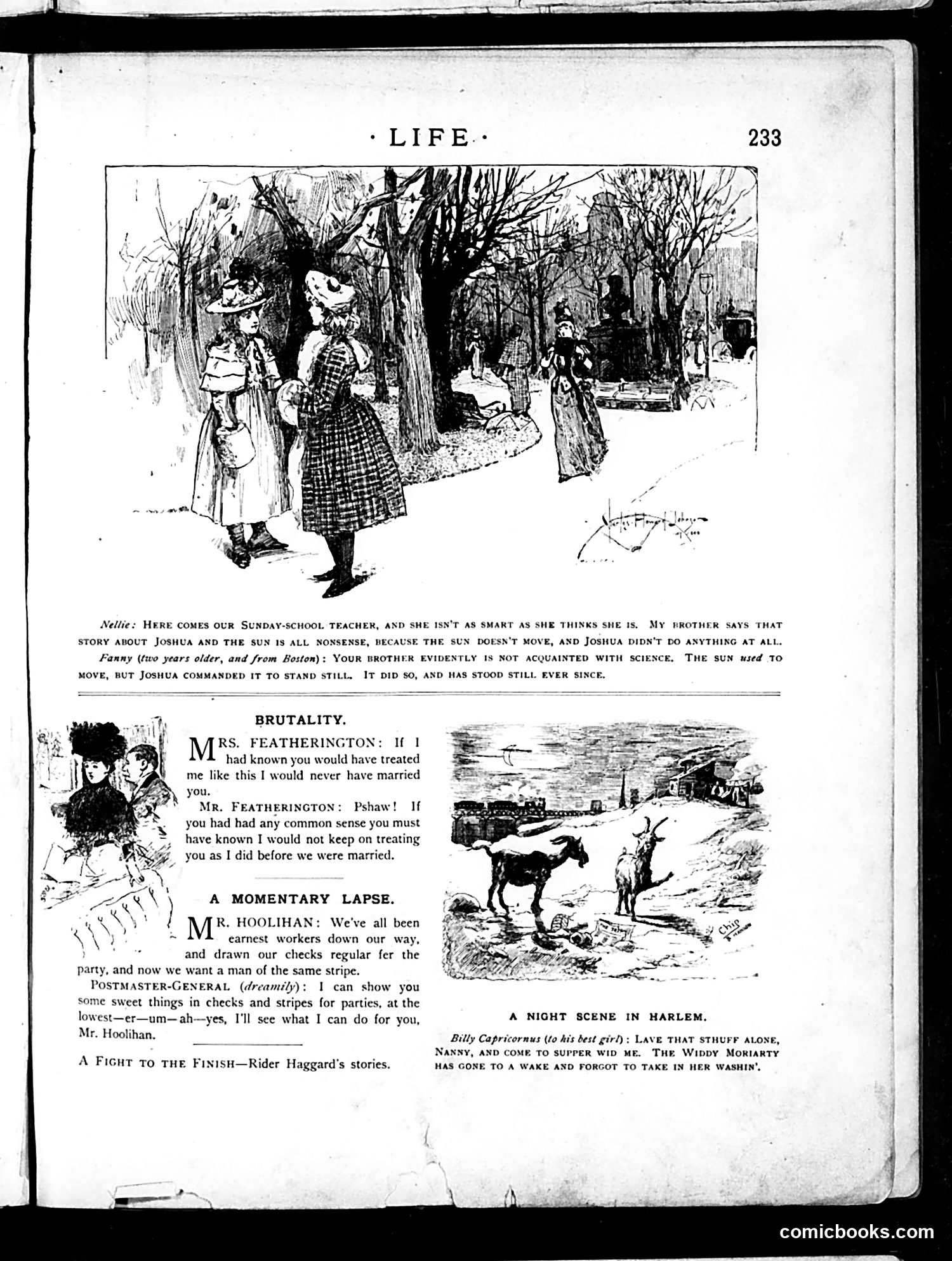
This page contains four separate satirical pieces mocking different social groups: **"Nellie"** ridicules a Boston girl's pedantic literalism—she defends the biblical Joshua story by claiming the sun literally obeyed Joshua's command and "has stood still ever since," missing obvious scientific absurdity while boasting of education. **"Brutality"** satirizes marital hypocrisy: a husband argues his wife should have known he'd treat her poorly after marriage since he behaved badly beforehand. **"A Momentary Lapse"** depicts a Postmaster-General distracted into offering decorative "checks and stripes for parties" when a political operative requests patronage positions—mocking government corruption and confused priorities. **"A Night Scene in Harlem"** uses ethnic dialect humor (Irish and implied Black characters) in a domestic scene, typical of turn-of-century comedy that relied on stereotyped speech patterns. The page's humor targets pretension, hypocrisy, political graft, and relies heavily on period stereotyping now considered offensive.
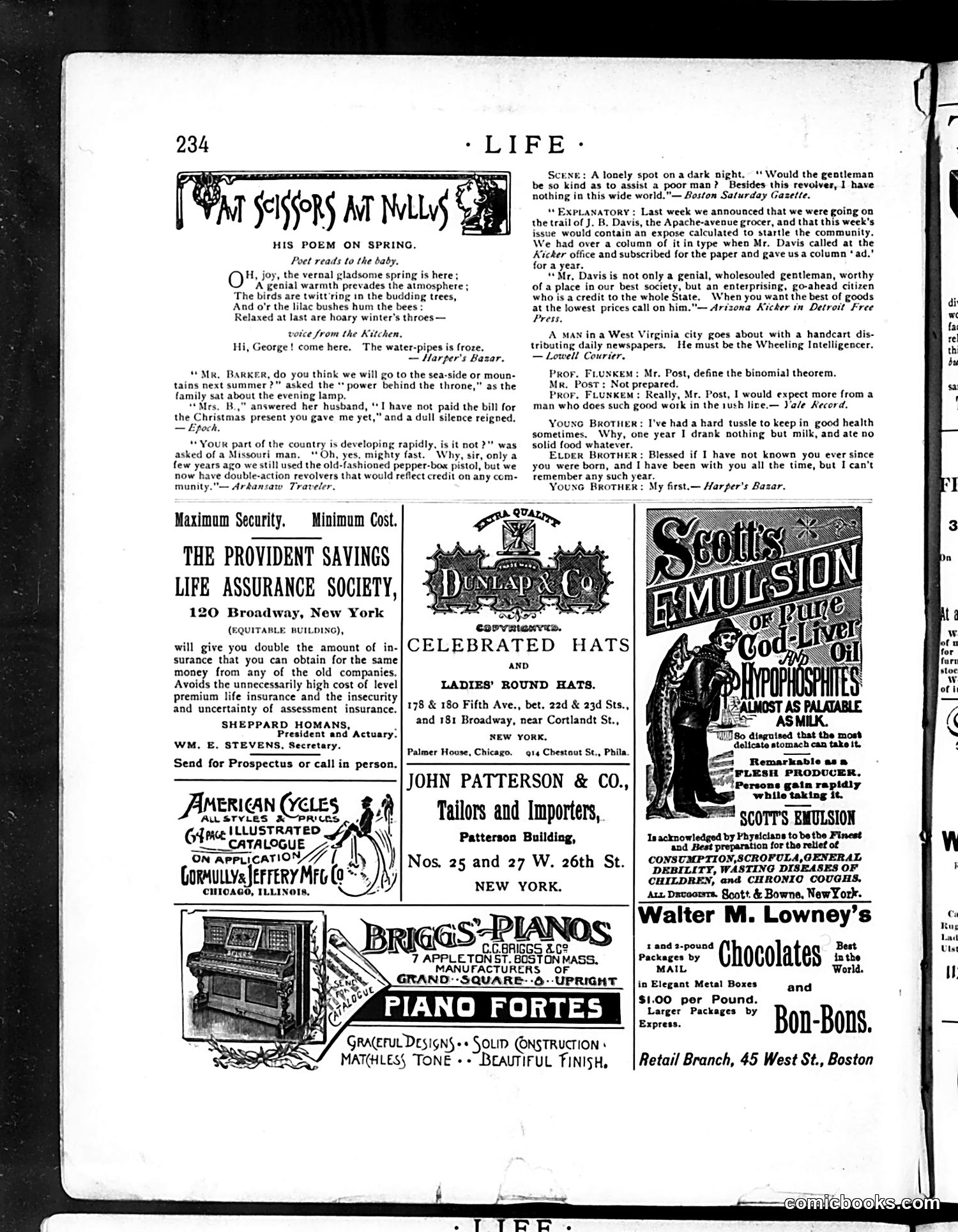
This page is primarily **advertising with brief humor pieces**, typical of Life magazine's format. The main content includes: **Humor Pieces:** - "His Poem on Spring": A poet romantically recites spring verses while his wife interrupts from the kitchen about frozen water pipes—satirizing the gap between romantic idealism and domestic reality. - "Apache-avenue grocer" joke: Satirizes small-town newspaper corruption. A grocer threatened with negative exposure quickly advertises in the paper, after which the same publication praises him effusively. This mocks how local papers could be bought off. - Other brief jokes about Missouri's rapid development (weapons technology), financial avoidance, and a young man's dubious health claims. **Advertisements:** The page features typical late-19th-century ads for life insurance, pianos, tailors, hats, bicycles, chocolates, and patent medicines—Scott's Emulsion (cod liver oil for various ailments). The satire targets **hypocrisy, journalistic corruption, and patent medicine claims**, reflecting Progressive Era skepticism about business and media ethics.
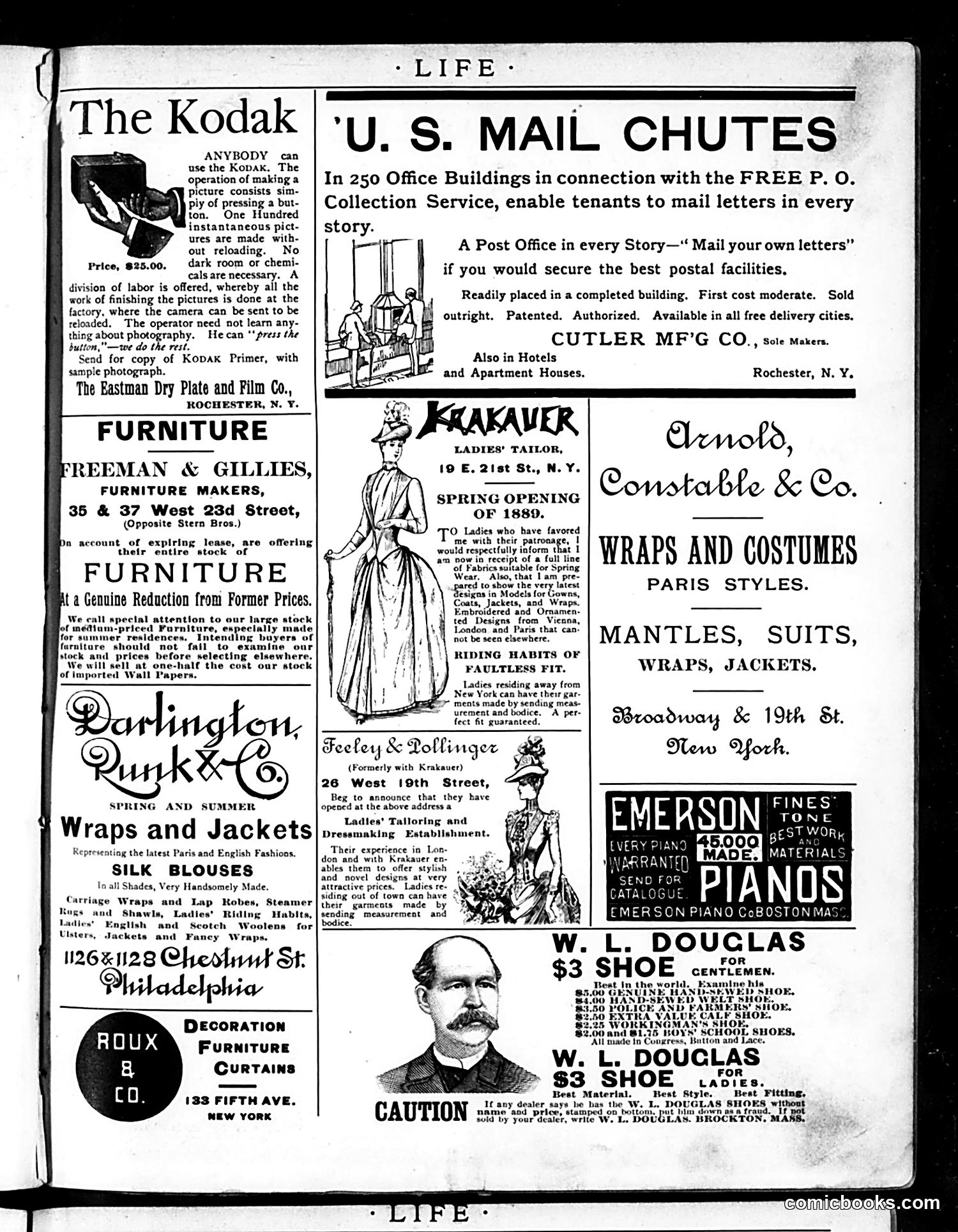
This is primarily an **advertisement page** from Life magazine. It contains no political cartoons or satirical content to analyze. The page showcases consumer goods from the late 1880s: the Kodak camera (emphasizing ease-of-use for ordinary people), furniture, women's clothing and tailoring services, pianos, and shoes. Most notable is the mail chute advertisement—a then-novel innovation for urban office buildings, allowing tenants to post letters within their buildings rather than visiting post offices. The fashion advertisements featuring Krakauer, Feeley & Vollinger, and Arnold Constable & Co. promote Paris-style clothing, reflecting the era's cultural deference to French fashion. W.L. Douglas shoe advertisements tout affordability and American manufacturing ("Made in Congress, Button and Lace"). This represents typical Life magazine advertising—commercial, not satirical—targeting middle and upper-class urban readers in a growing consumer economy.
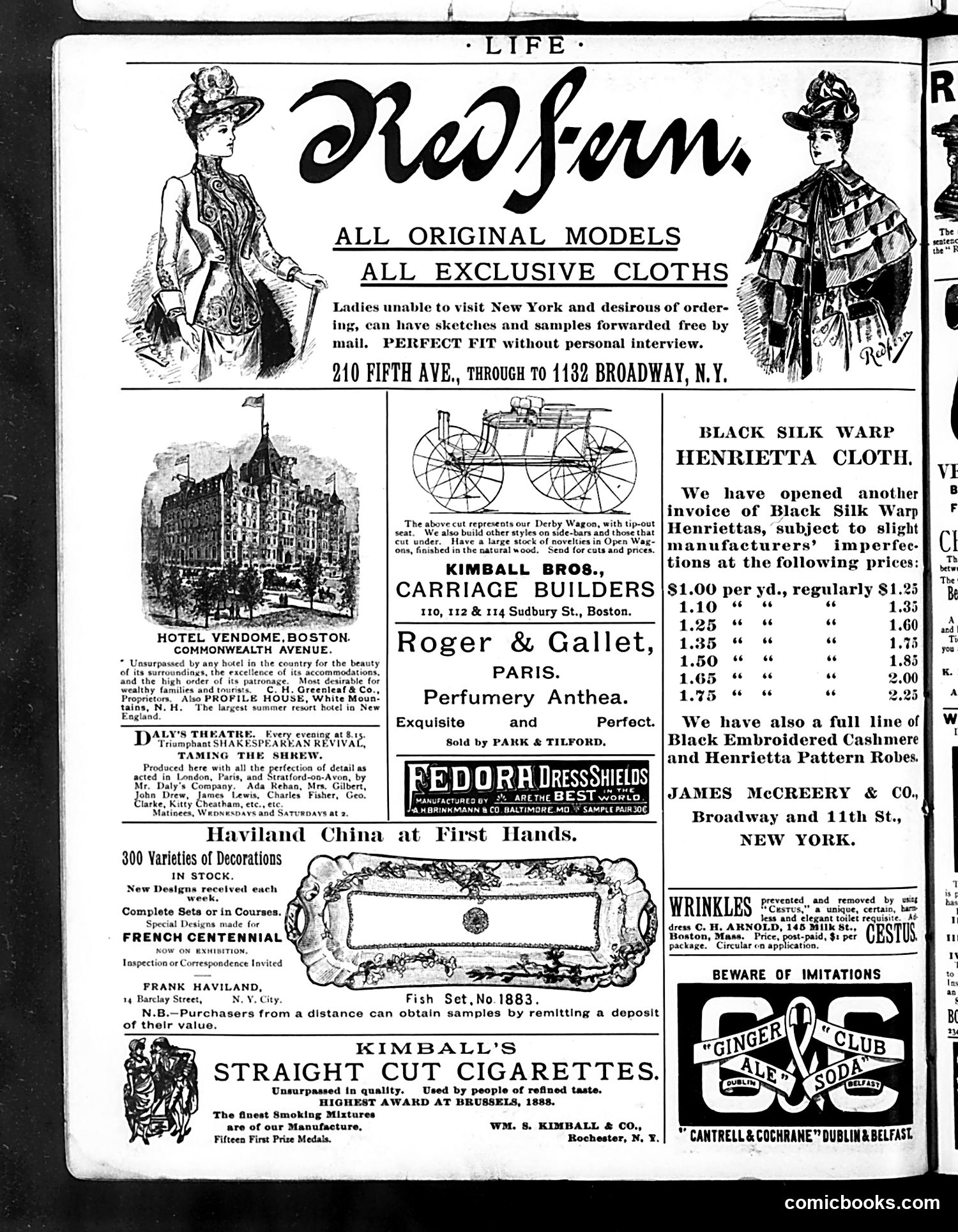
This is not a political cartoon page but rather a **advertisements section** from Life magazine (likely 1880s-1890s based on styling and references). The page features commercial ads for: - **Red Fern** clothing (ladies' fashion with mail-order service) - Hotels (Boston's Hotel Vendome) - **Daly's Theatre** (Shakespeare production) - Haviland china and tableware - Kimball Bros. carriages and cigarettes - French perfumery and clothing - Patent remedies (wrinkle cream called "Cestus") The only illustration with potential satirical content is the small **"Ginger Ale" soda advertisement** in the lower right, but it appears to be a straightforward product logo rather than political commentary. **No identifiable cartoon figures, caricatures, or satire are present on this page.** It demonstrates how Life magazine—while known for satire—also carried substantial advertising revenue.
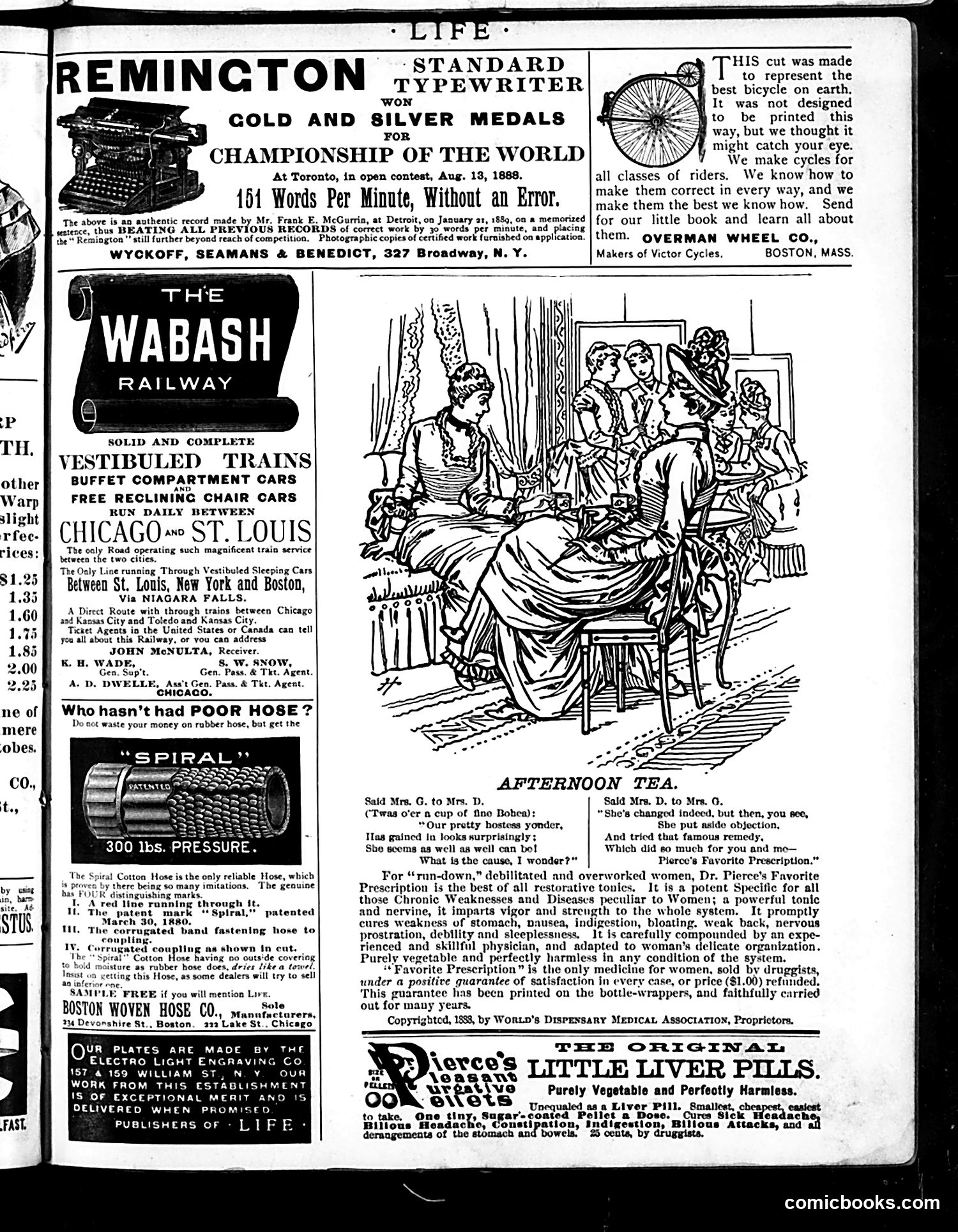
This page is primarily **advertising** from circa 1888-1889, with one illustrated narrative cartoon. The main cartoon, "Afternoon Tea," depicts Victorian women discussing a female acquaintance's improved appearance. The dialogue reveals the "cause"—Dr. Pierce's Favorite Prescription, a patent medicine advertised below. This reflects the period's marketing of dubious tonics to women, often for vague ailments like "nervousness" or being "run-down." The advertisements showcase late 1880s technology and consumer goods: Remington typewriters (promoting a speed-typing record), the Wabash Railway's luxury trains, Victor bicycles, and various patent remedies including the Spiral Cotton Hose and Pierce's Little Liver Pills. The cartoon gently satirizes how women attributed personal improvements to commercial products rather than actual causes—a common theme in advertising-heavy magazines of the era. The "satire" is subtle; the page primarily exists to showcase profitable advertisements to Life's readers.
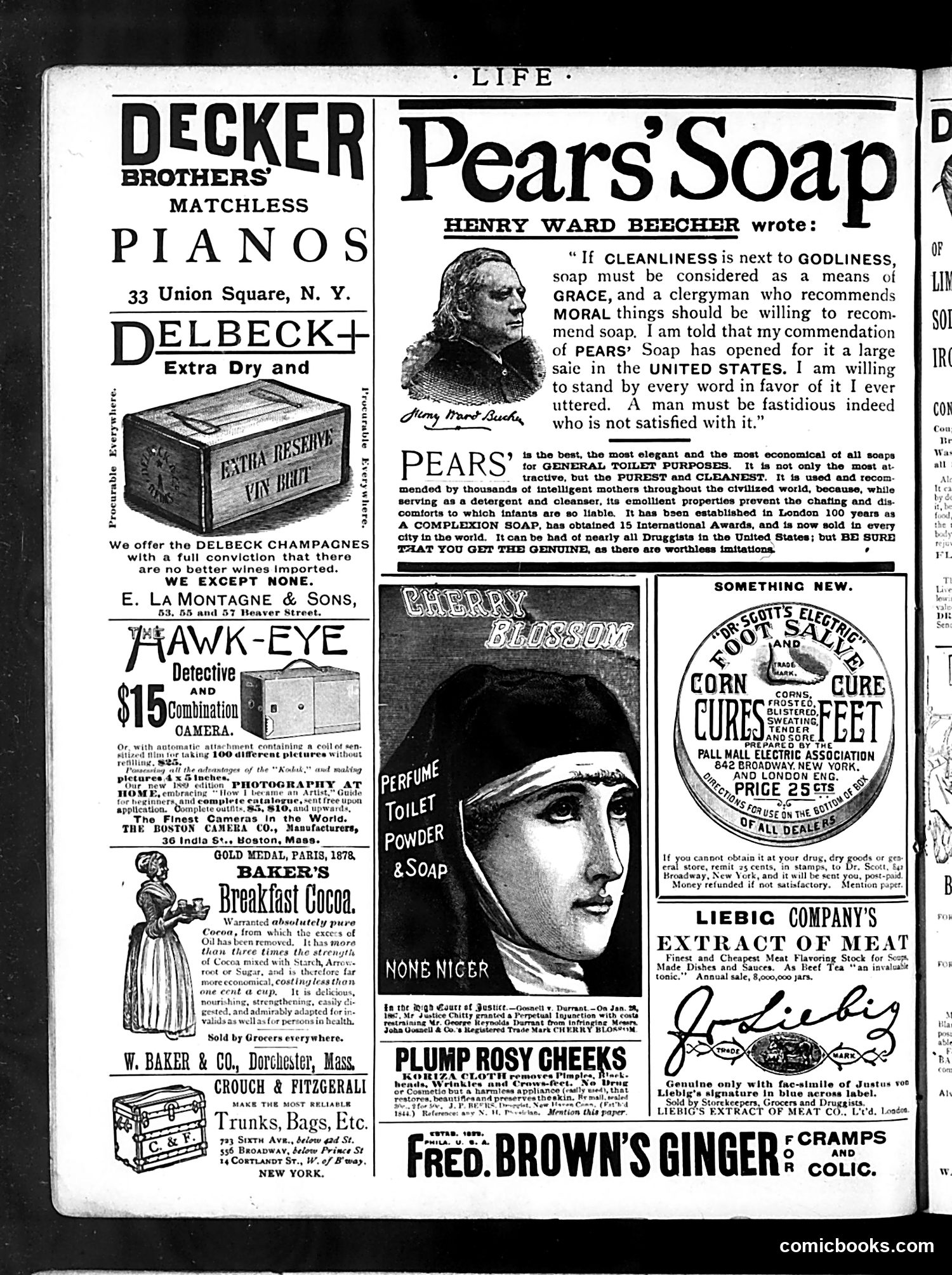
This page is primarily **advertisements** with one significant endorsement piece. The major content is a Pears' Soap advertisement featuring a quote attributed to **Henry Ward Beecher**, a prominent 19th-century American clergyman and abolitionist. The satirical appeal lies in Beecher's endorsement linking cleanliness to godliness and morality—a common Victorian trope. By having a respected religious figure publicly recommend commercial soap, the ad conflates spiritual virtue with consumer hygiene products, a form of satirical commentary on American commercialism and the commercialization of morality. The remaining page contains typical period advertisements for pianos, champagne, cameras, cocoa, trunks, and patent medicines—products marketed to middle and upper-class readers. The "Cherry Blossom" perfume advertisement and "Plump Rosy Cheeks" beauty product reflect period beauty standards. Overall, this represents Life magazine's model of mixing satirical content with profitable advertising to affluent readers.
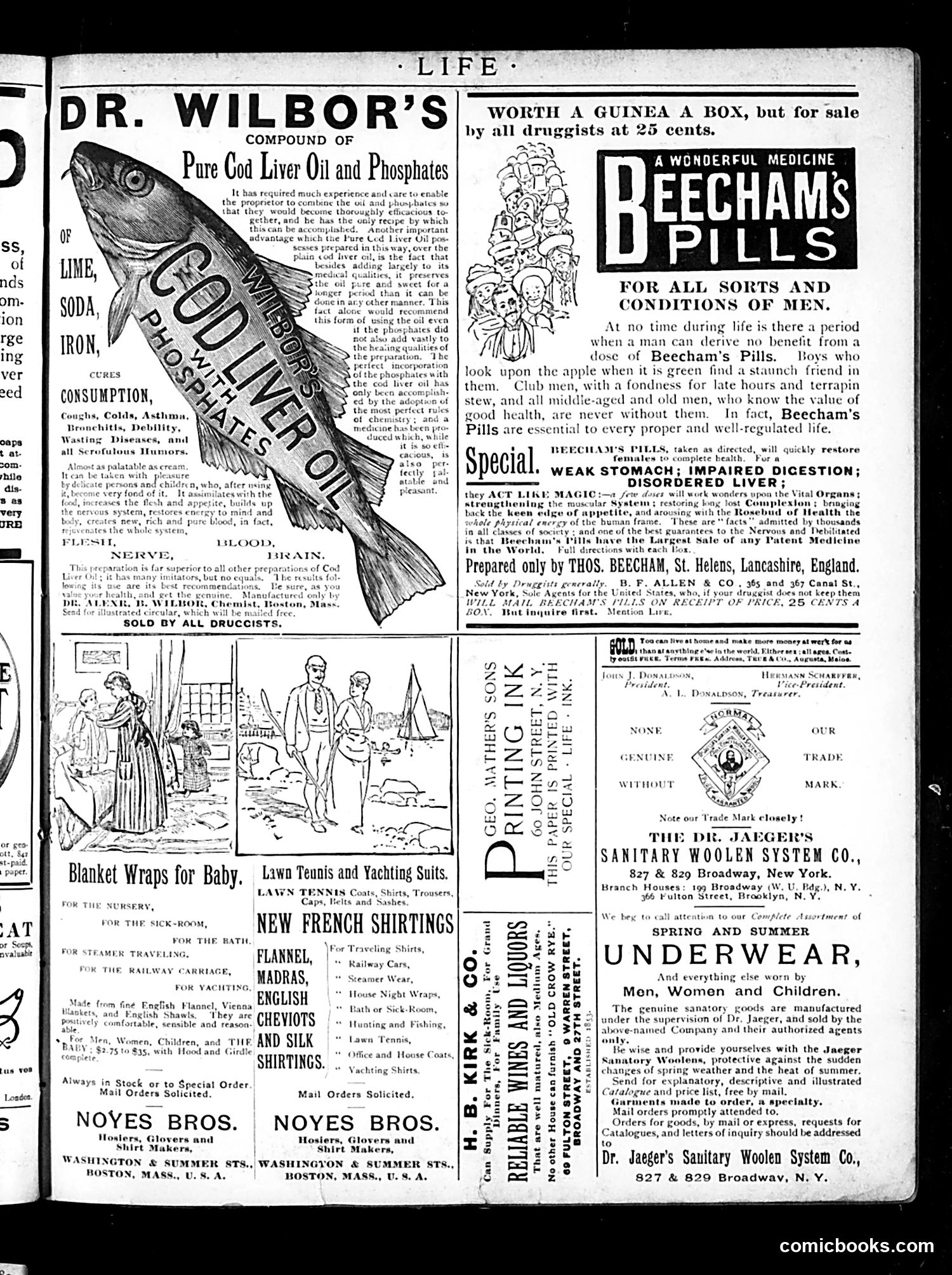
This is primarily an **advertising page** from a 19th-century American magazine, not a political cartoon. The page contains multiple patent medicine and clothing advertisements typical of the era. The main ads feature: 1. **Dr. Wilbor's Cod Liver Oil** and **Beecham's Pills**—patent medicines making expansive health claims ("for all sorts and conditions of men"), promising to cure consumption, asthma, weak digestion, and other ailments. These were common in the period before FDA regulation. 2. **Clothing advertisements** (Noyes Bros., French shirtings, Dr. Jaeger's Sanitary Woolen System)—offering blankets, yachting suits, and undergarments. 3. **Alcohol advertisement** (H.B. Kirk & Co.)—promoting wines and liquors, notably "Old Crow Rye." The satirical element is implicit rather than explicit: Life magazine was critiquing American consumer culture and the proliferation of dubious medical claims through exaggerated advertising. No specific political figures or events are referenced—the satire targets the commercialization of health itself.
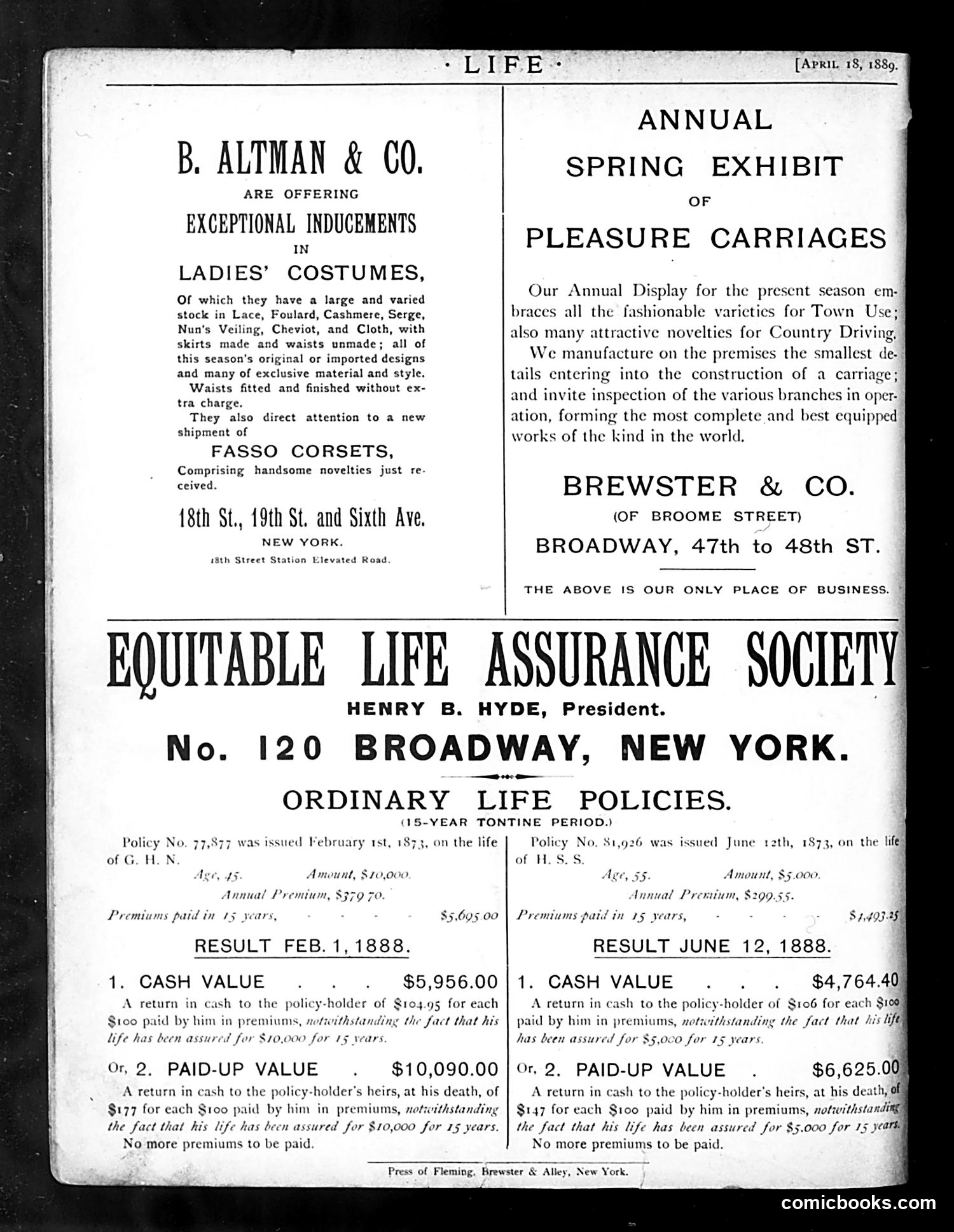
This is a **advertisements page** from *Life* magazine (April 18, 1889), not a satirical cartoon. It features four commercial ads: 1. **B. Altman & Co.** — a department store advertising ladies' clothing and corsets 2. **Brewster & Co.** — a luxury carriage manufacturer 3. **Equitable Life Assurance Society** — the dominant advertisement, showcasing life insurance policy examples with detailed financial results The Equitable ad occupies the largest space and presents two actual policy cases from 1873-1888, demonstrating returns on 15-year tontine policies. These figures were meant to convince readers of the policy's financial value. There is **no satire or political commentary** here—just period commercial advertising typical of this publication's revenue model.
I can see this is a page from Life magazine, but the image is almost entirely black/illegible, making it impossible to read the actual cartoon content or identify the figures, captions, or satirical references. The only clearly visible text is "comicbooks.com" at the bottom right corner and some partial text fragments along the left margin that are too fragmented to provide meaningful context. To accurately explain the cartoon's meaning, political references, and satirical point to a modern reader, I would need a clearer, more legible version of this page where the actual artwork and text are visible.