
Life, 1889-04-18 · page 9 of 21
Life — April 18, 1889 — page 9: what you’re looking at
What you’re looking at
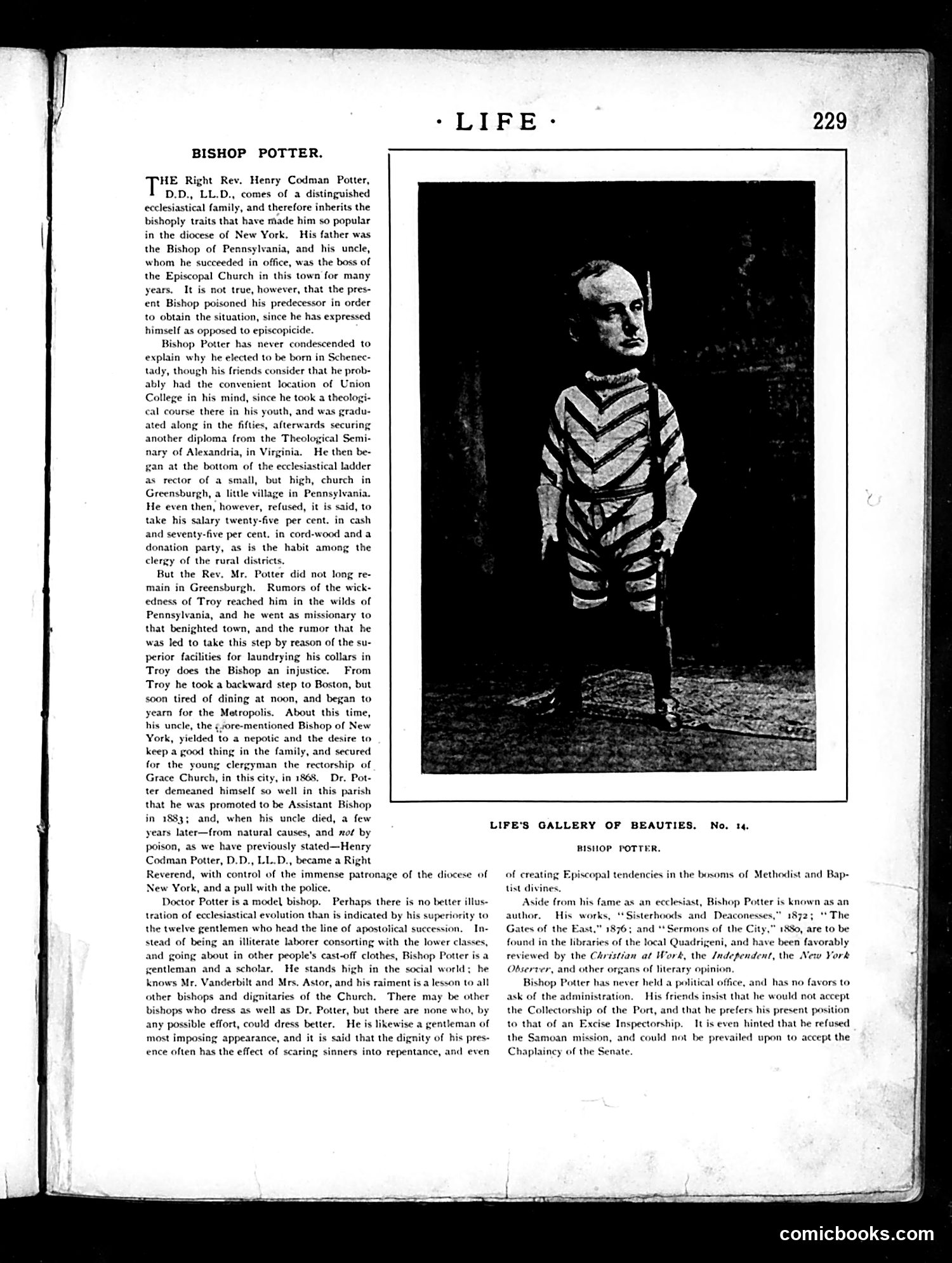
This page features a biographical article and portrait photograph of **Bishop Henry Codman Potter**, a prominent Episcopal Church leader in late 19th-century New York. The text traces his ecclesiastical career from Pennsylvania to his current position. The article emphasizes Potter's gentlemanly bearing and moral authority, noting he's known for refusing political positions and maintaining independence from secular influence. It describes him as a model bishop whose dignified presence commands respect—even "scaring sinners into repentance." The piece also mentions his published works on religious and social topics. Rather than satire, this appears to be a respectful profile celebrating Potter as an exemplar of ecclesiastical integrity and leadership during the Gilded Age, presented in *Life*'s "Gallery of Beauties" feature.
📄 Transcribed text from this page (OCR, searchable)
Machine-transcribed from the original scan — historical spelling and the odd misread are preserved.
BISHOP POTTER. HE Right Rev. Henry Codman Potter, D.D., LL.D., comes of a distinguished ecclesiastical family, and therefore inherits the bishoply traits that have made him so popular in the diocese of New York. His father was the Bishop of Pennsylvania, and his uncle, whom he succeeded in office, was the boss of the Episcopal Church in this town for many years, It is not true, however, that the pres- ent Bishop poisoned his predecessor in order to obtain the situation, since he has expressed himself as opposed to episcopicide. Bishop Potter has never condescended to explain why he elected to be born in Schenee- tady, though his friends consider that he prob- ably had the convenient location of Union College in his mind, since he took a theolog’ cal course there in his youth, and was gradu- ated along in the fifties, afterwards securing another diploma from the Theological Semi- nary of Alexandria, in Virginia. He then be- gan at the bottom of the ecclesiastical ladder as rector of a small, but high, church in Greensburgh, a little village in Pennsylvania. He even then, however, refused, it is said, to take his salary twenty-five per cent. in cash and seventy-five per cent, in cord-wood and a donation party, as is the habit among the clergy of the rural districts. But the Rev. Mr. Potter did not long re- main in Greensburgh, Rumors of the wick- edness of Troy reached him in the wilds of Pennsylvania, and he went as missionary to that benighted town, and the rumor that he was led to take this step by reason of the su- perior facilities for laundrying his collars in Troy does the Bishop an injustice. From Troy he took a backward step to Boston, but soon tired of dining at noon, and began to yearn for the Metropolis. About this time, his uncle, the ¢,/ore-mentioned Bishop of New York, yielded to a nepotic and the desire to keep a good thing in the family, and secured for the young clergyman the rectorship of Grace Church, in this city, in 1868, Dr. Pot- ter demeaned himself so well in this parish that he was promoted to be Assistant Bishop in 1883; and, when his uncle died, a few years later—from natural causes, and nof by poison, as we have previously stated—Henry Codman Potter, D.D., LL.D., became a Right Reverend, with control of the immense patronage of the diocese New York, and a pull with the police. Doctor Potter is a model bishop. Perhaps there is no better illus- tration of ecclesiastical evolution than is indicated by his superiority to the twelve gentlemen who head the line of apostolical succession, In- stead of being an illiterate laborer consorting with the lower classes, and going about in other people's cast-off clothes, Bishop Potter is a gentleman and a scholar, He stands high in the social world; he knows Mr, Vanderbilt and Mrs, Astor, and his raiment is a lesson to all other bish and dignitaries of the Church. There may be other bishops who dress as well as Dr, Potter, but there are none who, any possible effort, could dress better. He is likewise a gentleman of most imposing appearance, and it is said that the dignity of his pres- ence often has the effect of scaring sinners into repentance, and even LIFE‘'S GALLERY OF BEAUTIES. No. 14. BISHOP POTTER, of creating Episcopal tendencies in the bosoms of Methodist and Bap- List divines. ter is known as an author. His works, 1872; “The Gates of the East," 1876 ys" 1880, are to be found io the libraries of the local Quadrigeni, and have been favorably reviewed by the Christian at Work, the Independent, the New York Observer, and other organs of literary opinion. Bishop Potter has never held a political office, and has no favors t ask of the administration. His friends insist that he would not accept the Collectorship of the Port, and that he prefers his present position to that of an Excise Inspectorship. the Samoan mission, and could not be prevailed upon to accept the Chaplaincy of the Senate. Aside from his fame as an ecclesiast, Bishop P “Sisterhoods and Deaconesses,” It is even hinted that he refused comicbooks.com