
Life, 1889-04-18 · page 8 of 21
Life — April 18, 1889 — page 8: what you’re looking at
What you’re looking at
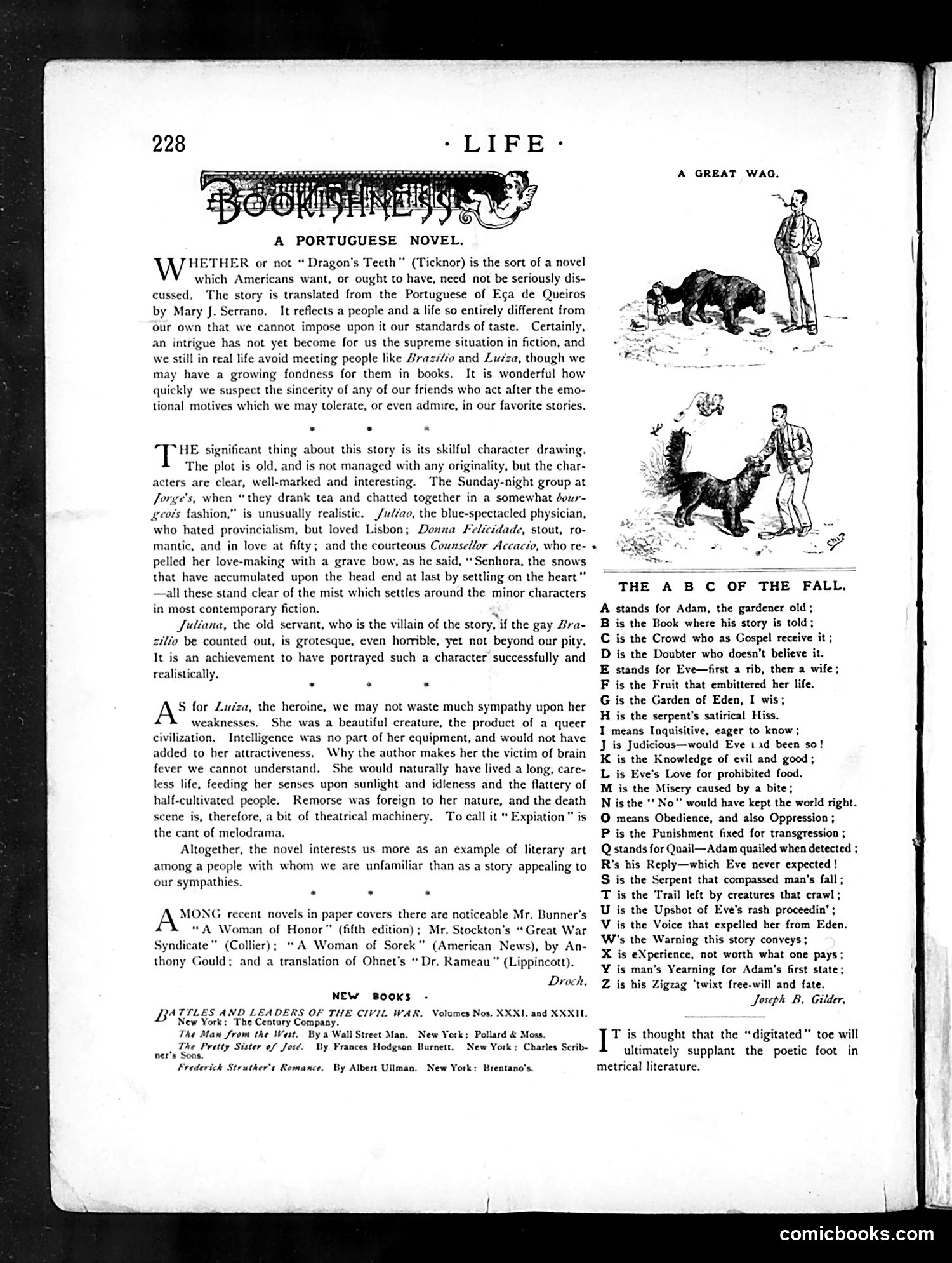
This is a Victorian-era moral alphabet, illustrating the Christian story of Adam and Eve's expulsion from Eden. Each letter represents a concept from Genesis: A is Adam (the gardener), B is the Book of Scripture, K is Knowledge of evil, S is the Serpent, and so on through Z (free will and fate). The accompanying sketches show figures acting out these biblical concepts—a man with dogs, another conversing with a woman. This was a common 19th-century educational device: teaching religious and moral lessons through alphabetical mnemonics paired with illustrations. The cartoons aren't political satire but rather a pious, allegorical meditation on sin and human nature—typical of Life magazine's occasional serious, moralistic content alongside its satirical pieces.
📄 Transcribed text from this page (OCR, searchable)
Machine-transcribed from the original scan — historical spelling and the odd misread are preserved.
A PORTUGUESE NOVEL. HETHER or not “ Dragon's Teeth” (Ticknor) is the sort of a novel which Americans want, or ought to have, need not be seriously dis- cussed. The story is translated from the Portuguese of Ega de Queiros by Mary J. Serrano, It reflects a people and a life so entirely different from our own that we cannot impose upon it our standards of taste. Certainly, an intrigue has not yet become for us the supreme situation in fiction, and we still in real life avoid meeting people like Brazz/o and Luzza, though we may have a growing fondness for them in books. It is wonderful how quickly we suspect the sincerity of any of our friends who act after the emo- tional motives which we may tolerate, or even admure, in our favorite stories. ~HE significant thing about this story is its skilful character drawing. The plot is old, and is not managed with any originality, but the char- acters are clear, well-marked and interesting. The Sunday-night group at Jorge's, when “they drank tea and chatted together in a somewhat dour geots fashion,” is unusually realistic, /w/rao, the blue-spectacled physician, who hated provincialism, but loved Lisbon; Donna Felicidade, stout, ro- mantic, and in love at fifty; and the courteous Counsellor Accacto, who re- pelled her love-making with a grave bow, as he said, ‘Senhora, the snows that have accumulated upon the head end at last by settling on the heart" —all these stand clear of the mist which settles around the minor characters in most contemporary fiction. “ Juliana, the old servant, who is the villain of the story, if the gay Bra- silfo be counted out, is grotesque, even horrible, yet not beyond our pity. It is an achievement to have portrayed such a character successfully and realistically, . . . S for Luza, the heroine, we may not waste much sympathy upon her weaknesses. She was a beautiful creature, the product of a queer civilization, Intelligence was no part of her equipment, and would not have added to her attractiveness. Why the author makes her the victim of brain fever we cannot understand. She would naturally have lived a long, care- less life, feeding her senses upon sunlight and idleness and the flattery of f-cultivated people. Remorse was foreign to her nature, and the death scene is, therefore, a bit of theatrical machinery. To call it piation " is the cant of melodrama. Altogether, the novel interests us more as an example of literary art among a people with whom we are unfamiliar than as a story appealing to our sympathies. . * . MONG recent novels in paper covers there are noticeable Mr. Bunner’s *“A Woman of Honor” (fifth edition); Mr. Stockton's Great War Syndicate" (Collier); A Woman of Sorek" (American News), by An- thony Gould; and a translation of Ohnet's “ Dr. Rameau” (Lippincott). Droch. NEW BOOKS - BATILES AND LEADERS OF THE CIVIL WARK. Volumes Nos. XXXI. and XXXII. New York: The Century Company. The Mam from the West. By a Wall Street Man, New York: Pollard & Moss, ., The Pretty Sister of José. By Frances Hodgson Burnett. New York: Charles Scrib- ner's Sons. Frederick Struthers Romance. By Albert Ullman, New York: Breatani A GREAT WAG, THE A B C OF THE FALL. A stands for Adam, the gardener old; B is the Book where his story is told; C is the Crowd who as Gospel receive it ; D is the Doubter who doesn't believe it. E stands for Eve—first a rib, then a wife; F is the Fruit that embittered her life. G is the Garden of Eden, I wis; H is the serpent's satirical Hiss. I means Inquisitive, eager to know; J is Judicious—would Eve 1 ad been so! K is the Knowledge of evil and good ; L is Eve's Love for prohibited food. M is the Misery caused by a bite; N is the ‘‘ No” would have kept the world right. O means Obedience, and also Oppression ; P is the Punishment fixed for transgression ; Q stands for Quail—Adam quailed when detected ; R's his Reply—which Eve never expected ! S is the Serpent that compassed man’s fall; T is the Trail left by creatures that crawl ; U is the Upshot of Eve's rash proceedin’ ; V is the Voice that expelled her from Eden. W's the Warning this story conveys; X is eXperience, not worth what one pays; Y is man’s Yearning for Adam's first stat Z is his Zigzag ‘twixt free-will and fate. Joseph B. Gilder. I"? is thought that the “digitated” toe will ultimately supplant the poetic foot in metrical literature. comicbooks.com