
A complete issue · 18 pages · 1889
Life — March 28, 1889
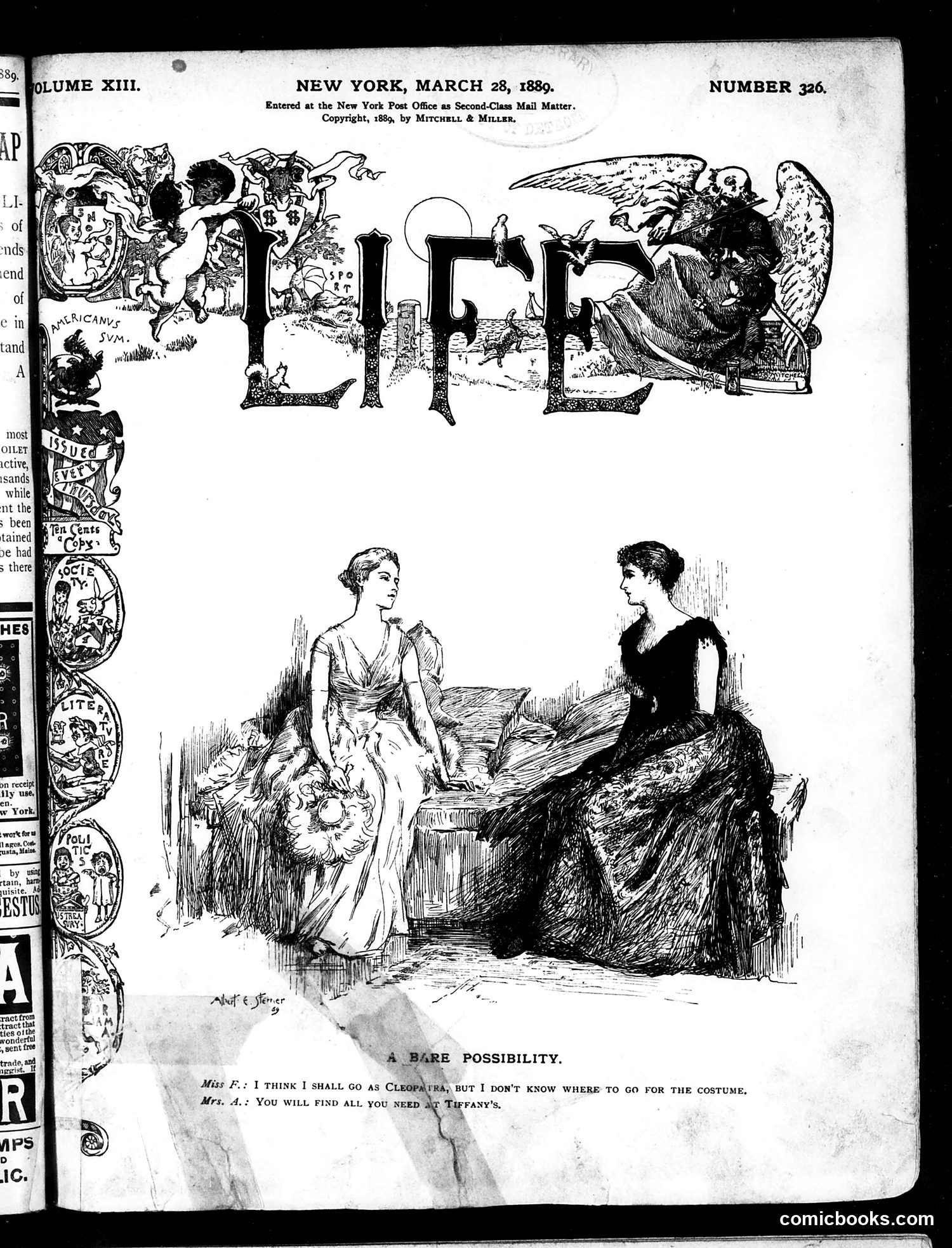
**Main Cartoon: "A Bare Possibility"** Two women discuss costume options for what appears to be a theatrical or social event. Mrs. F. proposes dressing as Cleopatra but lacks a costume source. Mrs. A. suggests shopping at Tiffany's—the luxury jewelry retailer. The satire targets wealthy women's casual extravagance: the joke is that Tiffany's, primarily a jeweler rather than costume supplier, has become so associated with luxury goods that it's presented as a solution for high-society fashion needs. The cartoon mocks the assumption that affluent women can acquire anything—even theatrical costumes—through expensive retailers, reflecting late 19th-century consumer culture and class attitudes. The elaborate decorative header contains period ornaments and classical references befitting Life's sophisticated audience.
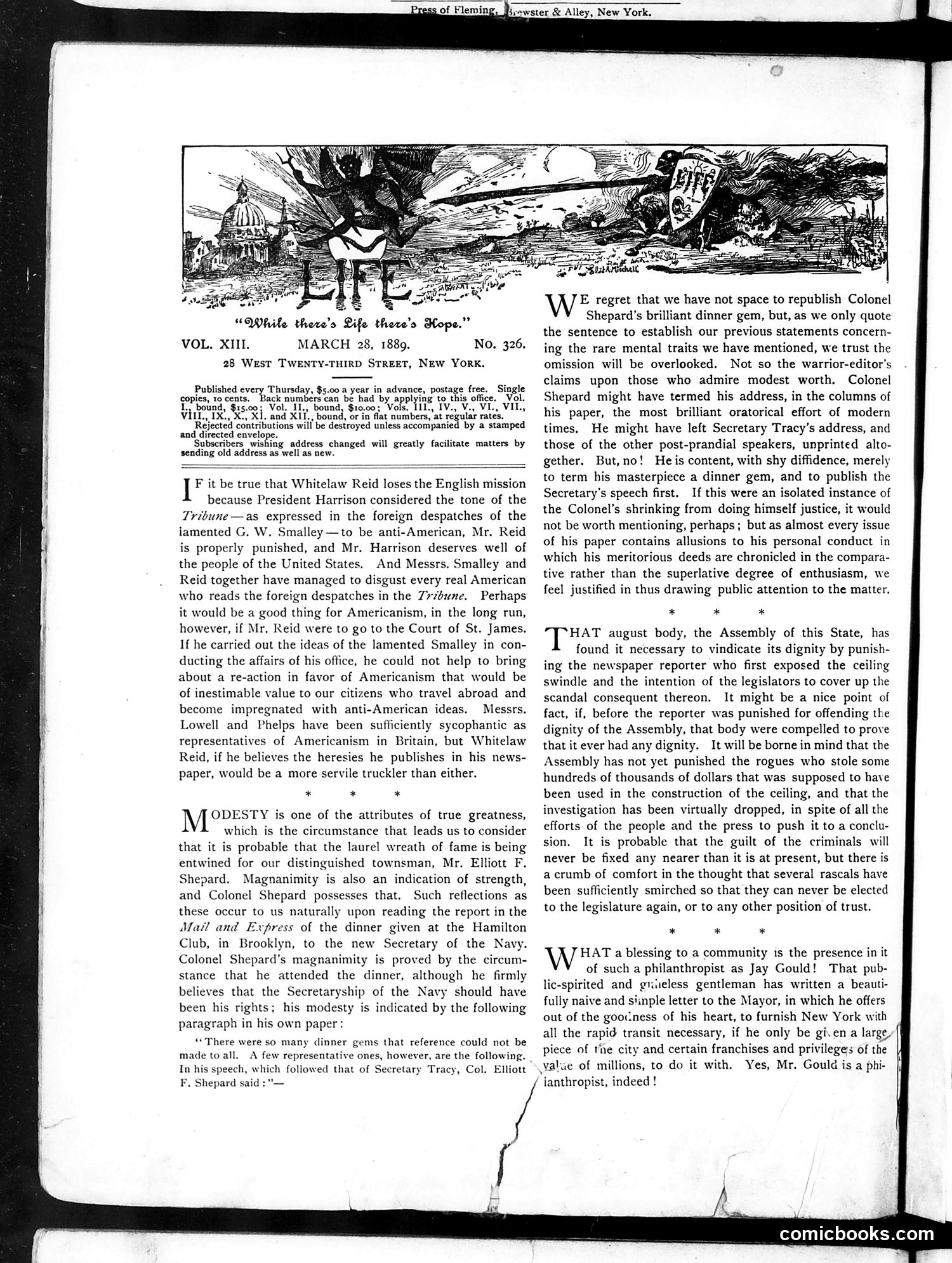
The cartoon's caption reads "White there's Life there's Hope." The imagery depicts a skeletal Death figure looming over a cityscape with a dome (likely the U.S. Capitol), suggesting American political mortality or crisis. The accompanying articles critique Colonel Shepard, apparently a newspaper editor, for his "shrinking" from publishing Secretary of the Navy's remarks in full and instead presenting his own edited version as a "dinner gem." The text accuses Shepard of cowardice—failing to champion Americanism or expose legislative scandal (involving misappropriated construction funds for a ceiling). The satire targets journalistic dishonesty and editorial self-interest over public accountability. A separate piece praises philanthropist Jay Gould for offering rapid transit infrastructure to New York.
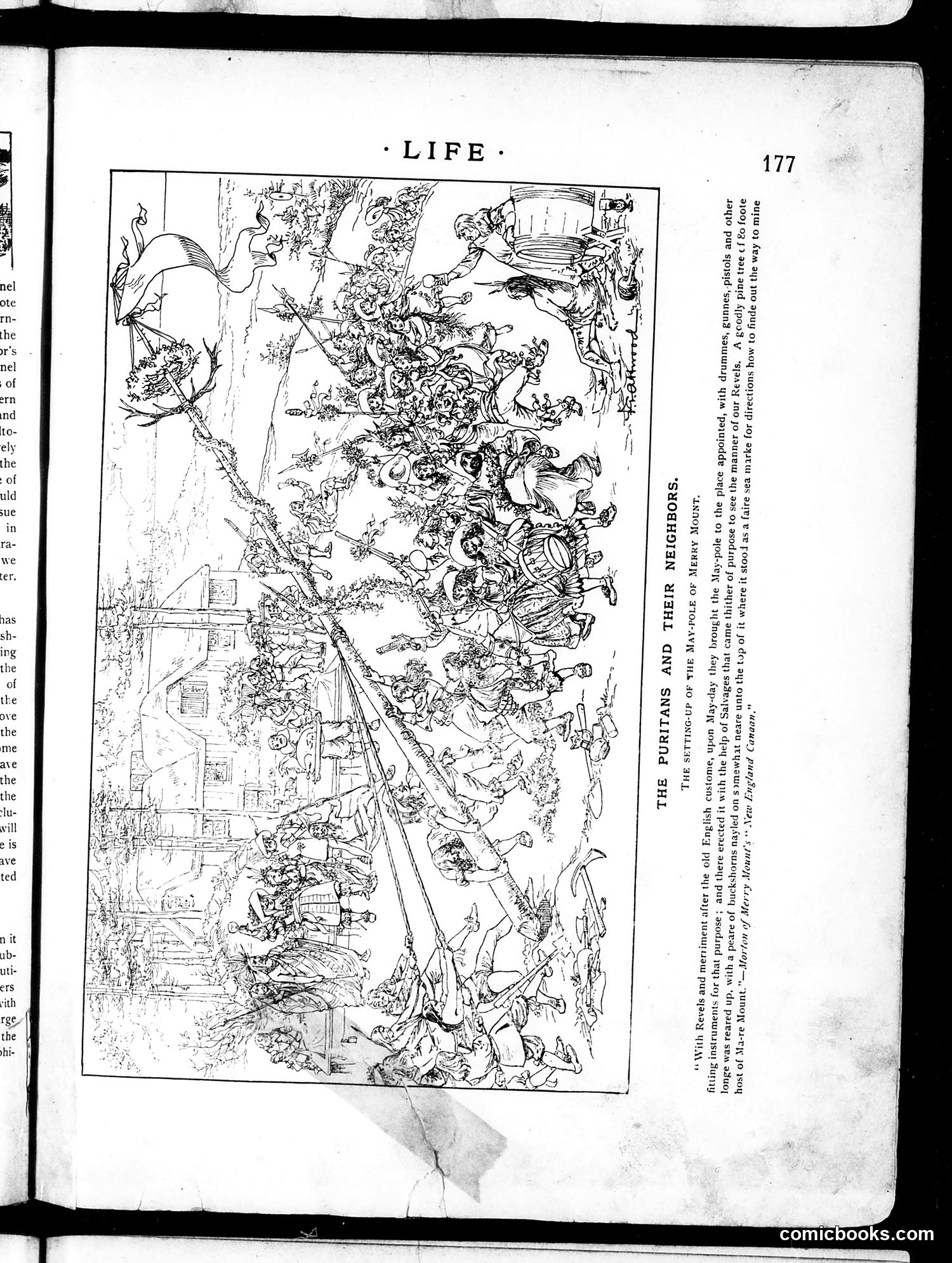
This appears to be a historical illustration rather than political satire. The image depicts an elaborate scene with multiple figures, architectural elements, and landscape features rendered in detailed line work. The caption indicates this illustrates Persians and their neighboring peoples, likely from an ancient historical context. The composition shows various figures engaged in activities around buildings and natural elements, suggesting a documentary or educational illustration of Persian civilization and its interactions with neighboring groups. Without clearer visibility of specific details or accompanying article text, the precise historical period and specific narrative being depicted remain unclear, though the style suggests this is meant to educate readers about ancient Persian history and geography.
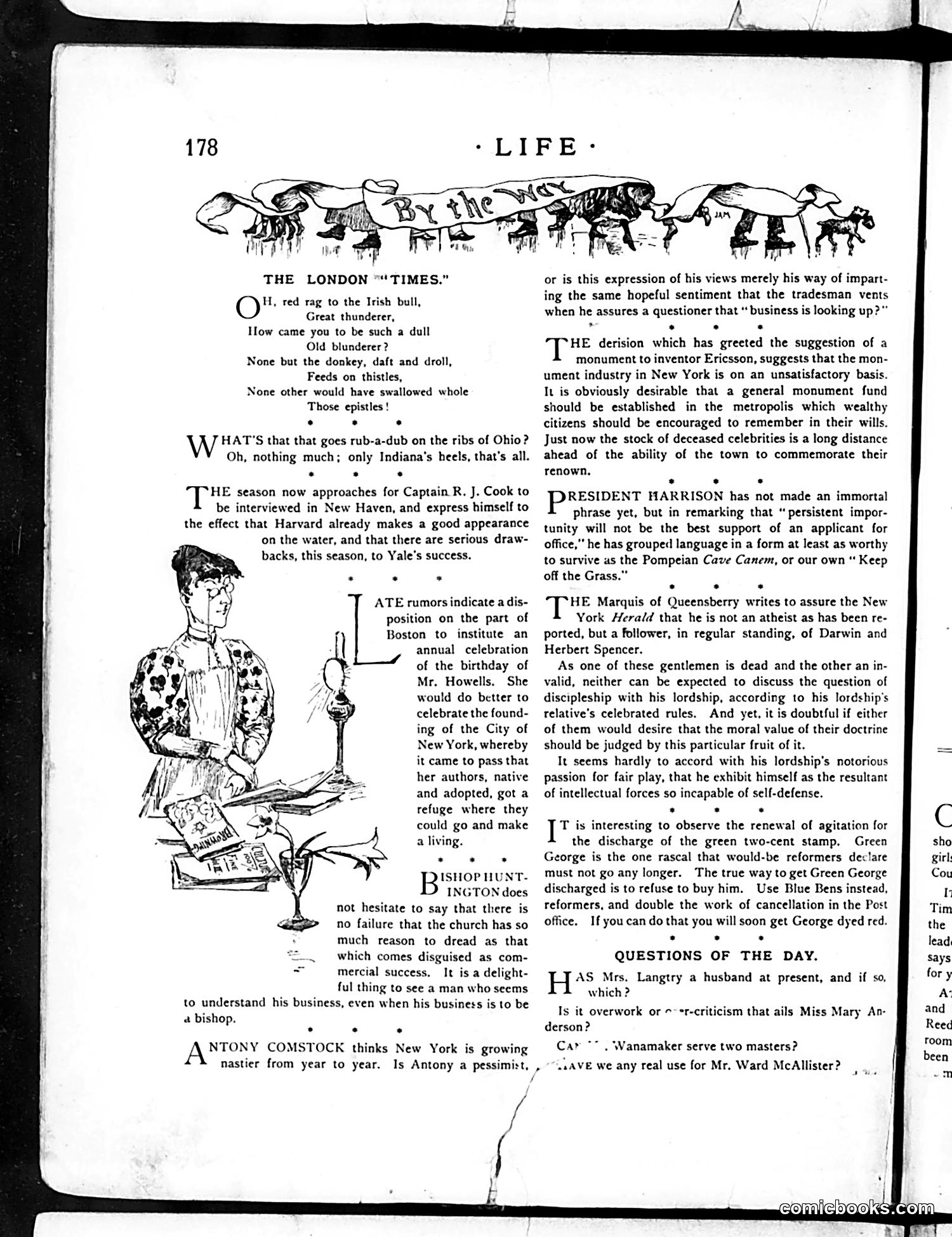
This page contains editorial commentary rather than political cartoons. The main illustration shows a fashionably-dressed woman at a desk, likely satirizing social pretension or journalism. The text discusses several contemporary topics: Captain R.J. Cook's upcoming interview about Harvard's water sports prospects; Bishop Huntington's views on church failure; and Antony Comstock's opinions on New York's growth. A "Questions of the Day" section poses rhetorical queries about whether Mrs. Langtry has a husband, whether Miss Mary Anderson faces overwork, if a character named Wanamaker serves two masters, and "Have we any real use for Mr. Ward McAllister?"—likely mocking prominent 1880s society figures and their relevance. The satire targets social gossip, institutional authority, and fashionable society's self-importance.
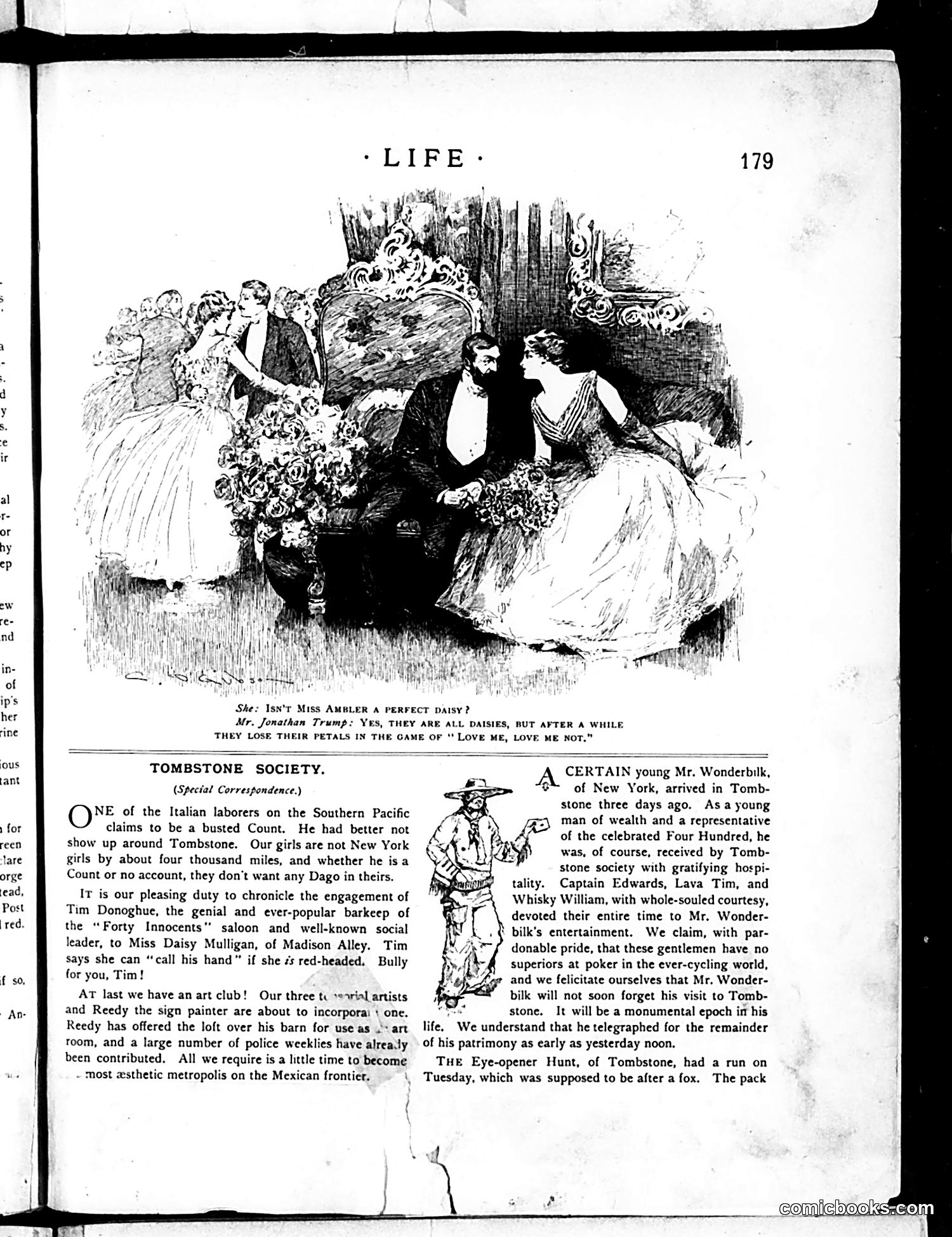
**The Top Cartoon:** A satirical dialogue between a woman asking "Isn't Miss Ambler a perfect daisy?" and a man (Jonathan Trump) responding that yes, the women are beautiful "but after a while they lose their petals in the game of 'Love me, love me not.'" This mocks the fickleness of romantic relationships and courtship rituals of the era—suggesting even the most perfect women lose their appeal through romantic games. **The "Tombstone Society" Section:** This satirizes the arrival of a wealthy New York businessman to Tombstone, Arizona. The text humorously describes how Italian laborers and locals receive him with gratifying hospitality. The piece appears to be gentle mockery of both pretentious Eastern wealth and the rustic frontier town's social dynamics—a common Life magazine theme contrasting urban sophistication with frontier culture.
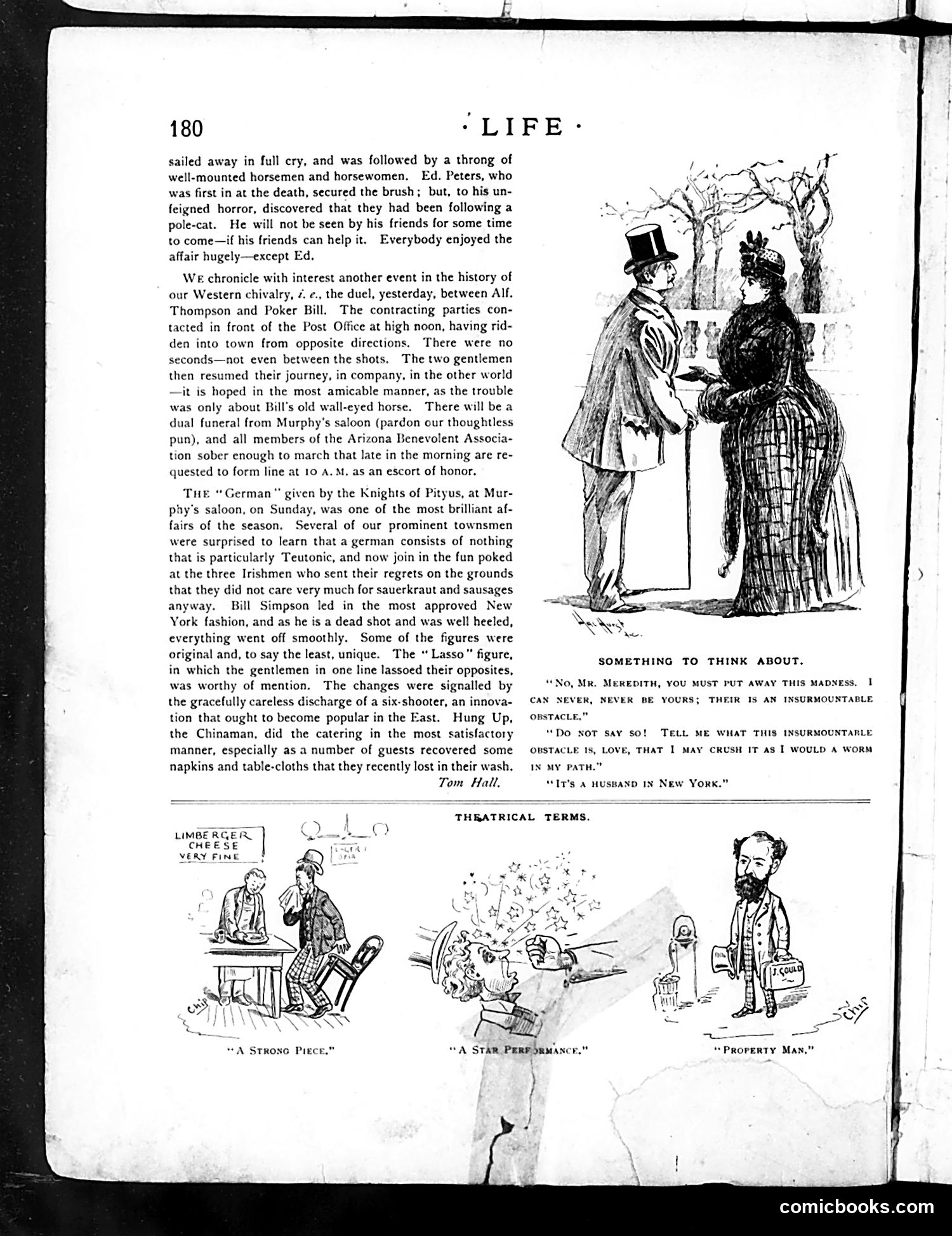
The main text describes social events in what appears to be a Western town (likely Arizona, given references). It chronicles a duel between "Alf. Thompson" and "Poker Bill" at the Post Office, and a "German" party at Murphy's saloon featuring Irish participants—satirizing how a "German" consisted merely of Teutonic-sounding games rather than authentic culture. The "Something to Think About" cartoon shows a couple discussing marriage obstacles, with the woman mentioning a husband in New York—a joke about bigamy or complicated romantic entanglements. The lower section, "Theatrical Terms," uses three small cartoons with puns: "A Strong Piece" (two men at a table), "A Star Performance" (explosive chaos), and "Property Man" (a man surrounded by luggage)—each illustrating theatrical vocabulary through visual wordplay.
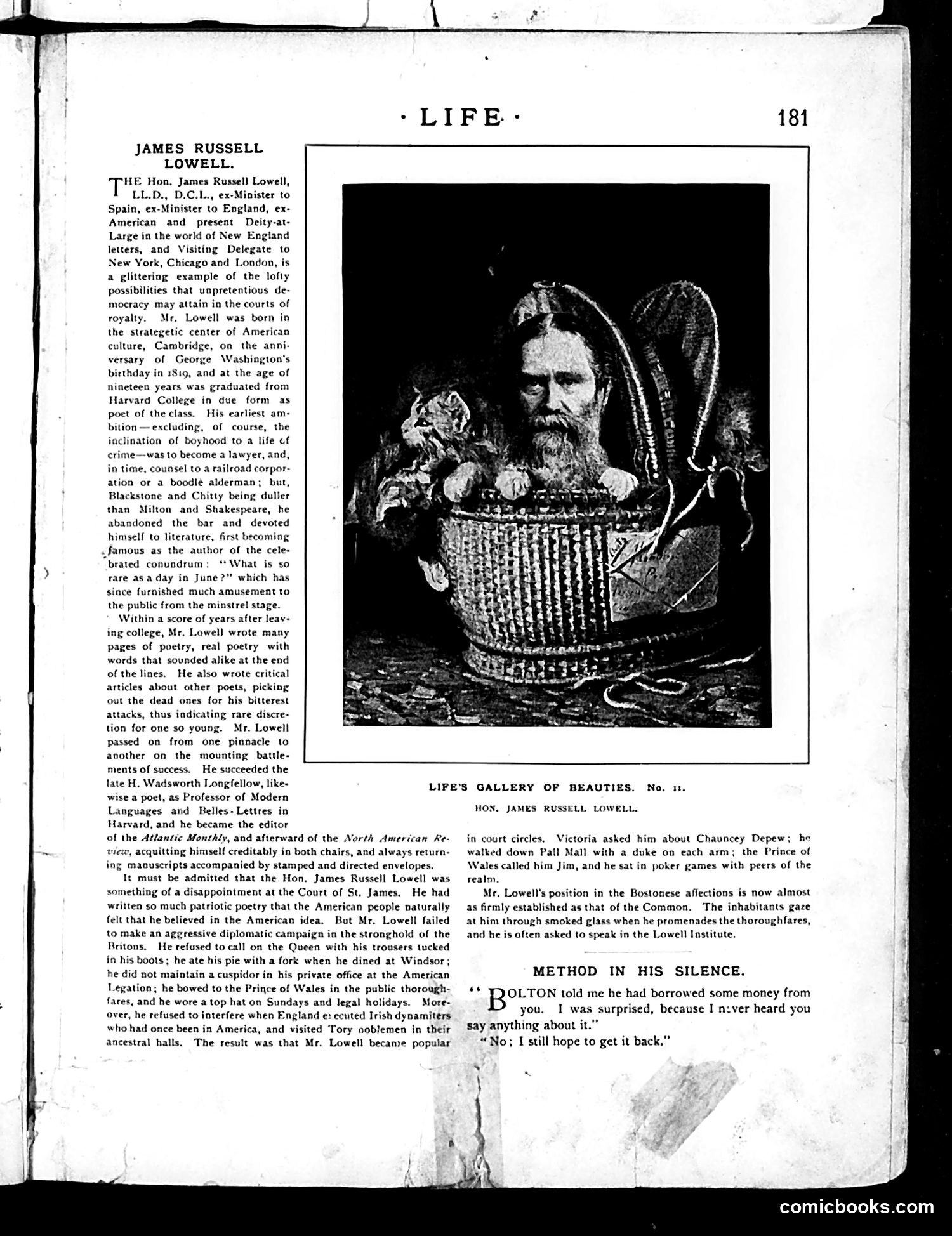
This page features a biographical profile of James Russell Lowell with an accompanying portrait photograph. The text describes Lowell's distinguished career as a diplomat, poet, and editor—highlighting his roles as Minister to Spain and England, and his work with the Atlantic Monthly and North American Review. Below the main article appears a brief humorous section titled "Method in His Silence," presenting a joke about borrowed money. Bolton apparently borrowed funds but never mentions repayment, and when asked about it, claims he still needs to get the money back—a comedic twist on the debtor's evasion of responsibility. This is primarily biographical content with light satirical humor, rather than political cartooning.
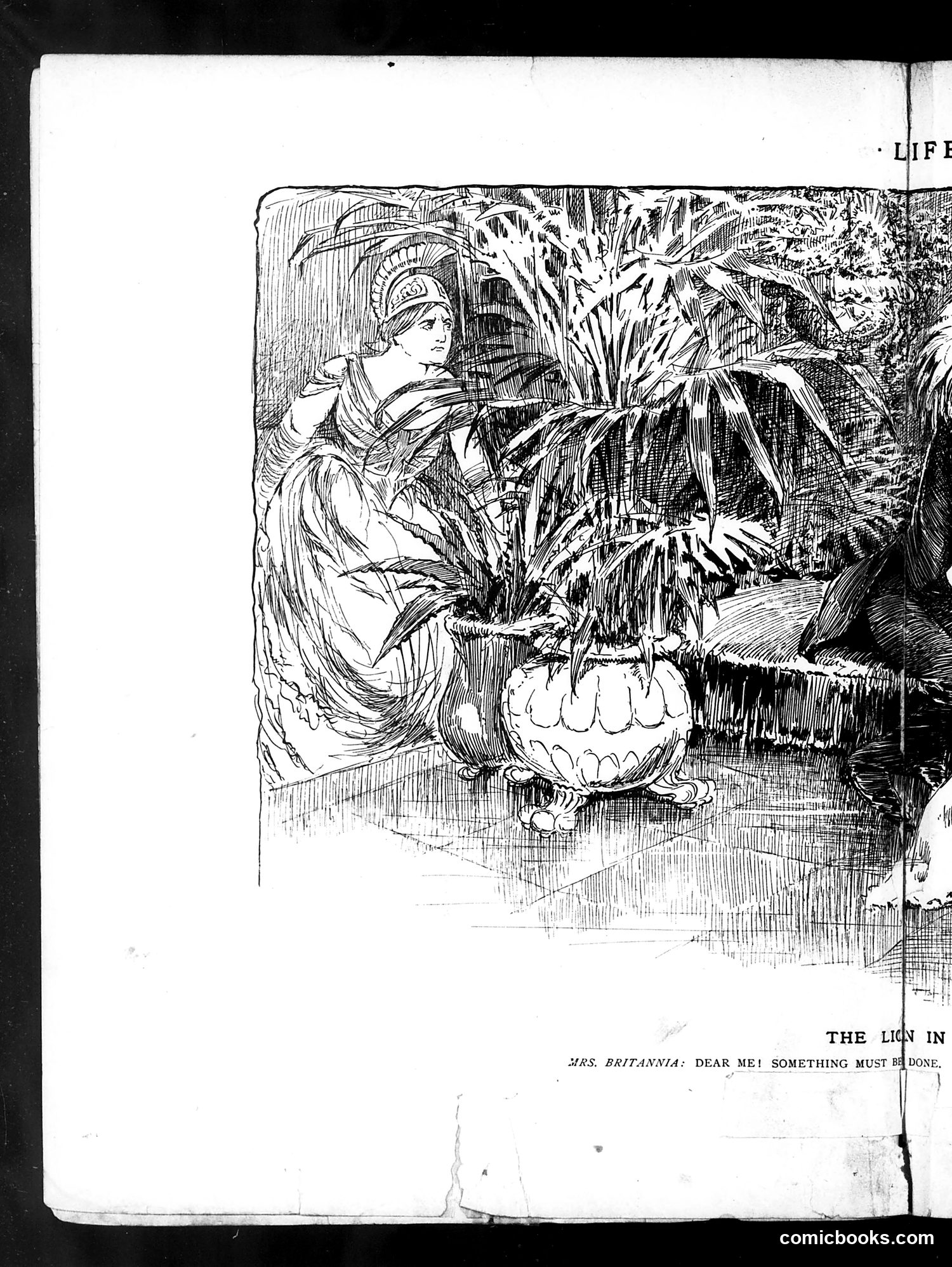
This political cartoon depicts a woman in classical dress labeled "Mrs. Britannia" (the personification of Britain) tending to a large potted plant with drooping leaves in an indoor setting. She states: "Dear me! Something must be done." The image appears to be satirizing British governance or policy during a period when Britain faced challenges requiring action. "Mrs. Britannia" represents the British nation itself, while the dying plant likely symbolizes a specific political, economic, or social problem requiring governmental intervention. The cartoon's title fragment "The Lion in..." (incomplete on this page) suggests reference to Britain's national symbol. Without the full caption or date, the specific issue being critiqued—whether imperial, domestic, or economic—remains unclear, though the tone implies urgent neglect of an important matter.
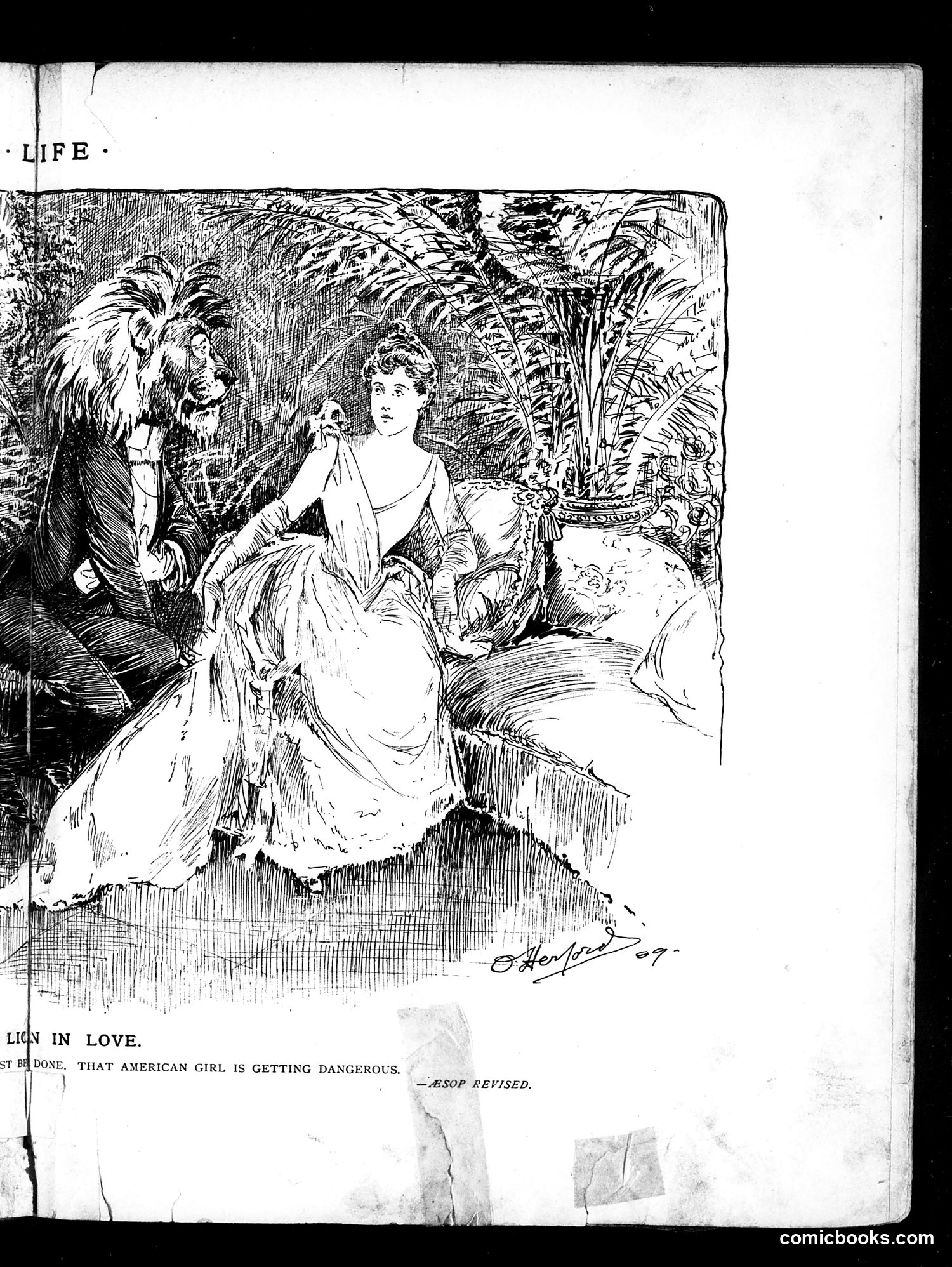
This satirical cartoon depicts a well-dressed man (appearing leonine or beast-like) on the left courting a seated woman in an elegant white gown. The caption reads: "A LION IN LOVE" with the subtitle "IT MUST BE DONE. THAT AMERICAN GIRL IS GETTING DANGEROUS." The satire appears to target anxieties about American women and international courtship, likely from the late 19th or early 20th century. The "lion" represents either a European aristocrat or wealthy foreigner pursuing an American woman, suggesting that American women are so formidable ("dangerous") that even powerful men must resort to romantic tactics to manage them. The joke mocks both European masculine pretension and American female independence—a common theme in Life's social commentary of this era.
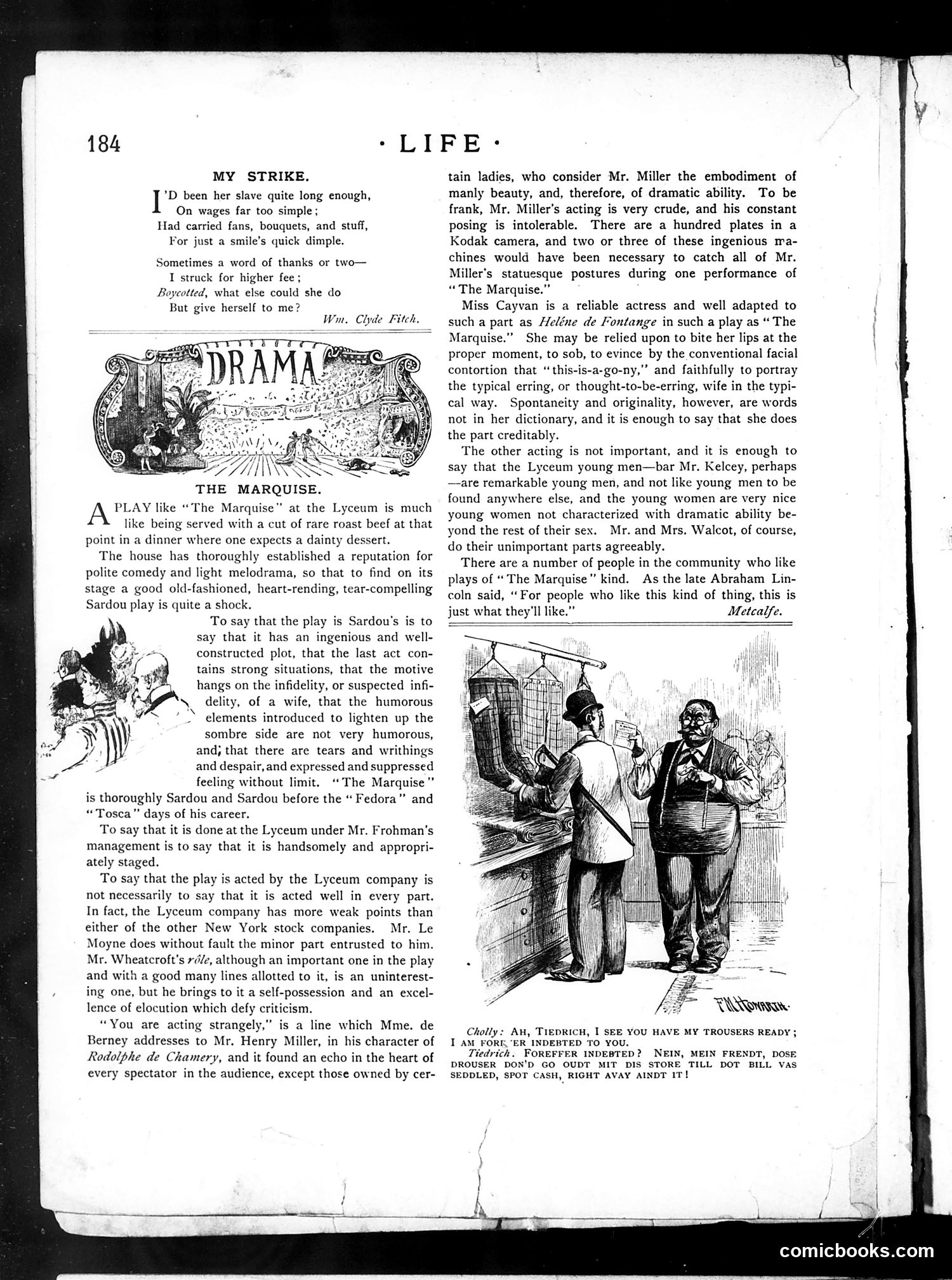
This page reviews a theatrical production of "The Marquise" at the Lyceum Theatre in New York. The sketch shows two men in period costume (appearing to be 18th-century French dress based on the caption's reference to "Marquise"), suggesting the play involves historical/aristocratic themes. The review criticizes actor Henry Miller's constant dramatic posing as "intolerable," noting he required hundreds of photographs to capture his theatrical poses. It praises actress Cayvan's reliable performance but notes she lacks originality. The overall assessment is that this is well-staged, old-fashioned melodrama—adequate entertainment for audiences who enjoy sentimental period plays, though not critically distinguished.
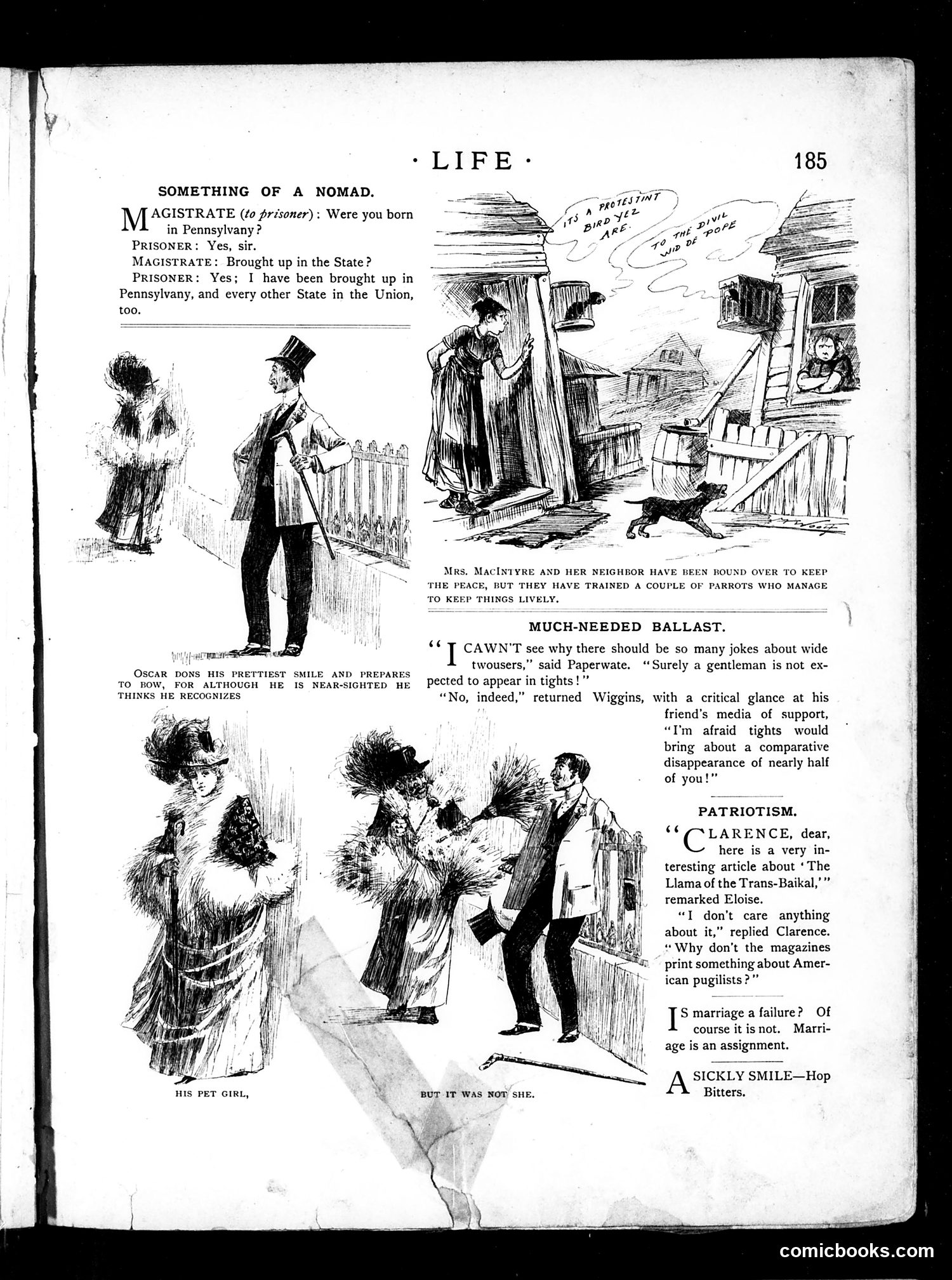
This page contains several unrelated satirical vignettes typical of Life magazine's humor: **"Something of a Nomad"** mocks a vagrant who claims to have lived in every U.S. state—commentary on transience and rootlessness in American society. **"Much-Needed Ballast"** jokes about wide trousers, with one character (Paperwate) suggesting that tight clothing would reveal an unflattering truth about his friend Wiggins's physique. The humor relies on body-shaming and fashion commentary. **"Patriotism"** satirizes intellectual pretension: Clarence dismisses his wife Eloise's interest in foreign literature (the Trans-Baikal llama article) in favor of American boxing, suggesting narrow nationalism and anti-intellectualism. The remaining brief items ("Is marriage a failure?" and "A Sickly Smile") are one-liners typical of period humor magazines. Overall, these sketches target American social types: vagrants, fashion-conscious dandies, and provincial patriots.
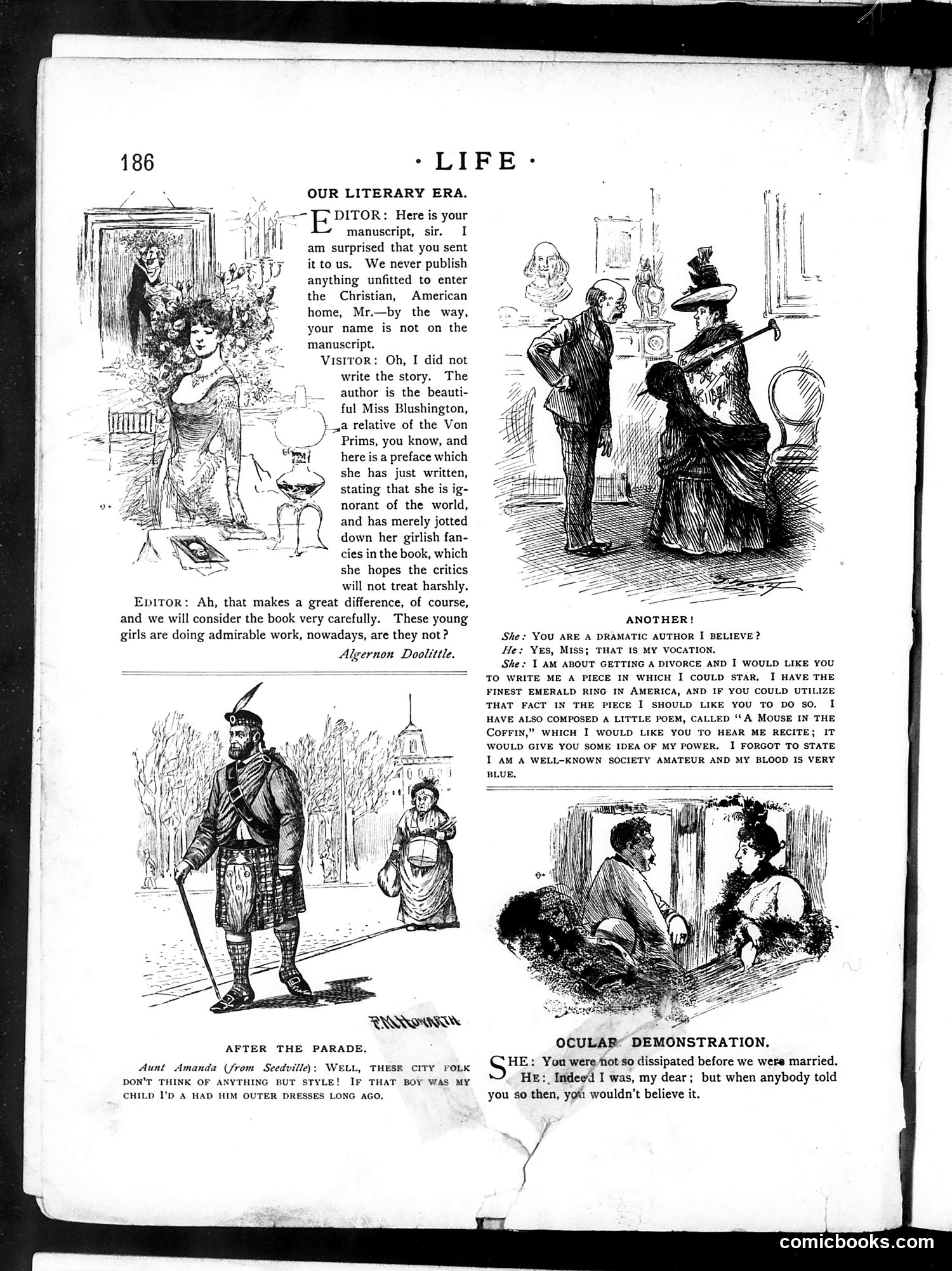
This page mocks literary pretension and gender hypocrisy in the Gilded Age. **Top section**: A publisher accepts an unmarked manuscript after learning it's by "Miss Blushington," a society woman claiming ignorant innocence. The satire: publishers lower editorial standards for fashionable female authors, assuming their "girlish fancies" need protection rather than scrutiny. The visitor's knowing smile suggests the author's real identity or quality is irrelevant—social status matters more. **"After the Parade"**: Rural Aunt Amanda critiques city fashion obsession (the boy's outfit). **"Ocular Demonstration"**: A husband and wife dispute his pre-marital behavior. The joke: she wouldn't believe warnings about him before marriage, but now complains about the same conduct. This mocks women's selective blindness regarding unsuitable suitors. The overall theme: society's double standards around female authorship, fashion, and marital judgment.
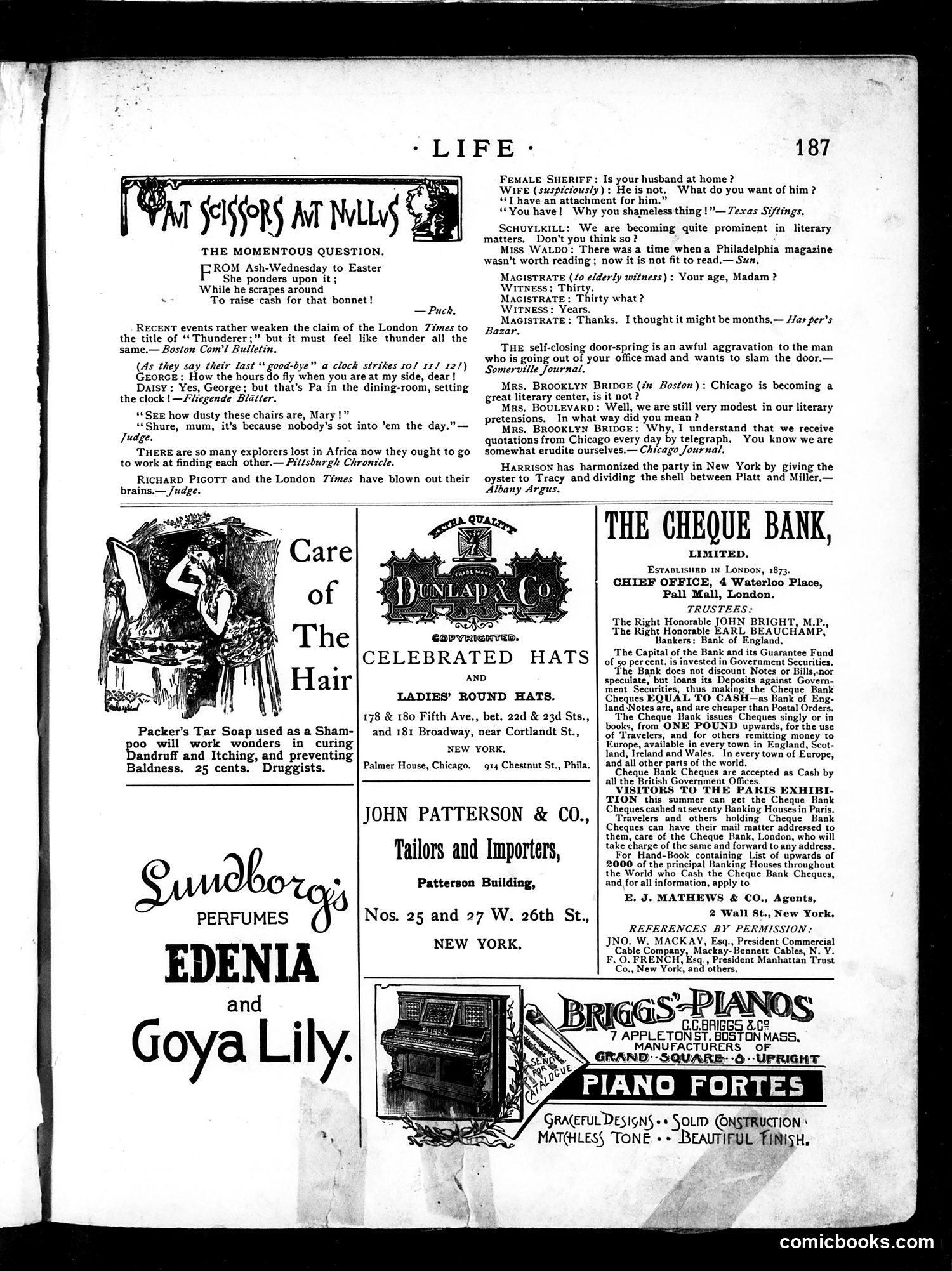
This page is primarily **advertising with brief satirical snippets** rather than a sustained cartoon narrative. The main content consists of short jokes reprinted from other publications (Puck, Judge, Harper's Bazar, etc.). Notable examples include: - A domestic joke about a wife pondering Easter bonnets while her husband scrapes together money - A Texas anecdote about a female sheriff's double entendre regarding "attachment" - Political commentary on Harrison harmonizing the New York Republican party by giving the "oyster to Tracy" and "dividing the shell between Platt and Miller"—likely referencing patronage disputes among party factions The remaining space features advertisements for hats, perfumes, pianos, tailoring services, and notably **The Cheque Bank**, a London financial institution marketing traveler's checks as cash equivalents for European travel. Without seeing detailed illustrations, the satirical points appear to target gender relations, politics, and commercial absurdities typical of 1890s American humor magazines.
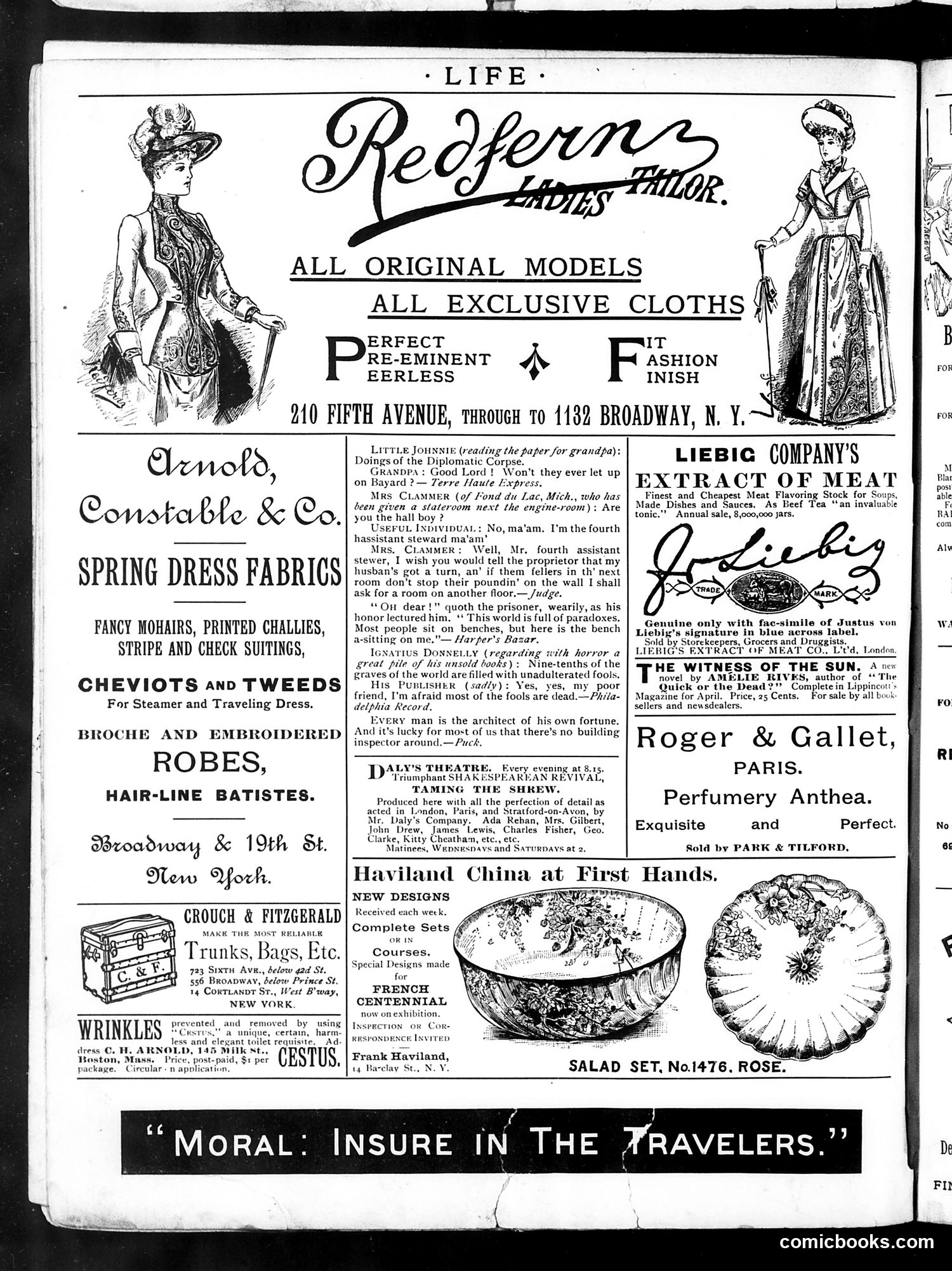
This is primarily a **advertising page** with minimal editorial content. The scattered short jokes and anecdotes appear filler material common to period magazines. The few identifiable references: - **"Bayard"** in the first joke likely refers to Thomas F. Bayard, a prominent diplomat of the era, suggesting ongoing diplomatic controversies. - **Ignatius Donnelly** appears in a joke about his unsold books—he was a real Minnesota politician/author known for prolific but commercially unsuccessful writing. - **Daly's Theatre** advertises Shakespeare's *The Taming of the Shrew*, produced with period-authentic detail. The page's primary purpose is showcasing luxury goods (Redfern ladies' tailor, spring dress fabrics, Haviland china, perfume, meat extract) to affluent readers. The scattered jokes mock everyday frustrations—demanding travelers, prisoners, unsuccessful authors—providing light satirical relief rather than political commentary. The closing moral about insurance appears cynical humor typical of the era.
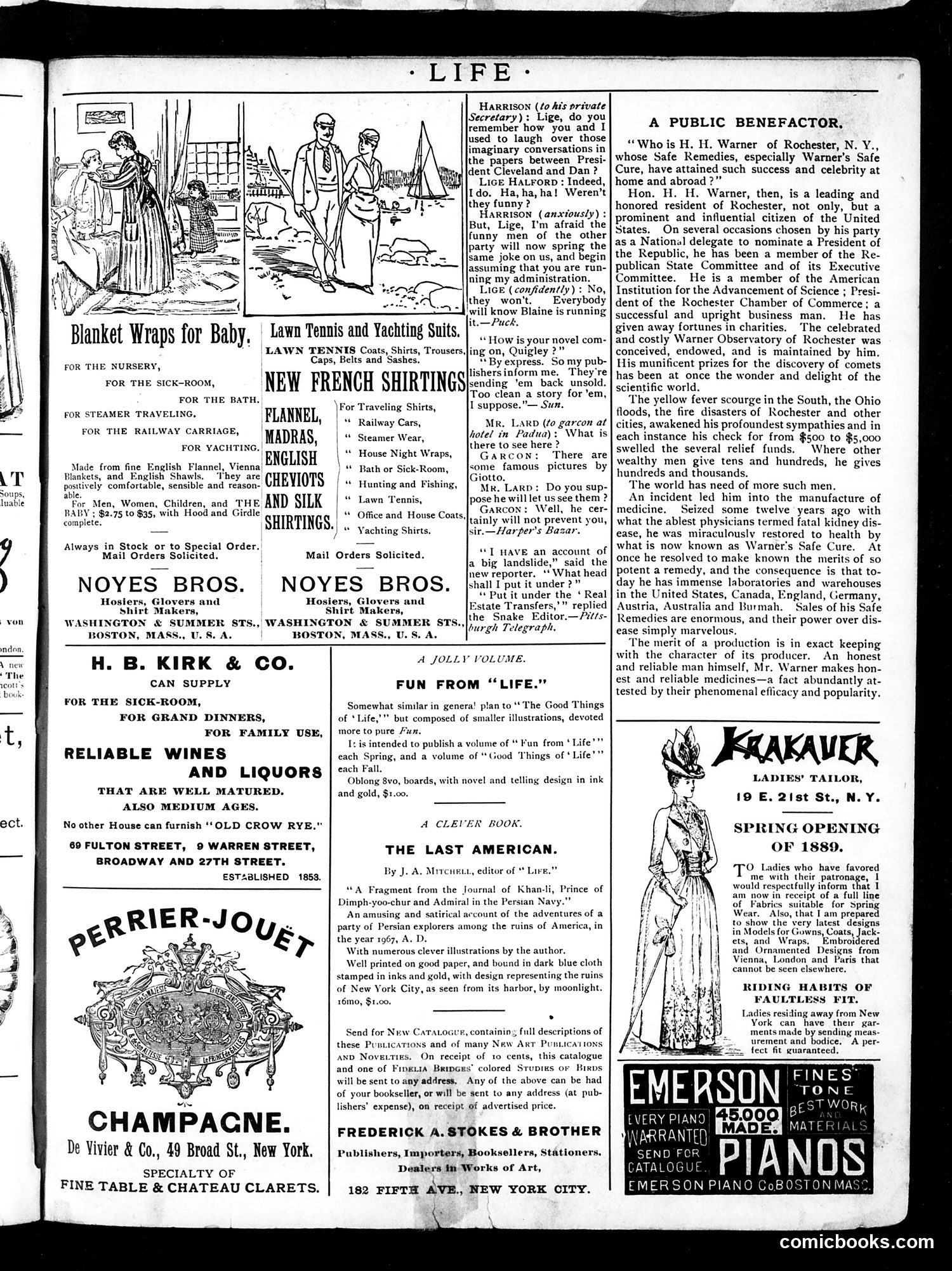
This cartoon satirizes President Benjamin Harrison's anxiety about his political dependence on James G. Blaine, his Secretary of State. **The Setup:** Harrison recalls with amusement how he and his secretary "Lige" Halford once laughed at newspaper rumors of imaginary conversations between President Cleveland and Dan (Lamont, Cleveland's Secretary of State)—implying Cleveland was merely a puppet. **The Joke:** Now that Harrison himself is president with Blaine as a powerful advisor, he nervously worries the *opposing party* will turn the same mockery on *him*—suggesting Blaine actually runs the administration. Lige confidently reassures him "everybody will know Blaine is running" it. **The Satire:** The humor lies in the ironic reversal: what seemed funny when directed at Democrats now threatens Republicans. It mocks Harrison's actual political weakness and Blaine's outsized influence, while revealing how such rumors reflect real power dynamics in government. The cartoon captures late 1880s anxieties about shadowy advisors controlling presidents.
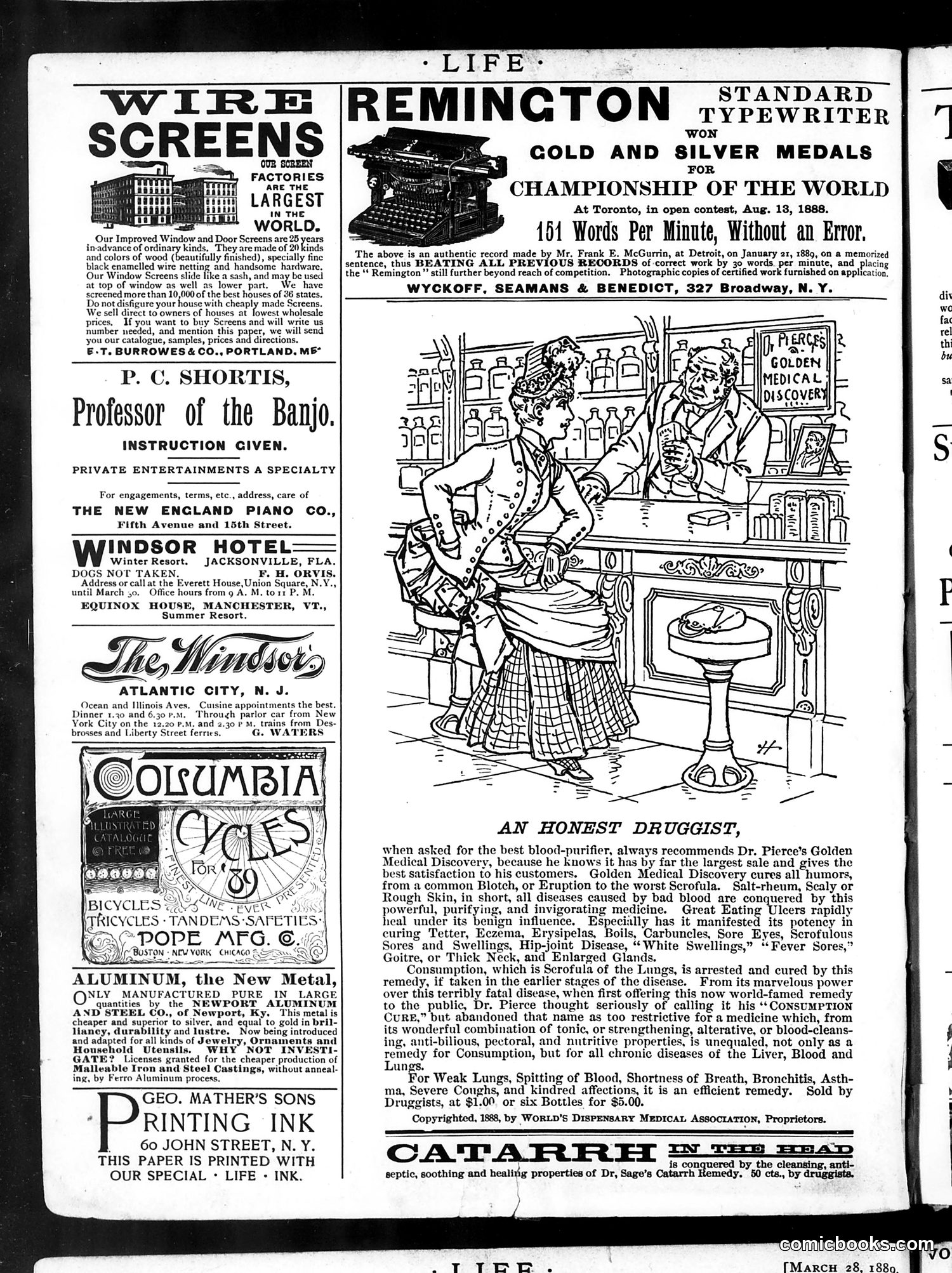
This page is primarily **advertising**, not political satire. It contains multiple product ads typical of the era: wire window screens, Remington typewriters, banjo instruction, hotels, bicycles, aluminum products, and patent medicines. The main illustration depicts a domestic scene: a woman in a kitchen appears startled or distressed while a man (appearing to be a druggist or salesman) gestures from behind a counter displaying bottles. This accompanies an ad for "Dr. Pierce's Golden Medical Discovery," a patent medicine marketed as a blood-purifier cure-all for various ailments including scrofula, eczema, and consumption. The satire—if present—likely mocks the era's **dubious patent medicine industry**: the "honest druggist" headline is presumably tongue-in-cheek, as such nostrums were notoriously ineffective and often dangerous. The woman's expression might suggest skepticism or alarm at the salesman's pitch, subtly critiquing the aggressive marketing of unproven remedies to desperate patients.
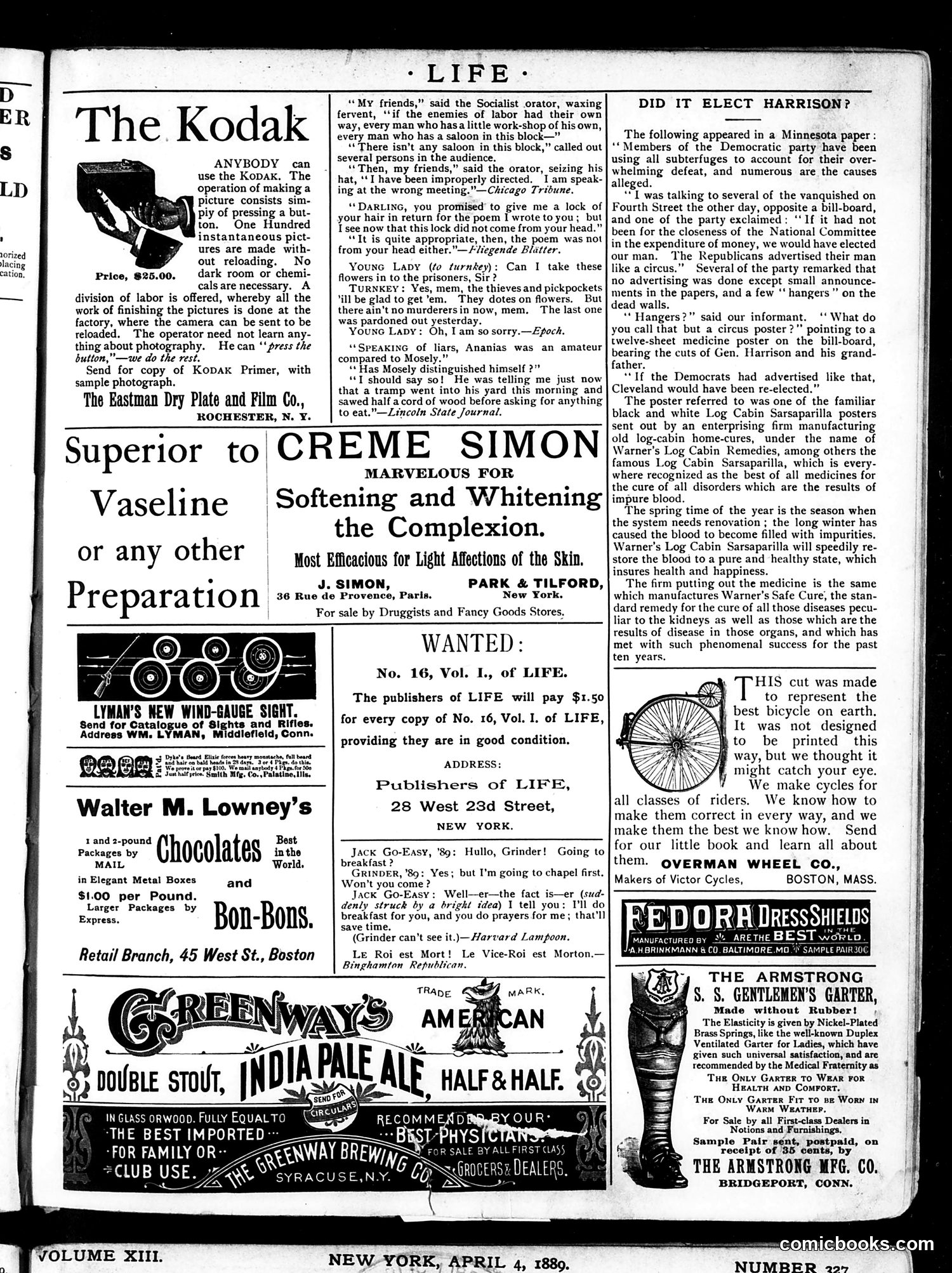
This page is primarily **advertisements and humor columns** rather than political cartoons. The main satirical content includes: **"Socialist Orator" joke**: A Socialist speaker begins addressing workers about labor enemies, mentioning shop owners and saloon keepers. When audience members interrupt saying there's no saloon in that block, the embarrassed orator admits he's at the wrong meeting. The satire mocks Socialist organizers as incompetent and suggests their rhetoric is generic, interchangeable propaganda rather than locally informed. **Other humor**: Brief jokes about infidelity, prison flowers, and a liar named Mosely satirize various human follies. **"Did It Elect Harrison?" section**: References the 1888 presidential election (Benjamin Harrison's victory), with Democrats allegedly making excuses for their defeat. The page otherwise features product advertisements (Kodak cameras, cosmetics, chocolates, bicycles, beer) typical of 1889 Life magazine, which blended satirical commentary with commercial content.
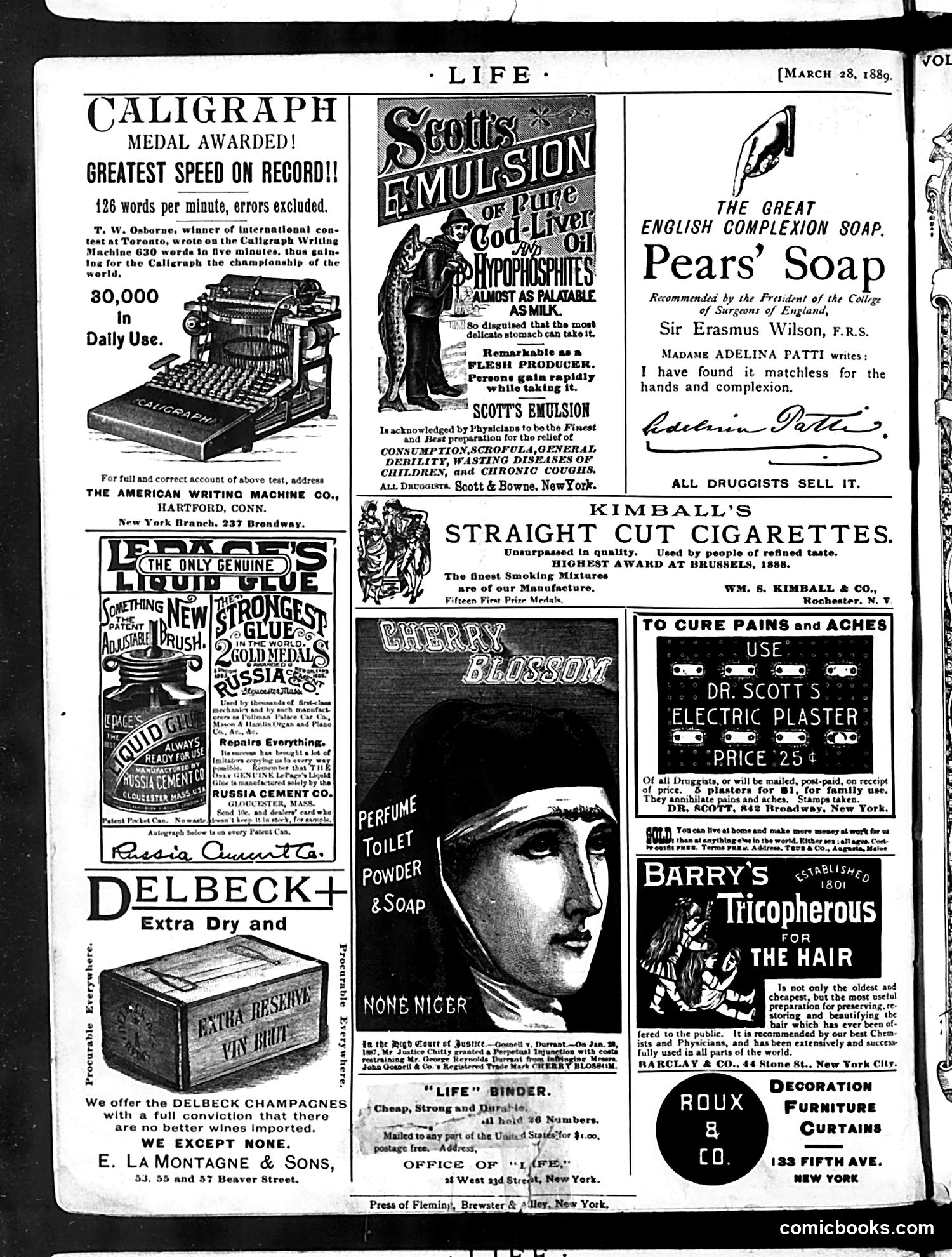
This is primarily an **advertising page** from Life magazine's early period. There are no political cartoons or satire here—instead, it showcases late-19th-century patent medicines and consumer products typical of the era. Notable ads include: - **Caligraph typewriter**: Boasts a speed record (126 words/minute) to promote business efficiency - **Scott's Emulsion**: Cod-liver oil marketed as a "flesh producer" for consumption and wasting diseases—reflecting the era's tuberculosis epidemic - **Pears' Soap**: Features celebrity endorsement from opera singer Adelina Patti, emphasizing complexion care - **Patent medicines**: Dr. Scott's Electric Plaster and Barry's Tricopherous hair treatment represent the unregulated medical claims common to the period The ads collectively reveal Victorian consumer culture: concerns about health, appearance, productivity, and the aggressive marketing of dubious remedies before FDA regulation. Products like electric plasters had no scientific basis but sold widely through celebrity endorsement and dramatic claims.