
Life, 1889-03-28 · page 4 of 18
Life — March 28, 1889 — page 4: what you’re looking at
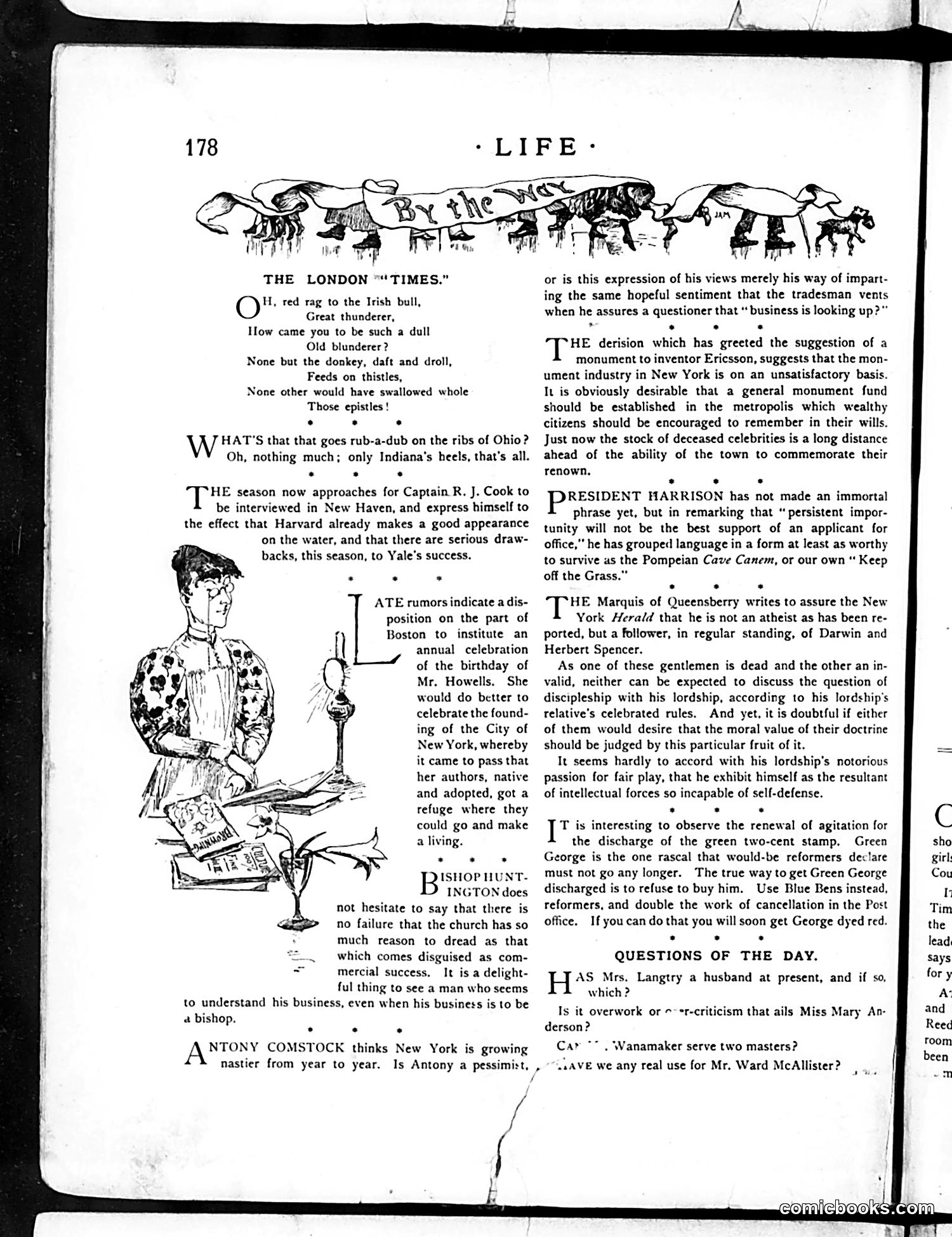
What you’re looking at
This page contains editorial commentary rather than political cartoons. The main illustration shows a fashionably-dressed woman at a desk, likely satirizing social pretension or journalism. The text discusses several contemporary topics: Captain R.J. Cook's upcoming interview about Harvard's water sports prospects; Bishop Huntington's views on church failure; and Antony Comstock's opinions on New York's growth. A "Questions of the Day" section poses rhetorical queries about whether Mrs. Langtry has a husband, whether Miss Mary Anderson faces overwork, if a character named Wanamaker serves two masters, and "Have we any real use for Mr. Ward McAllister?"—likely mocking prominent 1880s society figures and their relevance. The satire targets social gossip, institutional authority, and fashionable society's self-importance.
📄 Transcribed text from this page (OCR, searchable)
Machine-transcribed from the original scan — historical spelling and the odd misread are preserved.
THE LONDON “TIMES.” H, red rag to the Irish bull, Great thunderer, How came you to be such a dull Old blunderer? None but the donkey, daft and droll, Feeds on thistles, None other would have swallowed whole Those epistles ! . . . HAT'S that that goes rub-a-dub on the ribs of Ohio? Oh, nothing much; only Indiana's heels, that's all. . . . TH season now approaches for Captain R. J. Cook to be interviewed in New Haven, and express himself to the effect that Harvard already makes a good appearance on the water, and that there are serious draw- backs, this season, to Yale’s success. . . * ATE rumors indicate a dis- position on the part of Boston to institute an annual celebration of the birthday of Mr. Howells. She would do better to celebrate the found- ing of the City of New York, whereby it came to pass that her authors, native and adopted, got a refuge where they could go and make a living. . 8 8 ISHOP HUNT- INGTON does not hesitate to say that there is no failure that the church has so much reason to dread as that which comes disguised as com- mercial success. It is a delight- ful thing to see a man who seems to understand his business, even when his business is to be a bishop. . . . NTONY COMSTOCK thinks New York is growing nastier from year to year. Is Antony a pessimist, , / or is this expression of his views merely his way of impart- ing the same hopeful sentiment that the tradesman vents when he assures a questioner that “ business is looking up?” % . * . HE derision which has greeted the suggestion of a monument to inventor Ericsson, suggests that the mon- ument industry in New York is on an unsatisfactory basis. It is obviously desirable that a general monument fund should be established in the metropolis which wealthy citizens should be encouraged to remember in their wills. Just now the stock of deceased celebrities is a long distance ahead of the ability of the town to commemorate their renown, * . . RESIDENT HARRISON has not made an immortal phrase yet, but in remarking that “persistent impor- tunity will not be the best support of an applicant for office,” he has grouped language in a form at least as worthy to survive as the Pompeian Cave Canem, or our own “ Keep off the Grass.” . . . ete Marquis of Queensberry writes to assure the New York Herald that he is not an atheist as has been re- ported, but a follower, in regular standing, of Darwin and Herbert Spencer. As one of these gentlemen is dead and the other an in- valid, neither can be expected to discuss the question of discipleship with his lordship, according to his lordship’s relative’s celebrated rules. And yet, it is doubtful if either of them would desire that the moral value of their doctrine should be judged by this particular fruit of it. It seems hardly to accord with his lordship’s notorious passion for fair play, that he exhibit himself as the resultant of intellectual forces so incapable of self-defense. . . . T is interesting to observe the renewal of agitation for the discharge of the green two-cent stamp. Green George is the one rascal that would-be reformers declare must not go any longer. The true way to get Green George discharged is to refuse to buy him. Use Blue Bens instead, reformers, and double the work of cancellation in the Post office. If you can do that you will soon get George dyed red. . . . QUESTIONS OF THE DAY. AS Mrs. Langtry a husband at present, and if so, which ? Is it overwork or -~er-criticism that ails Miss Mary An- derson? Car “* , Wanamaker serve two masters? sAVE we any real use for Mr. Ward McAllister? H