
Life, 1889-03-28 · page 10 of 18
Life — March 28, 1889 — page 10: what you’re looking at
What you’re looking at
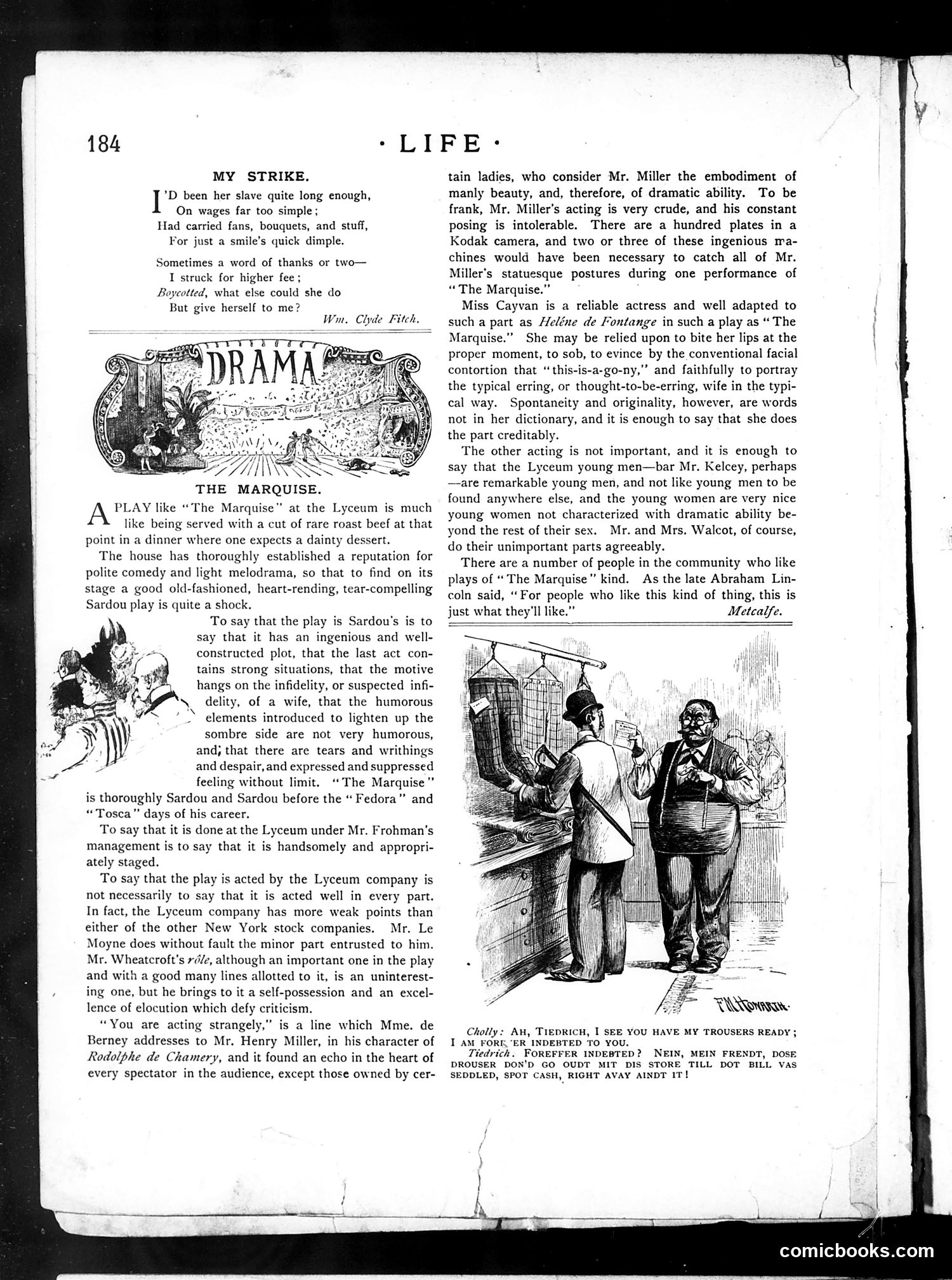
This page reviews a theatrical production of "The Marquise" at the Lyceum Theatre in New York. The sketch shows two men in period costume (appearing to be 18th-century French dress based on the caption's reference to "Marquise"), suggesting the play involves historical/aristocratic themes. The review criticizes actor Henry Miller's constant dramatic posing as "intolerable," noting he required hundreds of photographs to capture his theatrical poses. It praises actress Cayvan's reliable performance but notes she lacks originality. The overall assessment is that this is well-staged, old-fashioned melodrama—adequate entertainment for audiences who enjoy sentimental period plays, though not critically distinguished.
📄 Transcribed text from this page (OCR, searchable)
Machine-transcribed from the original scan — historical spelling and the odd misread are preserved.
> LIFE: MY STRIKE. I? been her slave quite long enough, On wages far too simple; Had carried fans, bouquets, and stuff, For just a smile’s quick dimple. Sometimes a word of thanks or two— I struck for higher fee ; Boycotted, what else could she do But give herself to me? THE MARQUISE. PLAY like “The Marquise” at the Lyceum is much like being served with a cut of rare roast beef at that point in a dinner where one expects a dainty dessert. The house has thoroughly established a reputation for polite comedy and light melodrama, so that to find on its stage a good old-fashioned, heart-rending, tear-compelling Sardou play is quite a shock, To say that the play is Sardou's is to say that it has an ingenious and well- constructed plot, that the last act con- tains strong situations, that the motive hangs on the infidelity, or suspected infi- \. delity, of a wife, that the humorous elements introduced to lighten up the sombre side are not very humorous, and, that there are tears and writhings and despair, and expressed and suppressed feeling without limit. ‘The Marquise” is thoroughly Sardou and Sardou before the “ Fedora” and “Tosca” days of his career. To say that it is done at the Lyceum under Mr. Frohman’s management is to say that it is handsomely and appropri- ately staged. To say that the play is acted by the Lyceum company is not necessarily to say that it is acted well in every part. In fact, the Lyceum company has more weak points than either of the other New York stock companies. Mr. Le Moyne does without fault the minor part entrusted to him. Mr. Wheatcroft’s ré/e, although an important one in the play and with a good many lines allotted to it, is an uninterest- ing one, but he brings to it a self-possession and an excel- lence of elocution which defy criticism. “You are acting strangely,” is a line which Mme. de Berney addresses to Mr. Henry Miller, in his character of Rodolphe de Chamery, and it found an echo in the heart of every spectator in the audience, except those owned by cer- tain ladies, who consider Mr. Miller the embodiment of manly beauty, and, therefore, of dramatic ability. To be frank, Mr. Miller's acting is very crude, and his constant posing is intolerable. There are a hundred plates in a Kodak camera, and two or three of these ingenious ma- chines would have been necessary to catch all of Mr. Miller's statuesque postures during one performance of “The Marquise.” Miss Cayvan is a reliable actress and well adapted to such a part as Heléne de Fontange in such a play as “ The Marquise.” She may be relied upon to bite her lips at the proper moment, to sob, to evince by the conventional facial contortion that “this-is-a-go-ny,” and faithfully to portray the typical erring, or thought-to-be-erring, wife in the typi- cal way. Spontaneity and originality, however, are words not in her dictionary, and it is enough to say that she does the part creditably. The other acting is not important, and it is enough to say that the Lyceum young men—bar Mr. Kelcey, perhaps —are remarkable young men, and not like young men to be found anywhere else, and the young women are very nice young women not characterized with dramatic ability be- yond the rest of their sex. Mr. and Mrs. Walcot, of course, do their unimportant parts agreeably. There are a number of people in the community who like plays of “ The Marquise” kind. As the late Abraham Lin- coln said, “For people who like this kind of thing, this is Metcalfe. just what they'll like.” Cholly: Au, TiepRicH, I SEE YOU HAVE MY TROUSERS READY ; I AM FORK “ER INDEBTED TO YOU. Tiedrich. FOREFFER INDEBTED? NEIN, MEIN FRENDT, DOSE DROUSER DON’D GO OUDT MIT DIS STORE TILL DOT BILL VAS SEDDLED, SPOT CASH, RIGHT AVAY AINDT IT!