
A complete issue · 22 pages · 1889
Life — February 28, 1889
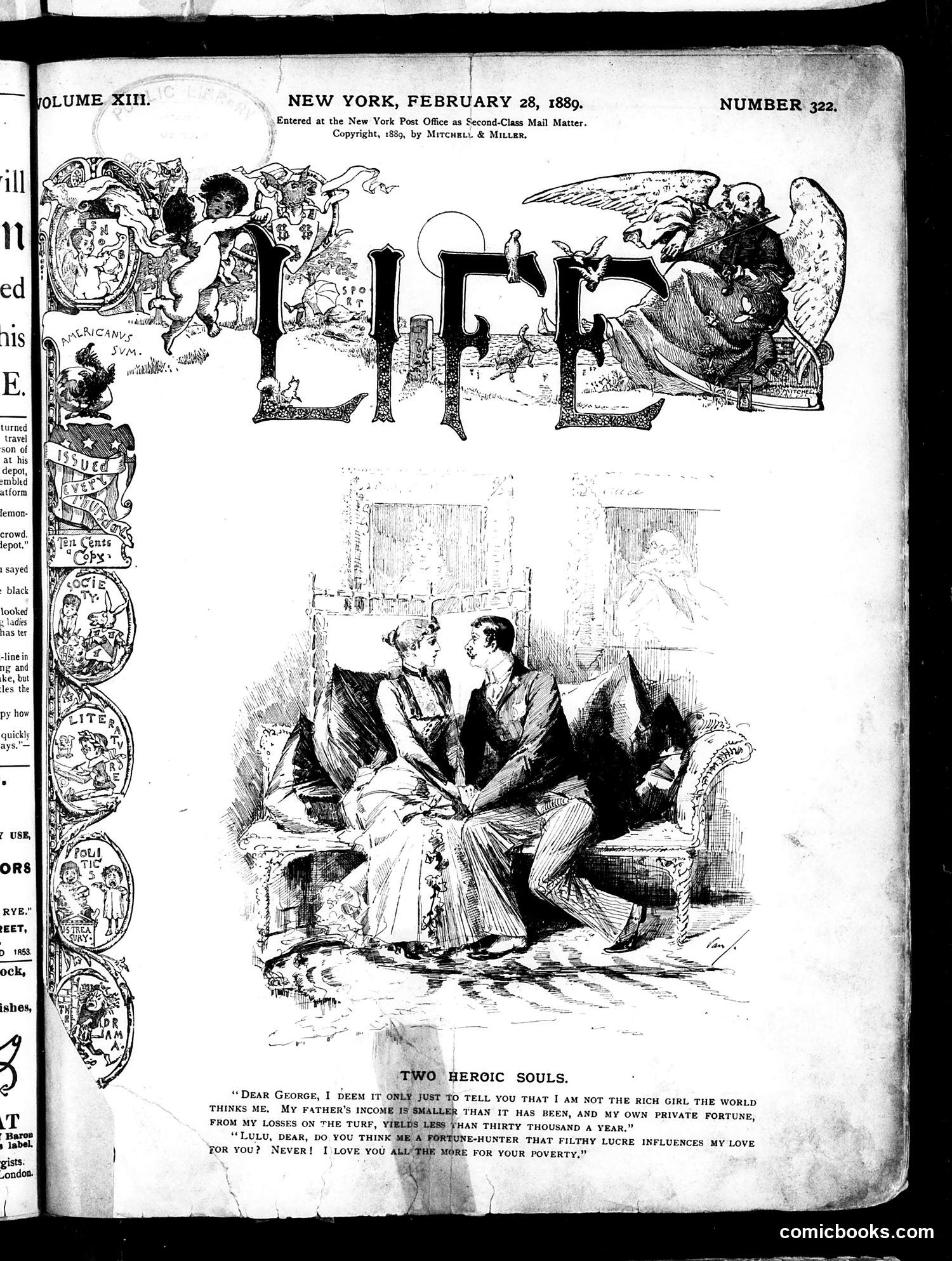
This satirical illustration depicts a conversation between two men discussing love and poverty. The caption quotes a woman telling a man named George that she loves him despite his financial struggles—that his poverty doesn't diminish her affection. The cartoon's title, "Two Heroic Souls," uses irony to mock what appears to be melodramatic Victorian sentimentality about romance transcending class. The elaborate decorative header with cherubs and classical imagery reinforces this mockery of romantic idealization. The satire targets the gap between sentimental declarations of love and harsh economic reality. The "heroic" framing sarcastically elevates what is essentially a couple's financial struggle into noble romance—poking fun at both the romanticism and the precarious circumstances working-class or lower-middle-class couples faced in 1880s America.
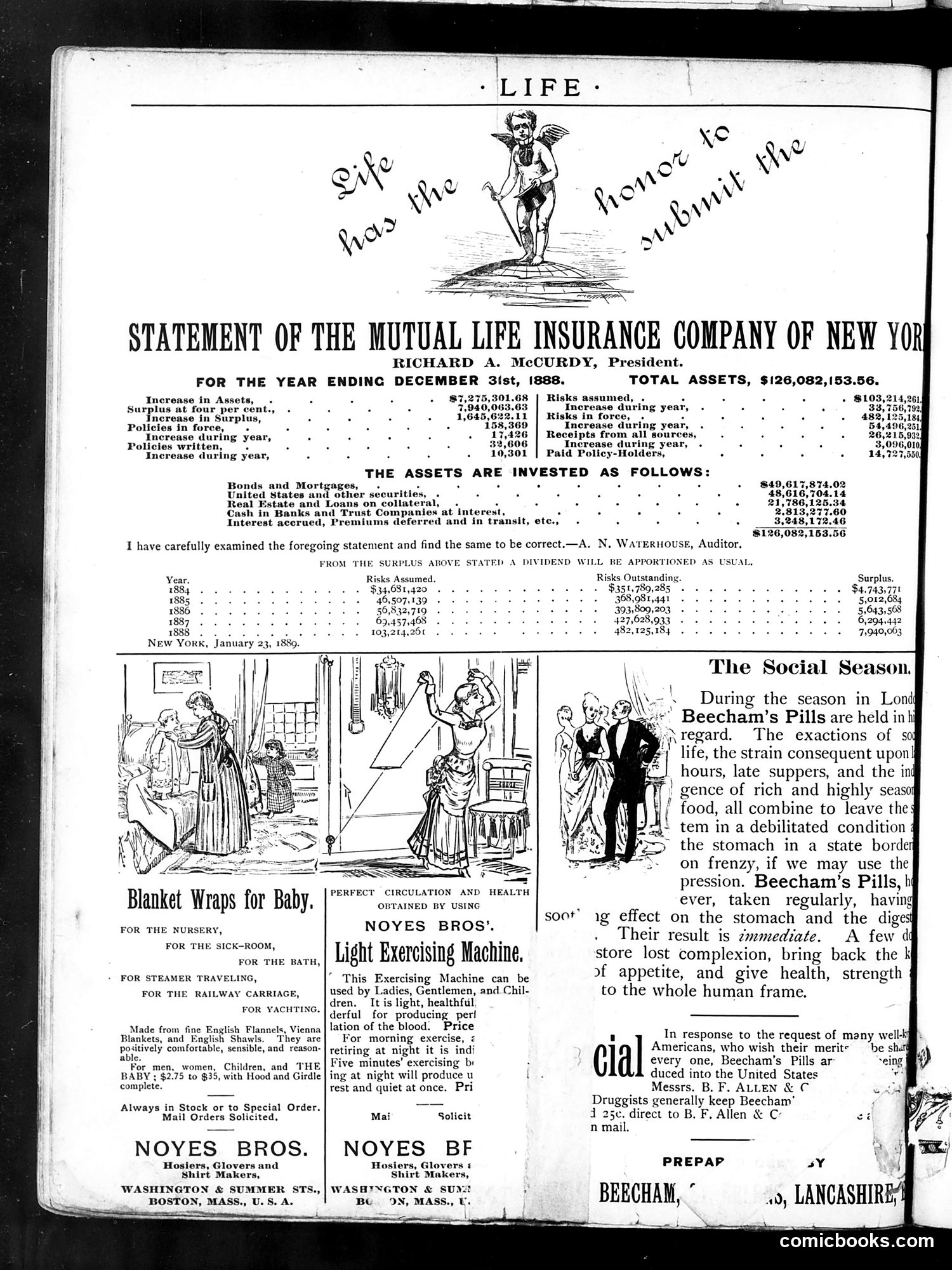
This page is **primarily advertising and financial statements** rather than satirical content. The top half features a Mutual Life Insurance Company financial statement dated December 31, 1888, with an insurance-related logo (Cupid). Below that are three small domestic vignettes illustrating the problems solved by advertised products: **Noyes Bros.' blanket wraps for babies** (left) and **Noyes Bros.' Light Exercising Machine** (center). These appear designed to address real Victorian anxieties about infant care and women's health through exercise. The right side contains an advertisement for **Beecham's Pills**, a patent medicine claiming to cure digestive complaints and restore "complexion" and "health." The accompanying text uses exaggerated testimonial language typical of 19th-century medical advertising. The satire here, if any, is subtle—mocking the era's faith in commercial remedies for life's problems.
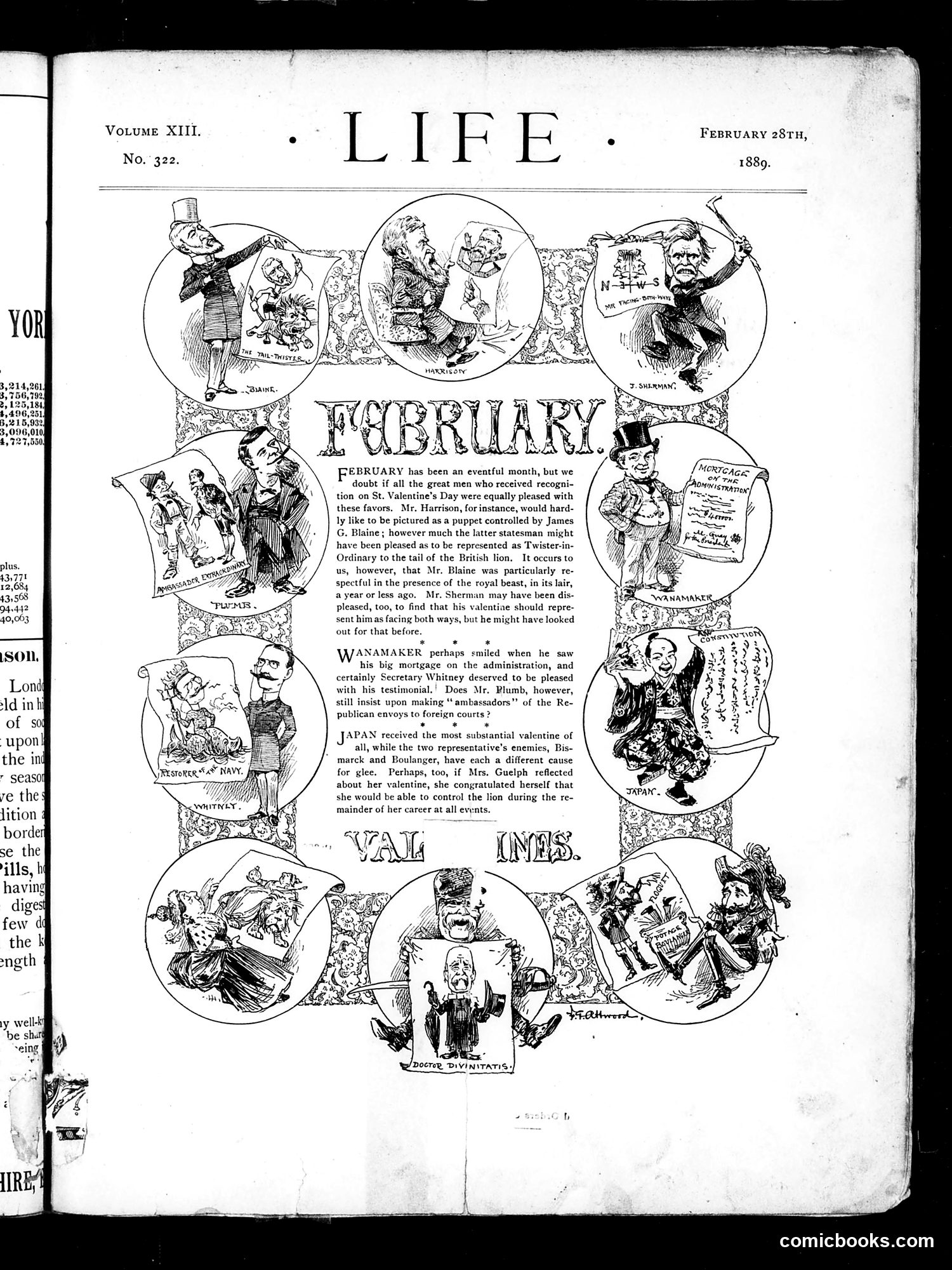
This satirical page mocks prominent political figures who received Valentine's Day recognition. The text specifically names **Harrison** (President Benjamin Harrison), **James G. Blaine** (Secretary of State), **Sherman** (likely William Tecumseh Sherman), and **Wanamaker** (likely John Wanamaker, Postmaster General). The circular vignettes caricature these men in humorous situations. One panel references **Japan** receiving a "substantial valentine," likely alluding to diplomatic relations. Another mocks **Secretary Whitney** regarding "ambassadors" to foreign courts. The cartoons satirize the vanity of these powerful men by imagining them as recipients of romantic valentines—an absurd contrast to their serious political roles. The satire suggests these politicians were self-important or seeking public adulation during Valentine's season.
The main illustration depicts a figure in formal dress gesturing dramatically, with what appears to be a cityscape and the moon in the background. Based on the text below, this likely refers to **Henry M. Stanley Ives**, described as a recent "Young Napoleon of Finance" who engaged in criminal financial schemes and theft. The satire mocks Ives's notoriety—his exploits were widely covered in newspapers, with portraits circulating publicly. The article criticizes how his criminal cleverness initially attracted admiration from young men seeking wealth, but ultimately exposed the corrupting influence of unchecked ambition in commercial life. The cartoon appears to satirize the celebrity status granted to financial criminals and the dangerous example they set for impressionable youth.
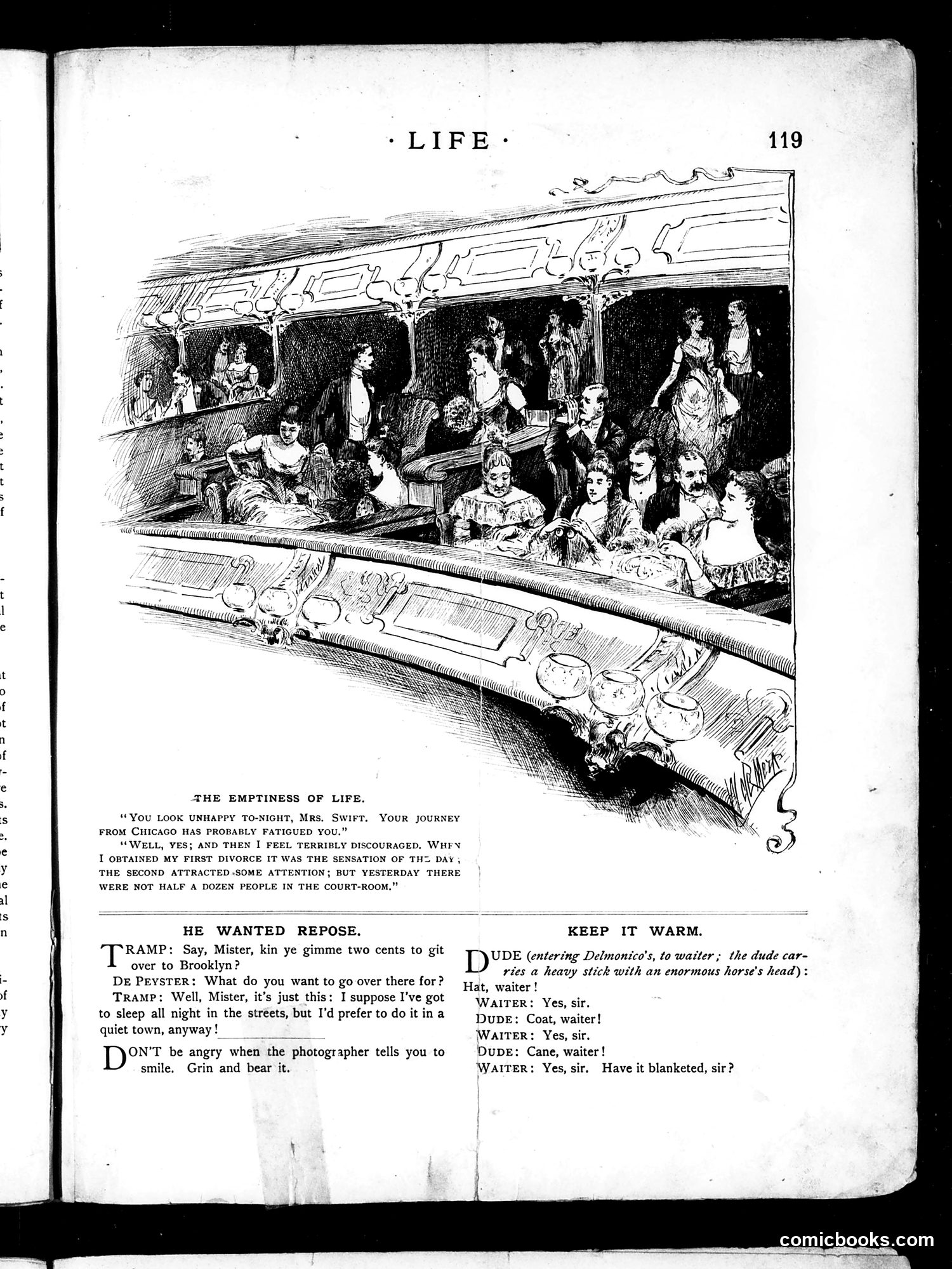
This page contains three separate humorous pieces from Life magazine: 1. **"The Emptiness of Life"** (top): A sketch showing an opera box or theater balcony filled with well-dressed society women. The caption describes Mrs. Swift's unhappiness despite attending social events—her journey from Chicago, divorce proceedings, and court appearances have left her exhausted and jaded. The satire targets wealthy women's shallow social lives and the emptiness of their leisure pursuits. 2. **"He Wanted Repose"** (bottom left): A brief exchange between a Tramp and De Pyster about sleeping rough versus getting shelter. The joke is that even destitute men prefer quiet rest to noisy urban life. 3. **"Keep It Warm"** (bottom right): Wordplay humor between a dude (wealthy gentleman) and a waiter, with the dude repeatedly requesting warm items (coat, cane) as double-entendre, likely suggesting intoxication.
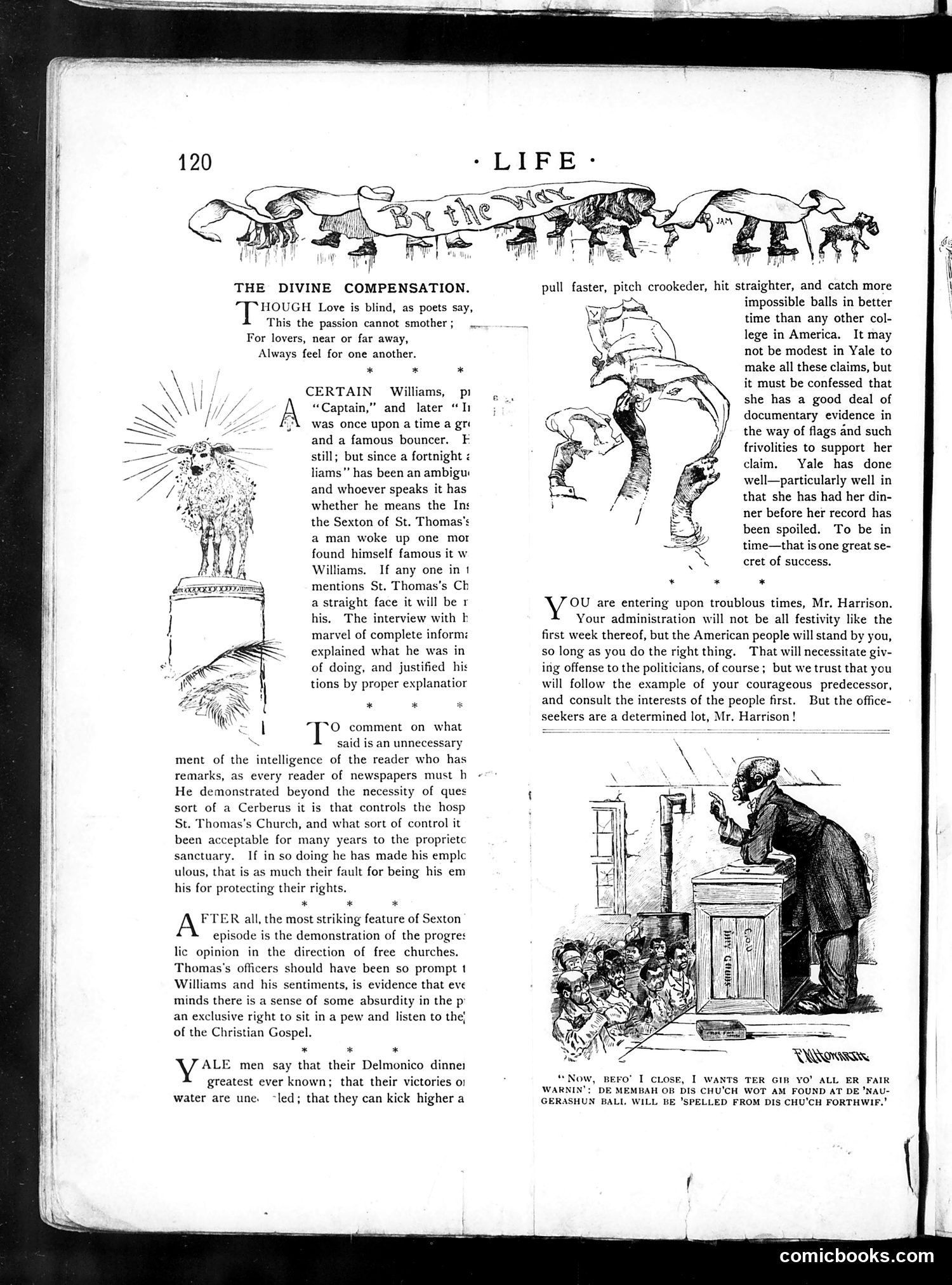
This page contains satirical commentary on contemporary political and religious issues. The main text discusses "Certain Williams," apparently a figure involved in St. Thomas's Church controversy, with references to church control and free churches. The bottom illustration depicts a man at what appears to be a podium or lectern addressing an audience, with the caption containing dialect speech that appears mocking. The cartoon seems to satirize either a specific church dispute or broader debates about ecclesiastical authority and democratic principles in American churches during this era. The page's title "The Divine Compensation" and references to "Delmonico dinner" suggest commentary on wealth, church privilege, and social hypocrisy among the elite. Without more specific historical context, the exact figures and events referenced remain unclear, though the satire targets institutional religious authority.
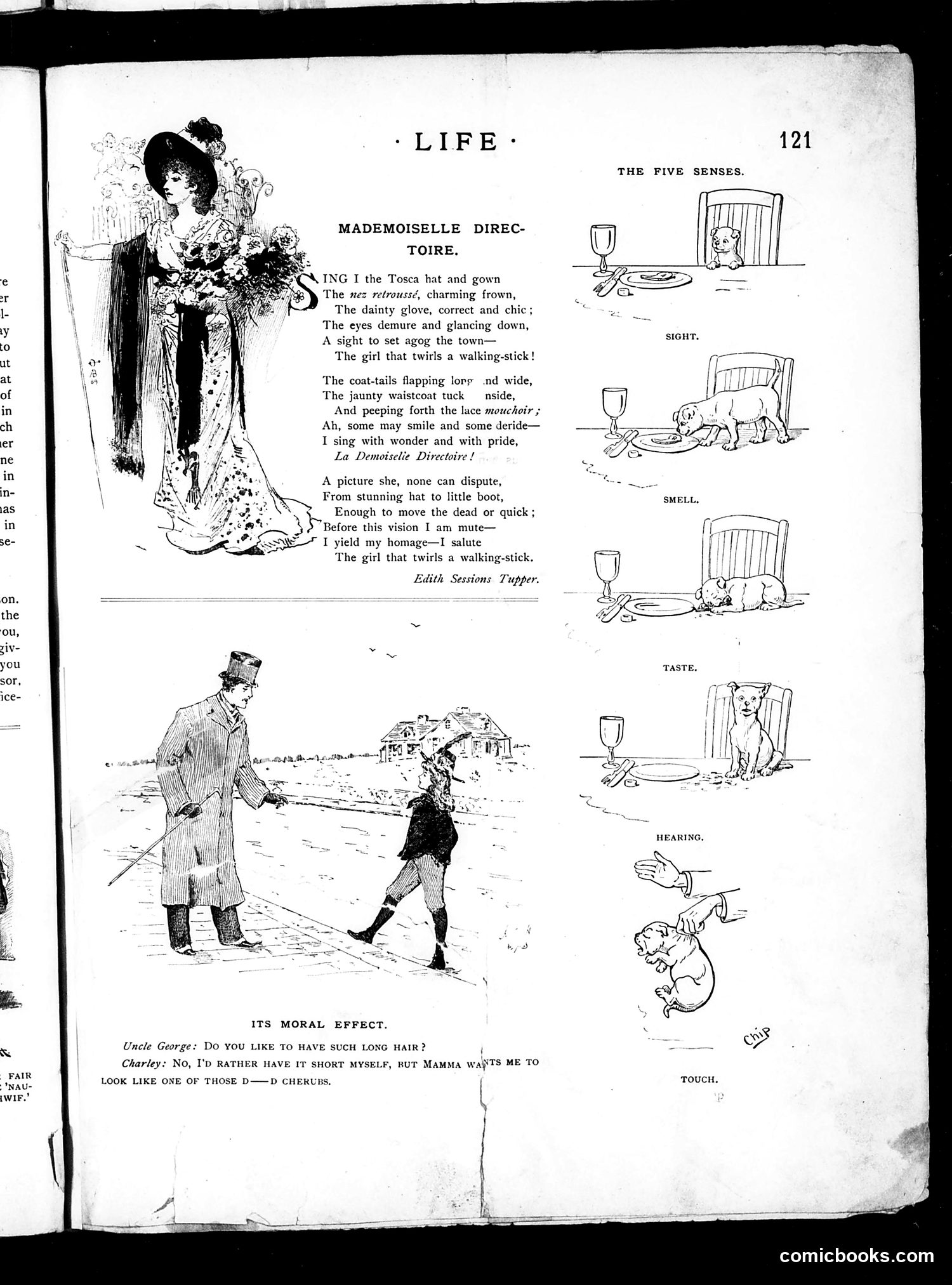
**Right panel** ("The Five Senses"): A humorous series of illustrations showing a baby encountering everyday objects—a glass, a plate, food—labeled to represent sight, smell, taste, hearing, and touch. This is straightforward satirical instruction on infant sensory development. **Left panel** ("Mademoiselle Directoire"): A fashion illustration mocking the "Directoire" style (high-waisted, low-cut gowns popular around 1910-1920), showing an elegantly dressed woman. The accompanying poem by Edith Sessions Tupper satirizes this fashionable look as absurd. **Bottom panel** ("Its Moral Effect"): A dialogue between Uncle George and Charley about hair length, humorously suggesting maternal authority over children's grooming. The page satirizes contemporary fashion trends and parental discipline through gentle humor.
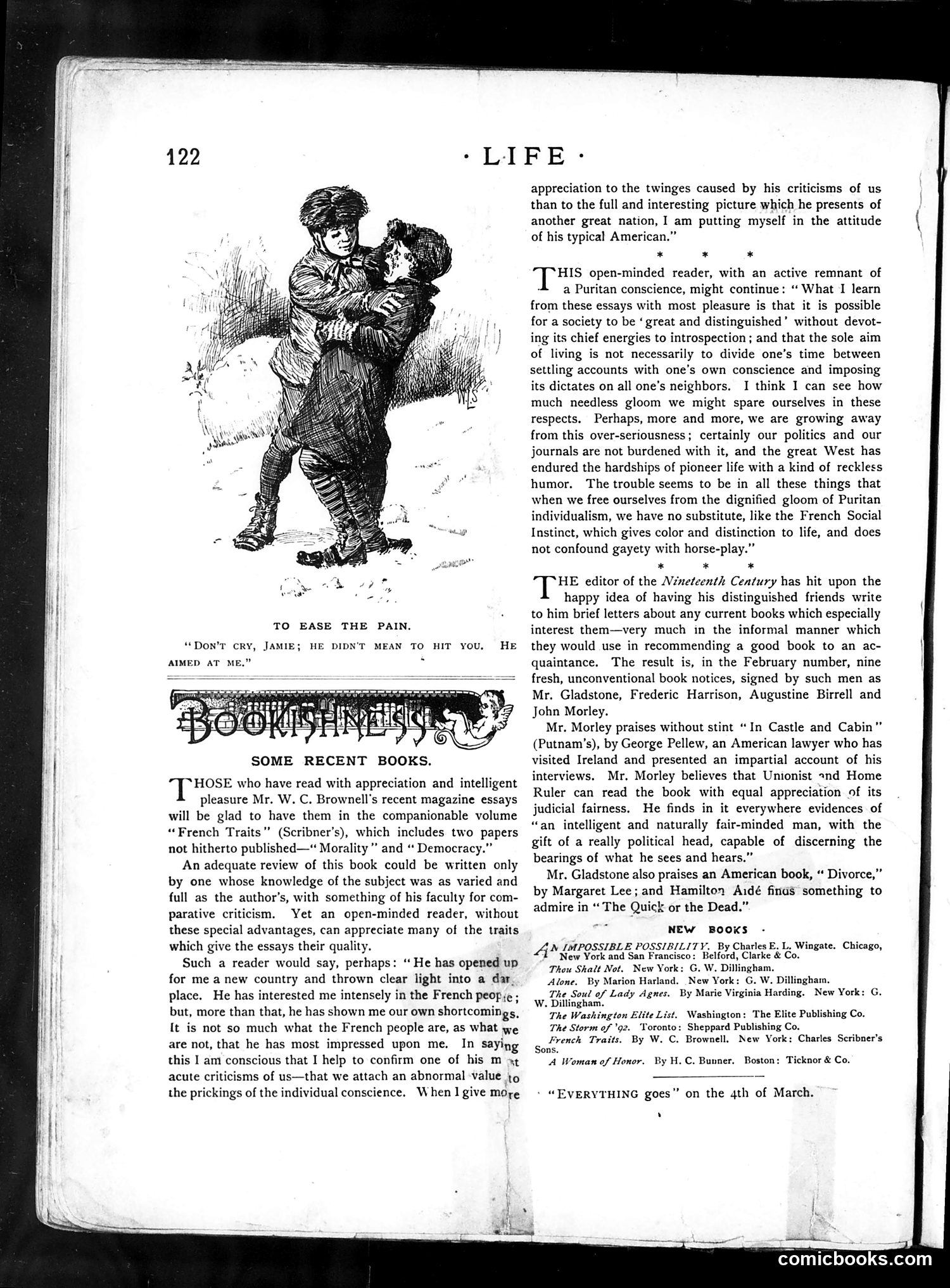
This illustration depicts an adult comforting a crying child, with the caption "Don't cry, Jamie; he didn't mean to hit you. His arm's up." The cartoon satirizes adults' unconvincing attempts to minimize children's suffering through hollow reassurances. The humor lies in the absurdity of the explanation—suggesting the arm being "up" somehow negates the impact of a blow—representing how adults often offer inadequate comfort to distressed children. The surrounding text discusses W.C. Brownell's essay collection and book reviews, but the cartoon itself stands alone as social satire about parent-child dynamics and the gap between adult rationalization and children's genuine pain.
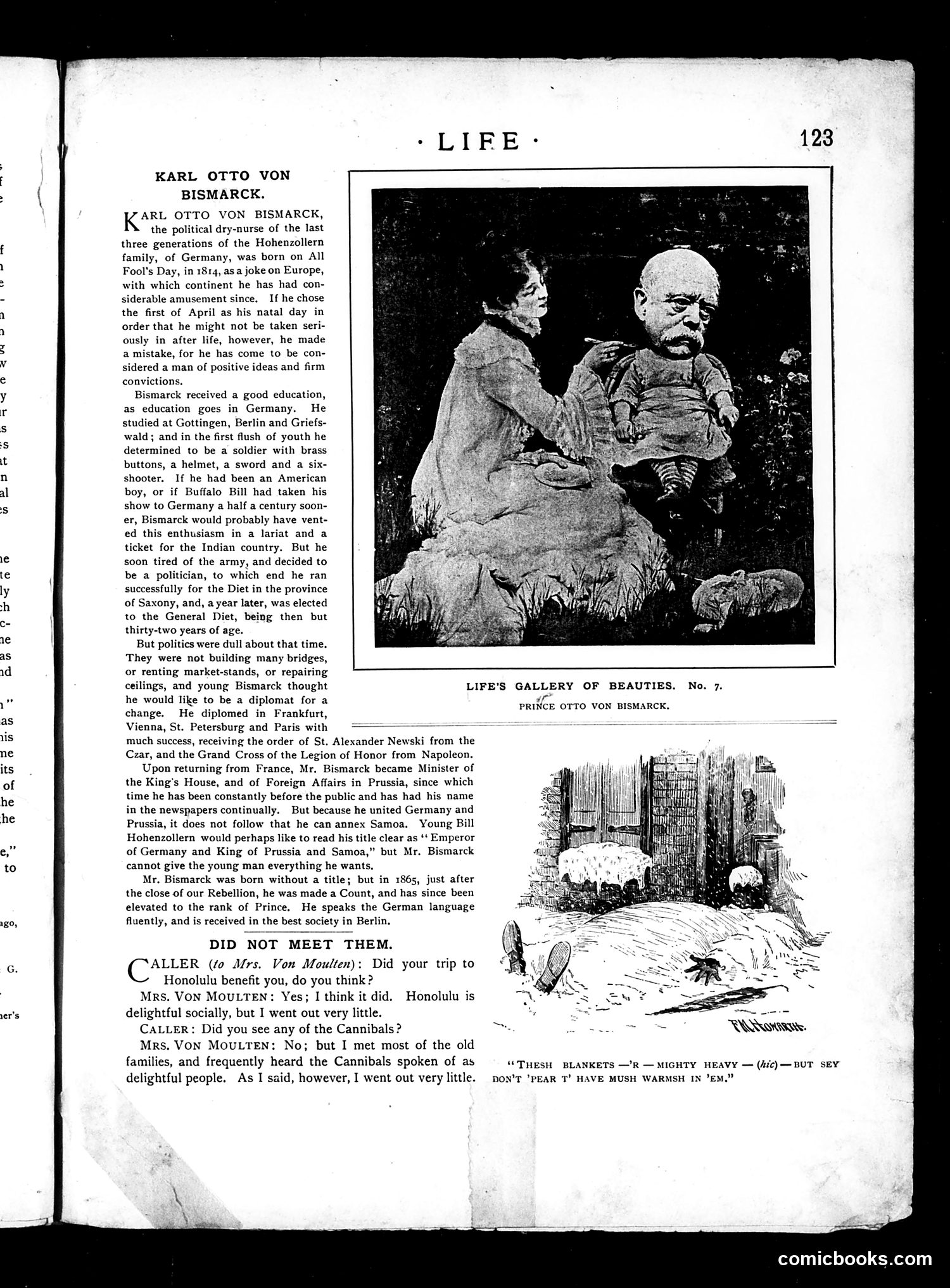
This page features a biographical article on **Karl Otto von Bismarck**, the Prussian statesman, accompanied by a portrait photograph labeled "Prince Otto von Bismarck." The main image shows two figures in what appears to be a casual setting. Below is a sketch illustrating a scene with the caption referencing "blankets" and "bush warmth," likely depicting colonial or frontier life. The article discusses Bismarck's military ambitions, diplomatic career, and rise to prominence in German politics and the Prussian government. A dialogue section titled "Did Not Meet There" presents a conversation between a Caller and Mrs. Von Moulten about a trip to Honolulu, referencing "Cannibals" in a manner typical of period-era stereotypes about Pacific Islanders. The satire appears gentle, focusing on social observations rather than sharp political critique.
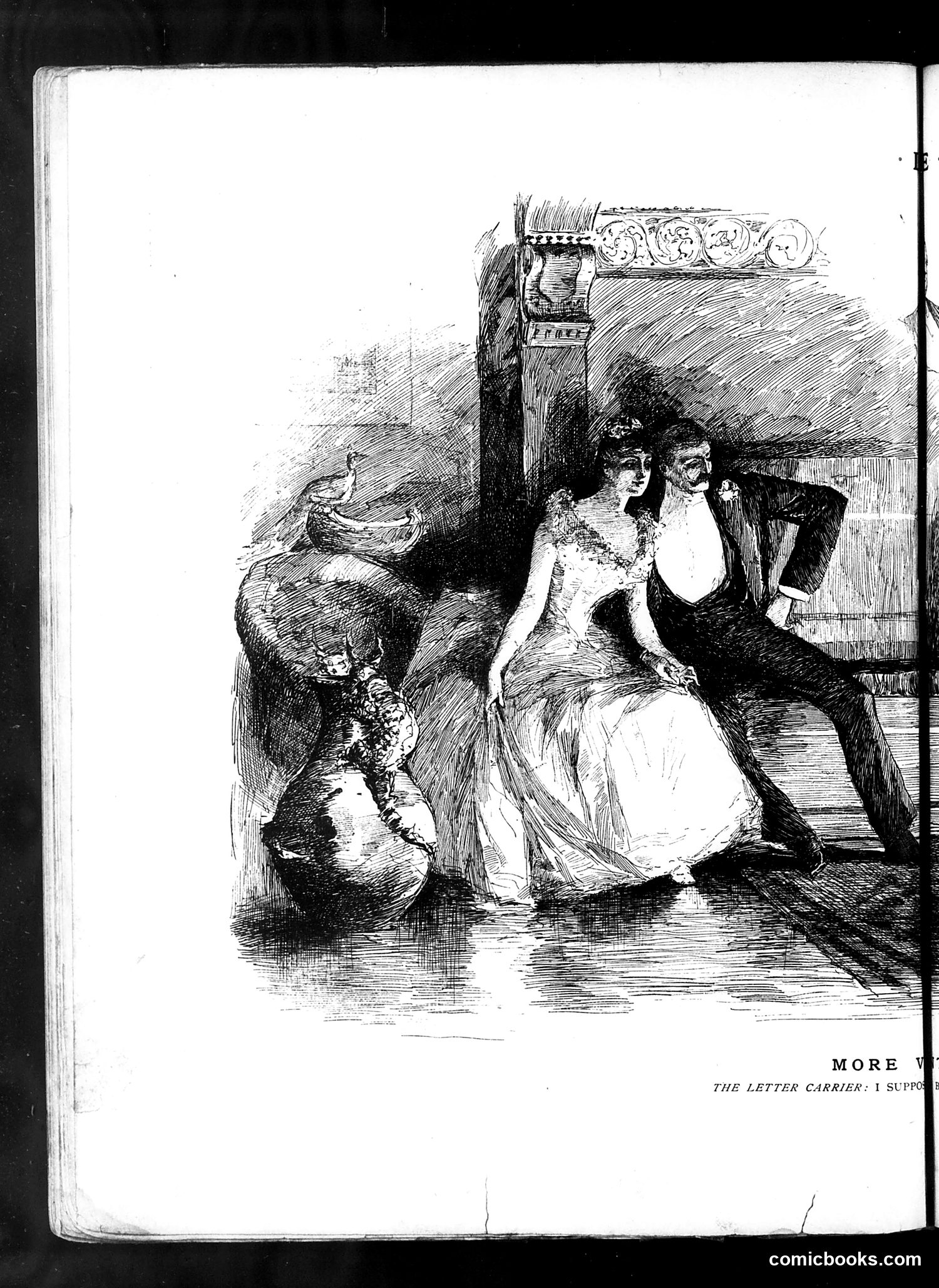
This appears to be a satirical illustration titled "The Letter Carrier" (partial caption visible: "I SUPPO..."). The engraving depicts a domestic scene with three figures: a woman in a light dress, a man in dark formal attire leaning toward her, and what appears to be a cherub or cupid figure on the left. The ornamental architectural detail at top suggests an interior setting. The satire likely concerns romantic correspondence or infidelity—a common theme in 19th-century Life magazine. The "letter carrier" title and the composition suggest commentary on illicit mail delivery or secret romantic communications, playing on the double meaning of "carrier" while depicting the social dynamics of Victorian courtship or scandal.
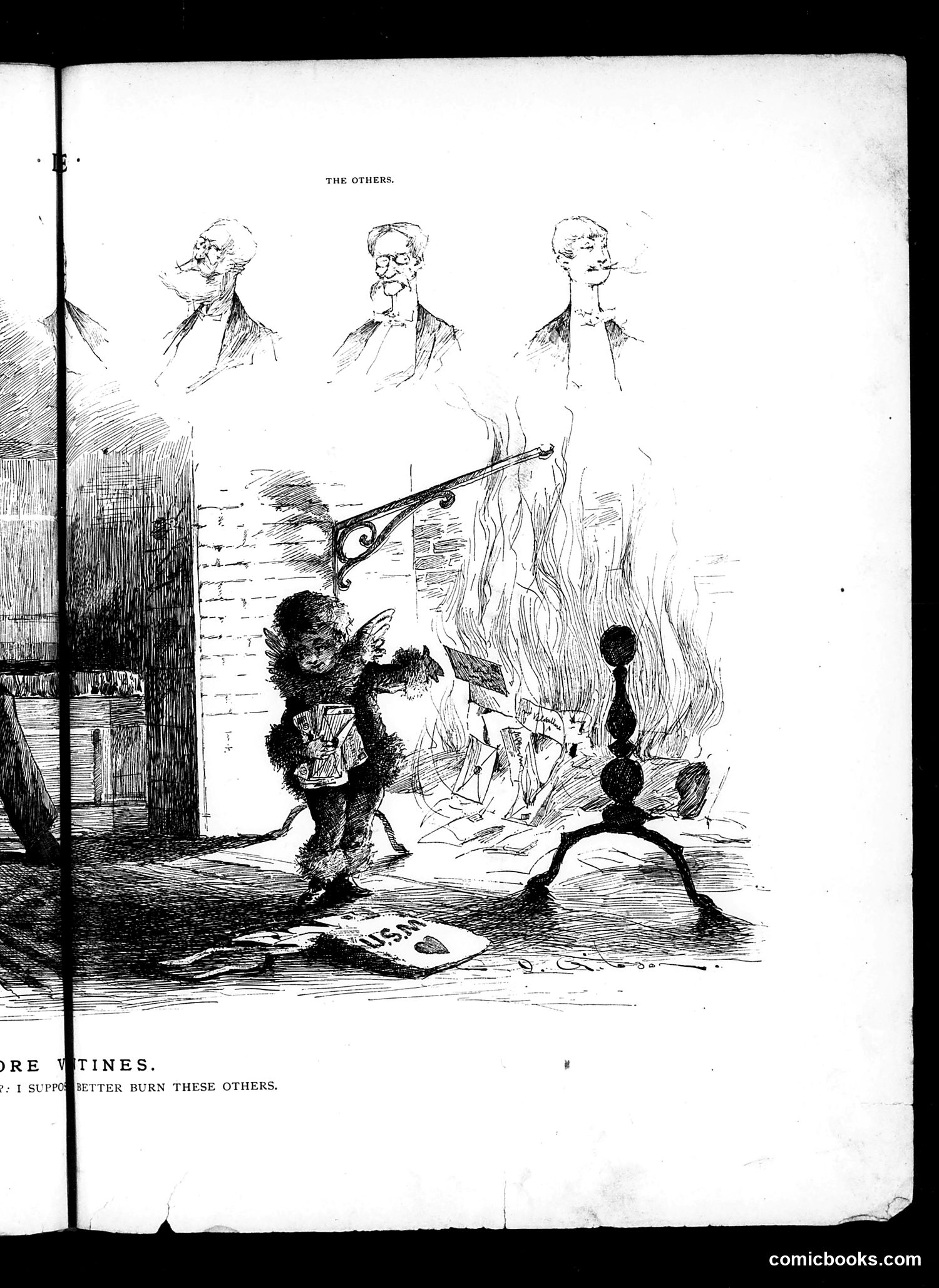
This satirical cartoon depicts two demonic or grotesque figures attempting to burn documents labeled "USGA" (likely referring to a political or governmental organization). Three head sketches appear above, seemingly representing political figures being mocked. The caption "I suppose better burn these others" suggests destruction of evidence or records—a common satirical trope criticizing political corruption or cover-ups. The cartoon employs dark humor by literally visualizing the metaphorical "burning" of documents to conceal wrongdoing. Without clear date context or identification of the specific figures, the exact political scandal or controversy remains unclear. However, the image clearly mocks corruption, destruction of records, and complicity among officials in concealing evidence. The grotesque characterization of the document-burners emphasizes the cartoon's moral condemnation of such actions.
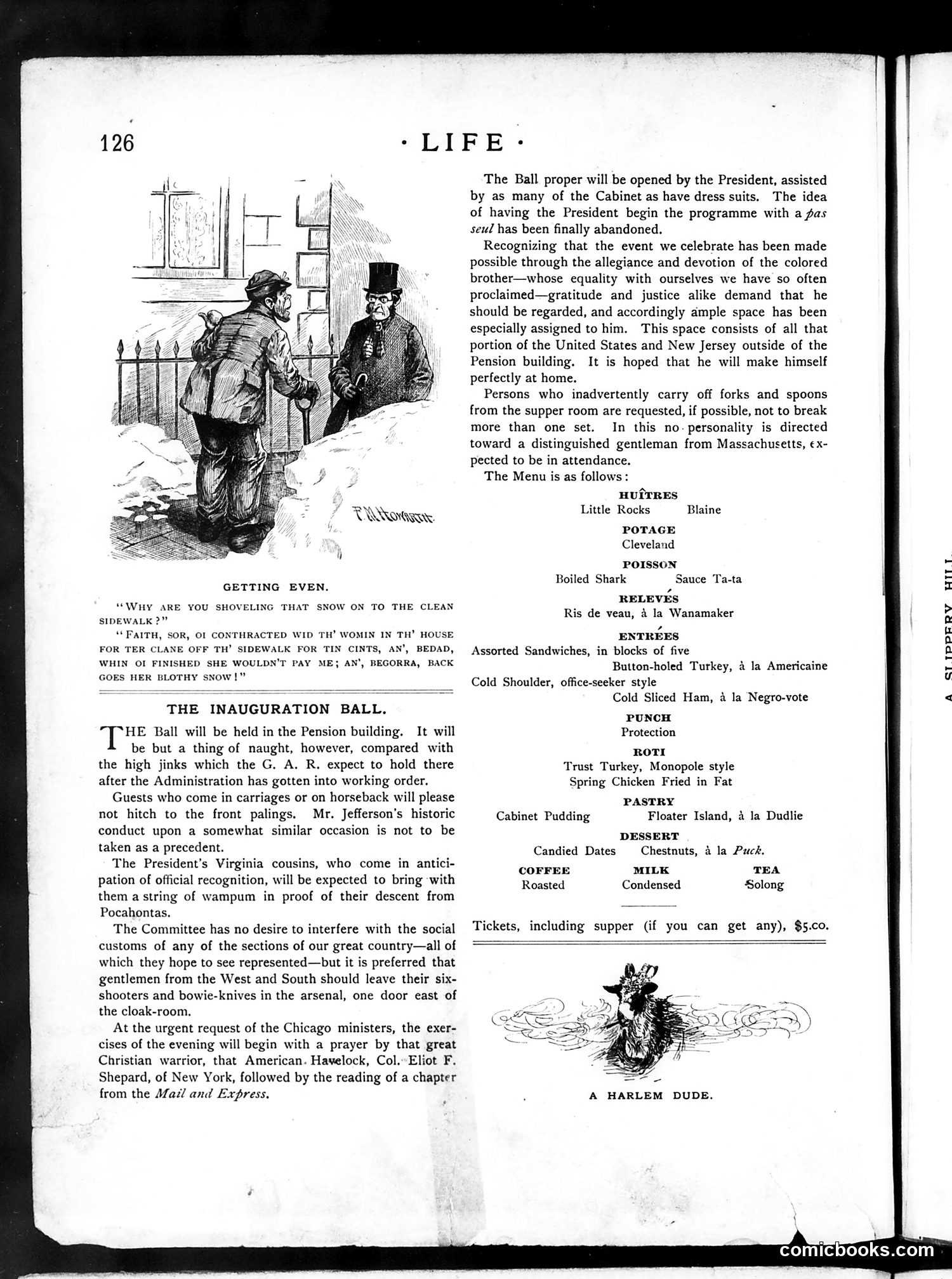
**The Cartoon (top left):** A caricatured Irish immigrant laborer confronts a woman about unpaid snow-shoveling work. He's dumping her cleaned snow back onto her sidewalk in revenge. The heavy Irish dialect stereotype ("FAITH, SOR," "BEDAD") was typical of period anti-Irish prejudice, though the joke frames the worker sympathetically—cheated workers deserve retaliation. **The Inauguration Ball article:** Heavy political satire mocking the incoming administration's pretensions and regional divisions. References include: - Jabs at Southern politicians claiming Pocahontas descent ("string of wampum") - Western delegates bringing weapons (six-shooters, bowie-knives) - Menu items as political in-jokes: "Cleveland" potage, "Wanamaker" dishes, "Negro-vote" ham - Mocking tokenism toward Black citizens: grudging acknowledgment of their contribution while segregating them outside the Pension building - Sarcastic jibes at Massachusetts politicians and spoils-system opportunists The satire targets Republican hypocrisy about racial equality and regional unity.
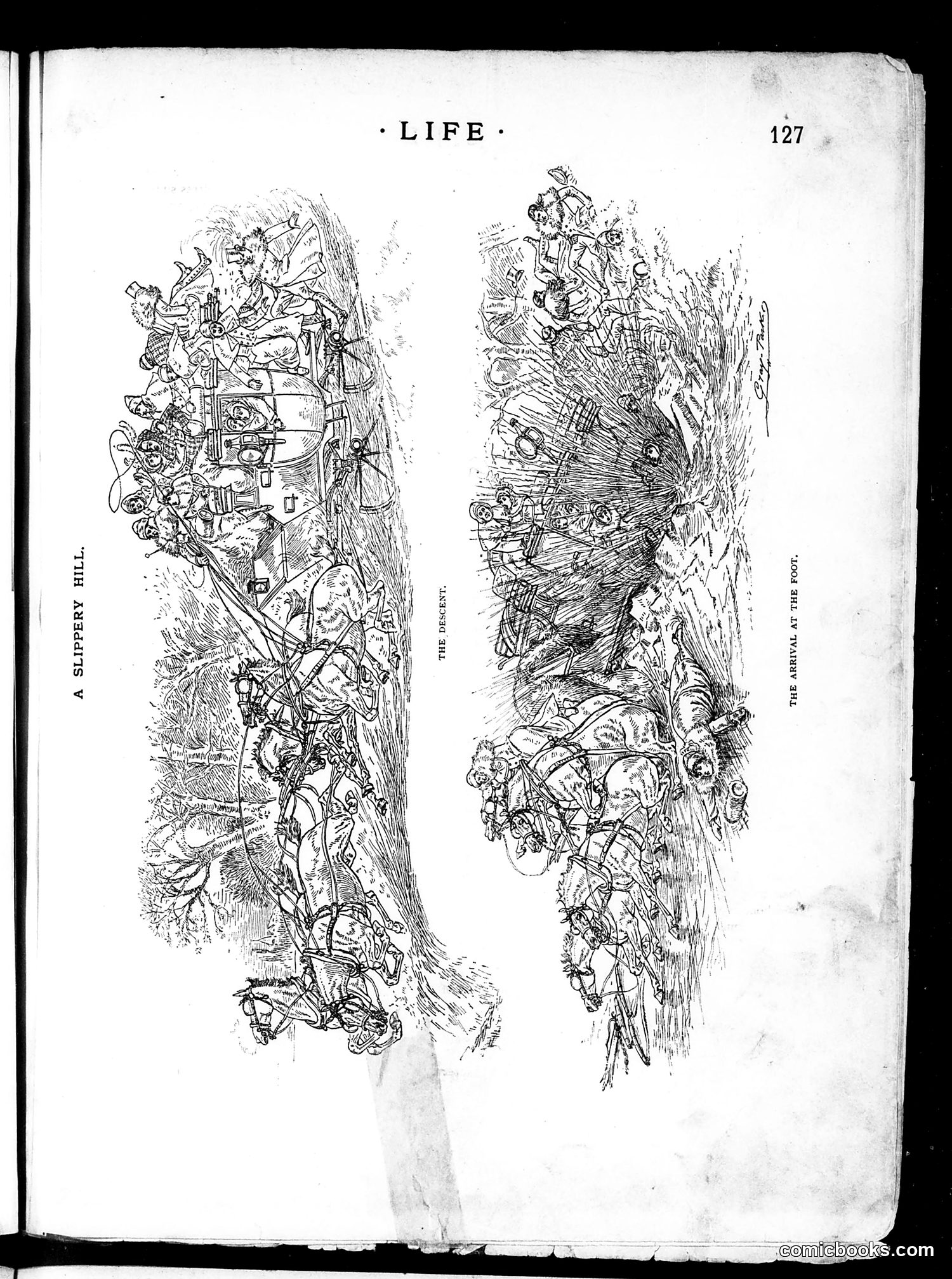
This page contains two companion satirical illustrations titled "The Descent" (left) and "The Arrival at the Foot" (right), drawn in a chaotic, densely-packed style typical of 19th-century political cartoons. The images appear to depict a tumultuous scene of numerous figures in disarray—possibly representing political or social disorder. The crowded, swirling composition suggests chaos or collapse, with figures seemingly falling or piling atop one another. Without clearer visibility of specific caricatured faces or readable caption text beyond the titles, I cannot definitively identify which political figures or events this references. The style and composition suggest commentary on political turmoil, governmental dysfunction, or social upheaval, but the specific context requires additional historical documentation to interpret accurately.
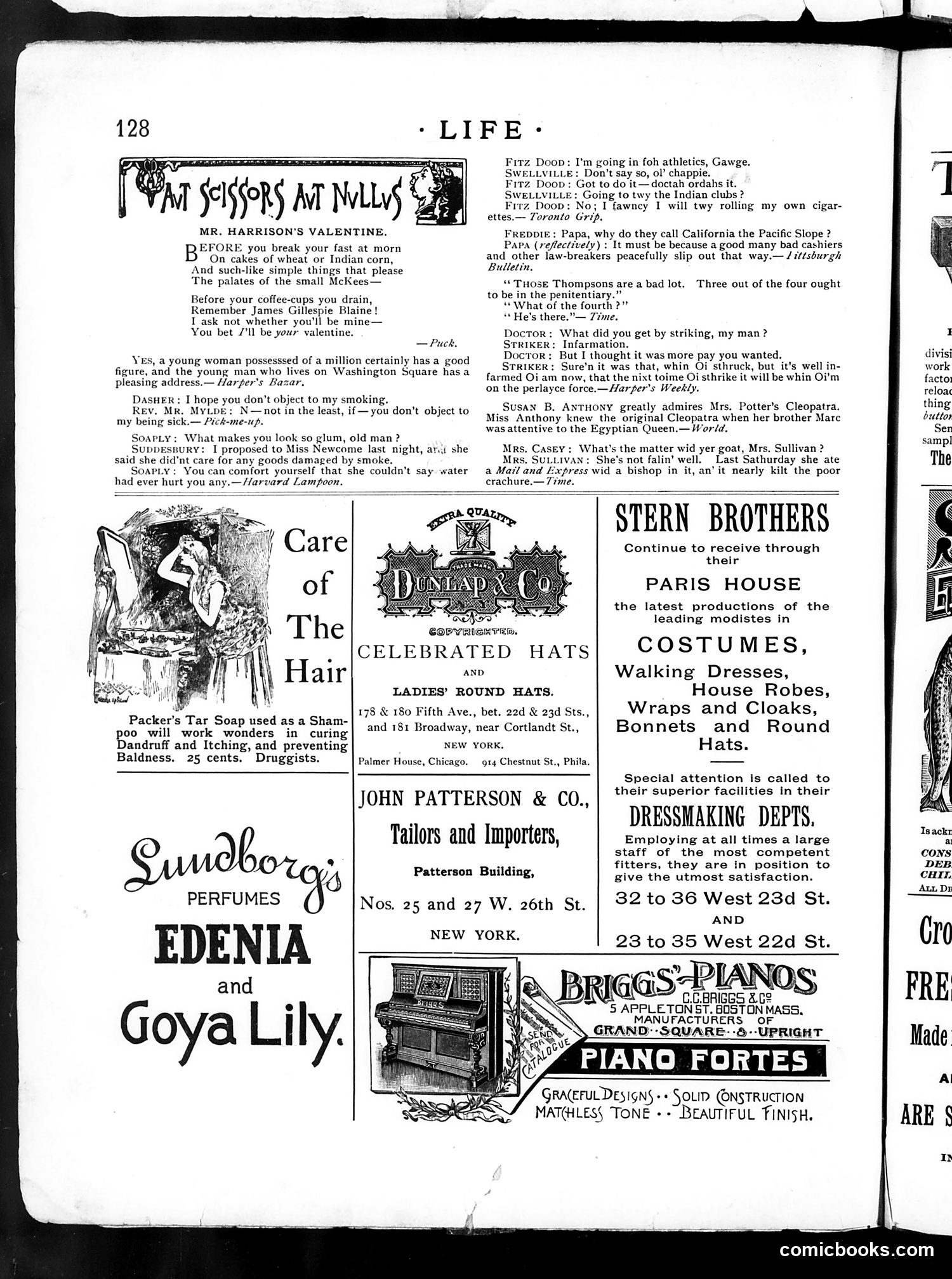
This page is primarily **advertising with satirical humor scattered throughout**—typical of Life magazine's format. The main cartoon, "At Scissors at Nullys: Mr. Harrison's Valentine," appears to mock **James Gillespie Blaine**, a prominent 19th-century politician. The Valentine's Day poem sarcastically suggests Blaine is so self-interested that even his romantic overtures are really about himself ("You bet I'll be your valentine"). Below are miscellaneous jokes poking fun at contemporary social situations: a reverend made sick by smoking, a rejected suitor whose fiancée dislikes smoke-damaged goods, and a quip about California harboring criminals ("bad cashiers...slip out that way"). One joke references **Susan B. Anthony**, the women's suffrage activist, claiming she knew the historical Cleopatra—an absurdist jab at Anthony's age and activism. The remainder consists of period advertisements for hats, tailoring, perfume, and pianos—no political content. The page reflects Life's blend of satirical commentary on recognizable figures mixed with commercial content.
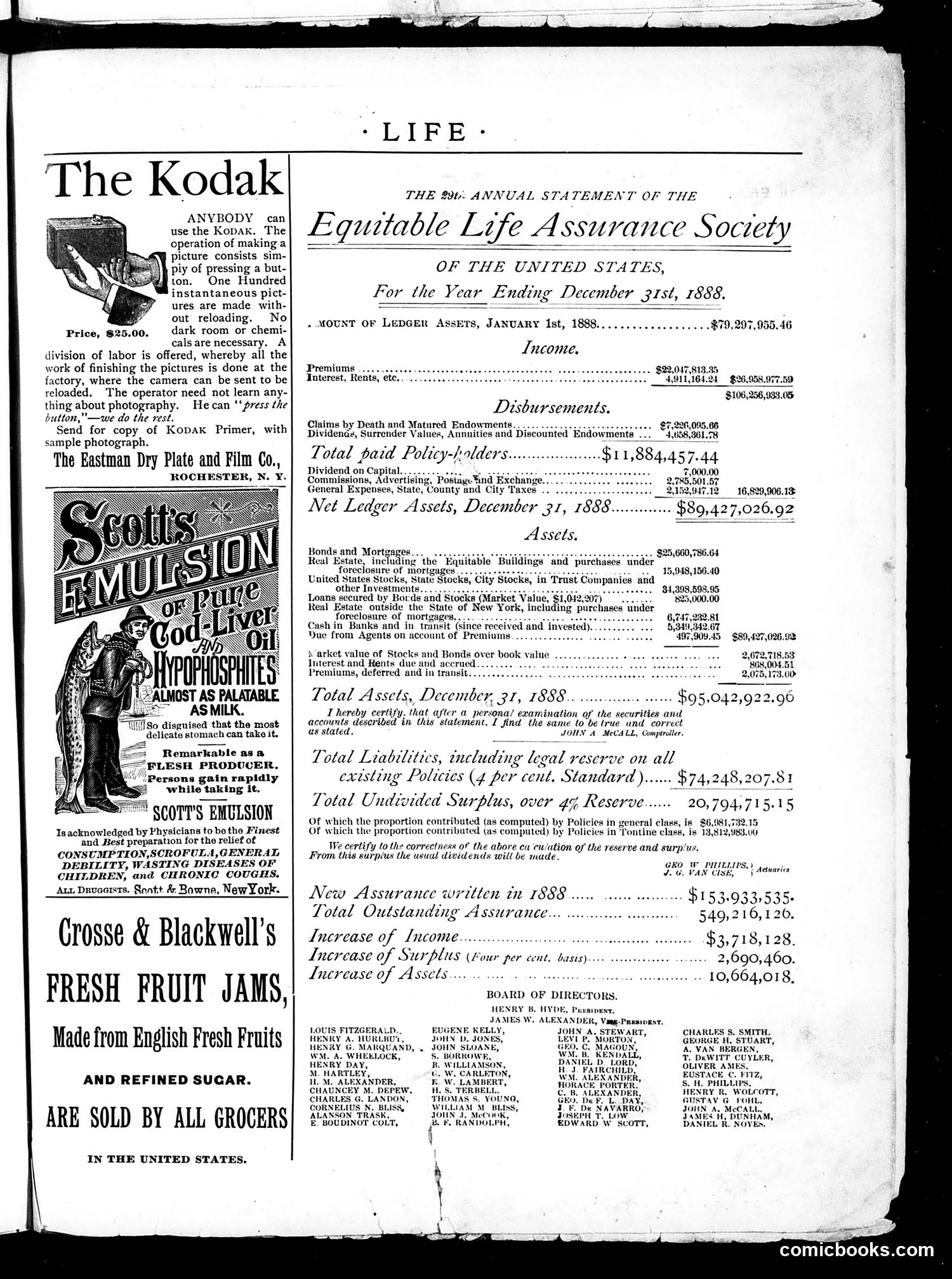
This page is primarily a **financial statement and advertisement page**, not a satirical cartoon page. The main content is the 29th Annual Statement of the **Equitable Life Assurance Society of the United States for 1888**—a straightforward corporate financial report listing assets ($95 million), income, disbursements, and board members. The surrounding space contains **product advertisements** typical of 1888: Kodak cameras ($25, emphasizing ease-of-use), Scott's Emulsion (a cod-liver oil health supplement for consumption and wasting diseases), Grosse & Blackwell's jams, and the Eastman Dry Plate and Film Company. **There is no political cartoon or satire visible on this page.** It represents Life magazine functioning as a general-interest publication mixing news, financial reports, and advertising—standard practice for late-19th-century periodicals before Life later became primarily known for satirical cartoons and humor.
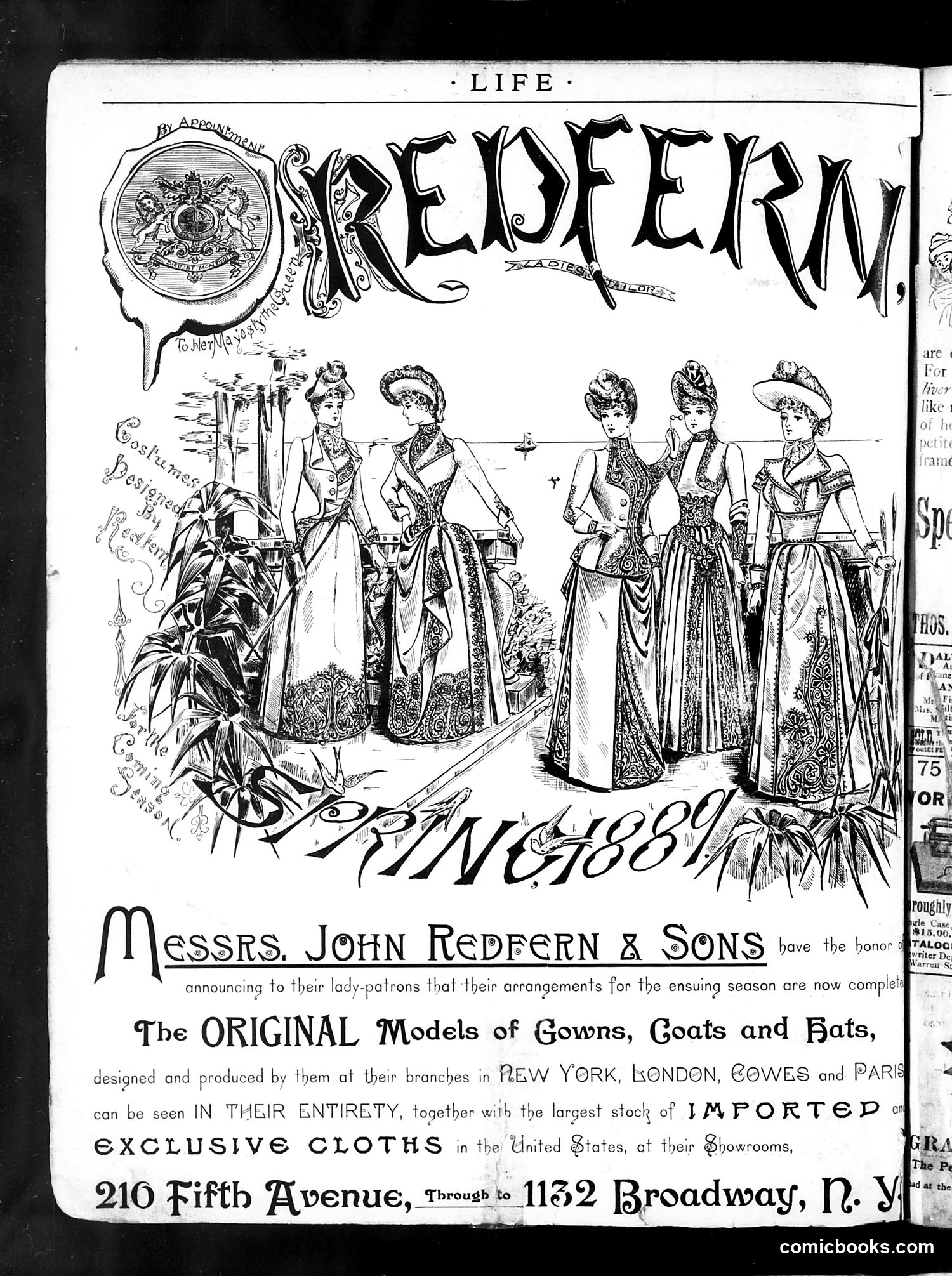
This page is primarily a **fashion advertisement**, not political satire. It shows Messrs. John Redfern & Sons announcing their spring 1899 season collections. The illustration depicts six fashionably dressed women in elaborate 1890s gowns with the ornate styling typical of that era—high collars, voluminous skirts, decorative trim, and elaborate hats. The decorative header features a coat of arms, suggesting the company's prestige. The text advertises "Original Models of Gowns, Coats and Bats" (likely "Bats" meaning bonnets or hats) designed at their branches in New York, London, Cowes, and Paris. They're promoting exclusive imported fabrics and two New York showroom locations. This is a high-end luxury fashion announcement typical of *Life* magazine's advertising content, targeting wealthy women patrons—not editorial commentary or political cartoons.
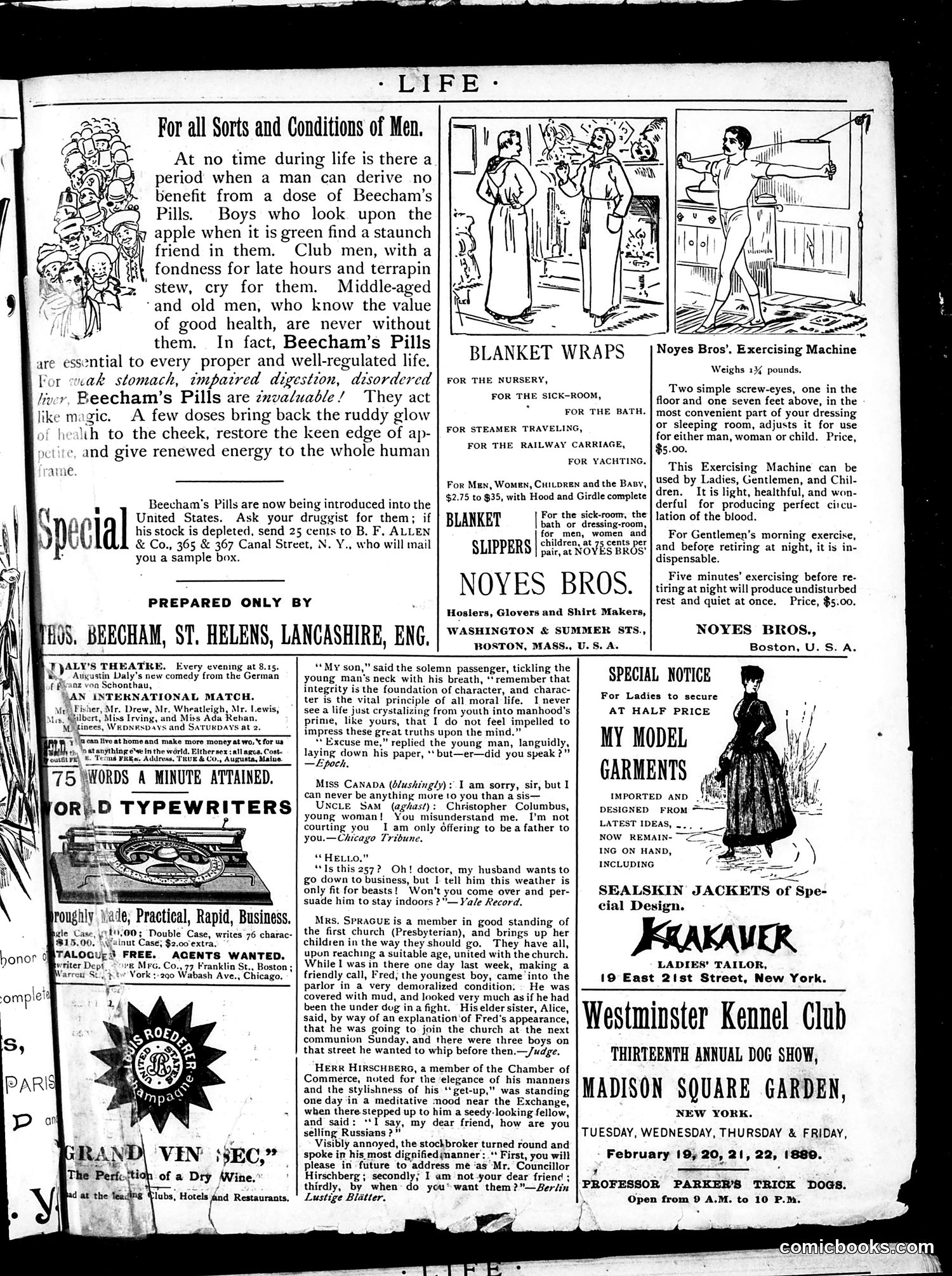
This is primarily a **Victorian-era advertising page** (circa 1880s, based on the Westminster Kennel Club Show date of February 1880) with embedded satirical comic anecdotes rather than traditional cartoons. The page advertises patent medicines (Beecham's Pills), exercise equipment, typewriters, and clothing. The satire lies in three brief humorous dialogues: 1. **"My son" anecdote**: A pompous older man lectures a young man about integrity and character—but the young man ignores him, suggesting the moralizing is tiresome and ineffective. 2. **Miss Canada/Uncle Sam joke**: A young woman misunderstands an elderly man's offer of paternal support as a romantic proposal, poking fun at social awkwardness and miscommunication. 3. **Doctor's weather call**: A wife prevents her husband from going to work due to bad weather, suggesting domestic control. These brief comic moments mock Victorian social pretension, generational disconnect, and domestic dynamics—typical of *Life* magazine's satirical approach before it became a general-interest publication.
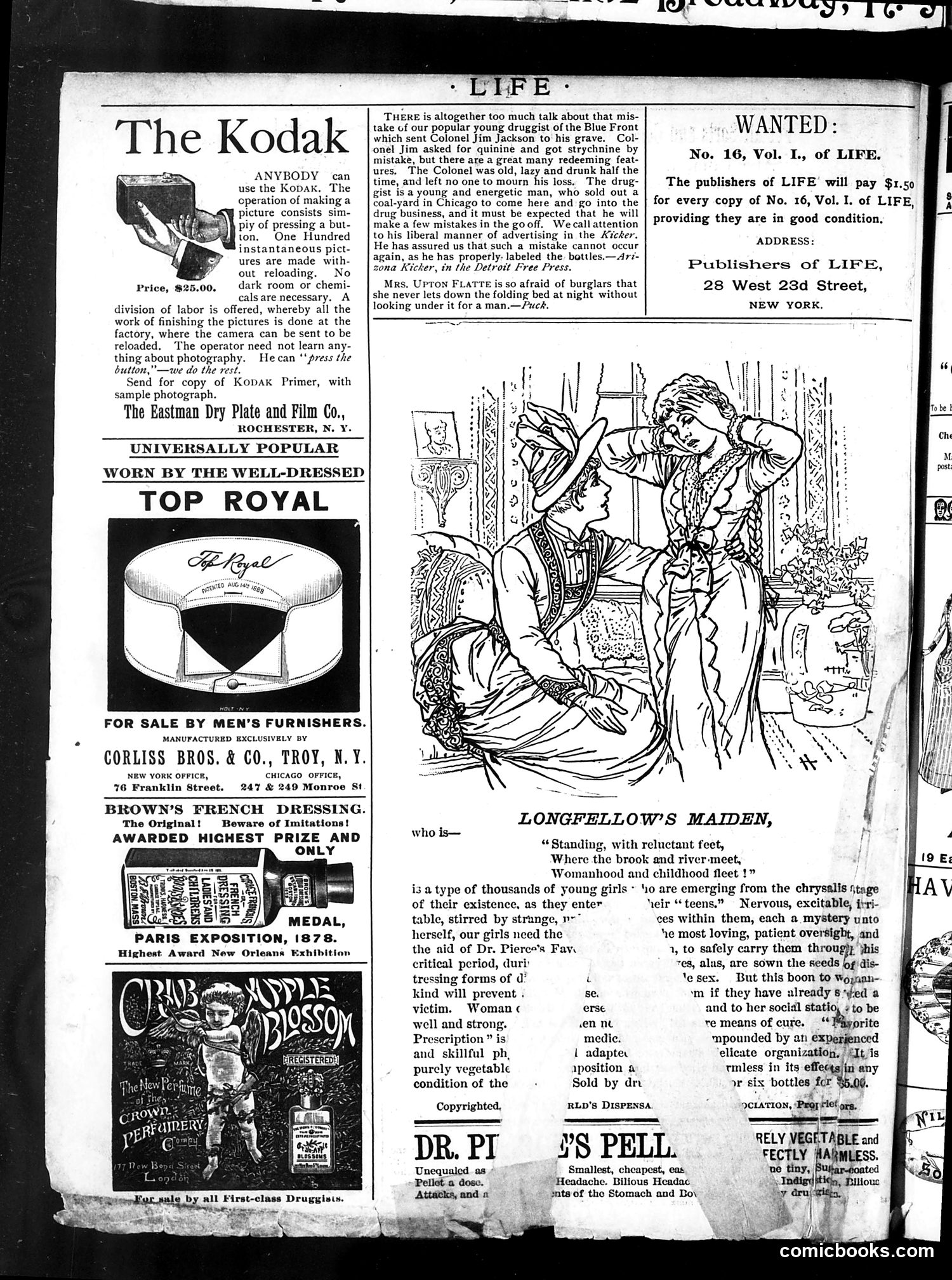
This page is primarily **advertising** rather than political satire. It contains: 1. **The Kodak Camera ad** (top left): Promotes the revolutionary new camera technology, emphasizing its simplicity—users need only "press the button" while the factory handles development. This represents early consumer photography democratization. 2. **Top Royal hat advertisement**: A standard men's furnishing product ad. 3. **Brown's French Dressing**: A humorous local anecdote about a careless druggist who gave strychnine instead of quinine to Colonel Jim Jackson, defending the young druggist's character despite the fatal mistake. 4. **"Longfellow's Maiden"**: A Dr. Pierce's medical advertisement using Longfellow's poetry to market a "Favorite Prescription" tonic for young women entering womanhood, addressing "nervous" conditions. 5. **Dr. Pierce's pills and patent medicines**: Standard late-19th-century proprietary medicine ads. The page reflects **Victorian-era consumer culture** and the patent medicine industry, which heavily advertised tonics and pills for vaguely-defined "female complaints."
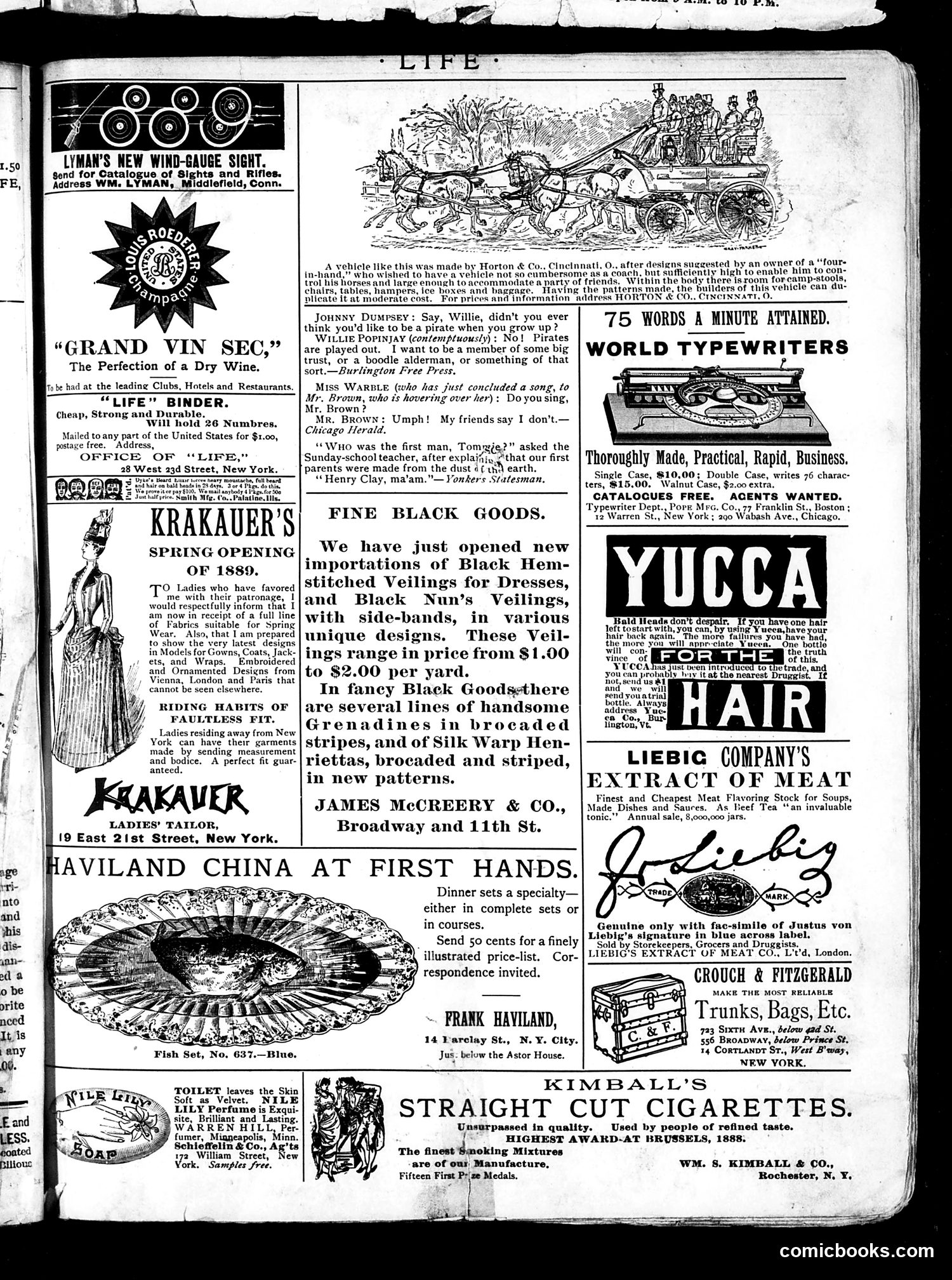
This is primarily an **advertising page** from Life magazine (circa 1889, based on "Krakauer's Spring Opening of 1889"). The page contains three brief **comic dialogues** satirizing contemporary American values: 1. **Willie Popinjay dialogue**: A child abandons pirate fantasies for more "modern" criminal aspirations—joining a trust or becoming a corrupt alderman. This mocks the Gilded Age's rampant corporate monopolies and political corruption as worse than traditional villainy. 2. **Sunday school joke**: A child names "Henry Clay" as the first man. This likely references Clay's prominence in earlier American politics, creating humor through the child's anachronistic confusion of historical figures. 3. **Musical performance joke**: Standard Victorian-era banter about a woman's singing. The bulk of the page consists of **period advertisements** for ladies' tailoring, china, fabrics, typewriters, and food products—typical commercial content for a magazine subsidized by advertising revenue. No coherent political cartoon dominates; rather, the satire is contained in the brief comedic snippets interspersed among ads.
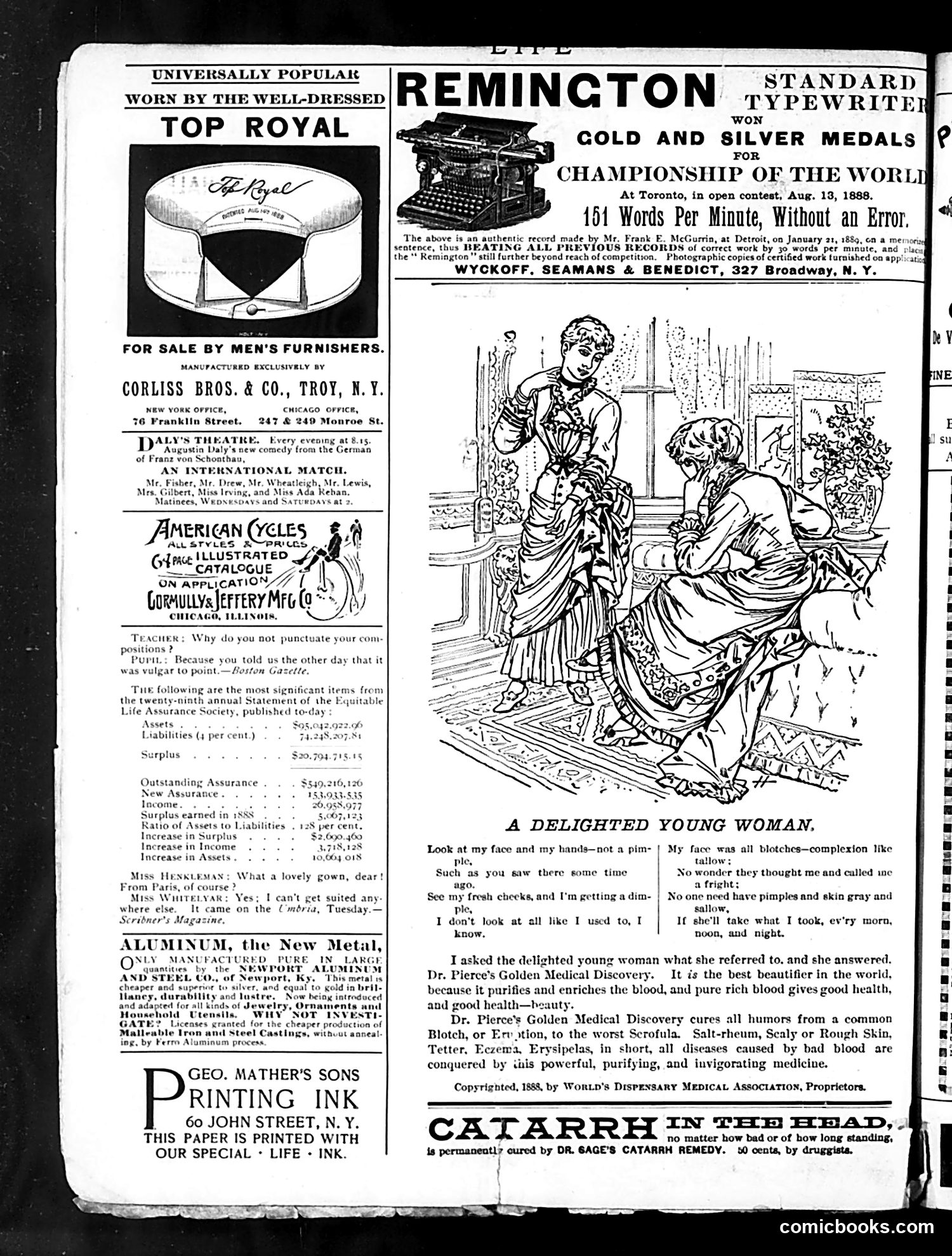
This page is primarily **advertisements and filler content** rather than political satire. The notable elements: **Main Cartoon:** "A Delighted Young Woman" depicts a before-and-after testimonial for Dr. Pierce's Golden Medical Discovery. The illustration shows a woman claiming the patent medicine cured her facial blemishes and complexion problems. This is characteristic of late-19th-century **medical advertising**, which made sweeping health claims (often fraudulent by modern standards). **Other Content:** The page includes ads for Remington typewriters (promoting their speed records), Top Royal hats, aluminum products, and printing ink. There's also a minor joke about a student not punctuating compositions. **Historical Context:** This reflects the 1888 era's aggressive patent medicine marketing, targeting appearance-conscious women with promises of "purifying blood" to cure skin conditions. Such advertisements were common in Life magazine and largely unregulated until the FDA's establishment. The page demonstrates how satirical magazines funded themselves through product advertising rather than relying on editorial content alone.
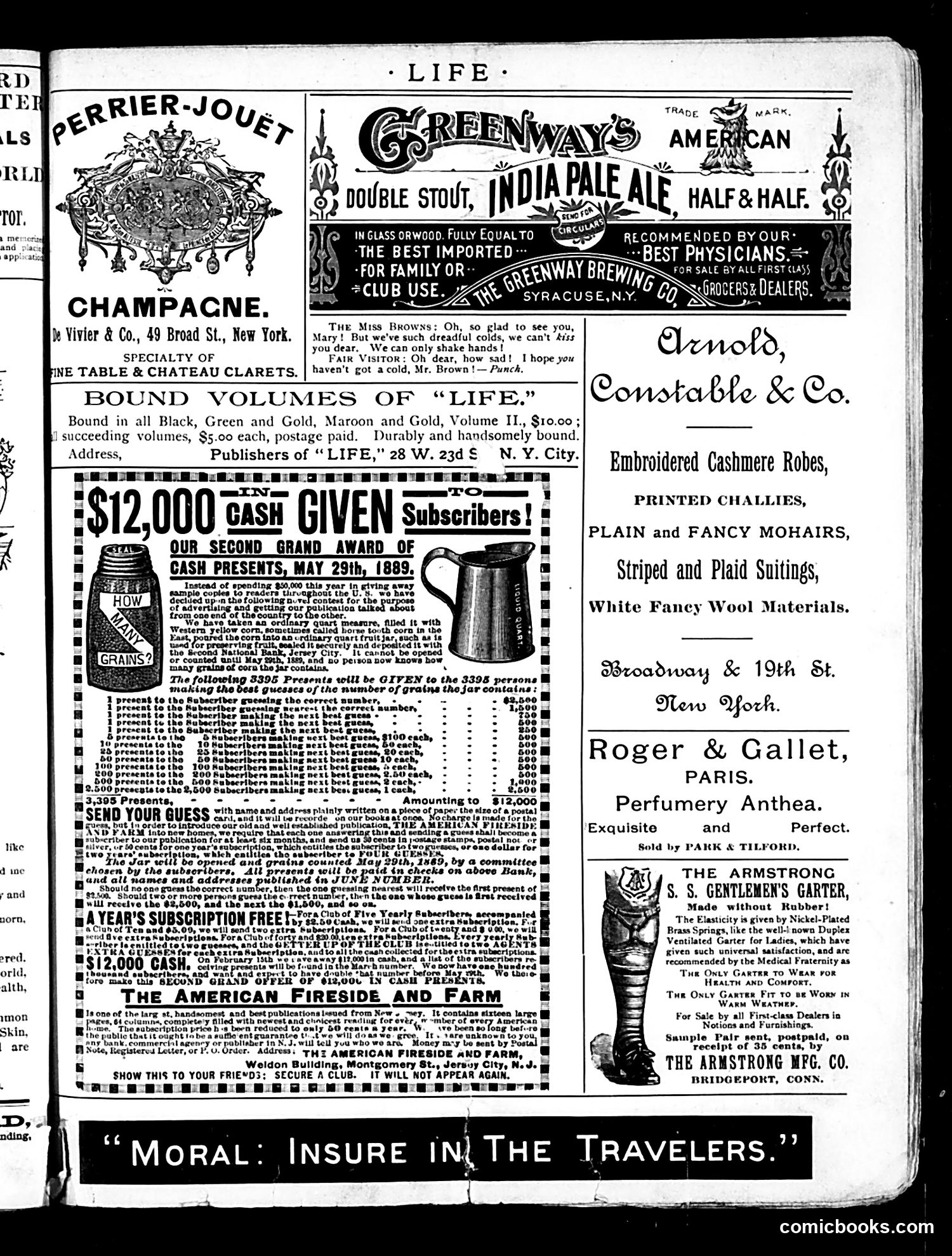
This page is primarily **advertising and promotional material** rather than editorial cartoon content. The main elements are: **Central Feature:** A "$12,000 Cash" contest advertisement for Life magazine's "Second Grand Award" (May 29, 1889). Readers guess the number of grains in a jar; correct or closest guesses win cash prizes distributed among 3,398 participants. **Small Comic Interlude:** A brief dialogue titled "The Miss Browns" shows social etiquette humor—visitors with colds refusing to kiss, only shake hands, with the punchline being a mild joke about contagion. **Surrounding Ads:** Various luxury product advertisements (champagne, cashmere robes, perfume, gentlemen's garters, medical devices) typical of Life's affluent readership. **Bottom Tagline:** "Moral: Insure in the Travelers"—a final advertisement for insurance. The page reflects Life's dual nature as both satirical magazine and advertising vehicle for upper-class consumers in 1889.
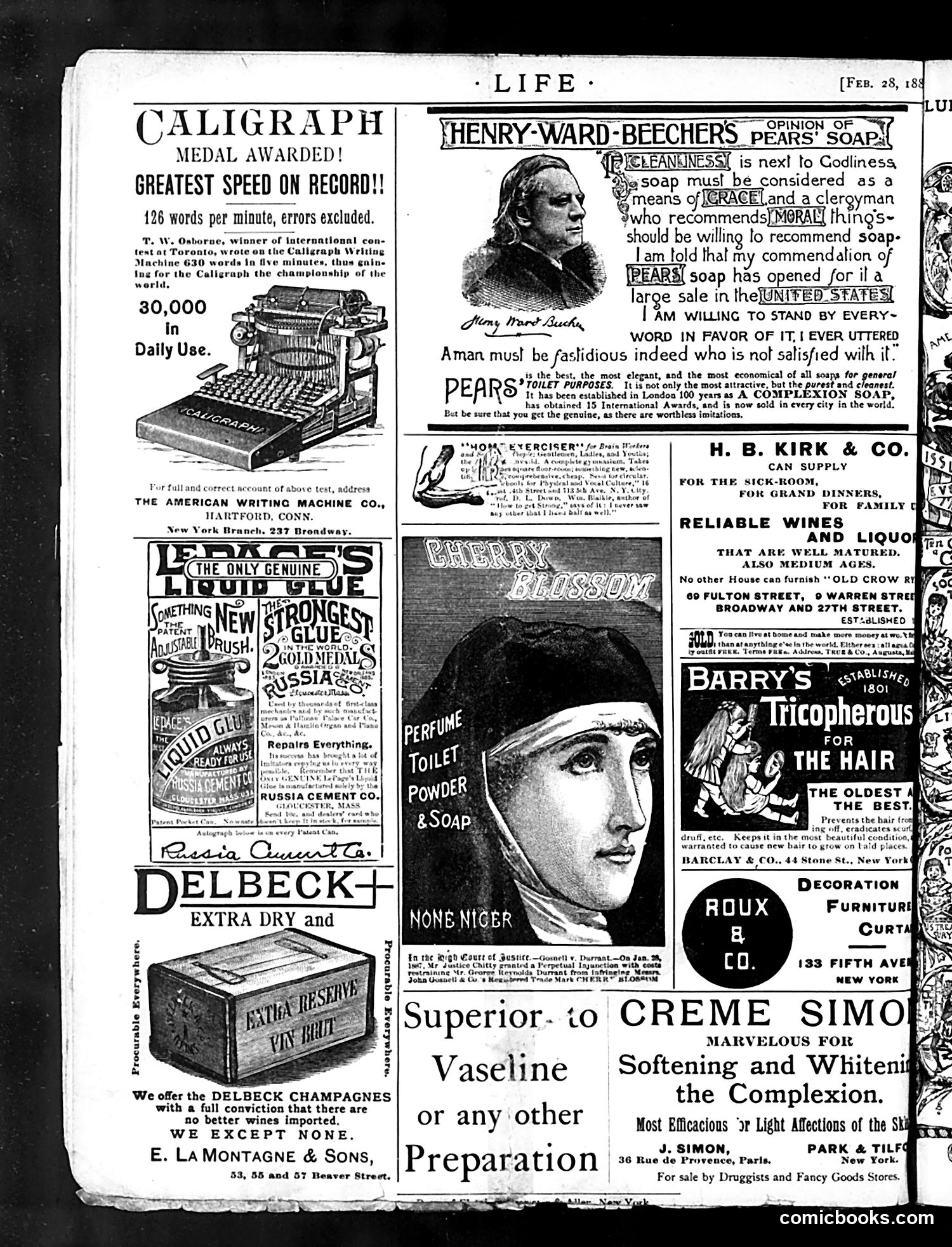
This page is primarily **advertisements**, not satirical content. It showcases late-Victorian consumer products and services: **Main advertisements:** - **Caligraph typewriter**: Promoted as the fastest writing machine (126 words/minute), emphasizing American technological superiority - **Pears' soap**: Features an endorsement attributed to "Henry Ward Beecher," a famous clergyman, claiming the soap ensures cleanliness and morality - **Alcoholic beverages**: Multiple wine and liquor advertisements (Delbeck champagne, H.B. Kirk whiskeys, Old Crow) - **Hair and beauty products**: Barry's Tricopherous (hair treatment), Creme Simo (complexion whitener) - **Russia Cement** and **Liquid Glue** **Historical context**: These ads reflect Victorian-era marketing, where celebrity endorsements (like Beecher's for Pears') and appeals to respectability were common sales tactics. The prominence of alcohol advertisements and skin-whitening products reflects period attitudes toward luxury and beauty standards. No political satire appears on this page.