
Life, 1889-02-28 · page 8 of 22
Life — February 28, 1889 — page 8: what you’re looking at
What you’re looking at
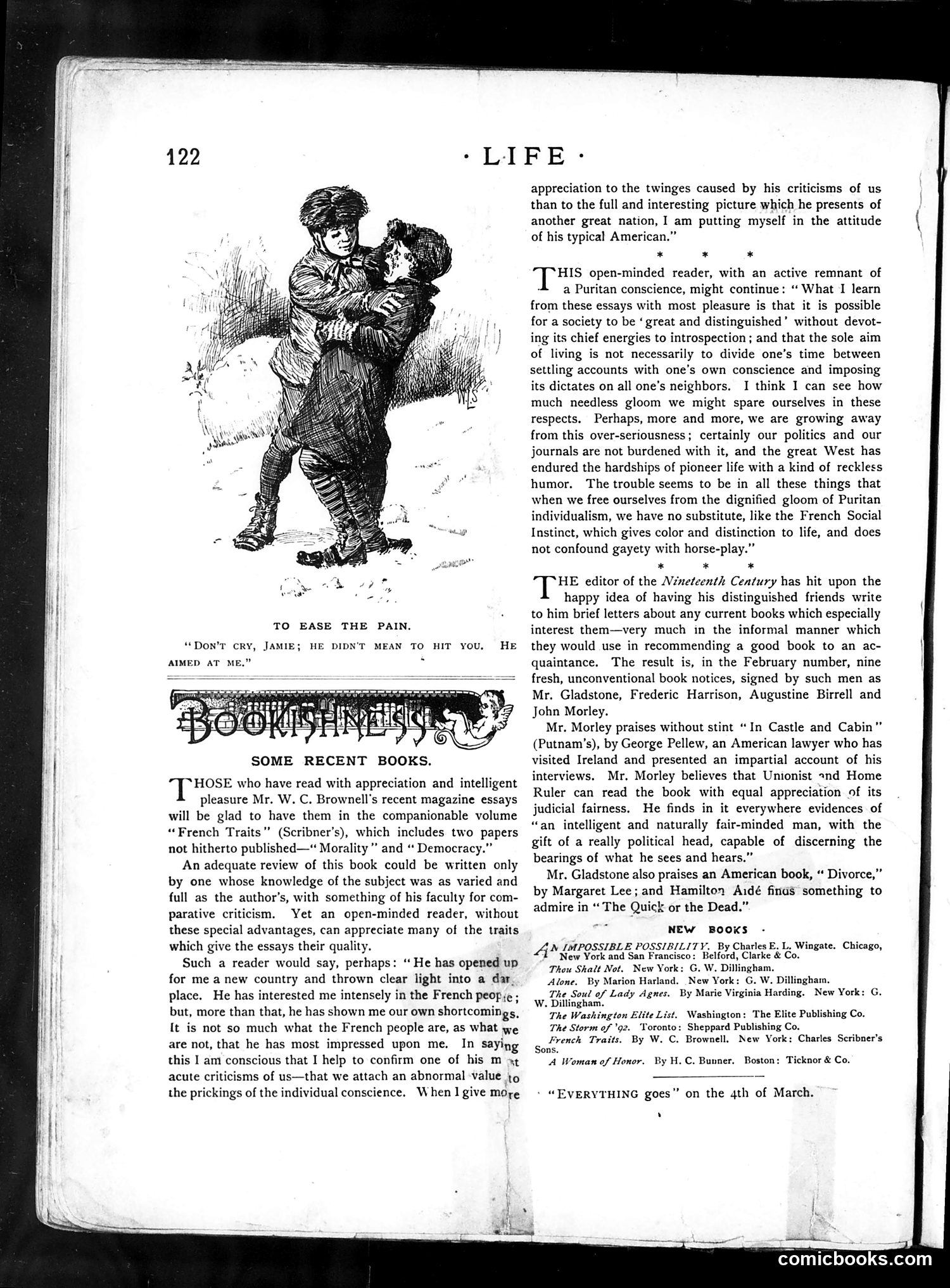
This illustration depicts an adult comforting a crying child, with the caption "Don't cry, Jamie; he didn't mean to hit you. His arm's up." The cartoon satirizes adults' unconvincing attempts to minimize children's suffering through hollow reassurances. The humor lies in the absurdity of the explanation—suggesting the arm being "up" somehow negates the impact of a blow—representing how adults often offer inadequate comfort to distressed children. The surrounding text discusses W.C. Brownell's essay collection and book reviews, but the cartoon itself stands alone as social satire about parent-child dynamics and the gap between adult rationalization and children's genuine pain.
📄 Transcribed text from this page (OCR, searchable)
Machine-transcribed from the original scan — historical spelling and the odd misread are preserved.
-LIFE: TO EASE THE PAIN, “Don’r CRY, JAMIE; HE DIDN'T MEAN TO HIT YoU, AIMED AT ME.” SOME RECENT BOOKS. “HOSE who have read with appreciation and intelligent pleasure Mr. W. C. Brownell’s recent magazine essays will be glad to have them in the companionable volume “French Traits” (Scribner's), which includes two papers not hitherto published—“ Morality” and “ Democracy.” An adequate review of this book could be written only by one whose knowledge of the subject was as varied and full as the author’s, with something of his faculty for com- parative criticism. Yet an open-minded reader, without these special advantages, can appreciate many of the traits which give the essays their quality. Such a reader would say, perhaps: ‘‘ He has opened up for me a new country and thrown clear light into a dar. place. He has interested me intensely in the French peope ; but, more than that, he has shown me our own shortcomings, {t is not so much what the French people are, as what we are not, that he has most impressed upon me. In saying this 1 am conscious that I help to confirm one of his m xt acute criticisms of us—that we attach an abnormal value to the prickings of the individual conscience. When | give more appreciation to the twinges caused by his criticisms of us than to the full and interesting picture which he presents of another great nation, I am putting myself in the attitude of his typical American.” * * * HIS open-minded reader, with an active remnant of a Puritan conscience, might continue: ‘“ What I learn from these essays with most pleasure is that it is possible for a society to be ‘great and distinguished’ without devot- ing its chief energies to introspection; and that the sole aim of living is not necessarily to divide one’s time between settling accounts with one’s own conscience and imposing its dictates on all one’s neighbors. I think 1 can see how much needless gloom we might spare ourselves in these respects. Perhaps, more and more, we are growing away from this over-seriousness ; certainly our politics and our journals are not burdened with it, and the great West has endured the hardships of pioneer life with a kind of reckless humor. The trouble seems to be in all these things that when we free ourselves from the dignified gloom of Puritan individualism, we have no substitute, like the French Social Instinct, which gives color and distinction to life, and does not confound gayety with horse-play.” * * * HE editor of the Vzneteenth Century has hit upon the happy idea of having his distinguished friends write to him brief letters about any current books which especially interest them—very much in the informal manner which they would use in recommending a good book to an ac- quaintance. The result is, in the February number, nine fresh, unconventional book notices, signed by such men as Mr. Gladstone, Frederic Harrison, Augustine Birrell and John Morley. Mr. Morley praises without stint “In Castle and Cabin” (Putnam’s), by George Pellew, an American lawyer who has visited Ireland and presented an impartial account of his interviews. Mr. Morley believes that Unionist nd Home Ruler can read the book with equal appreciation of its judicial fairness. He finds in it everywhere evidences of “an intelligent and naturally fair-minded man, with the gift of a really political head, capable of discerning the bearings of what he sees and hears.” Mr. Gladstone also praises an American book, “ Divorce,” by Margaret Lee; and Hamilton Aidé finds something to admire in ‘‘ The Quick or the Dead.” NEW BOOKS 4 IMPOSSIBLE POSSIBILITY. By Charles E. L, Wingate. Chicago, 1” New York and San Francisco: Belford, Clarke & Co. Thou Shalt Not. New York: G. W. Dillingham. Alone. By Marion Harland. New York: G. W. Dillingham, The Soul of Lady Agnes. By Marie Virginia Harding. New York: G. W. Dillingham. The Washington Elite List. Washington: The Elite Publishing Co. The Storm of ‘92. Toronto: Sheppard Publishing Co. French Traits. By W. C. Brownell, New York: Charles Scribner's Sons. A Woman of Honor. By H.C. Bunner, Boston: Ticknor & Co. “EVERYTHING goes” on the 4th of March. 5 comicbooks.com