
Life, 1889-02-28 · page 4 of 22
Life — February 28, 1889 — page 4: what you’re looking at
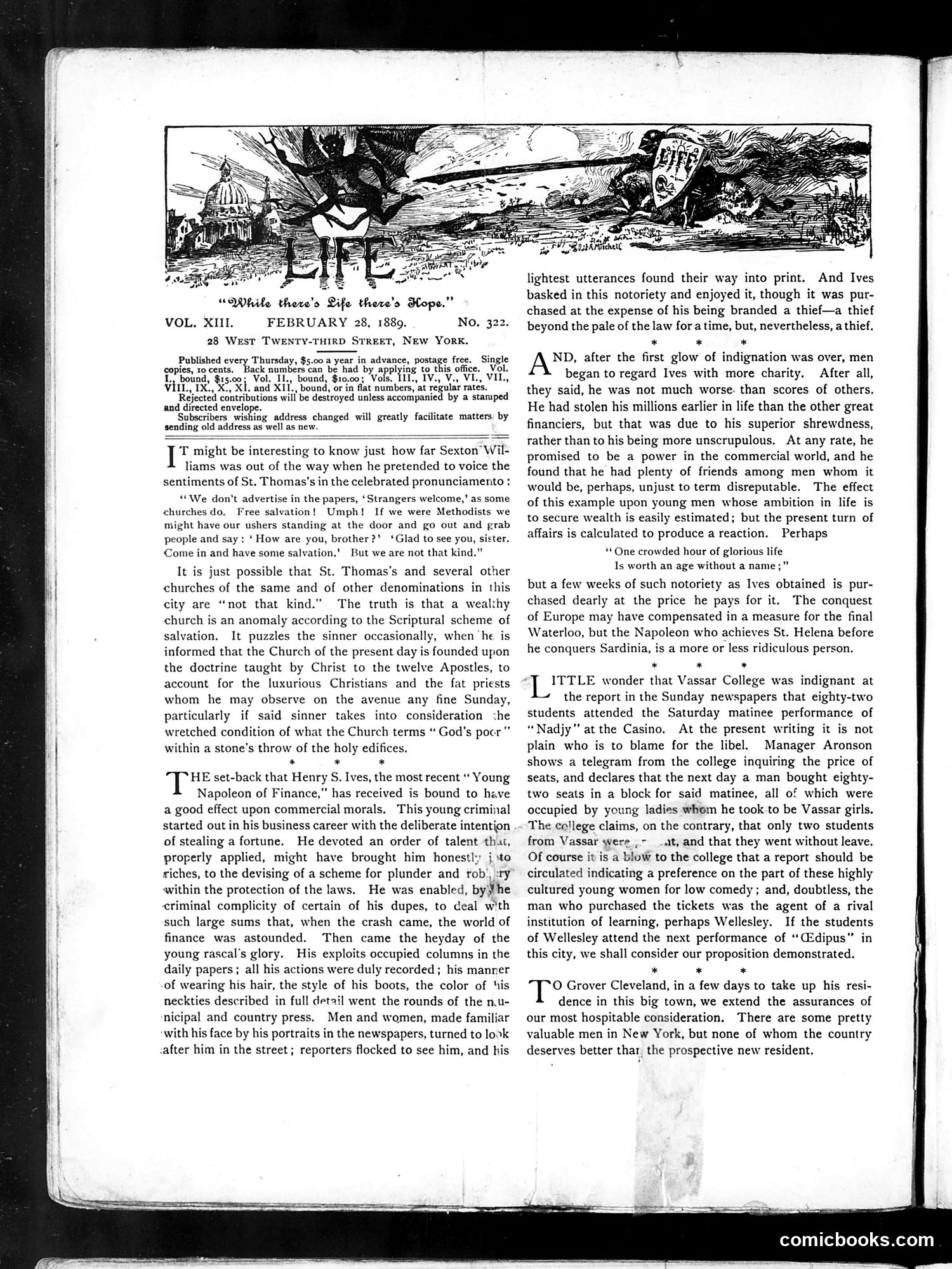
What you’re looking at
The main illustration depicts a figure in formal dress gesturing dramatically, with what appears to be a cityscape and the moon in the background. Based on the text below, this likely refers to **Henry M. Stanley Ives**, described as a recent "Young Napoleon of Finance" who engaged in criminal financial schemes and theft. The satire mocks Ives's notoriety—his exploits were widely covered in newspapers, with portraits circulating publicly. The article criticizes how his criminal cleverness initially attracted admiration from young men seeking wealth, but ultimately exposed the corrupting influence of unchecked ambition in commercial life. The cartoon appears to satirize the celebrity status granted to financial criminals and the dangerous example they set for impressionable youth.
📄 Transcribed text from this page (OCR, searchable)
Machine-transcribed from the original scan — historical spelling and the odd misread are preserved.
“While there's Life there’s Hope.” VOL, XIII. FEBRUARY 28, 1889. No, 322. 28 WesT TWENTY-THIRD STREET, NEw YorK. Published every Thursday, $5.00 a year in advance, postage free. Single gorics, 10 cents. “Back numbers can be had By ay applying te to tl i otc Vol. L, bound, $15.00; Vol. Il., bound, $10.00; I « VEL, Vie Te, NER, Nod KIT, Sound, brie fa numbers, at eval Sate Rejected contributions will be destroyed unless accompanied by a stamped and directed envelope. Subscribers wishing address changed will greatly facilitate matters: by sending old address as well as new. E- might be interesting to know just how far Sexton Wil- liams was out of the way when he pretended to voice the sentiments of St. Thomas's in the celebrated pronunciamento : “We don’t advertise in the papers, ‘Strangers welcome,’ as some churches do. Free salvation! Umph! If we were Methodists we might have our ushers standing at the door and go out and grab people and say : ‘How are you, brother?’ ‘Glad to see you, sister. Come in and have some salvation,’ But we are not that kind.” It is just possible that St. Thomas's and several other churches of the same and of other denominations in this city are “not that kind.” The truth is that a wealthy church is an anomaly according to the Scriptural scheme of salvation. It puzzles the sinner occasionally, when ‘he is informed that the Church of the present day is founded upon the doctrine taught by Christ to the twelve Apostles, to account for the luxurious Christians and the fat priests whom he may observe on the avenue any fine Sunday, particularly if said sinner takes into consideration :he wretched condition of what the Church terms “ God’s pocr” within a stone's throw of the holy edifices. * * * HE set-back that Henry S. Ives, the most recent “ Young Napoleon of Finance,” has received is bound to have a good effect upon commercial morals. This young criminal started out in his business career with the deliberate intention of stealing a fortune. He devoted an order of talent th.t, properly applied, might have brought him honestl: j sto riches, to the devising of a scheme for plunder and rob’, :ry within the protection of the laws. He was enabled, bythe criminal complicity of certain of his dupes, to deal w'th such large sums that, when the crash came, the world of finance was astounded. Then came the heyday of the young rascal’s glory. His exploits occupied columns in the daily papers ; all his actions were duly recorded ; his manner of wearing his hair, the style of his boots, the color of his neckties described in full detail went the rounds of the nu- nicipal and country press. Men and women, made familiar with his face by his portraits in the newspapers, turned to look after him in the street; reporters flocked to see him, and his lightest utterances found their way into print. And Ives basked in this notoriety and enjoyed it, though it was pur- chased at the expense of his being branded a thief—a thief beyond the pale of the law fora time, but, nevertheless, a thief. * * * AM after the first glow of indignation was over, men began to regard Ives with more charity. After all, they said, he was not much worse: than scores of others. He had stolen his millions earlier in life than the other great financiers, but that was due to his superior shrewdness, rather than to his being more unscrupulous. At any rate, he promised to be a power in the commercial world, and he found that he had plenty of friends among men whom it would be, perhaps, unjust to term disreputable. The effect of this example upon young men whose ambition in life is to secure wealth is easily estimated; but the present turn of affairs is calculated to produce a reaction. Perhaps “One crowded hour of glorious life Is worth an age without a name;” but a few weeks of such notoriety as Ives obtained is pur- chased dearly at the price he pays for it. The conquest of Europe may have compensated in a measure for the final Waterloo, but the Napoleon who achieves St. Helena before he conquers Sardinia, is a more or less ridiculous person. * * * ITTLE wonder that Vassar College was indignant at the report in the Sunday newspapers that eighty-two students attended the Saturday matinee performance of “Nadjy” at the Casino, At the present writing it is not plain who is to blame for the libel. Manager Aronson shows a telegram from the college inquiring the price of seats, and declares that the next day a man bought eighty- two seats in a block for said matinee, all of which were occupied by young ladies whom he took to be Vassar girls. ‘The college claims, on the contrary, that only two students from Vassar were ,~ at, and that they went without leave. Of course it is a blow to the college that a report should be circulated indicating a preference on the part of these highly cultured young women for low comedy ; and, doubtless, the man who purchased the tickets was the agent of a rival institution of learning, perhaps Wellesley. If the students of Wellesley attend the next performance of “(Edipus” in this city, we shall consider our proposition demonstrated. * * * T° Grover Cleveland, in a few days to take up his resi- dence in this big town, we extend the assurances of our most hospitable consideration. There are some pretty valuable men in New York, but none of whom the country deserves better thar, the prospective new resident. comicbooks.com