
A complete issue · 14 pages · 1889
Life — February 21, 1889
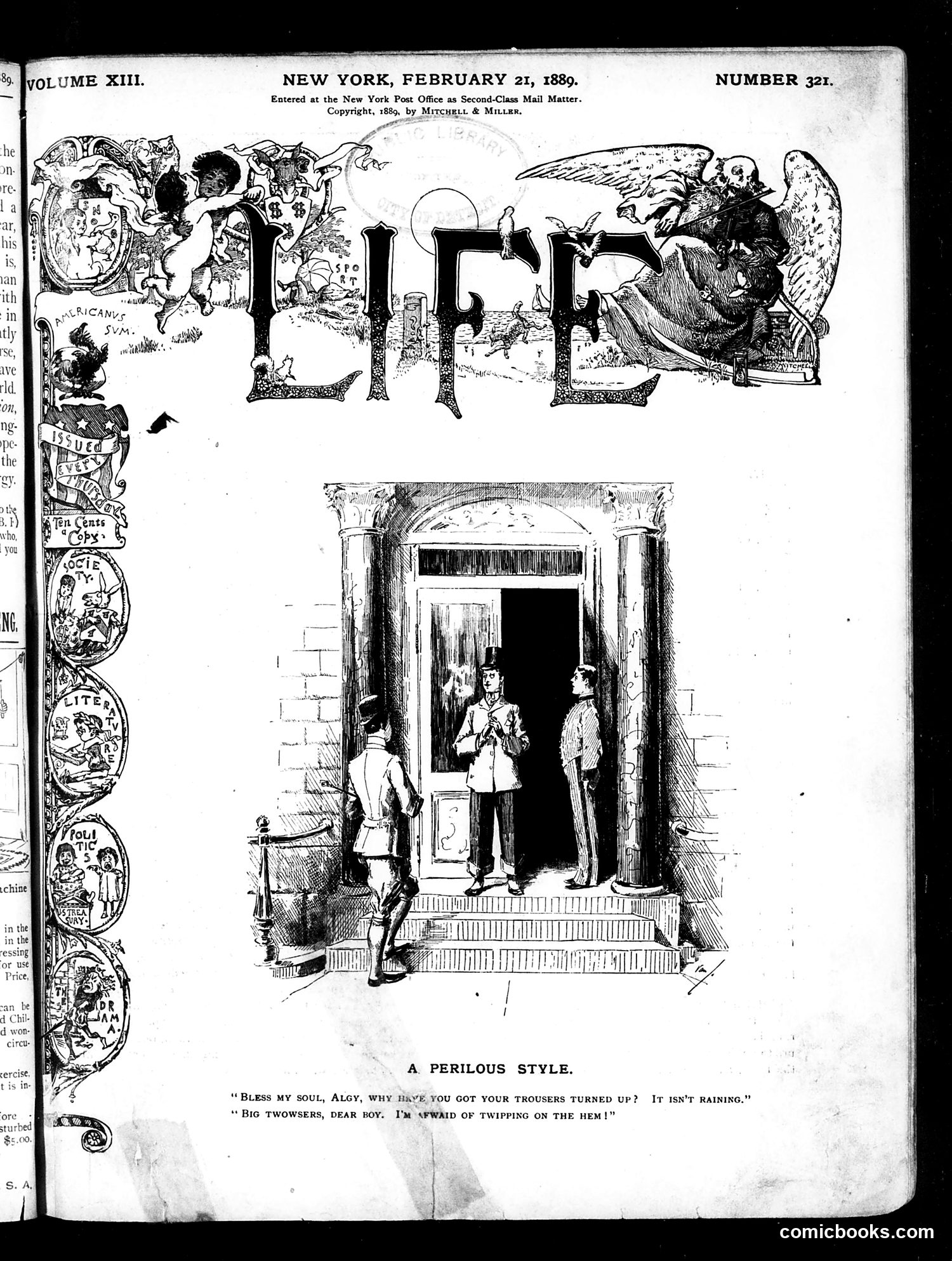
This 1880 cartoon satirizes Victorian fashion anxieties. The illustration shows a young man with his trousers rolled up or turned inward, standing at a doorway while others react with concern. The dialogue reveals the joke: one character asks "Bless my soul, Algy, why have you got your trousers turned up? It isn't raining," while another responds "Big trousers, dear boy. I'm afraid of twiping on the hem!" The satire mocks fashionable young men ("Algy" suggests an affected dandy) who adopt impractical clothing trends—in this case, wearing excessively long trousers that require rolling up to avoid tripping. The cartoon ridicules both the absurdity of following fashion and the anxiety it causes wearers. "Life" magazine frequently lampooned Victorian fashion excess and pretension.
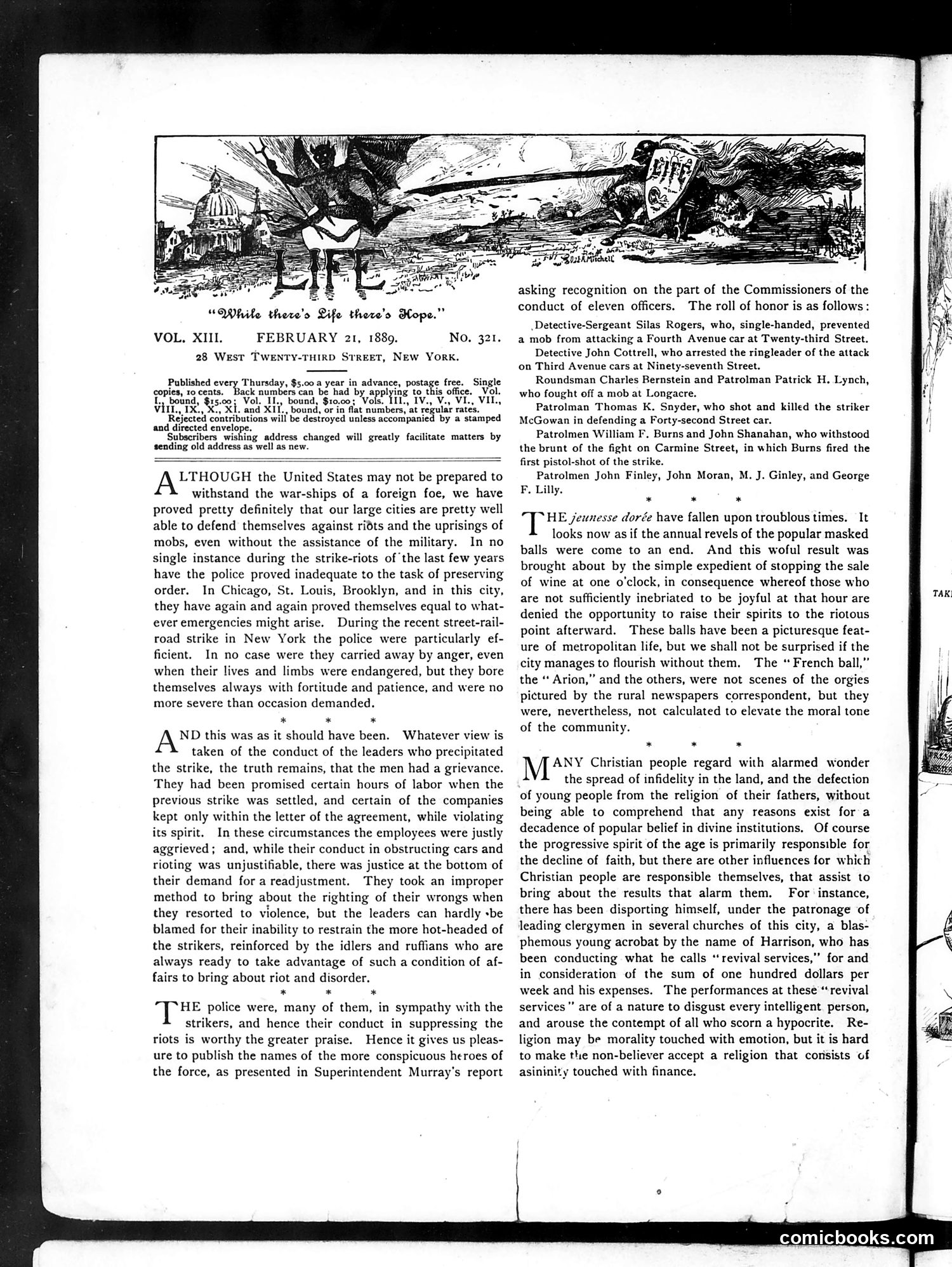
The masthead cartoon depicts a chaotic scene with a large figure labeled "LIFE" wielding a club against a mob, with a Capitol building visible. This illustrates the article's central argument: that American cities have proven capable of defending themselves against violent mobs without military intervention during recent labor strikes. The article specifically references the "strike-riots of the last few years" in Chicago, St. Louis, Brooklyn, and New York, praising police conduct during these incidents. It commends officers for maintaining order despite personal danger, and names eleven police officers honored for their bravery—including actions like stopping mob violence and protecting streetcars. The piece argues that while strikers had legitimate grievances about broken labor agreements, their violent methods were unjustifiable.
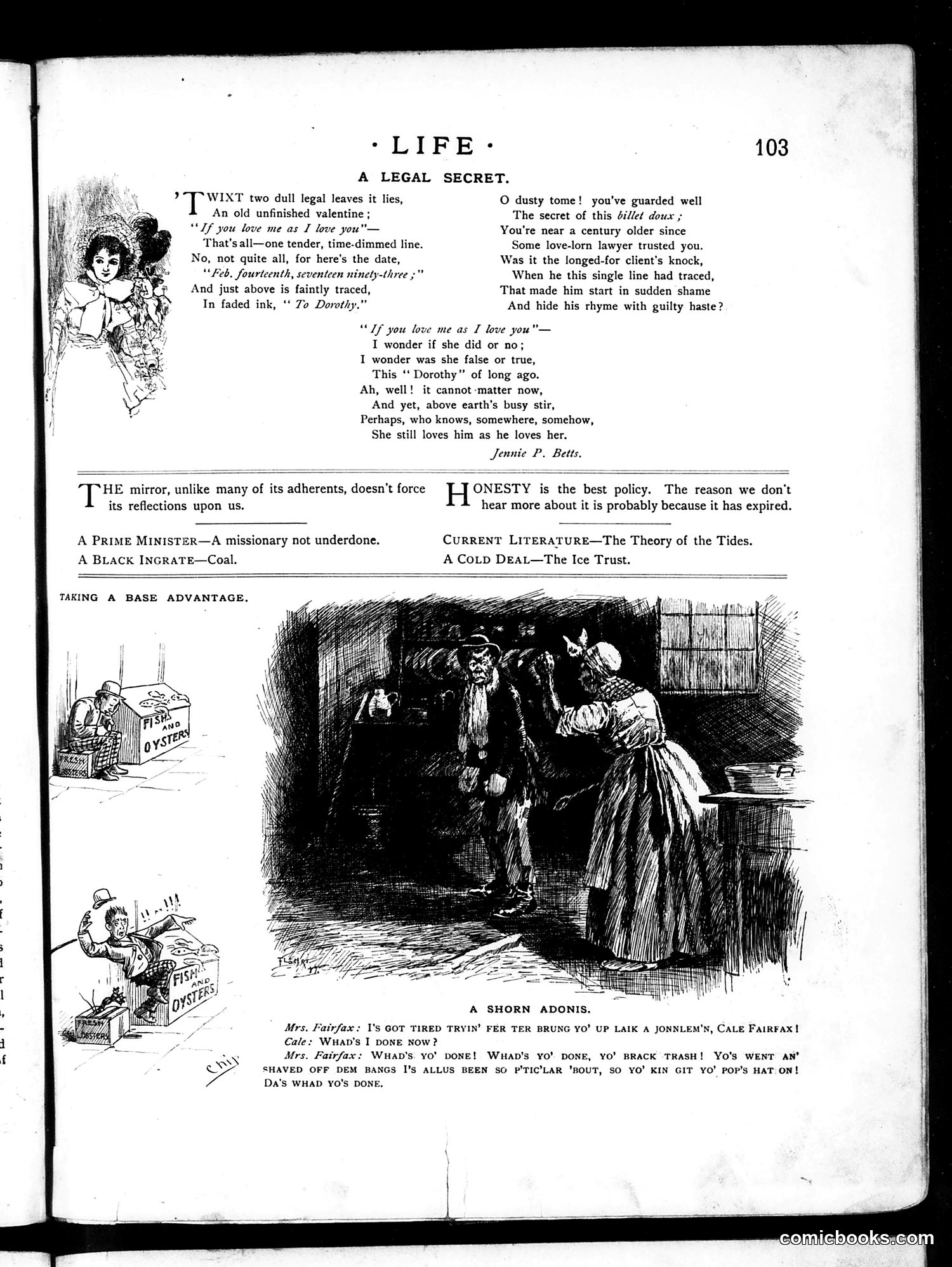
**"A Legal Secret"** is a poem about a love letter ("If you love me as I love you") dated 1894, discovered in old legal documents. The satire suggests lawyers guard such romantic secrets for decades—the humor lies in imagining century-old love letters surfacing in dusty legal files. **"Taking a Base Advantage"** shows two cartoon panels with an oyster vendor. The visual joke appears to be a pun: a vendor selling oysters uses their stand as a "base" for some advantage (possibly romantic or commercial—unclear exactly). **"A Shorn Adonis"** depicts a woman scolding a man about his appearance ("shaved off the bangs"), with dialogue in exaggerated working-class dialect, suggesting social commentary on changing grooming fashions and domestic conflict.
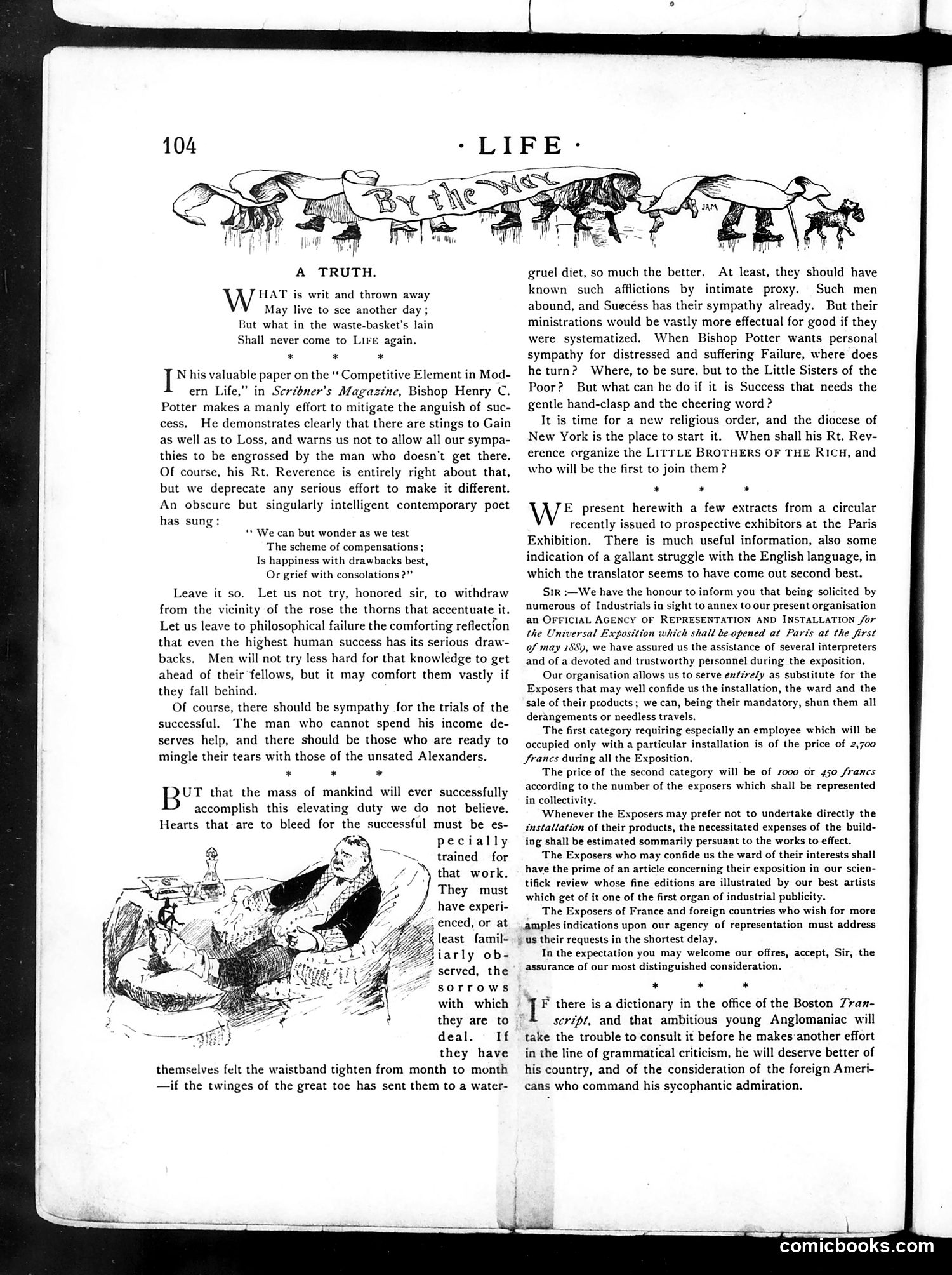
This page from *Life* magazine contains primarily text rather than political cartoons. The main content includes: **"A Truth"** — a short poem about regret and lost opportunities, followed by commentary on Bishop Henry C. Potter's writing about competitive success in modern life. The author argues that sympathy for the unsuccessful should be systematized through charitable organizations like the "Little Brothers of the Rich." **A small illustration** (lower left) depicts a figure in apparent distress or poverty, likely supporting the editorial's argument about suffering among the unsuccessful. **A letter** about the Paris Exhibition discusses representation and installation of products, appearing to be business correspondence rather than satire. The page emphasizes *social responsibility* toward those failed by competition, without specific political targets or identifiable caricatures visible in the text or image provided.
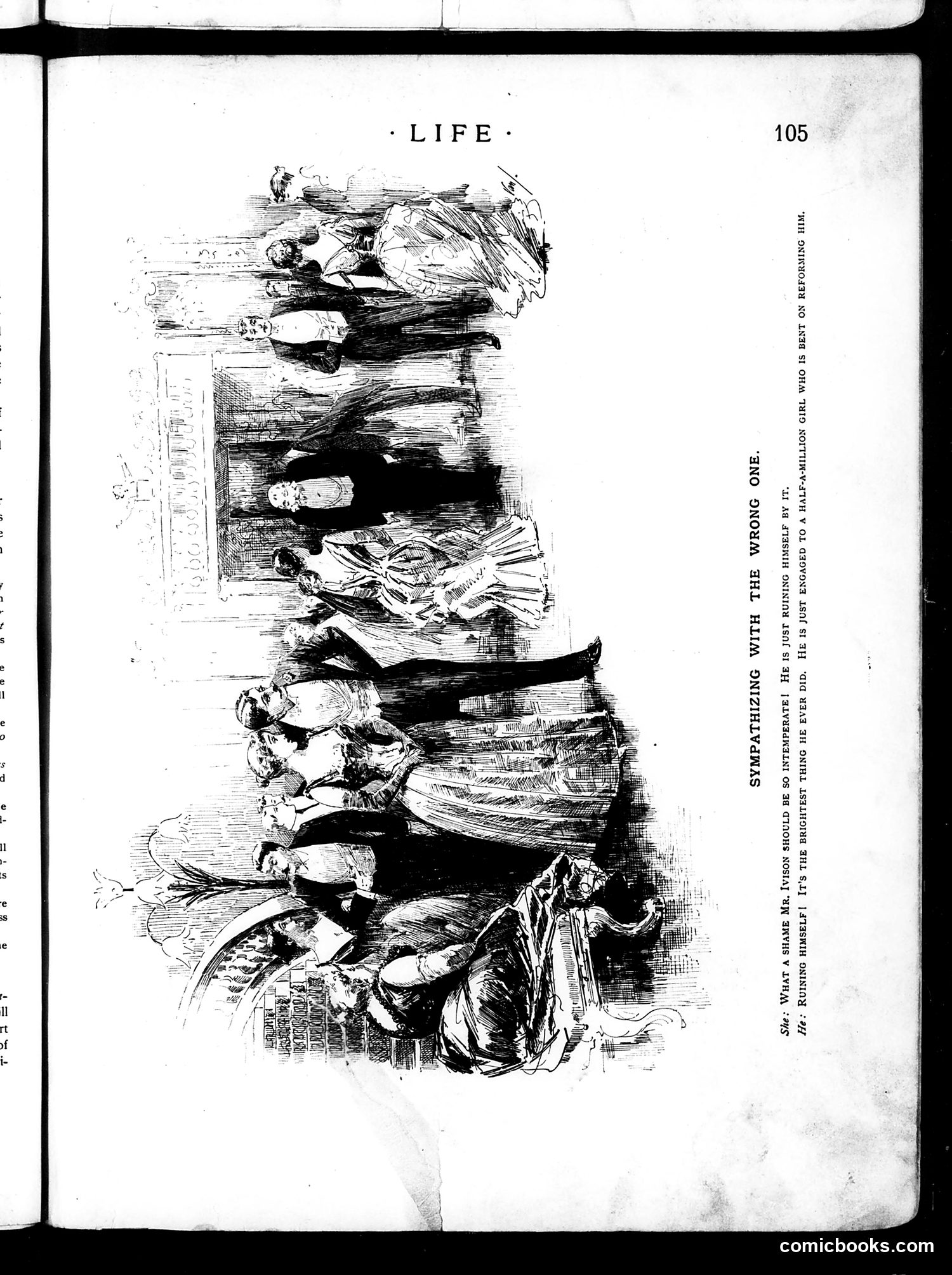
This cartoon depicts a social scene showing couples in what appears to be a romantic or intimate situation. The title suggests the satire concerns being stuck with an unsuitable romantic partner—the humor likely plays on the discomfort of being "sweltering" (sweating, uncomfortable) beside the wrong person in close quarters. The sketch-style illustration shows multiple figures in period dress, with the composition rotated so viewers must turn the page to read it properly. This was common in Life magazine's satirical cartoons. Without clearer visual details or additional context, the specific social commentary remains unclear—it could address courtship customs, marriage mismatches, or social embarrassment of the era. The caption's wry tone suggests poking fun at romantic or social conventions of the time.
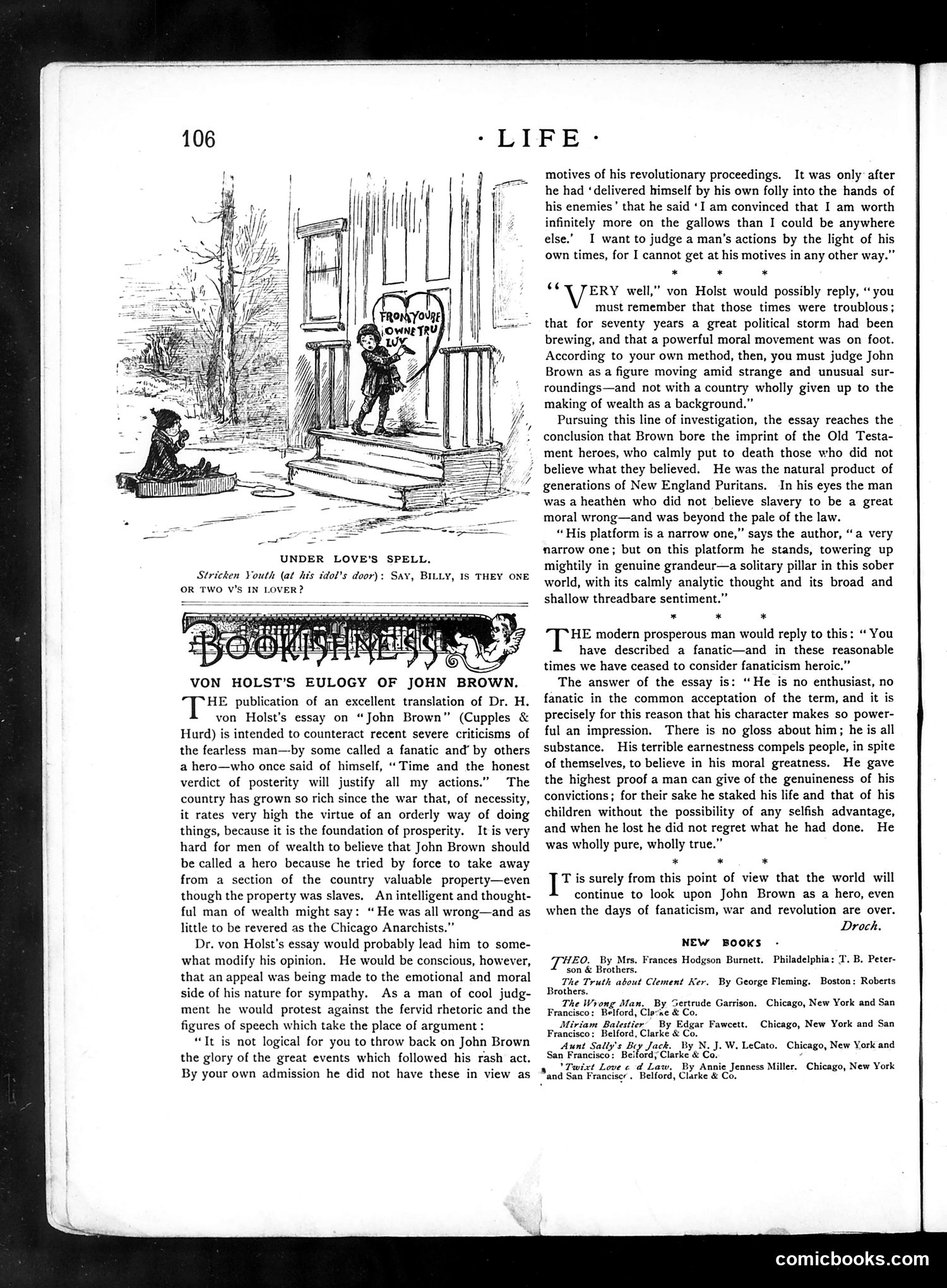
This page primarily features a literary essay titled "Von Holst's Eulogy of John Brown," discussing Brown's legacy and moral character. The small cartoon at the top, captioned "Under Love's Spell," depicts a young boy at a doorway calling out to a girl, asking "Say, Billy, is there one or two V's in lover?" This is a simple visual pun playing on children's spelling confusion—the boy is uncertain whether "lover" contains one or two V's (it contains one). The cartoon exploits the innocent context of childhood education for mild humor. The page itself is primarily text-based editorial content rather than political satire, focusing on historical and moral arguments about abolitionist John Brown.
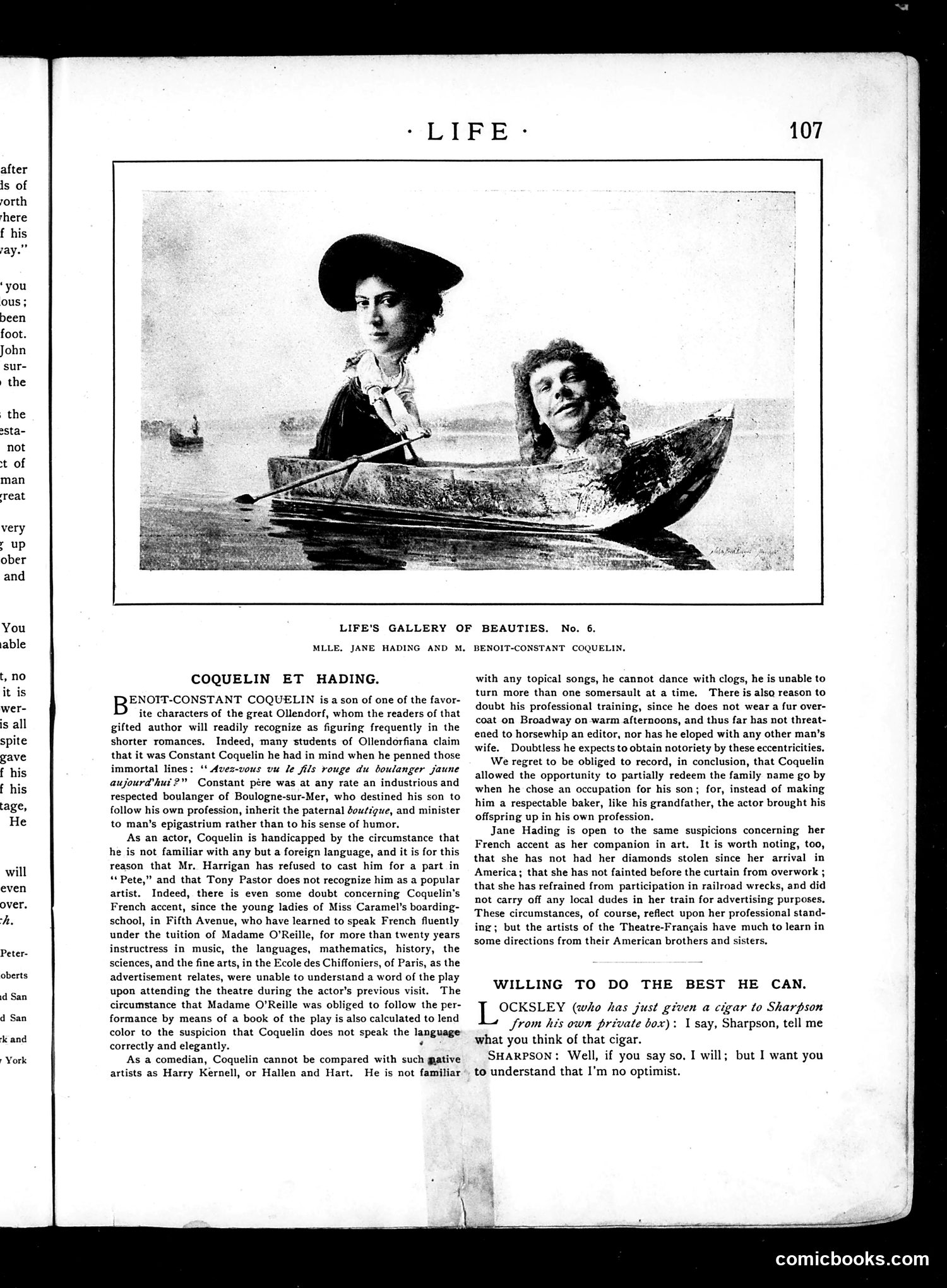
This page features "Life's Gallery of Beauties, No. 6," profiling two theatrical performers: Mlle. Jane Hading and M. Benoit-Constant Coquelin. The photograph shows them in a boat, likely a theatrical scene. The text describes Coquelin as a distinguished French actor from the Comédie-Française, noting his handicap as an actor due to lacking formal training and his inability to dance. Jane Hading, a French actress, is noted for her accent and professional restraint. At the bottom, there's a brief satirical exchange titled "Willing to Do the Best He Can" between characters Locksley and Sharpson regarding a cigar, suggesting mild social commentary on optimism. This appears primarily a **celebrity profile page** with light theatrical satire rather than political commentary.
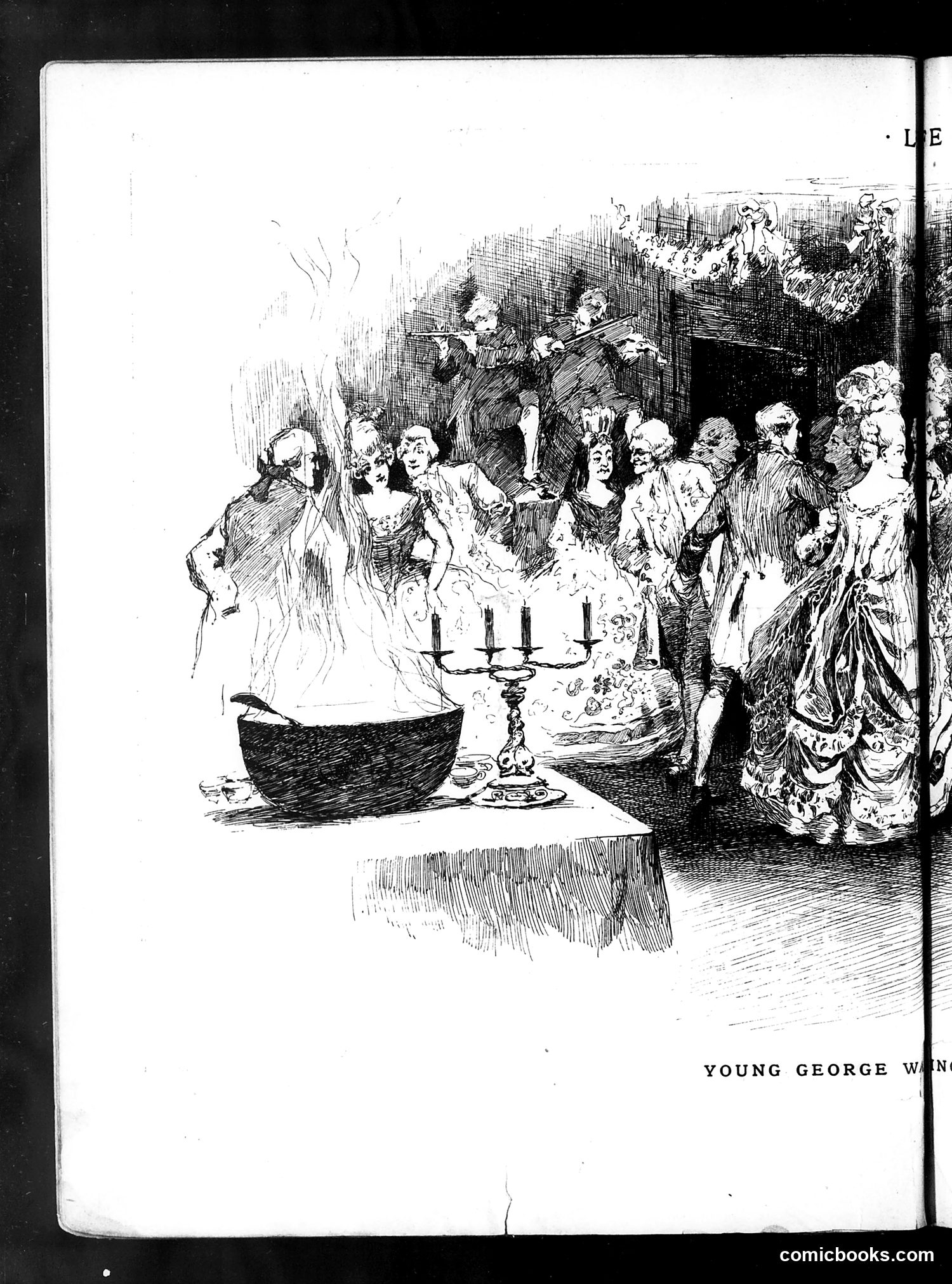
This appears to be an illustration from *Life* magazine titled "Young George W[ashington]" (text visible at bottom). The sketch depicts an 18th-century scene with elegantly dressed figures in a parlor setting. A prominent cauldron with flames sits center-left, while well-dressed men and women in period costume observe. The satirical point likely concerns young George Washington in a domestic or social situation, possibly mocking his manners, social climbing, or youthful pretensions. The cauldron's prominent placement suggests either a cooking/household reference or metaphorical "brewing" of something. Without additional context from the full article, the exact satirical target remains unclear, though it appears to be social satire about 18th-century manners or Washington's personal conduct.
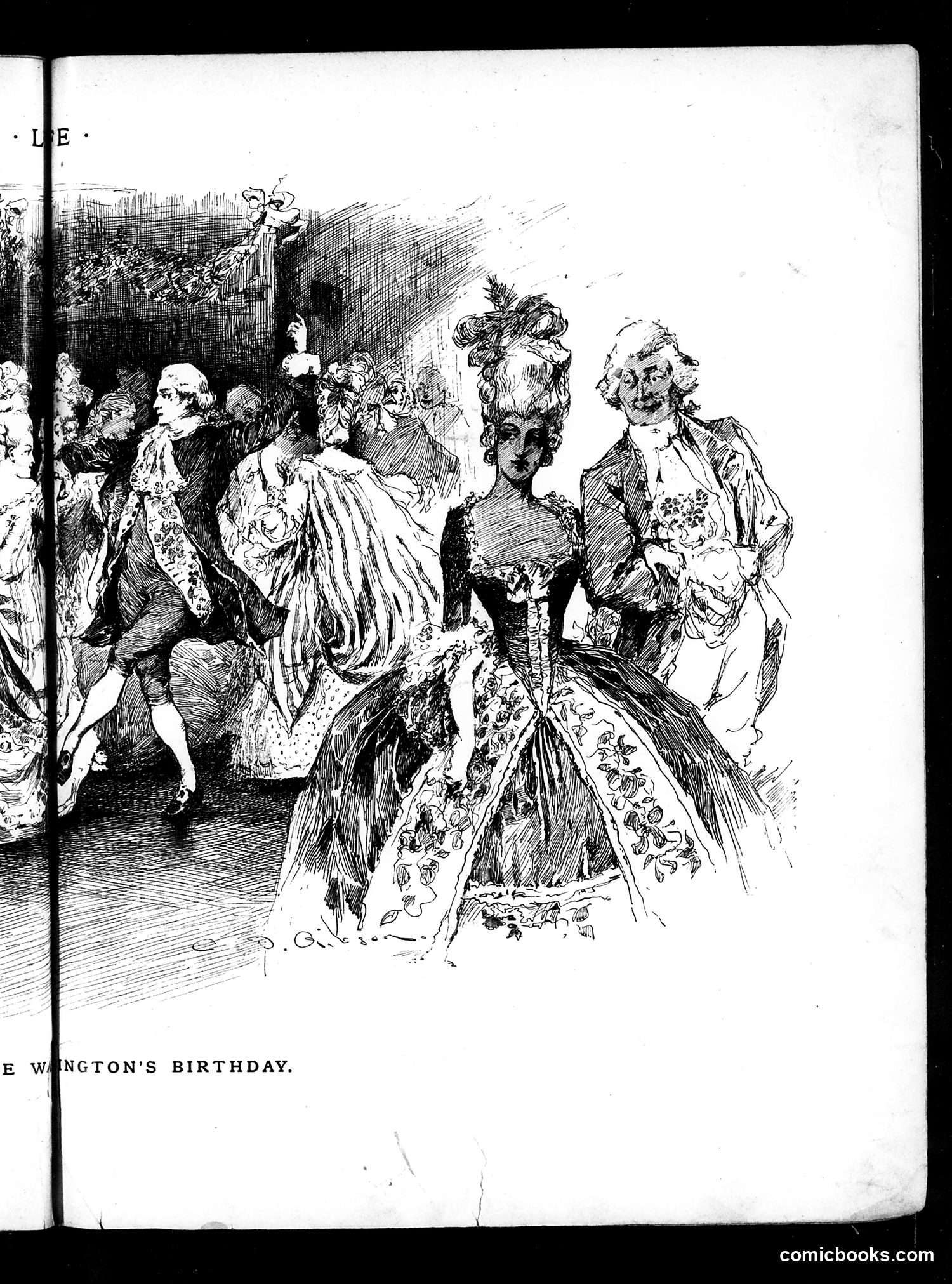
This appears to be a satirical illustration of a formal 18th-century social gathering or court scene. The caption references "Wington's Birthday," though the full first name is cut off (likely "Washington's"). The sketch depicts elegantly dressed figures in period costume—men in ornate coats and women in elaborate gowns with decorative patterns—attending what seems to be a formal celebration. The caricatured facial features and exaggerated clothing details suggest mockery of aristocratic pretension or social vanity. The satire likely targets either the excessive formality of high society gatherings or, if this is indeed about George Washington, possibly American aspirations to aristocratic grandeur. The detailed cross-hatching and sketch style is typical of Life magazine's editorial illustrations from the late 19th/early 20th century.
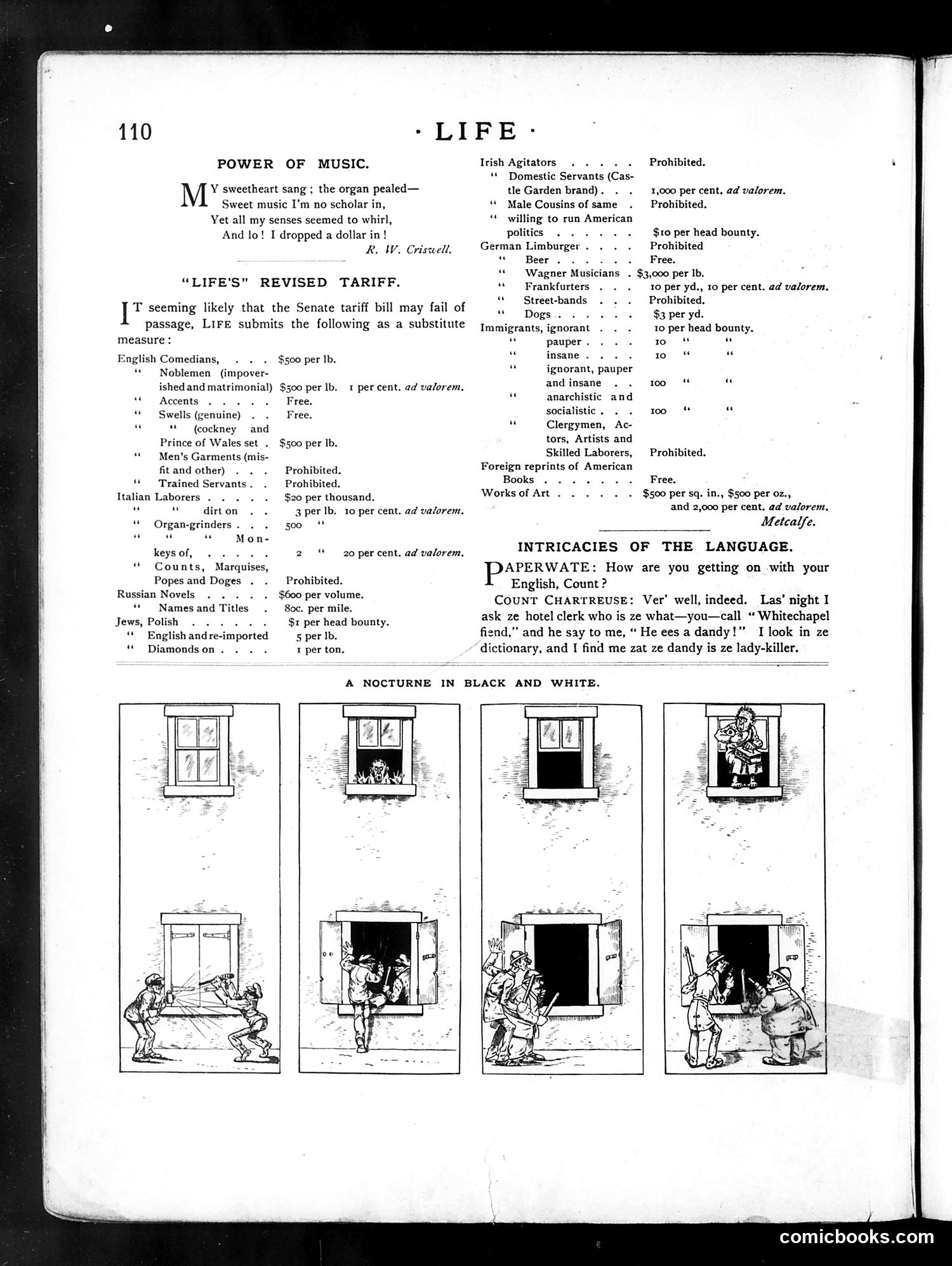
This four-panel comic depicts a nighttime sequence at windows and doors. The progression shows figures outside attempting to communicate with or gain entry to someone inside—likely illustrating a comedic domestic or romantic scenario common to early 20th-century humor. The panel sequence uses the stark contrast of black (interior darkness/lit interiors) against white (exteriors/shadows) to create dramatic visual effect, which explains the title's reference to "black and white." Without clearer identification of the specific figures or context, the exact satirical point remains unclear—it may reference domestic quarrels, romantic intrigue, or social etiquette violations typical of Life magazine's satirical content. The detailed architectural rendering suggests this targets middle-class household situations.
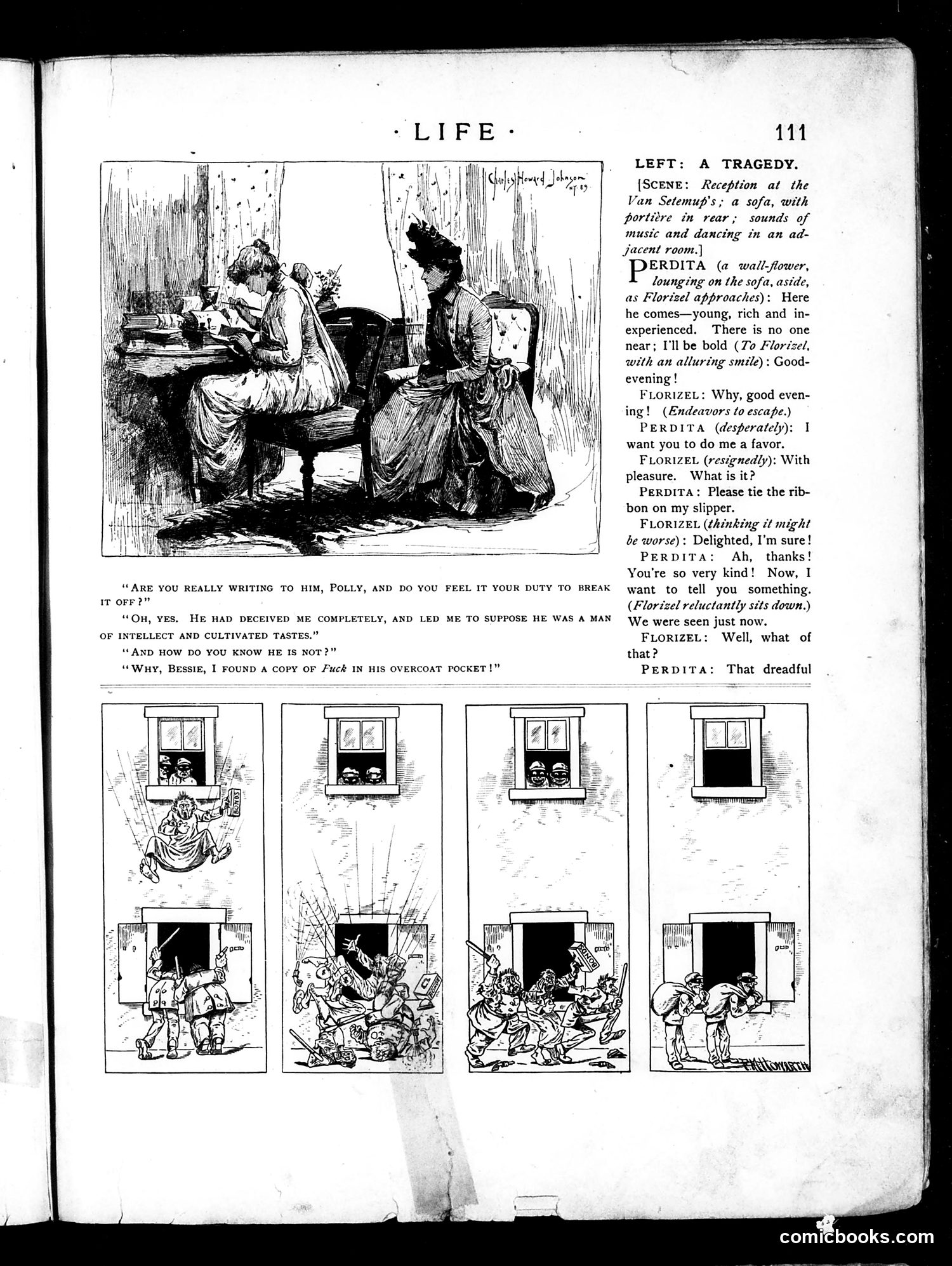
This page satirizes courtship manipulation and social gossip among the leisure class. The main illustration shows "Perdita," a wallflower at a Van Setemup society reception, deliberately entrap "Florizel," a young, wealthy, inexperienced man, by requesting he tie her slipper ribbon—a pretext to compromise him socially. The dialogue reveals the con: being "seen together" will force him into either marriage or scandal. The secondary dialogue strips below mock women's casual deception in romance—one woman breaks off an engagement because her fiancé reads *Puck* (a competing satirical magazine), calling him intellectually unfit. The satire targets both predatory female matchmaking tactics and the frivolous pretenses of high society, where appearances and gossip matter more than genuine character or intellect.
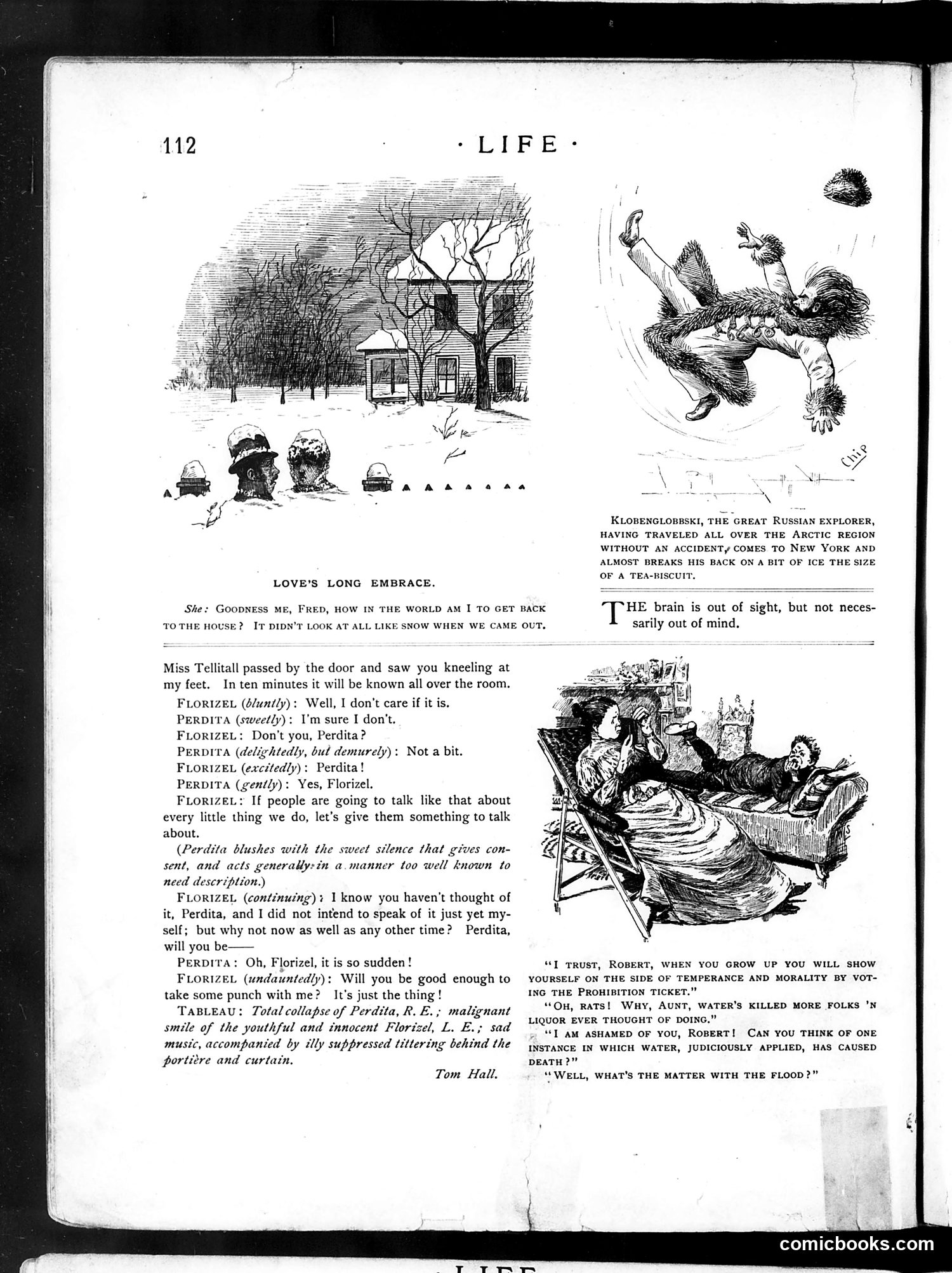
This page contains two distinct satirical pieces: **"Love's Long Embrace"** (left): A romantic comedy sketch where two young people, Florizel and Perdita (names from Shakespeare's *The Winter's Tale*), banter about social gossip. The humor relies on double entendre—she worries about being seen kneeling before him, and when he suggests "giving people something to talk about," she blushes in consent. The punchline subverts expectation: his actual proposal is merely to share punch, leaving her mortified. **"Klobenglobbski" (top right)**: A slapstick joke mocking a celebrated Russian Arctic explorer who survived extreme conditions only to comically slip on trivial ice in New York—physical comedy emphasizing the gap between reputation and reality. **"Prohibition Debate" (bottom right)**: A political satire where a boy uses logical absurdity to undermine his aunt's temperance moralizing. When she asks for instances where water caused death, he replies "the flood"—mocking prohibition advocates' selective reasoning about alcohol's dangers while ignoring water's destructive potential. All three pieces use humor to critique Victorian propriety, pretension, and ideological hypocrisy.
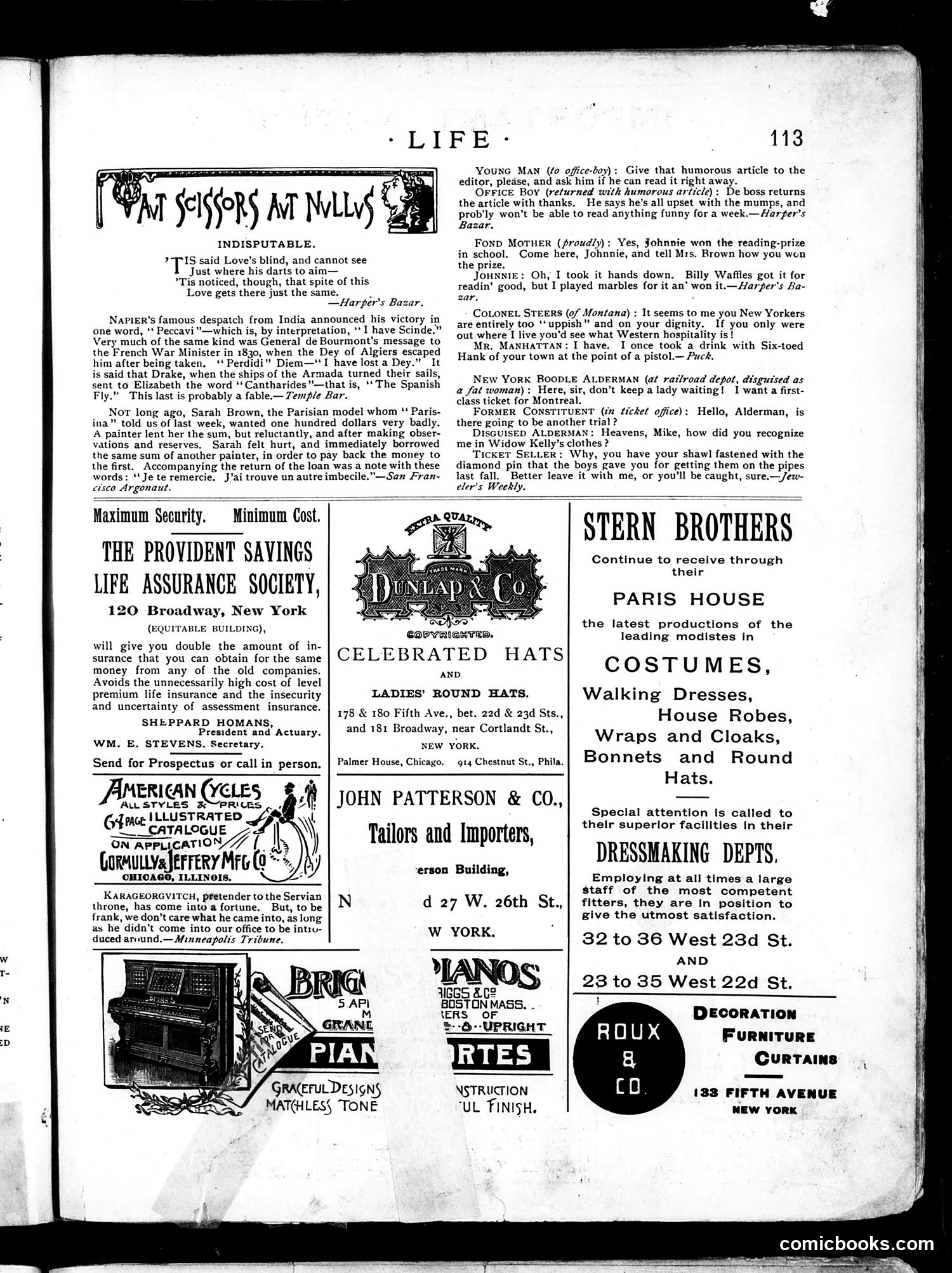
This page is primarily **advertisements and short satirical jokes** rather than a detailed political cartoon. The main humor pieces mock social pretensions and corruption: - **"Fond Mother" joke**: Satirizes cheating—a boy wins a reading prize not through literacy but by gambling at marbles against competitors. - **Colonel Steers/New Yorker exchange**: Jokes about Western vs. Eastern manners. The New Yorker's response—claiming he experienced "hospitality" at gunpoint from someone named "Six-toed Hank"—is darkly comic, implying frontier lawlessness. - **Alderman disguise**: A corrupt New York alderman flees the city disguised as a woman, fearful of trial. A constituent recognizes him by his diamond pin (likely bribes from construction kickbacks). This mocks municipal corruption as endemic and recognized even in disguise. The remaining content is **commercial advertising** for life insurance, hats, tailors, pianos, and furniture—typical of the era's magazines.
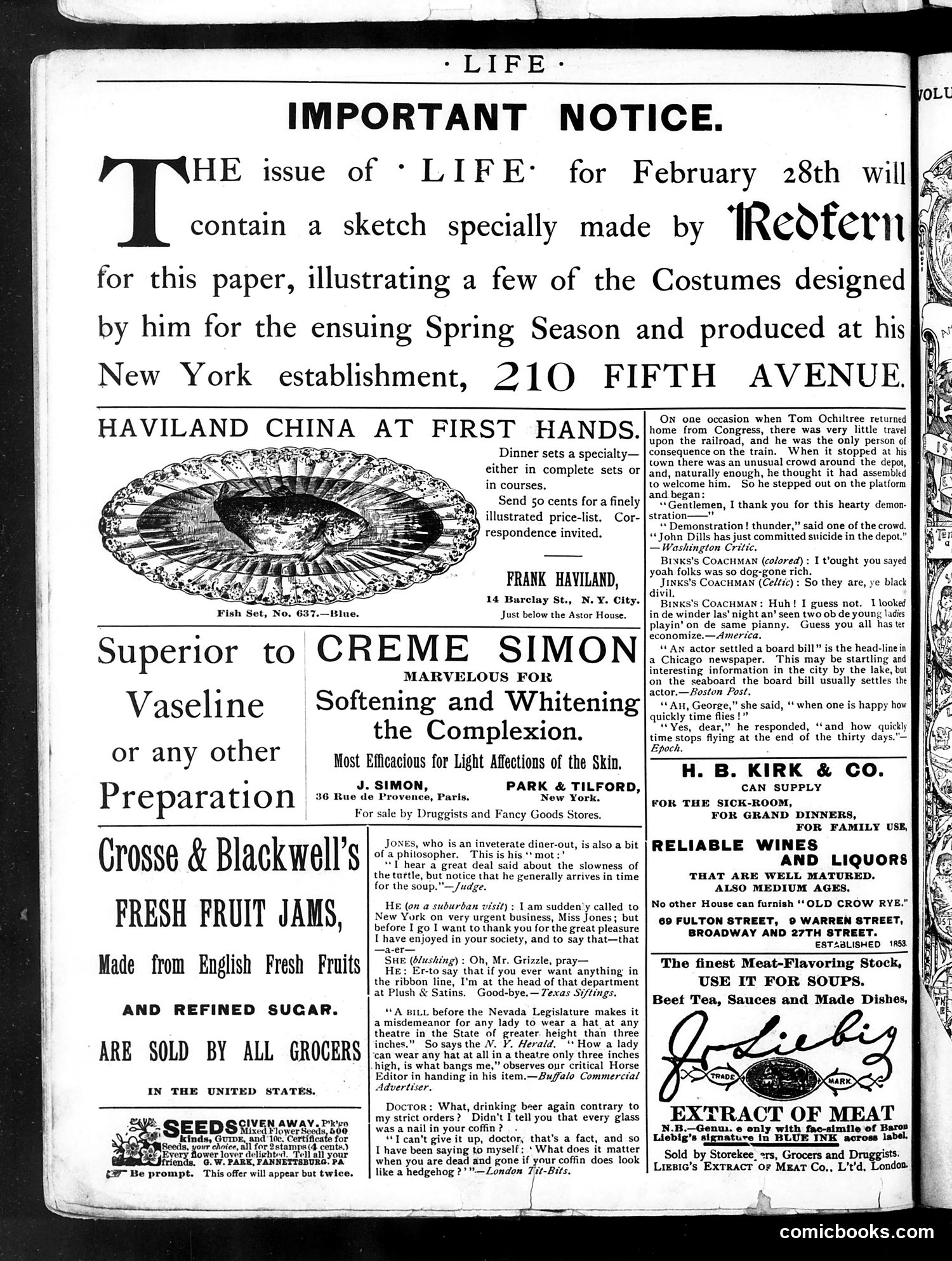
This is primarily an **advertising and notices page** from Life magazine, with minimal cartoon content. The main feature is an "Important Notice" announcing that the February 28th issue will include fashion sketches by designer Redfern for spring clothing. The page includes several **brief humorous anecdotes** in small print rather than visual cartoons: - A joke about a turtle's punctuality at dinner - A sentimental farewell between visitors where a man awkwardly plugs his ribbon business - A Nevada bill proposal about hat heights in theaters (mocking women's fashion) - A doctor-patient exchange about beer and coffins - A story about Tom Ochiltree, a congressman, misreading a crowd's intentions - Dialogue between two coachmen about wealth and piano-playing The humor relies on **wordplay, social observation, and mild satire** about Victorian manners, fashion, and class distinctions. The page is otherwise filled with period product advertisements for china, cosmetics, and food products typical of the era.