
Life, 1889-02-21 · page 6 of 14
Life — February 21, 1889 — page 6: what you’re looking at
What you’re looking at
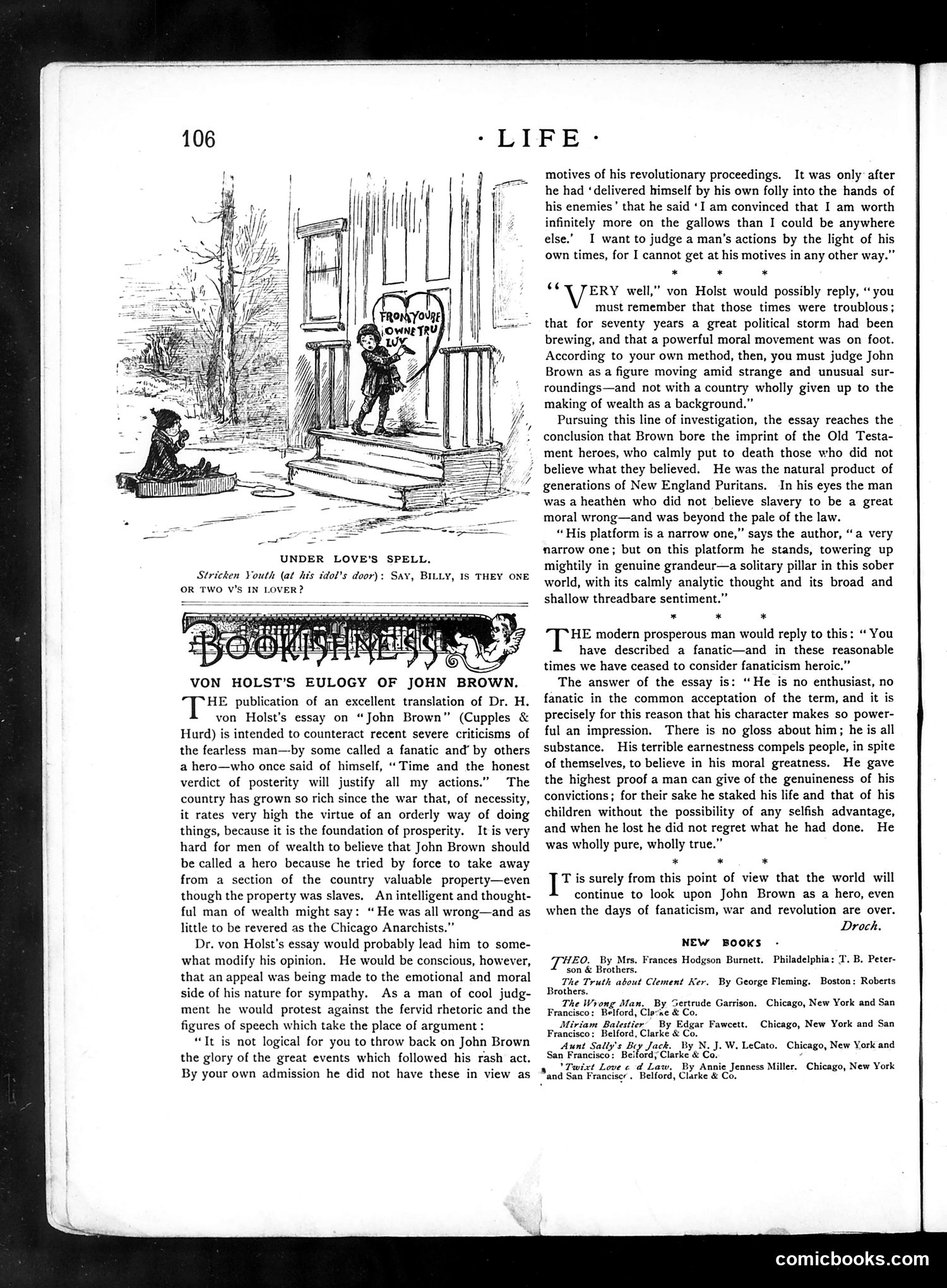
This page primarily features a literary essay titled "Von Holst's Eulogy of John Brown," discussing Brown's legacy and moral character. The small cartoon at the top, captioned "Under Love's Spell," depicts a young boy at a doorway calling out to a girl, asking "Say, Billy, is there one or two V's in lover?" This is a simple visual pun playing on children's spelling confusion—the boy is uncertain whether "lover" contains one or two V's (it contains one). The cartoon exploits the innocent context of childhood education for mild humor. The page itself is primarily text-based editorial content rather than political satire, focusing on historical and moral arguments about abolitionist John Brown.
📄 Transcribed text from this page (OCR, searchable)
Machine-transcribed from the original scan — historical spelling and the odd misread are preserved.
- LIFE: UNDER LOVE'S SPELL, Stricken Youth (at his idol’s door): SAY, BILLY, 18 THEY ONE OR TWO V’S IN LOVER? VON HOLST’S EULOGY OF JOHN BROWN. HE publication of an excellent translation of Dr. H. von Holst’s essay on “John Brown” (Cupples & Hurd) is intended to counteract recent severe criticisms of the fearless man—by some called a fanatic and’ by others a hero—who once said of himself, ‘Time and the honest verdict of posterity will justify all my actions.” The country has grown so rich since the war that, of necessity, it rates very high the virtue of an orderly way of doing things, because it is the foundation of prosperity. It is very hard for men of wealth to believe that John Brown should be called a hero because he tried by force to take away from a section of the country valuable property—even though the property was slaves. An intelligent and thought- ful man of wealth might say: “He was all wrong—and as little to be revered as the Chicago Anarchists.” Dr. von Holst’s essay would probably lead him to some- what modify his opinion. He would be conscious, however, that an appeal was being made to the emotional and moral side of his nature for sympathy. As a man of cool judg- ment he would protest against the fervid rhetoric and the figures of speech which take the place of argument : “Tt is not logical for you to throw back on John Brown the glory of the great events which followed his rash act. By your own admission he did not have these in view as "and San Franciscr « motives of his revolutionary proceedings. It was only’ after he had ‘delivered himself by his own folly into the hands of his enemies’ that he said ‘I am convinced that I am worth infinitely more on the gallows than I could be anywhere else.’ I want to judge a man’s actions by the light of his own times, for I cannot get at his motives in any other way.” * * * se ERY well,” von Holst would possibly reply, “you must remember that those times were troublous; that for seventy years a great political storm had been brewing, and that a powerful moral movement was on foot. According to your own method, then, you must judge John Brown as a figure moving amid strange and unusual sur- roundings—and not with a country wholly given up to the making of wealth as a background.” Pursuing this line of investigation, the essay reaches the conclusion that Brown bore the imprint of the Old Testa- ment heroes, who calmly put to death those who did not believe what they believed. He was the natural product of generations of New England Puritans. In his eyes the man was a heathén who did not believe slavery to be a great moral wrong—and was beyond the pale of the law. “His platform is a narrow one,” says the author, “a very narrow one; but on this platform he stands, towering up mightily in genuine grandeur—a solitary pillar in this sober world, with its calmly analytic thought and its broad and shallow threadbare sentiment.” * * * HE modern prosperous man would reply to this: “ You have described a fanatic—and in these reasonable times we have ceased to consider fanaticism heroic.” The answer of the essay is: “He is no enthusiast, no fanatic in the common acceptation of the term, and it is precisely for this reason that his character makes so power- ful an impression. There is no gloss about him; he is all substance. His terrible earnestness compels people, in spite of themselves, to believe in his moral greatness. He gave the highest proof a man can give of the genuineness of his convictions; for their sake he staked his life and that of his children without the possibility of any selfish advantage, and when he lost he did not regret what he had done. He was wholly pure, wholly true.” * * * Jt is surely from this point of view that the world will continue to look upon John Brown as a hero, even when the days of fanaticism, war and revolution are over. Droch. NEW BOOKS EO. By Mrs. Frances Hodgson Burnett. Philadelphia: ‘I. B. Peter- son & Brothers. The Truth about Clement Ker. Brothers. The Wrong Man. By Gertrude Garrison. Francisco: Belford, Clevae & Co. Miriam Balestier By Edgar Fawcett. Francisco: Belford, Clarke & Co. Aunt Sally's Bey Jack. By N.J.W. LeCato, Chicago, New York and San Francisco: Beiford, Clarke & Co, *Twixt Love « d Law, By Annie Jenness Miller. Belford, Clarke & Co. By George Fleming. Boston: Roberts Chicago, New York and San Chicago, New York and San Chicago, New York comicbooks.com