
Life, 1889-02-21 · page 2 of 14
Life — February 21, 1889 — page 2: what you’re looking at
What you’re looking at
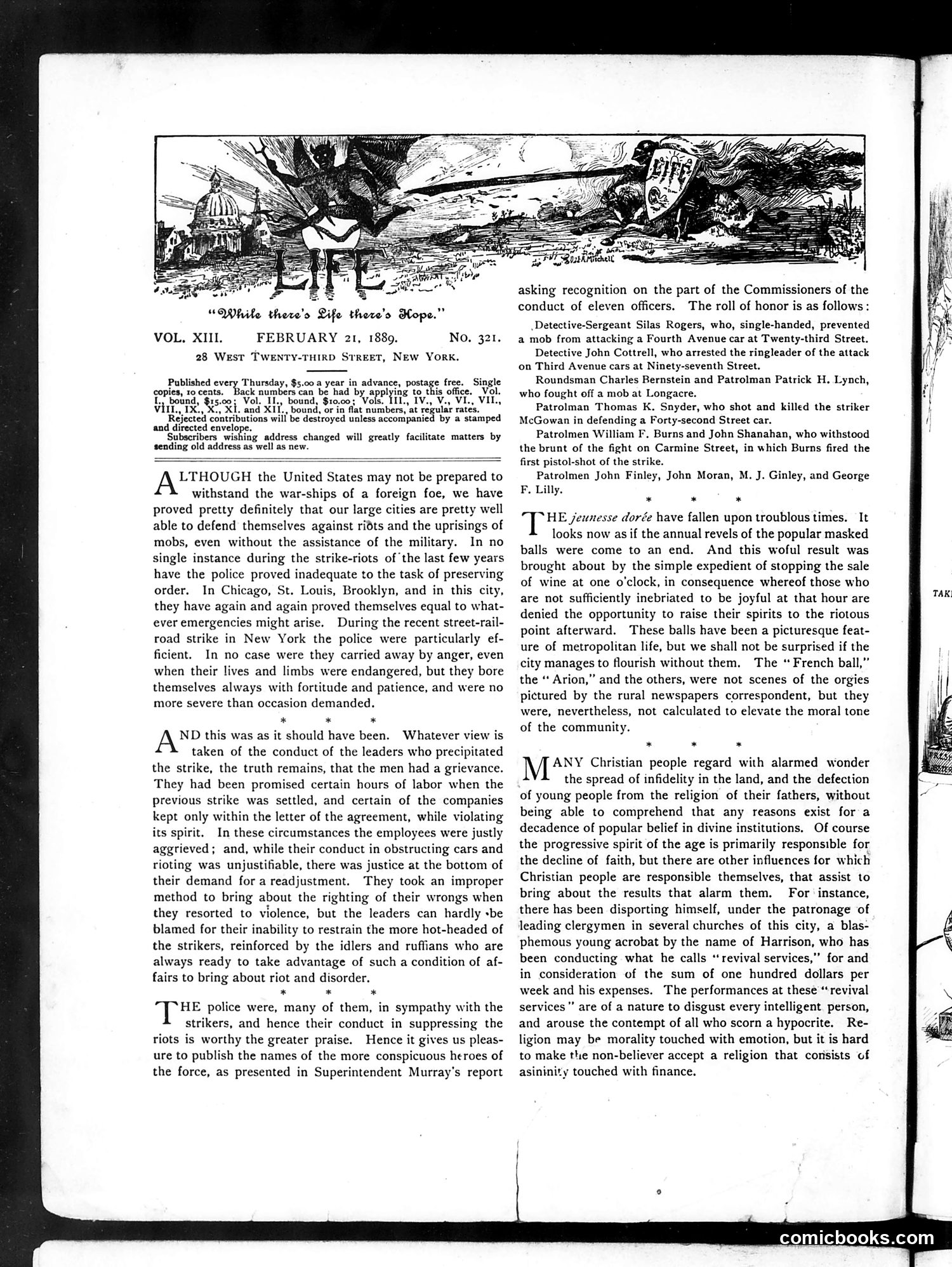
The masthead cartoon depicts a chaotic scene with a large figure labeled "LIFE" wielding a club against a mob, with a Capitol building visible. This illustrates the article's central argument: that American cities have proven capable of defending themselves against violent mobs without military intervention during recent labor strikes. The article specifically references the "strike-riots of the last few years" in Chicago, St. Louis, Brooklyn, and New York, praising police conduct during these incidents. It commends officers for maintaining order despite personal danger, and names eleven police officers honored for their bravery—including actions like stopping mob violence and protecting streetcars. The piece argues that while strikers had legitimate grievances about broken labor agreements, their violent methods were unjustifiable.
📄 Transcribed text from this page (OCR, searchable)
Machine-transcribed from the original scan — historical spelling and the odd misread are preserved.
“PMhile there's Life there’s Hope.” VOL, XIII. FEBRUARY 21, 1889. 28 West TWENTY-THIRD No, 321. "REET, NEW YORK. Published every Thursday, $5.00 a year in advance, postage free. Single copies, ro cents. Back numbers can be had by applying to this office. Vol. 15-00; Vol. Il., bound, $10.00; Vols. Illy IV., V.. VI., VIl., a», 1X., X-, XL. and XI7., bound, or in flat numbers, at regular rates, Rejected contributions wiil be destroyed unless accompanied by a stamped and directed envelope. Subscribers wishing address changed will greatly facilitate matters by sending old address as well as new. LTHOUGH the United States may not be prepared to withstand the war-ships of a foreign foe, we have proved pretty definitely that our large cities are pretty well able to defend themselves against ridts and the uprisings of mobs, even without the assistance of the military. In no single instance during the strike-riots of the last few years have the police proved inadequate to the task of preserving order. In Chicago, St. Louis, Brooklyn, and in this city, they have again and again proved themselves equal to what- ever emergencies might arise. During the recent street-rail- road strike in New York the police were particularly ef- ficient. In no case were they carried away by anger, even when their lives and limbs were endangered, but they bore themselves always with fortitude and patience, and were no more severe than occasion demanded. * * * ND this was as it should have been. Whatever view is taken of the conduct of the leaders who precipitated the strike, the truth remains, that the men had a grievance. They had been promised certain hours of labor when the previous strike was settled, and certain of the companies kept only within the letter of the agreement, while violating its spirit. In these circumstances the employees were justly aggrieved; and, while their conduct in obstructing cars and rioting was unjustifiable, there was justice at the bottom of their demand for a readjustment. They took an improper method to bring about the righting of their wrongs when they resorted to violence, but the leaders can hardly +be blamed for their inability to restrain the more hot-headed of the strikers, reinforced by the idlers and ruffians who are always ready to take advantage of such a condition of af- fairs to bring about riot and disorder. * * * HE police were, many of them, in sympathy with the strikers, and hence their conduct in suppressing the riots is worthy the greater praise. Hence it gives us pleas- ure to publish the names of the more conspicuous heroes of the force, as presented in Superintendent Murray's report oe BE ginktib asking recognition on the part of the Commissioners of the conduct of eleven officers. The roll of honor is as follows : Detective-Sergeant Silas Rogers, who, single-handed, prevented a mob from attacking a Fourth Avenue car at Twenty-third Street. Detective John Cottrell, who arrested the ringleader of the attack on Third Avenue cars at Ninety-seventh Street. Roundsman Charles Bernstein and Patrolman Patrick H. Lynch, who fought off a mob at Longacre. Patrolman Thomas K. Snyder, who shot and killed the striker McGowan in defending a Forty-second Street car. Patrolmen William F, Burns and John Shanahan, who withstood the brunt of the fight on Carmine Street, in which Burns fired the first pistol-shot of the strike. Patrolmen John Finley, John Moran, M. J. Ginley, and George F, Lilly. * * * HE jeunesse dorée have fallen upon troublous times. It looks now as if the annual revels of the popular masked balls were come to an end. And this woful result was brought about by the simple expedient of stopping the sale of wine at one o'clock, in consequence whereof those who are not sufficiently inebriated to be joyful at that hour are denied the opportunity to raise their spirits to the riotous point afterward. These balls have been a picturesque feat- ure of metropolitan life, but we shall not be surprised if the city manages to flourish without them. The “French ball,” the “Arion,” and the others, were not scenes of the orgies pictured by the rural newspapers correspondent, but they were, nevertheless, not calculated to elevate the moral tone of the community. * * * ANY Christian people regard with alarmed wonder the spread of infidelity in the land, and the defection of young people from the religion of their fathers, without being able to comprehend that any reasons exist for a decadence of popular belief in divine institutions. Of course the progressive spirit of the age is primarily responsible for the decline of faith, but there are other influences for which Christian people are responsible themselves, that assist to bring about the results that alarm them. For instance, there has been disporting himself, under the patronage of leading clergymen in several churches of this city, a blas- phemous young acrobat by the name of Harrison, who has been conducting what he calls ‘revival services,” for and in consideration of the sum of one hundred dollars per week and his expenses. The performances at these “revival services ” are of a nature to disgust every intelligent person, and arouse the contempt of all who scorn a hypocrite. Re- ligion may be morality touched with emotion, but it is hard to make the non-believer accept a religion that corisists of ity touched with finance. % y i comicbooks.com