
Life, 1889-02-21 · page 4 of 14
Life — February 21, 1889 — page 4: what you’re looking at
What you’re looking at
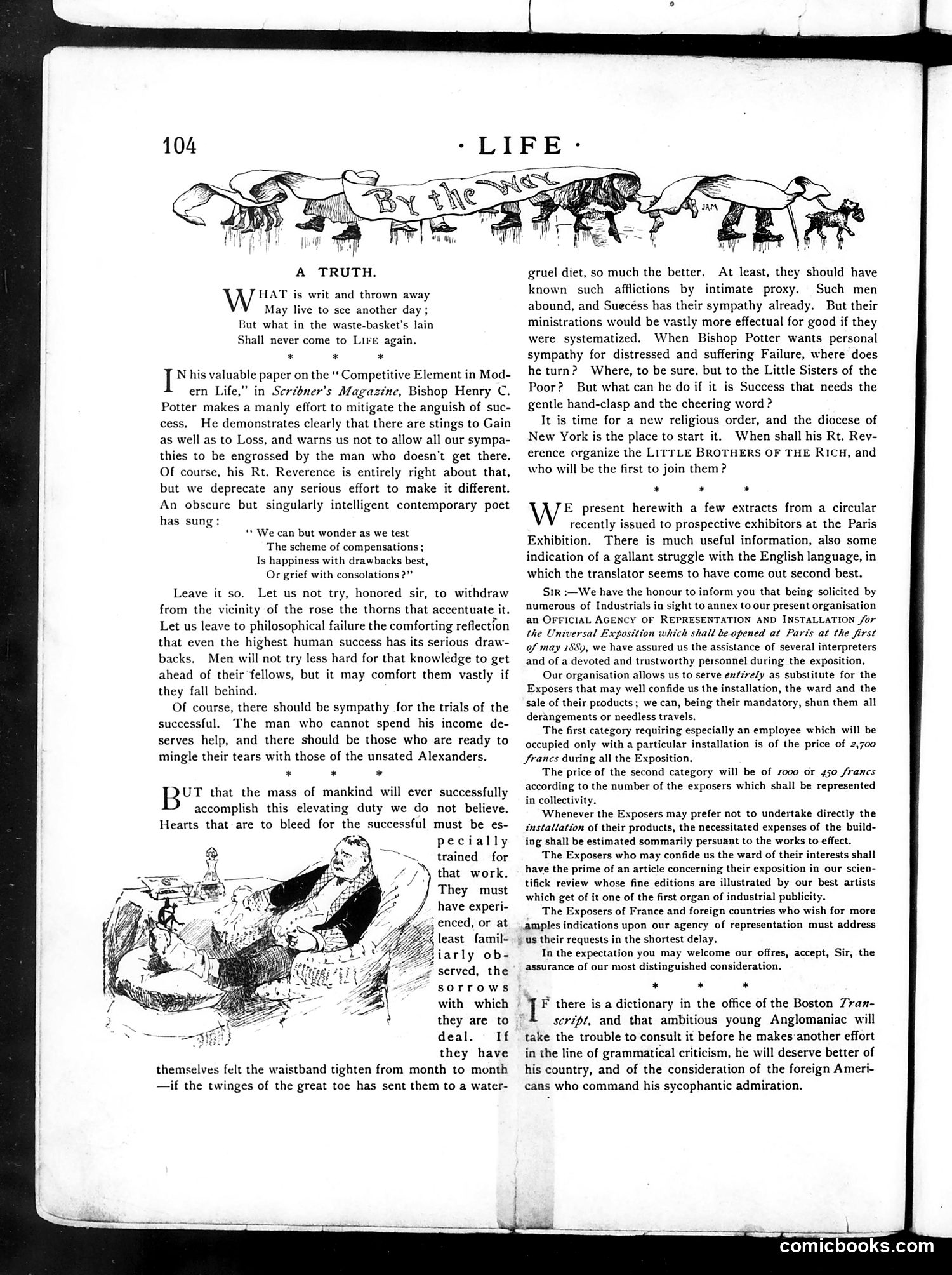
This page from *Life* magazine contains primarily text rather than political cartoons. The main content includes: **"A Truth"** — a short poem about regret and lost opportunities, followed by commentary on Bishop Henry C. Potter's writing about competitive success in modern life. The author argues that sympathy for the unsuccessful should be systematized through charitable organizations like the "Little Brothers of the Rich." **A small illustration** (lower left) depicts a figure in apparent distress or poverty, likely supporting the editorial's argument about suffering among the unsuccessful. **A letter** about the Paris Exhibition discusses representation and installation of products, appearing to be business correspondence rather than satire. The page emphasizes *social responsibility* toward those failed by competition, without specific political targets or identifiable caricatures visible in the text or image provided.
📄 Transcribed text from this page (OCR, searchable)
Machine-transcribed from the original scan — historical spelling and the odd misread are preserved.
A TRUTH. HAT is writ and thrown away May live to see another day ; But what in the waste-basket’s lain Shall never come to Lire again. * * * N his valuable paper on the “ Competitive Element in Mod- ern Life,” in Scrzéner’s Magazine, Bishop Henry C. Potter makes a manly effort to mitigate the anguish of suc- cess. He demonstrates clearly that there are stings to Gain as well as to Loss, and warns us not to allow all our sympa- thies to be engrossed by the man who doesn’t get there. Of course, his Rt. Reverence is entirely right about that, but we deprecate any serious effort to make it different. An obscure but singularly intelligent contemporary poet has sung: “* We can but wonder as we test The scheme of compensations ; Is happiness with drawbacks best, Or grief with consolations ?” Leave it so. Let us not try, honored sir, to withdraw from the vicinity of the rose the thorns that accentuate it. Let us leave to philosophical failure the comforting reflection that even the highest human success has its serious draw- backs. Men will not try less hard for that knowledge to get ahead of their fellows, but it may comfort them vastly if they fall behind. Of course, there should be sympathy for the trials of the successful. The man who cannot spend his income de- serves help, and there should be those who are ready to mingle their tears with those of the unsated Alexanders. * * * Br that the mass of mankind will ever successfully accomplish this elevating duty we do not believe. Hearts that are to bleed for the successful must be es- pecially trained for that work. They must have experi- ; enced, or at % least famil- Ziegiarly ob- y¢ served, the “ sorrows with which they are to deal. If they have themselves felt the waistband tighten from month to month —if the twinges of the great toe has sent them to a water- gruel diet, so much the better. At least, they should have known such afflictions by intimate proxy. Such men abound, and Suecéss has their sympathy already. But their ministrations would be vastly more effectual for good if they were systematized. When Bishop Potter wants personal sympathy for distressed and suffering Failure, where does he turn? Where, to be sure, but to the Little Sisters of the Poor? But what can he do if it is Success that needs the gentle hand-clasp and the cheering word ? It is time for a new religious order, and the diocese of New York is the place to start it. When shall his Rt. Rev- erence organize the LITTLE BROTHERS OF THE RICH, and who will be the first to join them? W present herewith a few extracts from a circular recently issued to prospective exhibitors at the Paris Exhibition. There is much useful information, also some indication of a gallant struggle with the English language, in which the translator seems to have come out second best. Sir :—We have the honour to inform you that being solicited by numerous of Industrials in sight to annex to our present organisation an OFFICIAL AGENCY OF REPRESENTATION AND INSTALLATION for the Universal Exposition which shall be opened at Paris at the first of may 188), we have assured us the assistance of several interpreters and of a devoted and trustworthy personnel during the exposition. Our organisation allows us to serve entirely as substitute for the Exposers that may well confide us the installation, the ward and the sale of their products; we can, being their mandatory, shun them all derangements or needless travels. The first category requiring especially an employee which will be occupied only with a particular installation is of the price of 2,700 Jrancs during all the Exposition. The price of the second category will be of sooo or 450 francs according to the number of the exposers which shall be represented in collectivity. ‘Whenever the Exposers may prefer not to undertake directly the installation of their products, the necessitated expenses of the build- ing shall be estimated sommarily persuant to the works to effect. ‘The Exposers who may confide us the ward of their interests shall have the prime of an article concerning their exposition in our scien- tifick review whose fine editions are illustrated by our best artists which get of it one of the first organ of industrial publicity. The Exposers of France and foreign countries who wish for more amples indications upon our agency of representation must address * * * + us their requests in the shortest delay. In the expectation you may welcome our offres, accept, Sir, the assurance of our most distinguished consideration. * * * F there is a dictionary in the office of the Boston 7ran- script, and that ambitious young Anglomaniac will take the trouble to consult it before he makes-another effort in the line of grammatical criticism, he will deserve better of his country, and of the consideration of the foreign Ameri- cans who command his sycophantic admiration. comicbooks.com