
A complete issue · 16 pages · 1889
Life — February 7, 1889
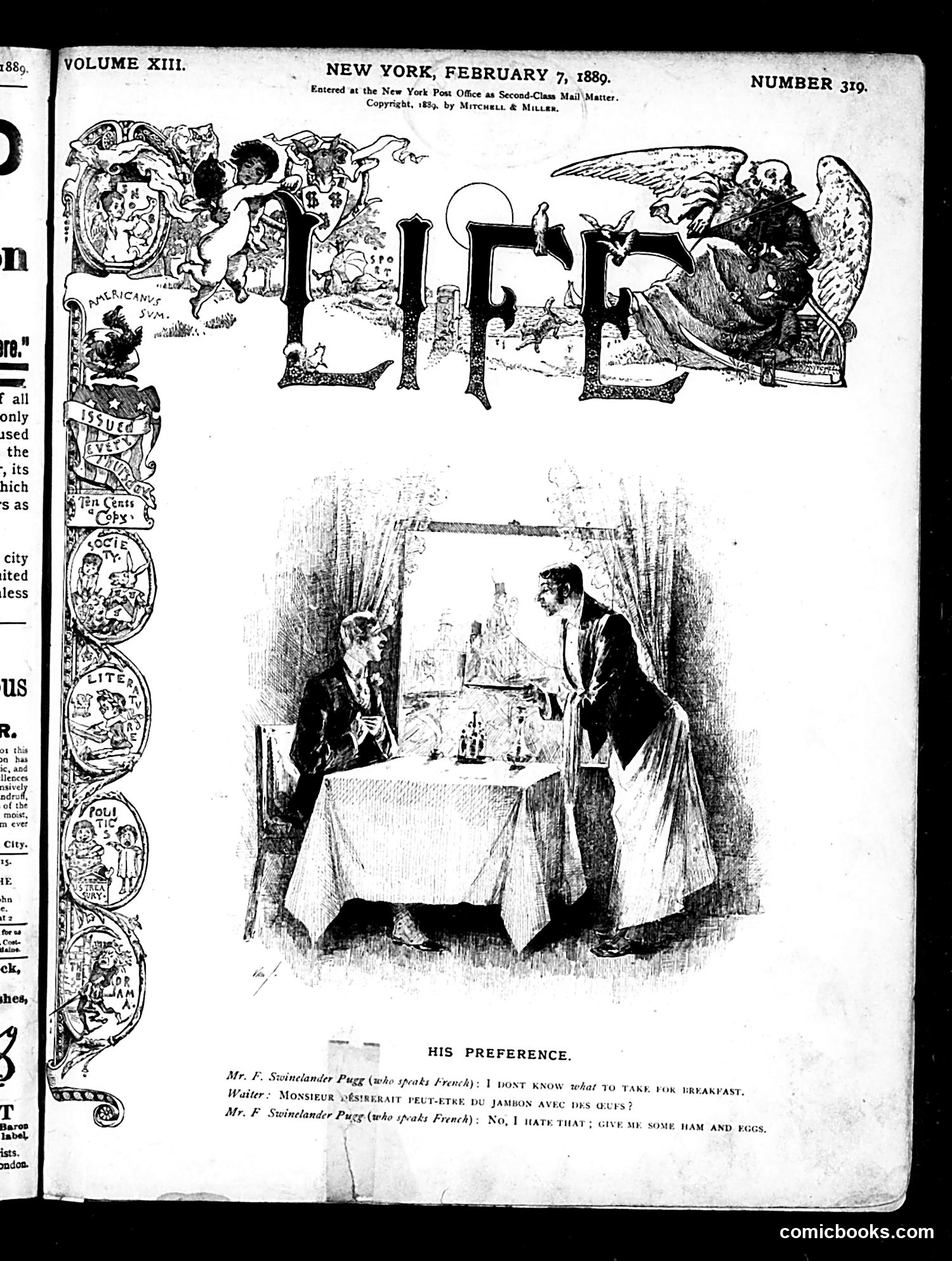
This cartoon satirizes French dining preferences through a breakfast scene. Mr. F. Swinclaunder Puge (who speaks French) asks a waiter what to order. The waiter suggests "Monsieur désirerait peut-être du jambon avec des œufs?" (perhaps ham with eggs?). Puge refuses, declaring: "No, I hate that; give me some ham and eggs." The joke relies on the apparent absurdity: the waiter's French suggestion and Puge's English response describe identical dishes, yet Puge rejects the French version while accepting the English version. This satirizes American snobbery and prejudice against French cuisine, suggesting Americans would accept the same food if presented in English rather than French—mocking both French pretension and American cultural insecurity.
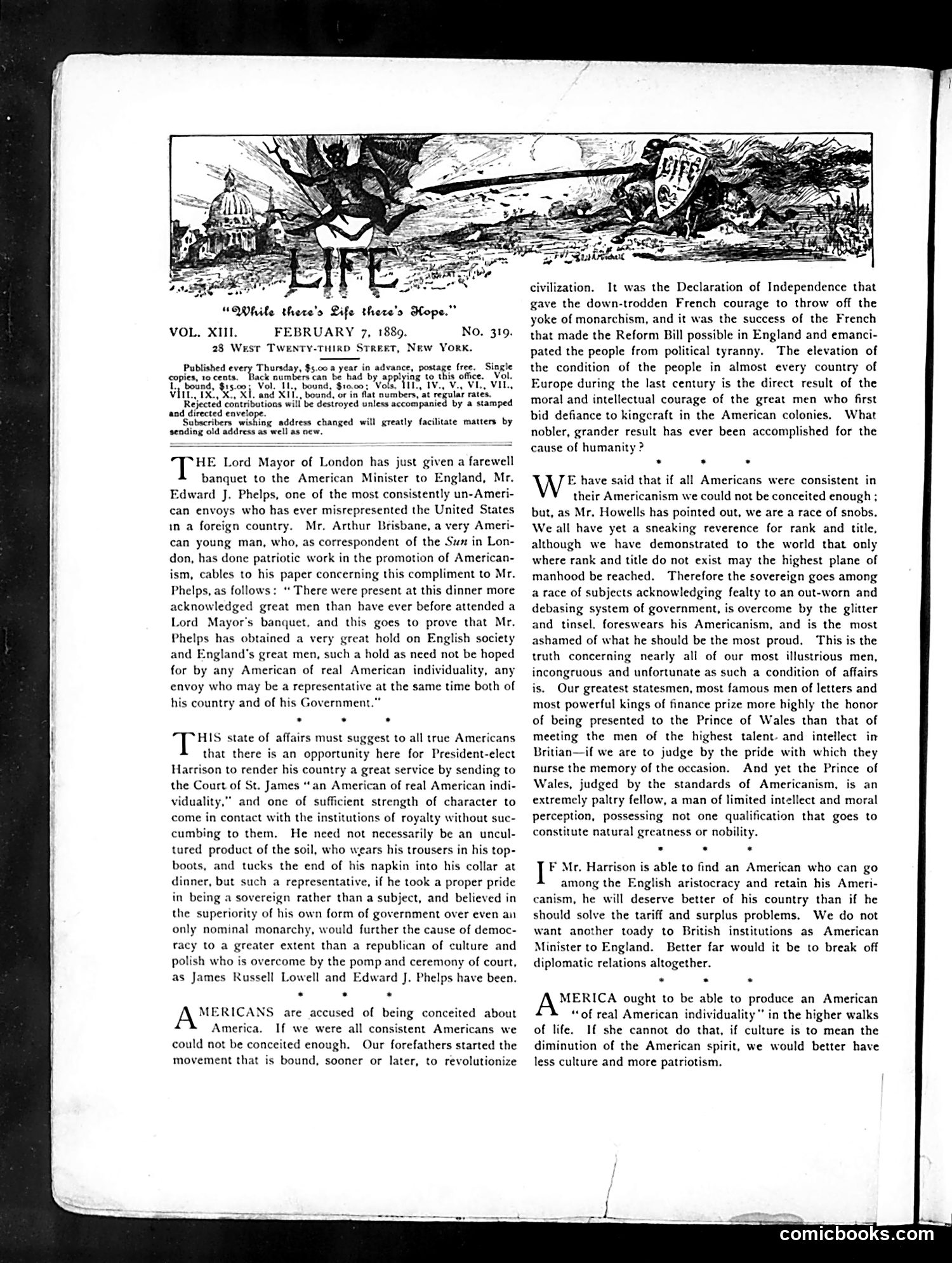
The masthead and decorative header dominate the upper portion. The text discusses American identity and diplomacy, particularly referencing President-elect Harrison and his potential diplomatic appointments. The articles criticize Americans who adopt British aristocratic manners and titles, arguing this undermines democratic values. Specific targets appear to include James Russell Lowell and Edward J. Phelps (likely diplomats who adopted affected British customs). The satire's core message: authentic American "individuuality" requires rejecting European aristocratic pretension. The author argues that American statesmen should embody democratic principles rather than mimicking English court culture, or America risks becoming merely another monarchy-worshipping nation. This reflects Gilded Age anxieties about American cultural identity amid increasing transatlantic elite social exchange.
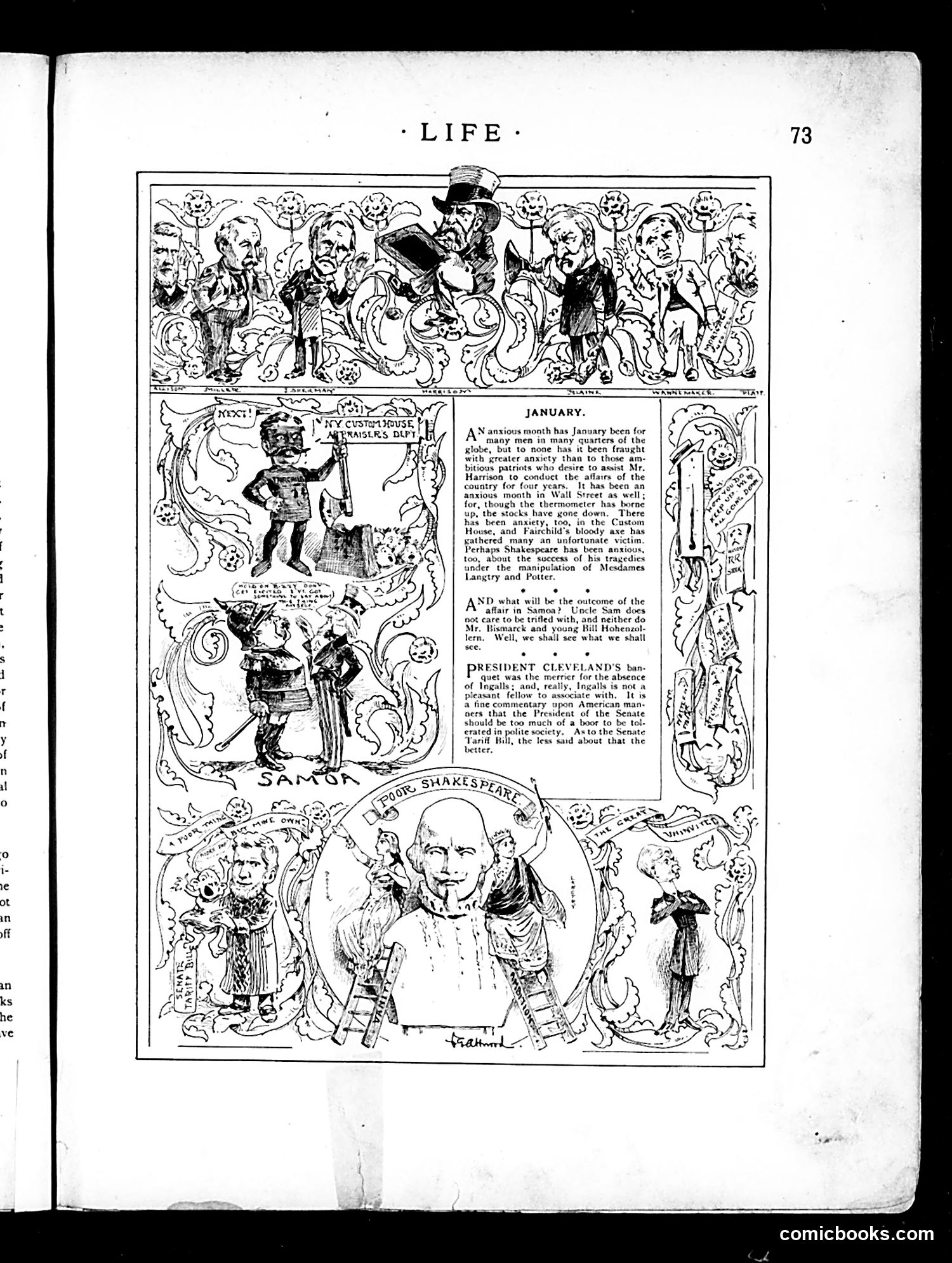
This January issue page features political satire centered on financial anxiety and market manipulation. The top panel shows a crowd of worried figures—likely investors or speculators concerned about stock market volatility. The main text discusses January's anxiety regarding market conditions, mentioning "Mr. Harrison's" conduct during financial turmoil. References to Wall Street and stock manipulation, along with "Messieurs Langry & Potter," suggest critique of specific financiers or brokers involved in market schemes that harmed ordinary people. The lower section prominently features a bust of Shakespeare labeled "Good Shakespeare," possibly contrasting honest artistic values against contemporary financial dishonesty or greed. The ornate decorative borders typical of Life's style frame what appears to be commentary on Gilded Age financial manipulation and its victims.
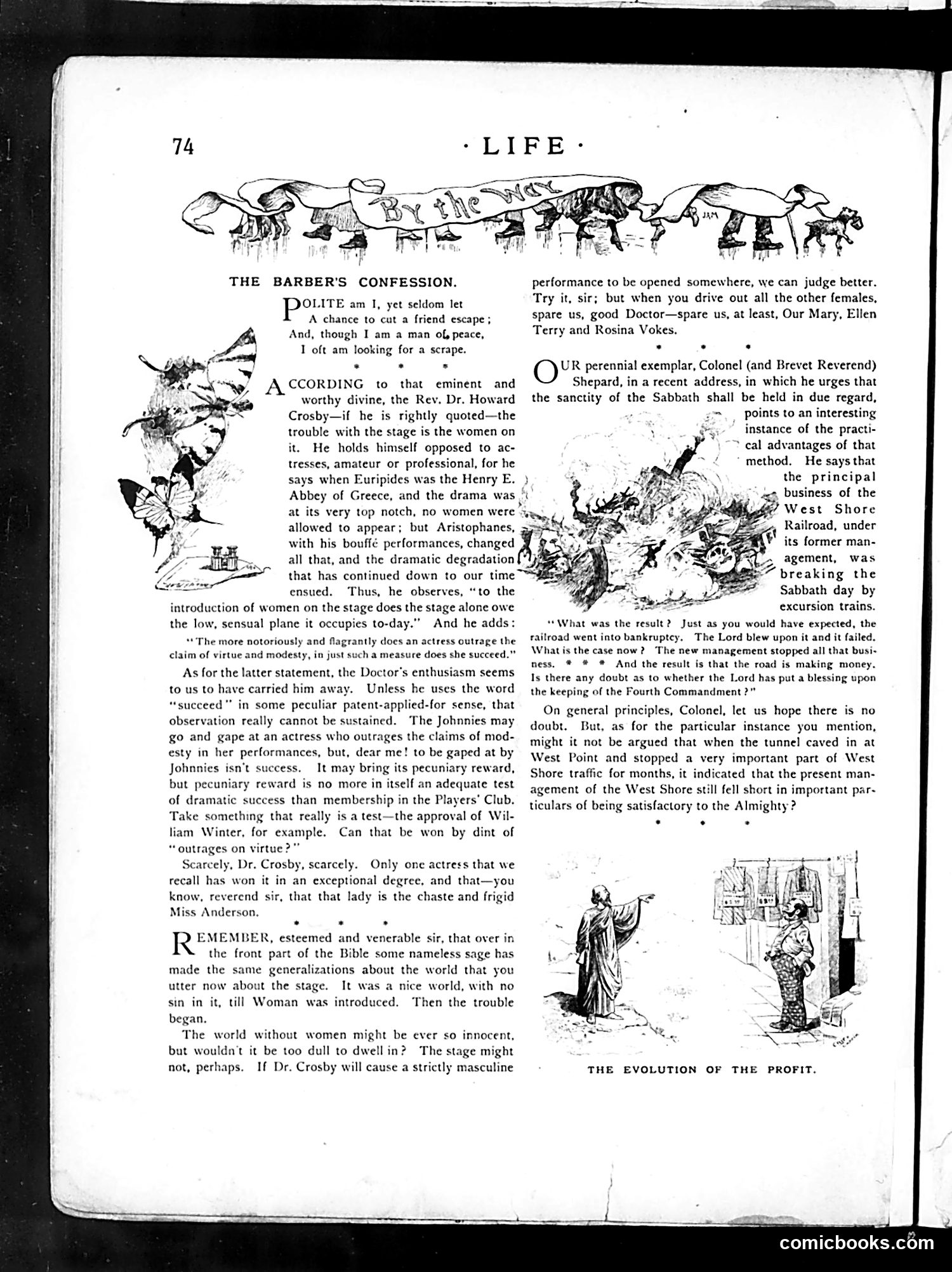
**"The Barber's Confession"** presents a satirical dialogue between a barber and Dr. Crosby (apparently a religious figure or moralist) debating women's presence in theater. The barber defends actresses, citing their talent and virtue, while Dr. Crosby argues—referencing ancient Greek drama—that women's appearance on stage inherently degrades performance and morality. **"The Evolution of the Profit"** (lower right) appears to be a separate cartoon showing a figure in religious robes gesturing toward a businessman or entrepreneur, likely satirizing the relationship between religious institutions and commercial interests or profit-seeking. Both pieces critique Victorian-era moral anxiety about women in public performance and apparent hypocrisy regarding religious principles versus financial gain. The humor relies on readers' familiarity with contemporary moral debates.
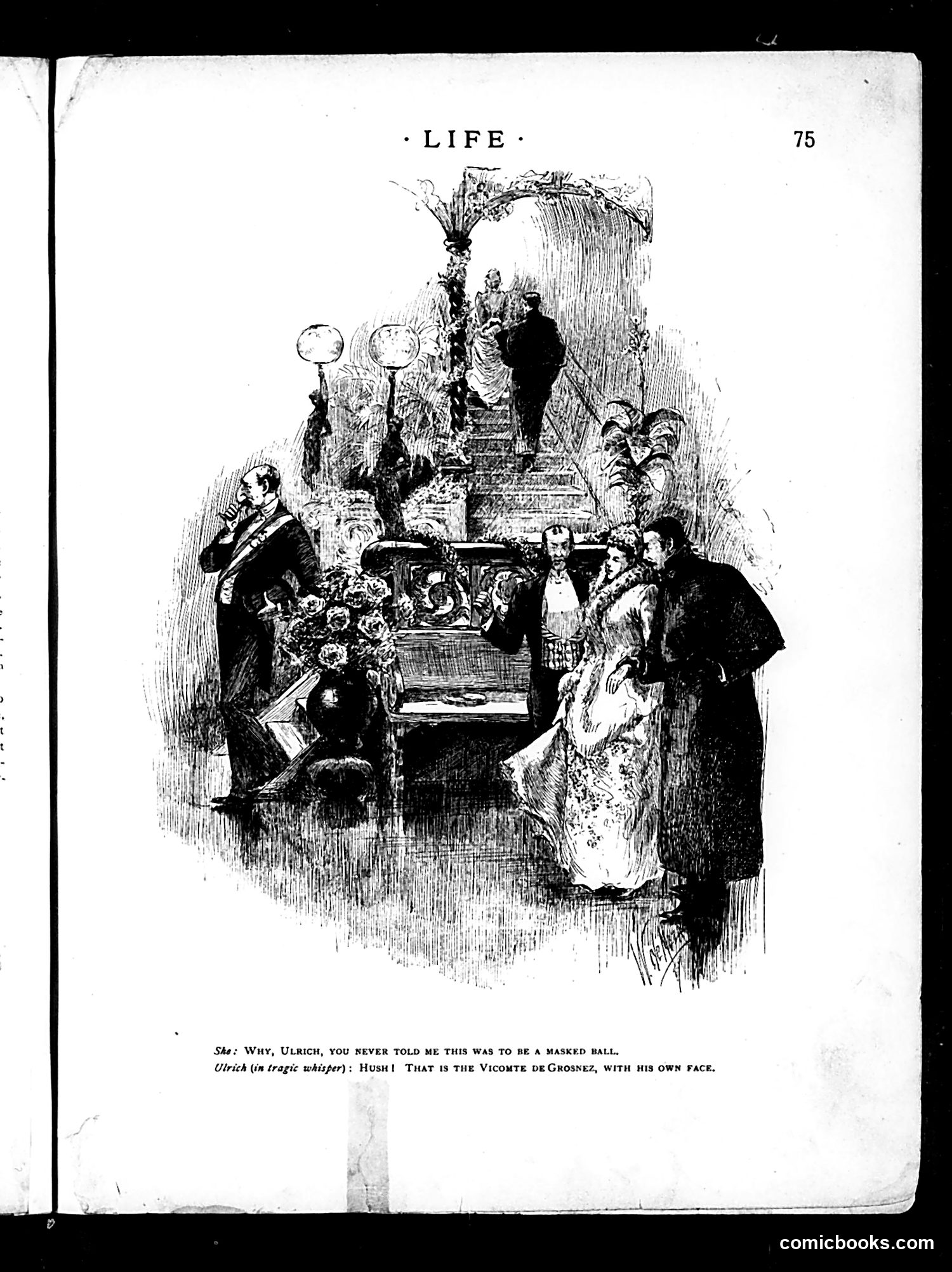
This is a satirical scene from a masquerade ball. The dialogue reveals the joke: a woman expresses shock that her companion Ulrich never mentioned this was a masked ball, and Ulrich responds (in a "tragic whisper") that the figure revealed is the Vicomte de Grosnez—appearing "with his own face." The satire targets the Vicomte de Grosnez, suggesting his actual appearance is so grotesque or ridiculous that it appears as a *mask itself*—his genuine face is indistinguishable from costume disguise. This is a personal insult implying extreme ugliness or comical physiognomy. The joke relies on readers recognizing Grosnez as a contemporary figure, likely a public personality or aristocrat known to Life's audience, whose appearance was considered fair game for mockery.
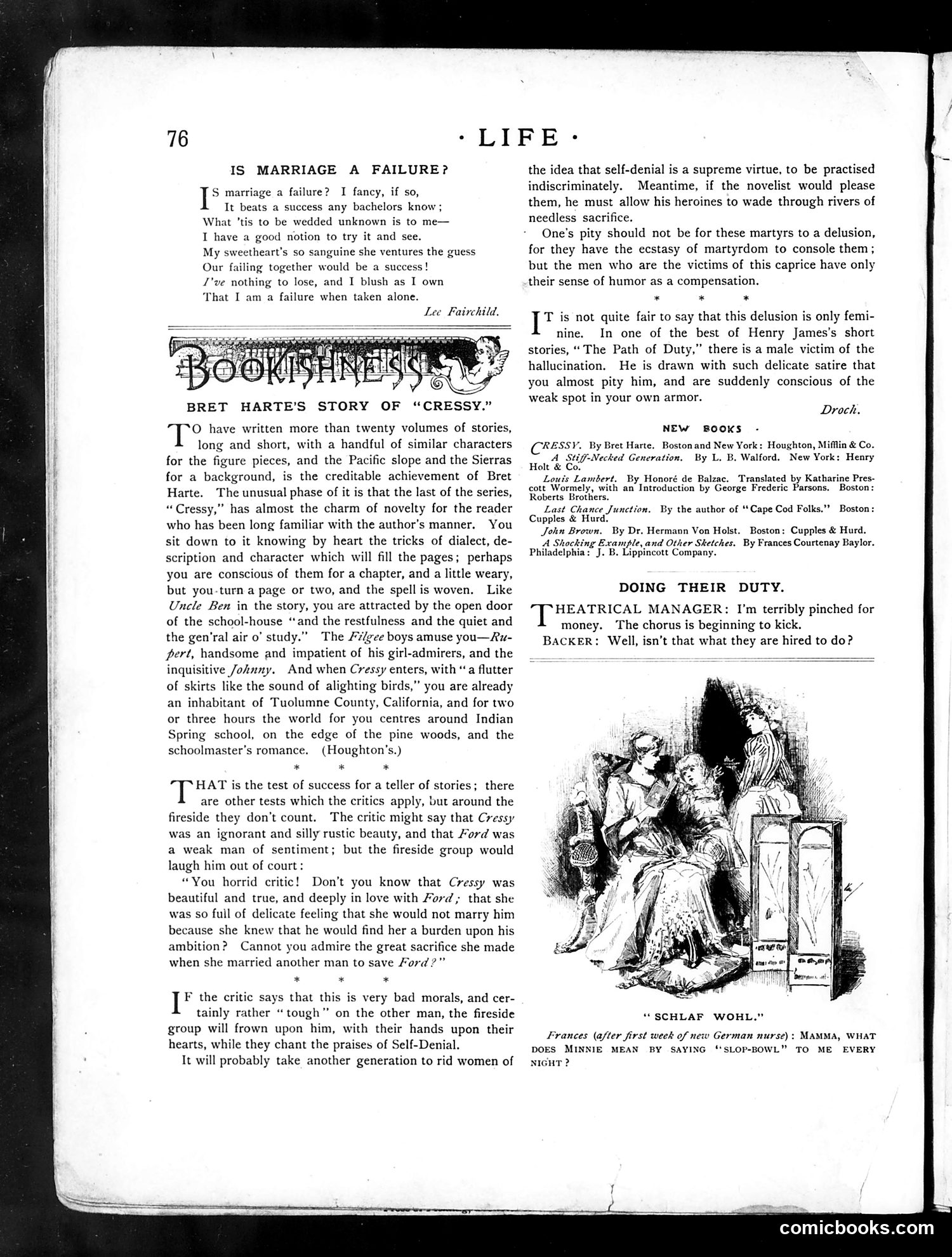
This page contains literary commentary rather than political cartoons. The main article discusses Bret Harte's story series "Cressy," praising how his dialect and character work create compelling fiction. The author argues the story's popularity among fireside readers (ordinary people) matters more than critical approval. The cartoon "Schlap Wohl" depicts a German nurse telling a patient (identified in caption as "Minnie") that her mother says to say "slop-wohl" (likely "Gute Nacht"/"good night") every night. This appears to be gentle ethnic humor about German language and customs, typical of early 20th-century American magazines. The context suggests post-WWI era when German cultural references were common in American publications.
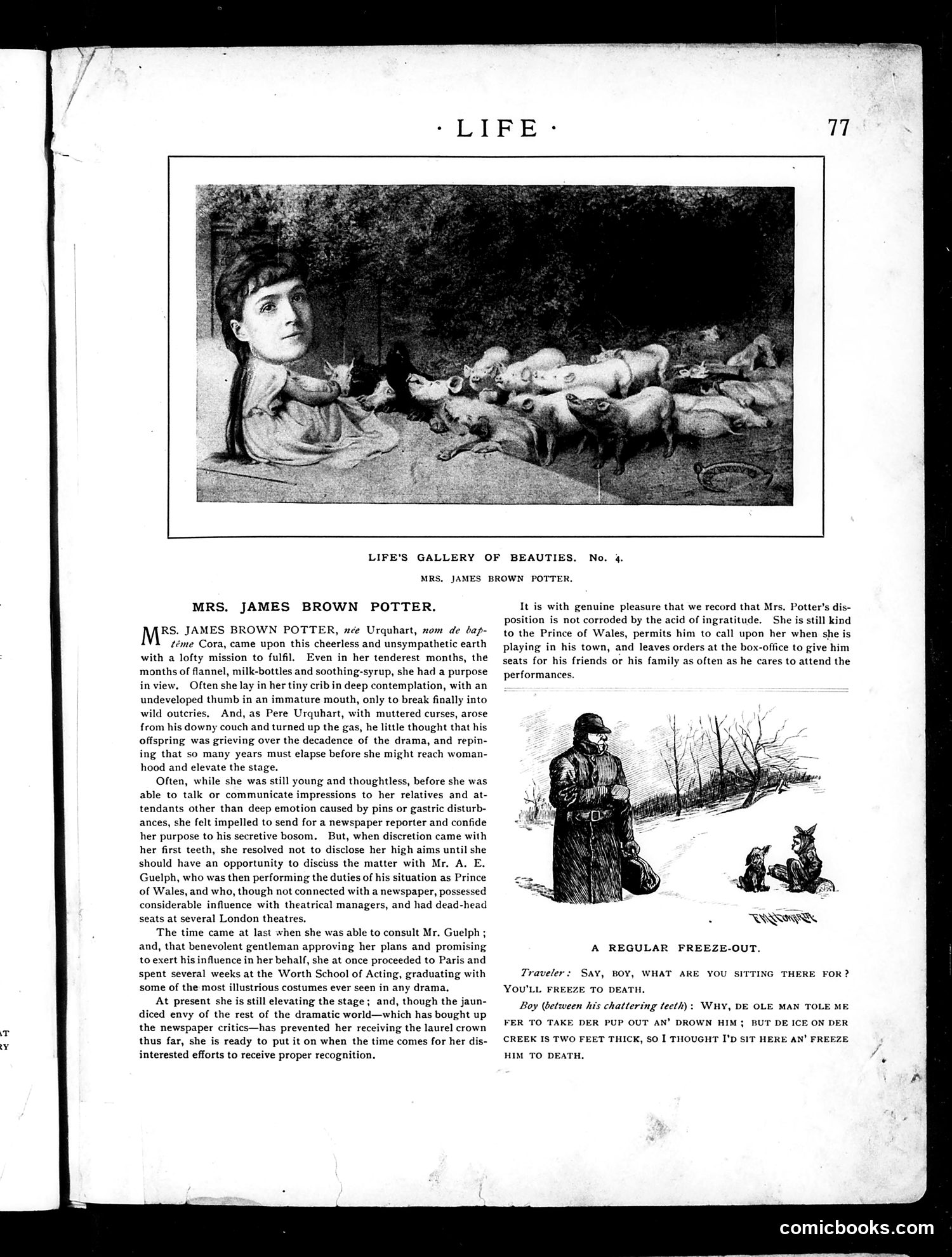
This page from *Life* magazine features an article about **Mrs. James Brown Potter**, a prominent theatrical performer of the late 19th century. The top illustration shows her surrounded by admiring dogs, a visual metaphor for her popularity and ability to command attention. The text describes Potter's rise from humble beginnings to theatrical success, emphasizing her intelligence and ambition. It notes her connection to the Prince of Wales and her influence with theatrical managers. Below is a separate illustrated joke titled "A Regular Freeze-Out," depicting a traveler encountering someone sitting in the cold. The humor appears to involve wordplay about freezing and a pup (puppy/dog). The page combines theatrical biography with unrelated comic humor typical of *Life's* mixed content approach during this period.
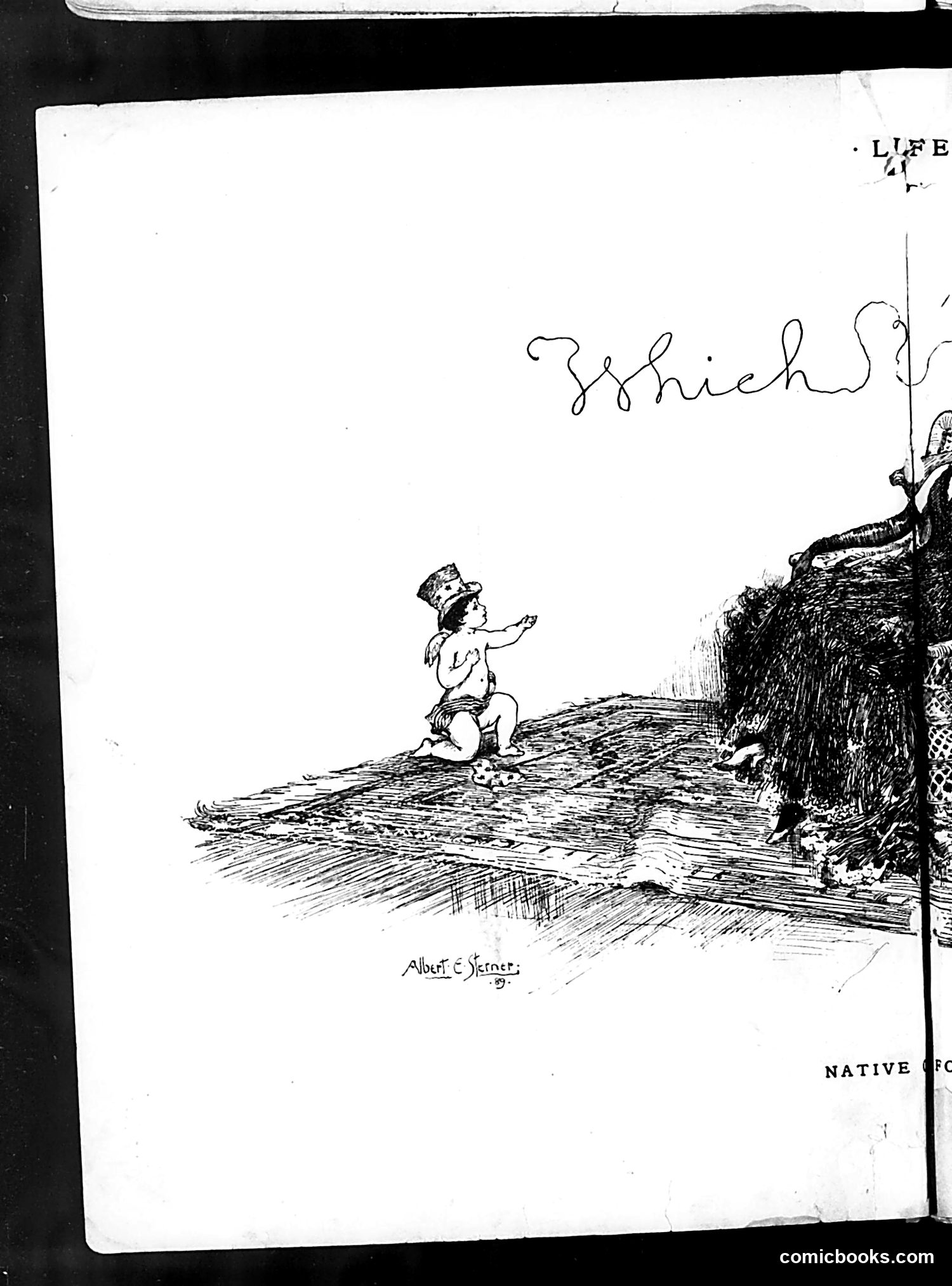
This appears to be a satirical illustration by Albert E. Sterner from *Life* magazine. The handwritten title "Schiehl's[?]" at the top suggests it references a specific person or event, though the exact reference is unclear from the image alone. The cartoon shows a small child in a top hat kneeling on the ground, gesturing toward a large, heavily-shaded rock or boulder formation on the right. The style and composition suggest social or political commentary, possibly mocking someone's ambitions, pretensions, or relationship to power (implied by the formal top hat on an infant). Without clearer context about the title's referent or the date of publication, the specific satire remains difficult to pinpoint with certainty.
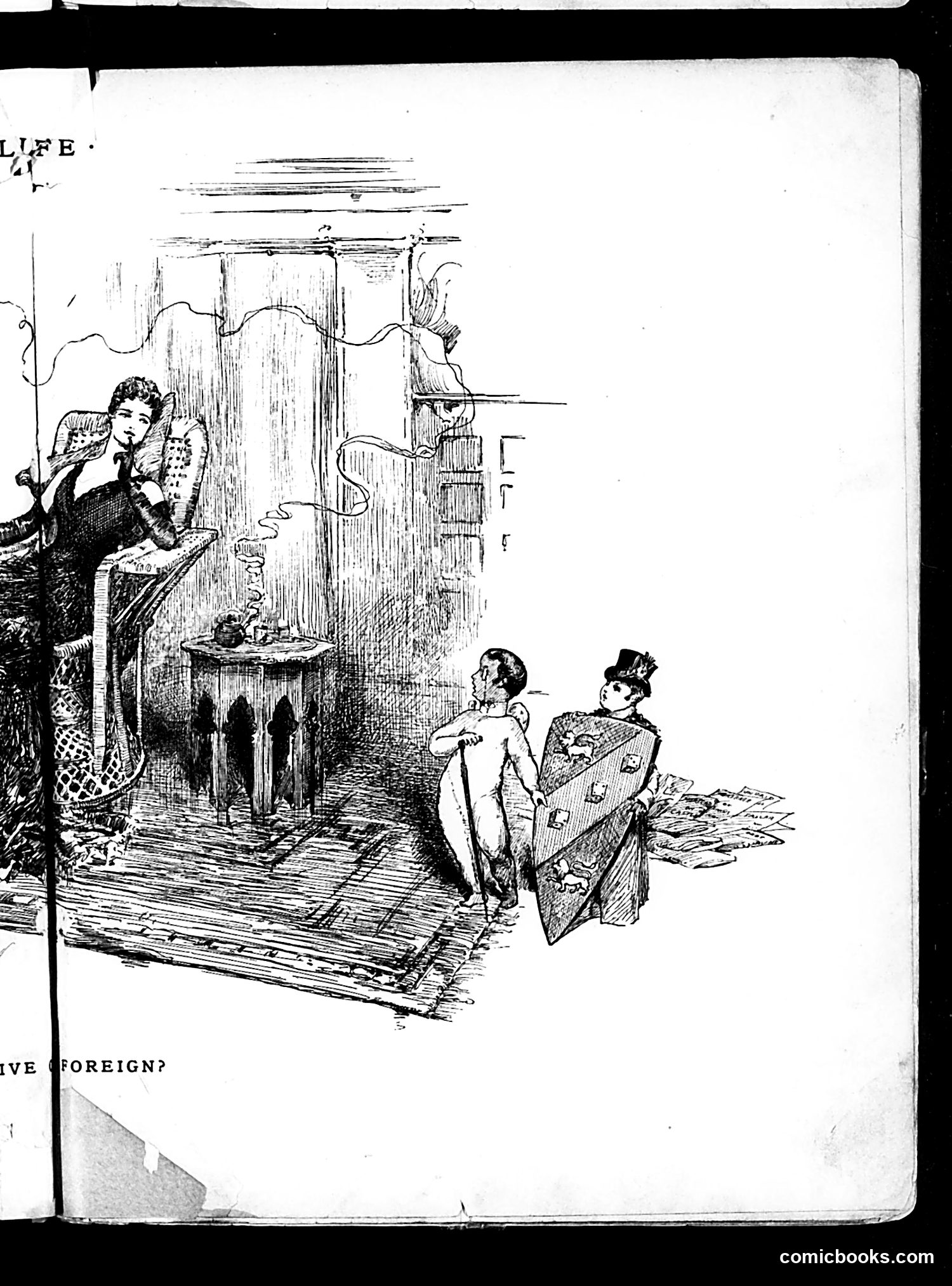
This appears to be a satirical cartoon from *Life* magazine depicting a domestic scene. The visible text fragment "IVE FOREIGN?" (likely part of a longer caption) suggests the cartoon comments on foreignness or immigration. The scene shows a woman at a window (upper left) observing two figures below—a shirtless boy and a man in formal dress with a top hat sitting on scattered papers. The contrast between the formally dressed gentleman and the undressed child, combined with the question about something being "foreign," likely satirizes either: 1. Class or social pretensions (a well-dressed foreigner amid American informality) 2. Immigration and assimilation debates common to early 20th-century American satire The exact joke remains unclear without the complete caption, but it plays on visual incongruity between the figures and their surroundings.
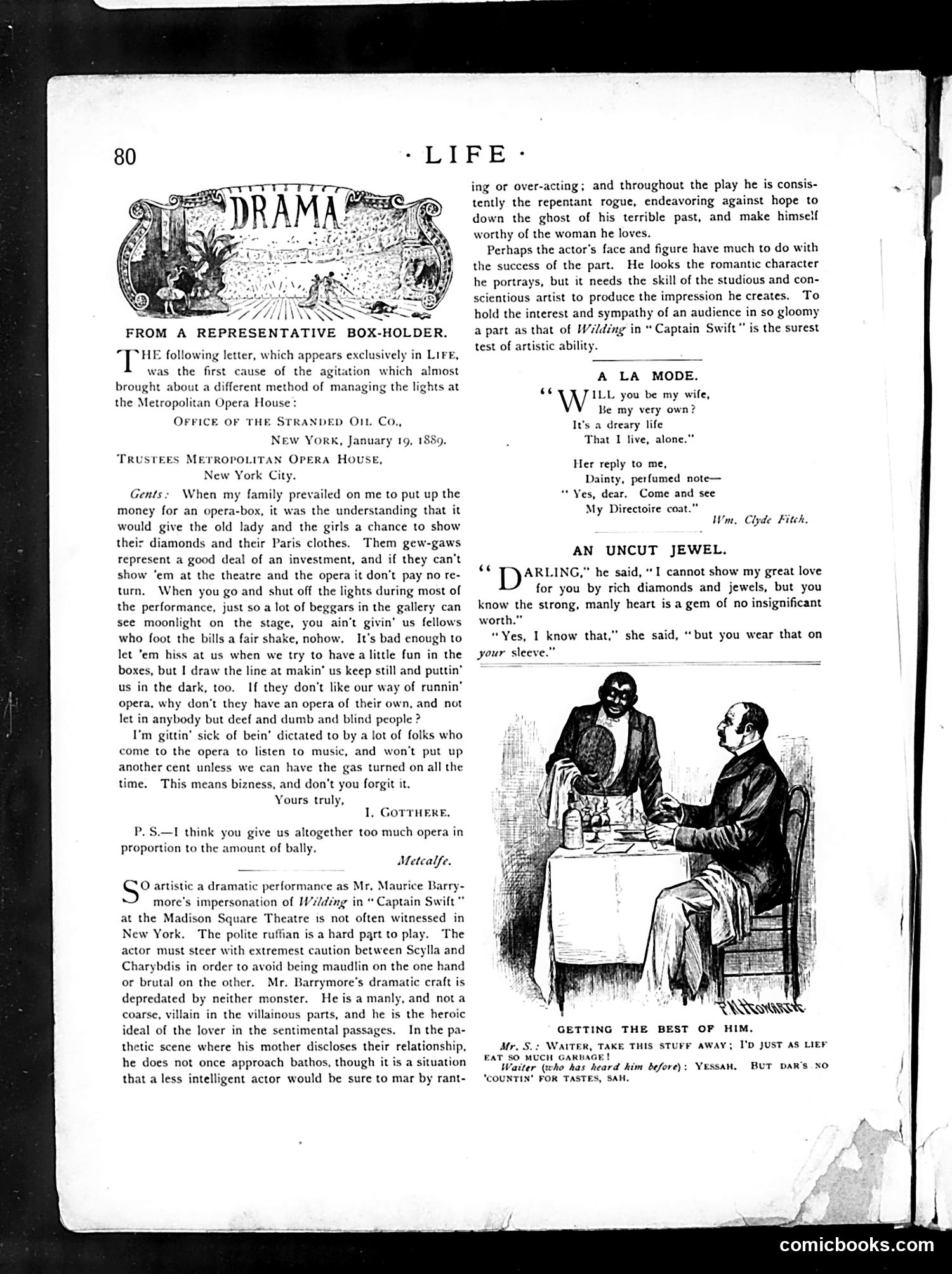
This page from *Life* magazine contains drama criticism and satirical illustrations. The main content discusses Maurice Barrymore's performance in *Wilding*, playing the character "Captain Swift" at the Madison Square Theatre. The critic praises Barrymore's nuanced dramatic skill in portraying a morally complex "polite ruffian" character—avoiding both excessive brutality and excessive sentimentality. The illustration titled "GETTING THE BEST OF HIM" depicts a waiter and diner in conversation, with the waiter complaining about being treated poorly. The satire mocks class dynamics and restaurant service culture of the era, showing the working-class waiter attempting to gain dignity through sass and complaint. The page also includes brief comedic literary quotes ("A La Mode," "An Uncut Jewel") satirizing romantic and materialistic attitudes among the wealthy.
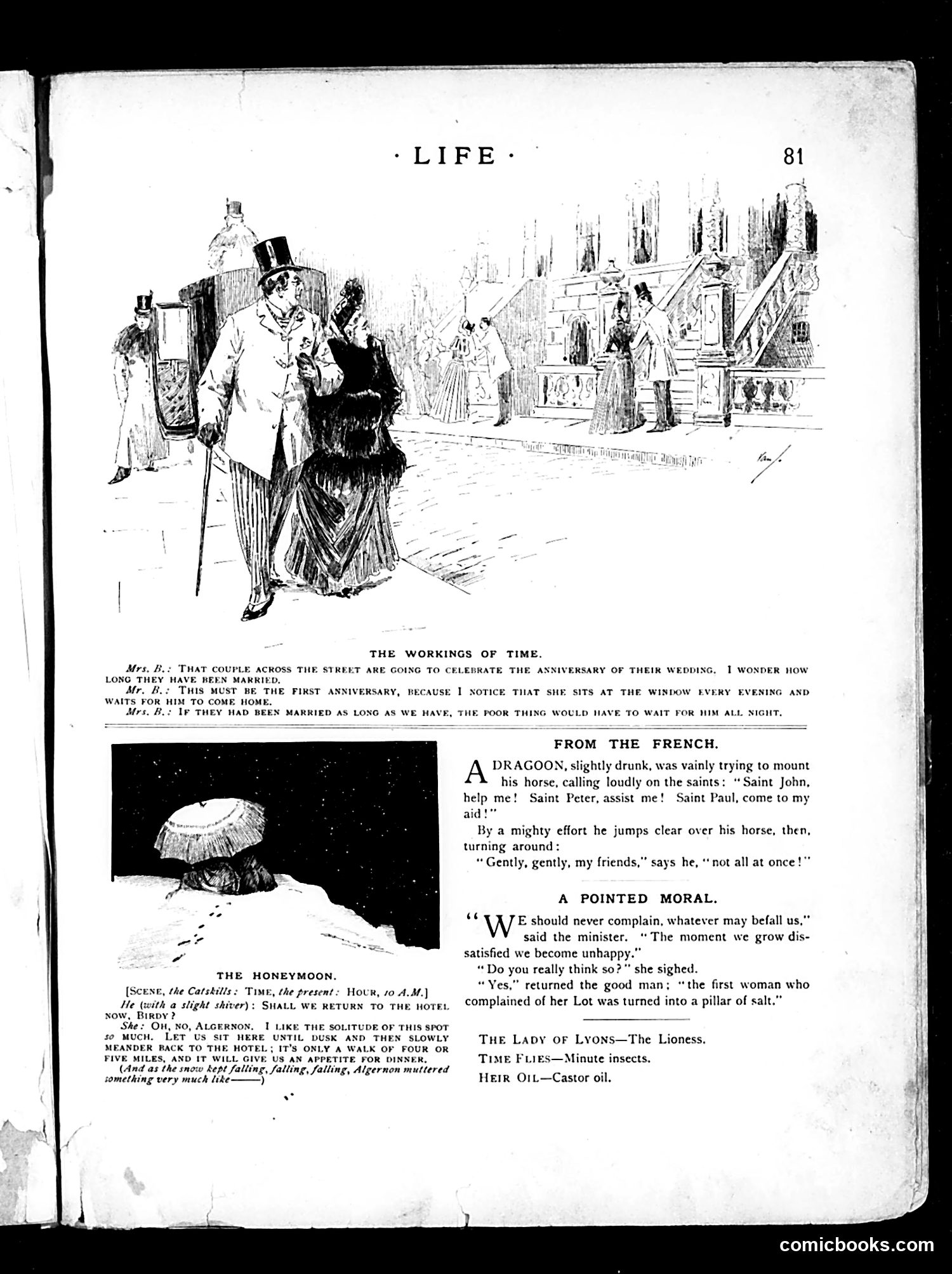
This cartoon satirizes how marriage changes over time. Two gossiping neighbors observe a young couple celebrating their first wedding anniversary. The wife waits anxiously each evening for her husband's return home—she still cares deeply about his presence. The joke's punchline reveals the bitter reality of long marriage: Mrs. B. reveals that *she and her husband* have been married so long that his wife wouldn't bother waiting for him at all, much less all night. The satire mocks how marital affection and attentiveness supposedly deteriorate with years of marriage, transforming devoted newlyweds into indifferent, negligent spouses. The page also includes unrelated humor pieces—a drunken French dragoon's failed horse-mounting and moral aphorisms—typical of Life's miscellaneous satirical content. These attack human folly and hypocrisy in domestic life and social conduct.
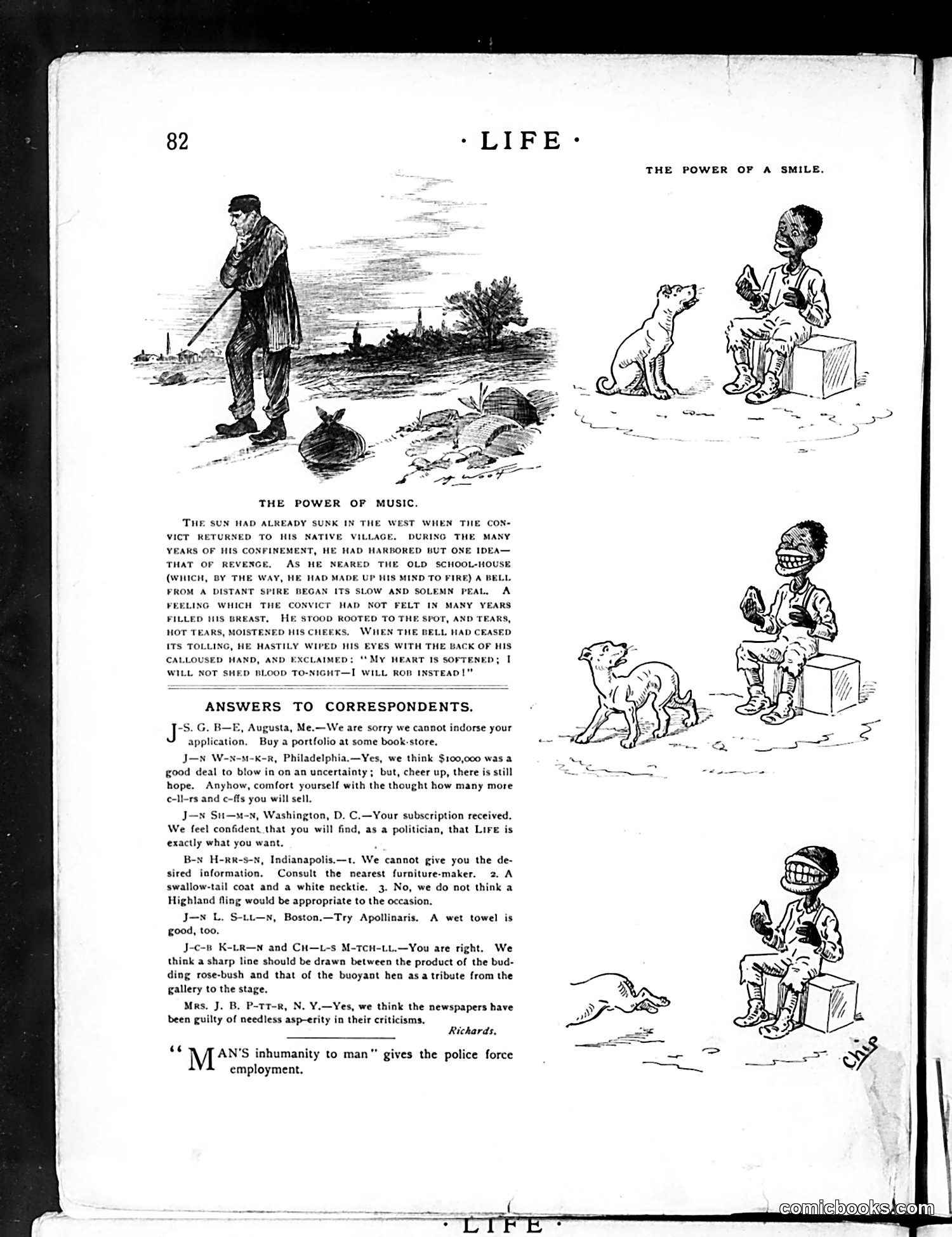
**Left panel ("The Power of Music"):** A melodramatic narrative illustrated shows a hardened convict returning to his village bent on revenge—specifically planning to burn down the schoolhouse. When he hears a church bell toll, he's moved to tears and abandons his violent plans, exclaiming his heart is softened. The satire mocks overly sentimental Victorian storytelling tropes about redemption through emotion. **Right panel ("The Power of a Smile"):** A series of vignettes showing a child's smile having transformative effects on various adults and animals—all responding with joy or compliance to the child's grin. This contrasts with the left panel's "power of music," suggesting innocent childhood charm works better than grand emotional narratives. **"Answers to Correspondents" section:** Satirical responses to reader queries using partially obscured names (likely recognizable contemporaries). The magazine mocks various public figures with thinly veiled barbs about financial deals, political ambitions, and social pretensions—typical of *Life*'s irreverent commentary on American public life.
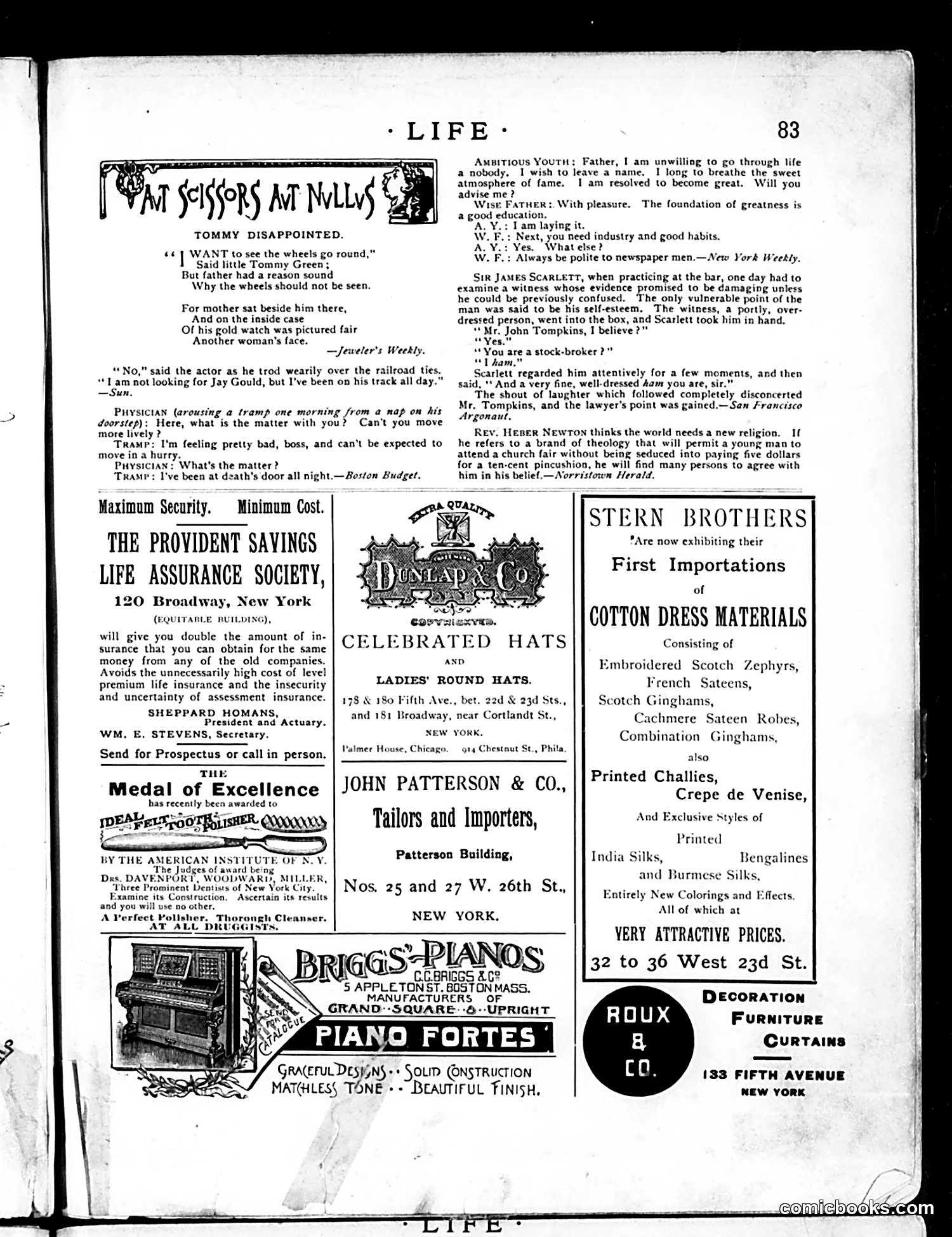
This page presents several short satirical pieces typical of Life magazine's humor: **"Tommy Disappointed"** mocks infidelity: a boy wants to see a watch's internal mechanisms, but his father forbids it because the case's interior displays a picture of another woman—revealing an affair to the mother sitting nearby. **Other brief jokes** target: a struggling actor pursuing financier Jay Gould; a vagrant too exhausted to move, claiming he's "been at death's door all night"; and an ambitious youth advised that success requires education, industry, *and* politeness to newspaper men (satirizing media influence). **The Scarlett anecdote** depicts a barrister confusing a pompous stock-broker witness through flattery, causing the man to lose composure—a legal strategy. **Rev. Heber Newton's critique** sarcastically suggests the world needs a religion permitting young men to attend church fairs without being pressured into overpriced purchases. The page is primarily **advertising** (life insurance, hats, pianos, fabrics), with satirical content filling gaps—typical of period Life magazines blending humor with commerce.
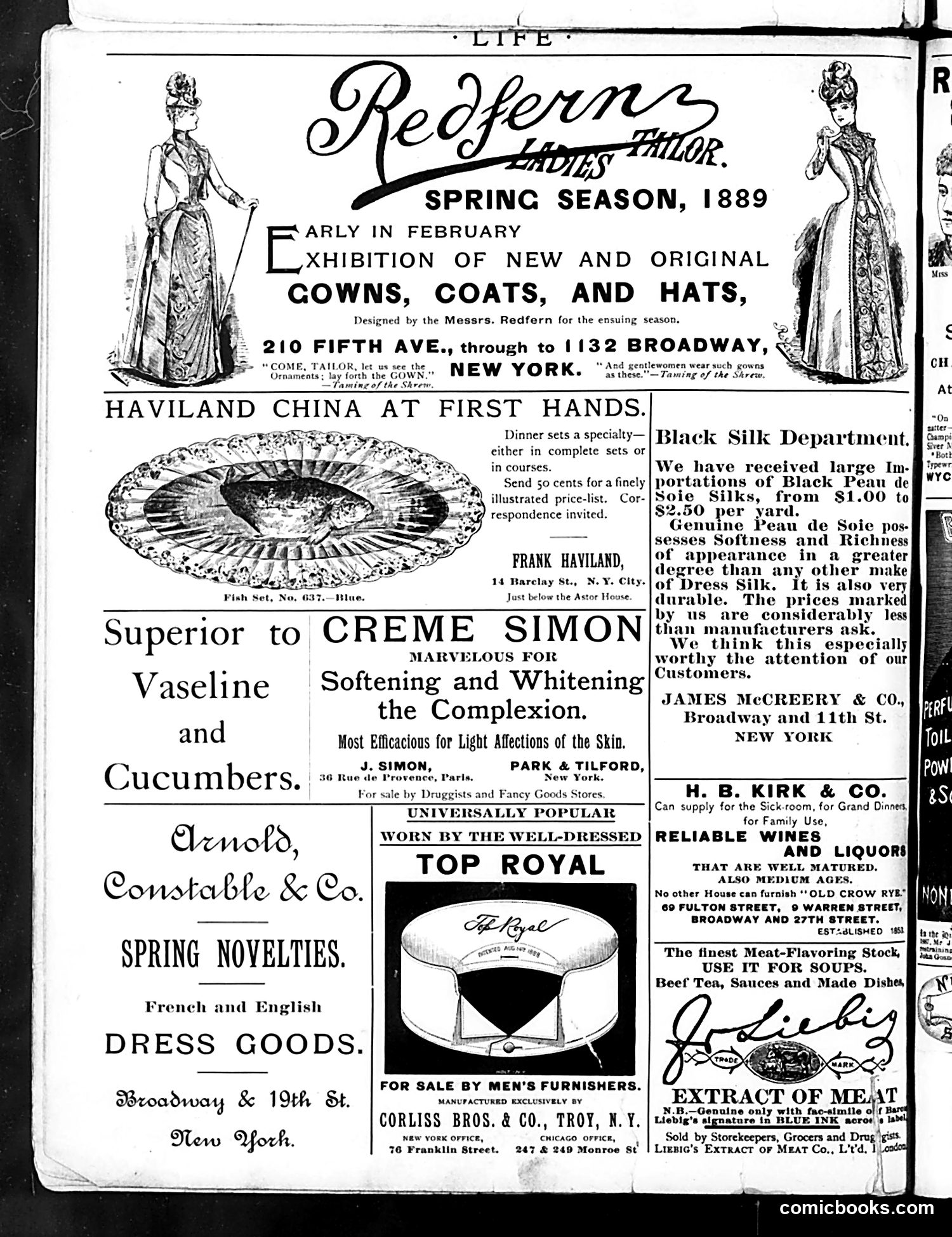
This is primarily a **commercial advertisement page**, not a political cartoon. It showcases luxury goods for New York's wealthy class during the Gilded Age. The page features two illustrated fashion figures at top advertising **Redfern's** spring 1889 clothing collection—elegant gowns indicating high-end tailoring for women of means. Below are various ads for luxury items: fine china dinnerware, beauty products (complexion creams), designer dress goods, silk fabrics, men's hats, wines and liquors, and meat extract. The single literary reference—Shakespeare's *Taming of the Shrew* ("And gentlewomen wear such gowns as these")—suggests aspirational consumption. **The satire is implicit**: Life magazine, despite its satirical reputation, carried substantial advertising that catered to the wealthy elite, reflecting the consumer culture and class divisions of 1880s New York. The juxtaposition of luxury goods demonstrates the era's conspicuous consumption among the upper class.
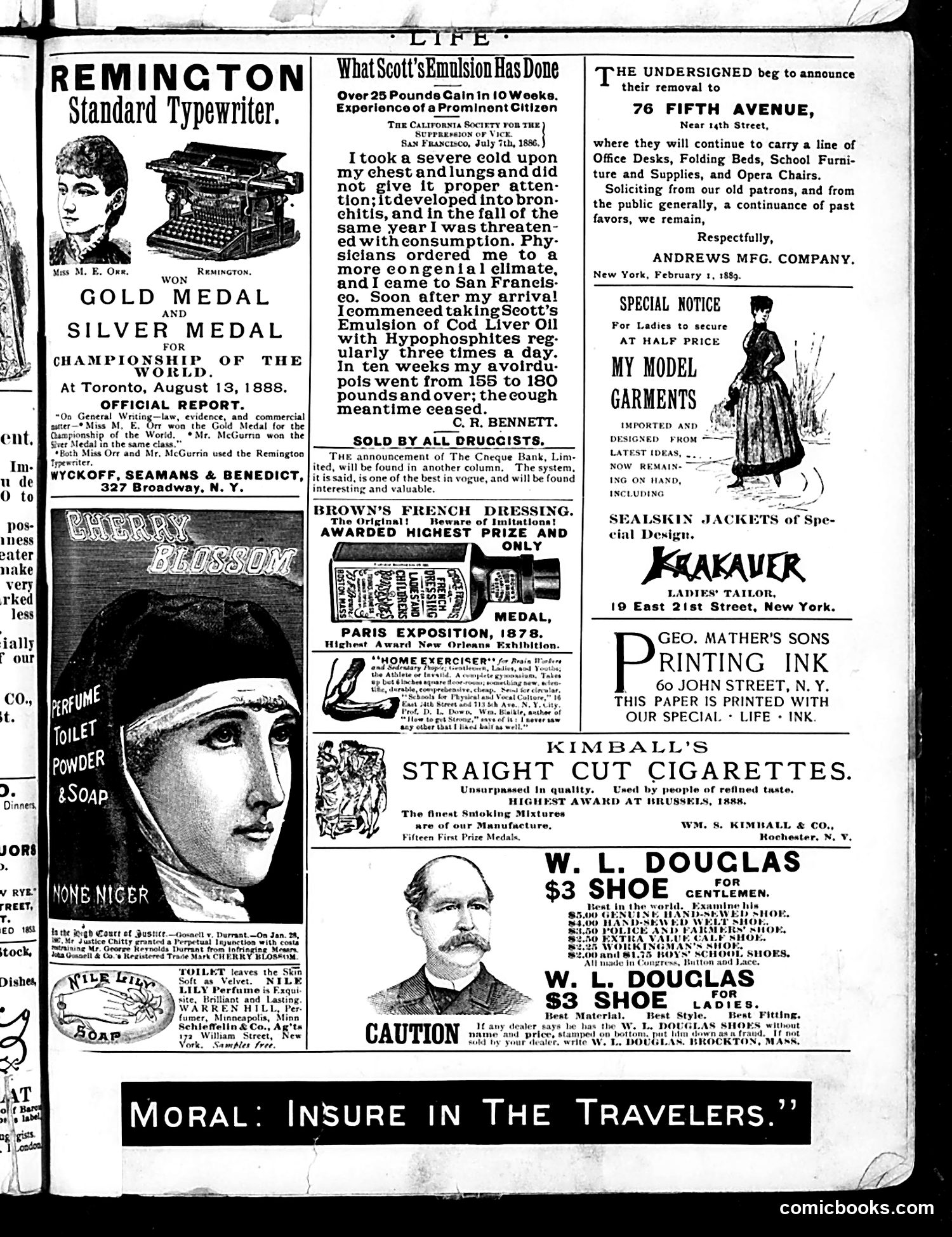
This is primarily an **advertising page** from Life magazine (February 1889), with minimal editorial content. The page showcases late-19th-century consumer products: typewriters, patent medicines, clothing, shoes, and tobacco. Key advertisements include: - **Remington Typewriter**: Emphasizes a championship win by "Miss M. E. Ore" at a Toronto competition (1888), suggesting typewriters were novel enough to warrant competitive demonstrations - **Scott's Emulsion**: A cod liver oil supplement claiming dramatic weight gain (155 to 180 pounds in 10 weeks) for tuberculosis/consumption patients—reflecting the era's desperation for TB treatments before antibiotics - **W.L. Douglas Shoes** ($3): Positioned as affordable quality footwear - **Brown's French Dressing** and **Kimball Cigarettes**: Luxury goods emphasizing international awards The **moral at bottom**—"Insure in the Travelers"—appears unrelated to page content, likely a running slogan. This page reflects Victorian consumer culture, with emphasis on scientific/medical claims and competitive prestige to sell products.
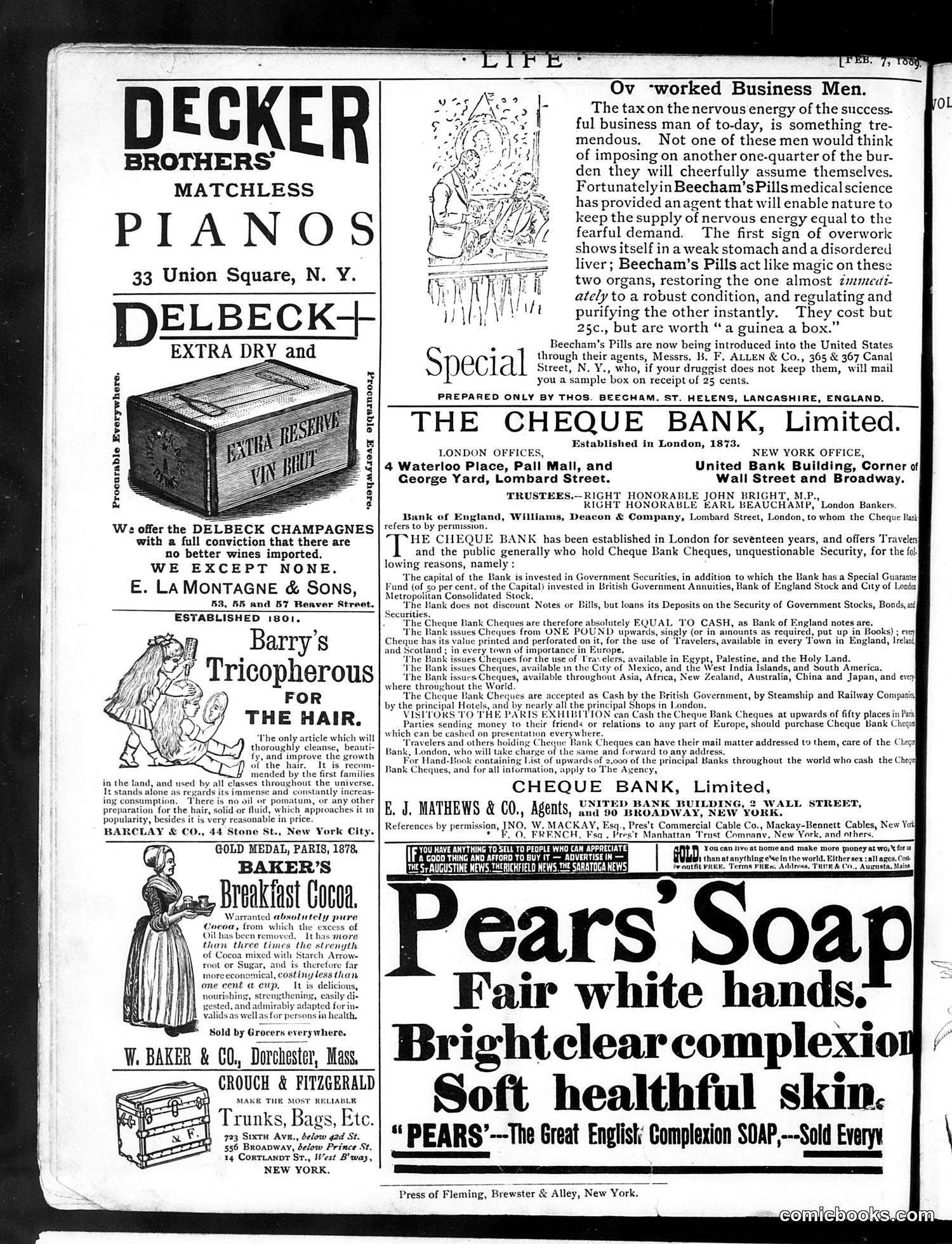
This page is **primarily advertising** with one notable editorial cartoon. The main illustration—"Barry's Tricopherous for the Hair"—depicts a woman applying hair tonic. The accompanying text claims it's "the only article which will" promote hair growth and is "recommended by the first families." This is typical Victorian-era patent medicine advertising, making exaggerated health claims (common practice before FDA regulation). The largest advertisement features **Pears' Soap**, emphasizing "Fair white hands," "Bright clear complexion," and "Soft healthful skin"—reflecting period beauty standards and the era's problematic racial attitudes about skin color. Other advertisements promote Decker pianos, Beecham's Pills (for "overworked business men"), and the Cheque Bank—all legitimate businesses of the era. **No significant political satire** appears on this page. The content reflects late-19th-century consumer culture, medical quackery acceptance, and beauty ideals rather than political commentary.