
Life, 1889-02-07 · page 4 of 16
Life — February 7, 1889 — page 4: what you’re looking at
What you’re looking at
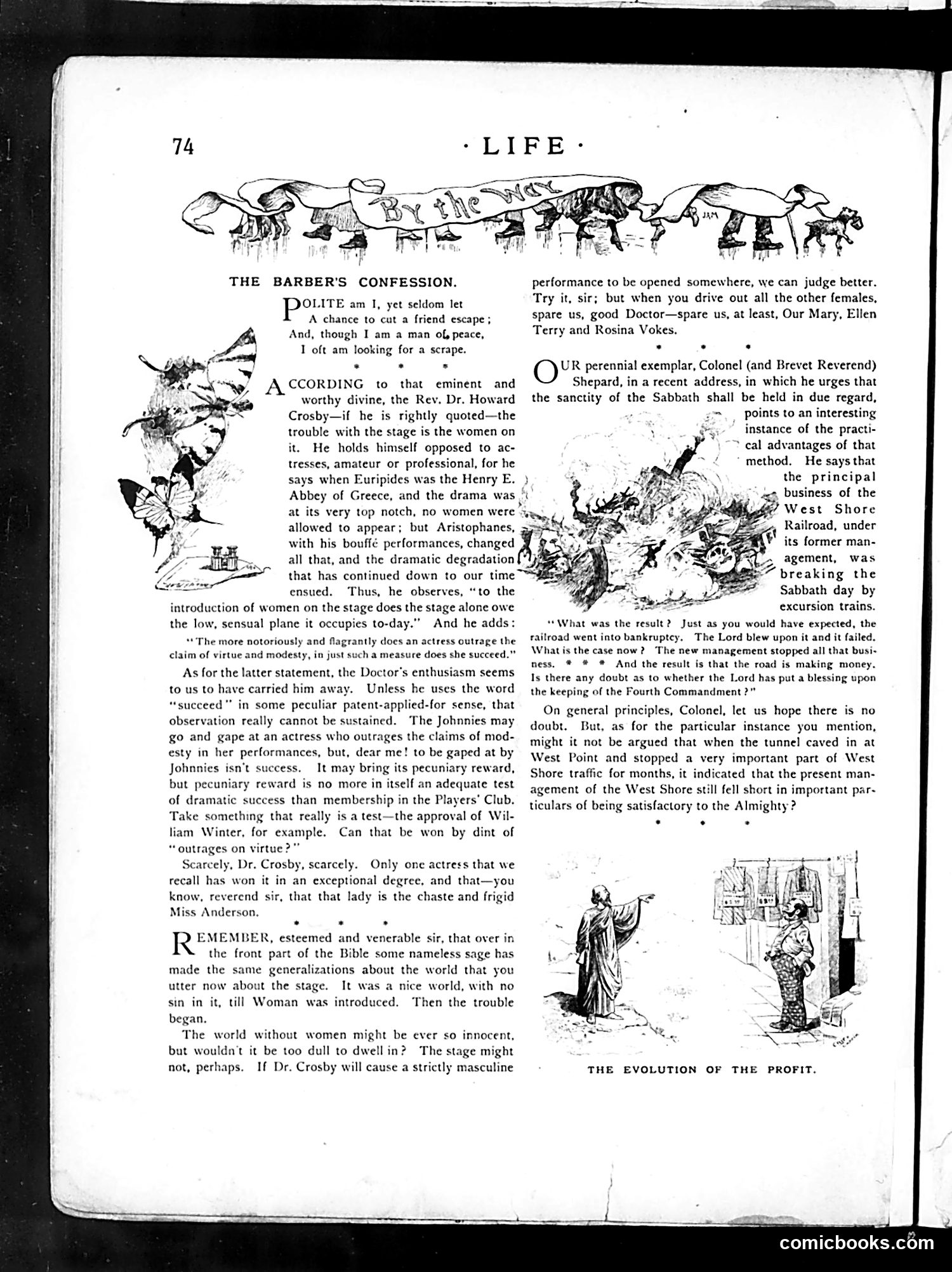
**"The Barber's Confession"** presents a satirical dialogue between a barber and Dr. Crosby (apparently a religious figure or moralist) debating women's presence in theater. The barber defends actresses, citing their talent and virtue, while Dr. Crosby argues—referencing ancient Greek drama—that women's appearance on stage inherently degrades performance and morality. **"The Evolution of the Profit"** (lower right) appears to be a separate cartoon showing a figure in religious robes gesturing toward a businessman or entrepreneur, likely satirizing the relationship between religious institutions and commercial interests or profit-seeking. Both pieces critique Victorian-era moral anxiety about women in public performance and apparent hypocrisy regarding religious principles versus financial gain. The humor relies on readers' familiarity with contemporary moral debates.
📄 Transcribed text from this page (OCR, searchable)
Machine-transcribed from the original scan — historical spelling and the odd misread are preserved.
THE BARBER'S CONFESSION. OLITE am I, yet seldom let A chance to cut a friend escape ; And, though I am a man of, peace, I oft am looking for a scrape. * . . Me el ; Hee, ACCORDING to that eminent and oy worthy divine, the Rev, Dr. Howard Crosby—if he is rightly quoted—the trouble with the stage is the women on it. He holds himself opposed to ac- tresses, amateur or professional, for he says when Euripides was the Henry E. Abbey of Greece, and the drama was at its very top notch, no women were allowed to appear; but Aristophanes, with his bouffé performances, changed all that, and the dramatic degradation that has continued down to our time ensued. Thus, he observes, “to the introduction of women on the stage does the stage alone owe the low, sensual plane it occupies to-day.” And he adds: “The more notoriously and flagrantly does an actress outrage the claim of virtue and modesty, in just such a measure does she succeed.” As for the latter statement, the Doctor's enthusiasm seems. to us to have carried him awa Unless he uses the word “succeed in some peculiar patent-applied-for sense, that observation really cannot be sustained. The Johnnies may go and gape at an actress who outrages the claims of mod- esty in her performances, but, dear me! to be gaped at by Johnnies isn’t succes It may bring its pecuniary reward, but pecuniary reward is no more in itself an adequate test of dramatic success than membership in the Players’ Club. Take something that really is a test—the approval of Wil- liam Winter, for example. Can that be won by dint of “outrages on virtue?” Scarcely, Dr. Crosby, scarcely. Only one actress that we recall has won it in an exceptional degree, and that—you know, reverend sir, that that lady is the chaste and frigid Miss Anderson. I EMEMBER, esteemed and venerable sir, that over in the front part of the Bible some nameless sage has made the same generalizations about the world that you utter now about the stage. It was a nice world, with no sin in it, till Woman was introduced. Then the trouble began. The world without women might be ever so innocent, but wouldn't it be too dull to dwell in? The stage might not, perhaps. If Dr. Crosby will cause a strictly masculine performance to be opened somewhere, we can judge better. Try it, sir; but when you drive out all the other females, spare us, good Doctor—spare us, at least, Our Mary, Ellen Terry and Rosina Vokes. . . . UR perennial exemplar, Colonel (and Brevet Reverend) Shepard, in a recent address, in which he urges that the sanctity of the Sabbath shall be held in due regard, i points to an interesting instance of the practi- > cal advantages of that method. He says that the principal business of the West Shore Railroad, under its former man- [+ agement, was <~ breaking the Sabbath day by excursion trains. “What was the result? Just as you would have expected, the railroad went into bankruptcy. The Lord blew upon it and it failed. What is the case now? The new management stopped all that bus ness. * *® ® And the result is that the road is making money. Is there any doubt as to whether the Lord has put a blessing upon the keeping of the Fourth Commandment ?” On general principles, Colonel, let us hope there is no doubt, But, as for the particular instance you mention, might it not be argued that when the tunnel caved in at West Point and stopped a very important part of West Shore traffic for months, it indicated that the present man- agement of the West Shore still fell short in important par- ticulars of being satisfactory to the Almighty ? . . THE EVOLUTION OF THE PROFIT. comicbooks.cém