
Life, 1889-02-07 · page 2 of 16
Life — February 7, 1889 — page 2: what you’re looking at
What you’re looking at
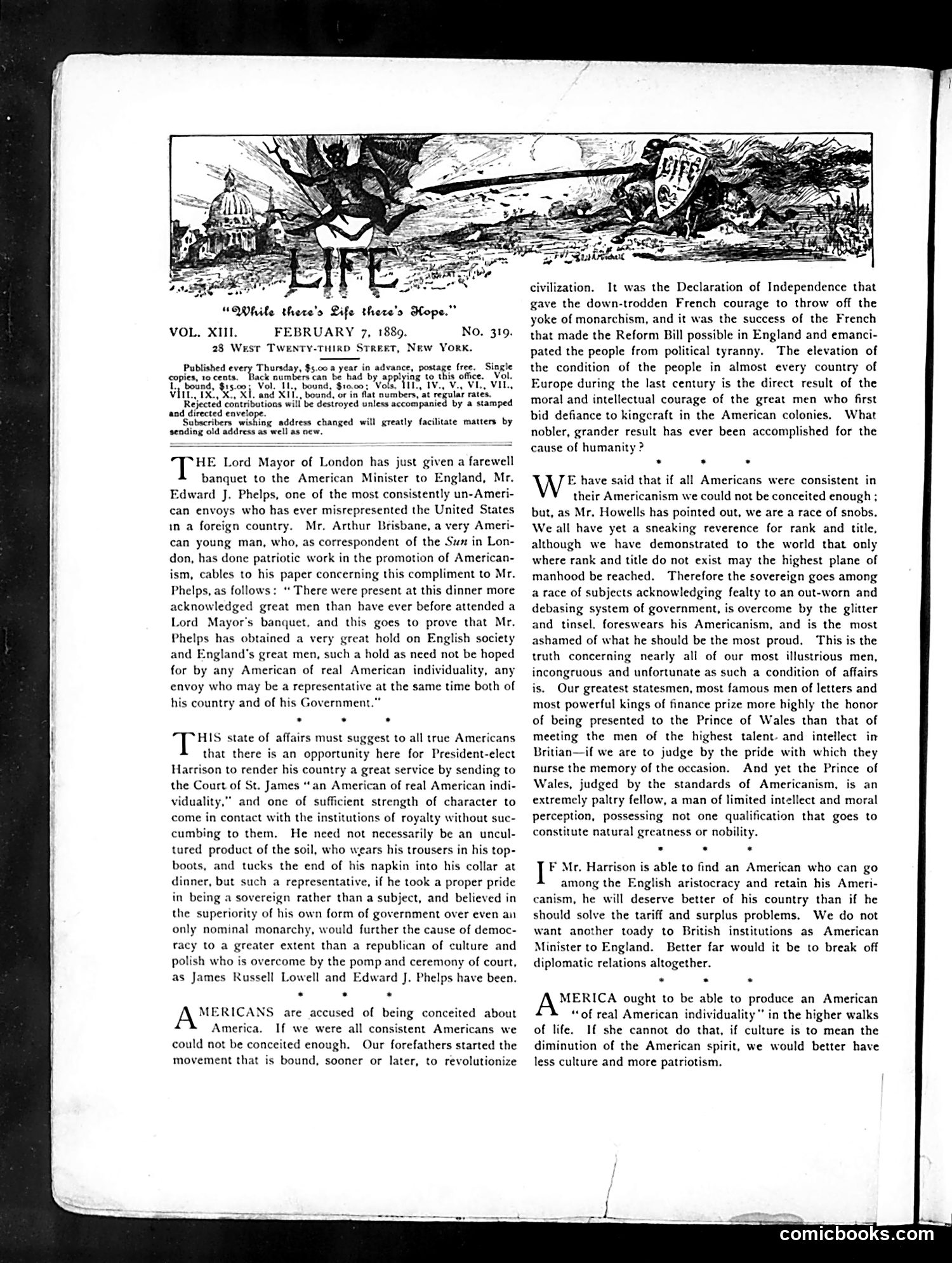
The masthead and decorative header dominate the upper portion. The text discusses American identity and diplomacy, particularly referencing President-elect Harrison and his potential diplomatic appointments. The articles criticize Americans who adopt British aristocratic manners and titles, arguing this undermines democratic values. Specific targets appear to include James Russell Lowell and Edward J. Phelps (likely diplomats who adopted affected British customs). The satire's core message: authentic American "individuuality" requires rejecting European aristocratic pretension. The author argues that American statesmen should embody democratic principles rather than mimicking English court culture, or America risks becoming merely another monarchy-worshipping nation. This reflects Gilded Age anxieties about American cultural identity amid increasing transatlantic elite social exchange.
📄 Transcribed text from this page (OCR, searchable)
Machine-transcribed from the original scan — historical spelling and the odd misread are preserved.
“QMhile there's Sife there's Hope.” VOL. XIII. FEBRUARY 7, 1889. No. 319. 28 West Twenty-THInD Street, New York. Published every Thursday, $5.co a year in advance, postage free. Single govies, rg cents. Tack numbers can be had by applying to this office. Vol L,, bound, $: ve . bound, $1.00; Vols, II. Vi. VIL, vitt., 1x, x. Rejected and directed env Subscribers wishing address changed will greatly facilitate matters by sending old address as well as new. > bound, of in flat numbers, at kot tributions will be destroyed unless accompanied by a stamped THE Lord Mayor of London has just given a farewell banquet to the American Minister to England, Mr. Edward J. Phelps, one of the most consistently un-Ameri- can envoys who has ever misrepresented the United States in a foreign country. Mr. Arthur Brisbane, a very Ameri- can young man, who, as correspondent of the Sux in Lon- don, has done patriotic work in the promotion of American- ism, cables to his paper concerning this compliment to Mr. Phelps, as follows: “ There were present at this dinner more acknowledged great men than have ever before attended a Lord Mayor's banquet, and this goes to prove that Mr. Phelps has obtained a very great hold on English society and England's great men, such a hold as need not be hoped for by any American of real American individuality, any envoy who may be a representative at the same time both of his country and of his Government.” HIS state of affairs must suggest to all true Americans that there is an opportunity here for President-elect Harrison to render his country a great service by sending to the Court of St. James “an American of real American indi- viduality,”” and one of sufficient strength of character to come in contact with the institutions of royalty without suc- cumbing to them. He need not necessarily be an uncul- tured product of the soil, who wears his trousers in his top- boots, and tucks the end of his napkin into his collar at dinner, but such a representative, if he took a proper pride in being a sovereign rather than a subject, and believed in the superiority of his own form of government over even an only nominal monarchy, would further the cause of democ- racy to a greater extent than a republican of culture and polish who is overcome by the pomp and ceremony of court, as James Russell Lowell and Edward J. Phelps have been. A™ RICANS are accused of being conceited about America. If we were all consistent Americans we could not be conceited enough. Our forefathers started the movement that is bound, sooner or later, to revolutionize civilization. It was the Declaration of Independence that gave the down-trodden French courage to throw off the yoke of monarchism, and it was the success of the French that made the Reform Bill possible in England and emanci- pated the people from political tyranny. The elevation of the condition of the people in almost every country of Europe during the last century is the direct result of the moral and intellectual courage of the great men who first bid defiance to kingcraft in the American colonies. What nobler, grander result has ever been accomplished for the cause of humanity ? . . . E have said that if all Americans were consistent in their Americanism we could not be conceited enough ; but, as Mr. Howells has pointed out, we are a race of snobs. We all have yet a sneaking reverence for rank and title, although we have demonstrated to the world that only where rank and title do not exist may the highest plane of manhood be reached. Therefore the sovereign goes among a race of subjects acknowledging fealty to an out-worn and debasing system of government, is overcome by the glitter and tinsel. foreswears his Americanism, and is the most ashamed of what he should be the most proud. This is the truth concerning nearly all of our most illustrious men, incongruous and unfortunate as such a condition of affairs is. Our greatest statesmen, most famous men of letters and most powerful kings of finance prize more highly the honor of being presented to the Prince of Wales than that of meeting the men of the highest talent. and intellect in Britian—if we are to judge by the pride with which they nurse the memory of the occasion. And yet the Prince of Wales, judged by the standards of Americanism, is an extremely paltry fellow, a man of limited intellect and moral perception, possessing not one qualification that goes to constitute natural greatness or nobility. F Mr. Harrison is able to find an American who can go among the English aristocracy and retain his Ameri- canism, he will deserve better of his country than if he should solve the tariff and surplus problems. We do not want another toady to British institutions as American Minister to England. Better far would it be to break off diplomatic relations altogether. AMERICA ought to be able to produce an American “of real American individuality” in the higher walks of life. If she cannot do that, if culture is to mean the diminution of the American spirit, we would better have less culture and more patriotism. ~ comicbooks.com