
Life, 1889-02-07 · page 6 of 16
Life — February 7, 1889 — page 6: what you’re looking at
What you’re looking at
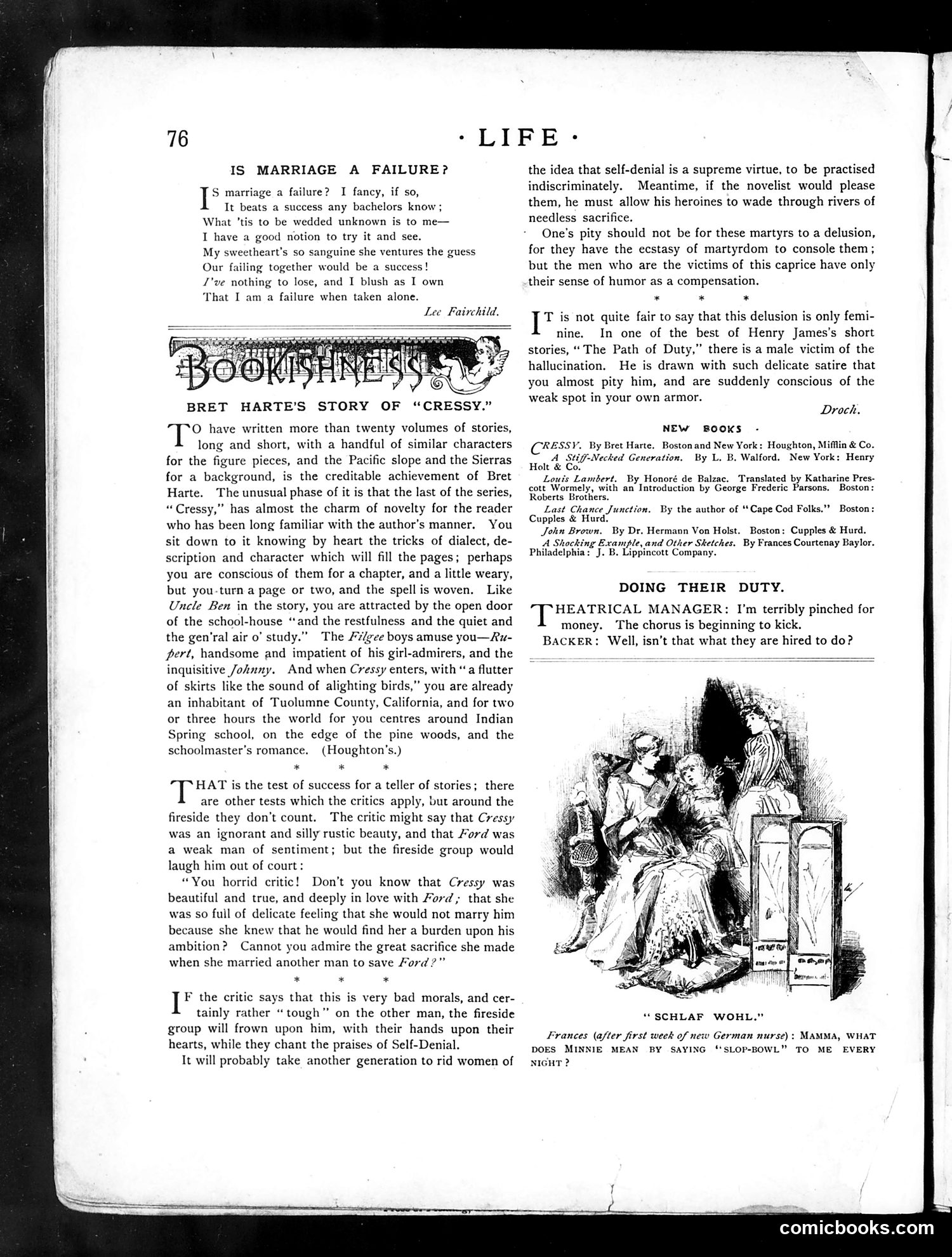
This page contains literary commentary rather than political cartoons. The main article discusses Bret Harte's story series "Cressy," praising how his dialect and character work create compelling fiction. The author argues the story's popularity among fireside readers (ordinary people) matters more than critical approval. The cartoon "Schlap Wohl" depicts a German nurse telling a patient (identified in caption as "Minnie") that her mother says to say "slop-wohl" (likely "Gute Nacht"/"good night") every night. This appears to be gentle ethnic humor about German language and customs, typical of early 20th-century American magazines. The context suggests post-WWI era when German cultural references were common in American publications.
📄 Transcribed text from this page (OCR, searchable)
Machine-transcribed from the original scan — historical spelling and the odd misread are preserved.
- LIFE: IS MARRIAGE A FAILURE? $ marriage a failure? I fancy, if so, It beats a success any bachelors know ; What ‘tis to be wedded unknown is to me— I have a good notion to try it and see. My sweetheart’s so sanguine she ventures the guess Our failing together would be a success! /'ve nothing to lose, and I blush as I own That I am a failure when taken alone. Lee Fairchild. BRET HARTE’S STORY OF “CRESSY.” O have written more than twenty volumes of stories, long and short, with a handful of similar characters for the figure pieces, and the Pacific slope and the Sierras for a background, is the creditable achievement of Bret Harte. The unusual phase of it is that the last of the series, “Cressy,” has almost the charm of novelty for the reader who has been long familiar with the author’s manner. You sit down to it knowing by heart the tricks of dialect, de- scription and character which will fill the pages; perhaps you are conscious of them for a chapter, and a little weary, but you-turn a page or two, and the spell is woven. Like Uncle Ben in the story, you are attracted by the open door of the school-house “and the restfulness and the quiet and the gen’ral air o’ study.” The F7/gee boys amuse you—Ru- pert, handsome and impatient of his girl-admirers, and the inquisitive Johnny. And when Cressy enters, with “a flutter of skirts like the sound of alighting birds,” you are already an inhabitant of Tuolumne County, California, and for two or three hours the world for you centres around Indian Spring school, on the edge of the pine woods, and the schoolmaster’s romance. (Houghton’s * * * HAT is the test of success for a teller of stories; there are other tests which the critics apply, but around the fireside they don’t count. The critic might say that Cressy was an ignorant and silly rustic beauty, and that Ford was a weak man of sentiment; but the fireside group would laugh him out of court : “You horrid critic! Don’t you know that Cressy was beautiful and true, and deeply in love with Ford, that she was so full of delicate feeling that she would not marry him because she knew that he would find her a burden upon his ambition? Cannot you admire the great sacrifice she made when she married another man to save Ford?” * * * I' the critic says that this is very bad morals, and cer- tainly rather “tough” on the other man, the fireside group will frown upon him, with their hands upon their hearts, while they chant the praises of Self-Denial. It will probably take another generation to rid women of the idea that self-denial is a supreme virtue, to be practised indiscriminately. Meantime, if the novelist would please them, he must allow his heroines to wade through rivers of needless sacrifice. One's pity should not be for these martyrs to a delusion, for they have the ecstasy of martyrdom to console them ; but the men who are the victims of this caprice have only their sense of humor as a compensation. * * * ii is not quite fair to say that this delusion is only femi- In one of the best of Henry James's short stories, “The Path of Duty,” there is a male victim of the hallucination. He is drawn with such delicate satire that you almost pity him, and are suddenly conscious of the weak spot in your own armor. nine. Droch, NEW BOOKS By Bret Harte, Boston and New York: Houghton, Mifflin & Co. By L, B, Walford. New York: Henry CRES: A Stiff-Necked Generation. Holt & Co. Louis Lambert, By Honoré de Balzac. Translated by Katharine Pres- cott Wormely, with an Introduction by George Frederic Parsons. Boston: Roberts Brothers. Last Chance Junction. Cupples & Hurd? John Brown. By Dr. Hermann Von Holst. Boston: Cupples & Hurd. A Shocking Example, and Other Sketches. By Frances Courtenay Baylor. Philadelphia: J. B. Lippincott Company. By the author of “Cape Cod Folks.”” Boston: DOING THEIR DUTY. HEATRICAL MANAGER: I'm terribly pinched for money. The chorus is beginning to kick. BACKER: Well, isn’t that what they are hired to do? ““SCHLAF WOHL.” Frances (after first week of new DOES MINNIE MEAN BY SAYING NIGHT ? German nurse): MAMMA, WHAT “SLOP-BOWL” TO ME comicbooks.com