
A complete issue · 16 pages · 1889
Life — January 17, 1889
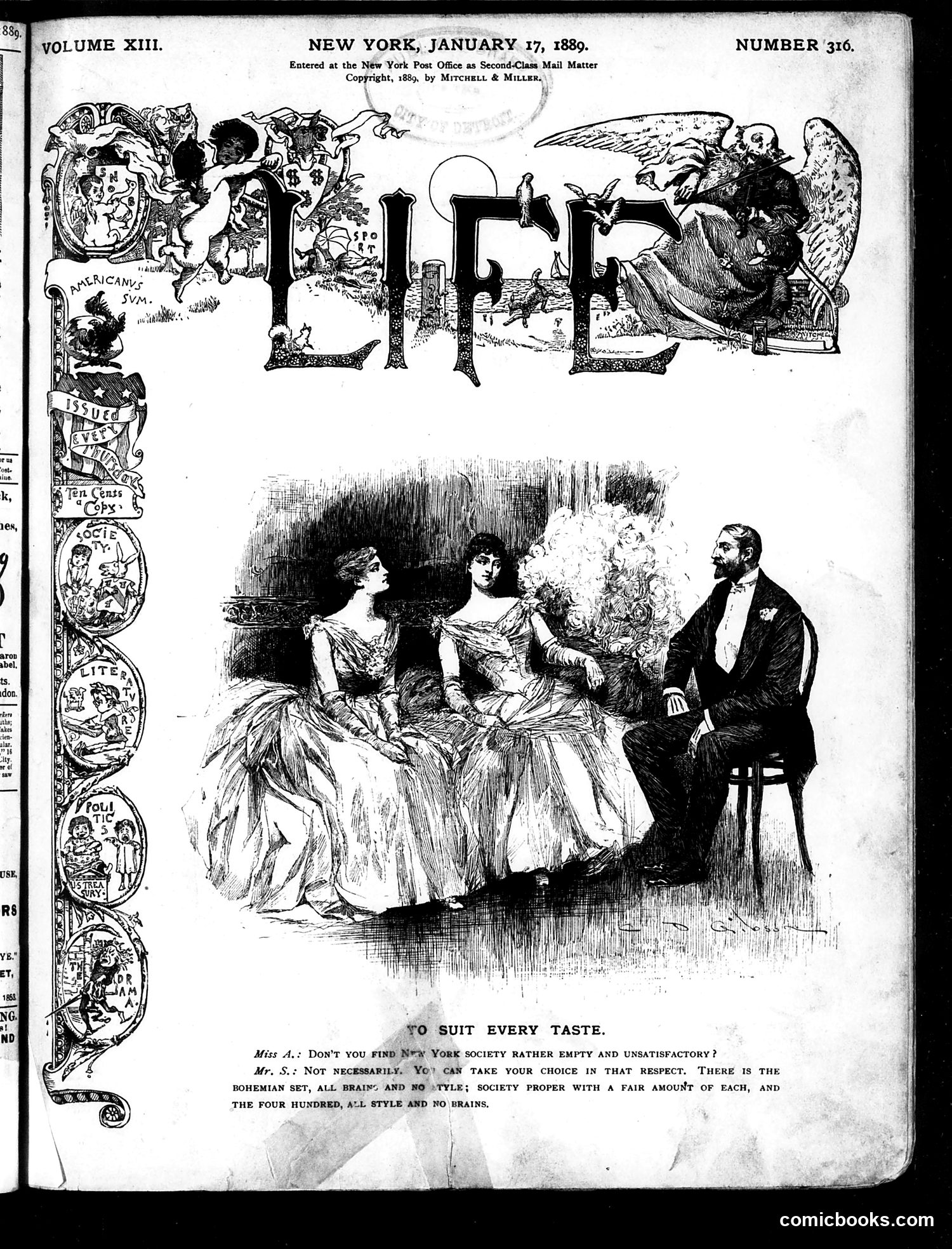
**The Cartoon's Subject:** This page satirizes New York high society's diversity of tastes and pretensions. The dialogue reads: Miss A complains that New York society seems "rather empty and unsatisfactory." Mr. S responds that there's actually plenty of choice—"the Bohemian set, all shades, and no style; society proper with a fair amount of each, and the four hundred, all style and no brains." **The Satire:** The cartoon mocks the city's rigid social stratification. "The Four Hundred" refers to the elite social circle (wealthy Manhattan families fitting in Mrs. Astor's ballroom). The joke ridicules all classes: bohemians lack polish, respectable society lacks substance, and the ultra-wealthy possess style but no intellectual merit. It's a biting commentary on 1889 New York's hollow social hierarchies regardless of wealth level.
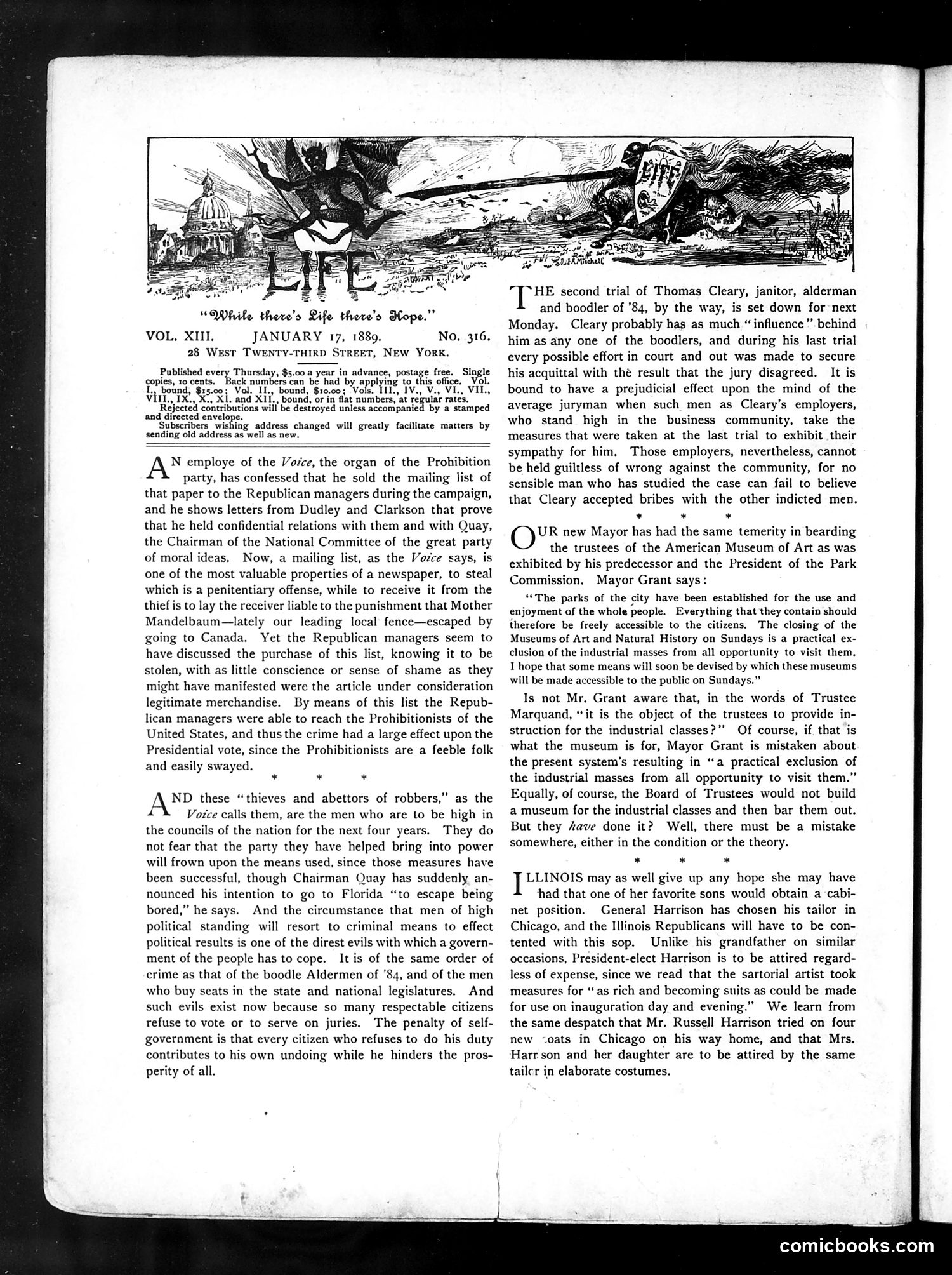
The masthead illustration depicts Death (skeleton with scythe) confronting "Life" itself, symbolizing the magazine's satirical mission examining mortality, morality, and current events. The text discusses Thomas Cleary, a janitor and "bootlegger of '84," whose second trial is upcoming. The article suggests Cleary accepted bribes alongside other indicted men, though his employers claim prejudice against him due to his association with the Prohibition party's *Voice* newspaper. The piece critiques Republican politicians and party leaders (particularly Chairman Quay) for allegedly using stolen mailing lists and engaging in corrupt practices, while hypocritically claiming moral authority. It argues that respectable citizens enabling such corruption through inaction bear responsibility for undermining democratic governance.
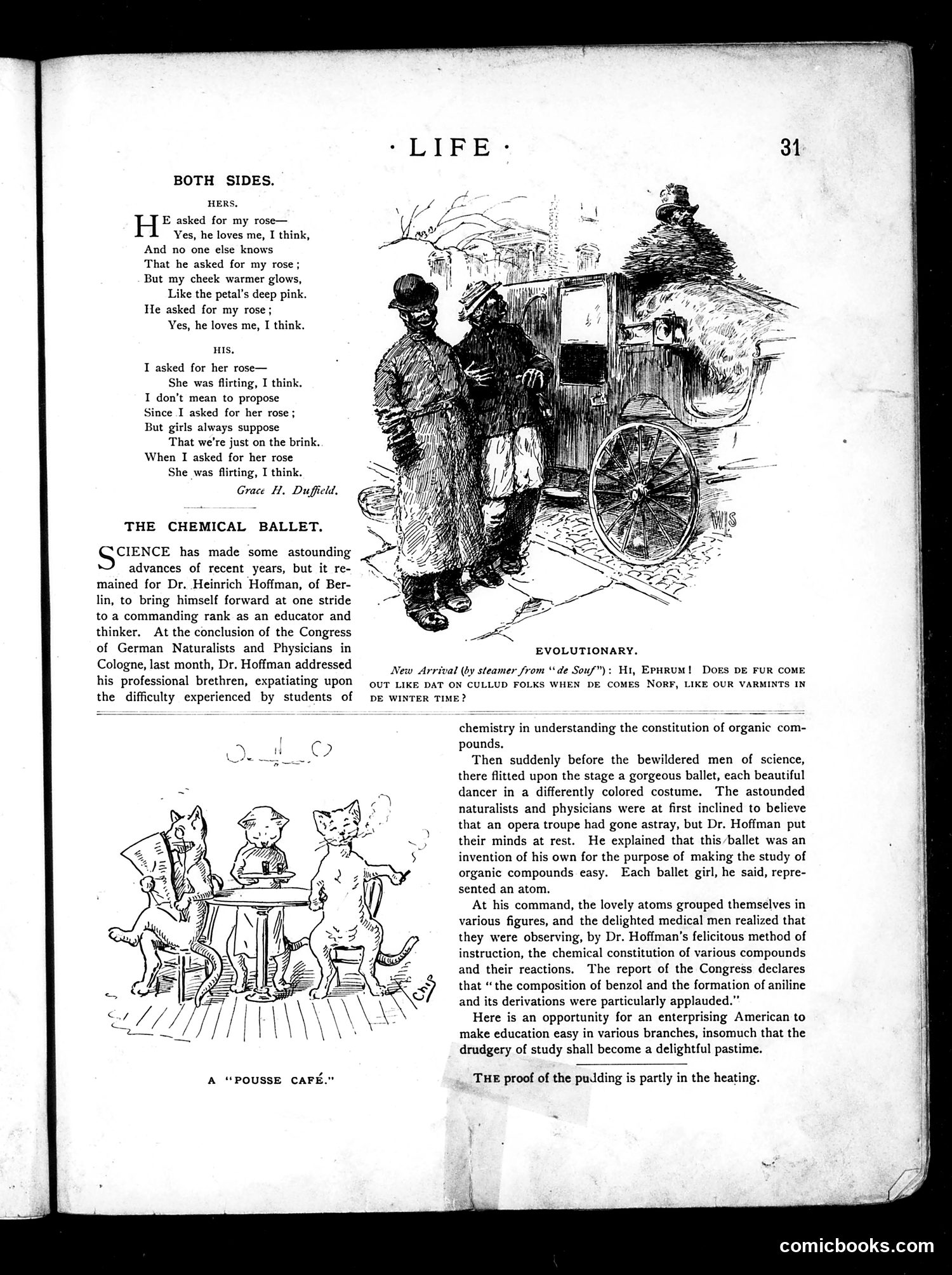
**"Both Sides" Poem**: A light romantic piece where a man and woman each claim the other asked for a rose first—a humorous reversal of courtship expectations where both parties pretend innocence. **"The Chemical Ballet"**: The main article describes Dr. Heinrich Hoffmann's educational innovation presented at a Congress of German Naturalists and Physicians in Cologne. He used costumed dancers representing atoms to physically demonstrate chemical compound formation and reactions—making organic chemistry instruction entertaining and visual rather than purely theoretical. **Illustrations**: Two sketches accompany the piece: one showing people with a horse-drawn cart (context unclear), and another depicting anthropomorphic cats in a "Pousse Café" setting, likely unrelated to the main article or providing comic relief. The satire celebrates making science education engaging and accessible through creative theatrical methods.
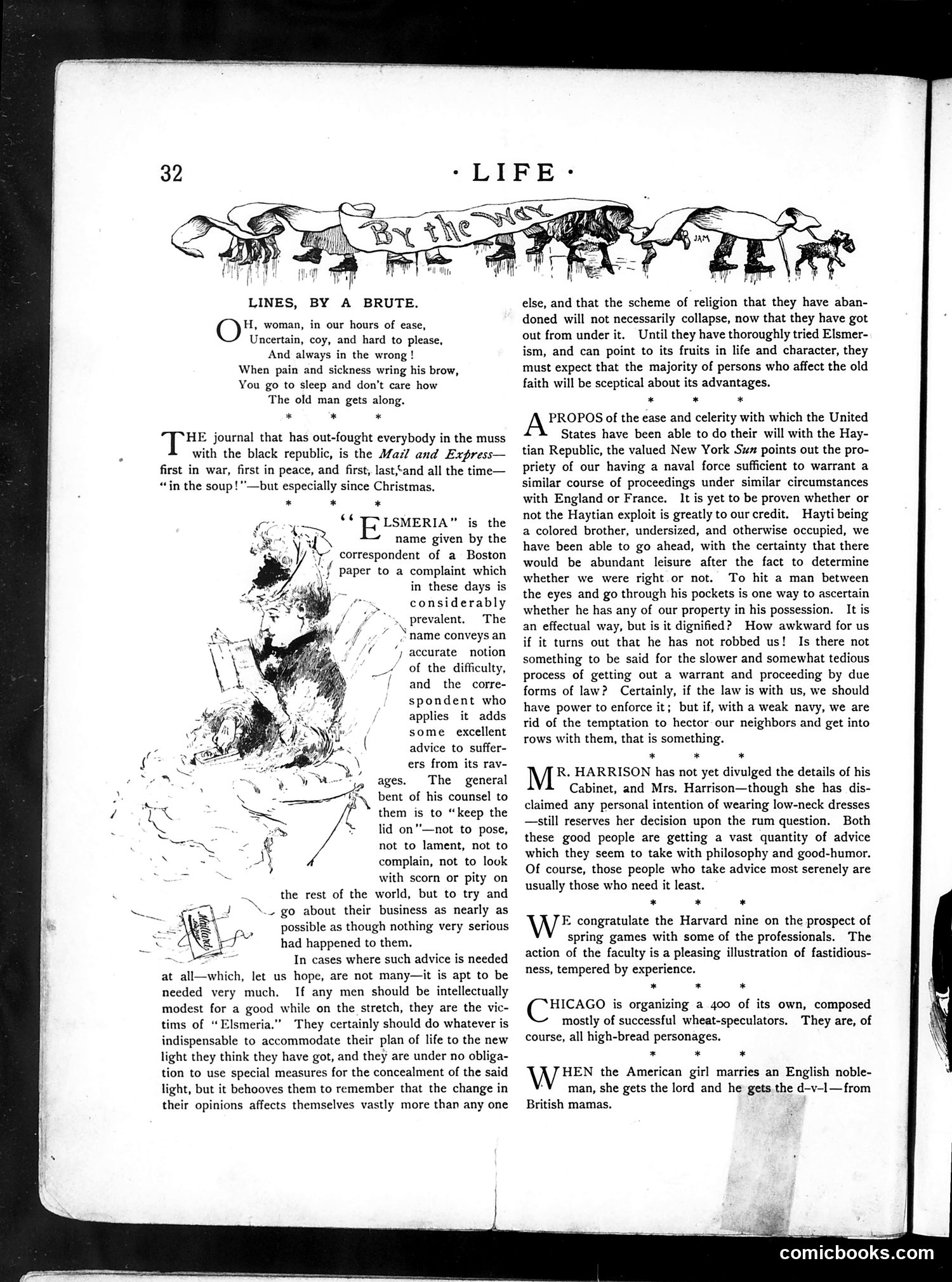
The page contains satirical commentary rather than political cartoons. The "Lines, by a Brute" poem mocks women as difficult to please. The main illustrated piece, "Elsmeria," shows a caricatured figure and discusses a Boston newspaper correspondent's complaints about difficulty and suffering—advice the writer dismisses as self-pitying whining. The satire targets those who complain excessively while offering little practical help. The remaining brief items mock contemporary figures: Harrison's cabinet and Mrs. Harrison over rum consumption; Harvard's spring athletic games; Chicago as a city of wheat speculators; and American women marrying English noblemen for titles. The overall tone is cynical, focusing on hypocrisy, vanity, and social pretension among both genders and classes.
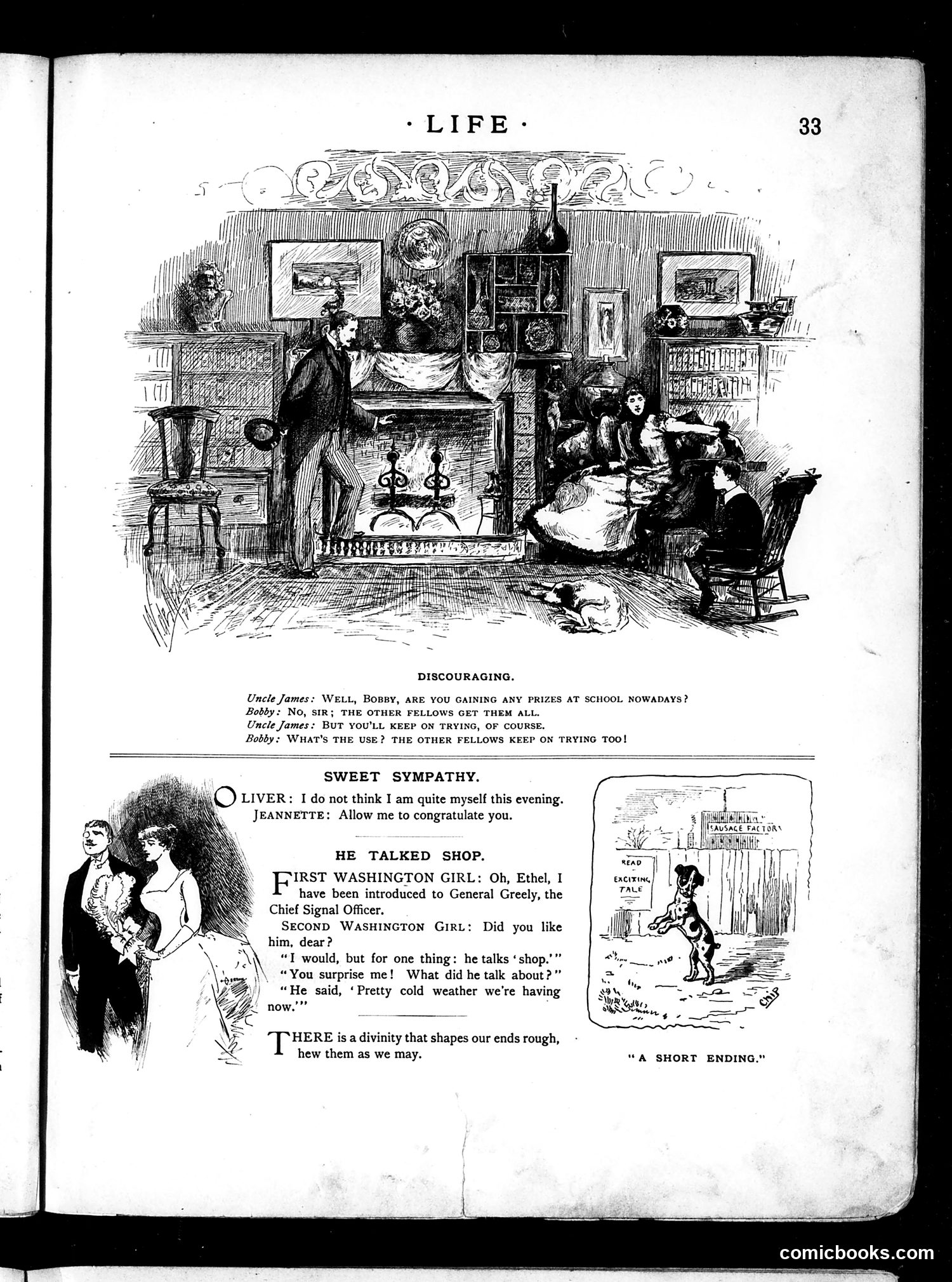
This page contains three separate satirical pieces: **"Discouraging"** depicts an uncle discouraging his nephew Bobby from academic effort, claiming other students get prizes anyway—a commentary on learned helplessness and defeatist attitudes toward education. **"Sweet Sympathy"** shows a man (Oliver) feeling unwell while a woman (Jeannette) offers hollow congratulations, satirizing insincere social politeness. **"He Talked Shop"** mocks two Washington society women discussing General Greely (the famous Arctic explorer). One complains he only discusses weather—satirizing how even distinguished figures resort to trivial conversation at social events, and perhaps poking fun at Washington's social pretensions. The small illustration "A Short Ending" appears unrelated, showing a dog in domestic chaos. These are typical early-20th-century American humor pieces targeting social behavior and manners.
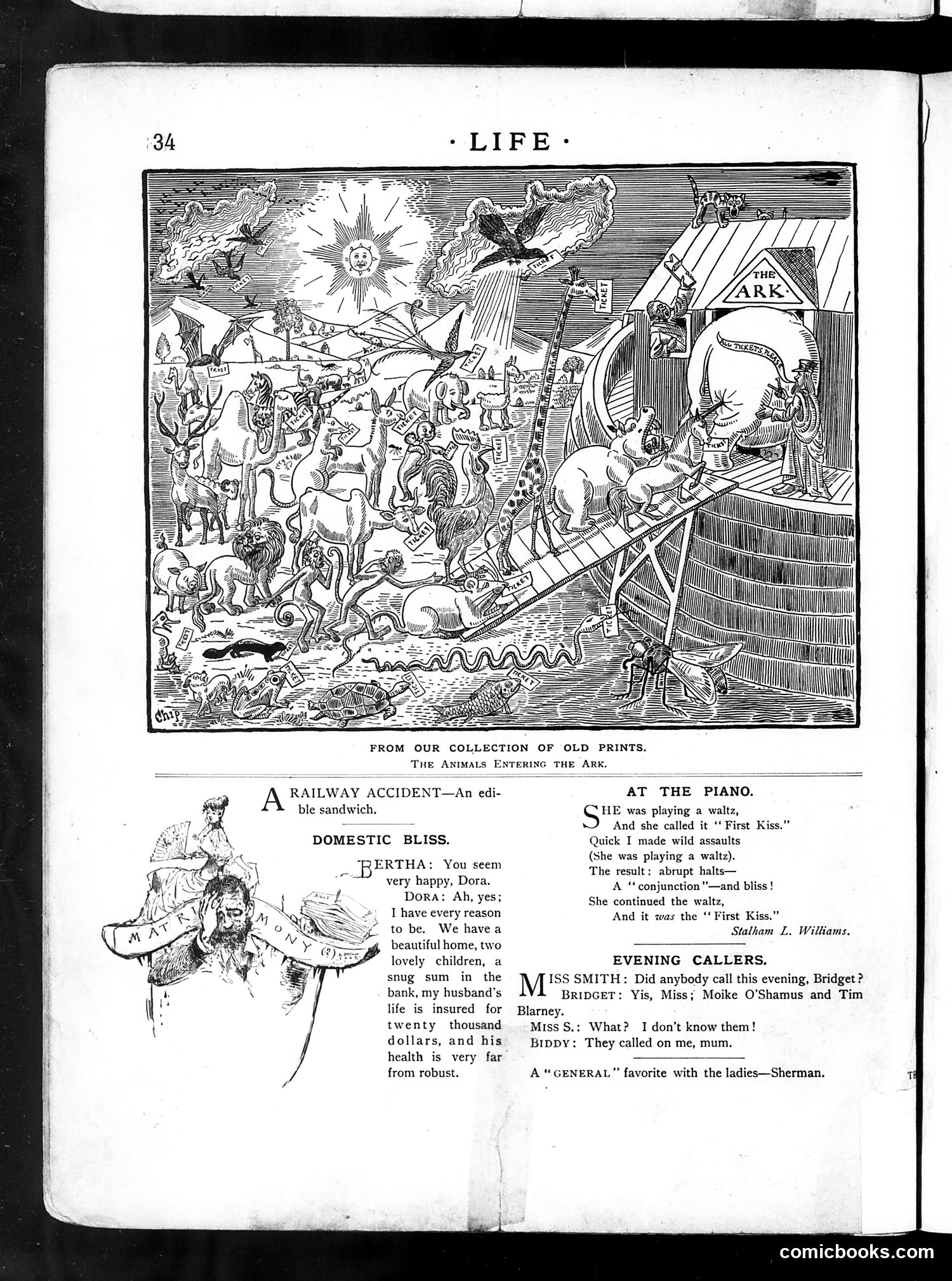
The main illustration depicts a chaotic scene of animals boarding Noah's Ark, presented as a satirical engraving from "our collection of old prints." This appears to be satirical commentary on contemporary social chaos or disorder, using the biblical flood narrative as an allegory—though the specific political reference is unclear without additional context. Below are three separate humor pieces: "A Railway Accident" (a pun about an "edle sandwich"), "Domestic Bliss" (dialogue between Bertha and Dora about marital contentment), and "Evening Callers" (a brief exchange about social visits). The "At the Piano" section contains a poem about interrupted dancing. These are standard Victorian-era domestic humor pieces with no apparent political content—primarily light social satire about everyday middle-class life and etiquette.
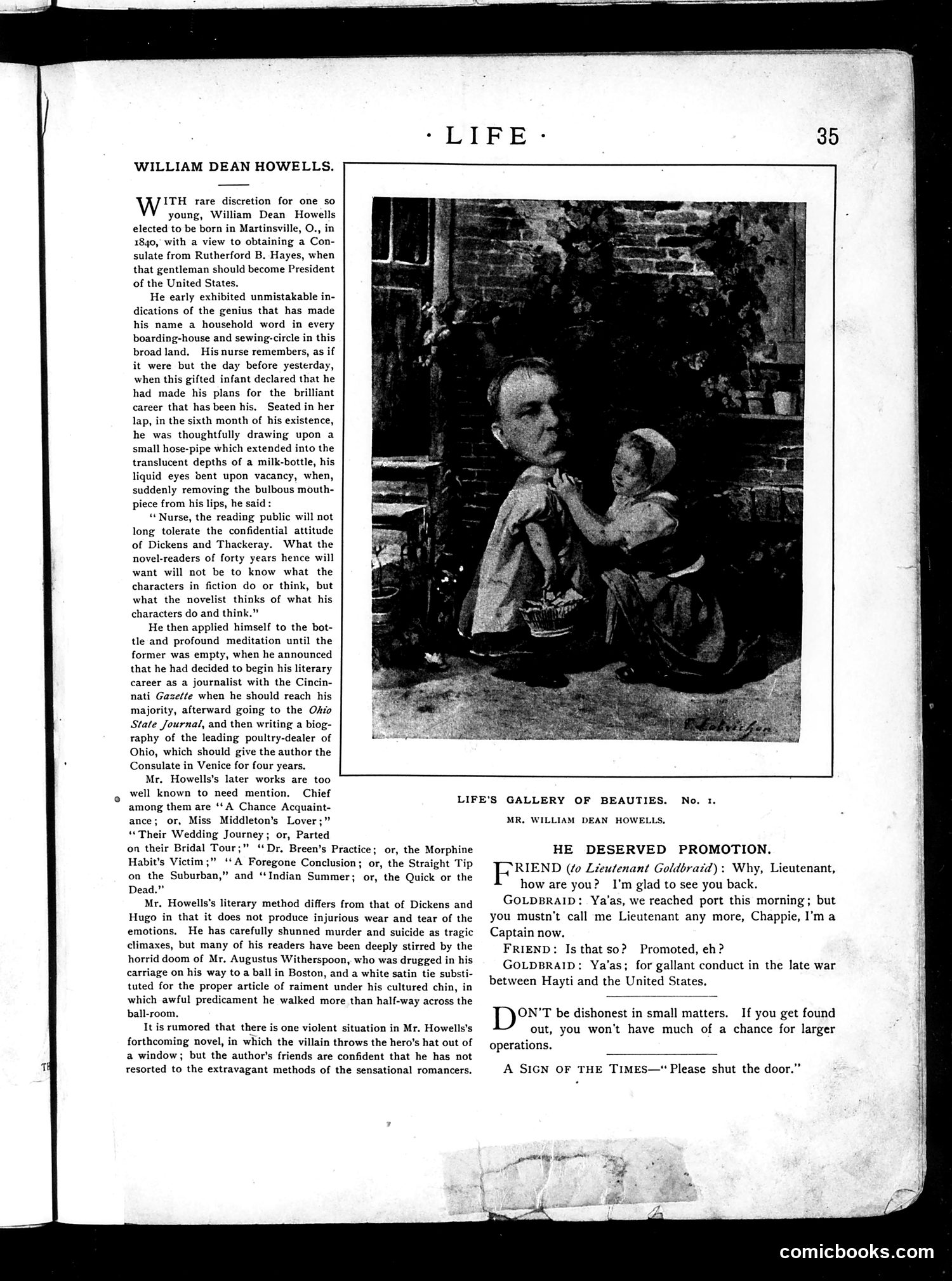
This page features a biographical profile of **William Dean Howells**, a prominent American novelist and literary figure. The left column discusses his career, noting his early literary genius and works like "A Chance Acquaintance" and "Their Wedding Journey." The main image shows a **portrait photograph of Howells**, identifying him as part of "Life's Gallery of Beauties, No. 1." Below the portrait is a short comedic dialogue titled **"He Deserved Promotion,"** featuring a conversation between a Lieutenant and Captain Goldbraith about a wartime promotion. The joke appears to mock military bureaucracy—the captain claims promotion came from "gallant conduct" in the Hayt-United States conflict, but his friend skeptically questions whether such opportunities actually exist in military hierarchies. The page blends celebrity profile with satirical social commentary typical of Life magazine's format.
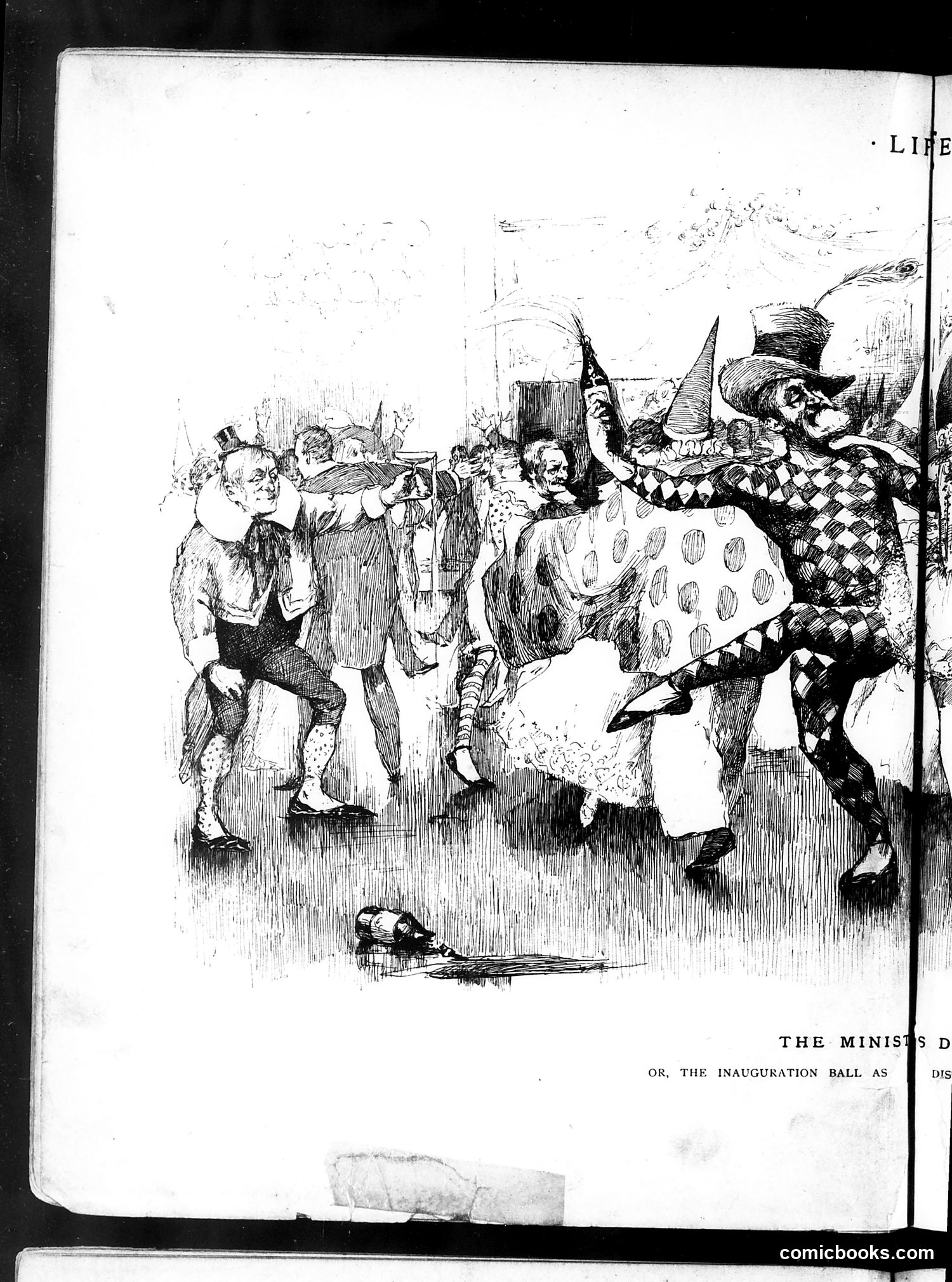
This satirical cartoon depicts what appears to be a nightmarish fantasy of government ministers attending an inaugural ball. The exaggerated caricatures—particularly the grotesque figure on the right wearing a pointed hat and diamond-patterned costume—suggest political mockery typical of Life magazine's style. The fantastical, demonic appearance of some figures implies the cartoonist views these politicians as absurd or sinister. The "ministers' dream" framing suggests this depicts either an actual controversial inauguration event or an imagined scenario mocking the politicians' pretensions. Without clearer identification of the specific figures or date, the exact political scandal or event referenced remains unclear, though the theatrical, nightmarish quality indicates strong satirical disapproval of the depicted officials.
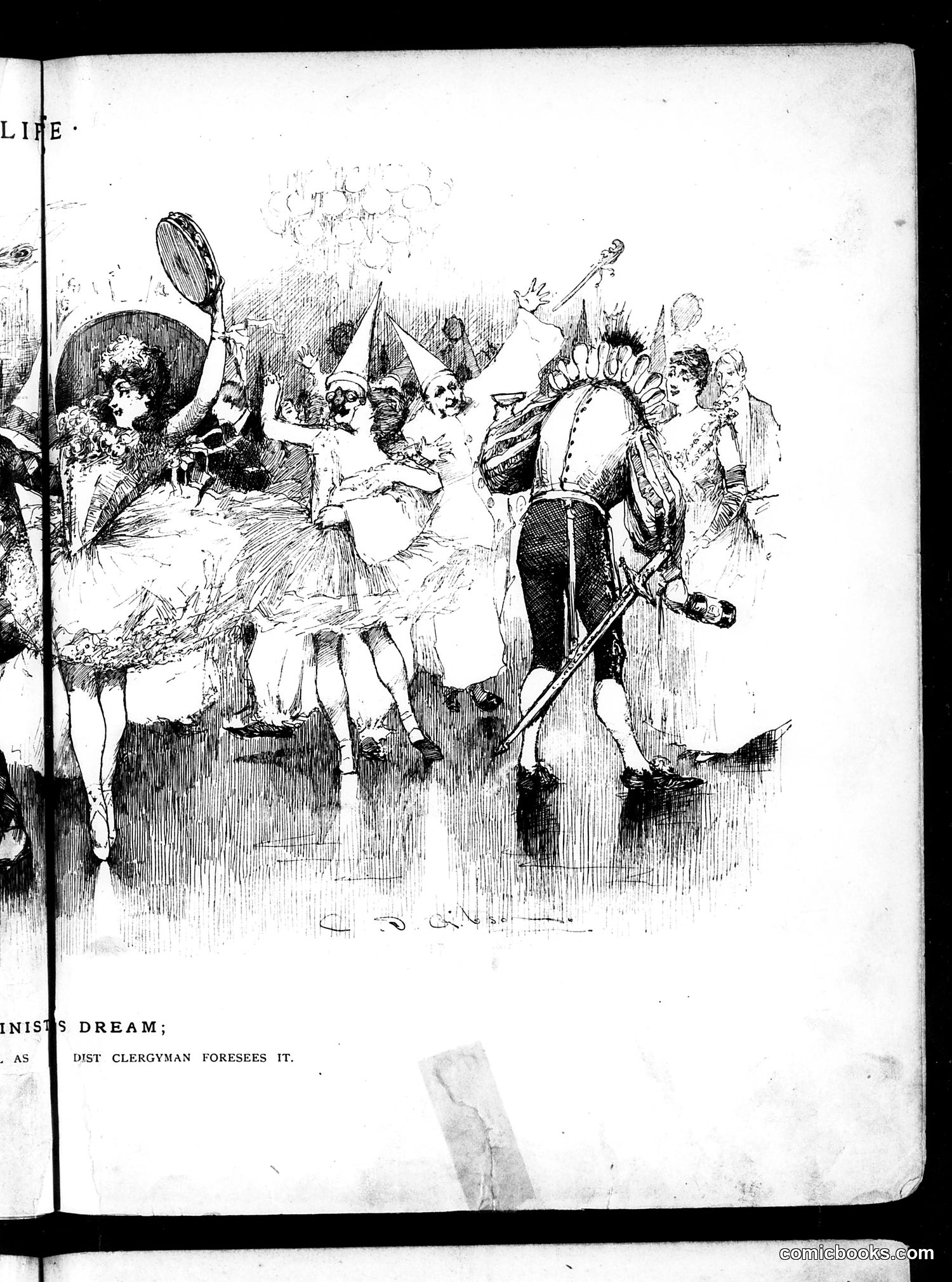
This appears to be a satirical illustration titled "A MINISTER'S DREAM; AS DIST CLERGYMAN FORESEES IT" (text partially visible at bottom). The cartoon depicts a fantastical, chaotic scene with elaborately dressed figures engaged in what appear to be frivolous activities—including someone with a large feathered headdress, people in theatrical poses, and various ornate costumes. A clergyman figure (likely the dreamer) observes this scene with apparent concern. The satire likely mocks the clergyman's anxieties about worldly excess, materialism, or moral decay in society—possibly targeting contemporary fashion, entertainment, or secular leisure activities the clergy viewed as sinful or threatening to morality. The "dream" format allows the artist to exaggerate these fears for humorous effect, presenting the clergyman's worst-case scenario of social corruption.
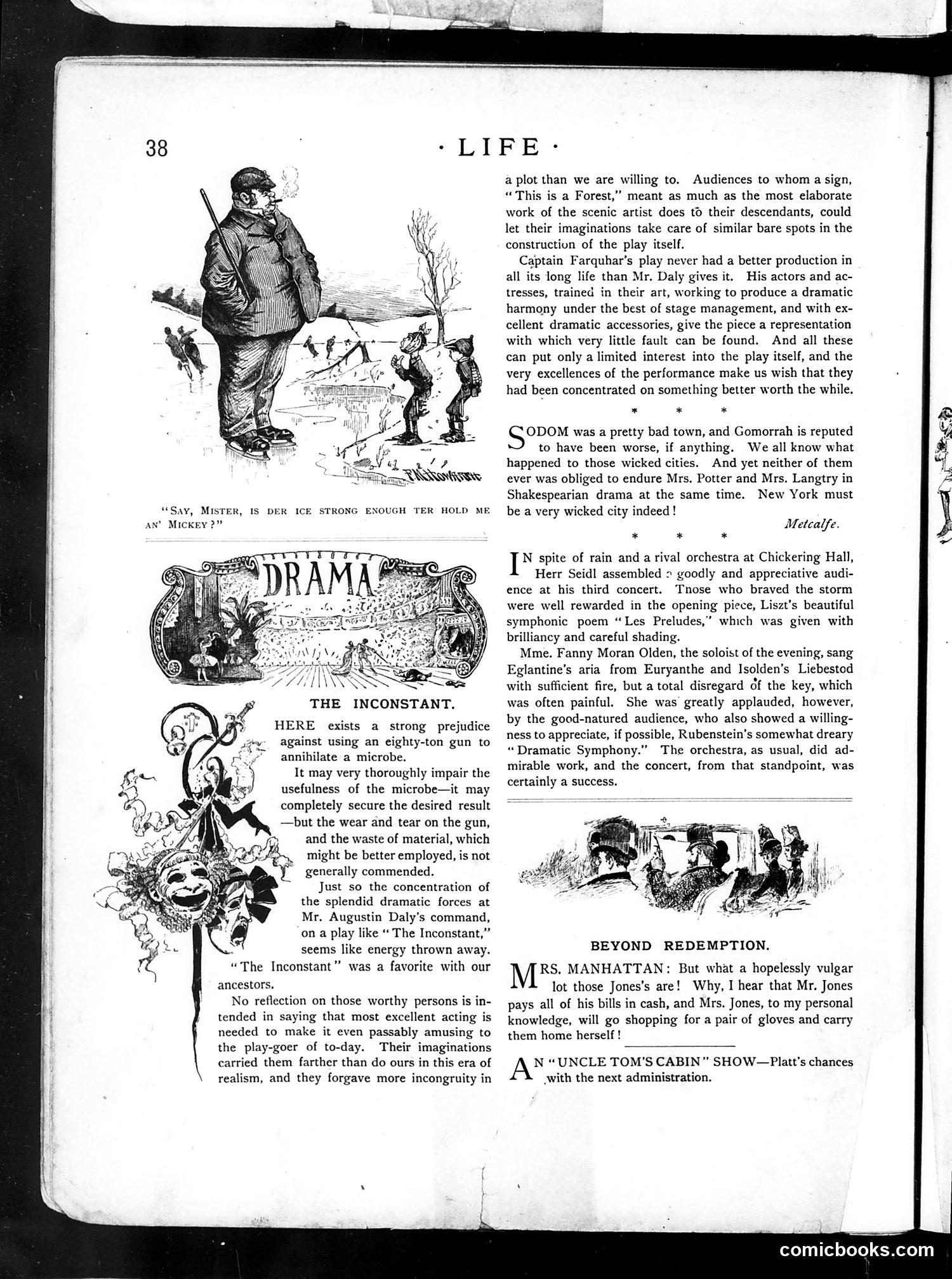
This page contains theater reviews rather than political cartoons. The main illustration shows a large man with a gun and small figures—likely satirizing **"The Inconstant,"** a play reviewed in the "DRAMA" section. The text criticizes the play for wasting "splendid dramatic forces" under Mr. Augustus Daly's direction, suggesting the talented cast deserves better material. The reviewer argues the production is overly elaborate—like using an "eighty-ton gun" to kill a microbe—when the play itself lacks substance. Other brief reviews mention **Captain Farquhar's play**, **Herr Seidl's concert** at Chickering Hall featuring Mme. Fanny Moran Olden, and shows titled **"Beyond Redemption"** and **"Uncle Tom's Cabin."** The tone is witty and dismissive of mediocre theatrical productions.
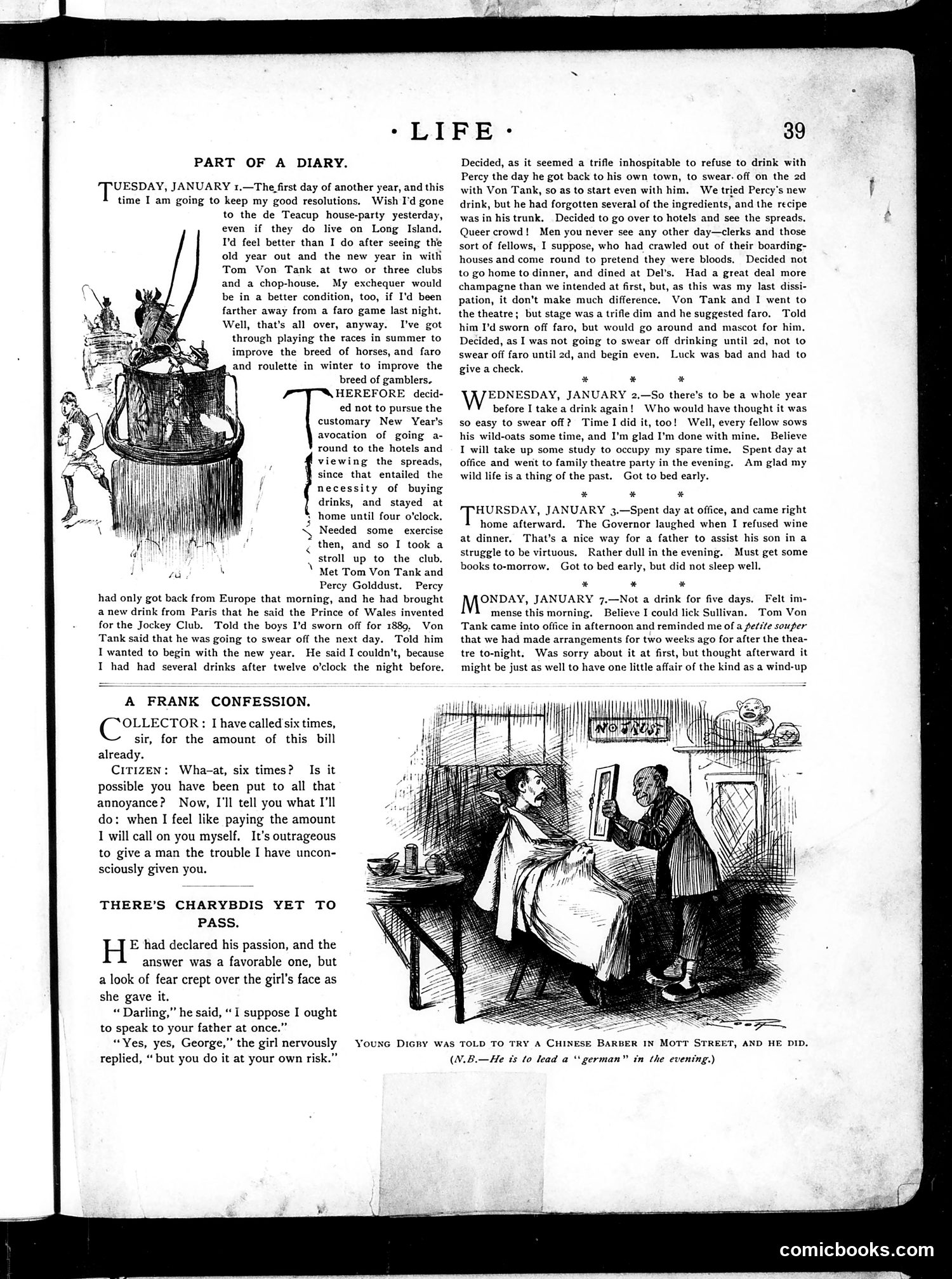
This page from *Life* magazine (page 39) contains satirical diary entries mocking wealthy young men's New Year's resolutions and dissolute behavior. **The Main Satire:** The unnamed diarist repeatedly claims to be "swearing off" drinking and gambling, yet immediately breaks these resolutions. He postpones sobriety from January 1st to January 2nd, then to the 2nd, while continuing to drink, gamble at faro and roulette, and visit theaters. The humor lies in his self-deception and transparent rationalizations. **Social Context:** References to "Von Tank," expensive clubs, champagne, the Jockey Club, and hotels reflect the Gilded Age leisure class. The casual mentions of faro games and losses ("had to give a check") satirize wealthy men's wasteful gambling habits. **The Additional Sketches:** Lower sections include a debt-collector joke about a debtor's mock-civility, and a courtship scene where a girl nervously warns her suitor that asking her father's permission is risky—likely alluding to class or financial concerns. The overall point: mocking privileged men's hollow promises of self-improvement.
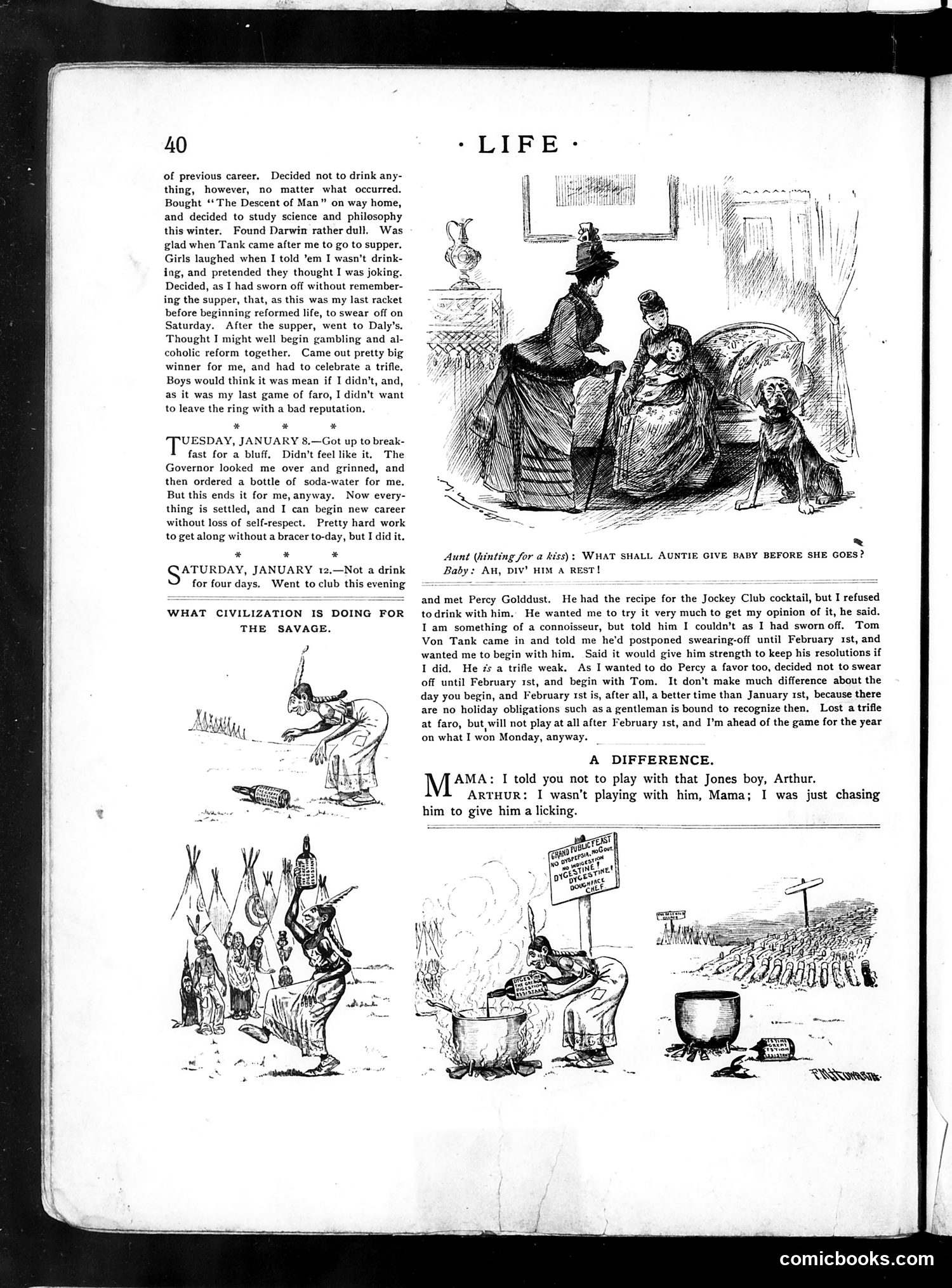
This page satirizes **self-deception and failed moral reform**. The main text humorously chronicles a man's repeated failed attempts to quit drinking and gambling. He constantly postpones his "reform" with elaborate justifications—swearing off "after the supper," then "until February 1st," while immediately breaking his pledges. The humor lies in his transparent rationalization: he loses money at faro but claims to be "ahead of the game," celebrates his "last" vice, and asks others to join his reform to strengthen their (not his) resolve. The cartoons at bottom satirize **hypocrisy about civilization's impact on indigenous peoples**—a popular Victorian debate. The caption "What Civilization is Doing for the Savage" ironically shows Native Americans adopting destructive Western vices (alcohol, weapons, warfare) rather than moral enlightenment. The child's dialogue provides a separate joke about childhood mischief being disguised as innocent play, reinforcing the page's theme of **self-serving deception**.
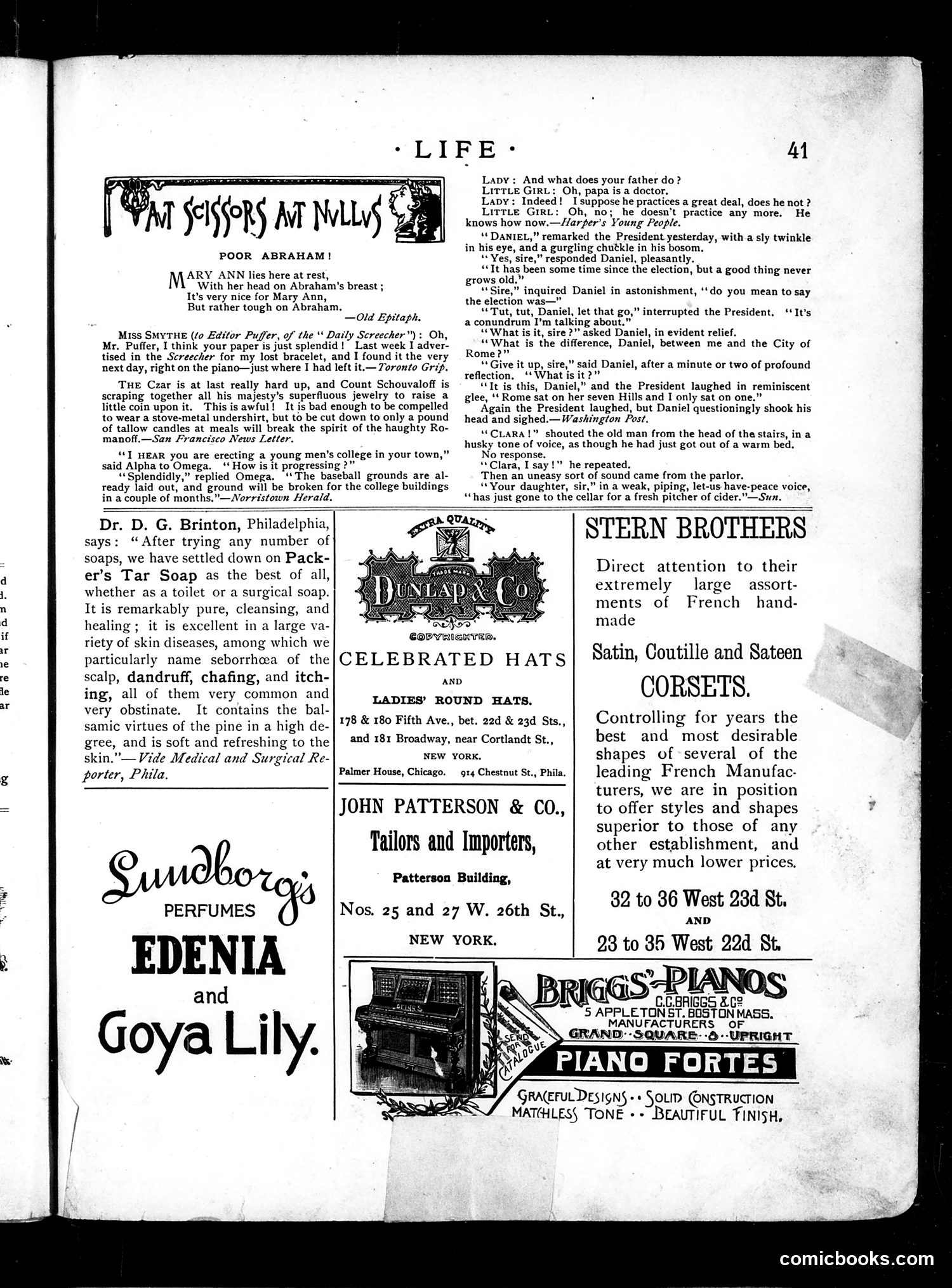
This page is primarily **advertisements and reprinted jokes** from other newspapers—not original political satire. The content includes humorous anecdotes: a doctor who no longer needs to "practice" because he's experienced; a czar scraping together jewelry because he's broke; and a president's riddle comparing himself to Rome (sitting on "one" hill vs. seven). The only potentially political element is the czar joke, which mocks Russian financial distress—likely referencing 19th-century Russian fiscal problems—but it's mild satire. The remainder is **commercial advertising**: perfumes (Edenia, Goya Lily), hats (Dunlap & Co.), corsets (Stern Brothers), tailoring services (John Patterson & Co.), and pianos (Briggs). This was standard for *Life* magazine's format during this era. The page contains **no identifiable caricatured figures or major political commentary**—just period humor and ads.
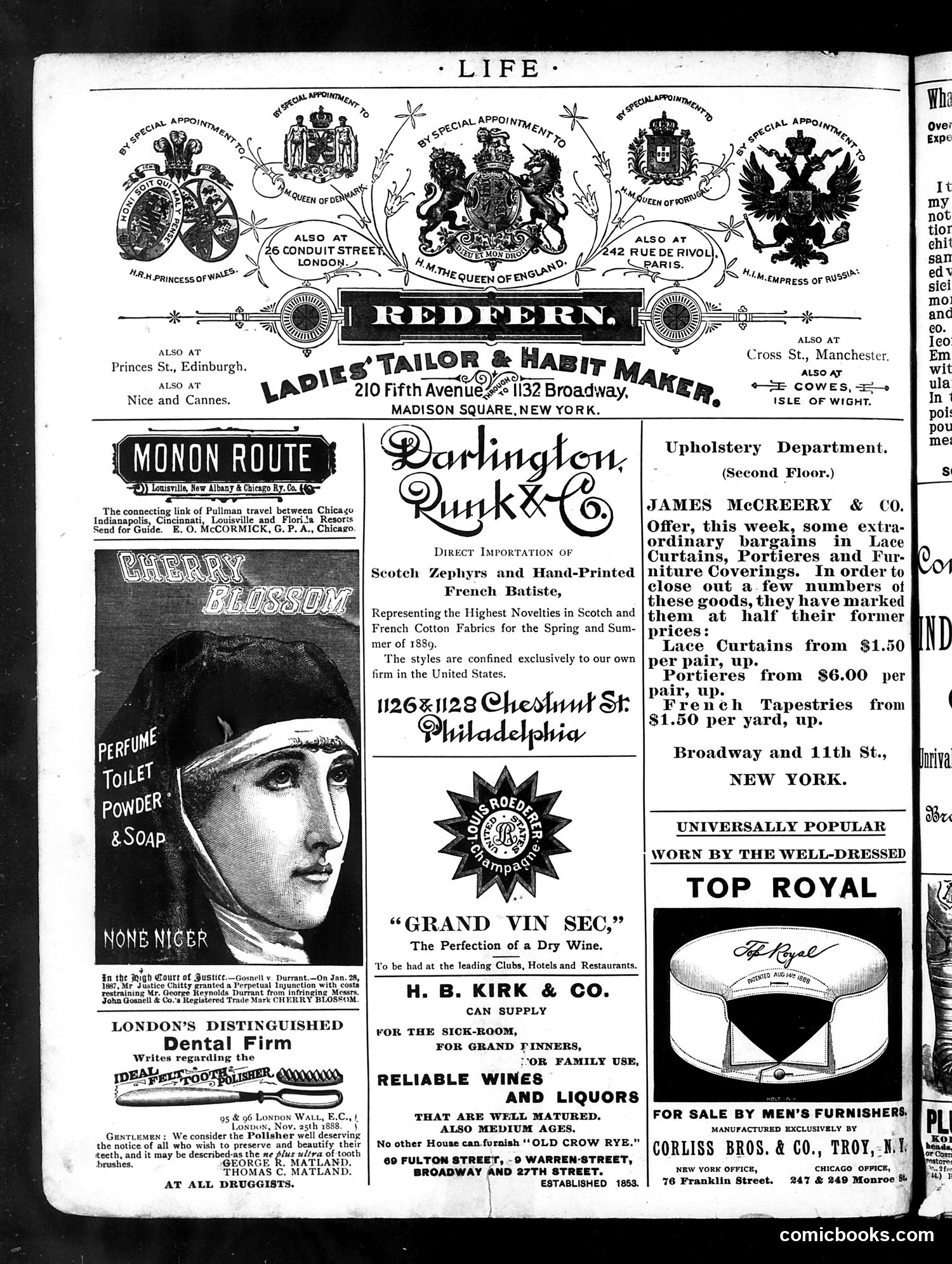
This is primarily an **advertisements page**, not a political cartoon. The page displays various commercial advertisements from circa 1889, including: **Notable ads:** - **Redfern** (top): A prestigious London ladies' tailor with royal warrants, advertising locations across Britain and Paris - **Darlington, Runk & Co.**: Imported Scottish and French fabrics for spring/summer fashion - **Cherry Blossom Perfume**: Advertises a legal victory protecting its trademarked name - **H.B. Kirk & Co.**: Wine and liquor merchant, emphasizing aged stock and "Old Crow Rye" - **James McCreery & Co.**: Department store offering clearance sales on luxury upholstery items - **Top Royal**: A hat brand for gentlemen The page reflects **late 19th-century consumer culture** targeting wealthy, fashionable urbanites. The emphasis on imported European goods, royal appointments, and premium pricing indicates these were luxury products for the affluent. No political satire or caricature is present—this is purely commercial content.
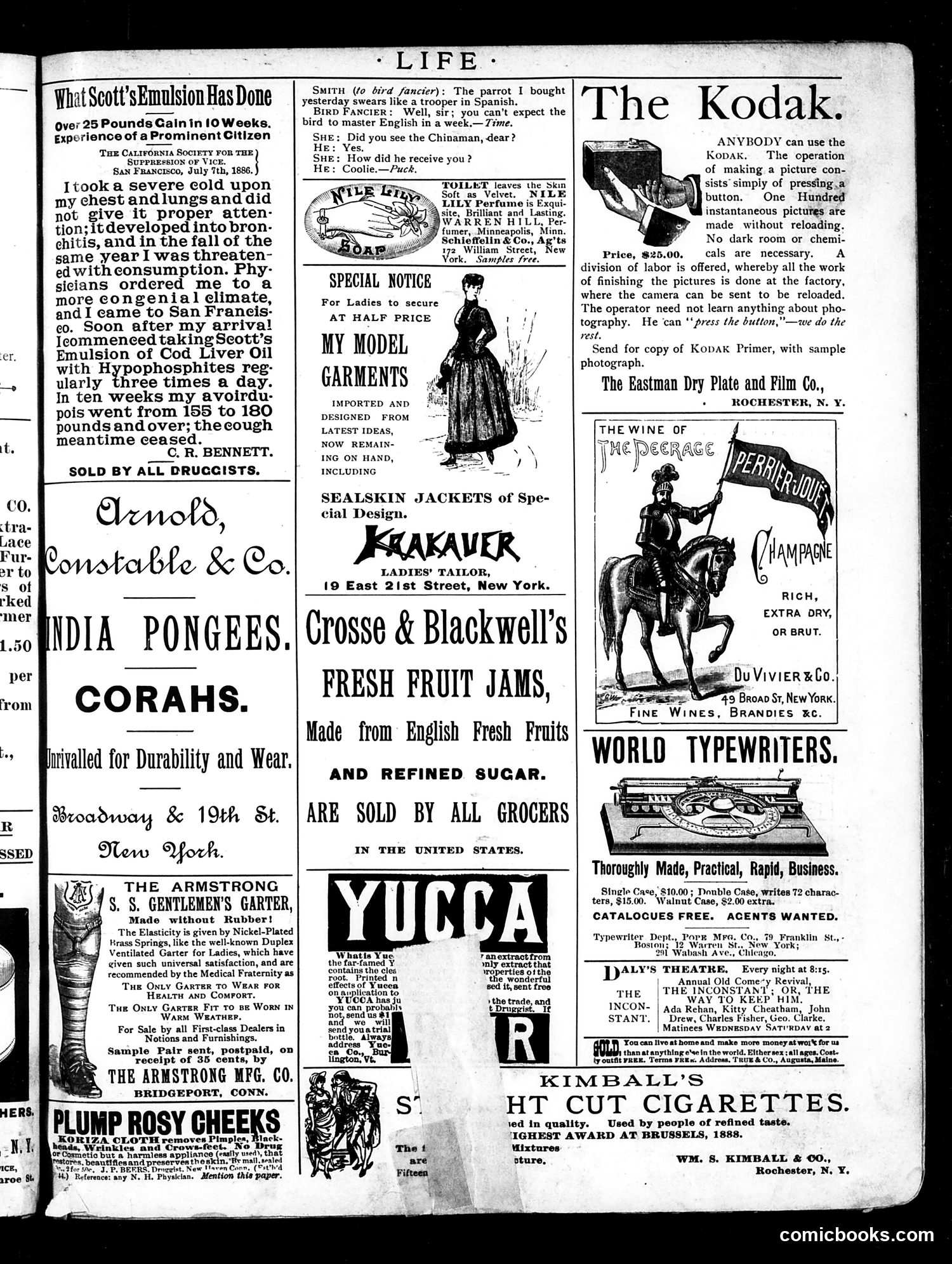
This page is primarily **advertisements** with minimal editorial cartoons. The small comic content includes two brief jokes: 1. **Bird Fancier exchange**: A pun-based joke about a Spanish-speaking parrot—the humor relies on the owner's expectation that a parrot should quickly learn English, played against the bird-seller's reasonable response that language acquisition takes time. 2. **"Coolie" joke**: A visual/verbal pun where "How did he receive you?" is answered with "Coolie" (a play on the word, with racist undertones typical of 1880s humor). The Chinaman reference reflects period racial stereotyping. The rest consists of product advertisements: Scott's Emulsion (health tonic), garters, fabric, jam, perfume, the revolutionary Kodak camera, champagne, typewriters, and cigars. The Kodak ad is notably modern for its era—emphasizing ease-of-use and outsourced development ("we do the rest").
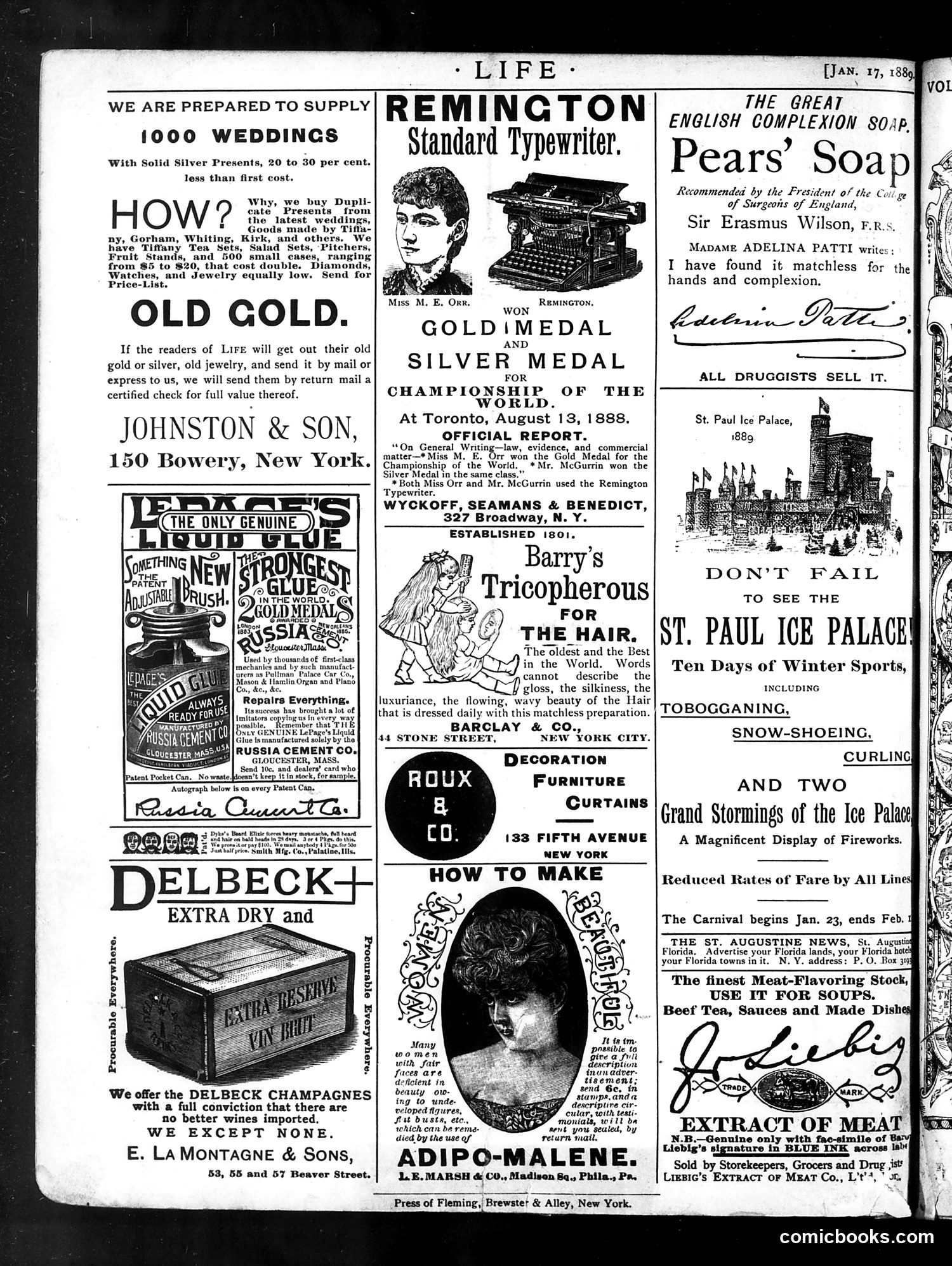
This page is **primarily advertising**, with no political cartoons or satire. It showcases late-19th-century consumer products and services typical of Life's commercial content. Notable advertisements include: - **Remington Standard Typewriter**: Promoted via a medal won at the 1888 Toronto Championship by typist Miss M.E. Orr, establishing typewriter superiority through competitive validation. - **Pears' Soap**: Endorsed by opera singer Adelina Patti and Sir Erasmus Wilson (a real surgeon), leveraging celebrity and authority to market complexion products—reflecting era concerns with appearance. - **St. Paul Ice Palace** (1889): A winter carnival attraction offering toboganning and fireworks, indicating leisure entertainment marketing. - **Adipo-Malene**: A body-shaping product for "underdeveloped figures," revealing contemporary beauty standards and women's body anxiety. Other ads promote champagne, hair tonic, meat extract, and gold recycling services. The page reflects consumer culture, celebrity endorsement marketing, and gendered beauty anxieties of the Gilded Age.