
Life, 1889-01-17 · page 2 of 16
Life — January 17, 1889 — page 2: what you’re looking at
What you’re looking at
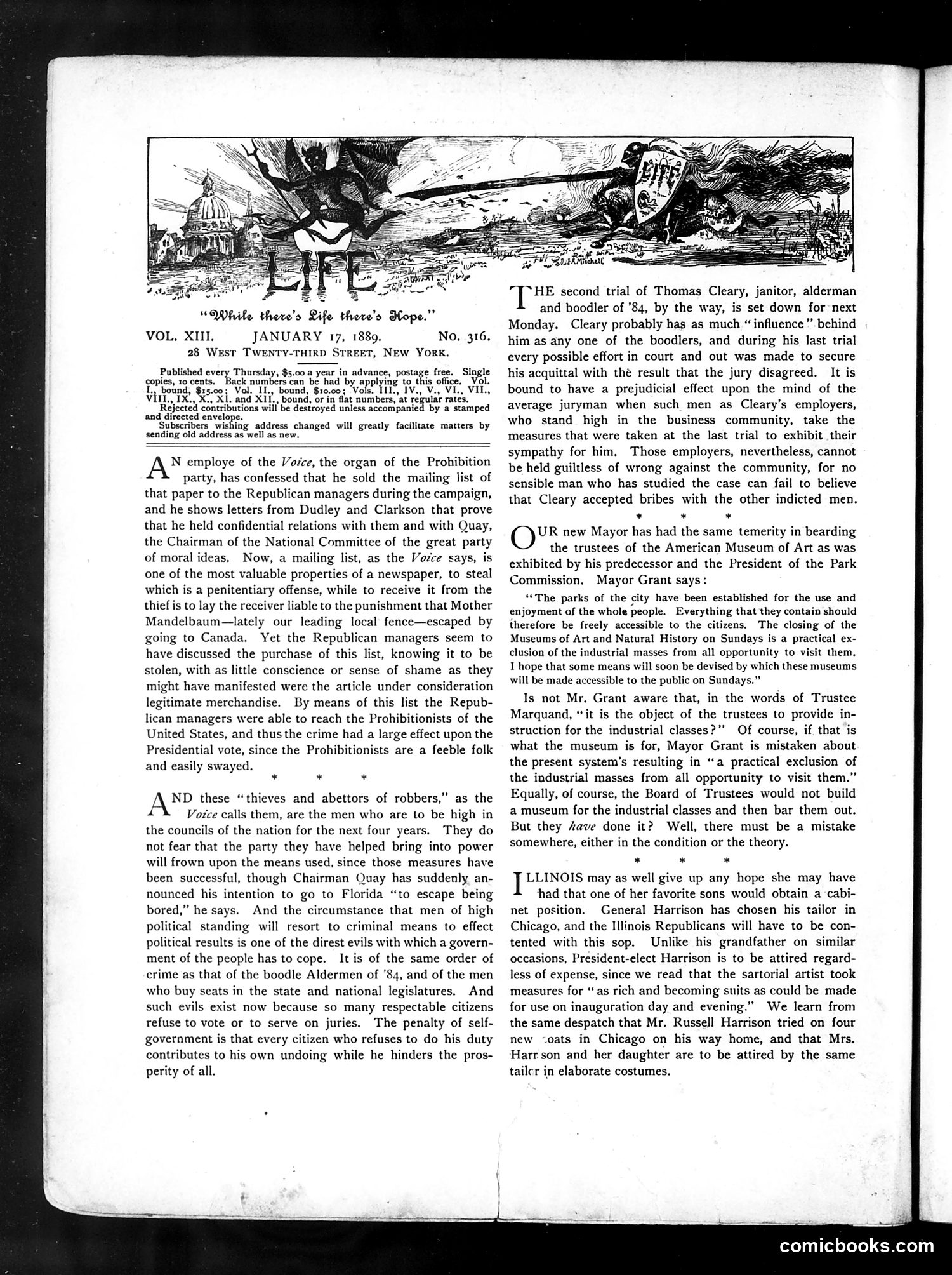
The masthead illustration depicts Death (skeleton with scythe) confronting "Life" itself, symbolizing the magazine's satirical mission examining mortality, morality, and current events. The text discusses Thomas Cleary, a janitor and "bootlegger of '84," whose second trial is upcoming. The article suggests Cleary accepted bribes alongside other indicted men, though his employers claim prejudice against him due to his association with the Prohibition party's *Voice* newspaper. The piece critiques Republican politicians and party leaders (particularly Chairman Quay) for allegedly using stolen mailing lists and engaging in corrupt practices, while hypocritically claiming moral authority. It argues that respectable citizens enabling such corruption through inaction bear responsibility for undermining democratic governance.
📄 Transcribed text from this page (OCR, searchable)
Machine-transcribed from the original scan — historical spelling and the odd misread are preserved.
VOL. XIII. JANUARY 17, 1889. No. 316. 28 West TWENTY-THIRD STREET, NEW YORK. Published ever copies, ro cents. Thursday, $5.00 a year in advance, postage free. Single eck numbers can be had by applying ¢9 ¢ Ty phound, €is.co) Val It bound: $ is office. Vol. 10.00; V., VI., VII, bound, or in flat numbers, at regular rates. be destroyed unless accompanied by a stamped L. and X) Rejected contril and directed envelo Subscribers wishing address changed will greatly facilitate matters by sending old address as well as new. A’ employe of the Vozce, the organ of the Prohibition party, has confessed that he sold the mailing list of that paper to the Republican managers during the campaign, and he shows letters from Dudley and Clarkson that prove that he held confidential relations with them and with Quay, the Chairman of the National Committee of the great party of moral ideas. Now, a mailing list, as the Vozce says, is one of the most valuable properties of a newspaper, to steal which is a penitentiary offense, while to receive it from the thief is to lay the receiver liable to the punishment that Mother Mandelbaum—lately our leading local fence—escaped by going to Canada. Yet the Republican managers seem to have discussed the purchase of this list, knowing it to be stolen, with as little conscience or sense of shame as they might have manifested were the article under consideration legitimate merchandise. By means of this list the Repub- lican managers were able to reach the Prohibitionists of the United States, and thus the crime had a large effect upon the Presidential vote, since the Prohibitionists are a feeble folk and easily swayed. * * ND these “thieves and abettors of robbers,” as the 4 Voéce calls them, are the men who are to be high in the councils of the nation for the next four years. They do not fear that the party they have helped bring into power will frown upon the means used, since those measures have been successful, though Chairman Quay has suddenly an- nounced his intention to go to Florida “to escape being bored,” he says. And the circumstance that men of high political standing will resort to criminal means to effect political results is one of the direst evils with which a govern- ment of the people has to cope. It is of the same order of crime as that of the boodle Aldermen of '84, and of the men who buy seats in the state and national legislatures. And such evils exist now because so many respectable citizens refuse to vote or to serve on juries. The penalty of self- government is that every citizen who refuses to do his duty contributes to his own undoing while he hinders the pros- perity of all. HE second trial of Thomas Cleary, janitor, alderman and boodler of ’84, by the way, is set down for next Monday. Cleary probably has as much “influence” behind him as any one of the boodlers, and during his last trial every possible effort in court and out was made to secure his acquittal with the result that the jury disagreed. It is bound to have a prejudicial effect upon the mind of the average juryman when such men as Cleary’s employers, who stand high in the business community, take the measures that were taken at the last trial to exhibit their sympathy for him. Those employers, nevertheless, cannot be held guiltless of wrong against the community, for no sensible man who has studied the case can fail to believe that Cleary accepted bribes with the other indicted men. * * * UR new Mayor has had the same temerity in bearding the trustees of the American Museum of Art as was exhibited by his predecessor and the President of the Park Commission. Mayor Grant says: “The parks of the city have been established for the use and enjoyment of the whole people. Everything that they contain should therefore be freely accessible to the citizens. The closing of the Museums of Art and Natural History on Sundays is a practical ex- clusion of the industrial masses from all opportunity to visit them. I hope that some means will soon be devised by which these museums will be made accessible to the public on Sundays.” Is not Mr. Grant aware that, in the words of Trustee Marquand, “it is the object of the trustees to provide in- struction for the industrial classes?” Of course, if that is what the museum is for, Mayor Grant is mistaken about the present system’s resulting in “a practical exclusion of the industrial masses from all opportunity to visit them.” Equally, of course, the Board of Trustees would not build a museum for the industrial classes and then bar them out. But they Zave done it? Well, there must be a mistake somewhere, either in the condition or the theory. * * * LLINOIS may as well give up any hope she may have had that one of her favorite sons would obtain a cabi- net position. General Harrison has chosen his tailor in Chicago, and the Illinois Republicans will have to be con- tented with this sop. Unlike his grandfather on similar occasions, President-elect Harrison is to be attired regard- less of expense, since we read that the sartorial artist took measures for “as rich and becoming suits as could be made for use on inauguration day and evening.” We learn from the same despatch that Mr. Russell Harrison tried on four new «oats in Chicago on his way home, and that Mrs. Harr son and her daughter are to be attired by the same tailcr in elaborate costumes. comicbooks.com