
A complete issue · 14 pages · 1888
Life — November 29, 1888
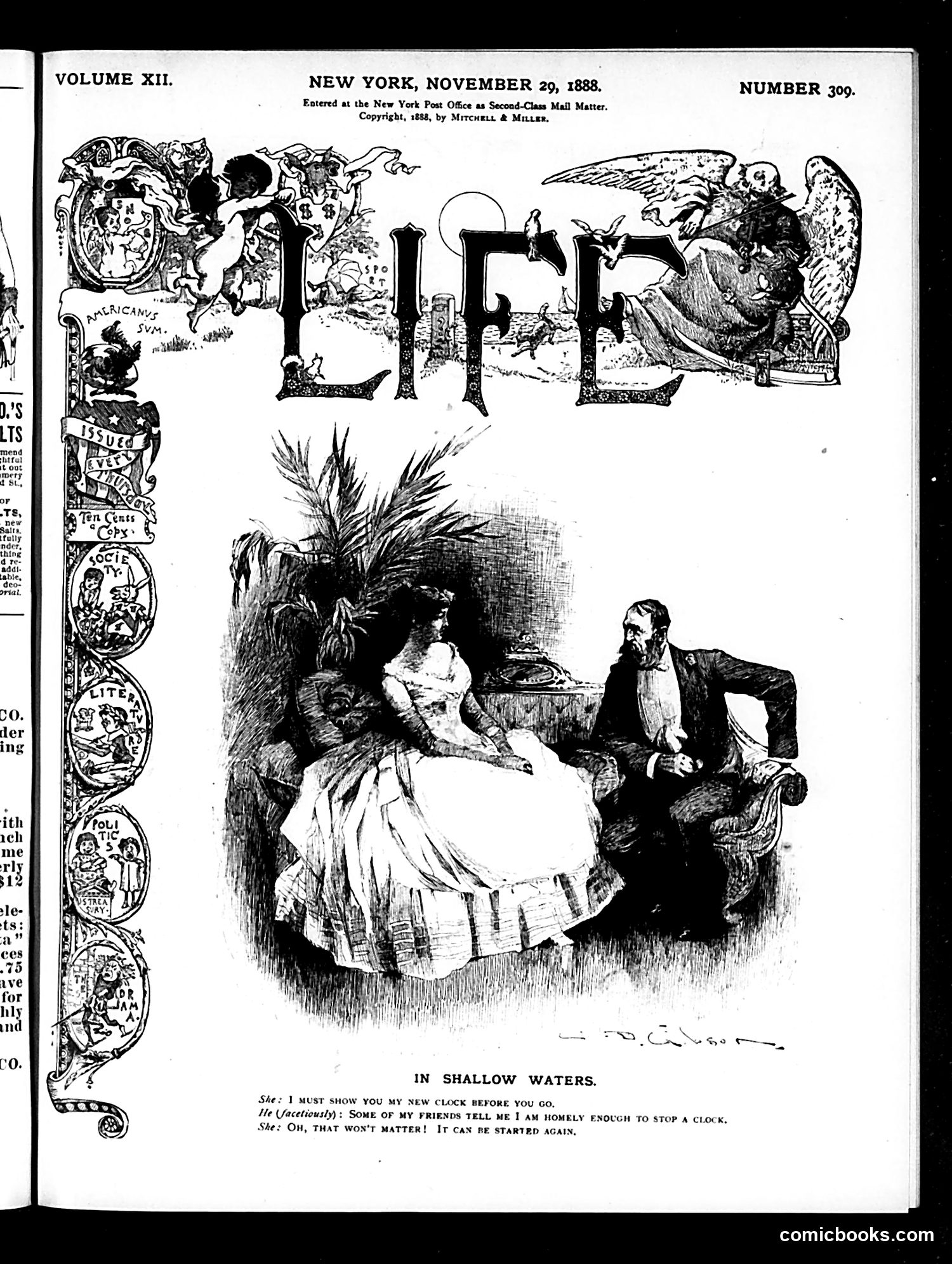
This satirical cartoon depicts a romantic scene between a well-dressed man and woman in an intimate moment. The title "In Shallow Waters" is a double entendre—literally suggesting shallow water, but figuratively implying emotional or moral shallowness. The dialogue reveals the joke: the woman insists on showing the man her new clock before he leaves, claiming some friends say she's "homely enough to stop a clock." The man responds that this won't matter because "it can be started again." The satire targets vanity and shallow courtship rituals of the era. The woman's concern about her appearance and the man's dismissive flattery mock both Victorian courtship conventions and the superficiality of romantic interactions based on appearance rather than substance.
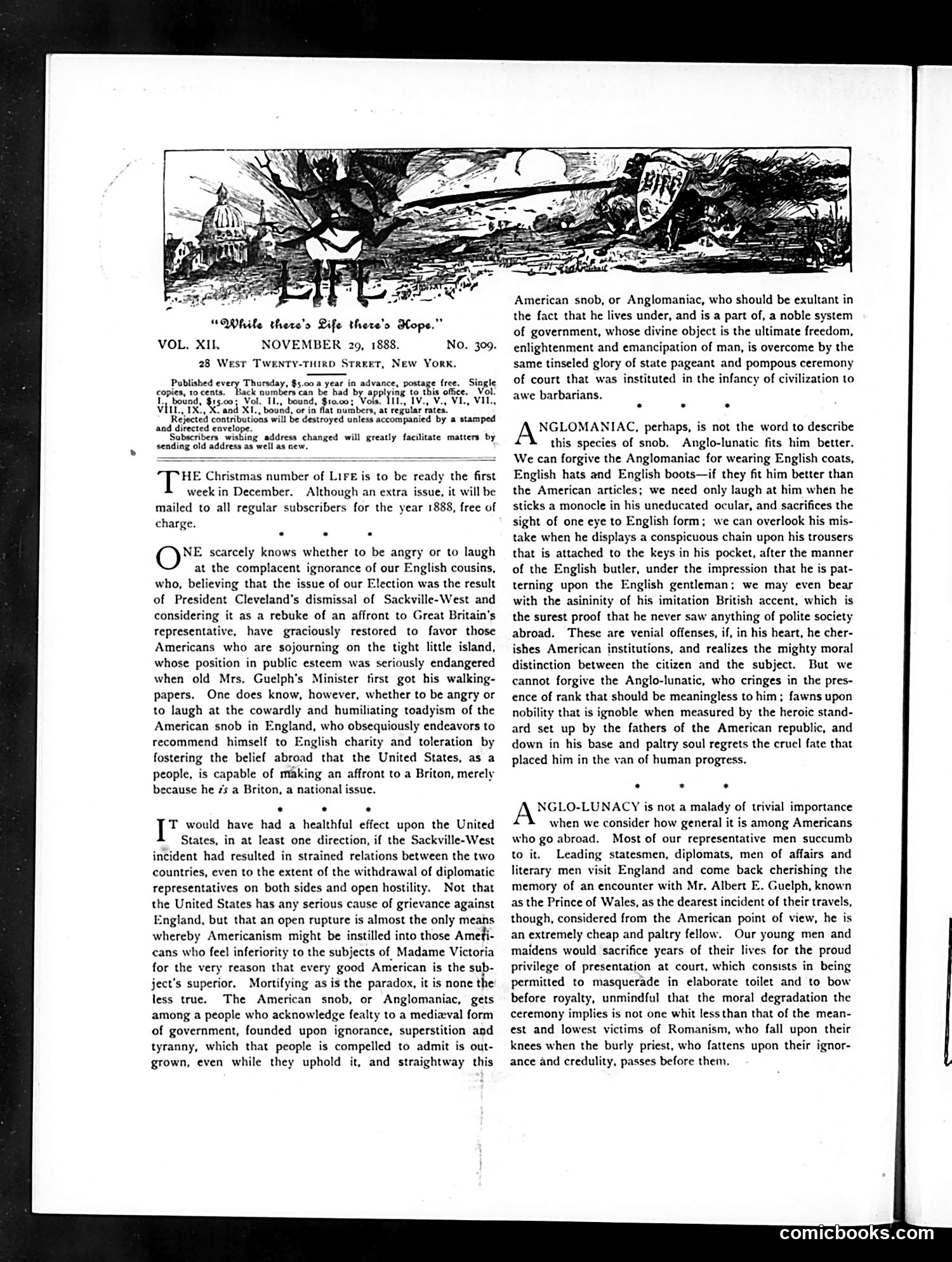
The masthead cartoon "While there's Life there's Hope" depicts a landscape with classical architecture—likely representing the enduring American republic. The editorial content primarily attacks "Anglomaniac" Americans who adopt English mannerisms, fashion, and social pretensions. The author criticizes Americans who: - Wear English clothing and imitate British style - Display subservience to English nobility and court ceremony - Abandon American democratic values for aristocratic affectation The satire targets American elites who traveled to England and returned affected by British culture, viewing themselves as superior. The piece argues this betrays the egalitarian principles of the American republic and represents moral degradation. The critique reflects post-Civil War American anxiety about social hierarchy and European cultural dominance among the wealthy classes.
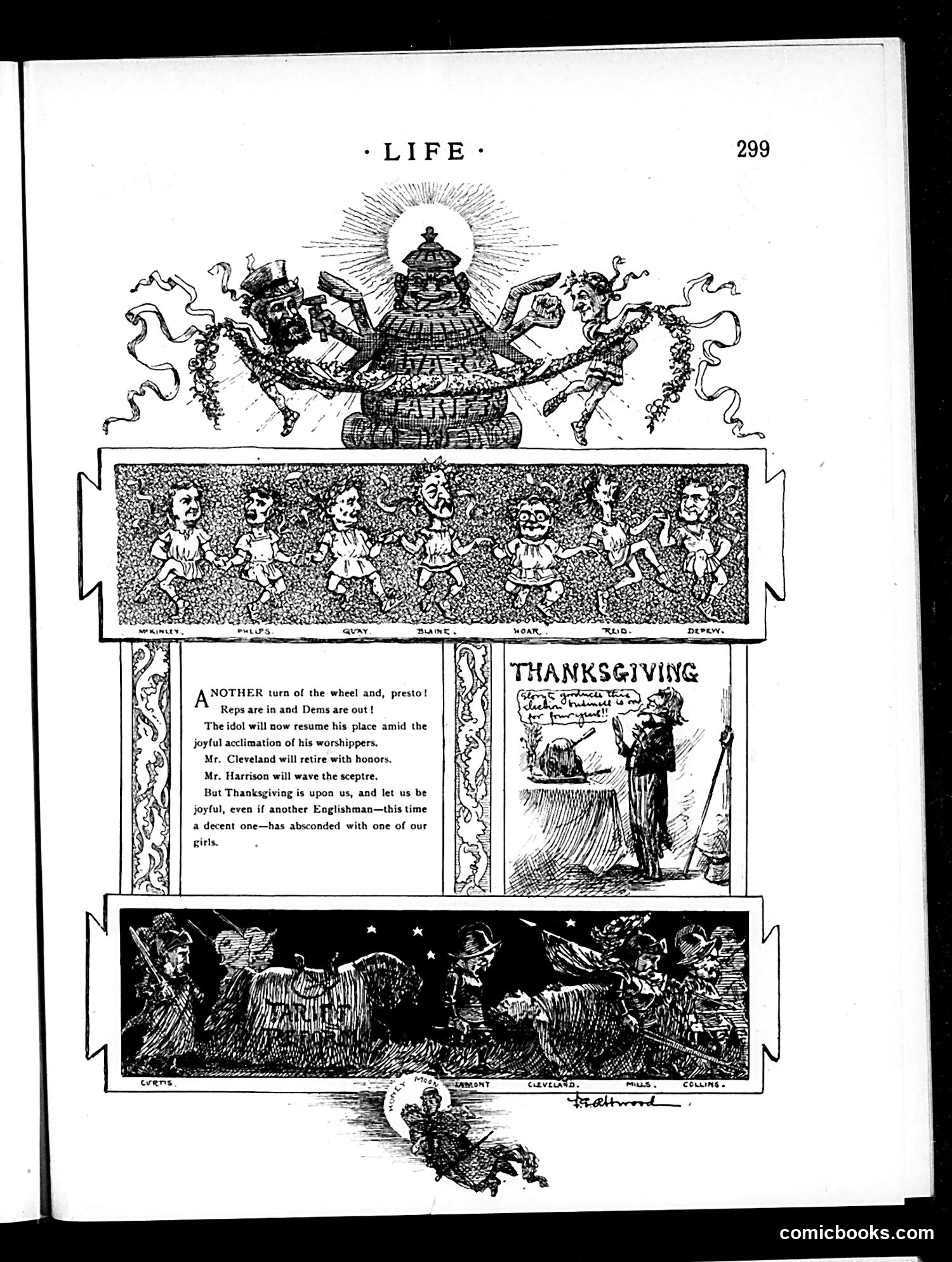
This page contains political commentary about American leadership transitions. The text references Mr. Cleveland and Mr. Harrison, suggesting this dates to a presidential transition era (likely 1889 or 1893, when these men alternated offices). The top illustration shows seven caricatured children representing different U.S. states or regions, labeled "PHILOS," "EQUITY," "GUST," "BLAME," "MARK," "TOSS," and "DERBY." The middle section is a Thanksgiving-themed cartoon showing a figure gesturing toward wheat fields, appearing to comment on agricultural or economic policy. The bottom illustration depicts winged creatures in a night sky with stars, possibly representing political forces or consequences of leadership change. The satire critiques how political transitions affect American governance and prosperity, using the children and allegorical figures to represent different regional or political interests.
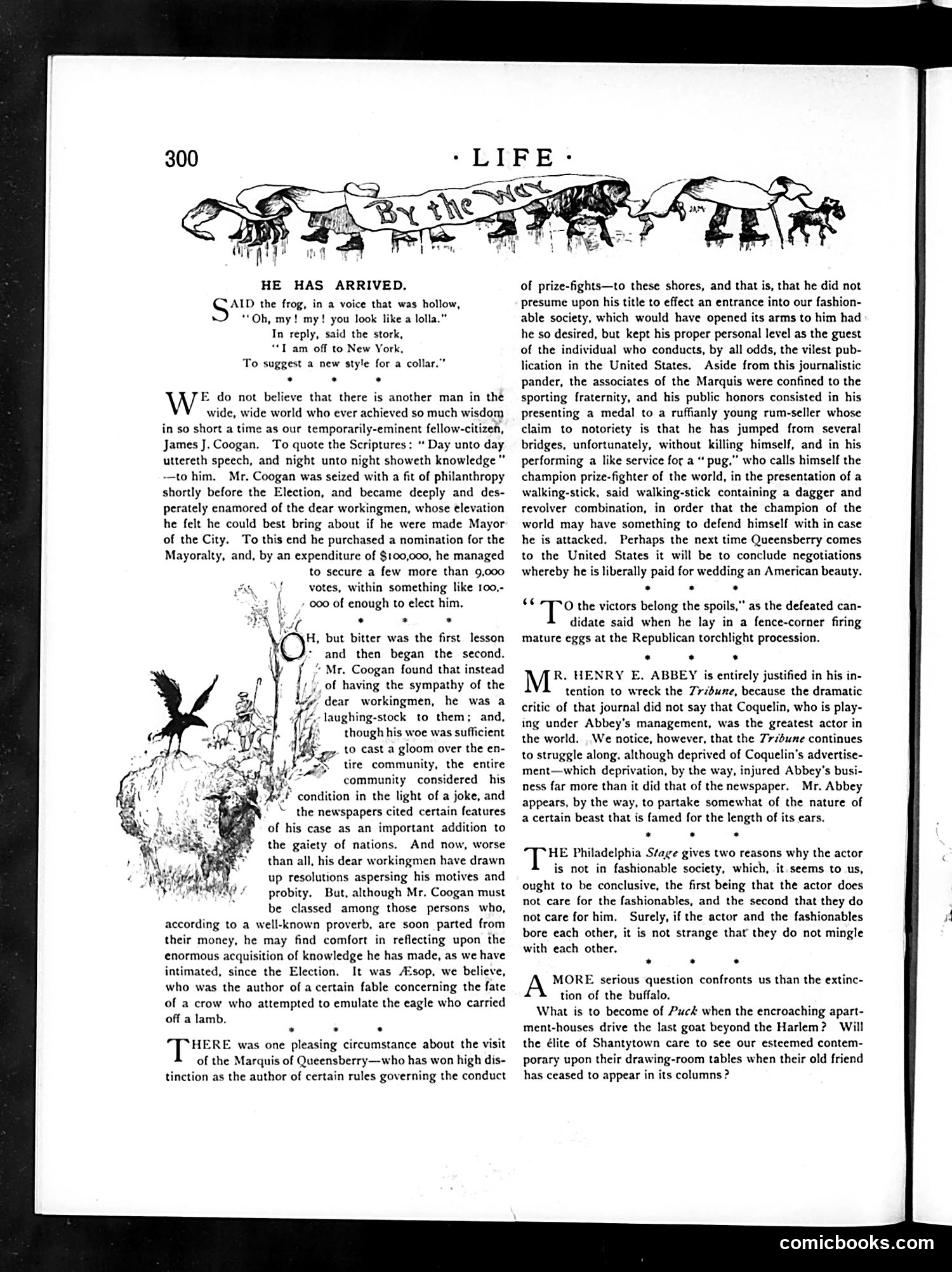
This page discusses James J. Coogan, a contemporary public figure who apparently achieved notoriety through prize-fighting and journalism. The text satirizes his social climbing—he purchased a mayoral nomination and spent $100,000 securing votes to gain entry into fashionable society. The humor centers on Coogan's contradiction: despite his wealth and efforts, he couldn't achieve the social status he desired. The magazine mocks him for lacking "proper personal level" in high society, suggesting money alone couldn't buy him acceptance among the established elite. The illustrated figures at the page's top appear to be stylized animals or creatures, possibly satirizing Coogan's character or the broader social pretensions being criticized. The text also includes commentary on theatrical figures like Henry E. Abbey and references to social institutions like Philadelphia's Stage club.
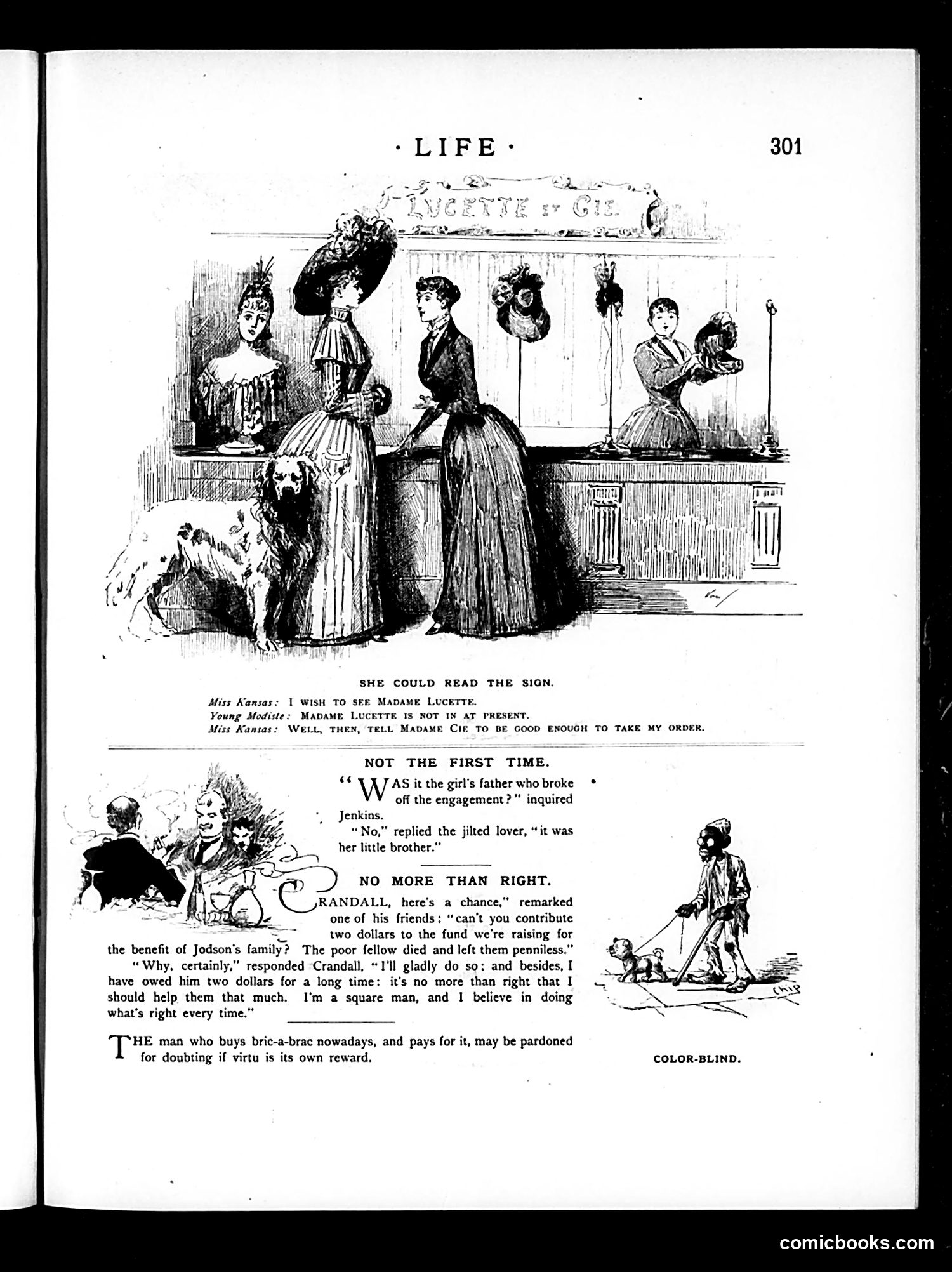
This page contains three separate satirical pieces from early 20th-century Life: 1. **"She Could Read the Sign"**: A shop scene where a young woman seeking Madame Lucette is told she's absent, with the implication being a commentary on women's shopping behavior or salon culture. 2. **"Not the First Time"**: A brief joke about a broken engagement where the jilted lover claims the girl's brother (not the father) ended things—suggesting a humorous twist on family interference in courtships. 3. **"No More Than Right"**: A Randall character discusses charitable contributions to help a deceased man's family, arguing it's morally obligatory—satirizing social responsibility and charity expectations among men. 4. **"Color-Blind"**: A small illustration, likely another social commentary. The page reflects turn-of-the-century attitudes toward gender, courtship, class, and social obligation.
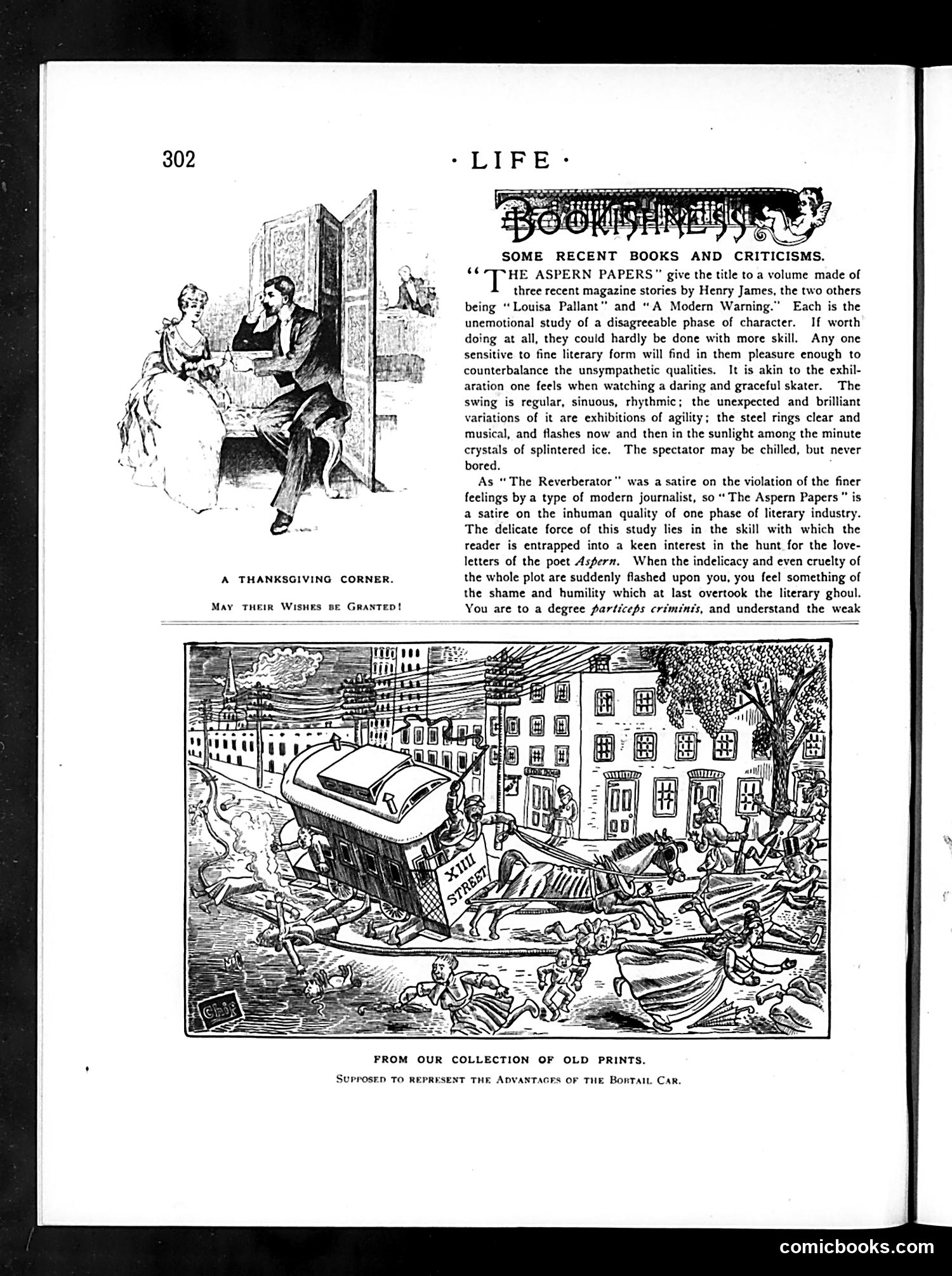
This page contains two distinct elements: **Upper section**: A book review column titled "Bookshelf" discussing recent literary works, including Henry James stories and their artistic merit. The accompanying sketch shows two figures in conversation, likely representing literary discussion. **Lower section**: A humorous engraving labeled "From Our Collection of Old Prints" depicting chaotic street chaos with a horse-drawn carriage (marked "XXIII") surrounded by scattered figures and pedestrians. The caption indicates it's "Supposed to Represent the Advantages of the Boatail Car"—appearing to be satire comparing modern automobiles to historical horse-drawn transportation, highlighting the traffic and social disruption caused by early motor vehicles. The juxtaposition suggests Life magazine's dual focus on highbrow literary criticism and satirizing contemporary technological change and urban chaos.
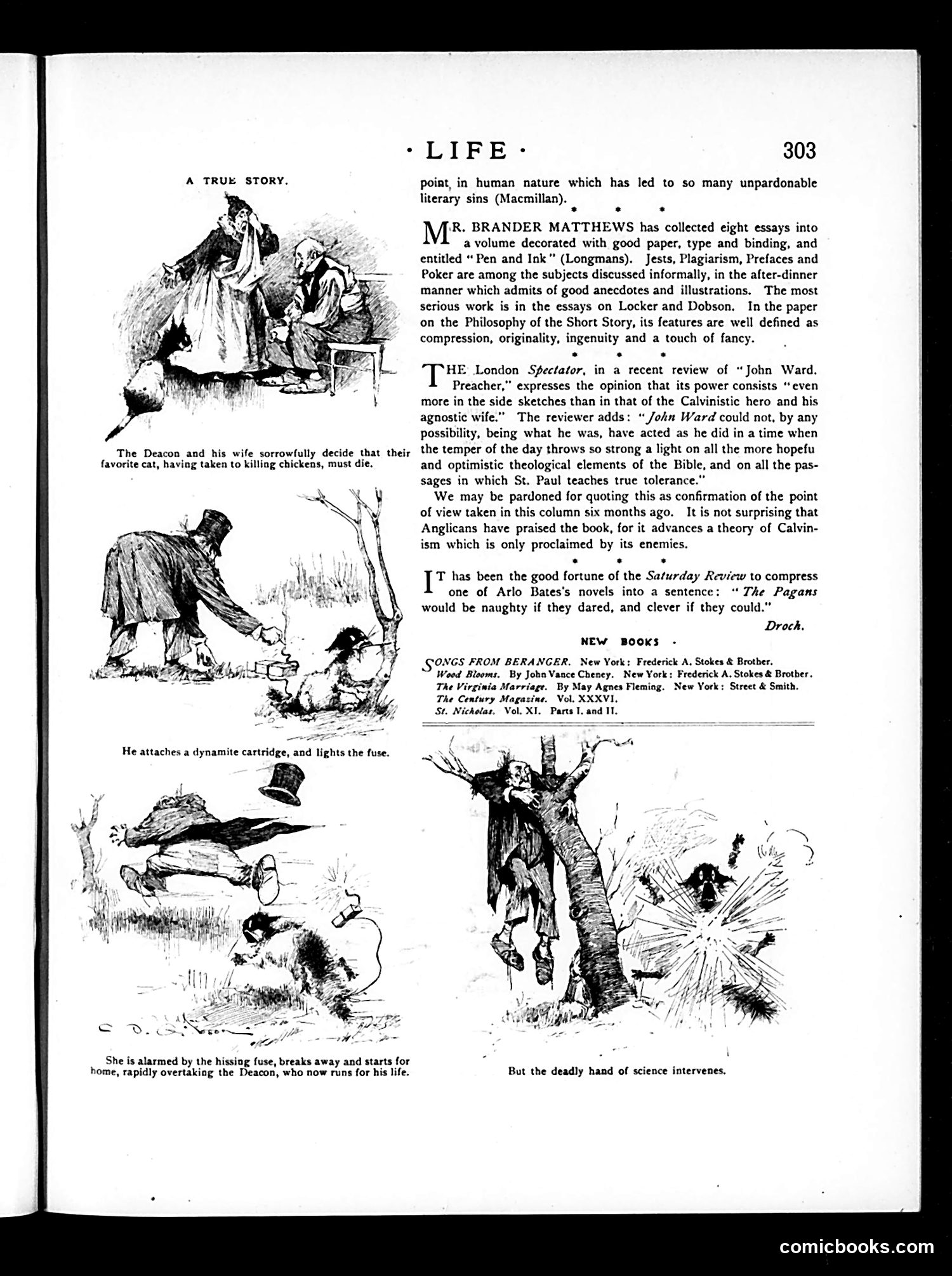
This appears to be a satirical illustrated story about anarchist violence, likely from the early 20th century when such threats were a genuine social concern in America. The sequential images depict: 1. A deacon and wife deciding to kill chickens 2. A man attaching dynamite to a cartridge and lighting the fuse 3. The woman alarmed by the "hissing fuse" fleeing homeward, with the deacon now "ruins for his life" 4. The final panel: "But the deadly hand of science intervenes" The joke appears to be dark irony: what begins as innocent farm work becomes confused with anarchist bomb-making, culminating in an accidental explosion. The satire mocks both anarchist violence and the period's anxiety about radical threats to ordinary American life.
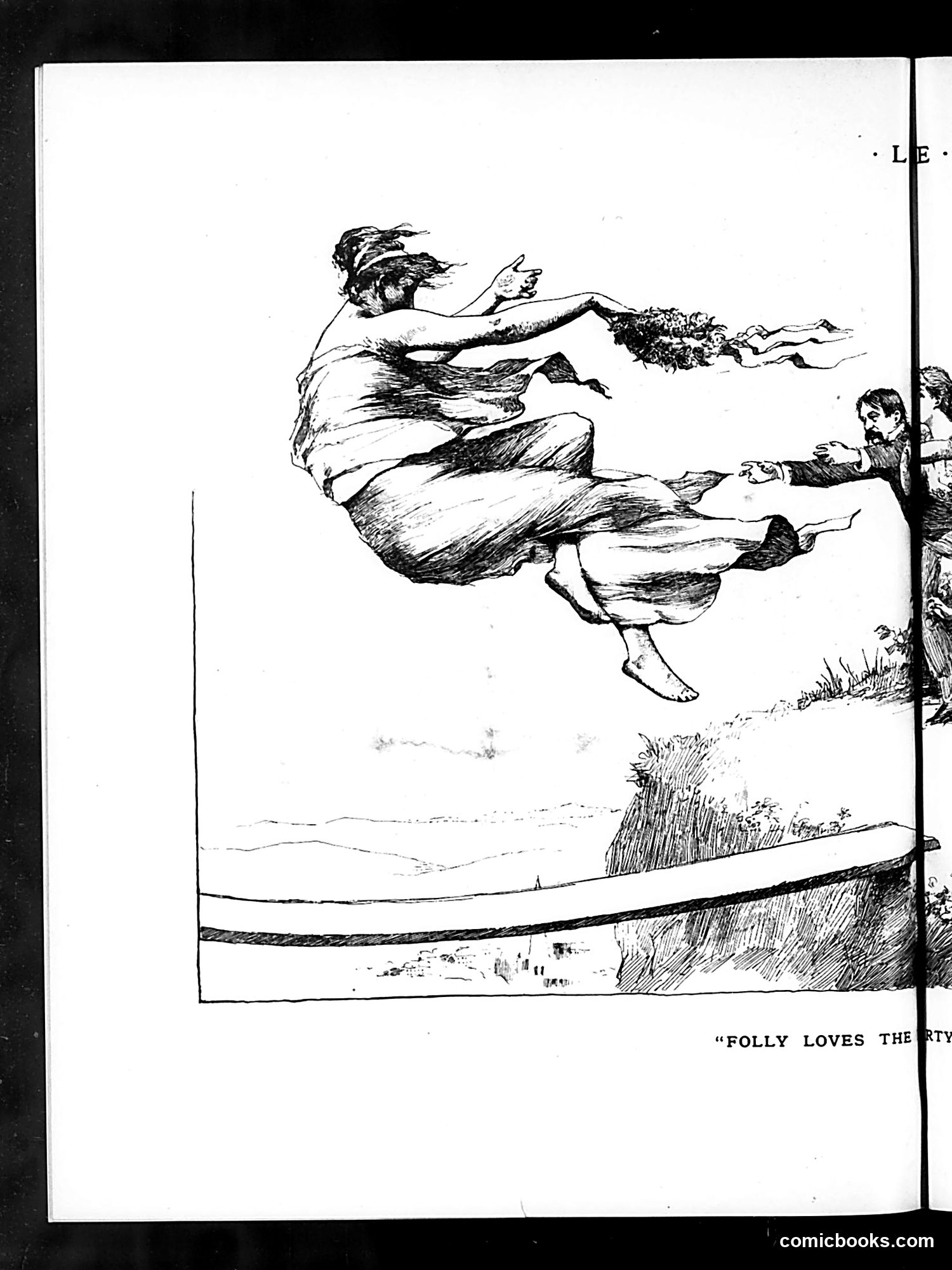
This ink drawing depicts a woman in flowing garments flying or leaping through the air with exuberant abandon, arms outstretched with flowers or foliage streaming behind her. A bearded man on the right observes her aerial display. The caption reads "Folly Loves the Rty" (likely "Folly Loves the City," with OCR error). The satire appears to target frivolous urban behavior—personifying "Folly" (foolishness) as a carefree woman reveling in city life, while a more staid, bearded figure (possibly representing wisdom, conservatism, or moral restraint) watches disapprovingly. This reflects early-20th-century satirical commentary on perceived moral decline and wild living in modern urban centers.
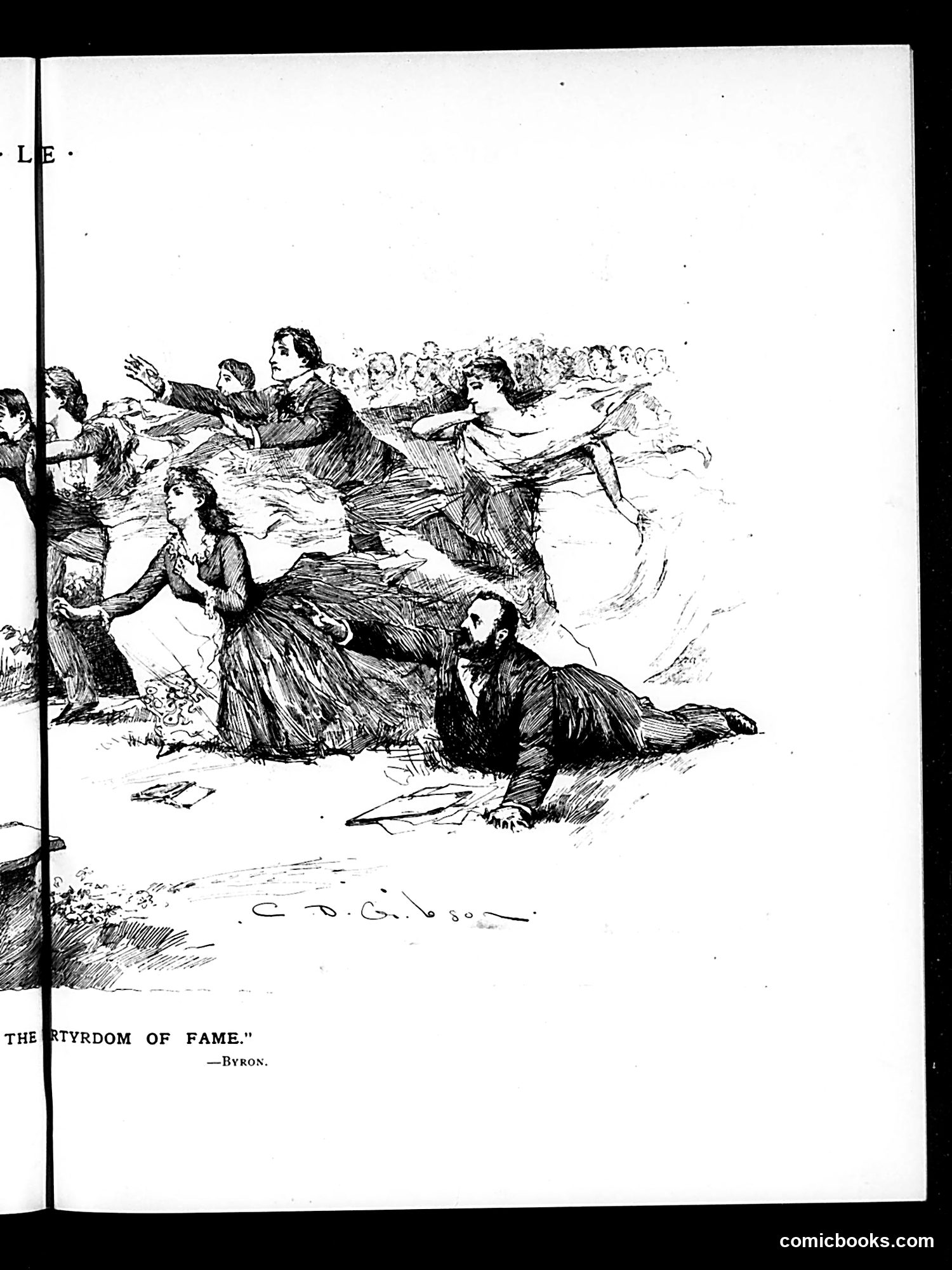
This ink illustration depicts a chaotic scene satirizing celebrity and public scrutiny. A man (likely representing the poet Lord Byron, given the attribution) lies prone on the ground, appearing exhausted or defeated, while figures around him—including women and men in period dress—gesticulate wildly and point at him. The crowd in the background watches intently. The cartoon critiques how fame becomes a form of torment. Byron, notorious for his scandalous personal life and romantic affairs, was constantly pursued by society and the press. The "martyrdom" suggests that public fame, rather than being desirable, subjects individuals to relentless scrutiny, gossip, and harassment. The frenzied crowd embodies society's appetite for celebrity drama and scandal.
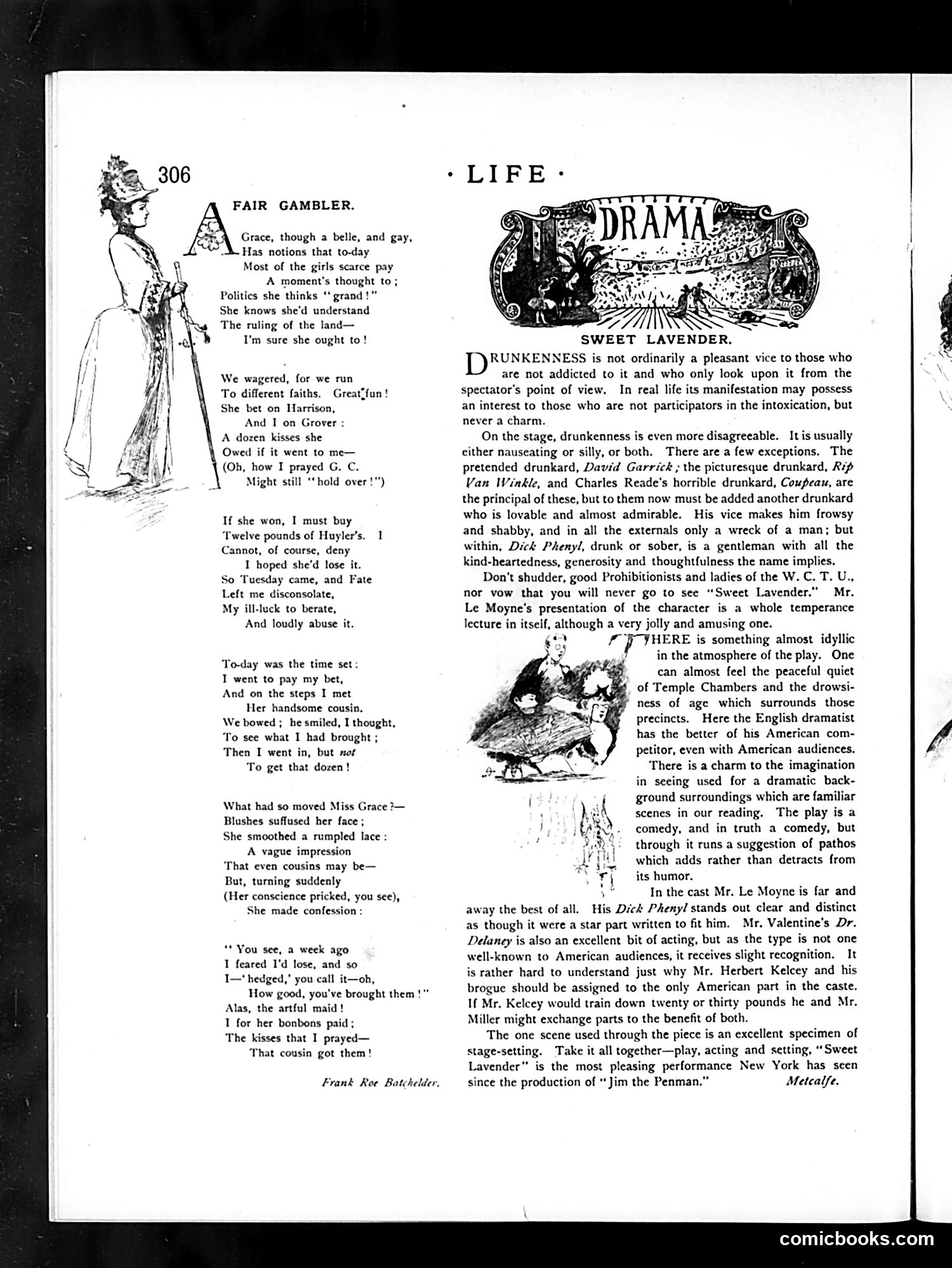
This page contains a satirical poem about a female gambler (left) alongside a theater review (right). **The Poem:** "A Fair Gambler" mocks a society woman named Grace who frequents gambling establishments. The satire targets her assumption that her social status and femininity exempt her from consequences—she wagered on horses and lost significantly, expecting male relatives to bail her out. The final stanza reveals her conscience-driven confession to a cousin, exposing the hypocrisy of upper-class women presenting respectability while engaging in vice. **The Review:** Critiques the theatrical production "Sweet Lavender," praising its English charm and the performance of the actor playing *Dick Phenyl*, while gently noting that staged drunkenness is generally unpleasant to watch—a rare exception being this particular character portrayal.
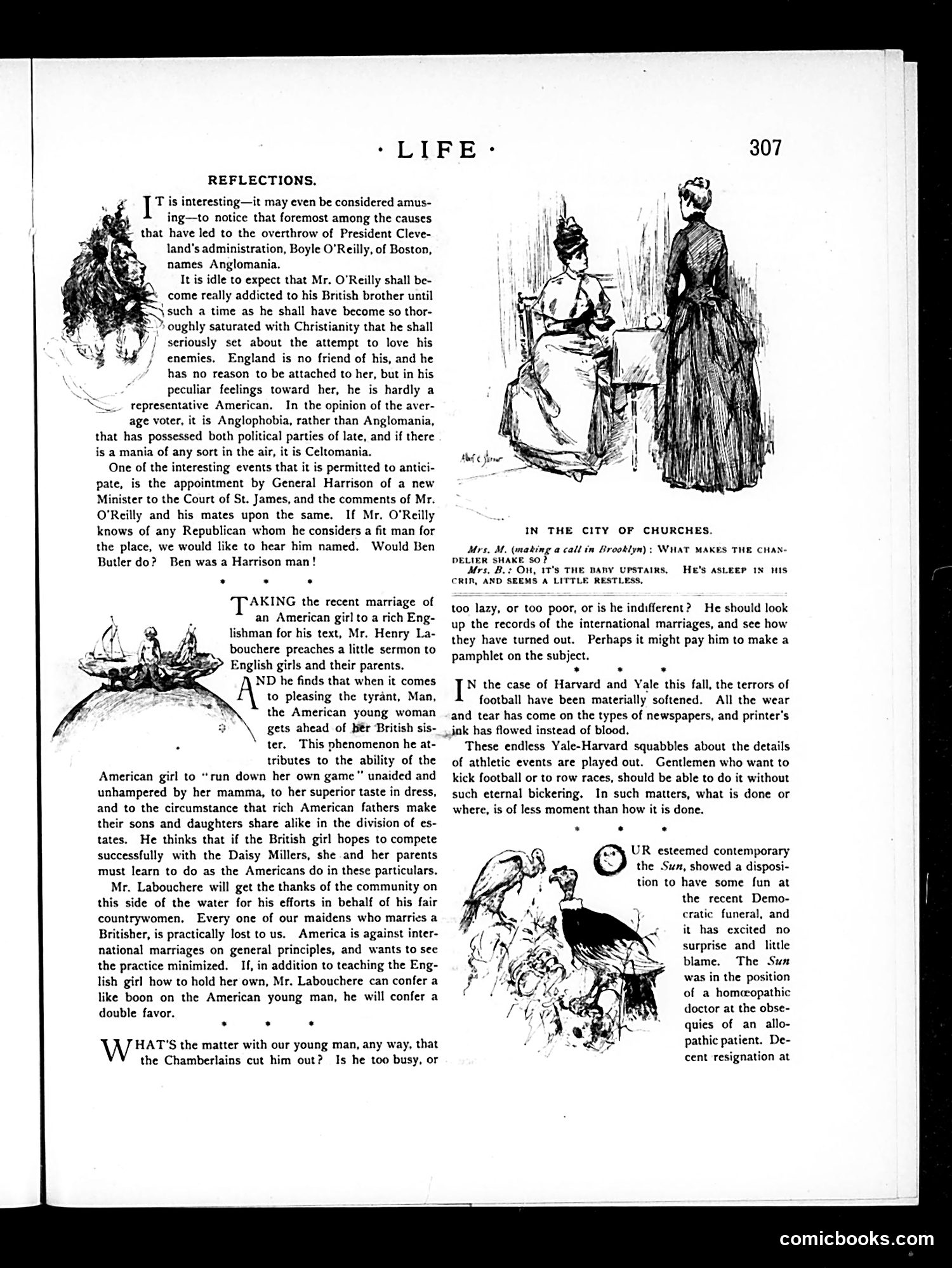
This page contains several distinct satirical commentary pieces typical of *Life* magazine's format: **Main Topic - International Marriages:** The bulk discusses Henry Labouchere's sermon criticizing American girls marrying wealthy Englishmen. The satire argues that while Americans complain about losing daughters to British husbands, they simultaneously oppose international marriages on principle—a contradiction. The text sarcastically welcomes Labouchere teaching British girls American independence, while questioning why American men don't compete as effectively. **Boyle O'Reilly Reference:** Opens with criticism of the Boston Irish-American editor's "Anglomania," arguing most Americans actually suffer from "Anglophobia" instead—a jab at Irish-American sentiment toward England. **Visual Cartoon ("In the City of Churches"):** Shows two Brooklyn women; one asks why the chandelier shakes. The answer: a baby upstairs is restless in its crib. The joke appears to mock Brooklyn's nickname as "City of Churches" through domestic banality. **Harvard-Yale Football:** Brief comment mocking endless athletic controversies, noting newspapers suffer more damage than players. The page reflects Gilded Age debates about American identity, class, and transatlantic relations.
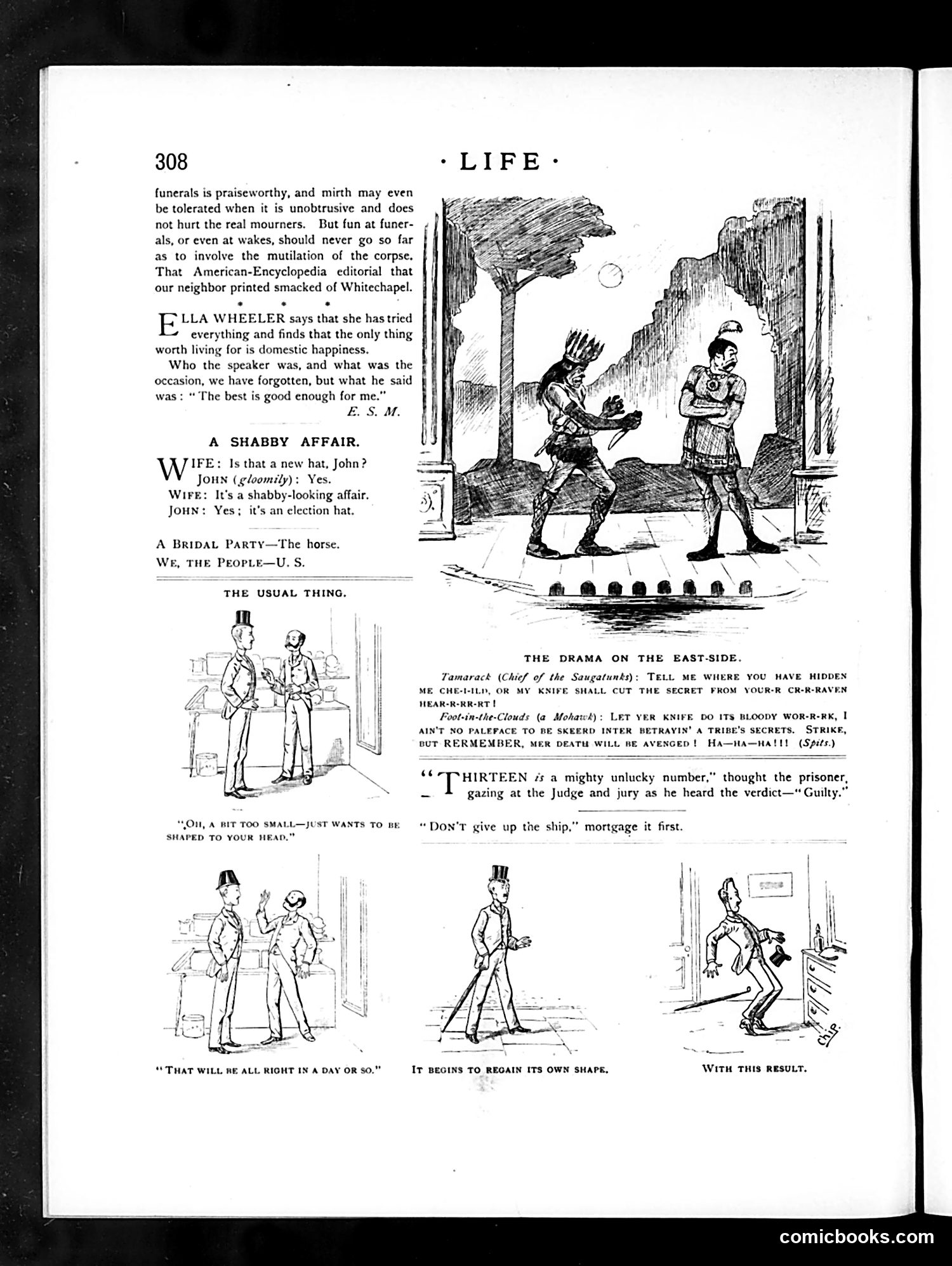
This page contains several satirical pieces mocking American life and culture: **"A Shabby Affair"**: A brief joke where a husband's new hat is shabby because it's an "election hat"—suggesting politicians' promises are cheap and poorly made, falling apart after election season. **"The Drama on the East-Side"**: A parody of melodramatic Wild West/Native American theatrical productions popular at the time. The exaggerated dialect and overwrought dialogue ("LET YER KNIFE DO ITS BLOODY WOR-R-RK") mock the overwrought acting and implausible plots of such entertainments. **The jury verdict cartoon**: Satirizes the American legal system, showing a prisoner convicted by a jury of thirteen (considered unlucky), then mocking financial hardship with "Don't give up the ship, mortgage it first"—suggesting Americans sacrifice their assets rather than give up. **"The Usual Thing"**: A visual gag about a hat that won't hold its shape, satirizing consumer goods quality or false advertising. The page reflects early 20th-century American anxieties about politics, commercialism, and popular entertainment.
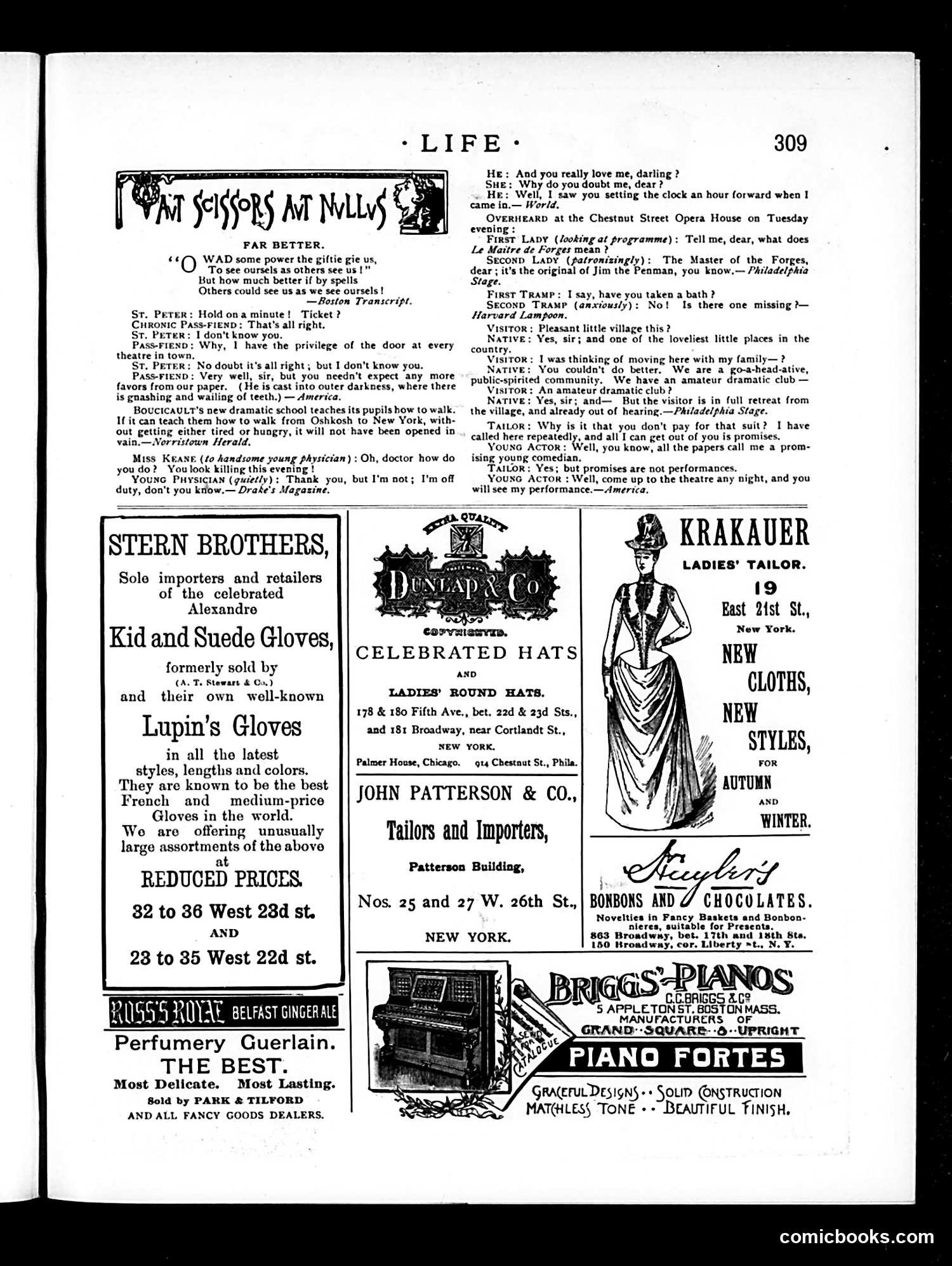
This page from *Life* magazine contains several brief satirical jokes typical of late 19th-century American humor, plus period advertising. **The main cartoon** titled "Scissors at Nullus" (appears to be a play on words) is not clearly visible in the OCR'd text, but the accompanying jokes mock various contemporary figures and situations: - A **theatre pass-holder** is denied entry to heaven by St. Peter because credentials don't transfer between realms—satirizing the pretensions of theater industry insiders - A **dramatic school** teacher is mocked for teaching actors to walk - A **young doctor** is humorously called "killing" in appearance - A **tailor pursues payment** from a struggling actor who claims to be "promising," but the tailor retorts that promises aren't performances—a pun mocking both the actor's financial irresponsibility and the acting profession's empty rhetoric The humor relies on wordplay and mild social commentary about theater culture, medicine, and business ethics. The page is otherwise dominated by period advertisements for gloves, hats, pianos, and women's clothing.
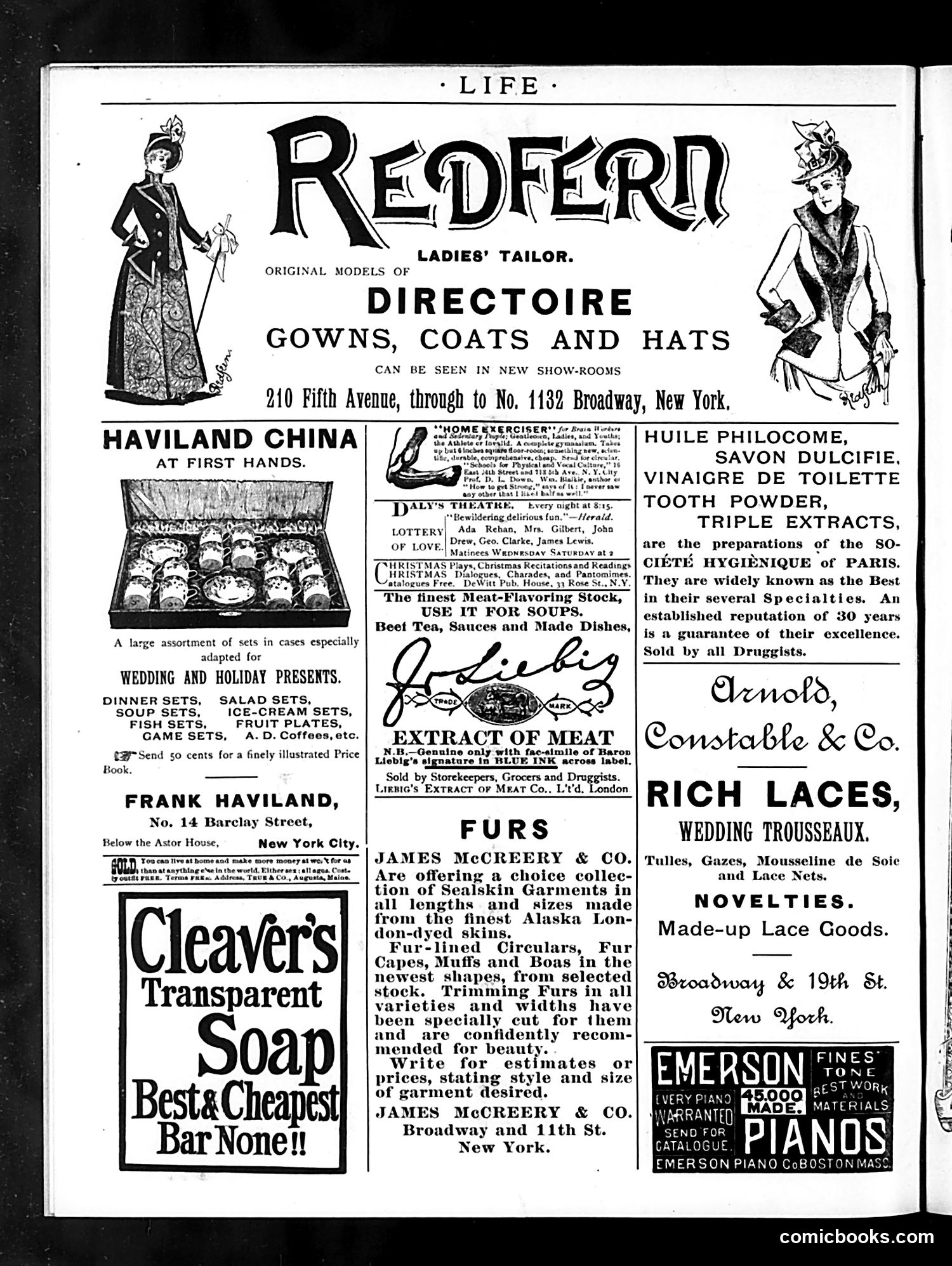
This is primarily an **advertisement page**, not a satirical cartoon page. It contains no political commentary or jokes for modern readers to decode. The page showcases luxury goods marketed to wealthy Americans of the era (likely late 1800s): fine china, furs, laces, soaps, and pianos. Notable features include: - **Redfern** (top): A prestigious ladies' tailor advertising fashionable "Directoire" gowns - **Haviland China**: High-end dinnerware for wedding gifts - **James McCreery & Co.**: Fur merchant selling sealskin garments - **French beauty products**: Preparations from "Société Hygiénique of Paris," suggesting European luxury goods held prestige - **Cleaver's Soap**: Positioned as affordable ("Best & Cheapest") The illustrations show fashionably dressed women, reflecting contemporary style. This represents commercial advertising from Life magazine's early period, before it became primarily known for satirical cartooning. No satire or political meaning is evident—it's straightforward period marketing.