
Life, 1888-11-29 · page 2 of 14
Life — November 29, 1888 — page 2: what you’re looking at
What you’re looking at
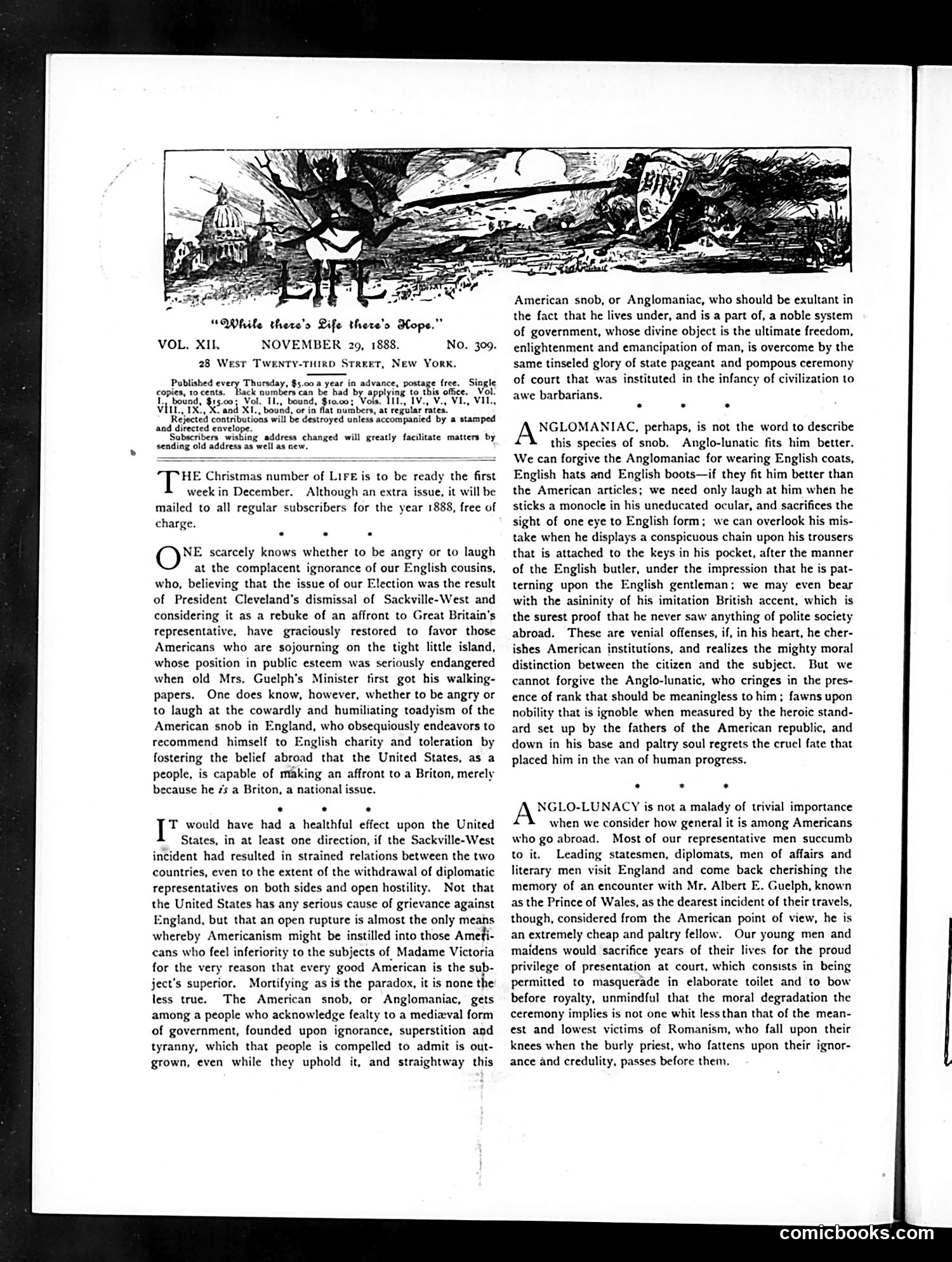
The masthead cartoon "While there's Life there's Hope" depicts a landscape with classical architecture—likely representing the enduring American republic. The editorial content primarily attacks "Anglomaniac" Americans who adopt English mannerisms, fashion, and social pretensions. The author criticizes Americans who: - Wear English clothing and imitate British style - Display subservience to English nobility and court ceremony - Abandon American democratic values for aristocratic affectation The satire targets American elites who traveled to England and returned affected by British culture, viewing themselves as superior. The piece argues this betrays the egalitarian principles of the American republic and represents moral degradation. The critique reflects post-Civil War American anxiety about social hierarchy and European cultural dominance among the wealthy classes.
📄 Transcribed text from this page (OCR, searchable)
Machine-transcribed from the original scan — historical spelling and the odd misread are preserved.
“Mhile there's Life there's Hope.” VOL. XII, NOVEMBER 29, 1888. No. 309. 28 West Twenty-THirD Street, New York. Published eve copies, 10 cents. Ly bound, $15.00; Vol. II., vin, 1X, XI. bound, of in dat numbers, at qin rates. Rejected contributions will be destroyed unless accompanied by a stamped and directed envelope, Subscribers wishing address changed will greatly facilitate matters by sending old address as well as new. Thursday, $5.00 a year in advance, postage free. Single hack numbers can be bad by apply ie to this office. Vol. ’ bound, $100; Voor dls IVs Vi. Vi-, VIL, HE Christmas number of Lire is to be ready the first week in December. Although an extra issue, it will be mailed to all regular subscribers for the year 1888, free of charge. NE scarcely knows whether to be angry or to laugh at the complacent ignorance of our English cousins, who, believing that the issue of our Election was the result of President Cleveland's dismissal of Sackville-West and considering it as a rebuke of an affront to Great Britain's representative, have graciously restored to favor those Americans who are sojourning on the tight little island, whose position in public esteem was seriously endangered when old Mrs. Guelph’s Minister first got his walking- papers. One does know, however, whether to be angry or to laugh at the cowardly and humiliating toadyism of the American snob in England, who obsequiously endeavors to recommend himself to English charity and toleration by fostering the belief abroad that the United States, as a people, is capable of making an affront to a Briton, merely because he ¢s a Briton, a national issue. . . . T would have had a healthful effect upon the United States, in at least one direction, if the Sackville-West incident had resulted in strained relations between the two countries, even to the extent of the withdrawal of diplomatic representatives on both sides and open hostility. Not that the United States has any serious cause of grievance against England, but that an open rupture is almost the only means whereby Americanism might be instilled into those Amefi- cans who feel inferiority to the subjects of, Madame Victoria for the very reason that every good American is the sub- ject’s superior. Mortifying as is the paradox, it is none the less true. The American snob, or Anglomaniac, gets among a people who acknowledge fealty to a medizval form of government, founded upon ignorance, superstition and tyranny, which that people is compelled to admit is out- grown, even while they uphold it, and straightway this American snob, or Anglomaniac, who should be exultant in the fact that he lives under, and is a part of, a noble system of government, whose divine object is the ultimate freedom, enlightenment and emancipation of man, is overcome by the same tinseled glory of state pageant and pompous ceremony of court that was instituted in the infancy of civilization to awe barbarians. NGLOMANIAC, perhaps, is not the word to describe this species of snob, Anglo-lunatic fits him better. We can forgive the Anglomaniac for wearing English coats, English hats and English boots—if they fit him better than the American articles; we need only laugh at him when he sticks a monocle in his uneducated ocular, and sacrifices the sight of one eye to English form; we can overlook his mis- take when he displays a conspicuous chain upon his trousers that is attached to the keys in his pocket, after the manner of the English butler, under the impression that he is pat- terning upon the English gentleman; we may even bear with the asininity of his imitation British accent, which is the surest proof that he never saw anything of polite society abroad. These are venial offenses, if, in his heart, he cher- ishes American institutions, and realizes the mighty moral distinction between the citizen and the subject. But we cannot forgive the Anglo-lunatic, who cringes in the pres- ence of rank that should be meaningless to him; fawns upon nobility that is ignoble when measured by the heroic stand- ard set up by the fathers of the American republic, and down in his base and paltry soul regrets the cruel fate that placed him in the van of human progress. . . * NGLO-LUNACY is not a malady of trivial importance when we consider how general it is among Americans who go abroad. Most of our representative men succumb to it. Leading statesmen, diplomats, men of affairs and literary men visit England and come back cherishing the memory of an encounter with Mr. Albert E. Guelph, known as the Prince of Wales, as the dearest incident of their travels, though, considered from the American point of view, he is an extremely cheap and paltry fellow. Our young men and maidens would sacrifice years of their lives for the proud privilege of presentation at court, which consists in being permitted to masquerade in elaborate toilet and to bow before royalty, unmindful that the moral degradation the ceremony implies is not one whit less than that of the mean- est and lowest victims of Romanism, who fall upon their knees when the burly priest, who fattens upon their ignor- ance and credulity, passes before them. comicbooks.com