
Life, 1888-11-29 · page 4 of 14
Life — November 29, 1888 — page 4: what you’re looking at
What you’re looking at
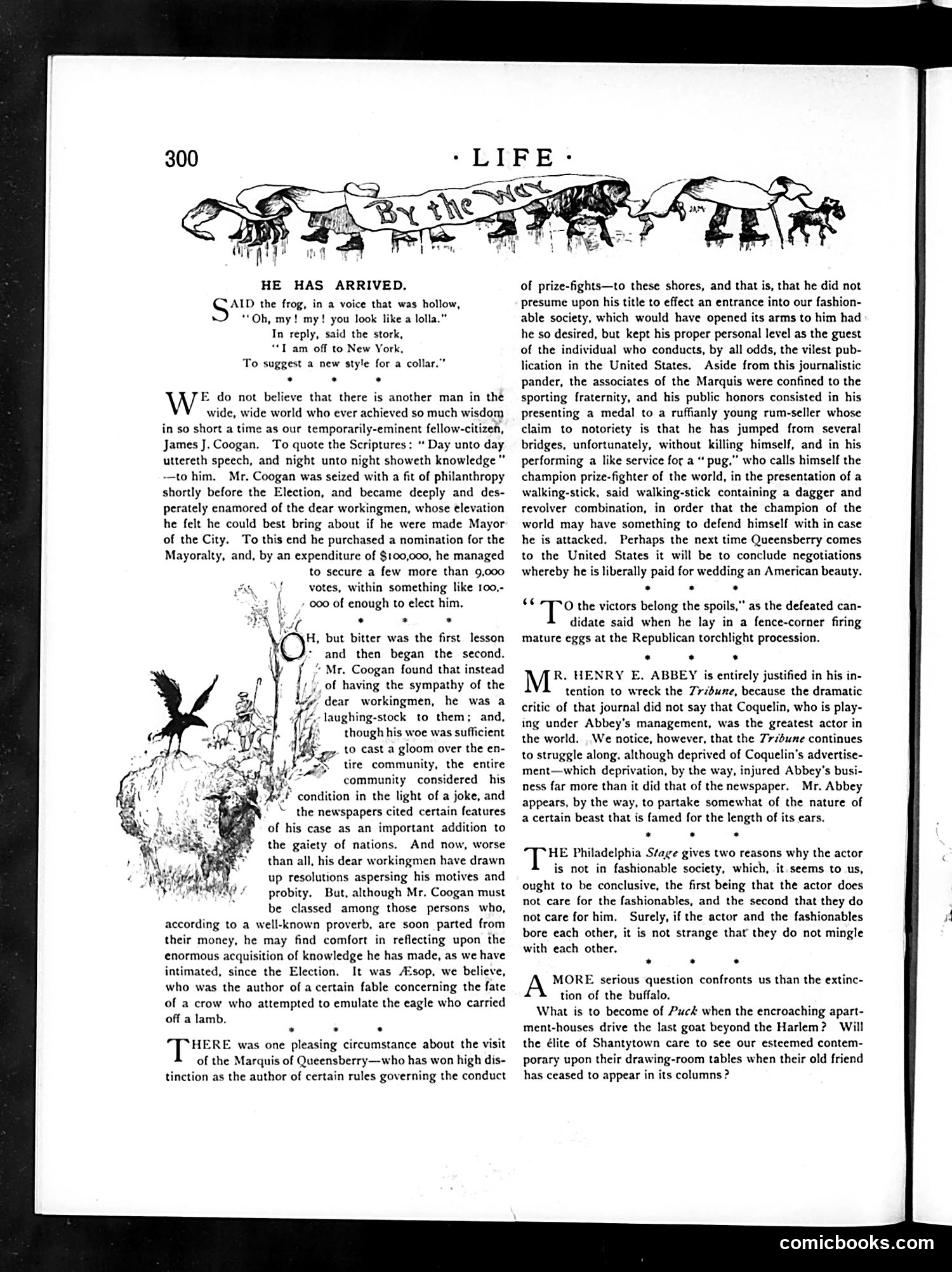
This page discusses James J. Coogan, a contemporary public figure who apparently achieved notoriety through prize-fighting and journalism. The text satirizes his social climbing—he purchased a mayoral nomination and spent $100,000 securing votes to gain entry into fashionable society. The humor centers on Coogan's contradiction: despite his wealth and efforts, he couldn't achieve the social status he desired. The magazine mocks him for lacking "proper personal level" in high society, suggesting money alone couldn't buy him acceptance among the established elite. The illustrated figures at the page's top appear to be stylized animals or creatures, possibly satirizing Coogan's character or the broader social pretensions being criticized. The text also includes commentary on theatrical figures like Henry E. Abbey and references to social institutions like Philadelphia's Stage club.
📄 Transcribed text from this page (OCR, searchable)
Machine-transcribed from the original scan — historical spelling and the odd misread are preserved.
HE HAS ARRIVED. Sie the frog, in a voice that was hollow, "Oh, my! my! you look like a lolla.” In reply, said the stork, “*T am off to New York, To suggest a new style for a collar.” . . . E do not believe that there is another man in the wide, wide world who ever achieved so much wisdom in so short a time as our temporarily-eminent fellow-citizeh, James J. Coogan. To quote the Scriptures: “ Day unto day uttereth speech, and night unto night showeth knowledge” -—to him. Mr. Coogan was seized with a fit of philanthropy shortly before the Election, and became deeply and des- perately enamored of the dear workingmen, whose elevation he felt he could best bring about if he were made Mayor of the City. To this end he purchased a nomination for the Mayoralty, and, by an expenditure of $100,000, he managed to secure a few more than 9,000 votes, within something like 100,- - 000 of enough to elect him. . . . \ H, but bitter was the first lesson KC)! and then began the second. y ’ Mr. Coogan found that instead , of having the sympathy of the dear workingmen, he was a laughing-stock to them; and, though his woe was sufficient to cast a gloom over the en- ~ tire community, the entire community considered his f condition in the light of a joke, and \ the newspapers cited certain features of his case as an important addition to the gaiety of nations. And now, worse than all, his dear workingmen have drawn up resolutions aspersing his motives and probity. But, although Mr. Coogan must be classed among those persons who, according to a well-known proverb, are soon parted from their money, he may find comfort in reflecting upon the enormous acquisition of knowledge he has made, as we have intimated, since the Election. It was /Esop, we believe, who was the author of a certain fable concerning the fate of a crow who attempted to emulate the eagle who carried off a lamb. f 4, i ¢ . ° . HERE was one pleasing circumstance about the visit of the Marquis of Queensberry—who has won high dis- tinction as the author of certain rules governing the conduct of prize-fights—to these shores, and that is, that he did not presume upon his title to effect an entrance into our fashion- able society, which would have opened its arms to him had he so desired, but kept his proper personal level as the guest of the individual who conducts, by all odds, the vilest pub- lication in the United States. Aside from this journalistic pander, the associates of the Marquis were confined to the sporting fraternity, and his public honors consisted in his presenting a medal to a ruffianly young rum-seller whose claim to notoriety is that he has jumped from several bridges, unfortunately, without killing himself, and in his performing a like service for a “ pug,” who calls himself the champion prize-fighter of the world, in the presentation of a walking-stick, said walking-stick containing a dagger and revolver combination, in order that the champion of the world may have something to defend himself with in case he is attacked. Perhaps the next time Queensberry comes to the United States it will be to conclude negotiations whereby he is liberally paid for wedding an American beauty. . . . ss ‘O the victors belong the spoils,” as the defeated can- didate said when he lay in a fence-corner firing mature eggs at the Republican torchlight procession. . . . R. HENRY E, ABBEY is entirely justified in his in- tention to wreck the 7rbune, because the dramatic critic of that journal did not say that Coquelin, who is play- ing under Abbey’s management, was the greatest actor in the world. We notice, however, that the 77zéune continues to struggle along, although deprived of Coquelin’s advertise- ment—which deprivation, by the way, injured Abbey's busi- ness far more than it did that of the newspaper. Mr. Abbey appears, by the way, to partake somewhat of the nature of a certain beast that is famed for the length of its ears. . . . HE Philadelphia Stage gives two reasons why the actor is not in fashionable society, which, it seems to us, ought to be conclusive, the first being that the actor does not care for the fashionables, and the second that they do not care for him. Surely, if the actor and the fashionables bore each other, it is not strange that they do not mingle with each other. . . . A MORE serious question confronts us than the extinc- tion of the buffalo. What is to become of Puck when the encroaching apart- ment-houses drive the last goat beyond the Harlem? Will the élite of Shantytown care to see our esteemed contem- porary upon their drawing-room tables when their old friend has ceased to appear in its columns? comicbooks.com