
Life, 1888-11-29 · page 10 of 14
Life — November 29, 1888 — page 10: what you’re looking at
What you’re looking at
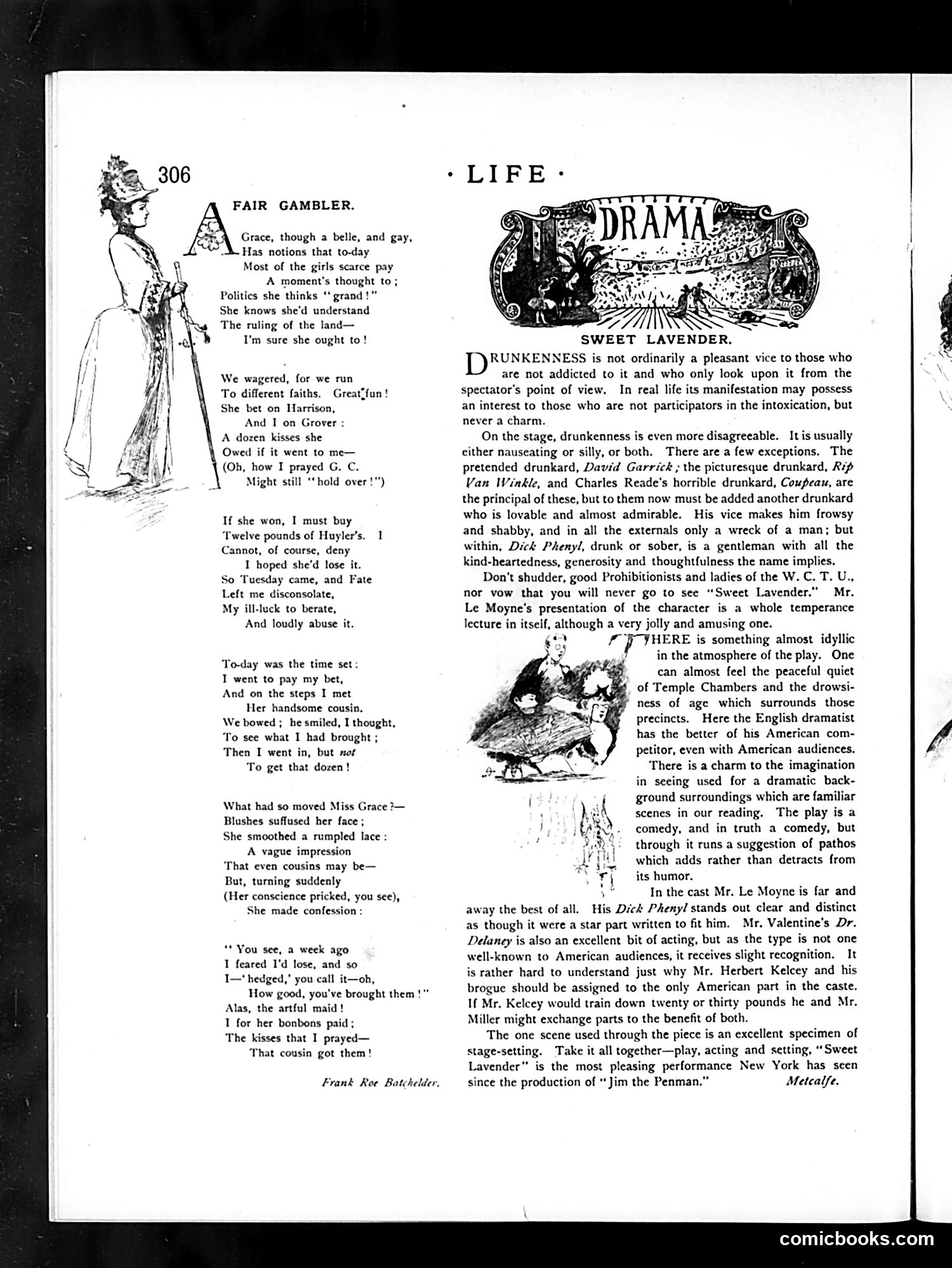
This page contains a satirical poem about a female gambler (left) alongside a theater review (right). **The Poem:** "A Fair Gambler" mocks a society woman named Grace who frequents gambling establishments. The satire targets her assumption that her social status and femininity exempt her from consequences—she wagered on horses and lost significantly, expecting male relatives to bail her out. The final stanza reveals her conscience-driven confession to a cousin, exposing the hypocrisy of upper-class women presenting respectability while engaging in vice. **The Review:** Critiques the theatrical production "Sweet Lavender," praising its English charm and the performance of the actor playing *Dick Phenyl*, while gently noting that staged drunkenness is generally unpleasant to watch—a rare exception being this particular character portrayal.
📄 Transcribed text from this page (OCR, searchable)
Machine-transcribed from the original scan — historical spelling and the odd misread are preserved.
FAIR GAMBLER. Grace, though a belle, and gay, Has notions that to-day Most of the girls scarce pay A moment's thought to; Politics she thinks ‘* grand!" She knows she'd understand The ruling of the land— I'm sure she ought to! We wagered, for we run To different faiths. GreatZfun! She bet on Harrison, And I on Grover : A dozen kisses she Owed if it went to me— (Oh, how I prayed G. C. Might still ‘hold over!") If she won, I must buy ‘Twelve pounds of Huyler’s. I Cannot, of course, deny I hoped she'd lose it. So Tuesday came, and Fate Left me disconsolate, My ill-luck to berate, And loudly abuse it. To-day was the time set: I went to pay my bet, And on the steps I met Her handsome cousin, We bowed ; he smiled, I thought, To see what I had brought ; Then I went in, but not To get that dozen! What had so moved Miss Grace ?— Blushes suffused her face ; She smoothed a rumpled lace : A vague impression ‘That even cousins may be— But, turning suddenly (Her conscience pricked, you see), She made confession : ** You see, a week ago I feared I'd lose, and so I—' hedged,’ you call it—oh, How good, you've brought them !” Alas, the artful maid! I for her bonbons paid; The kisses that I prayed— That cousin got them! Frank Roe Batchelder, SWEET LAVENDER. RUNKENNESS is not ordinarily a pleasant vice to those who are not addicted to it and who only look upon it from the spectator's point of view. In real life its manifestation may possess an interest to those who are not participators in the intoxication, but never a charm. On the stage, drunkenness is even more disagreeable. It is usually either nauseating or silly, or both. There are a few exceptions. The pretended drunkard, David Garrick ; the picturesque drunkard, Rip Van Winkle, and Charles Reade’s horrible drunkard, Coupeau, are the principal of these, but to them now must be added another drunkard who is lovable and almost admirable. His vice makes him frowsy and shabby, and in all the externals only a wreck of a man; but within, Dick Phenyl, drunk or sober, is a gentleman with all the kind-heartedness, generosity and thoughtfulness the name implies. Don't shudder, good Prohibitionists and ladies of the W. C. T. U., nor vow that you will never go to see “Sweet Lavender.” Mr. Le Moyne’s presentation of the character is a whole temperance lecture in itself, although a very jolly and amusing one. ry ERE is something almost idyllic m in the atmosphere of the play. One can almost feel the peaceful quiet of Temple Chambers and the drowsi- ness of age which surrounds those precincts. Here the English dramatist has the better of his American com- petitor, even with American audiences. There is a charm to the imagination in seeing used for a dramatic back- ground surroundings which are familiar scenes in our reading. The play is a comedy, and in truth a comedy, but through it runs a suggestion of pathos which adds rather than detracts from its humor. In the cast Mr. Le Moyne is far and away the best of all. His Dick Phenyl stands out clear and distinct as though it were a star part written to fit him. Mr. Valentine's Dr. Delaney is also an excellent bit of acting, but as the type is not one well-known to American audiences, it receives slight recognition. It is rather hard to understand just why Mr. Herbert Kelcey and his brogue should be assigned to the only American part in the caste. If Mr. Kelcey would train down twenty or thirty pounds he and Mr. Miller might exchange parts to the benefit of both. The one scene used through the piece is an excellent specimen of stage-setting. Take it all together—play, acting and setting, “Sweet Lavender” is the most pleasing performance New York has seen since the production of “Jim the Penman.” Metcalfe. comicbooks.com