
A complete issue · 14 pages · 1888
Life — October 25, 1888
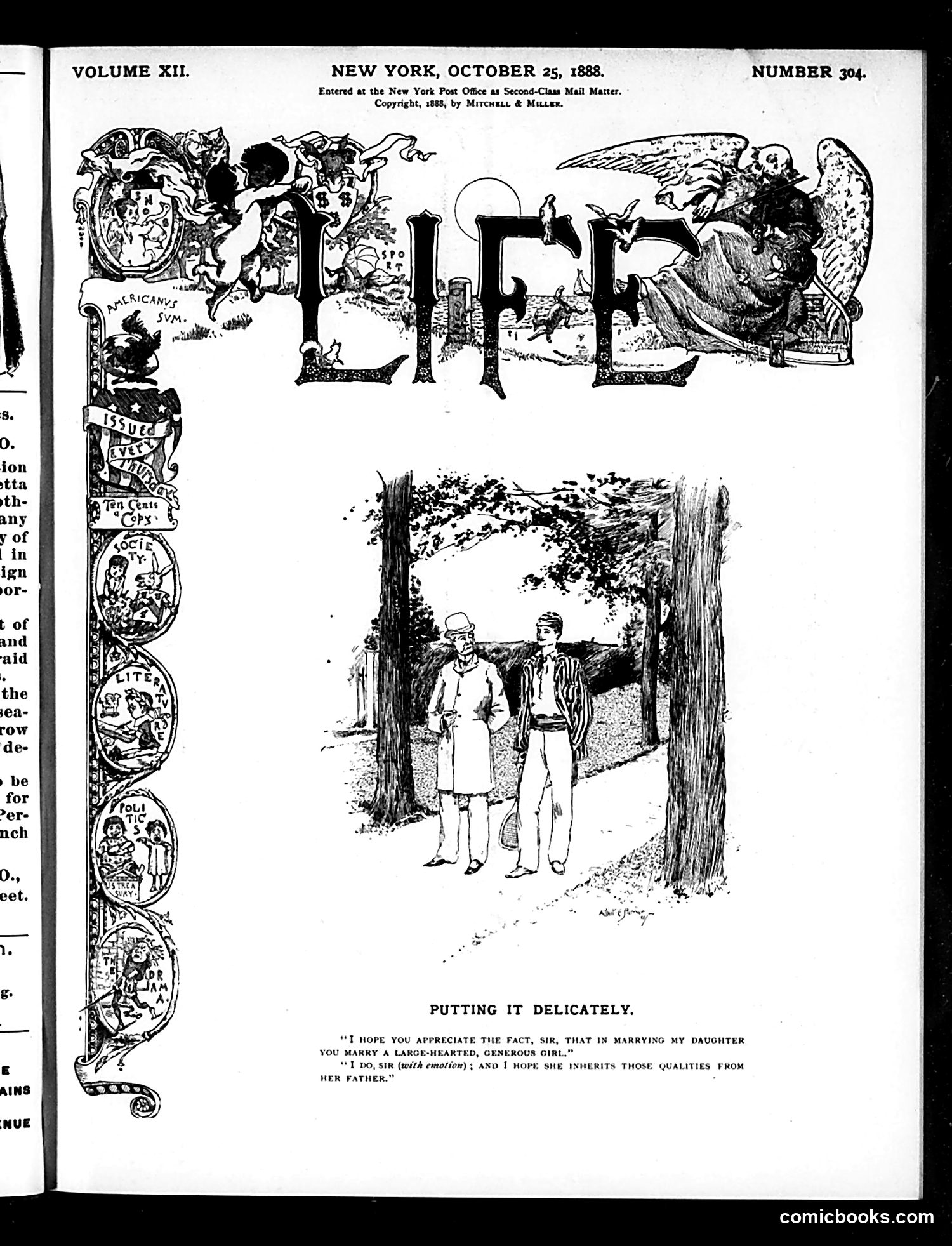
This page from *Life* magazine (October 25, 1888) contains a single cartoon titled "Putting It Delicately." The image shows two men in conversation on a country road. The caption below presents dialogue: a father is explaining to another man that in marrying his daughter, "you marry a large-hearted, generous girl" and hopes the son-in-law will inherit those qualities "from her father." The satire appears to center on the awkward, indirect way the father is communicating—"putting it delicately"—what seems to be either a compliment about his daughter's character or possibly a veiled reference to her dowry or financial expectations. The humor lies in the strained formality and circumlocution of Victorian courtship negotiations and family discussions about marriage arrangements. The cartoon mocks the era's stilted social conventions around such matters.
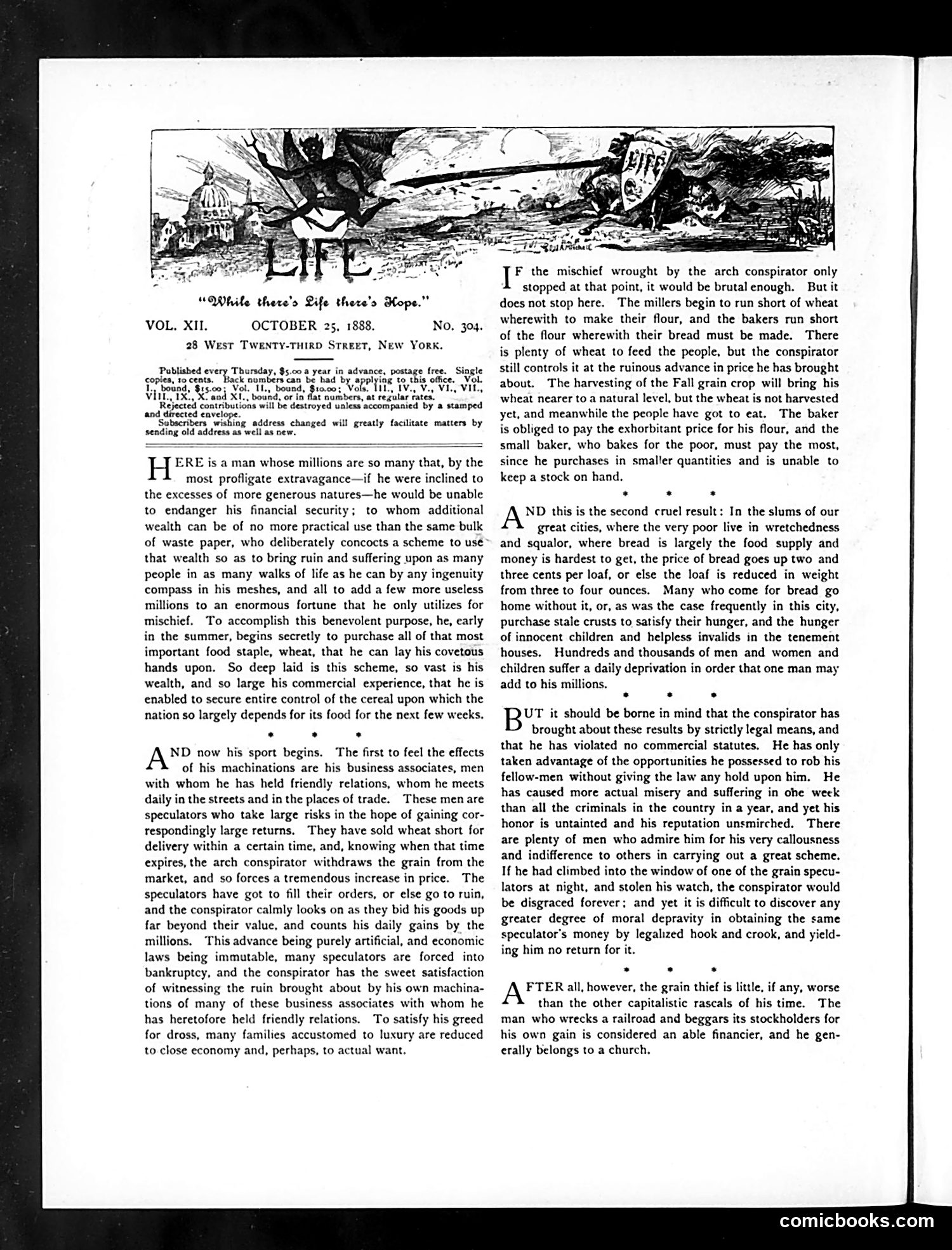
**The Cartoon:** The masthead illustration shows a grim reaper-like figure wielding a scythe above a barren landscape, with a banner reading "LIFE" — a darkly ironic juxtaposition of the magazine's name with death imagery. **The Article's Subject:** The text attacks a wealthy grain speculator who deliberately corners the wheat market to drive up bread prices. The conspirator uses legal means but causes severe suffering—particularly among poor urban families who cannot afford inflated bread costs. **The Satire:** The piece denounces how this "arch conspirator" exploits food necessity for profit, reducing families to hunger while enriching himself. The author argues this economic predation is morally worse than actual theft, since it's "legal" yet causes mass suffering. It's a critique of Gilded Age monopolistic capitalism.
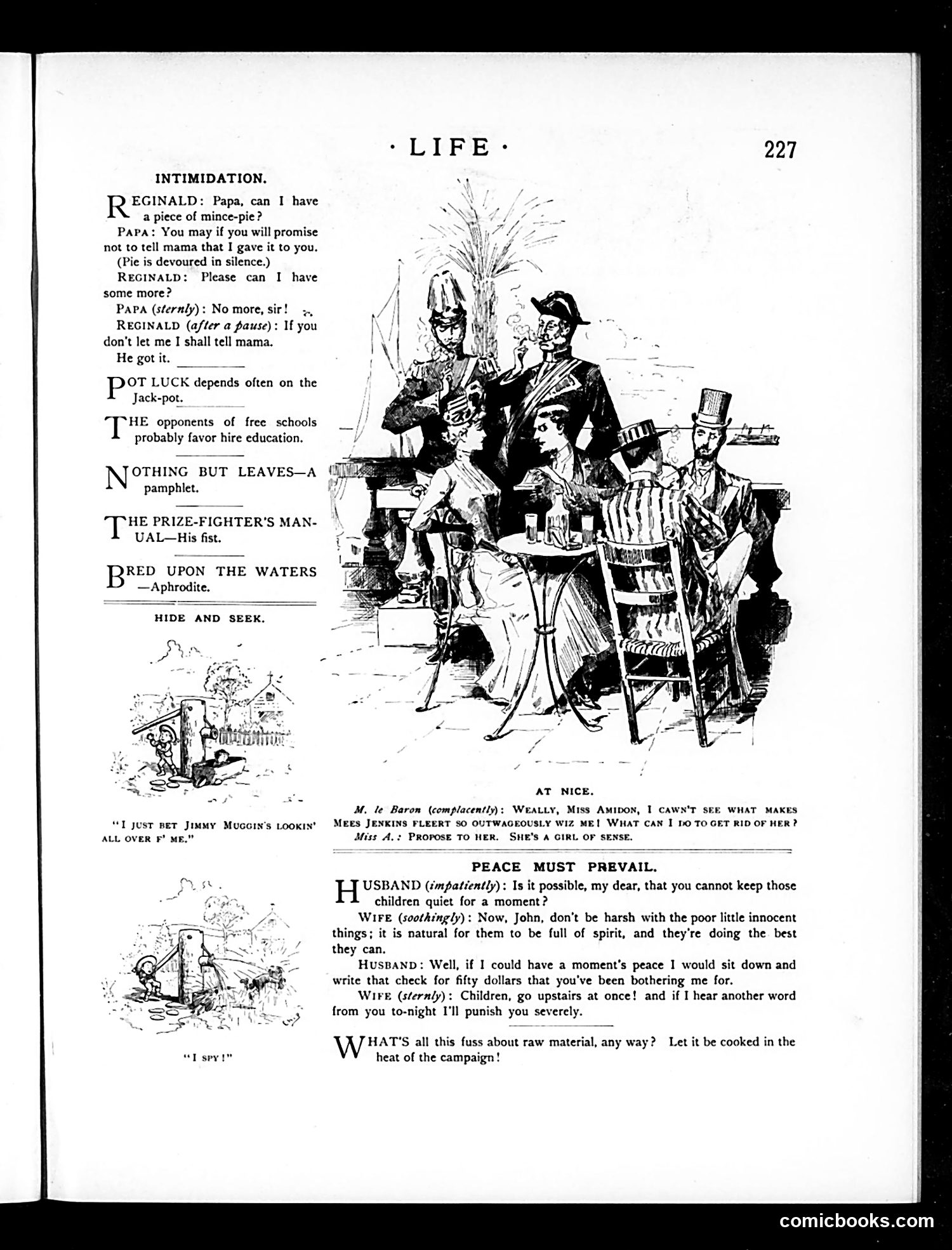
This page contains several satirical sketches and dialogue exchanges typical of early 20th-century American humor magazines. The main cartoon "At Nice" depicts a social scene with military officers and civilians. The caption references "Miss Jenkins" and suggests romantic/social comedy about a woman navigating attention from multiple suitors. "Hide and Seek" shows two small comic vignettes with children. The "Peace Must Prevail" dialogue humorously depicts a domestic argument between husband and wife over noisy children and unpaid bills—common domestic satire of the era. The final quip about "raw material" and "campaign" appears to reference cooking/housekeeping metaphors applied to wartime or political situations, though the specific context remains unclear without additional historical framing. The overall tone emphasizes domestic discord and social awkwardness as humor sources.
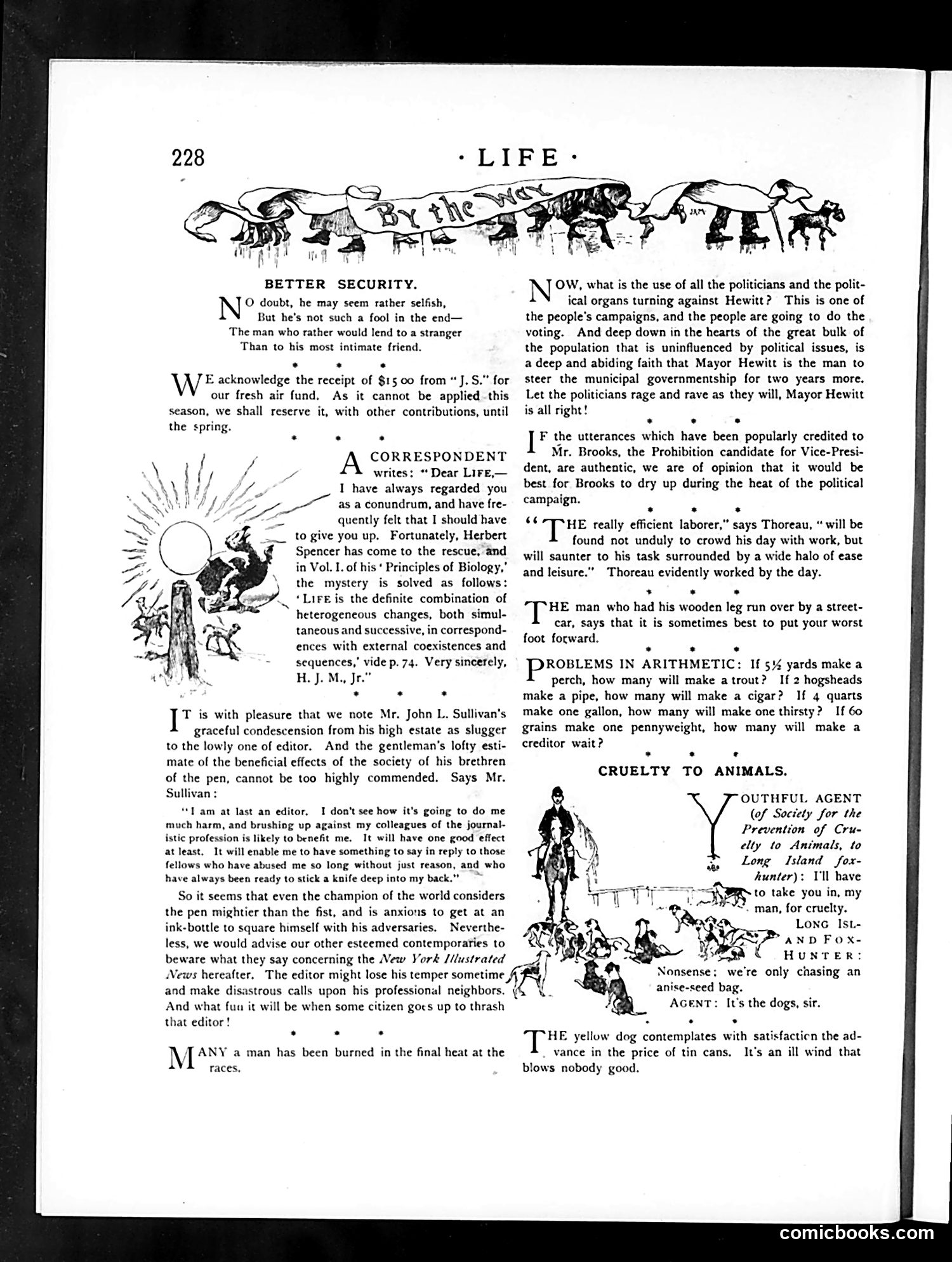
This page contains several distinct pieces of political satire and humor: **"Better Security"** argues that Mayor Hewitt should be re-elected because he's untainted by political influence—an unusual endorsement praising a politician's *detachment* from party politics rather than his activism. **"Cruelty to Animals"** is a humorous dialogue where a fox-hunter dismisses concerns about chasing an anise-seed bag (a mock hunt substitute) as "nonsense," then contradicts himself by claiming they're only chasing dogs. The joke satirizes hunters' defensive rationalizations. The remaining sections are miscellaneous satirical observations and reader correspondence typical of Life's format—witty commentary on contemporary absurdities rather than sustained political cartoons. The page's overall tone reflects Life's role as a satirical weekly mocking both politics and upper-class pretensions.
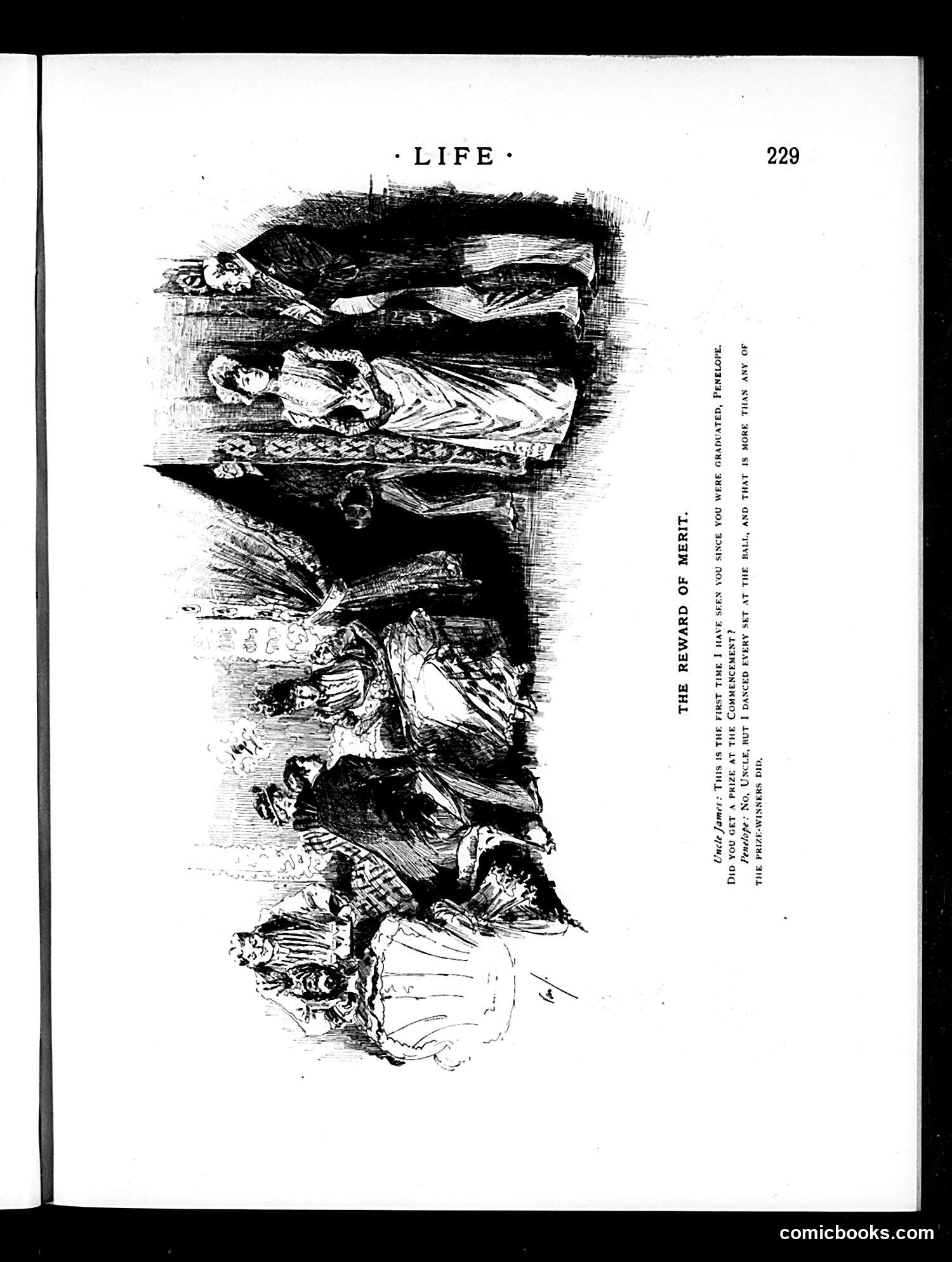
This page from *Life* magazine features a satirical cartoon titled "The Reward of Merit." The image, rendered as a vertical stack of figures, appears to depict a hierarchical scene showing multiple people in various poses and states of dress or undress. The caption beneath reads: "Karl-Ernst! There is the first time you have GRADUATED, PEOPLE, and I could swear as it the will, and state is more this performance too." Without clearer context about the specific date, publication, or historical figures depicted, I cannot definitively identify the individuals caricatured or the precise social/political situation being mocked. The title suggests commentary on merit-based advancement or rewards, possibly satirizing bureaucratic or social systems of advancement, but the specific target remains unclear from this image alone.
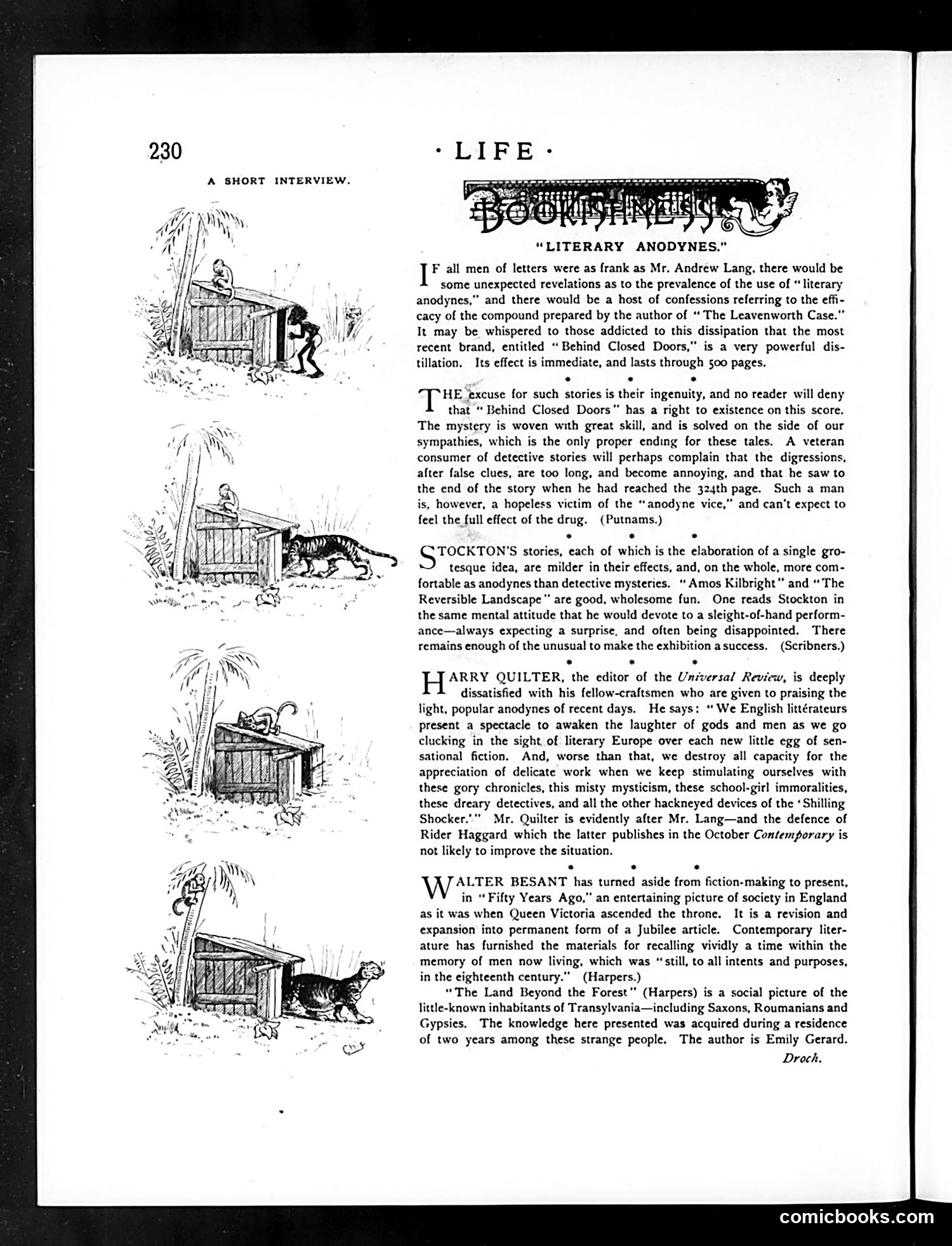
This is a literary criticism column reviewing contemporary fiction. The four cartoon panels on the left show a figure repeatedly seeking shelter in a small structure—likely satirizing readers turning to escapist literature for comfort during difficult times. The text critiques popular literary "anodynes" (painkillers/escape): detective stories, mystery novels, and romantic tales that provide temporary relief but no lasting substance. Andrew Lang's "Behind Closed Doors" is praised as genuinely skillful, while other works by Stockton and Quilter receive mixed reviews. The satire targets how readers consume shallow fiction seeking mental comfort—the cartoon's repetitive searching suggests this escape is temporary and cyclical. The column questions whether such entertainment improves readers' capacity for appreciating more serious, meaningful literature.
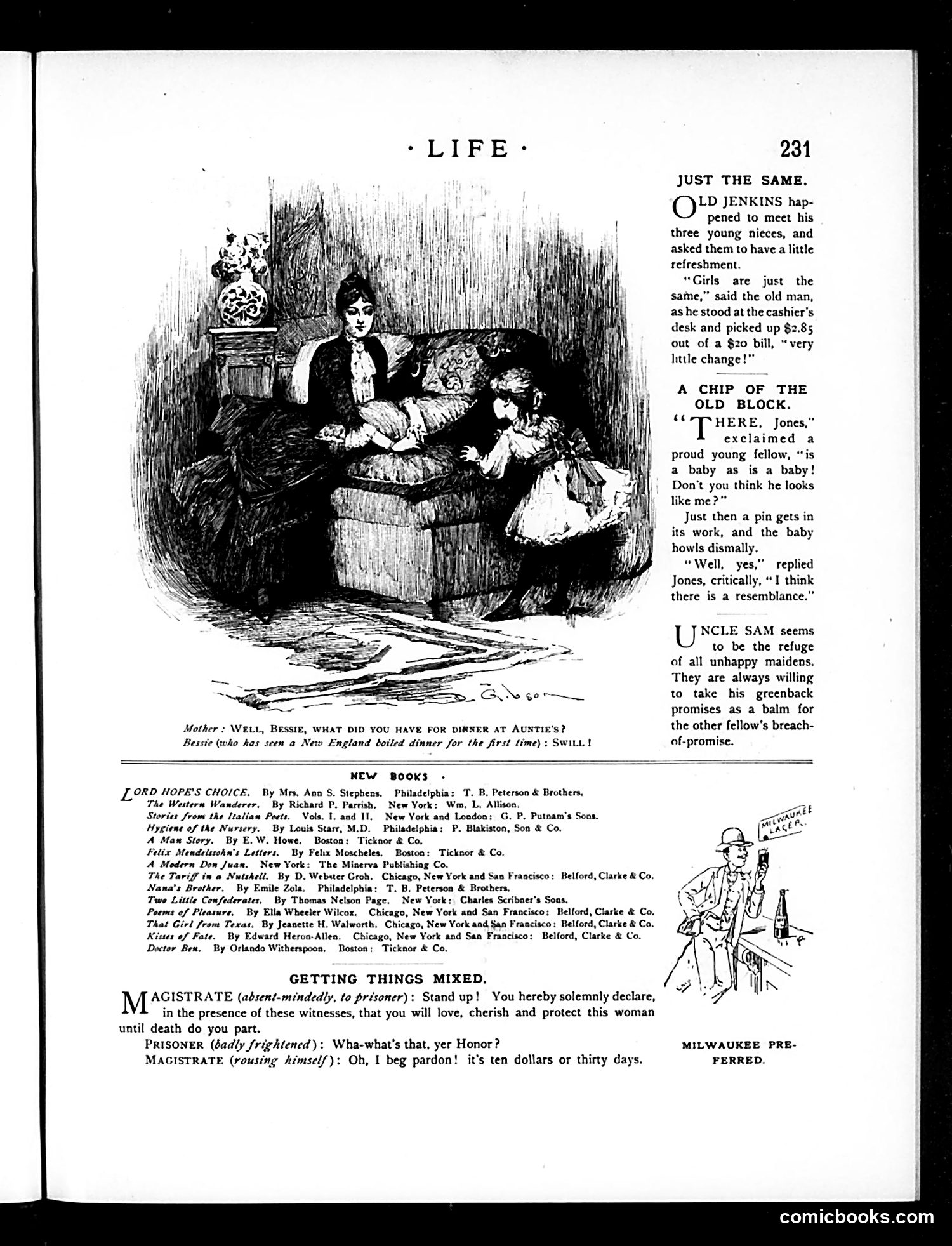
**Main Cartoon**: Shows an older woman at a cashier's desk with three young nieces, illustrating the joke "Just the Same." Old Jenkins remarks that "Girls are just the same" after receiving $2.85 change from a $20 bill—a commentary on women's supposed indifference to financial details or carelessness with money. The satire reflects early 20th-century gender stereotypes portraying women as frivolous spenders. **Lower Section**: Contains two brief humorous anecdotes—one about a proud father comparing his baby to another man, and another about "Uncle Sam" as a refuge for unhappy maidens seeking false romantic promises. The page exemplifies Life's satirical approach to contemporary social observations and gender relations of the era.
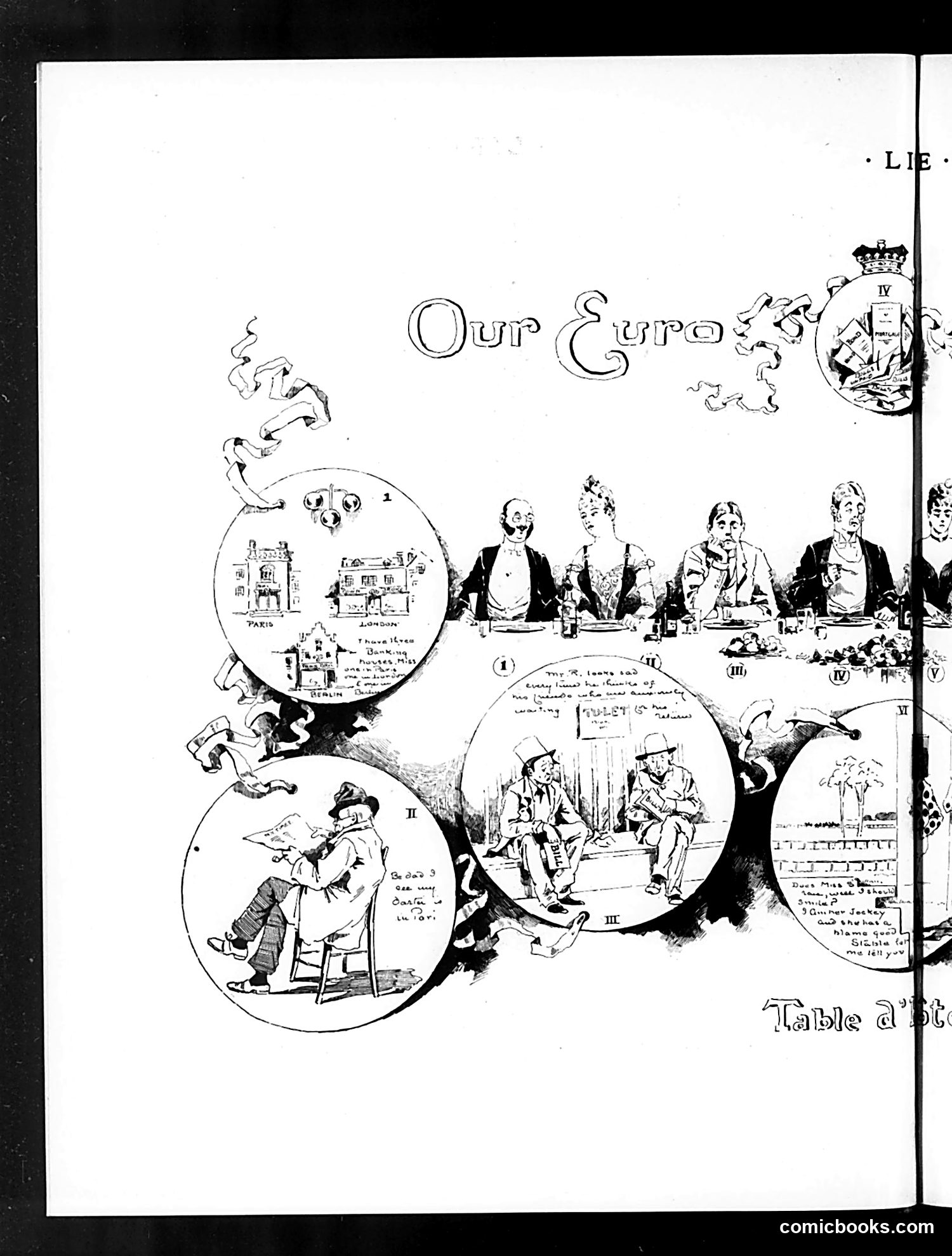
This Life magazine illustration satirizes European politics and society through interconnected vignettes labeled with Roman numerals. The central concept, "Our Europe," appears to critique the continent's political and social landscape, likely from the early 20th century. The composition shows: - A large globe featuring Paris and London, suggesting Anglo-French prominence - Multiple circular scenes depicting various European scenarios (labeled I-VI) - Figures at a dining table above, possibly representing European leaders or diplomats - Various caricatured characters in different situations below The satire appears to mock European pretensions, political intrigue, and social hierarchies, though specific figures and events remain unclear without additional historical context. The overall tone suggests skepticism about European stability and unity.
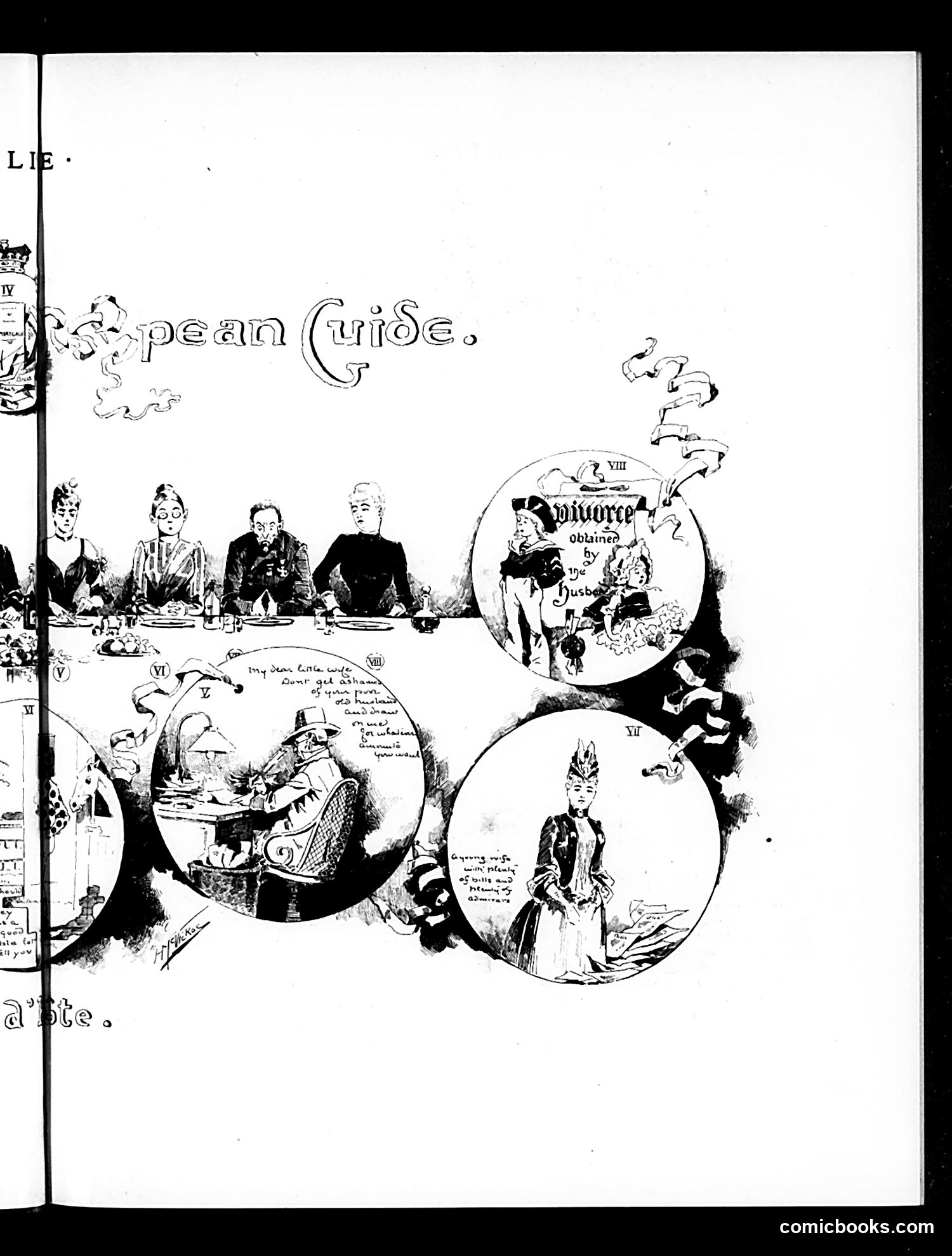
This satirical illustration depicts four stern-faced judges or authority figures seated at a dining table, observing three circular vignettes below. Each circle contains scenes related to marriage, divorce, and domestic relations—topics apparently under judicial scrutiny. The central circle explicitly references "Divorce obtained by the Husband," while another shows what appears to be marital or courtship scenes. The cartoon satirizes how legal authorities (the judges above) oversee and judge intimate personal matters. The title "Ocean Guide" and references to "abuse" suggest this commentary concerns how legal systems navigate—or fail to navigate—the murky waters of marriage and divorce law. The visual hierarchy emphasizes institutional control over private life during an era when divorce was socially controversial and legally complex.
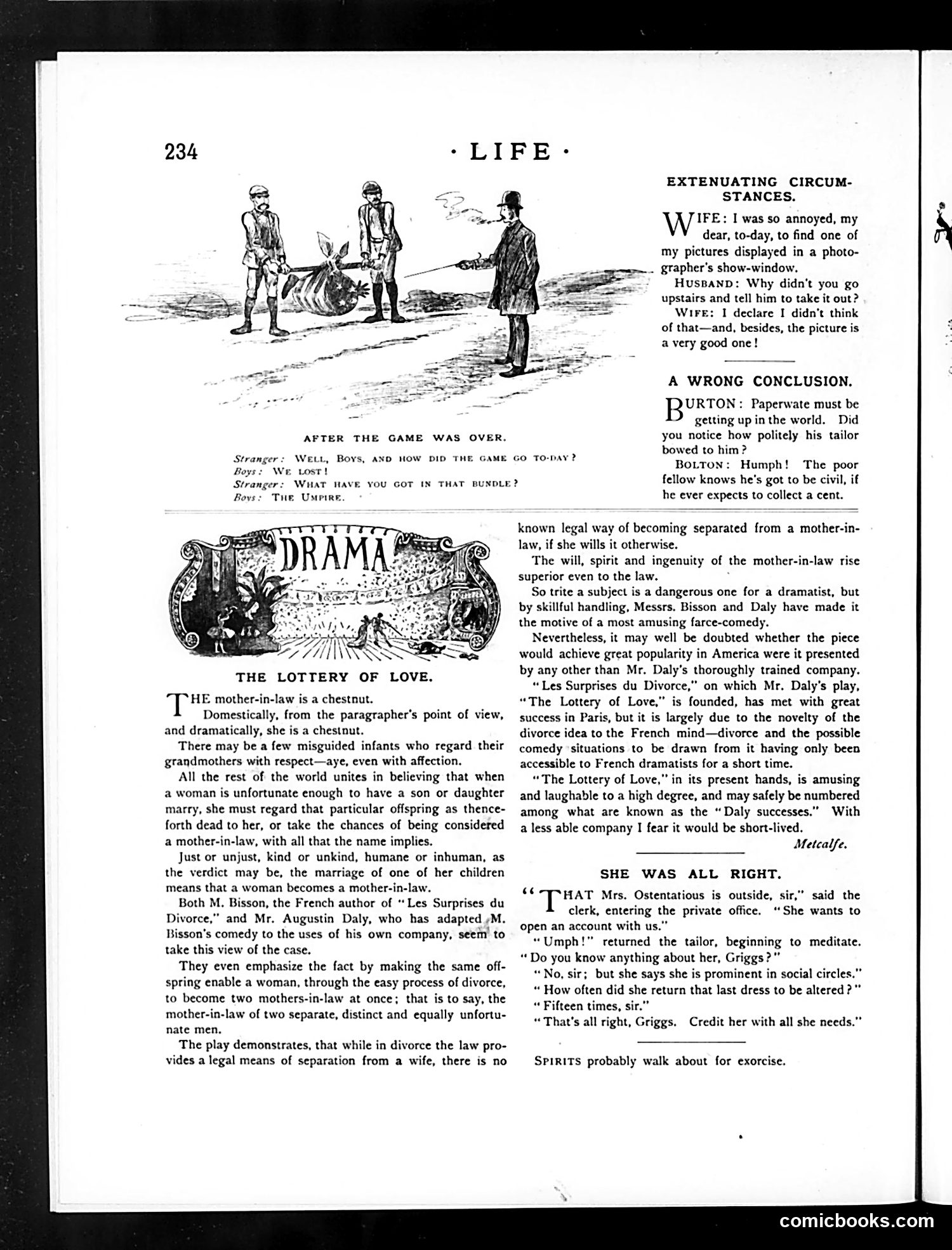
The top cartoon shows a hunting scene titled "After the Game Was Over." A stranger asks hunters what they caught; they reply "the umpire"—a joke about sports disputes where spectators blame officiating for losses. Below is a "Drama" section discussing "The Lottery of Love," a French play about divorce and mothers-in-law. The text argues that French audiences find humor in divorce situations and family entanglements that would resonate with American audiences if properly performed. The remaining sections contain brief social commentary: "Extenuating Circumstances" (a wife defends displaying an unflattering photograph), "A Wrong Conclusion" (misinterpreting a tailor's politeness as social climbing), and "She Was All Right" (a clerk's assumptions about a woman's social prominence are corrected). These are lighthearted observations on everyday social misunderstandings.
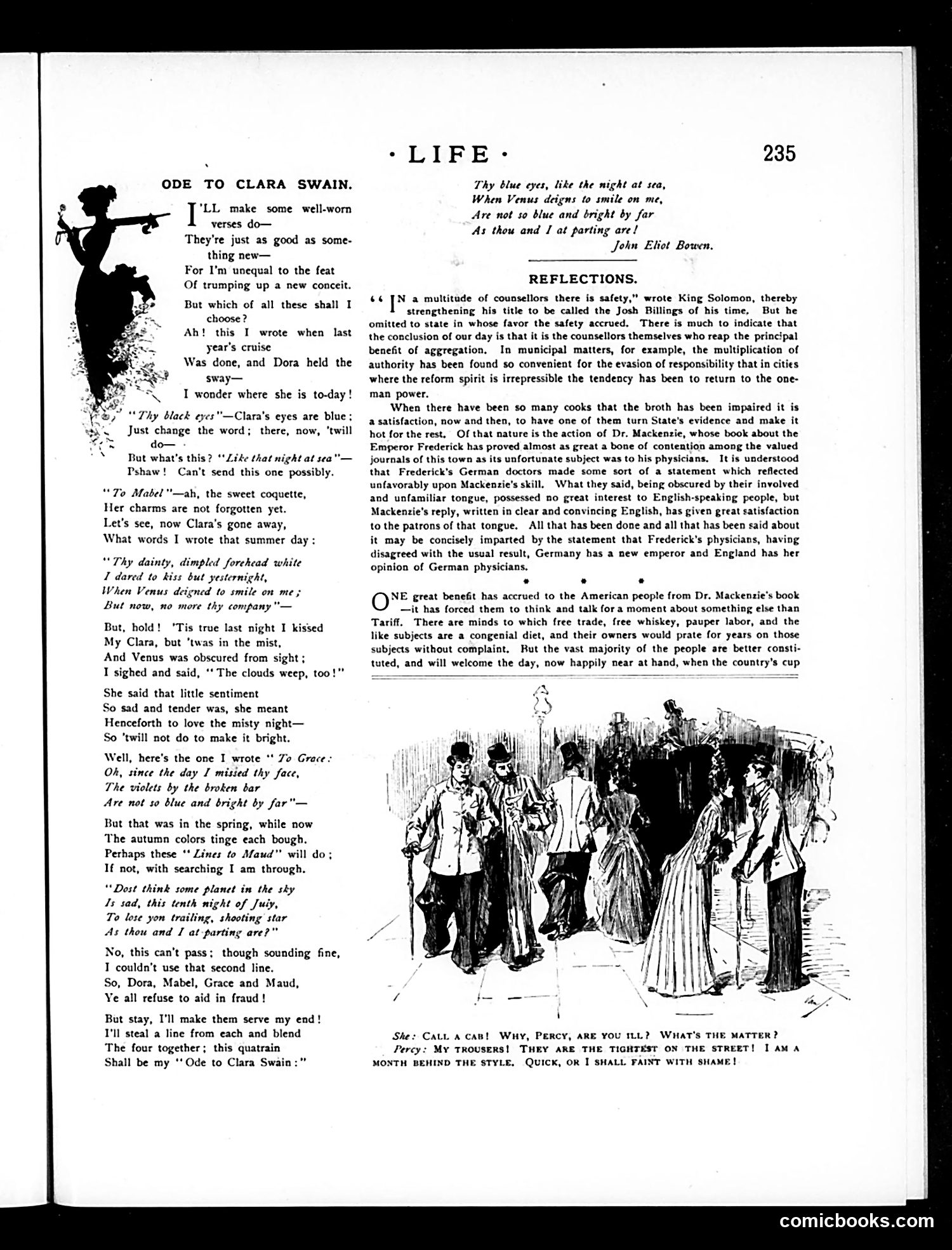
This page satirizes romantic poetry and male fickleness. The main poem (left) shows a suitor recycling love verses written to previous girlfriends—Dora, Grace, and Mabel—simply rewriting lines to fit Clara Swain. The joke: he's too lazy to compose original poetry, so he "steals a line from each and blend[s]" old romantic clichés together into one fraudulent "ode." The illustration (bottom right) depicts fashionable young people, likely showing the social context of casual romance and courtship where such insincere gestures occurred. The "Reflections" essay discusses Dr. Mackenzie's book about Emperor Frederick, positioning it as a case where clarity (English vs. German obscurity) wins public favor—unrelated to the poem's humor but part of the magazine's typical mixed content. The satire targets male laziness in romance and the disposability of romantic declarations.
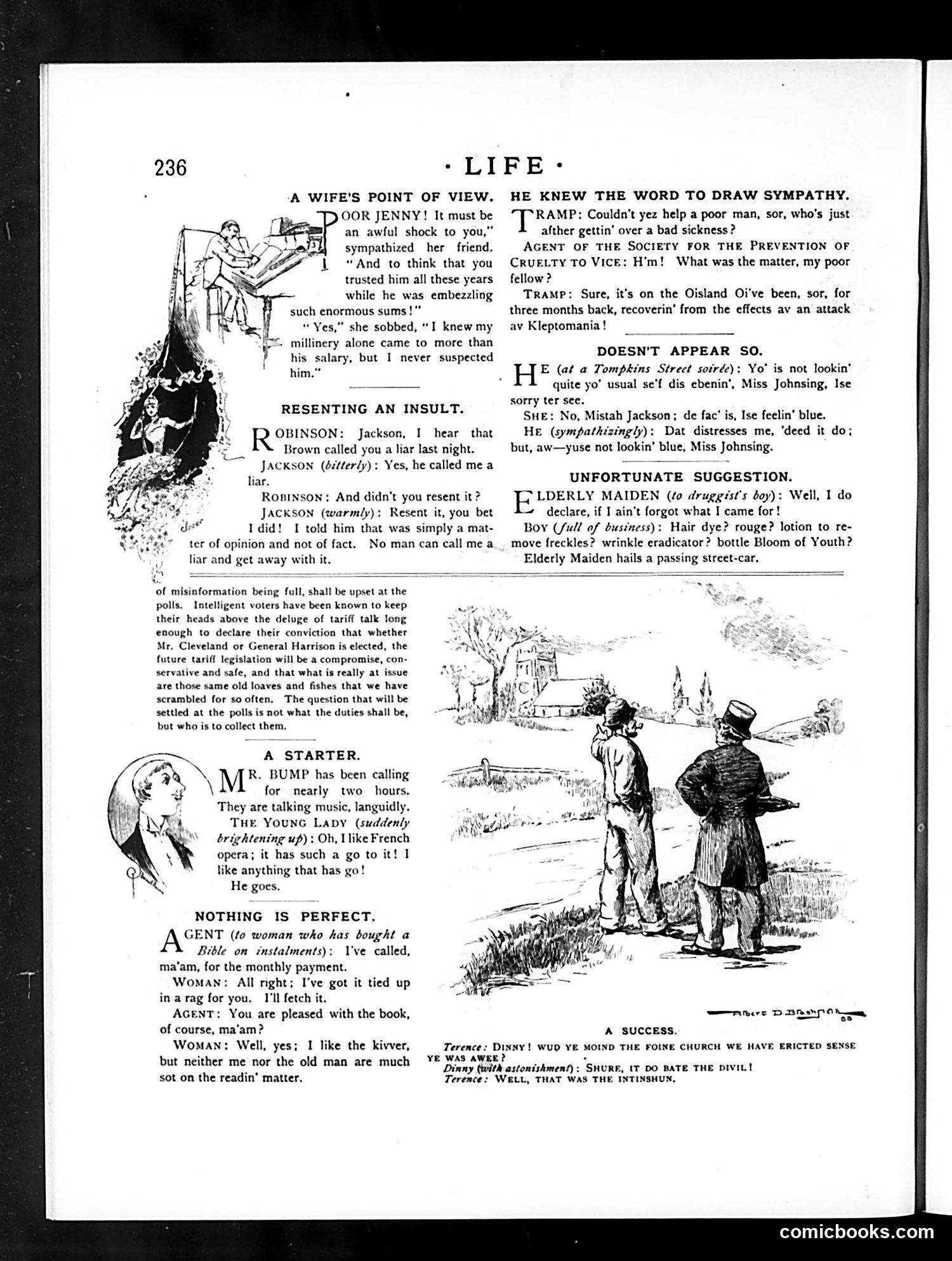
This page contains six separate humorous sketches mocking various social pretenses and character flaws: **"A Wife's Point of View"**: A woman discovers her husband embezzled vast sums, yet she's unsurprised—her millinery bills alone exceeded his salary. The joke satirizes both marital financial blindness and women's extravagant spending habits. **"Resenting an Insult"**: Jackson claims he resented being called a liar, but his "resentment" amounts to philosophically accepting it as mere opinion. The satire mocks self-deception and weak masculine honor. **Other sketches** mock: a beggar claiming "kleptomania" as illness to gain sympathy; a Black couple's awkward conversation using period dialect; a druggist's boy tactlessly suggesting wrinkle cream to an elderly woman; a bored suitor departing after a young woman's only enthusiastic comment; and an Irish couple's pride in building a church. The consistent satirical target is human pretense, self-deception, and social hypocrisy across class and racial lines. The humor relies heavily on dialect stereotypes, particularly regarding Irish and African American characters.
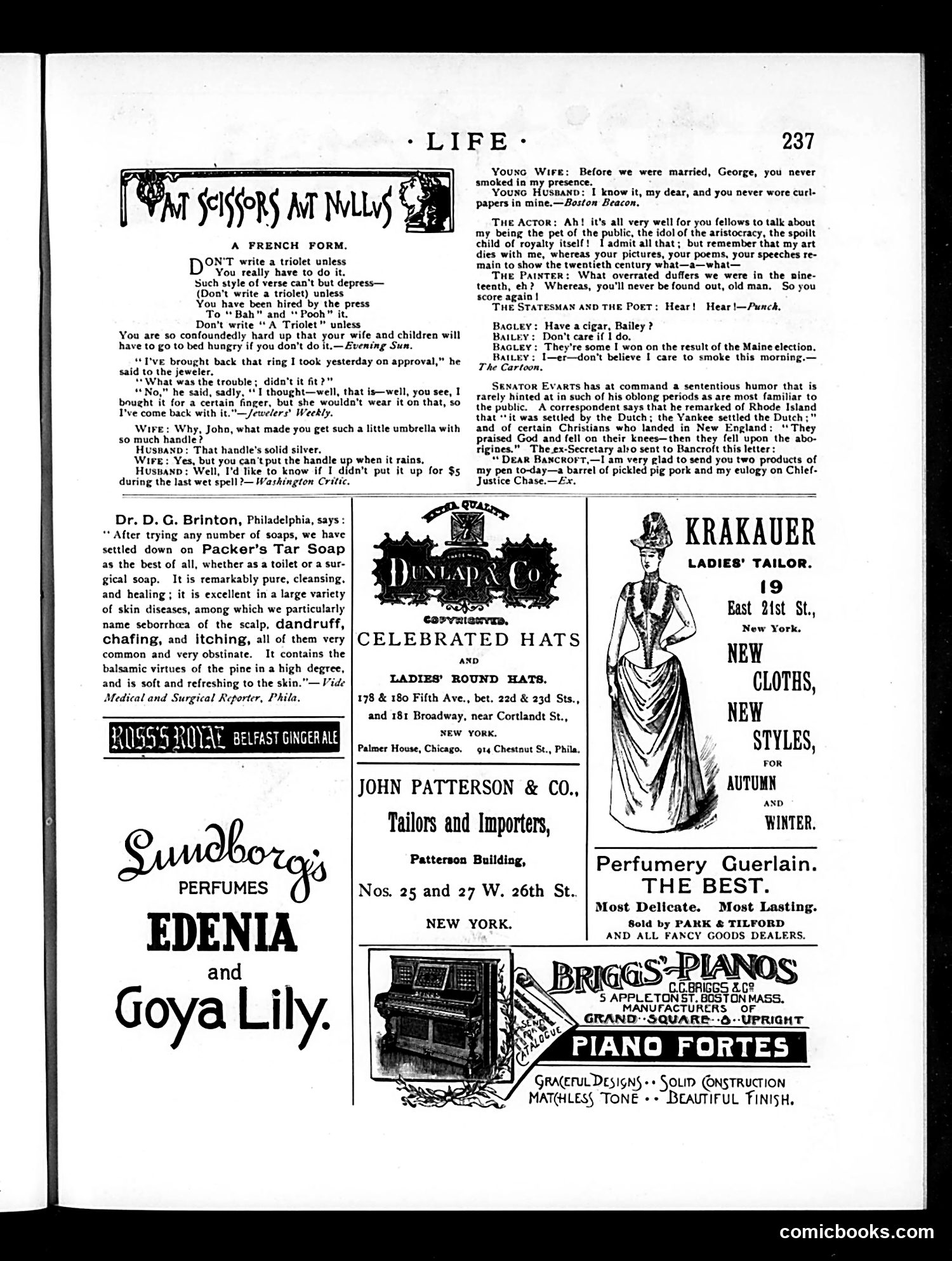
This page mixes humorous short pieces with advertisements. The cartoons satirize social hypocrisy and pretension: **"Young Wife/Husband"**: A joke about marital compromises—she complains he smoked before marriage; he notes she wore curlers. Both made false presentations. **"The Actor, Painter, and Sculptor"**: The actor boasts of public adoration but admits his art dies with him, while visual artists' work survives. The painter mockingly notes the actor will never be "found out" as overrated—a dig at theatrical vanity versus permanent artistic records. **"Bagley's Cigars"**: A political joke. Bagley won cigars betting on Maine's election result, now reluctant to smoke them—possibly implying uncertainty or regret about that election outcome. **Senator Evarts anecdote**: Showcases his dry wit comparing Dutch settlers and later Yankee/Christian colonizers in New England, sardonically noting they "praised God and fell on their knees—then they fell upon the aborigines" (Native Americans). The remaining content is primarily **period advertisements** for hats, tailoring, perfume, and pianos.
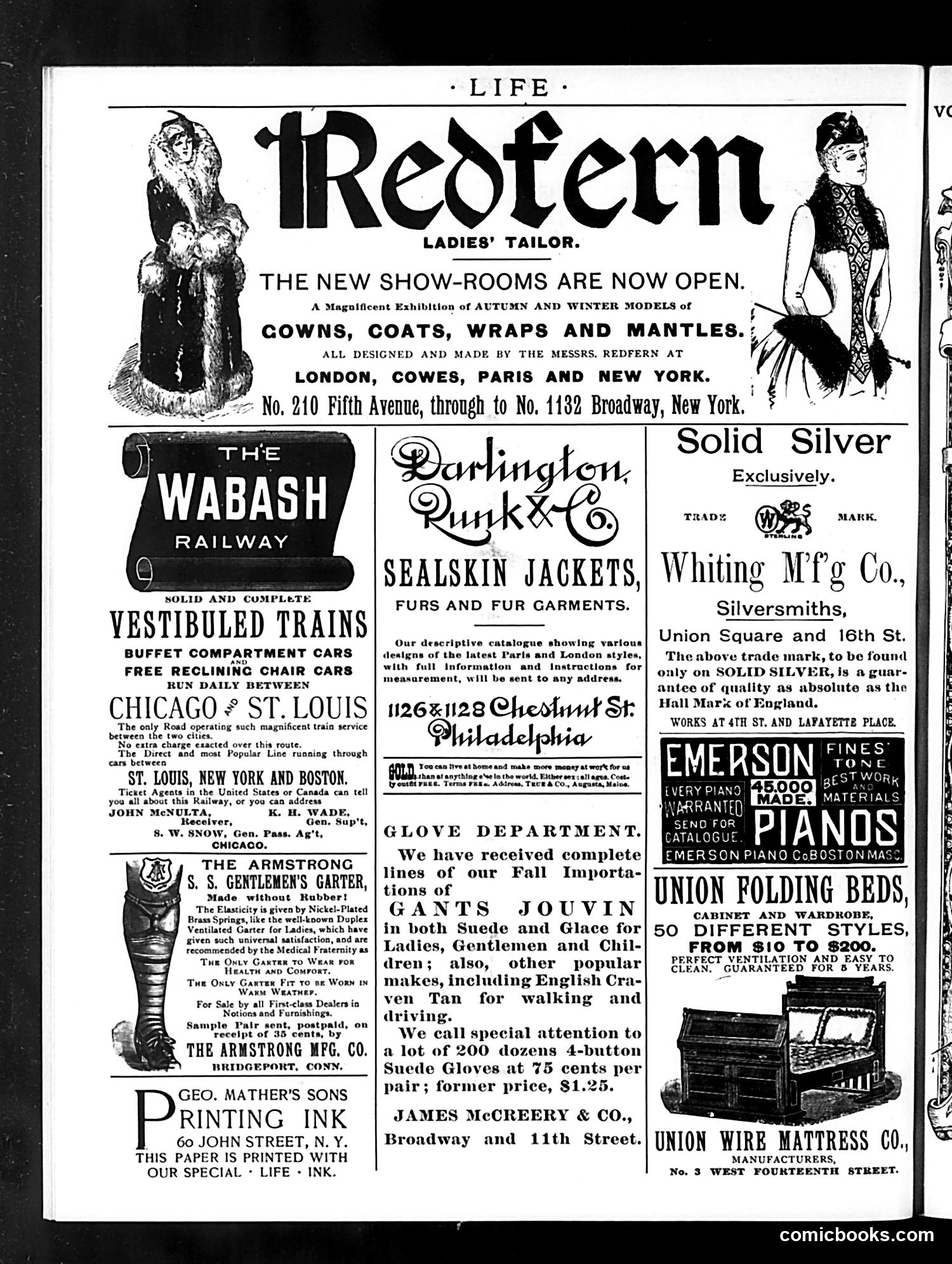
This is primarily an **advertising page** with no political cartoons or satirical content. It consists entirely of commercial advertisements typical of a late 19th-century American magazine. The ads showcase luxury goods aimed at affluent readers: high-end ladies' fashion (Redfern tailoring from Paris and London), sealskin furs, fine gloves (Gants Jouvin), solid silver tableware (Whiting Manufacturing), and pianos. There are also ads for transportation (Wabash Railway), men's garters, and furniture. The page reflects the **commercial aspirations and consumer culture** of the Gilded Age—advertisements emphasize European sophistication, quality materials, and exclusivity. The sheer volume and prominence of ads underscore that Life magazine, despite its satirical reputation, relied heavily on wealthy advertisers. No satirical commentary or political references are present on this particular page.