
Life, 1888-10-25 · page 2 of 14
Life — October 25, 1888 — page 2: what you’re looking at
What you’re looking at
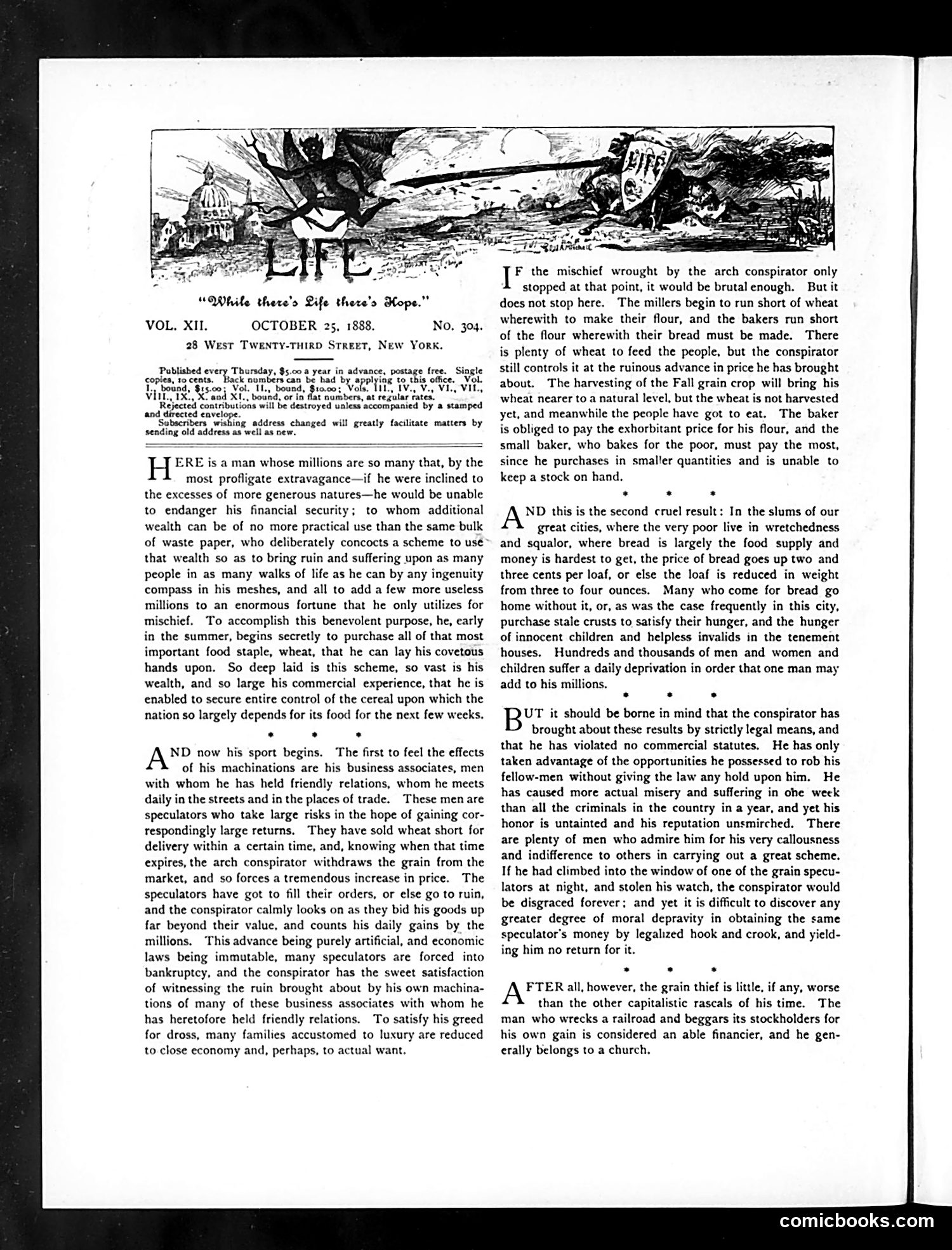
**The Cartoon:** The masthead illustration shows a grim reaper-like figure wielding a scythe above a barren landscape, with a banner reading "LIFE" — a darkly ironic juxtaposition of the magazine's name with death imagery. **The Article's Subject:** The text attacks a wealthy grain speculator who deliberately corners the wheat market to drive up bread prices. The conspirator uses legal means but causes severe suffering—particularly among poor urban families who cannot afford inflated bread costs. **The Satire:** The piece denounces how this "arch conspirator" exploits food necessity for profit, reducing families to hunger while enriching himself. The author argues this economic predation is morally worse than actual theft, since it's "legal" yet causes mass suffering. It's a critique of Gilded Age monopolistic capitalism.
📄 Transcribed text from this page (OCR, searchable)
Machine-transcribed from the original scan — historical spelling and the odd misread are preserved.
“While there's Life there's Hope.” VOL. XII. OCTOBER 25, 1888. No. 304. 28 West TwenTy-THIRD Street, New York. Published eve: Thursday, $5.00 a year in advance, postage free. Single copies, 10 cents. ck numbers can be had by applying to this office. Vol. 1., bound, $15.00; Vol. Il., bound, $10.00; Vols. HIl., IV., V., Vi, VIL, VIII, 1X1, Xoand XI., bound, or in flat numbers, at regular rates. Rejected contributions will be destroyed unless accompanied by a stamped and directed envelope Subscribers wishing address changed will greatly facilitate matters by sending old address as well as new. ERE is a man whose millions are so many that, by the most profligate extravagance—if he were inclined to the excesses of more generous natures—he would be unable to endanger his financial security; to whom additional wealth can be of no more practical use than the same bulk of waste paper, who deliberately concocts a scheme to us¢ that wealth so as to bring ruin and suffering upon as many people in as many walks of life as he can by any ingenuity compass in his meshes, and all to add a few more useless millions to an enormous fortune that he only utilizes for mischief, To accomplish this benevolent purpose, he, early in the summer, begins secretly to purchase all of that most important food staple, wheat, that he can lay his covetous hands upon. So deep laid is this scheme, so vast is his wealth, and so large his commercial experience, that he is enabled to secure entire control of the cereal upon which the nation so largely depends for its food for the next few weeks. . . . ND now his sport begins. The first to feel the effects of his machinations are his business associates, men with whom he has held friendly relations, whom he meets daily in the streets and in the places of trade. These men are speculators who take large risks in the hope of gaining cor- respondingly large returns. They have sold wheat short for delivery within a certain time, and, knowing when that time expires, the arch conspirator withdraws the grain from the market, and so forces a tremendous increase in price. The speculators have got to fill their orders, or else go to ruin, and the conspirator calmly looks on as they bid his goods up far beyond their value, and counts his daily gains by the millions. ‘This advance being purely artificial, and economic laws being immutable, many speculators are forced into bankruptcy, and the conspirator has the sweet satisfaction of witnessing the ruin brought about by his own machina- tions of many of these business associates with whom he has heretofore held friendly relations. To satisfy his greed for dross, many families accustomed to luxury are reduced to close economy and, perhaps, to actual want. F the mischief wrought by the arch conspirator only stopped at that point, it would be brutal enough. But it does not stop here. The millers begin to run short of wheat wherewith to make their flour, and the bakers run short of the flour wherewith their bread must be made. There is plenty of wheat to feed the people, but the conspirator still controls it at the ruinous advance in price he has brought about. The harvesting of the Fall grain crop will bring his wheat nearer to a natural level, but the wheat is not harvested yet, and meanwhile the people have got to eat. The baker is obliged to pay the exhorbitant price for his flour, and the small baker, who bakes for the poor, must pay the most, since he purchases in smaller quantities and is unable to keep a stock on hand. . . . ND this is the second cruel result: In the slums of our great cities, where the very poor live in wretchedness and squalor, where bread is largely the food supply and money is hardest to get, the price of bread goes up two and three cents per loaf, or else the loaf is reduced in weight from three to four ounces. Many who come for bread go home without it, or, as was the case frequently in this city, purchase stale crusts to satisfy their hunger, and the hunger of innocent children and helpless invalids in the tenement houses. Hundreds and thousands of men and women and children suffer a daily deprivation in order that one man may add to his millions. . . UT it should be borne in mind that the conspirator has brought about these results by strictly legal means, and that he has violated no commercial statutes. He has only taken advantage of the opportunities he possessed to rob his fellow-men without giving the law any hold upon him. He has caused more actual misery and suffering in ohe week than all the criminals in the country in a year, and yet his honor is untainted and his reputation unsmirched. There are plenty of men who admire him for his very callousness and indifference to others in carrying out a great scheme. If he had climbed into the window of one of the grain specu- lators at night, and stolen his watch, the conspirator would be disgraced forever; and yet it is difficult to discover any greater degree of moral depravity in obtaining the same speculator’s money by legalized hook and crook, and yield- ing him no return for it. . . . FTER all, however, the grain thief is little, if any, worse than the other capitalistic rascals of his time. The man who wrecks a railroad and beggars its stockholders for his own gain is considered an able financier, and he gen- erally belongs to a church, comicbooks.com