
Life, 1888-10-25 · page 11 of 14
Life — October 25, 1888 — page 11: what you’re looking at
What you’re looking at
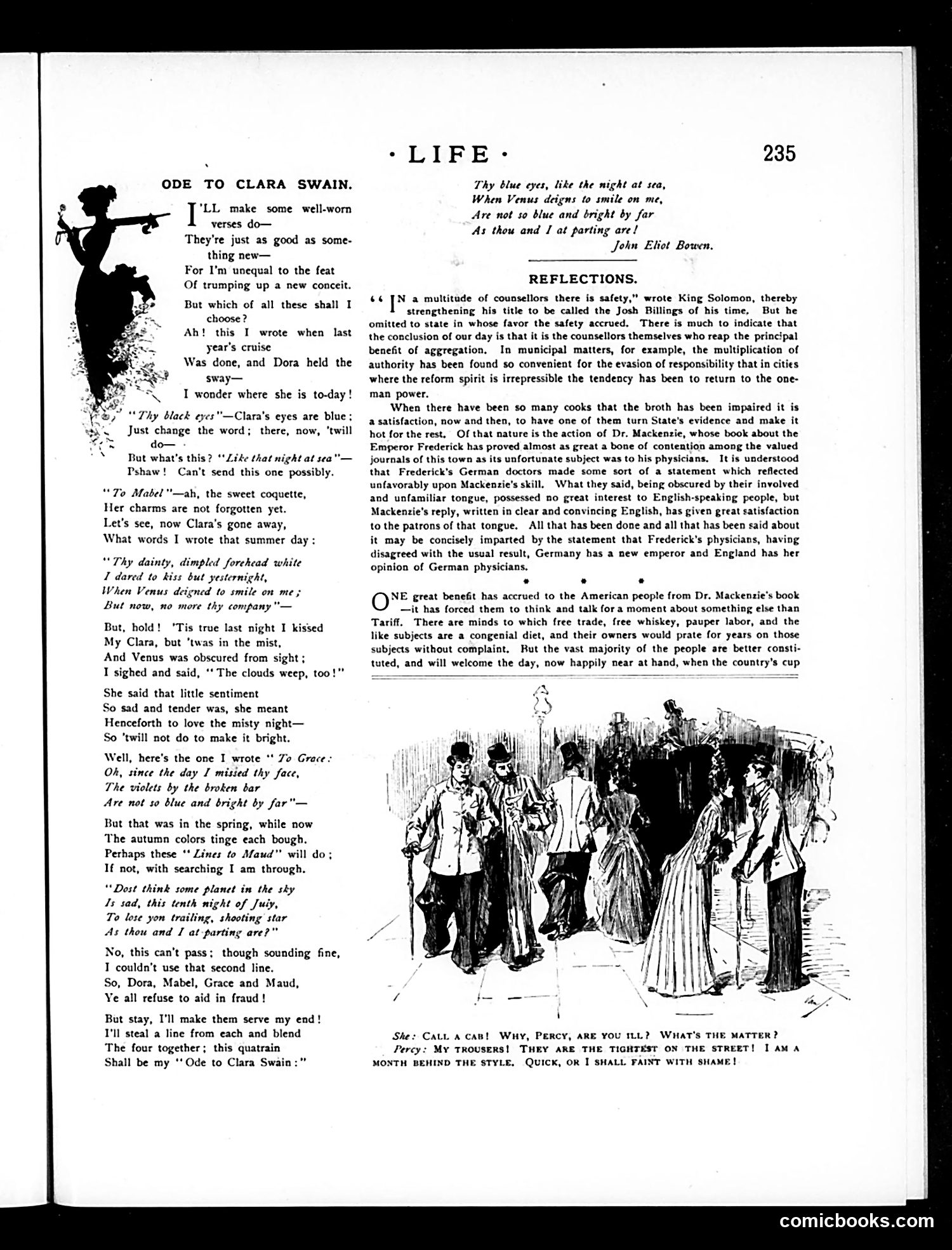
This page satirizes romantic poetry and male fickleness. The main poem (left) shows a suitor recycling love verses written to previous girlfriends—Dora, Grace, and Mabel—simply rewriting lines to fit Clara Swain. The joke: he's too lazy to compose original poetry, so he "steals a line from each and blend[s]" old romantic clichés together into one fraudulent "ode." The illustration (bottom right) depicts fashionable young people, likely showing the social context of casual romance and courtship where such insincere gestures occurred. The "Reflections" essay discusses Dr. Mackenzie's book about Emperor Frederick, positioning it as a case where clarity (English vs. German obscurity) wins public favor—unrelated to the poem's humor but part of the magazine's typical mixed content. The satire targets male laziness in romance and the disposability of romantic declarations.
📄 Transcribed text from this page (OCR, searchable)
Machine-transcribed from the original scan — historical spelling and the odd misread are preserved.
ODE TO CLARA SWAIN. "LL make some verses do— They're just as good as some- thing new— For I'm unequal to the feat Of trumping up a new conceit. But which of all these shall I choose ? this I wrote when last year's cruise Was done, and Dora held the sway— I wonder where she is to-day! well-worn Ah! ” “Thy black eyes" —Clara’s eyes are blue; Just change the word; there, now, ‘twill do— - But what's this? ‘Like that night at sea" — Pshaw! Can't send this one possibly. “To Mabel"—ah, the sweet coquette, Her charms are not forgotten yet. Let's see, now Clara's gone away, What words I wrote that summer day : “Thy dainty, dimpled forehead white I dared to kiss but yesternight, When Venus deigned to smile on me ; But now, no more thy company "— But, hold! ‘Tis true last night I kissed My Clara, but ‘twas in the mist, And Venus was obscured from sight ; I sighed and said, ‘* The clouds weep, too!” She said that little sentiment So sad and tender was, she meant Henceforth to love the misty night— So ‘twill not do to make it bright. Well, here's the one I wrote ‘ Zo Grace: Ok, since the day I misied thy face, The violets by the broken bar Are not s0 blue and bright by far" — But that was in the spring, while now The autumn colors tinge each bough. Perhaps these '* Lines to Maud" will do; If not, with searching I am through. “Dost think some planet in the shy Is sad, this tenth night of Juiy, To lose yon trailing, shooting star As thou and I at-parting are?” No, this can't pass; though sounding fine, I couldn’t use that second line. So, Dora, Mabel, Grace and Maud, Ye all refuse to aid in fraud ! But stay, I'll make them serve my end! I'll steal a line from each and blend The four together; this quatrain Shall be my ‘' Ode to Clara Swain:"” LIFE: Thy blue eyes, like the night at sea, When Venus deigns to smile on me, Are not so blue and bright by far As thou and J at parting are! John Eliot Bowen, REFLECTIONS. 6c Ix a multitude of counsellors there is safety,” wrote King Solomon, thereby strengthening his title to be called the Josh Billings of his time, But he omitted to state in whose favor the safety accrued. There is much to indicate that the conclusion of our day is that it is the counsellors themselves who reap the principal benefit of aggregation. In municipal matters, for example, the multiplication of authority has been found so convenient for the evasion of responsibility that in cities where the reform spirit is irrepressible the tendency has been to return to the one- man power. When there have been so many cooks that the broth has been impaired it is a satisfaction, now and then, to have one of them turn State's evidence and make it hot for the rest, Of that nature is the action of Dr. Mackenzie, whose book about the Emperor Frederick has proved almost as great a bone of contention among the valued journals of this town as its unfortunate subject was to his physicians, It is understood that Frederick's German doctors made some sort of a statement which reflected unfavorably upon Mackenzie's skill, What they said, being obscured by their involved and unfamiliar tongue, possessed no great interest to English-speaking people, but Mackenzie's reply, written in clear and convincing English, has given great satisfaction to the patrons of that tongue. All that has been done and all that has been said about it may be concisely imparted by the statement that Frederick's physicians, having disagreed with the usual result, Germany has a new emperor and England has her opinion of German physicians. . . . NE great benefit has accrued to the American people from Dr. Mackenzie's book —it has forced them to think and talk fora moment about something else than Tariff. There are minds to which free trade, free whiskey, pauper labor, and the like subjects are a congenial diet, and their owners would prate for years on those subjects without complaint. But the vast majority of the people are better consti- tuted, and will welcome the day, now happily near at hand, when the country’s cup She: Cat can! Percy: MY TROUSERS! MONTH BEHIND THE STYLE, Why, Percy, ARE YOU ILL? WHAT'S THE MATTER? THEY ARE THE TIGHTEST ON THE STREET! I AMA QUICK, OR T SHALL FAINT WITH SHAME! comicbooks.com