
Life, 1888-10-25 · page 6 of 14
Life — October 25, 1888 — page 6: what you’re looking at
What you’re looking at
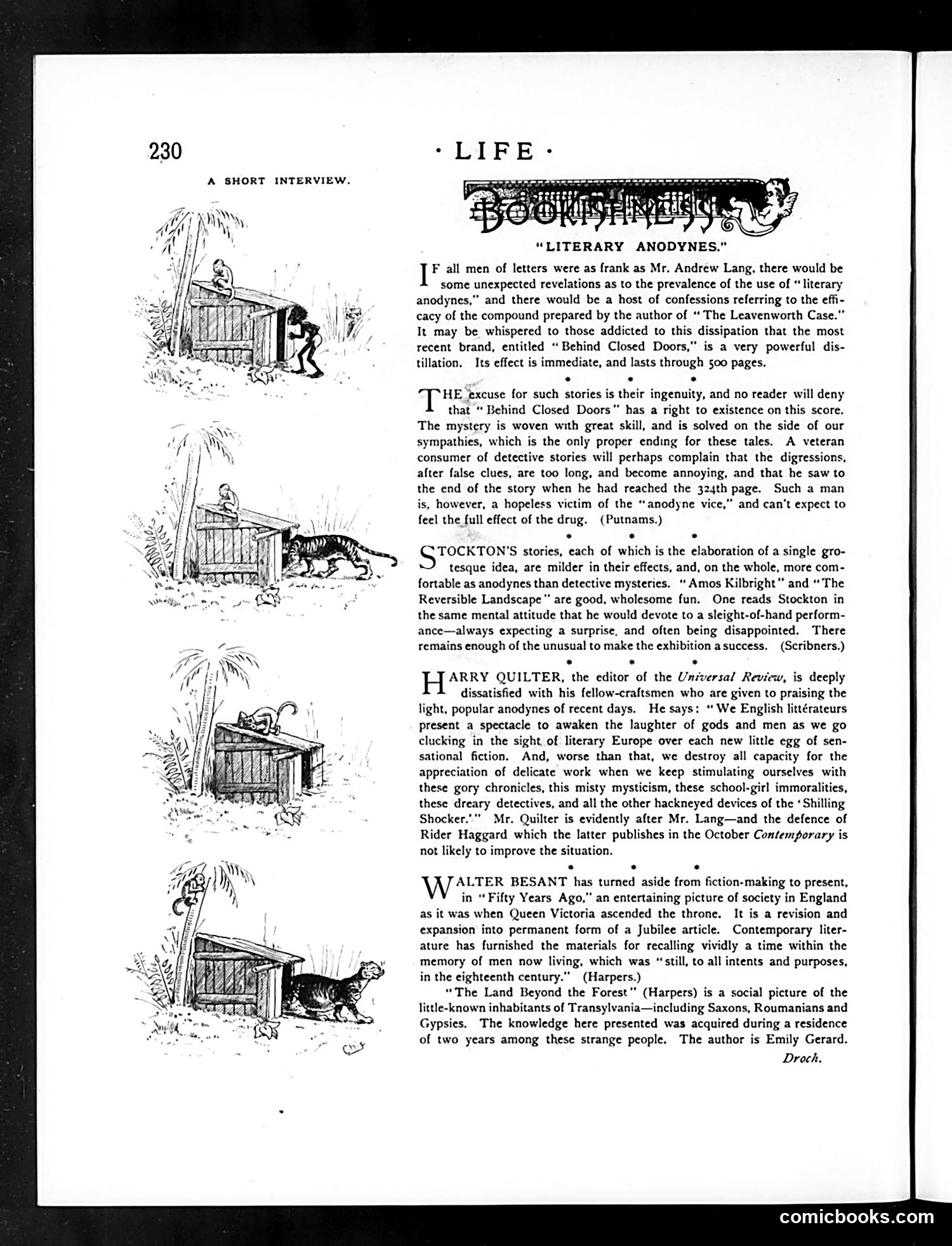
This is a literary criticism column reviewing contemporary fiction. The four cartoon panels on the left show a figure repeatedly seeking shelter in a small structure—likely satirizing readers turning to escapist literature for comfort during difficult times. The text critiques popular literary "anodynes" (painkillers/escape): detective stories, mystery novels, and romantic tales that provide temporary relief but no lasting substance. Andrew Lang's "Behind Closed Doors" is praised as genuinely skillful, while other works by Stockton and Quilter receive mixed reviews. The satire targets how readers consume shallow fiction seeking mental comfort—the cartoon's repetitive searching suggests this escape is temporary and cyclical. The column questions whether such entertainment improves readers' capacity for appreciating more serious, meaningful literature.
📄 Transcribed text from this page (OCR, searchable)
Machine-transcribed from the original scan — historical spelling and the odd misread are preserved.
A SHORT INTERVIEW. “LITERARY ANODYNES.” F all men of letters were as frank as Mr. Andrew Lang, there would be some unexpected revelations as to the prevalence of the use of “literary anodynes,” and there would be a host of confessions referring to the effi- cacy of the compound prepared by the author of “ The Leavenworth Case.” It may be whispered to those addicted to this dissipation that the most recent brand, entitled ‘Behind Closed Doors,” is a very powerful dis- tillation. Its effect is immediate, and lasts through 500 pages. . . . HE excuse for such stories is their ingenuity, and no reader will deny that “ Behind Closed Doors” has a right to existence on this score. The mystery is woven with great skill, and is solved on the side of our sympathies, which is the only proper ending for these tales. A veteran consumer of detective stories will perhaps complain that the digressions, after false clues, are too long, and become annoying, and that he saw to the end of the story when he had reached the 324th page. Such a man is, however, a hopeless victim of the “anodyne vice,” and can’t expect to feel the full effect of the drug. (Putnams.) . . . ~TOCKTON'S stories, each of which is the elaboration of a single gro- tesque idea, are milder in their effects, and, on the whole, more com- fortable as anodynes than detective mysteries. “ Amos Kilbright” and “The Reversible Landscape" are good, wholesome fun. One reads Stockton in the same mental attitude that he would devote to a sleight-of-hand perform- ance—always expecting a surprise, and often being disappointed. There remains enough of the unusual to make the exhibition asuccess. (Scribners.) . . . ARRY QUILTER, the editor of the Universal Review, is deeply dissatisfied with his fellow-craftsmen who are given to praising the light, popular anodynes of recent days. He says: “ We English littérateurs present a spectacle to awaken the laughter of gods and men as we go clucking in the sight of literary Europe over each new little egg of sen- sational fiction. And, worse than that, we destroy all capacity for the appreciation of delicate work when we keep stimulating ourselves with these gory chronicles, this misty mysticism, these school-girl immoralities, these dreary detectives, and all the other hackneyed devices of the ‘Shilling Shocker.’” Mr. Quilter is evidently after Mr. Lang—and the defence of Rider Haggard which the latter publishes in the October Contemporary is not likely to improve the situation. . . . ALTER BESANT has turned aside from fiction-making to present, in “Fifty Years Ago,” an entertaining picture of society in England as it was when Queen Victoria ascended the throne. It is a revision and expansion into permanent form of a Jubilee article. Contemporary liter- ature has furnished the materials for recalling vividly a time within the memory of men now living, which was “‘still, to all intents and purposes, in the eighteenth century.” (Harpers.) “The Land Beyond the Forest" (Harpers) is a social picture of the little-known inhabitants of Transylvania—including Saxons, Roumanians and Gypsies. The knowledge here presented was acquired during a residence of two years among these strange people. The author is Emily Gerard. Droch. comicbooks.com