
A complete issue · 14 pages · 1888
Life — October 18, 1888
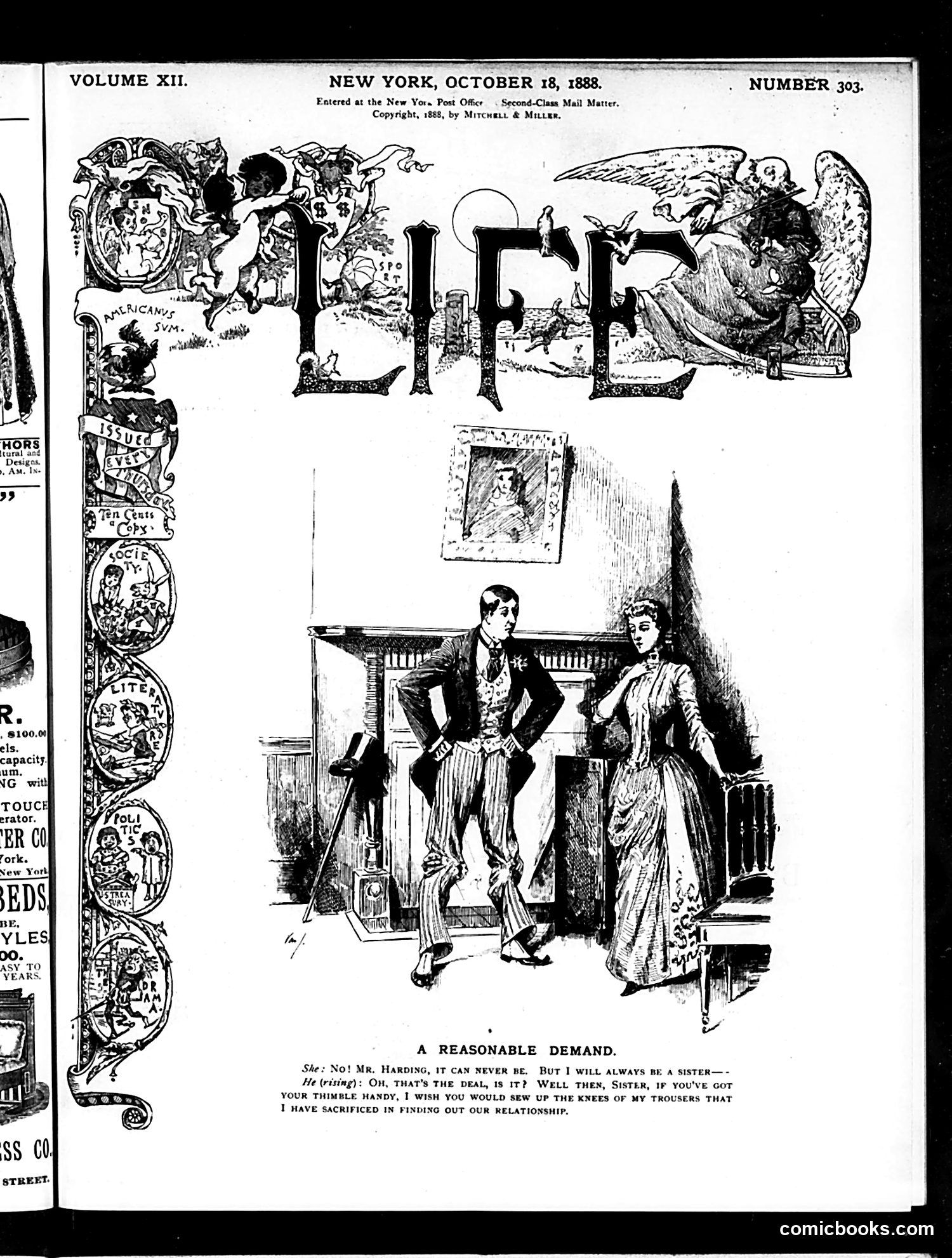
This 1888 *Life* magazine cartoon depicts a domestic dispute between a man and woman. The woman demands that her brother (Mr. Harding) sew up the knees of her trousers, which she claims were damaged while fishing during their relationship investigation. The humor relies on a social contradiction: she insists she'll "always be a sister" to maintain respectful propriety, yet simultaneously demands he perform intimate domestic labor (mending torn clothing). The joke satirizes Victorian-era relationship conventions—the woman wants the benefits of close family connection while imposing servant-like duties on the man. The title "A Reasonable Demand" is ironic, suggesting the request is actually quite unreasonable given the stated boundaries.
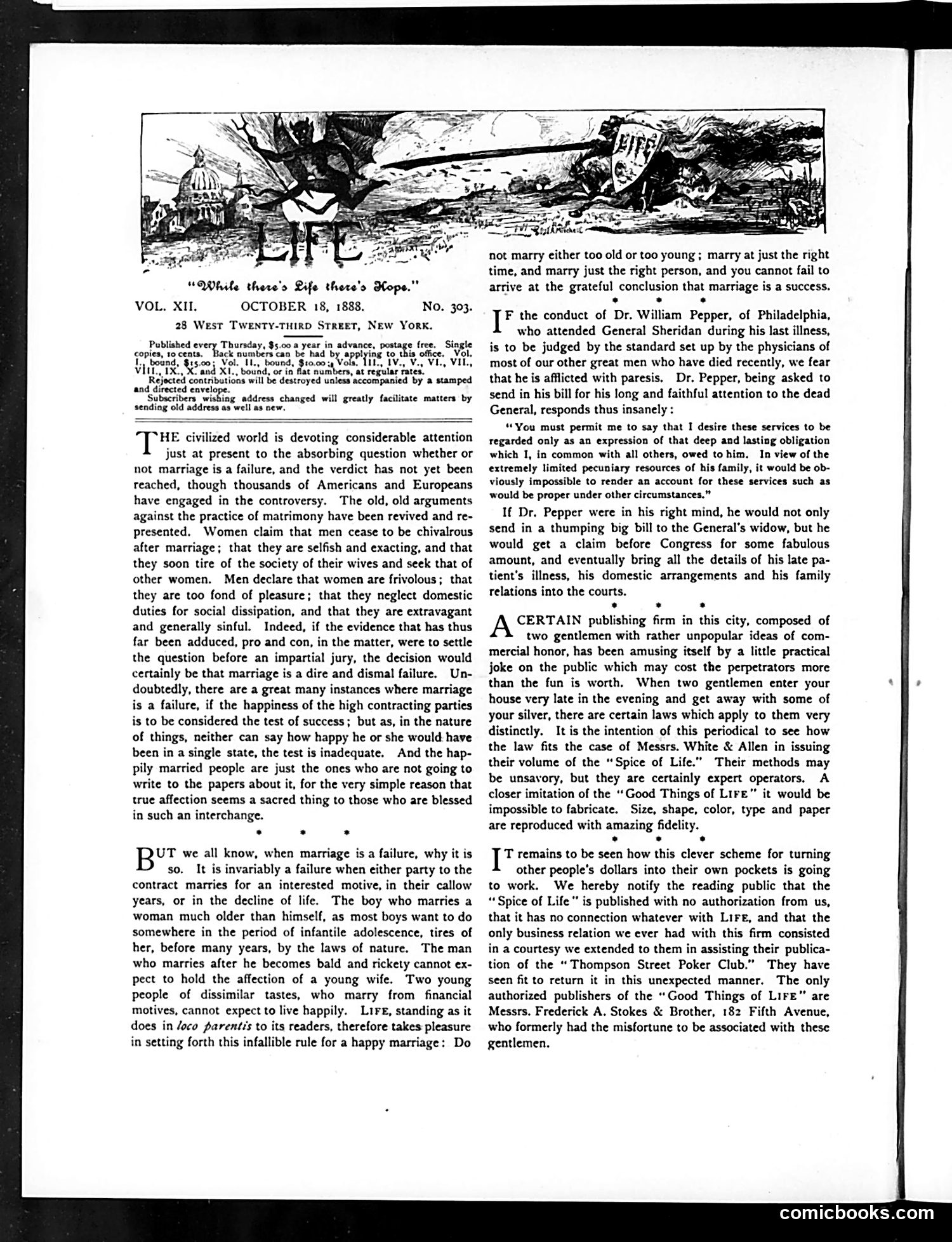
The masthead illustration labeled "While there's Life there's Hope" depicts a skeletal Death figure confronting Life personified as a woman—a standard Victorian memento mori image about mortality. The page's main content is editorial commentary on marriage, not political satire. It debates whether matrimony is inherently a "failure," arguing that successful marriage requires compatible partners of similar age and financial circumstances. The text criticizes a publishing firm (Messrs. Frederick A. Stokes & Brother) for issuing unauthorized editions of "Spice of Life," accusing them of unethical profiteering. This reflects late-19th-century concerns about marriage stability, copyright enforcement, and commercial ethics rather than contemporary political events.
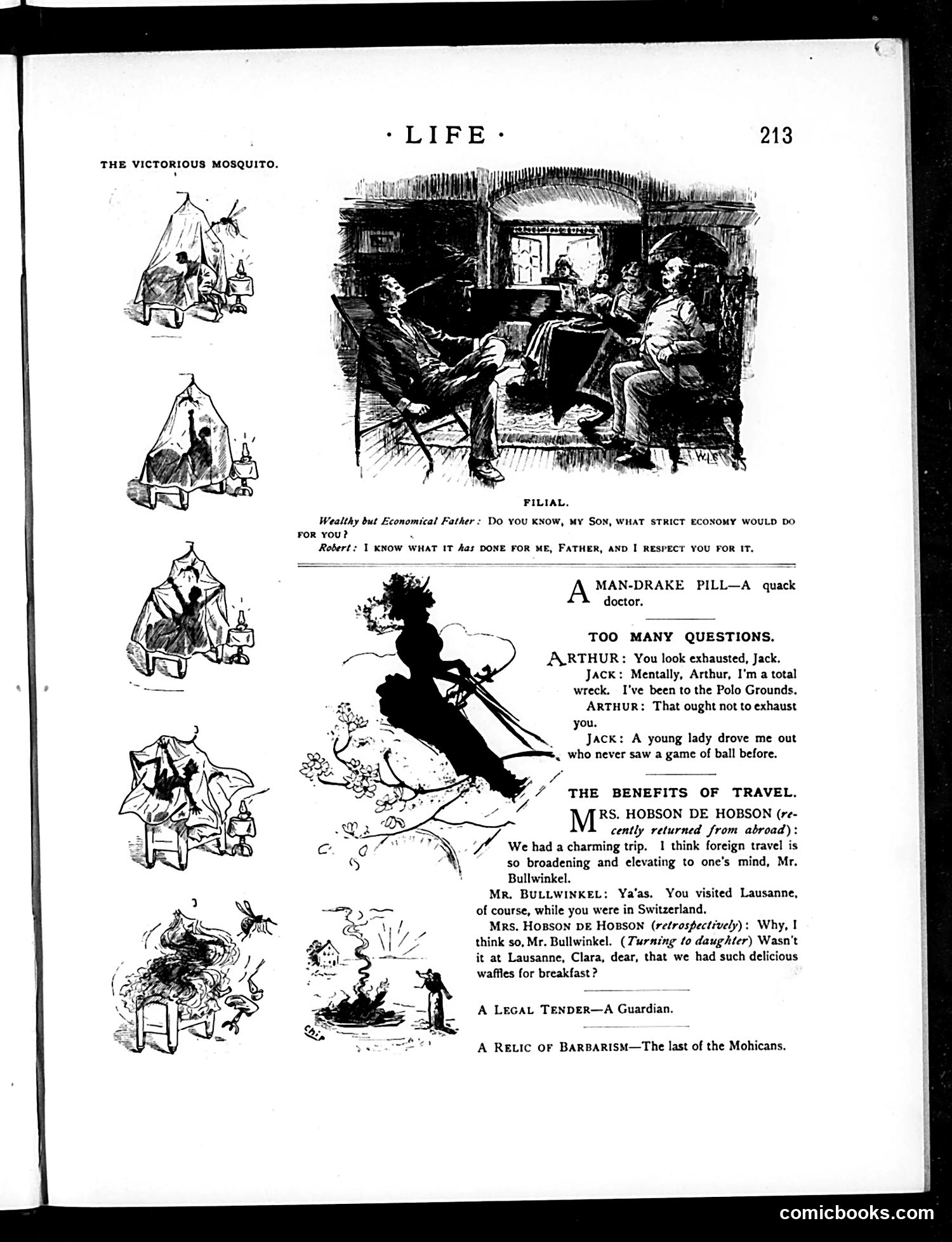
**"The Victorious Mosquito"** (left panel): A series of six illustrations showing a mosquito progressively attacking a sleeping person under a bed net. This is satirical commentary on mosquitoes as persistent pests—the joke being that despite protective measures, mosquitoes are unstoppable nuisances. **"Filial"** (center): A dialogue between a "Wealthy but Economical Father" and his son Robert about strict economy. The satire targets wealthy fathers who preach financial restraint to their sons while living comfortably themselves. **"A Man-Drake Pill"** and other brief items below are unrelated jokes or notices. The page exemplifies Life's satirical approach to everyday social frustrations and class hypocrisy rather than targeting specific political events or figures.
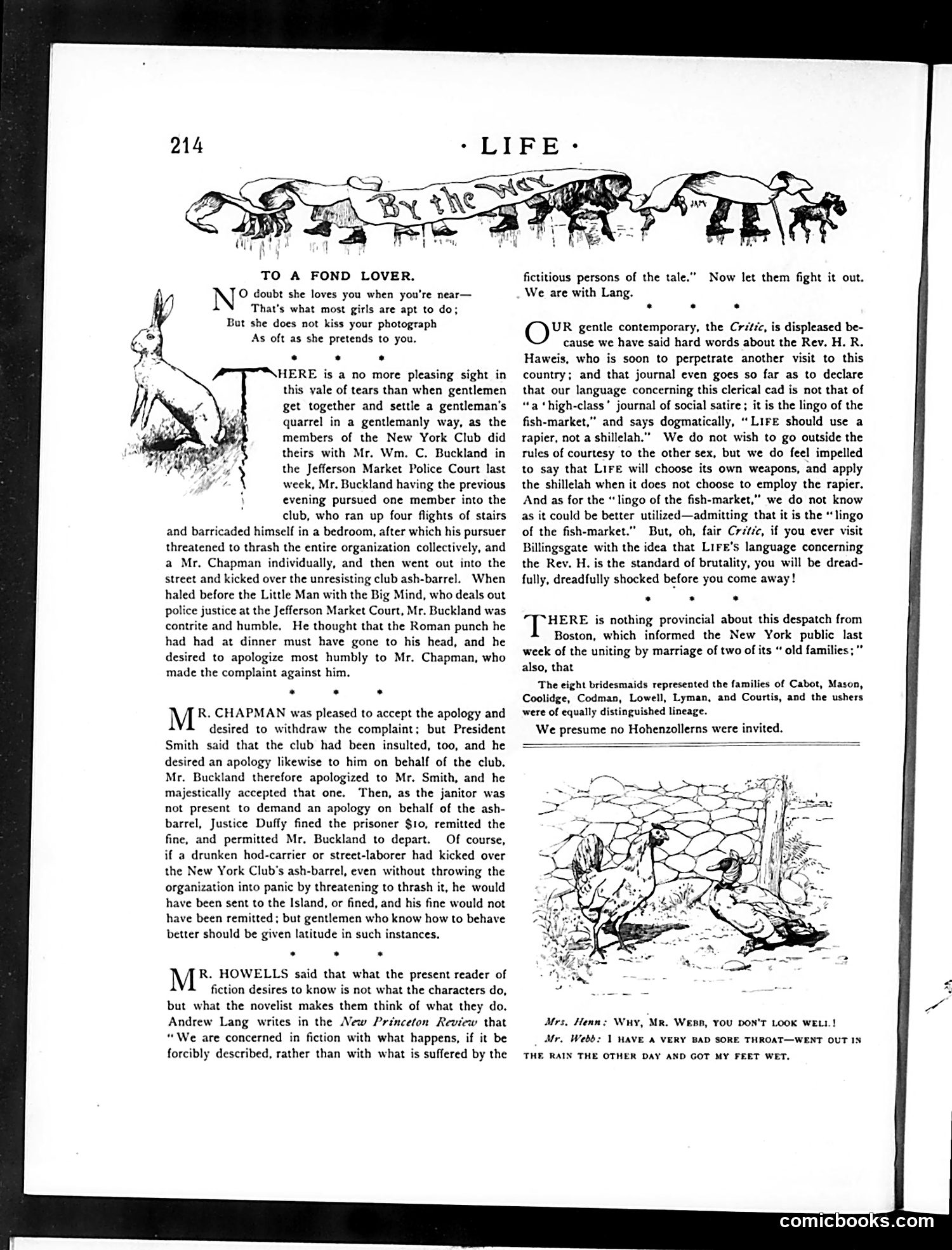
This page contains two distinct pieces: **"To a Fond Lover"** (top): A poem mocking insincere romantic gestures—suggesting men claim love while neglecting genuine attention to their girlfriends. **Main Article**: Satirizes the *Critic* magazine's complaint about *Life's* coverage of Rev. H.R. Haweis's visit. The *Critic* objected to *Life* using colloquial language ("lingo of the fish-market") rather than elevated prose. *Life* defends its accessible style, sarcastically suggesting the *Critic* confuses brutality with literary standards. The piece also reports on a New York Club incident where member William Buckland was locked out after a quarrel, later apologizing. The text criticizes overly formal literary pretension while defending popular journalism. The bottom illustration shows two figures in what appears to be a domestic scene with humorous caption dialogue about illness and wet feet.
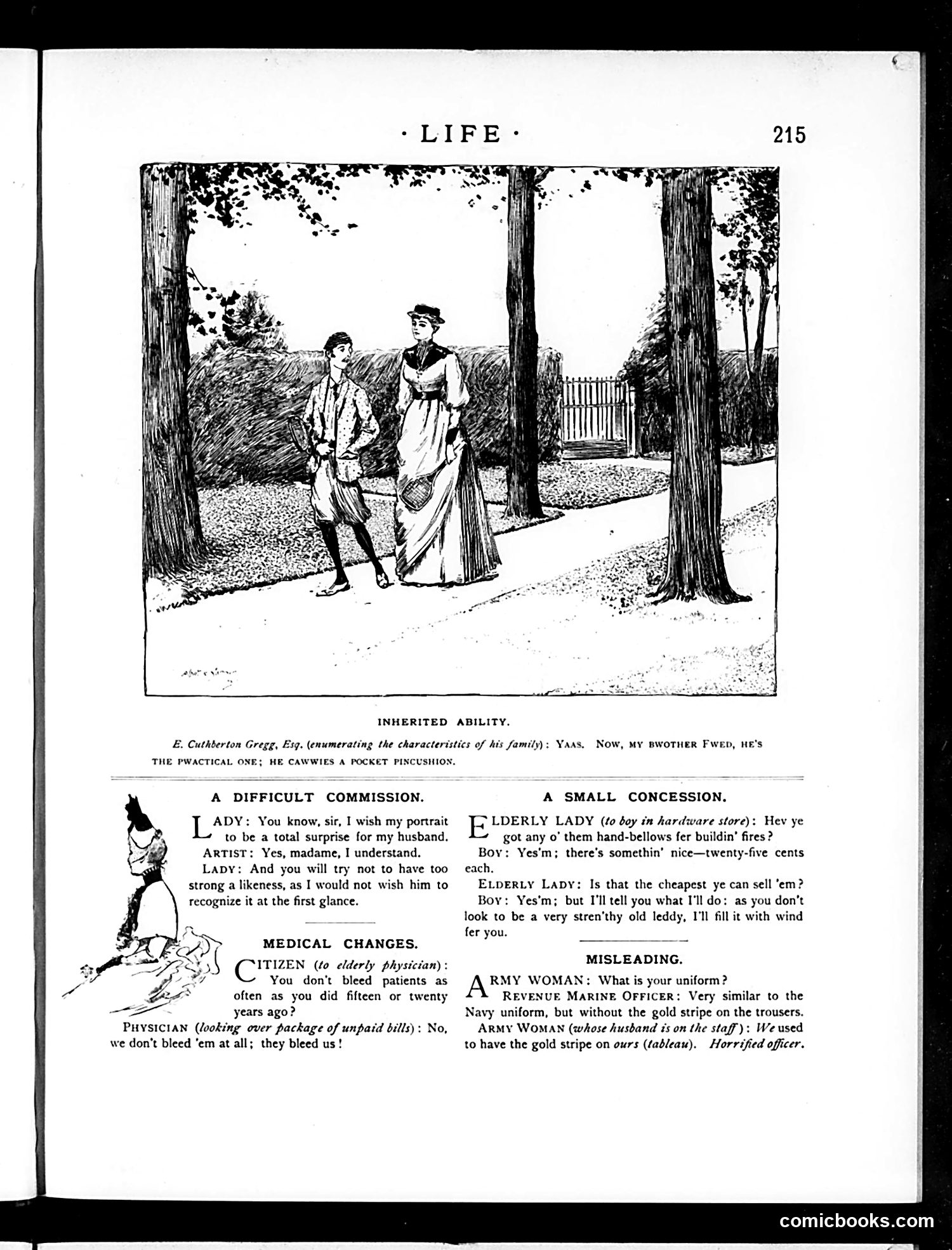
This page contains four brief satirical sketches typical of early 20th-century Life magazine humor: 1. **"Inherited Ability"**: A man and woman walking; the caption jokes that the man's brother is "practical" because he carries a pocket pinch-cushion—suggesting inherited family traits. 2. **"A Difficult Commission"**: A lady wants a portrait surprise for her husband, but worries the artist won't make it flattering enough that the husband recognizes it—poking fun at both portrait-painting and marital dynamics. 3. **"Medical Changes"**: A physician notes that modern medicine no longer bleeds patients (a common 19th-century practice), joking that patients do the bleeding themselves—satirizing outdated medical practices. 4. **"Misleading"**: A confusion between Army and Navy uniforms regarding gold stripes, mocking military insignia details. These are gentle, domestic humor pieces with no apparent political content.
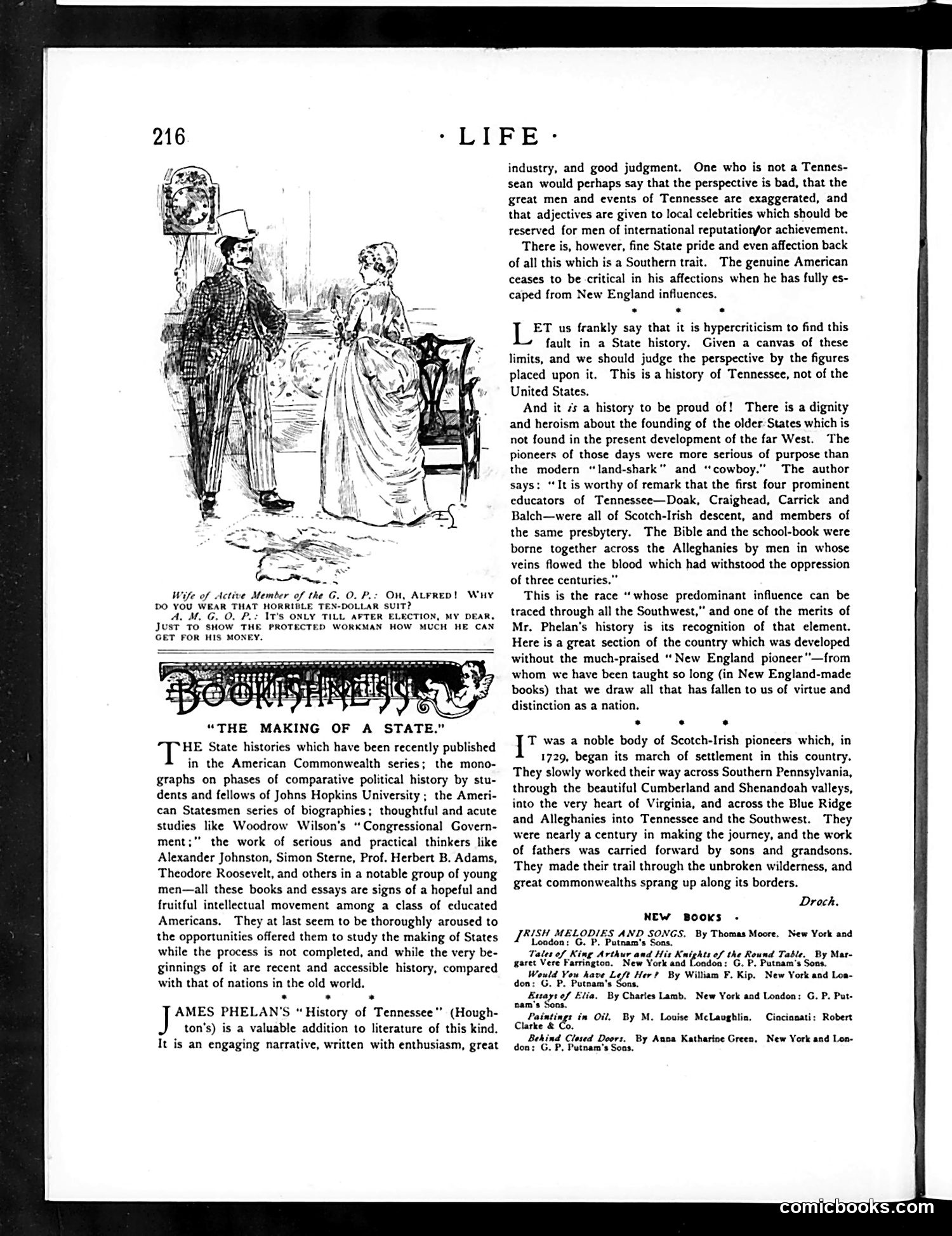
The illustrated cartoon depicts a woman confronting a man, with the caption: "Wife of Active Member of the G.O.P.: 'Oh, Alfred! Why do you insist that those ten-dollar contributions to the party are only till after election, my dear. Just to show the protected workmen how much he can get his money.'" This satirizes Republican (G.O.P./Grand Old Party) campaign practices during the Progressive Era. The joke mocks the apparent contradiction between politicians' promises of worker protection and their actual reliance on wealthy donors. The woman represents the conscience of the household questioning her husband's political contributions, suggesting hypocrisy in how Republicans courted working-class votes while depending on business money—a common Progressive-era critique of Republican fundraising tactics.
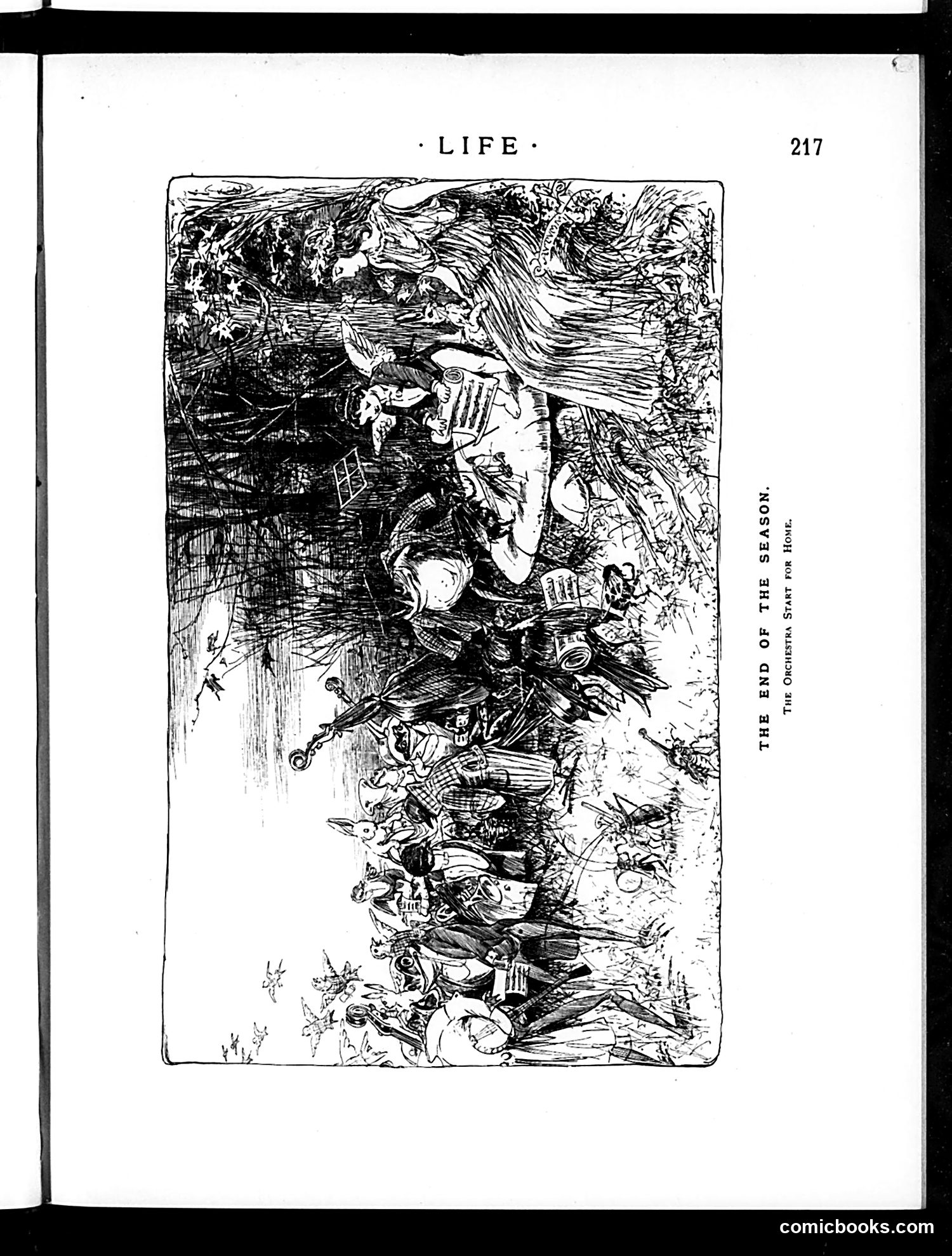
This is a densely-packed satirical illustration showing the closing of the social season, likely from the late 19th or early 20th century. The image depicts upper-class figures in elaborate dress engaged in revelry—dancing, socializing, and celebrating amid ornate furnishings and decorative elements. The satire appears to mock the excesses and frivolity of high society's seasonal gatherings. The chaotic composition, with overlapping figures and exaggerated poses, emphasizes the absurdity and disorder of these fashionable events. The title suggests this represents the exhausted conclusion of an extended period of social obligations and elaborate entertainment among the wealthy elite. Without clearer individual caricatures visible, the broader target is conspicuous consumption and aristocratic pretense.
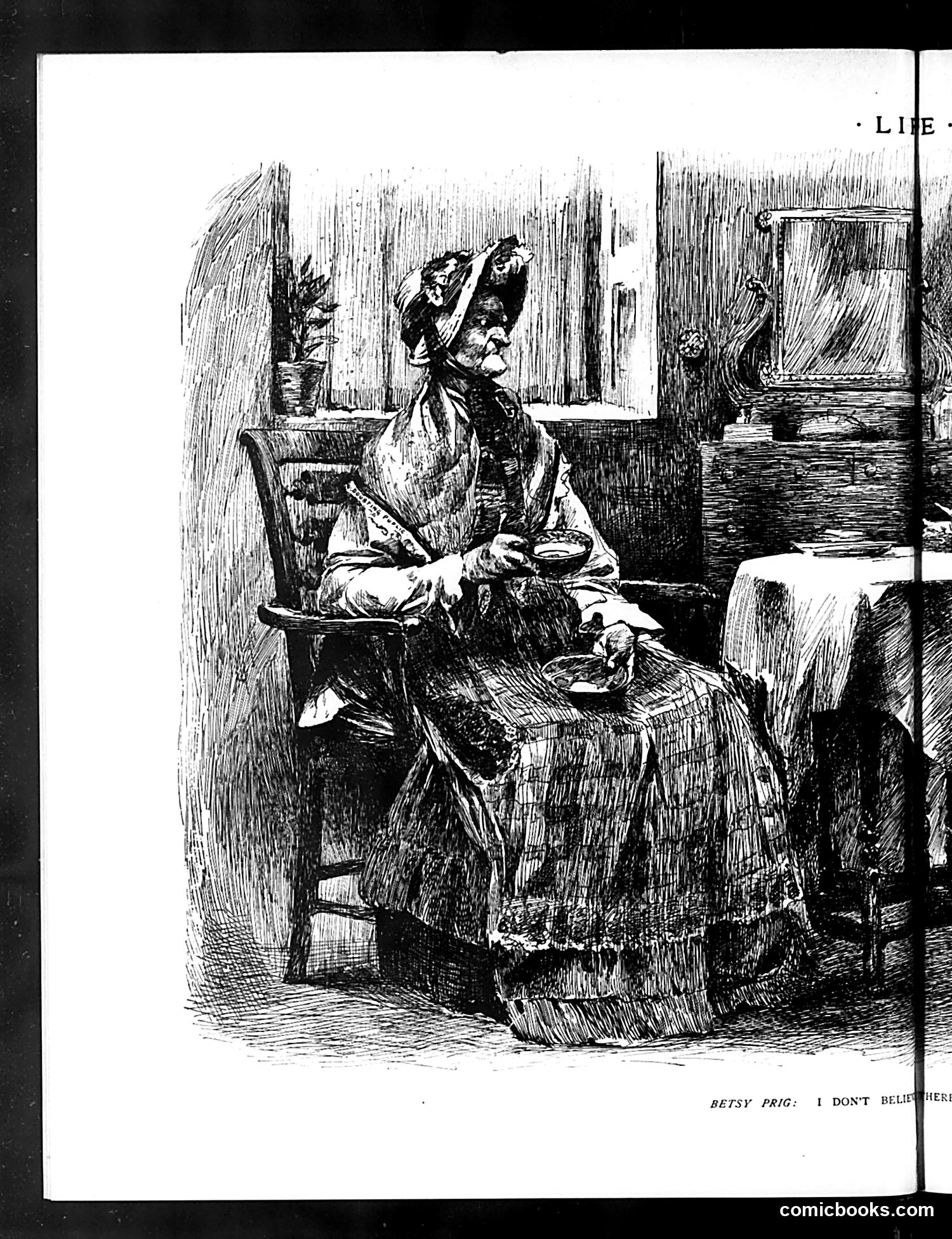
This appears to be an illustration from *Life* magazine featuring a character labeled "BETSY PRIG" with the caption "I DON'T BELIEVE HERE" (text appears cut off). The image shows a woman in period dress seated indoors, looking upward skeptically. "Betsy Prig" is a character from Charles Dickens' 1843-44 novel *Martin Chuzzlewit*—a disreputable, alcoholic nurse known for her dishonesty and crude behavior. The illustration likely satirizes the character's famous skepticism and tendency to dismiss or deny things, fitting with the visible caption about not believing something. Without additional page context, the specific satirical target remains unclear, but the reference leverages Dickens' well-known character to comment on contemporary skepticism or false claims.
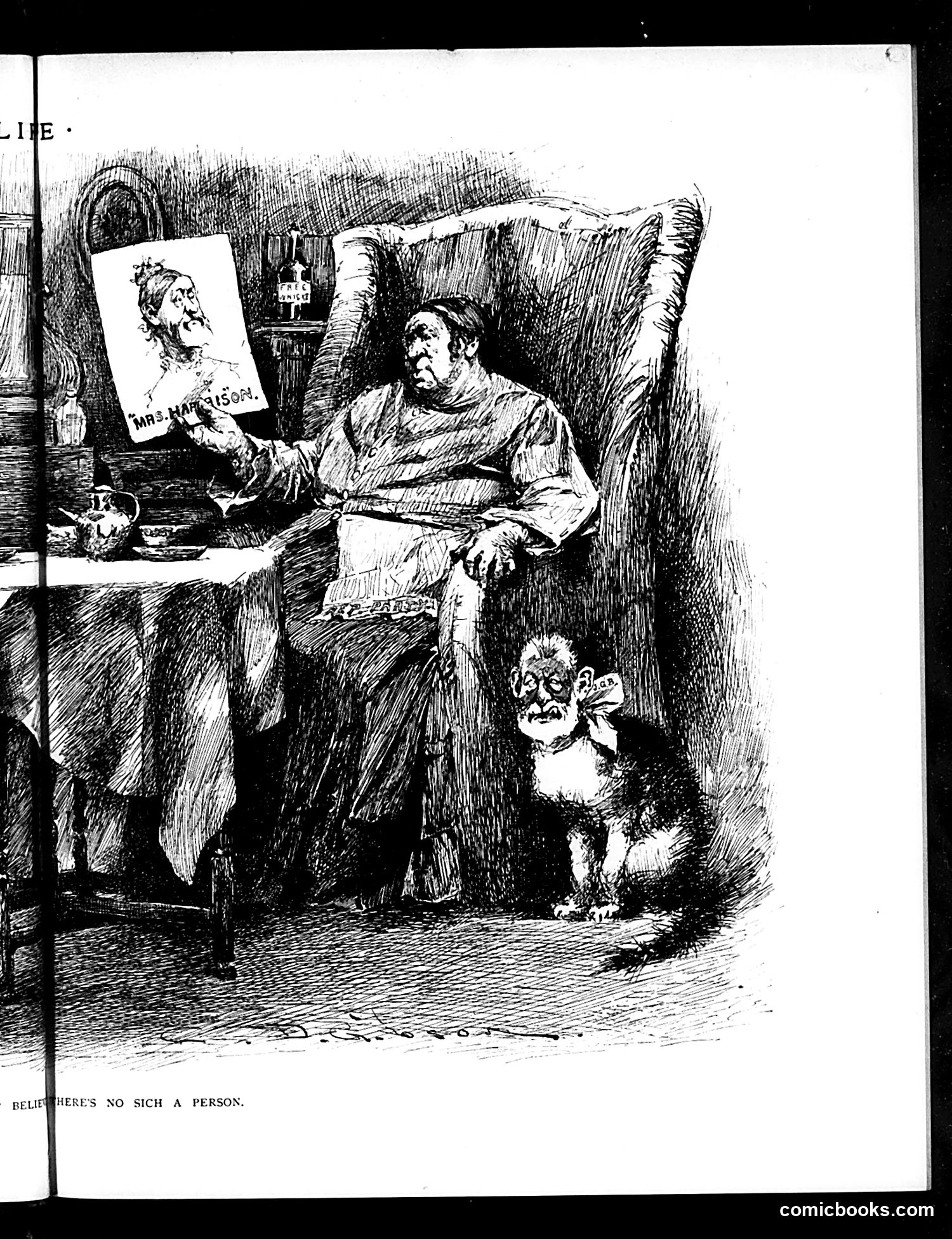
This is a satirical cartoon with the caption "BELIEF HERE'S NO SUCH A PERSON." A portly man sits in a chair holding a portrait labeled "MRS. HARRISON," while a small demon or imp-like creature crouches at his feet, grinning mischievously. The cartoon likely satirizes skepticism or denial regarding the existence of "Mrs. Harrison"—possibly referencing a specific contemporary figure or public scandal from Life magazine's era. The demon suggests duplicity or hidden truth. The man's dismissive gesture while holding her portrait creates the ironic joke: he claims she doesn't exist while literally displaying evidence of her. Without the publication date, identifying which Mrs. Harrison is referenced remains unclear, though the satire clearly mocks someone's unconvincing denial of a person's existence or legitimacy.
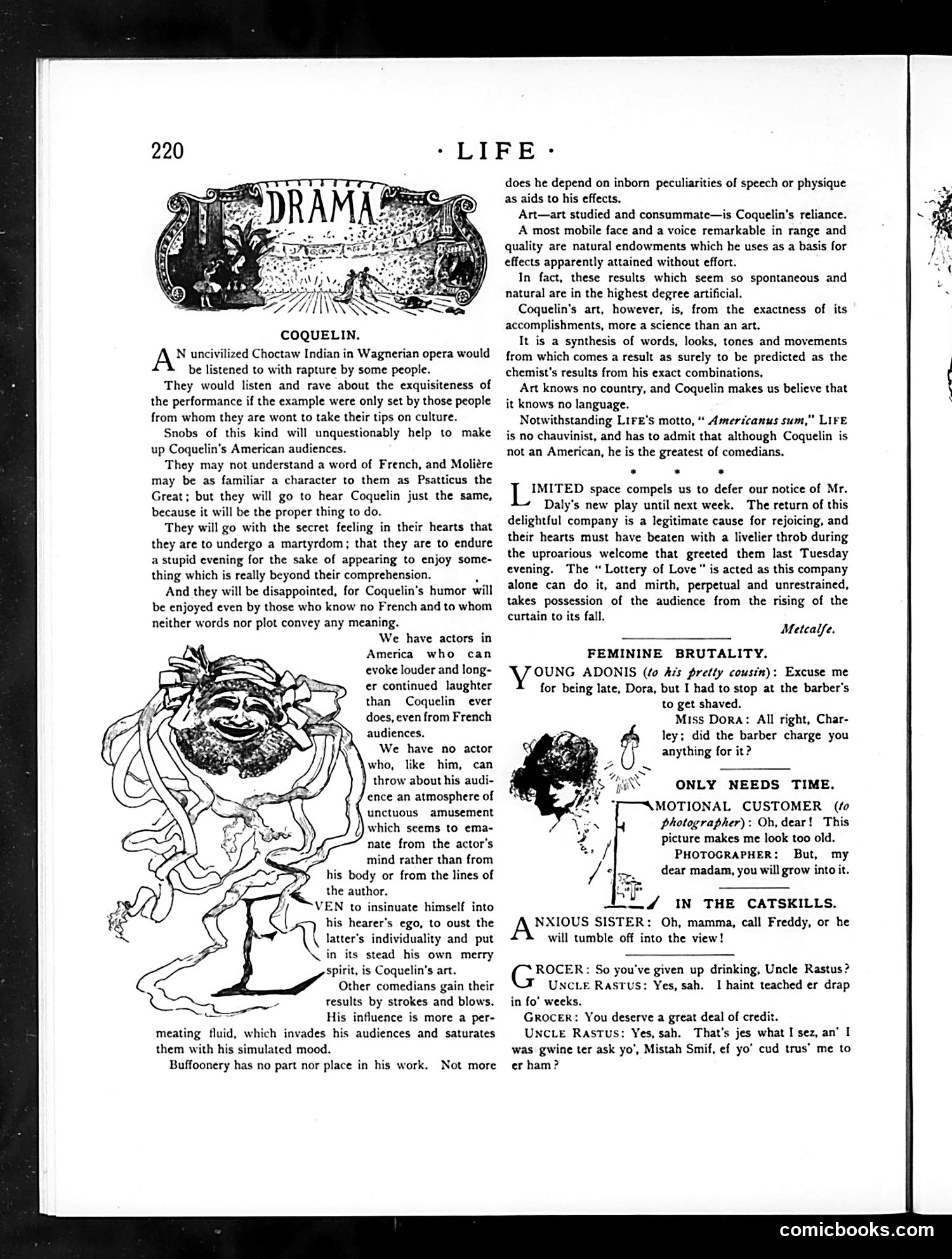
This page contains theatrical criticism and humor sketches rather than political cartoons. The main article discusses **Coquelin**, a French actor performing in Wagnerian opera. The text praises his technical mastery and mobile facial expressions, arguing his art is "synthesis of words, looks, tones and movements" rather than mere physical performance. The accompanying caricature exaggerates his expressive face grotesquely. Below are three separate comic dialogues: - "Feminine Brutality" (a woman dismisses a late suitor) - "Only Needs Time" (a photographer assures a concerned client) - "In the Catskills" (Uncle Rastus discusses quitting drinking with a grocer) These are light social humor pieces mocking everyday situations—vanity, aging, and rural dialect—typical of Life's satirical approach to American life and manners.
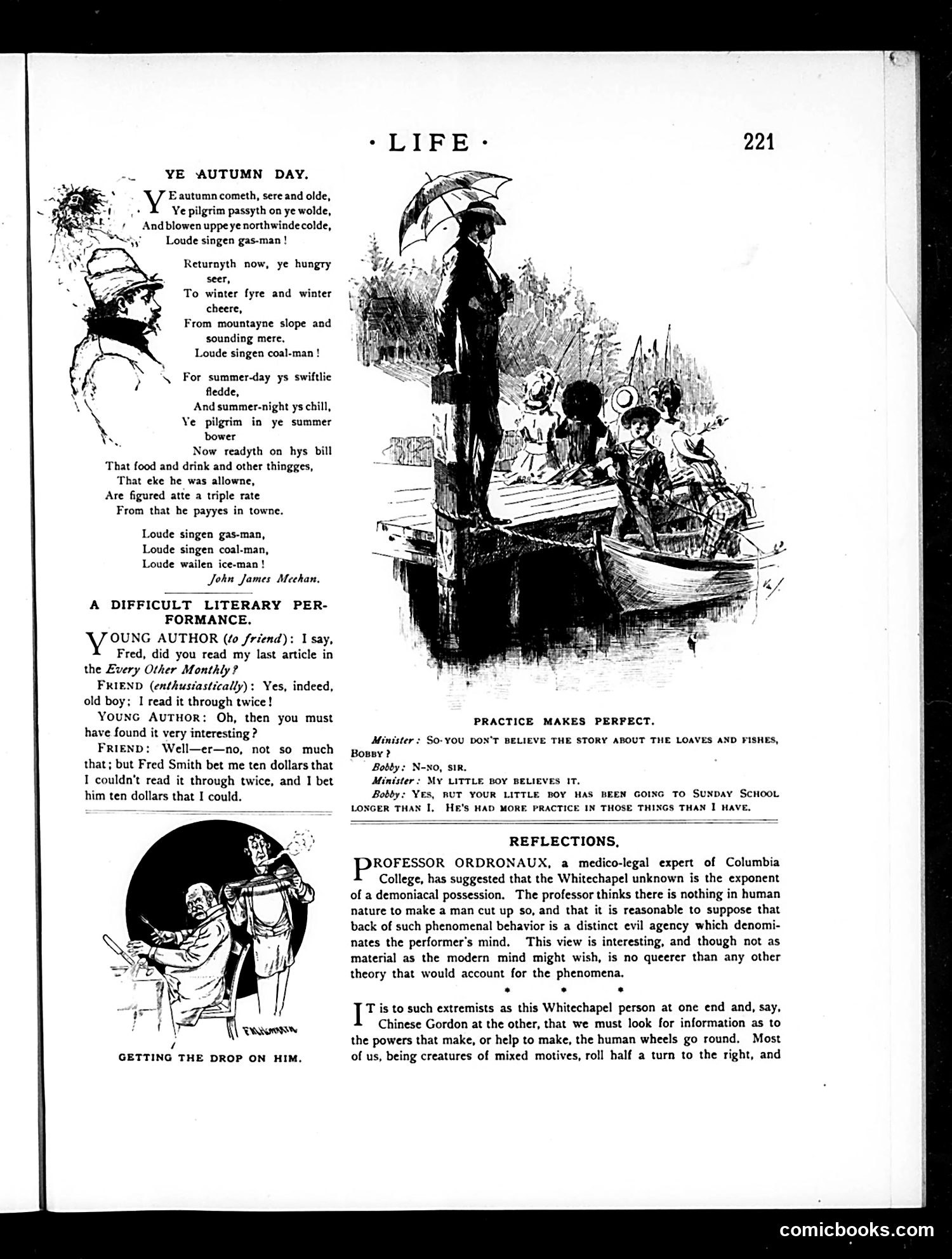
This page from *Life* magazine contains three satirical pieces: 1. **"Ye Autumn Day"** (poem by John James Meehan): A mock-archaic verse about autumn's return, when utility workers—gas-men, coal-men, ice-men—raise prices. The satire mocks inflated bills customers receive for the same services they paid less for in summer. 2. **"A Difficult Literary Performance"**: A joke about a young author whose friend only read his article because of a bet, not from genuine interest. The satire targets pretentious amateur writers and questions their actual readership. 3. **"Practice Makes Perfect"** and **"Reflections"**: A brief dialogue mocking religious instruction (a minister challenges a boy's literal belief in biblical miracles), followed by commentary on the "Whitechapel unknown"—likely referencing the Jack the Ripper murders—and comparing extremists like "Chinese Gordon" to understand human motivation. The overall theme criticizes hypocrisy, false pretension, and irrational behavior in society.
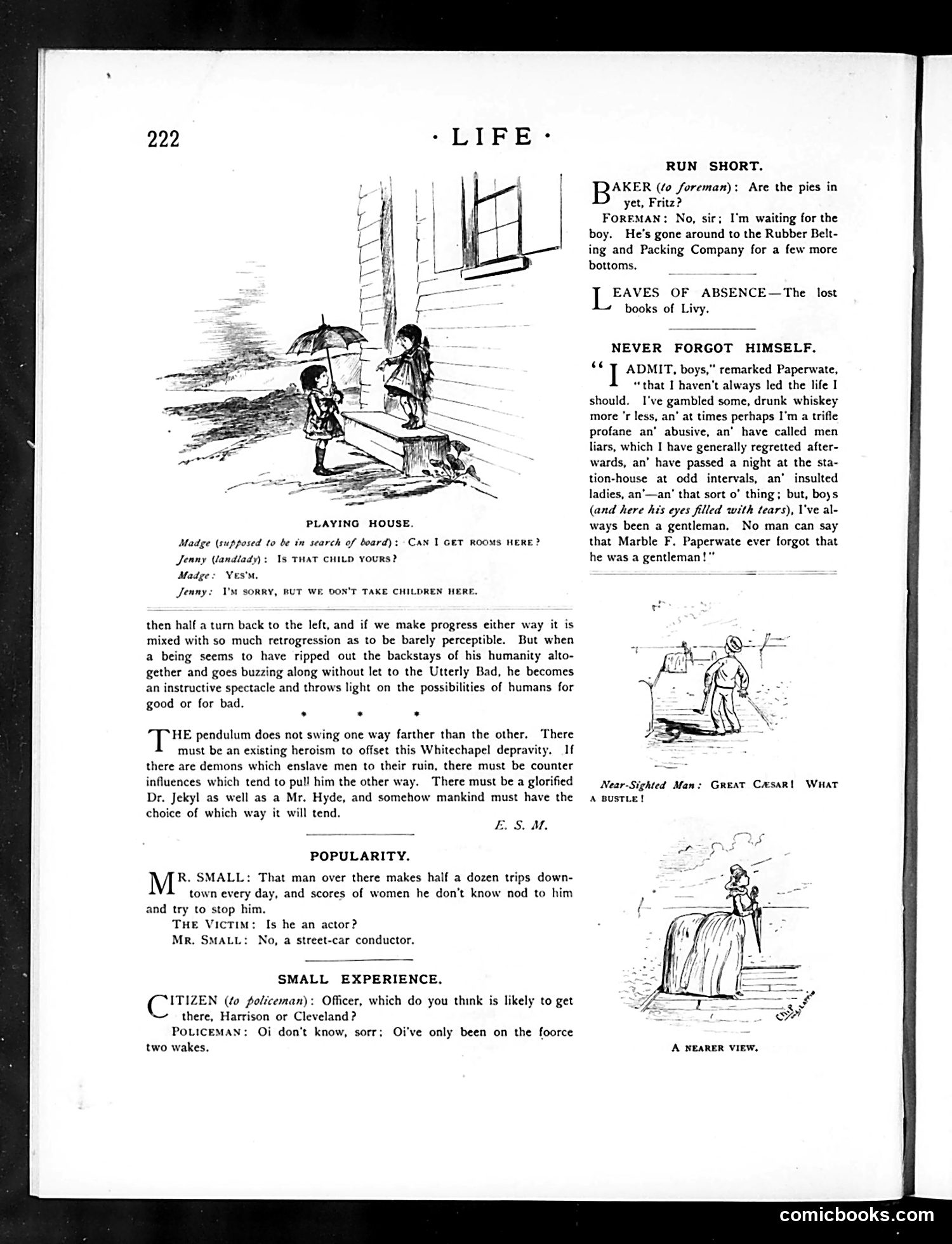
This page from *Life* magazine (a satirical publication, not the photo magazine) contains several disconnected jokes typical of the era's humor format: **"Run Short"** jokes about a baker waiting for pie bottoms from a rubber company—a pun on the double meaning of "bottoms." **"Playing House"** depicts a child seeking lodging; the landlady refuses because she won't rent to children, satirizing harsh boarding practices. **"Never Forgot Himself"** portrays a man named Paperwater confessing to gambling, drinking, and insulting women, yet insisting he remained "a gentleman"—mocking the contradiction between behavior and claimed respectability. **"Small Experience"** features a newly hired policeman (two weeks on force) asked about the Harrison-Cleveland election, unable to answer. This likely references an actual contemporary political race. The page also includes short illustrated gags about street-car conductors and near-sighted men. The humor relies on social class observations, puns, and absurdist situations typical of early American satirical magazines.
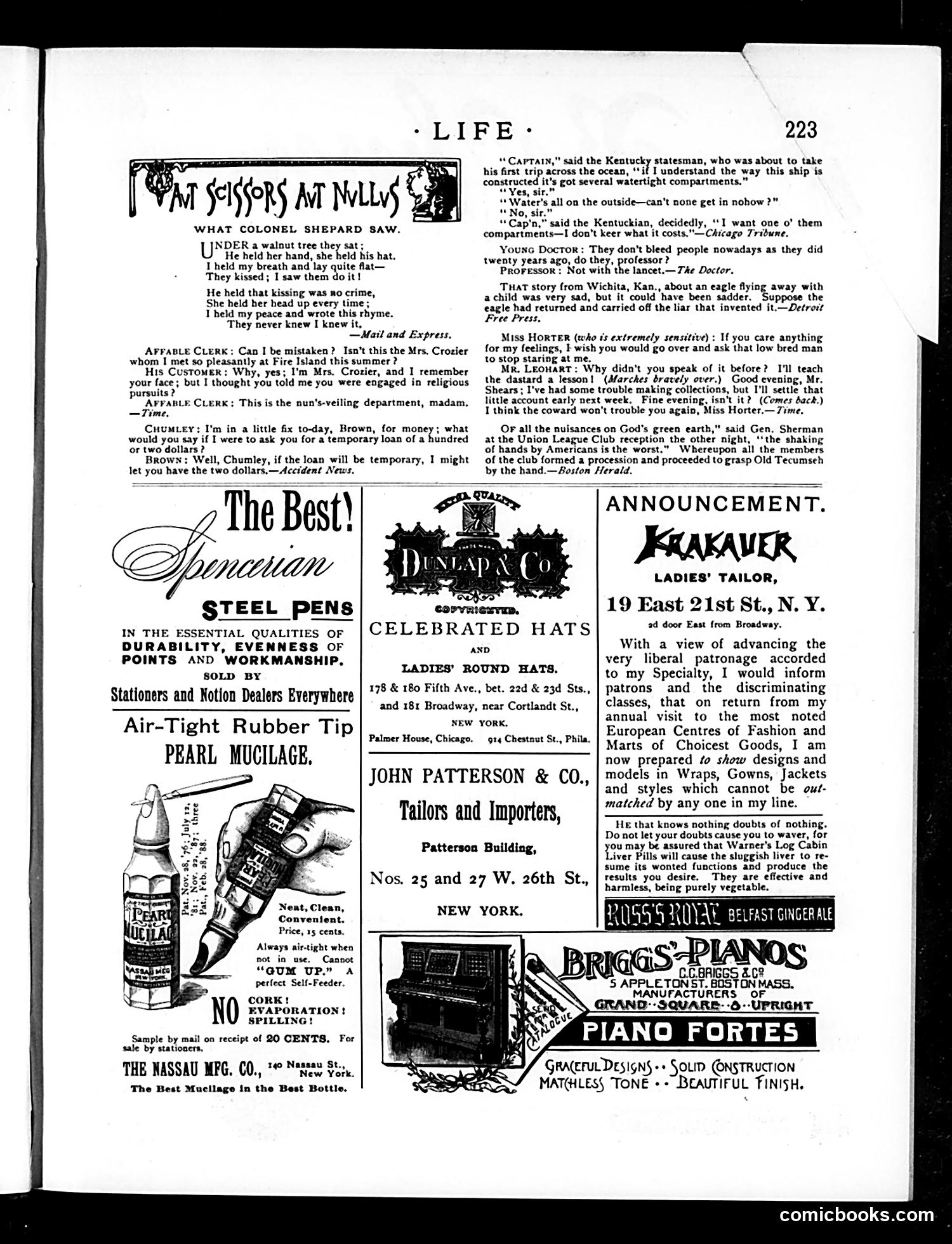
This page contains multiple short humorous anecdotes typical of *Life* magazine's satirical format, plus period advertisements. The cartoons mock social pretense and human folly: a clerk encounters a woman who claimed religious devotion but was actually on vacation; a man borrows two dollars after asking for a hundred; a Kentucky backwoods gentleman misunderstands a ship's watertight compartments, wanting one for himself. Other jokes target professional pomposity (a doctor explaining bloodletting practices) and General Sherman's famous cantankerous nature—he complains about Americans' hand-shaking custom at a club reception, prompting members to immediately shake his hand in mock sympathy. The page is dominated by period advertisements for steel pens, rubber-tipped pen holders, ladies' hats, tailoring services, pianos, and patent medicines—typical consumer products marketed in early-1900s American publications. The humor relies on period-specific social contexts: class distinctions, medical practices, and regional stereotypes (the Kentucky "rube").
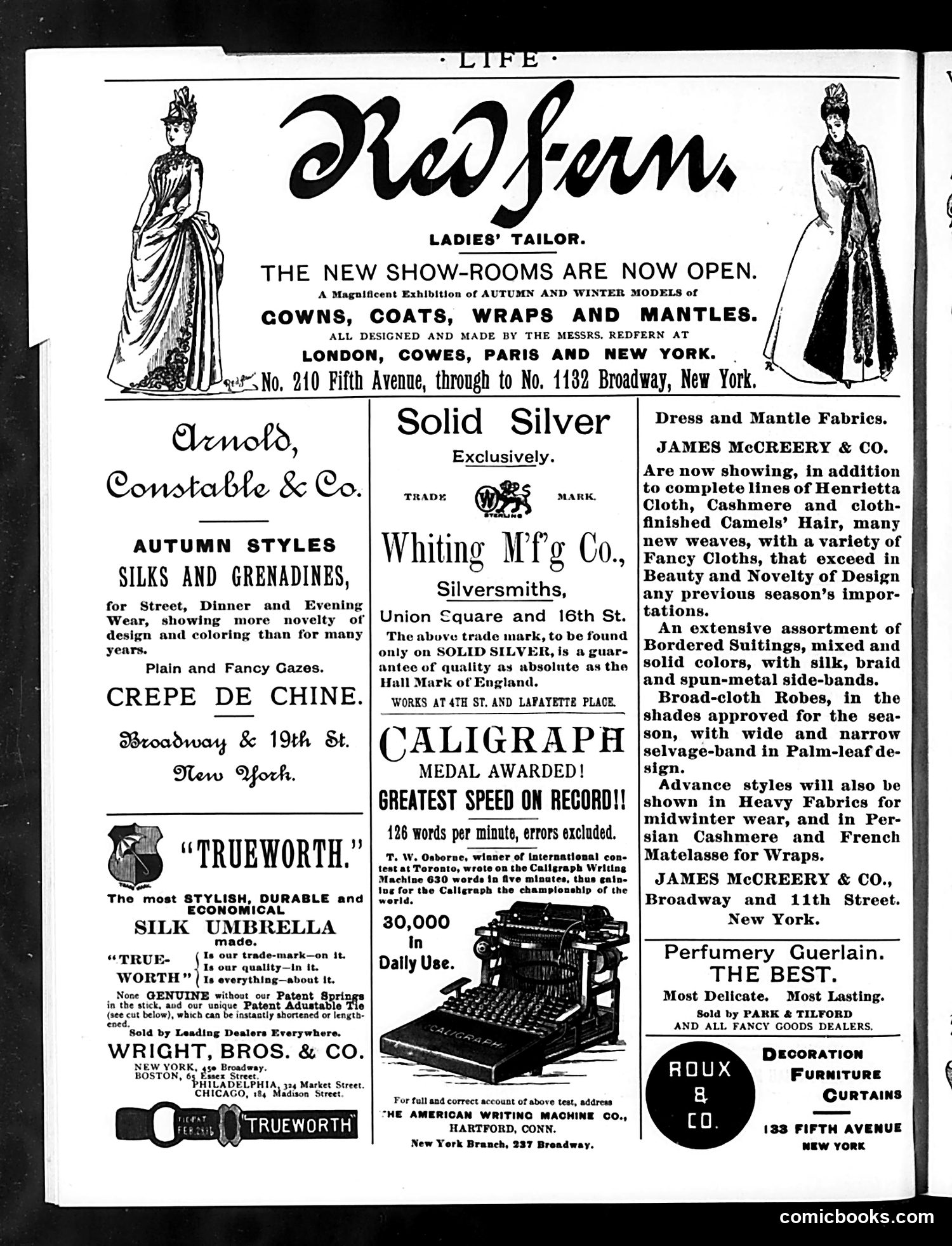
This is **not a cartoon page** but rather a **full-page advertisement compilation** from Life magazine's back matter. There is no satire or political content to decode. The page showcases luxury goods and services targeting wealthy, fashionable Americans of the era (appears to be late 1800s or early 1900s). Featured advertisers include: - **Red Fern**: High-end ladies' tailoring with showrooms in London, Paris, and New York - **Whiting Manufacturing Co.**: Solid silver goods with English hallmark guarantee - **Caligraph**: A typewriter claiming speed records (126 words per minute) - **Wright Bros.**: "Trueworth" silk umbrellas with patent springs - **James McCreery & Co.**: Fine dress fabrics and mantles - **Guerlain**: French perfumery The advertisements emphasize luxury, quality craftsmanship, international prestige (particularly British and French goods), and exclusivity—reflecting the aspirations of Life's affluent readership during the Gilded Age.