
Life, 1888-10-18 · page 2 of 14
Life — October 18, 1888 — page 2: what you’re looking at
What you’re looking at
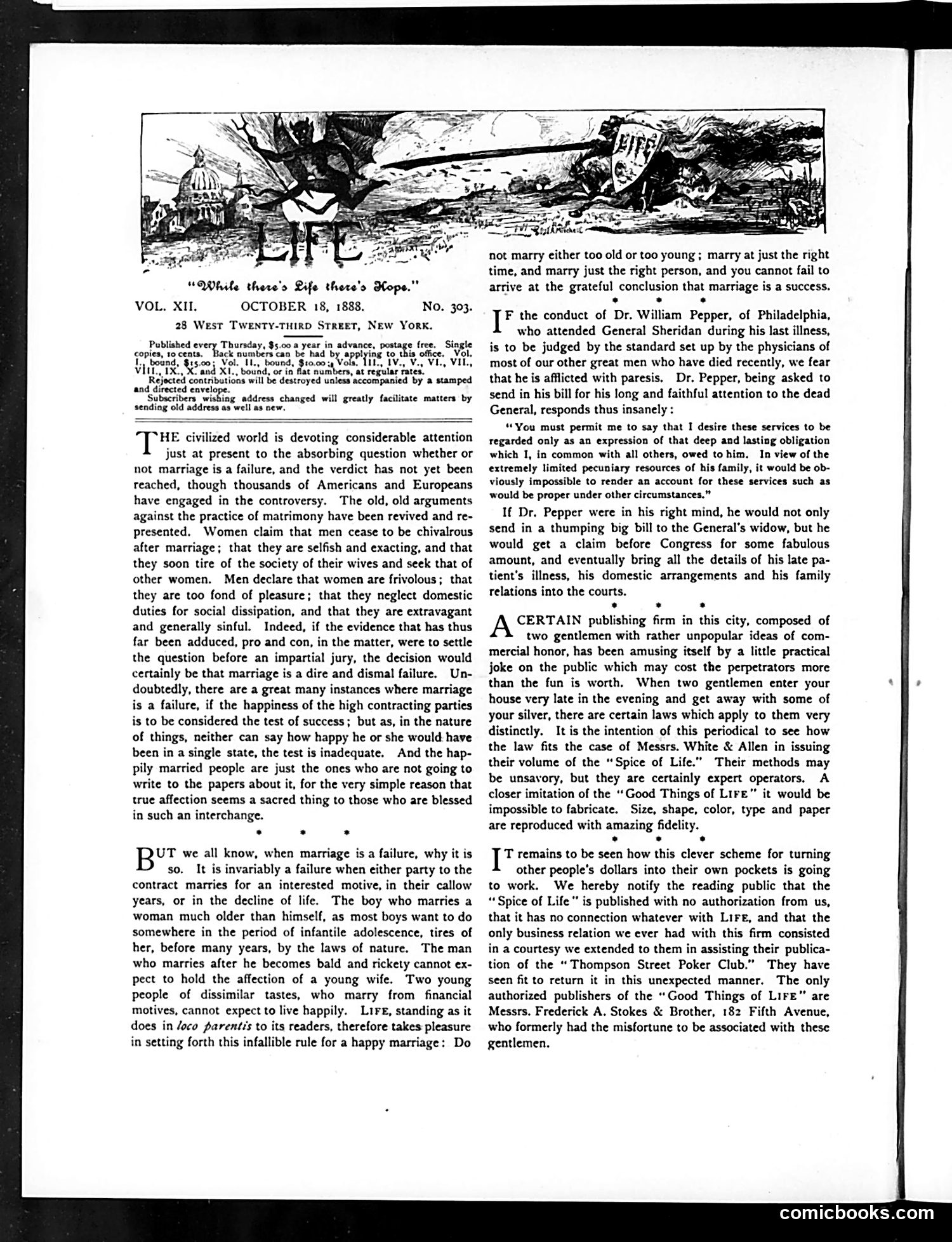
The masthead illustration labeled "While there's Life there's Hope" depicts a skeletal Death figure confronting Life personified as a woman—a standard Victorian memento mori image about mortality. The page's main content is editorial commentary on marriage, not political satire. It debates whether matrimony is inherently a "failure," arguing that successful marriage requires compatible partners of similar age and financial circumstances. The text criticizes a publishing firm (Messrs. Frederick A. Stokes & Brother) for issuing unauthorized editions of "Spice of Life," accusing them of unethical profiteering. This reflects late-19th-century concerns about marriage stability, copyright enforcement, and commercial ethics rather than contemporary political events.
📄 Transcribed text from this page (OCR, searchable)
Machine-transcribed from the original scan — historical spelling and the odd misread are preserved.
“While there's Life there's Hope.” VOL. XII. OCTOBER 18, 1888. No. 303. 28 West TWENTY-THIRD STREET, New York. Published every Thursday, $5.00 a year in advance, postage free. Single copies, to cents. Back numbers can be had by applying to this office. Vol. hound, $13.00; Vol. Il, bound, $io.o0: Vole Alte IV. Vay Vie, VIL, and XI., bound, of in flat numbers, at regular rates. Rej ontributions will be destroyed unless accompanied by a stamped and directed envelope. Subscribers wishing address changed will greatly facilitate matters by sending old address as well as new. HE civilized world is devoting considerable attention just at present to the absorbing question whether or not marriage is a failure, and the verdict has not yet been reached, though thousands of Americans and Europeans have engaged in the controversy. The old, old arguments against the practice of matrimony have been revived and re- presented. Women claim that men cease to be chivalrous after marriage; that they are selfish and exacting, and that they soon tire of the society of their wives and seek that of other women. Men declare that women are frivolous; that they are too fond of pleasure; that they neglect domestic duties for social dissipation, and that they are extravagant and generally sinful. Indeed, if the evidence that has thus far been adduced, pro and con, in the matter, were to settle the question before an impartial jury, the decision would certainly be that marriage is a dire and dismal failure. Un- doubtedly, there are a great many instances where marriage is a failure, if the happiness of the high contracting parties is to be considered the test of success; but as, in the nature of things, neither can say how happy he or she would have been in a single state, the test is inadequate. And the hap- pily married people are just the ones who are not going to write to the papers about it, for the very simple reason that true affection seems a sacred thing to those who are blessed in such an interchange. . . . UT we all know, when marriage is a failure, why it is so. It is invariably a failure when either party to the contract marries for an interested motive, in their callow years, or in the decline of life. The boy who marries a woman much older than himself, as most boys want to do somewhere in the period of infantile adolescence, tires of her, before many years, by the laws of nature. The man who marries after he becomes bald and rickety cannot ex- pect to hold the affection of a young wife. Two young people of dissimilar tastes, who marry from financial motives, cannot expect to live happily. LiFe, standing as it does in /oco parent's to its readers, therefore takes pleasure in setting forth this infallible rule for a happy marriage: Do not marry either too old or too young ; marry at just the right time, and marry just the right person, and you cannot fail to arrive at the grateful conclusion that marriage is a success. . . . IF the conduct of Dr. William Pepper, of Philadelphia, who attended General Sheridan during his last illness, is to be judged by the standard set up by the physicians of most of our other great men who have died recently, we fear that he is afflicted with paresis. Dr. Pepper, being asked to send in his bill for his long and faithful attention to the dead General, responds thus insanely : “You must permit me to say that I desire these services to be regarded only as an expression of that deep and lasting obligation which I, in common with all others, owed tohim. In view of the extremely limited pecuniary resources of his family, it would be ob- viously impossible to render an account for these services such as would be proper under other circumstances.” If Dr. Pepper were in his right mind, he would not only send in a thumping big bill to the General's widow, but he would get a claim before Congress for some fabulous amount, and eventually bring all the details of his late pa- tient’s illness, his domestic arrangements and his family relations into the courts. . . . CERTAIN publishing firm in this city, composed of two gentlemen with rather unpopular ideas of com- mercial honor, has been amusing itself by a little practical joke on the public which may cost the perpetrators more than the fun is worth. When two gentlemen enter your house very late in the evening and get away with some of your silver, there are certain laws which apply to them very distinctly. It is the intention of this periodical to see how the law fits the case of Messrs. White & Allen in issuing their volume of the “Spice of Life.” Their methods may be unsavory, but they are certainly expert operators. A closer imitation of the ‘Good Things of LiFe” it would be impossible to fabricate. Size, shape, color, type and paper are reproduced with amazing fidelity. . . . T remains to be seen how this clever scheme for turning other people's dollars into their own pockets is going to work. We hereby notify the reading public that the “Spice of Life” is published with no authorization from us, that it has no connection whatever with Lire, and that the only business relation we ever had with this firm consisted in a courtesy we extended to them in assisting their publica- tion of the “ Thompson Street Poker Club.” They have seen fit to return it in this unexpected manner. The only authorized publishers of the “Good Things of Lire” are Messrs. Frederick A. Stokes & Brother, 182 Fifth Avenue, who formerly had the misfortune to be associated with these gentlemen. comicbooks.com