
Life, 1888-10-18 · page 6 of 14
Life — October 18, 1888 — page 6: what you’re looking at
What you’re looking at
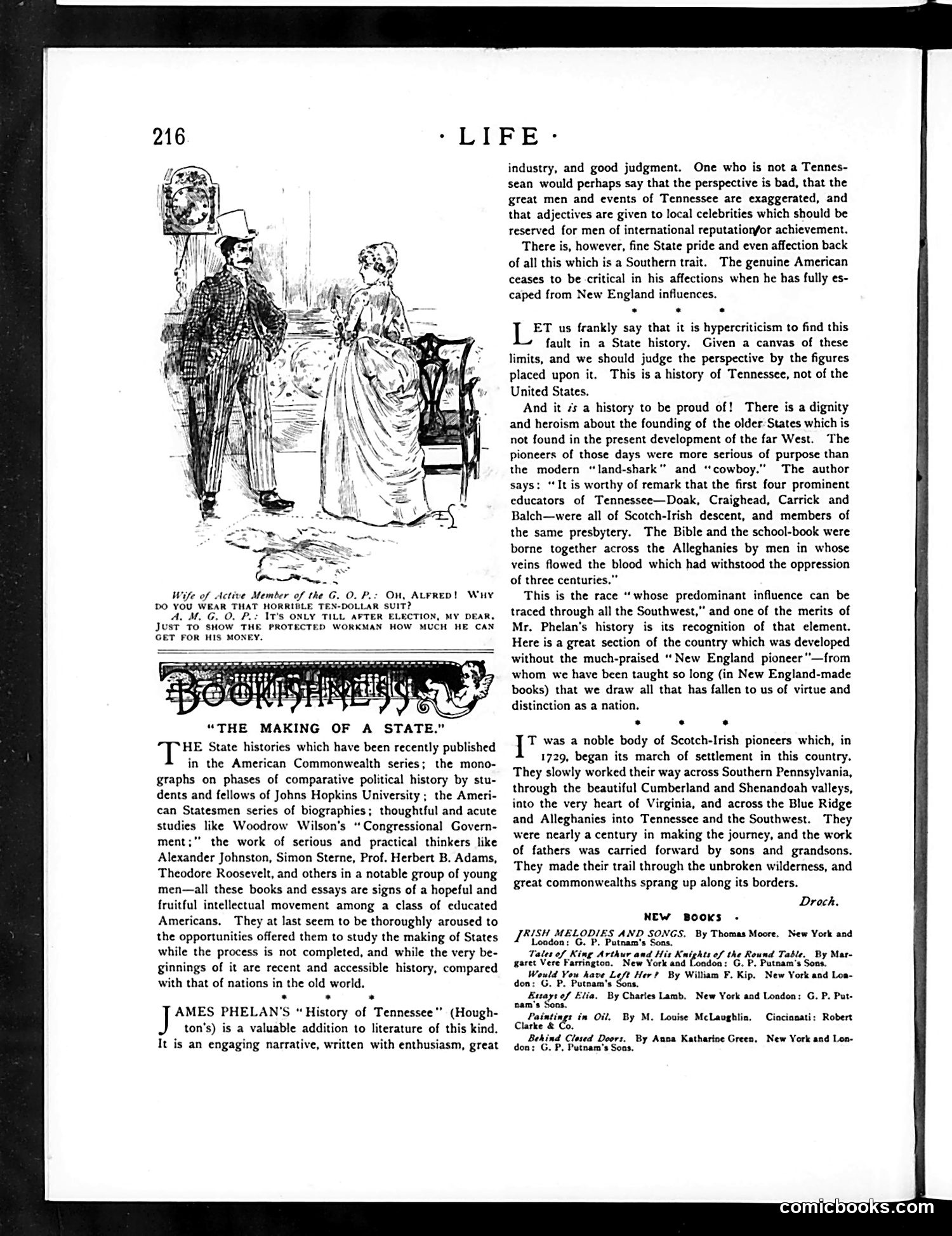
The illustrated cartoon depicts a woman confronting a man, with the caption: "Wife of Active Member of the G.O.P.: 'Oh, Alfred! Why do you insist that those ten-dollar contributions to the party are only till after election, my dear. Just to show the protected workmen how much he can get his money.'" This satirizes Republican (G.O.P./Grand Old Party) campaign practices during the Progressive Era. The joke mocks the apparent contradiction between politicians' promises of worker protection and their actual reliance on wealthy donors. The woman represents the conscience of the household questioning her husband's political contributions, suggesting hypocrisy in how Republicans courted working-class votes while depending on business money—a common Progressive-era critique of Republican fundraising tactics.
📄 Transcribed text from this page (OCR, searchable)
Machine-transcribed from the original scan — historical spelling and the odd misread are preserved.
‘LIFE: A Ans Wife of Active Member of the G. O. P.: Ou, ALFRED! Wuy DO YOU WEAR THAT HORRIBLE TEN-DOLLAR SUI A, M. G, O. P.: IT'S ONLY TILL AFTER ‘TION, MY DEAR. JUST TO SHOW THE PROTECTED WORKMAN HOW MUCH HE CAN GET FOR HIS MONEY. “THE MAKING OF A STATE.” HE State histories which have been recently published in the American Commonwealth series; the mono- graphs on phases of comparative political history by stu- dents and fellows of Johns Hopkins University ; the Ameri- can Statesmen series of biographies; thoughtful and acute studies like Woodrow Wilson's “Congressional Govern- ment;" the work of serious and practical thinkers like Alexander Johnston, Simon Sterne, Prof. Herbert B. Adams, Theodore Roosevelt, and others in a notable group of young men—all these books and essays are signs of a hopeful and fruitful intellectual movement among a class of educated Americans, They at last seem to be thoroughly aroused to the opportunities offered them to study the making of States while the process is not completed, and while the very be- ginnings of it are recent and accessible history, compared with that of nations in the old world. . . . AMES PHELAN'’S “History of Tennessee" (Hough- ton's) is a valuable addition to literature of this kind. It is an engaging narrative, written with enthusiasm, great industry, and good judgment. One who is not a Tennes- sean would perhaps say that the perspective is bad, that the great men and events of Tennessee are exaggerated, and that adjectives are given to local celebrities which should be reserved for men of international reputationfor achievement. There is, however, fine State pride and even affection back of all this which is a Southern trait. The genuine American ceases to be critical in his affections when he has fully es- caped from New England influences. . . . Lt us frankly say that it is hypercriticism to find this fault in a State history. Given a canvas of these limits, and we should judge the perspective by the figures placed upon it. This is a history of Tennessee, not of the United States. And it ¢s a history to be proud of! There is a dignity and heroism about the founding of the older States which is not found in the present development of the far West. The pioneers of those days were more serious of purpose than the modern “land-shark" and “cowboy.” The author says: ‘It is worthy of remark that the first four prominent educators of Tennessee—Doak, Craighead, Carrick and Balch—were all of Scotch-Irish descent, and members of the same presbytery. The Bible and the school-book were borne together across the Alleghanies by men in whose veins flowed the blood which had withstood the oppression of three centuries.” This is the race “whose predominant influence can be traced through all the Southwest,” and one of the merits of Mr. Phelan’s history is its recognition of that element. Here is a great section of the country which was developed without the much-praised “ New England pioneer"—from whom we have been taught so long (in New England-made books) that we draw all that has fallen to us of virtue and distinction as a nation. . . . {" was a noble body of Scotch-Irish pioneers which, in 1729, began its march of settlement in this country. They slowly worked their way across Southern Pennsylvania, through the beautiful Cumberland and Shenandoah valleys, into the very heart of Virginia, and across the Blue Ridge and Alleghanies into Tennessee and the Southwest. They were nearly a century in making the journey, and the work of fathers was carried forward by sons and grandsons. They made their trail through the unbroken wilderness, and great commonwealths sprang up along its borders. Droch, NEW BooKs - L[RISH, MELODIES AND SONGS. By Thomas Moore, New York and Loader . P. Patnam’s Sons. ing Arthur and Hi mights of the Round Table. By Mar- . New York and London: G. P. Putnam's Sons. eft Her? By William F. Kip. New York and Loa- . By Charles Lamb. New York and London: G. P. Put- a im Oil. By M. Louise McLaughlin. Cincinnati: Robert 0. Closed Doors, Bei By Anna Katharine Green, New York and Lon- don: G, P, Putnam's Sons.