
Life, 1888-10-18 · page 10 of 14
Life — October 18, 1888 — page 10: what you’re looking at
What you’re looking at
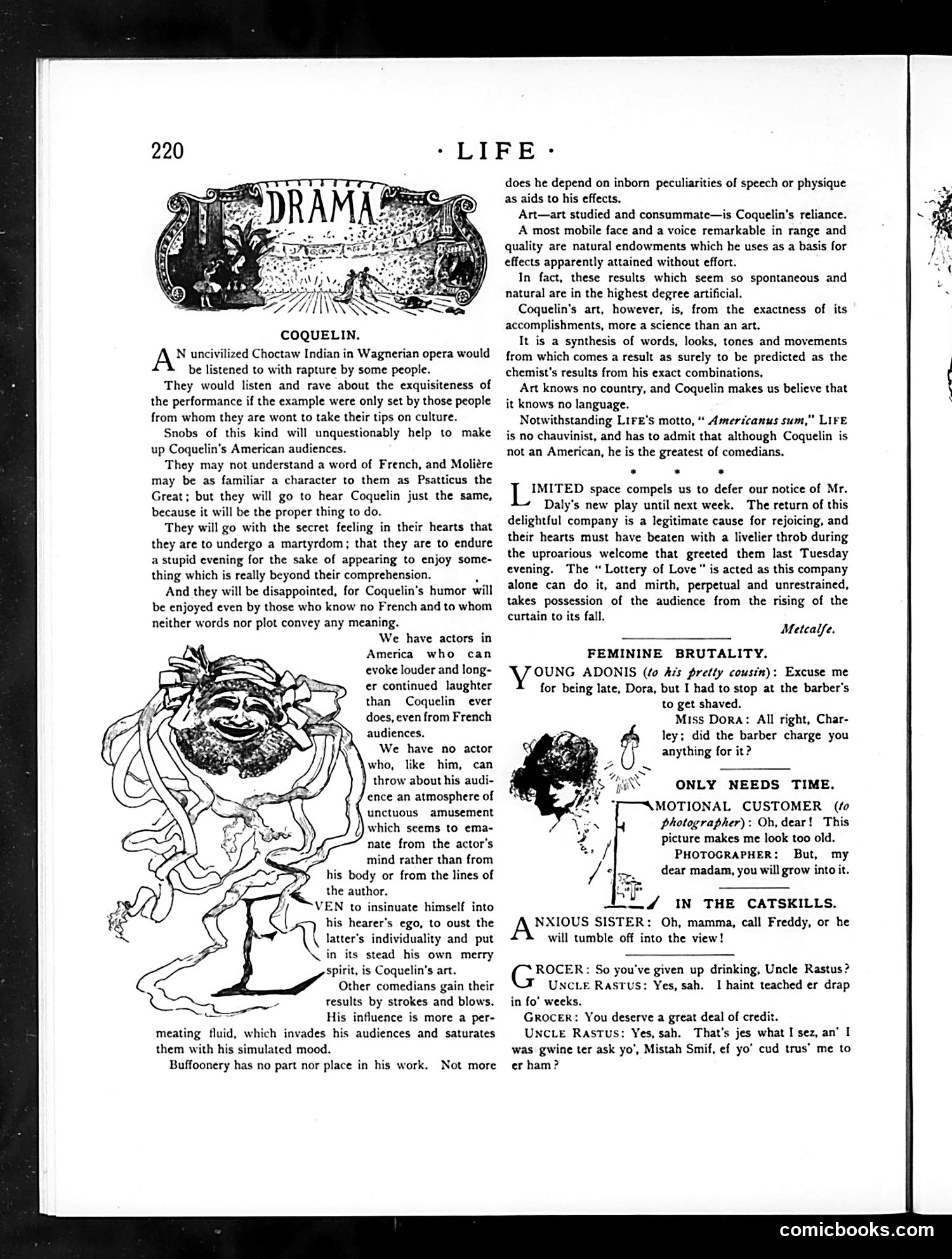
This page contains theatrical criticism and humor sketches rather than political cartoons. The main article discusses **Coquelin**, a French actor performing in Wagnerian opera. The text praises his technical mastery and mobile facial expressions, arguing his art is "synthesis of words, looks, tones and movements" rather than mere physical performance. The accompanying caricature exaggerates his expressive face grotesquely. Below are three separate comic dialogues: - "Feminine Brutality" (a woman dismisses a late suitor) - "Only Needs Time" (a photographer assures a concerned client) - "In the Catskills" (Uncle Rastus discusses quitting drinking with a grocer) These are light social humor pieces mocking everyday situations—vanity, aging, and rural dialect—typical of Life's satirical approach to American life and manners.
📄 Transcribed text from this page (OCR, searchable)
Machine-transcribed from the original scan — historical spelling and the odd misread are preserved.
- LIFE: COQUELIN. AS uncivilized Choctaw Indian in Wagnerian opera would be listened to with rapture by some people. They would listen and rave about the exquisiteness of the performance if the example were only set by those people from whom they are wont to take their tips on culture. Snobs of this kind will unquestionably help to make up Coquelin’s American audiences. They may not understand a word of French, and Moliére may be as familiar a character to them as Psatticus the Great; but they will go to hear Coquelin just the same, because it will be the proper thing to do. They will go with the secret feeling in their hearts that they are to undergo a martyrdom; that they are to endure a stupid evening for the sake of appearing to enjoy some- thing which is really beyond their comprehension. And they will be disappointed, for Coquelin's humor will be enjoyed even by those who know no French and to whom neither words nor plot convey any meaning. We have actors in America who can evoke louder and long- er continued laughter than Coquelin ever does, even from French audiences. We have no actor who, like him, can throw about his audi- ence an atmosphere of unctuous amusement which seems to ema- nate from the actor's mind rather than from his body or from the lines of the author. VEN to insinuate himself into his hearer’s ego, to oust the al latter's individuality and put in its stead his own merry spirit, is Coquelin’s art. Other comedians gain their a, results by strokes and blows. —= His influence is more a per- meating fluid, which invades his audiences and saturates them with his simulated mood. Buffoonery has no part nor place in his work. Not more does he depend on inborn peculiarities of speech or physique as aids to his effects. Art—art studied and consummate—is Coquelin’s reliance. A most mobile face and a voice remarkable in range and quality are natural endowments which he uses as a basis for effects apparently attained without effort. In fact, these results which seem so spontaneous and natural are in the highest degree artificial, Coquelin'’s art, however, is, from the exactness of its accomplishments, more a science than an art. It is a synthesis of words, looks, tones and movements from which comes a result as surely to be predicted as the chemist’s results from his exact combinations. Art knows no country, and Coquelin makes us believe that it knows no language. Notwithstanding Lrre's motto, “ Americanus sum,” LIFE is no chauvinist, and has to admit that although Coquelin is not an American, he is the greatest of comedians. IMITED space compels us to defer our notice of Mr. Daly's new play until next week. The return of this delightful company is a legitimate cause for rejoicing, and their hearts must have beaten with a livelier throb during the uproarious welcome that greeted them last Tuesday evening. The “Lottery of Love” is acted as this company alone can do it, and mirth, perpetual and unrestrained, takes possession of the audience from the rising of the curtain to its fall. Metcalfe. FEMININE BRUTALITY. OUNG ADONIS (fo kis pretly cousin): Excuse me for being late, Dora, but I had to stop at the barber's to get shaved. Miss Dora: All right, Char- ley; did the barber charge you anything for it? ONLY NEEDS TIME. MOTIONAL CUSTOMER (fo photographer): Oh, dear! This picture makes me look too old. PHOTOGRAPHER: But, my dear madam, you will grow into it. IN THE CATSKILLS. iArueus SISTER: Oh, mamma, call Freddy, or he will tumble off into the view! ROCER: So you've given up drinking, Uncle Rastus? UNCLE Rastus: Yes, sah. in fo’ weeks. Grocer: You deserve a great deal of credit. UNCLE Rastus: Yes, sah. That's jes what I sez, an’ I was. gwine ter ask yo’, Mistah Smif, ef yo’ cud trus’ me to er ham? I haint teached er drap comicbooks.com