
A complete issue · 14 pages · 1888
Life — October 11, 1888
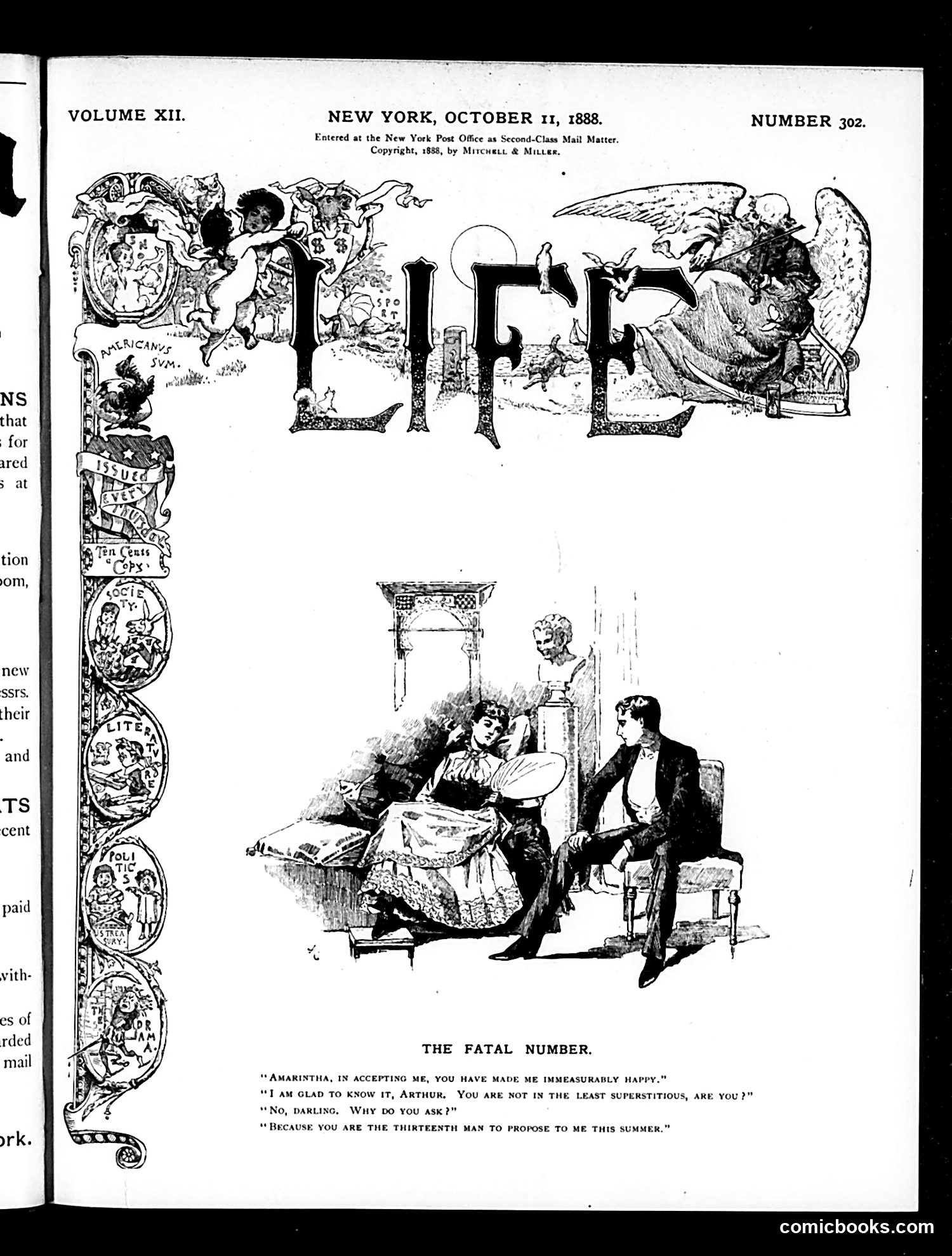
This cartoon satirizes superstitions about the number thirteen. The illustration shows a woman (Amarantha) speaking with a man (Arthur) who has just proposed to her—making him the thirteenth man to propose that summer. The woman jokes that she's accepting him despite his being number thirteen, then questions whether he's superstitious. Arthur responds that he *is* superstitious, which is precisely *why* he's asking—implying he believes proposing as the thirteenth suitor will result in bad luck for their marriage. The satire mocks Victorian-era superstitions about unlucky numbers while making a tongue-in-cheek comment about marriage prospects and courtship customs of the period.
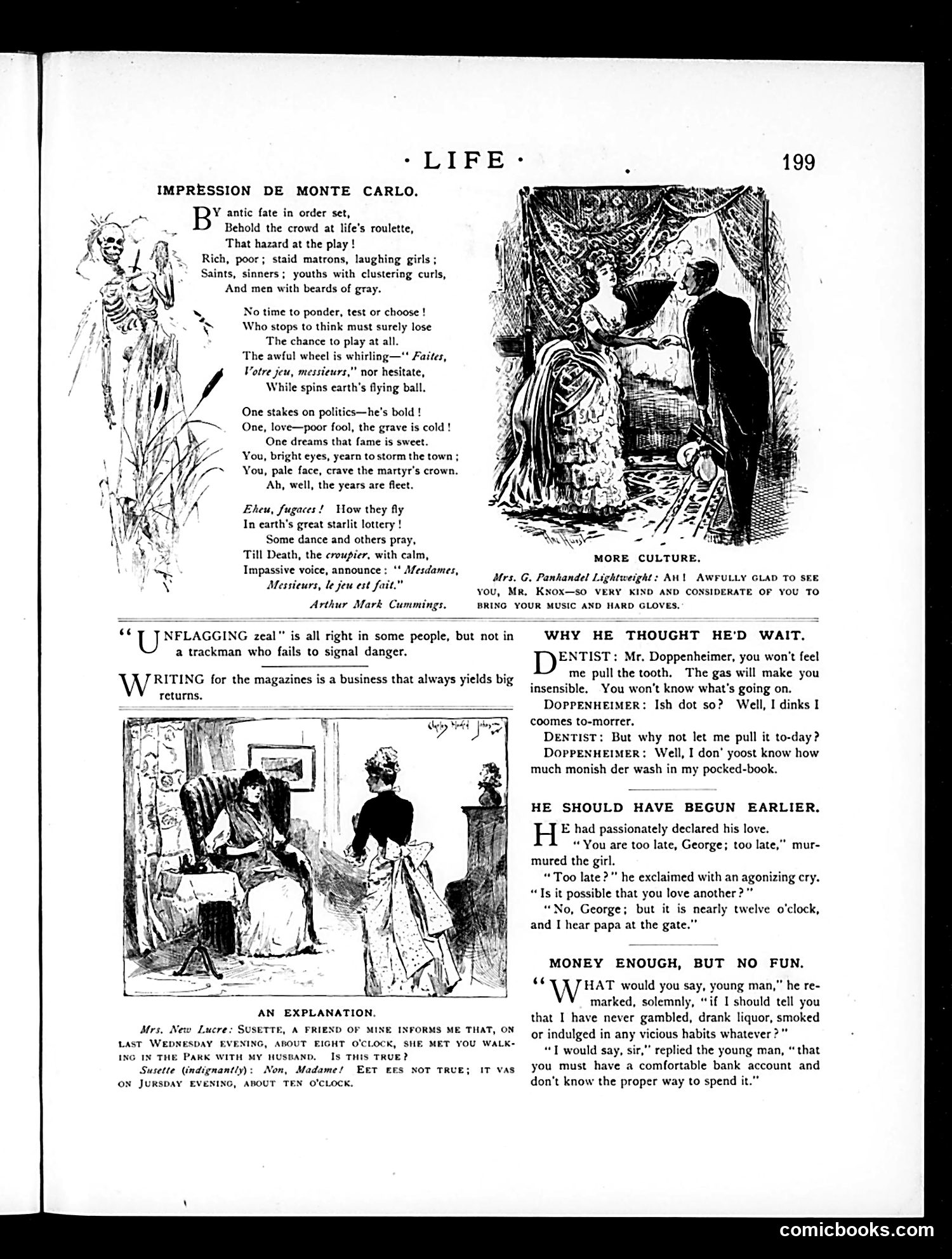
This page contains several distinct satirical pieces typical of early Life magazine humor: **"Impression de Monte Carlo"** (top left): A poem mocking the gambling culture and social chaos at the famous casino, with an accompanying skeleton illustration representing Death/fate. **"More Culture"** (top right): A brief sketch satirizing pretentious social gatherings, where a woman invites a man to bring "music and hard gloves"—likely mocking affected cultural pretensions. **The remaining stories** ("Why He Thought He'd Wait," "He Should Have Begun Earlier," "Money Enough, But No Fun") are domestic humor pieces about courtship, dentistry, and financial propriety—common Life magazine fare targeting middle-class social anxieties. The accompanying illustration shows a magazine office scene, satirizing the publishing business itself. The overall page reflects Life's focus on mocking social pretension, leisure-class excess, and Victorian courtship conventions.
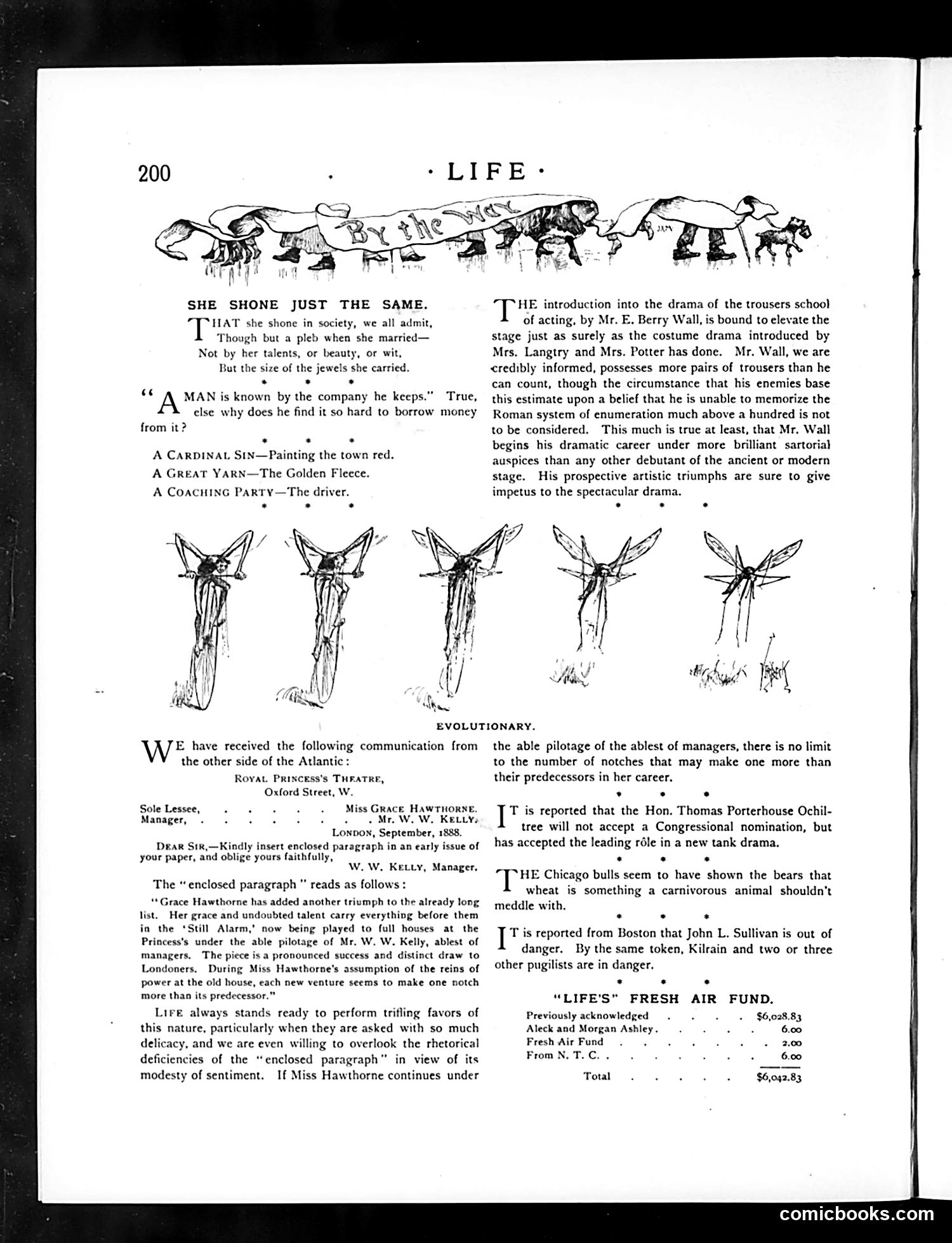
This page contains theatrical commentary and social satire rather than political cartoons. The main text discusses Mr. E. Berry Wall's introduction of "trousers school" acting techniques to the stage, comparing his dramatic innovations to costume reforms by earlier producers. The five ink sketches labeled "EVOLUTIONARY" appear to show the progressive development of a figure or form—possibly depicting theatrical or fashion evolution, though the specific reference is unclear from the image alone. The page also includes theater gossip: praise for actress Grace Hawthorne's performances at the Princess's theatre, a note about Thomas Porterhouse Ochiltree declining a role, and a comment on Chicago's financial markets ("Chicago bulls" and "bears"). The "Life's Fresh Air Fund" box shows charitable donations collected by the magazine.
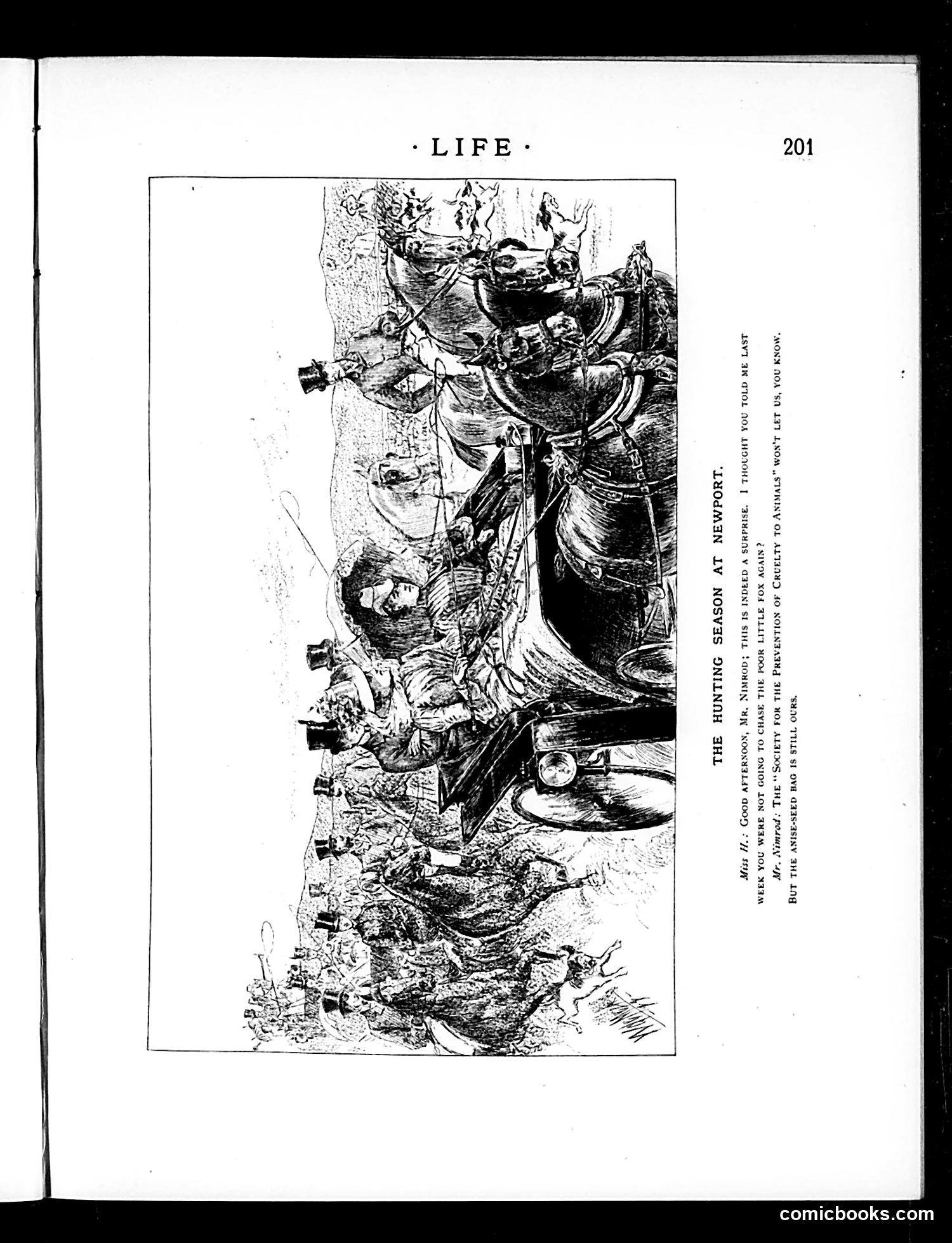
This satirical cartoon depicts wealthy socialites engaged in what appears to be a hunting or sport activity at Newport, Rhode Island—the exclusive resort destination for America's richest families. The caption's title puns on "hutting" (likely a sport like golf or polo), playing on "hunting season." The detailed illustration shows elegantly dressed figures in an exaggerated, frenzied scene of activity and competition. The satire likely mocks Newport's leisure class—their pretentious sporting pursuits, competitive social climbing, and excess. The chaotic composition suggests the undignified scramble beneath high-society's refined facade. This reflects Life magazine's regular criticism of Gilded Age wealth disparity and aristocratic American culture during the early 20th century.
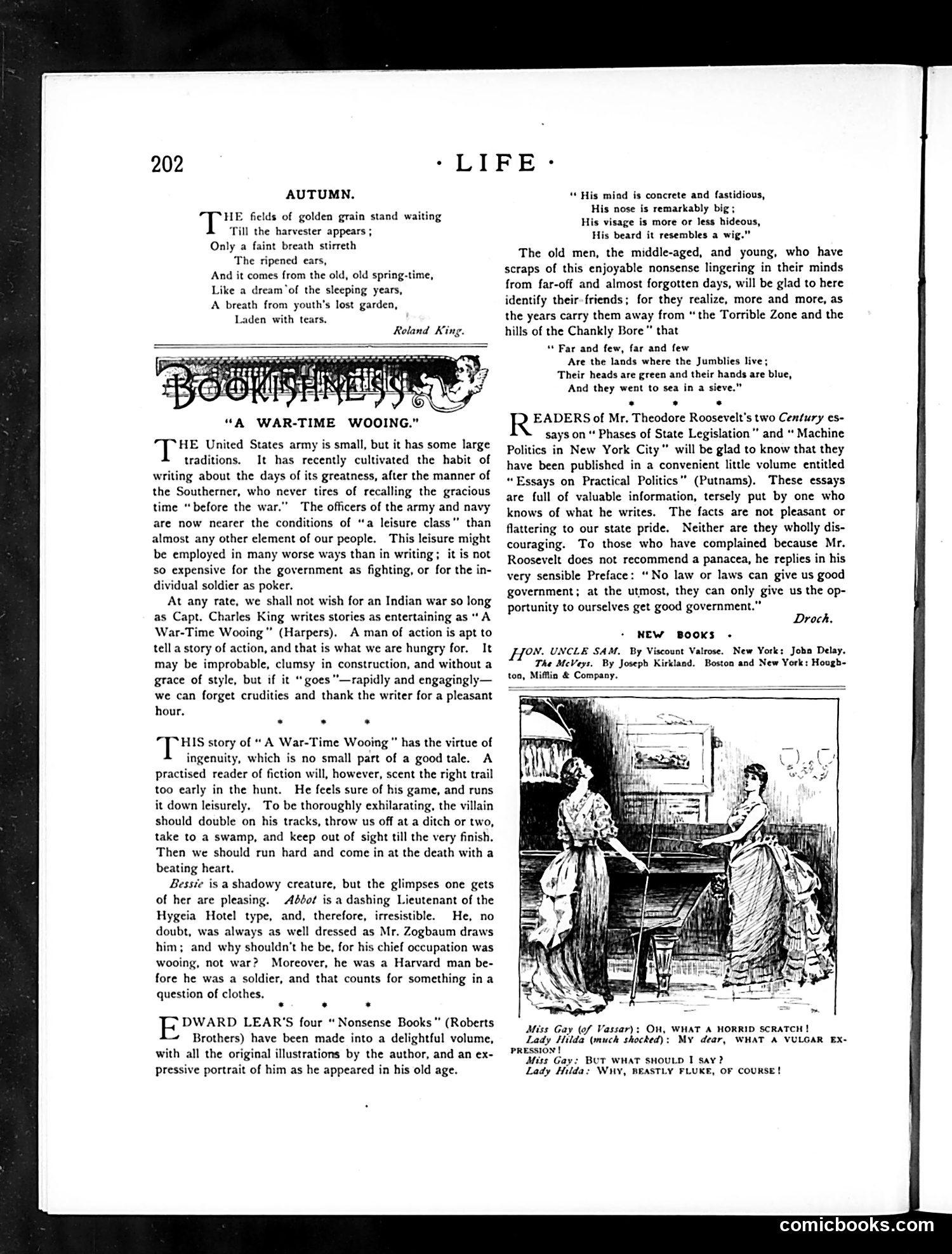
This page contains literary reviews and advertisements rather than political cartoons. The main illustration shows two women in what appears to be a parlor scene, with dialogue indicating social comedy about etiquette and propriety. One woman exclaims "Oh, what a horrid scratch!" while the other responds defensively about a "vulgar expression." The page reviews several books, including Theodore Roosevelt's essays on politics and Charles King's war stories. The text praises works that entertain without being preachy, and commends Roosevelt's practical approach to government. The illustration's humor derives from period-specific social conventions around "proper" speech and behavior among women—a common satirical target of Life magazine during this era, likely early 1900s based on the aesthetic and Roosevelt references.
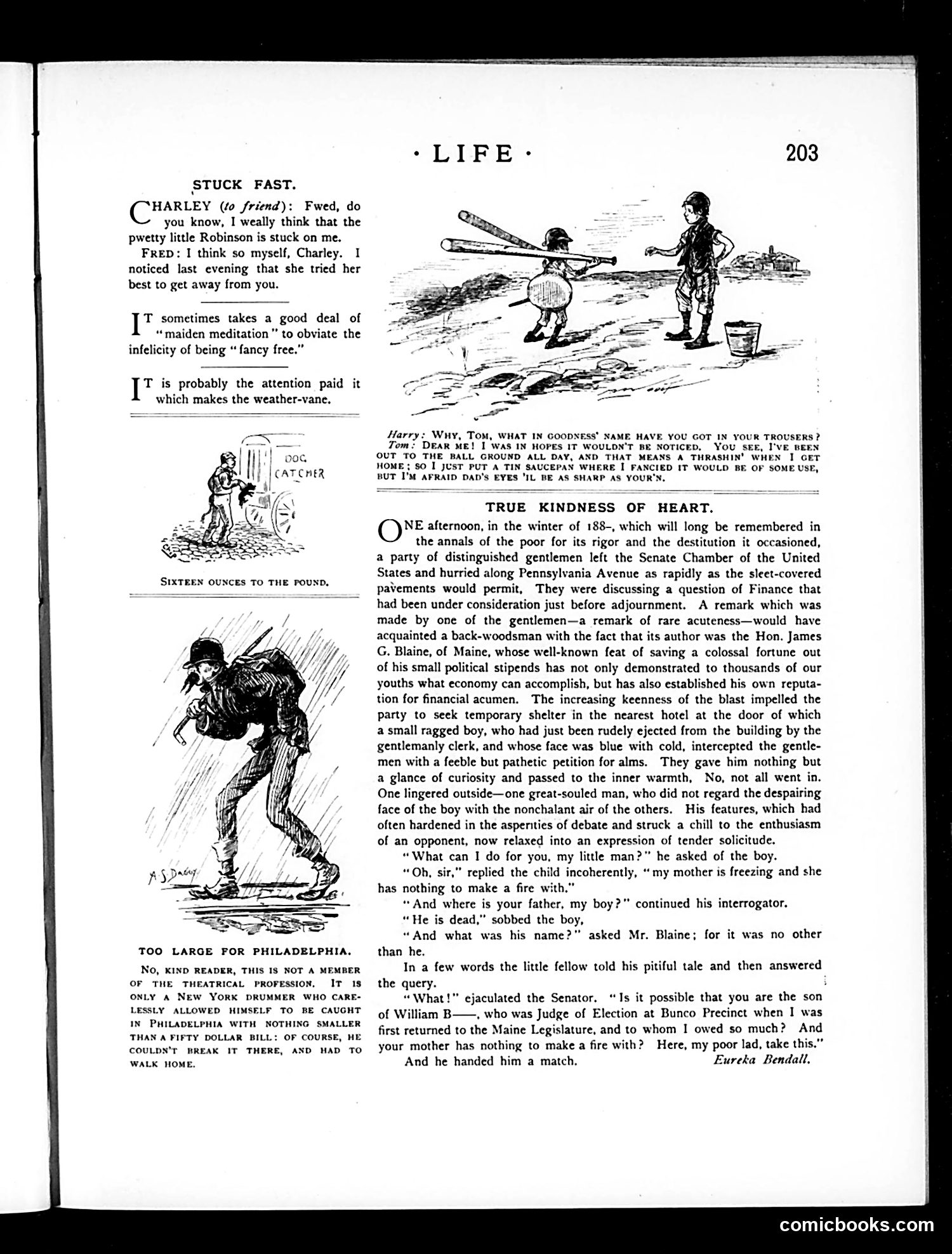
This page contains three distinct sections: **"Stuck Fast"** presents a brief dialogue between Charley and Fred about romantic entanglement, accompanied by observations on procrastination and weather vanes. **The main story, "True Kindness of Heart,"** describes an 1888 winter incident in Washington where Senator James G. Blaine of Maine encounters a impoverished boy outside the Senate Chamber. The boy's mother is freezing without fuel. Rather than give charity directly, Blaine identifies the boy as the son of a former political rival (Judge William B—), then provides a match—forcing the boy to seek help himself. The satire criticizes performative charity and political posturing disguised as kindness. The accompanying illustrations show poverty and social hardship typical of Gilded Age commentary. Blaine was a prominent late-19th-century Republican politician, making this a pointed critique of wealthy politicians' selective benevolence.
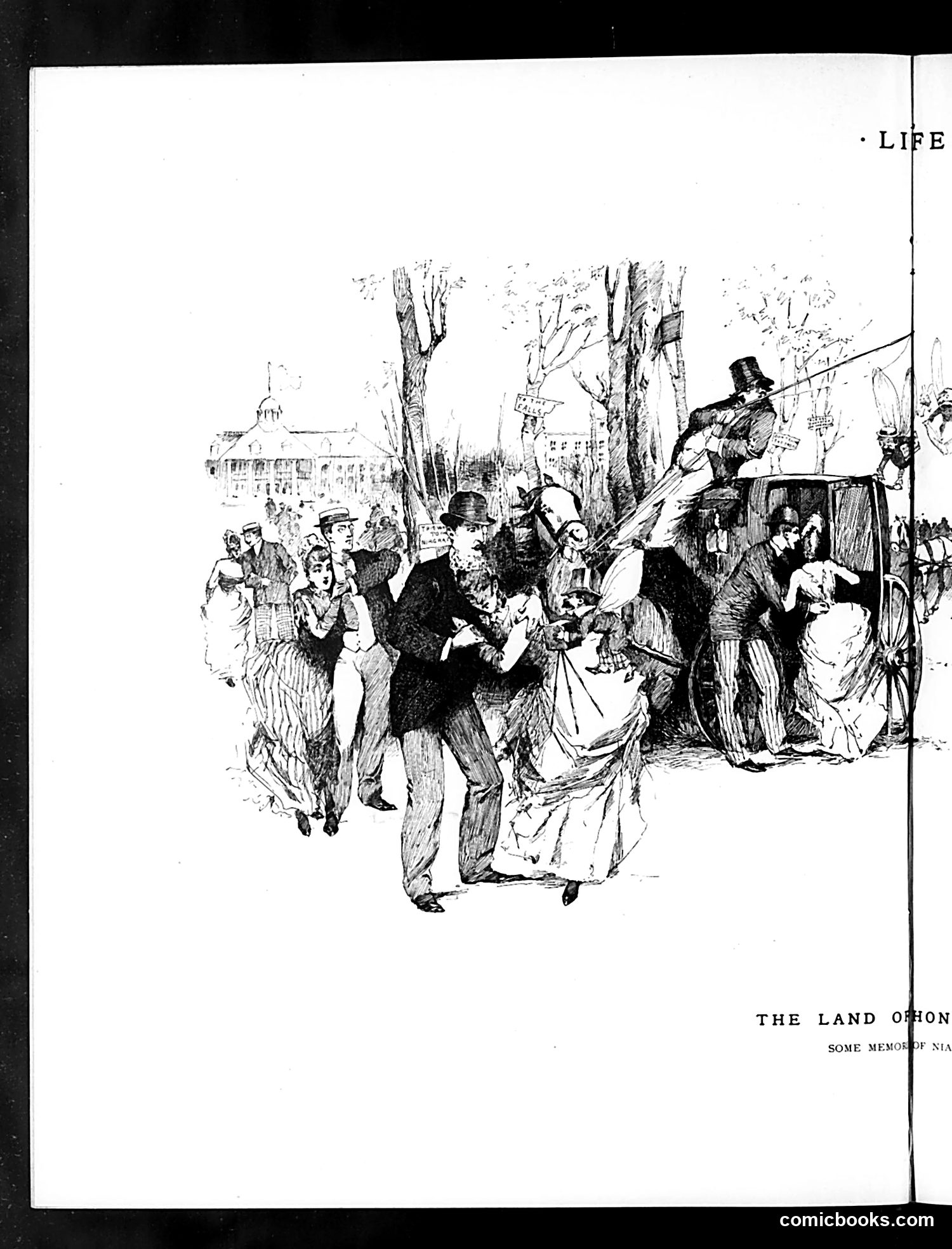
This appears to be a title page or section opener from *Life* magazine featuring a satirical sketch. The illustration depicts a crowded public gathering or carnival scene with well-dressed figures in 19th-century attire. A man in a top hat stands prominently on what appears to be a platform or stage on the right side, gesturing dramatically to the assembled crowd below. The partial text reads "THE LAND OF..." with additional text mentioning "SOME MEMO[IRS] OF NIA[...]" (likely cut off). Without the complete title or publication date visible, I cannot definitively identify the specific political figure, event, or satirical target. The scene suggests commentary on public spectacle, politics, or social gathering, typical of *Life*'s satirical approach, but the exact reference remains unclear from this partial page.
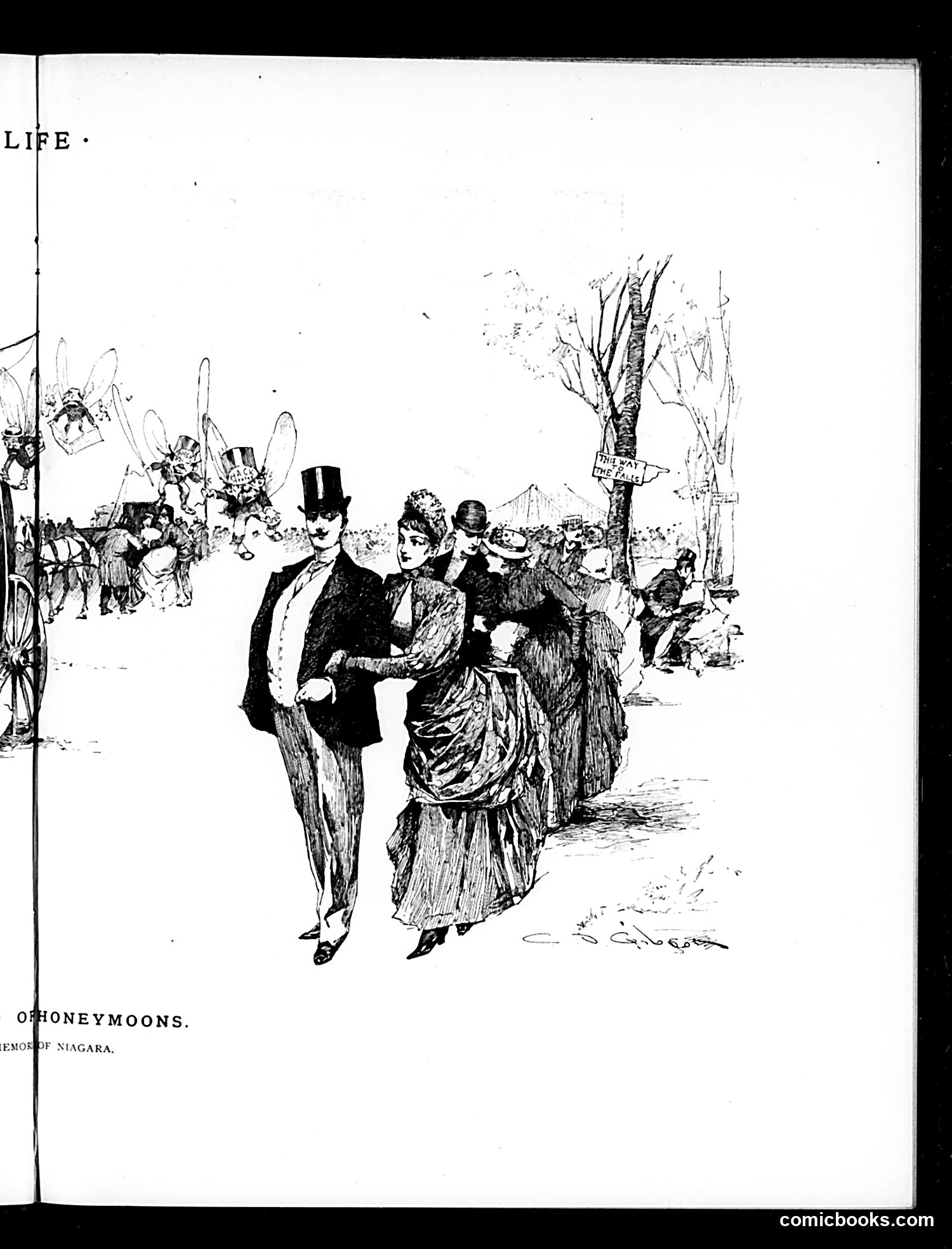
This pen-and-ink illustration depicts fashionably dressed couples promenading, likely at Niagara Falls (referenced in the partially visible OCR text "EMOR OF NIAGARA"). The page satirizes the Victorian-era tradition of honeymoon tourism, showing well-to-do newlyweds in formal attire parading publicly at this famous tourist destination. The satire targets the performative nature of honeymoons—the couples appear self-conscious and staged rather than intimate, walking among crowds of observers. The elaborate clothing and top hats suggest upper-class pretension. The work mocks how honeymoons functioned as public displays of wealth and social status rather than private romantic occasions, reflecting broader 19th-century social commentary on marriage customs among the affluent.
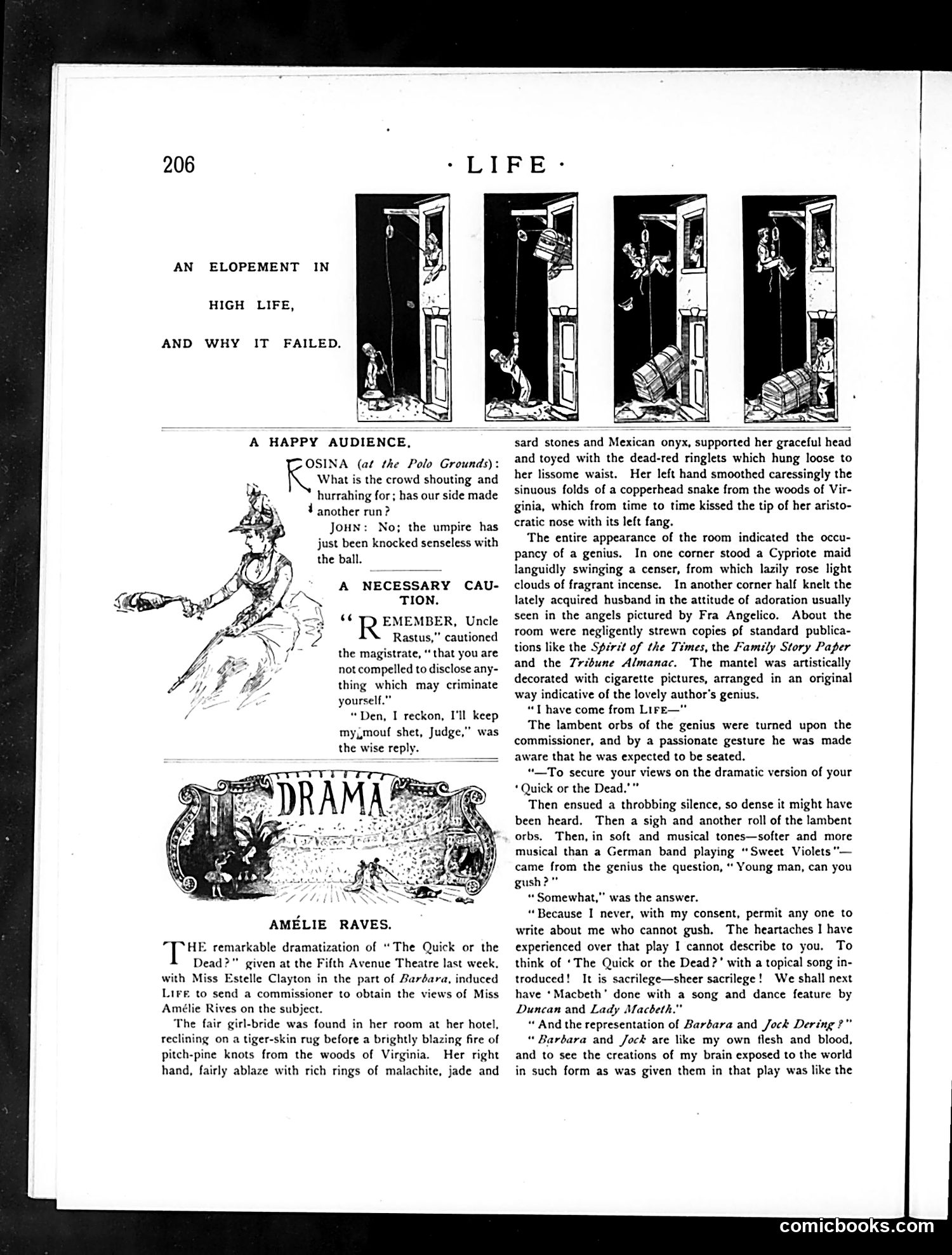
This page contains drama criticism rather than political satire. The main subject is a theatrical review of "The Quick or the Dead?" performed at the Fifth Avenue Theatre, starring Estelle Clayton as Barbara. The cartoon titled "A Happy Audience" depicts a polo player and appears illustrative rather than satirical—likely commenting on the wealthy leisure class attending such productions. The text criticizes the play's dramatization, with "Uncle Rastus" offering legal caution about disclosure. The review discusses the theatrical setting, costumes, and props in detail, praising the actress's performance and the play's artistic merit. This is primarily **theater criticism and gossip** aimed at Life's educated, upper-class readership interested in Broadway productions, not political commentary.
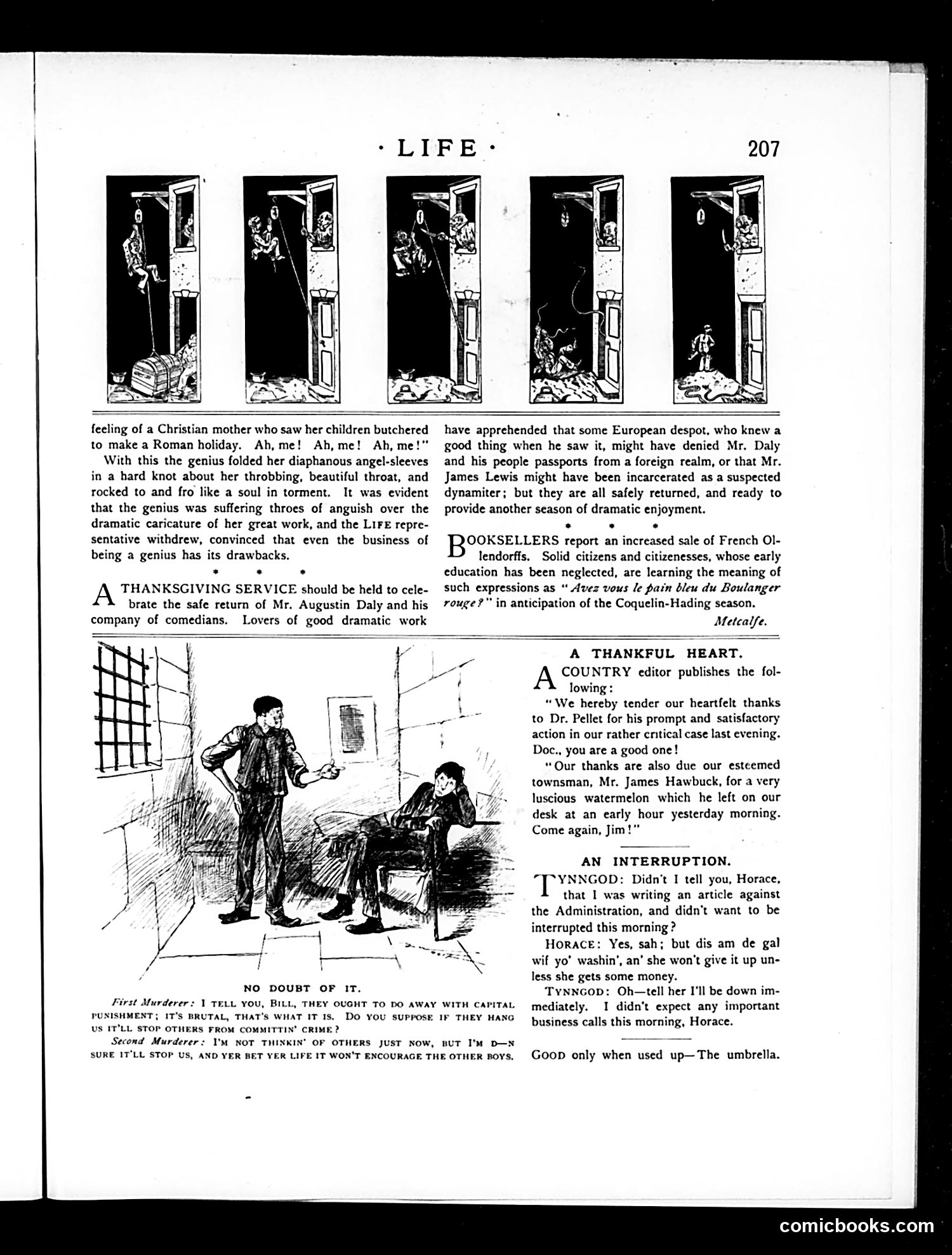
This page contains several distinct satirical pieces: **Top section**: Mocks a dramatic genius lamenting her work's caricature, suggesting even talented artists suffer professional disappointments. **"Thanksgiving Service"**: Celebrates the safe return of theatrical producer Augustin Daly and actor James Lewis from Europe, sarcastically implying European despots might have imprisoned them or denied passports—likely referencing contemporary anxieties about European political instability. **"No Doubt of It"**: Two murderers debate capital punishment. The joke satirizes criminal logic: they oppose execution as deterrent for *others*, but confidently assert it won't encourage *their own* crimes—revealing the absurd self-interest of criminals. **"An Interruption"**: A man writing anti-Administration rhetoric is interrupted by his laundress demanding payment, humorously deflating his political righteousness with domestic financial obligation. These pieces mock political posturing, artistic pretension, and criminal reasoning through everyday situations.
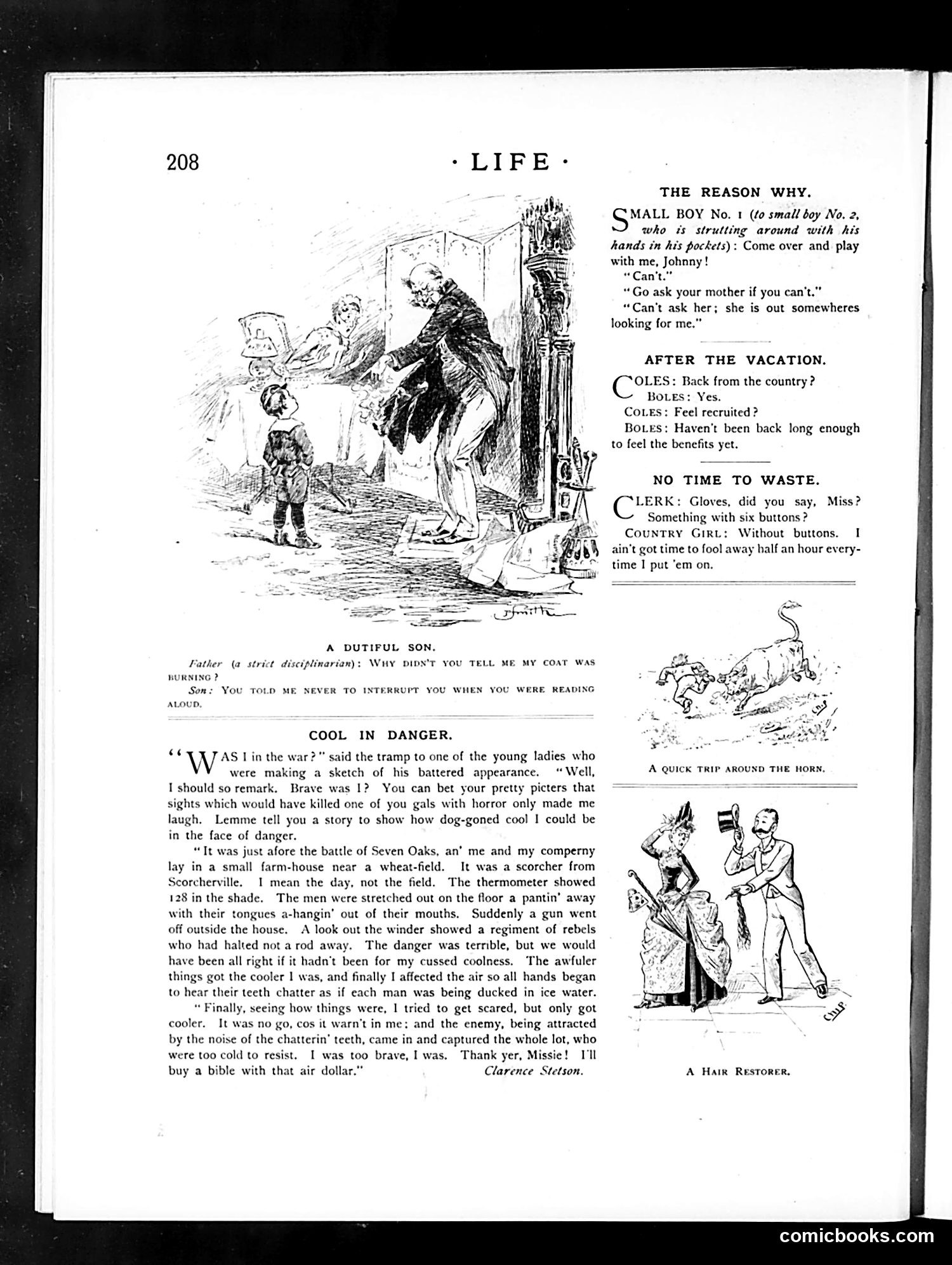
This page collects brief humorous sketches typical of *Life* magazine's satirical format. The jokes target everyday social absurdities: **"The Reason Why"** mocks parental neglect—a mother so preoccupied she's lost track of her own child. **"After the Vacation"** jokes about countryside visits failing to restore health despite their reputation. **"No Time to Waste"** satirizes modern impatience: a country girl refuses gloves requiring frequent buttoning, valuing efficiency over fashion. **"A Dutiful Son"** plays on strict parental discipline—a boy obeys his father's rule against interruption so literally he doesn't warn him his coat is burning. **"Cool in Danger"** features a tramp bragging to young ladies about Civil War service. His story—where his excessive composure literally froze his men into capture—is absurdist humor mocking both military braggadocio and the tall tale tradition. These reflect *Life*'s focus on middle-class social pretensions and behavioral ironies rather than political commentary.
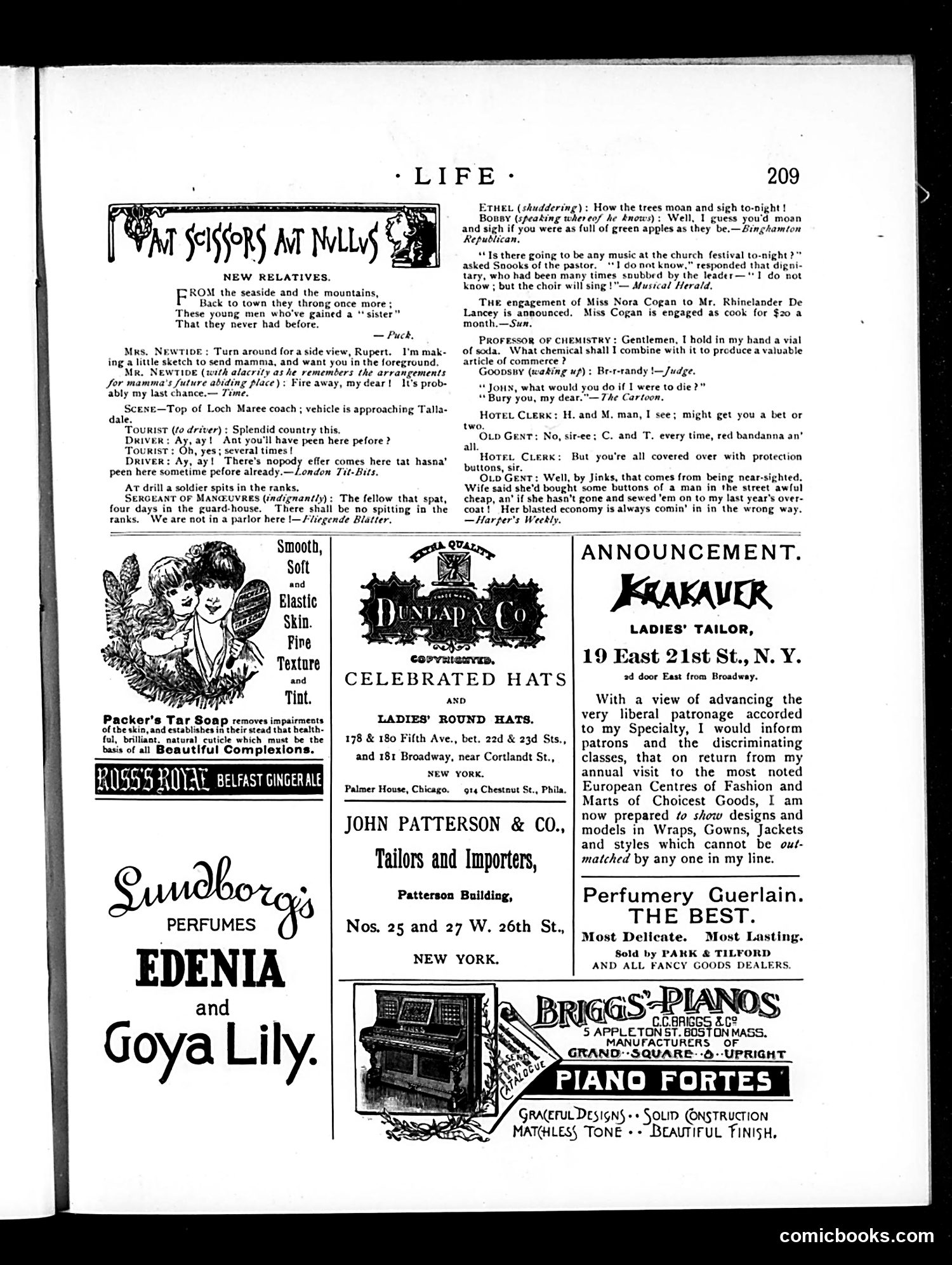
This page consists primarily of **short humorous anecdotes and advertisements** rather than political cartoons. The jokes reflect turn-of-the-century social humor: - **"New Relatives"**: Satirizes young men gaining sisters-in-law through marriage, with a husband's anxious quip about it being his "last chance" before his wife's sketch-sending to her mother. - **Tourist/Driver exchange**: Plays on Scottish dialect and the idea that remote Highland locations have repeat visitors. - **Military discipline**: A sergeant punishes spitting in ranks as unsoldierly conduct. - **Social satire**: A joke about Miss Nora Cogan's "engagement" as a cook (not marriage), mocking high-society pretension. - **Chemistry class**: A student's irreverent answer about combining chemicals with brandy. The page is **mostly advertising** (Packer's Tar Soap, Dunlap Hats, Briggs Pianos, perfume, tailoring services), interspersed with these brief, mild jokes typical of Life's satirical humor magazine format.
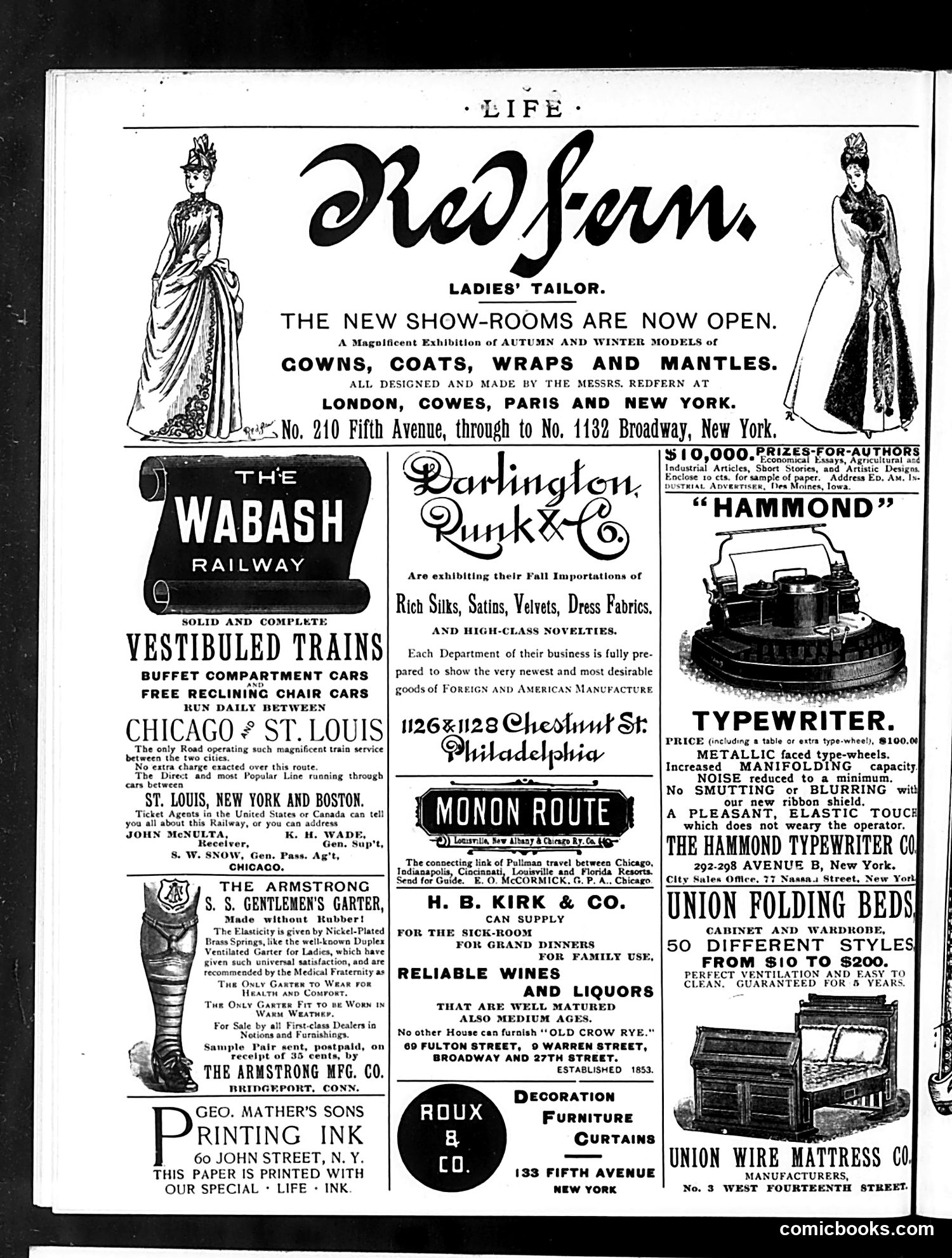
This is **primarily an advertising page** with no political cartoons or satirical content. It consists entirely of late-19th-century commercial advertisements. The page showcases period products and services: Red Fern ladies' fashion tailoring; the Wabash Railway promoting vestibuled train service between Chicago and St. Louis; Armstrong brand gentlemen's garters (emphasizing nickel-plated brass springs); the Hammond typewriter (highlighting reduced noise and improved manifolding); Union folding beds and wire mattresses; and various other goods including wines, printing ink, and fabric imports. The ads reflect contemporary consumer concerns: railway comfort and convenience, fashion, health-conscious undergarments, and emerging office technology. The Hammond typewriter advertisement is particularly notable as typewriters were still relatively new business machines. No satire or political commentary is present—this is a straightforward commercial publication page typical of Life magazine's revenue model.