
Life, 1888-10-11 · page 2 of 14
Life — October 11, 1888 — page 2: what you’re looking at
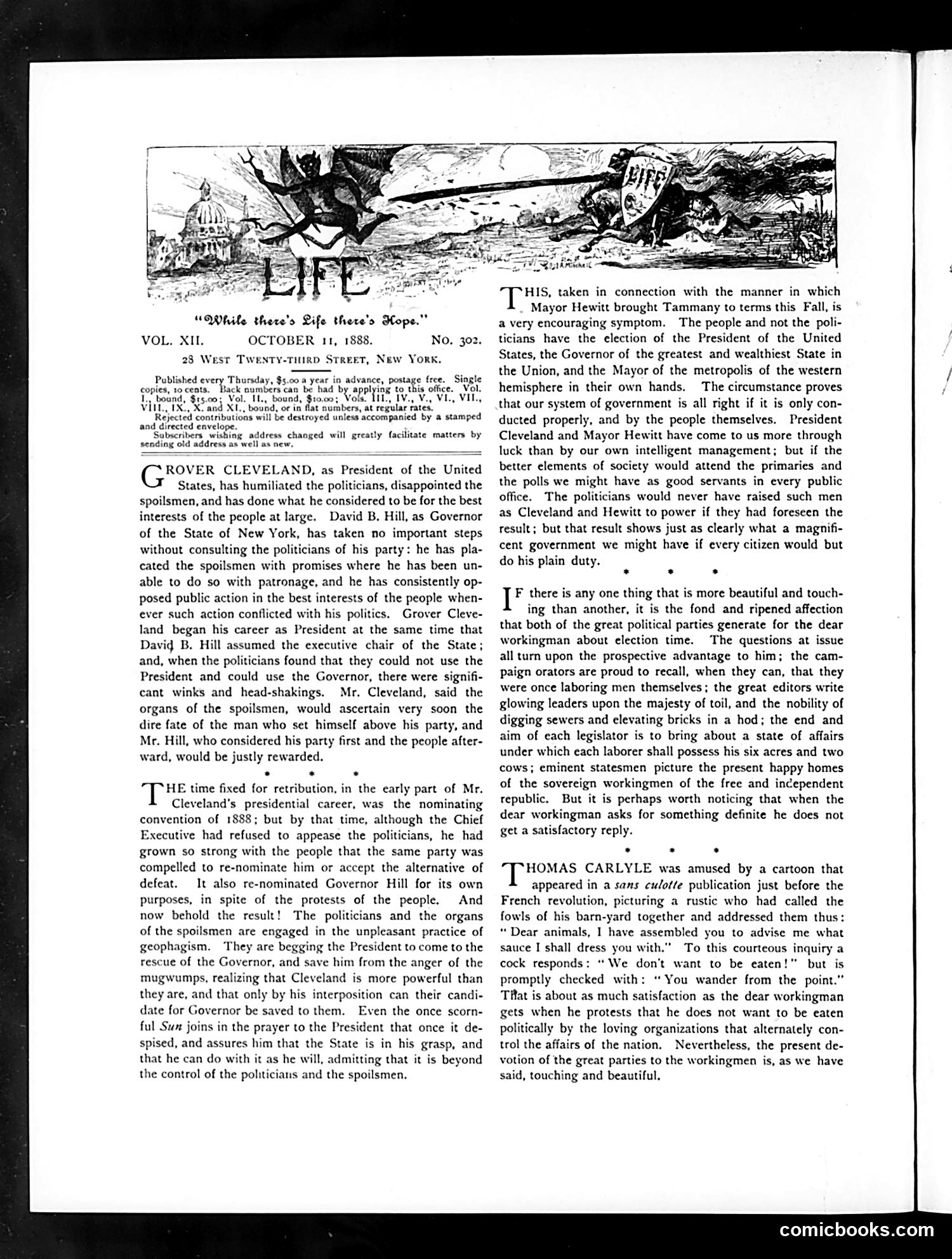
A restored page from Life, 1888-10-11. Page through the whole issue in the reader above.
📄 Transcribed text from this page (OCR, searchable)
Machine-transcribed from the original scan — historical spelling and the odd misread are preserved.
“Mile there's Life there's Hope.” XIL. OCTOBER 11, 1888. No, 302. 28 West Twenty-THIRD STREET, New York. VOL. Published every Thursday, $3.00 a year in advance, postage free. Single copies, 19 ceats. Back numbers tan be had ‘by applying to this ofice. Vol. bound, $15.004 Vol. I1-, bound, $10.00; TS 1V.,'¥. Vi, Vil, vin, X. and XI., bound, of in flat numbers, at au’ Fates. Wcjected contributions will be destroyed unless accompanied by a stamped and directed envelope. Subscribers wishing address changed will greatly facilitate matters by sending old address as well as ne ROVER CLEVELAND, as President of the United States, has humiliated the politicians, disappointed the spoilsmen, and has done what he considered to be for the best interests of the people at large. David B. Hill, as Governor of the State of New York, has taken no important steps without consulting the politicians of his party: he has pla- cated the spoilsmen with promises where he has been un- able to do so with patronage, and he has consistently op- posed public action in the best interests of the people when- ever such action conflicted with his politics. Grover Cleve- land began his career as President at the same time that David B. Hill assumed the executive chair of the State; and, when the politicians found that they could not use the President and could use the Governor, there were signifi- cant winks and head-shakings. Mr. Cleveland, said the organs of the spoilsmen, would ascertain very soon the dire fate of the man who set himself above his party, and Mr. Hill, who considered his party first and the people after- ward, would be justly rewarded. . . * HE time fixed for retribution, in the early part of Mr. Cleveland's presidential career, was the nominating convention of 1888; but by that time, although the Chief Executive had refused to appease the politicians, he had grown so strong with the people that the same party was compelled to re-nominate him or accept the alternative of defeat. It also re-nominated Governor Hill for its own purposes, in spite of the protests of the people. And now behold the result! The politicians and the organs of the spoilsmen are engaged in the unpleasant practice of geophagism. ‘They are begging the President to come to the rescue of the Governor, and save him from the anger of the mugwumps, realizing that Cleveland is more powerful than they are, and that only by his interposition can their candi- date for Governor be saved to them. Even the once scorn- ful Sux joins in the prayer to the President that once it de- spised, and assures him that the State is in his grasp, and that he can do with it as he will, admitting that it is beyond the control of the politicians and the spoilsmen. HIS, taken in connection with the manner in which Mayor Hewitt brought Tammany to terms this Fall, is a very encouraging symptom. The people and not the poli- ticians have the election of the President of the United States, the Governor of the greatest and wealthiest State in the Union, and the Mayor of the metropolis of the western hemisphere in their own hands. The circumstance proves that our system of government is all right if it is only con- ducted properly, and by the people themselves. President Cleveland and Mayor Hewitt have come to us more through luck than by our own intelligent management; but if the better elements of society would attend the primaries and the polls we might have as good servants in every public office. The politicians would never have raised such men as Cleveland and Hewitt to power if they had foreseen the result; but that result shows just as clearly what a magnifi- cent government we might have if every citizen would but do his plain duty. . . F there is any one thing that is more beautiful and touch- ing than another, it is the fond and ripened affection that both of the great political parties generate for the dear workingman about election time. The questions at issue all turn upon the prospective advantage to him; the cam- paign orators are proud to recall, when they can, that they were once laboring men themselves; the great editors write glowing leaders upon the majesty of toil, and the nobility of digging sewers and elevating bricks in a hod; the end and aim of each legislator is to bring about a state of affairs under which each laborer shall possess his six acres and two cows; eminent statesmen picture the present happy homes of the sovereign workingmen of the free and incependent republic. But it is perhaps worth noticing that when the dear workingman asks for something definite he does not get a satisfactory reply. . . * HOMAS CARLYLE was amused by a cartoon that appeared in a sans culotte publication just before the French revolution, picturing a rustic who had called the fowls of his barn-yard together and addressed them thus: “ Dear animals, I have assembled you to advise me what sauce I shall dress you with.” To this courteous inquiry a cock responds: “*We don't want to be eaten!" but is promptly checked with: “ You wander from the point.” Tftat is about as much satisfaction as the dear workingman gets when he protests that he does not want to be eaten politically by the loving organizations that alternately con- trol the affairs of the nation. Nevertheless, the present de- votion of the great parties to the workingmen is, as we have said, touching and beautiful, comicbooks.com