
Life, 1888-10-11 · page 6 of 14
Life — October 11, 1888 — page 6: what you’re looking at
What you’re looking at
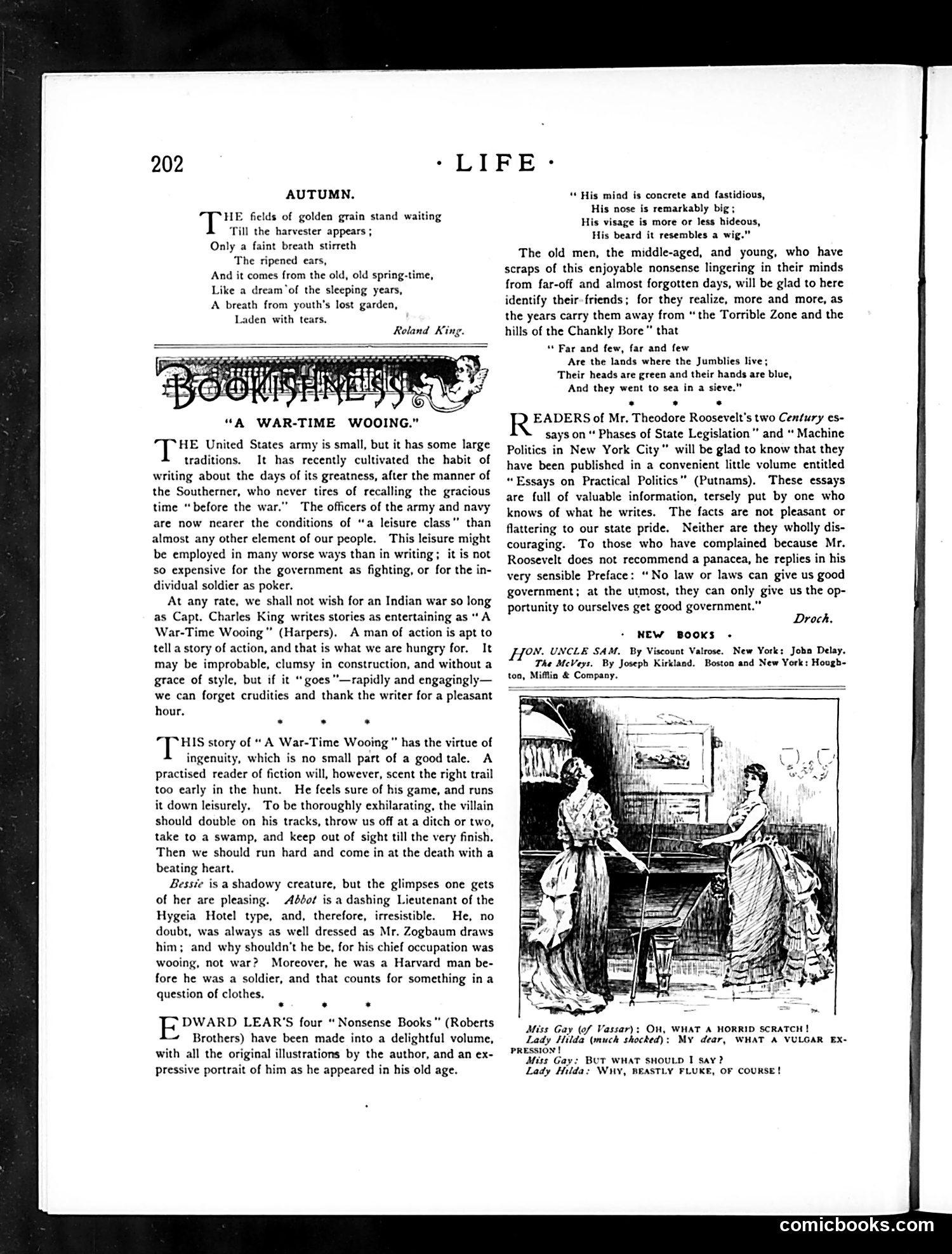
This page contains literary reviews and advertisements rather than political cartoons. The main illustration shows two women in what appears to be a parlor scene, with dialogue indicating social comedy about etiquette and propriety. One woman exclaims "Oh, what a horrid scratch!" while the other responds defensively about a "vulgar expression." The page reviews several books, including Theodore Roosevelt's essays on politics and Charles King's war stories. The text praises works that entertain without being preachy, and commends Roosevelt's practical approach to government. The illustration's humor derives from period-specific social conventions around "proper" speech and behavior among women—a common satirical target of Life magazine during this era, likely early 1900s based on the aesthetic and Roosevelt references.
📄 Transcribed text from this page (OCR, searchable)
Machine-transcribed from the original scan — historical spelling and the odd misread are preserved.
- LIFE: AUTUMN. HE fields of golden grain stand waiting Till the harvester appears ; Only a faint breath stirreth The ripened ears, And it comes from the old, old spring-time, Like a dream’of the sleeping years, A breath from youth's lost garden, Laden with tears, Roland King. “A WAR-TIME WOOING.” ‘| United States army is small, but it has some large traditions. It has recently cultivated the habit of writing about the days of its greatness, after the manner of the Southerner, who never tires of recalling the gracious time “before the war.” The officers of the army and navy are now nearer the conditions of “a leisure class" than almost any other element of our people. This leisure might be employed in many worse ways than in writing; it is not so expensive for the government as fighting, or for the in- dividual soldier as poker. At any rate, we shall not wish for an Indian war so long as Capt. Charles King writes stories as entertaining as “A War-Time Wooing" (Harpers). A man of action is apt to tell a story of action, and that is what we are hungry for. It may be improbable, clumsy in construction, and without a gtace of style, but if it “goes "—rapidly and engagingly— we can forget crudities and thank the writer for a pleasant hour. . . . HIS story of * A War-Time Wooing" has the virtue of ingenuity, which is no small part of a good tale. A practised reader of fiction will, however, scent the right trail too early in the hunt. He feels sure of his game, and runs it down leisurely, To be thoroughly exhilarating, the villain should double on his tracks, throw us off at a ditch or two, take to a swamp, and keep out of sight till the very finish. Then we should run hard and come in at the death with a beating heart. Bessie is a shadowy creature, but the glimpses one gets of her are pleasing. Adéot is a dashing Lieutenant of the Hygeia Hotel type, and, therefore, irresistible. He, no doubt, was always as well dressed as Mr. Zogbaum draws him; and why shouldn't he be, for his chief occupation was wooing, not war? Moreover, he was a Harvard man be- fore he was a soldier, and that counts for something ina question of clothes. . . . DWARD LEAR'S four “ Nonsense Books” (Roberts Brothers) have been made into a delightful volume, with all the original illustrations by the author, and an ex- pressive portrait of him as he appeared in his old age. “* His mind is concrete and fastidious, His nose is remarkably big; His visage is more or less hideous, His beard it resembles a wig.” The old men, the middle-aged, and young, who have scraps of this enjoyable nonsense lingering in their minds from far-off and almost forgotten days, will be glad to here identify their-friends; for they realize, more and more, as the years carry them away from “the Torrible Zone and the hills of the Chankly Bore" that “ Far and few, far and few Are the lands where the Jumblies live ; Their heads are green and their hands are blue, And they went to sea in a sieve.” . . . EADERS of Mr. Theodore Roosevelt's two Century es- says on “ Phases of State Legislation” and “ Machine Politics in New York City” will be glad to know that they have been published in a convenient little volume entitled “Essays on Practical Politics” (Putnams). These essays are full of valuable information, tersely put by one who knows of what he writes. The facts are not pleasant or flattering to our state pride. Neither are they wholly dis- couraging. To those who have complained because Mr. Roosevelt does not recommend a panacea, he replies in his very sensible Preface: “No law or laws can give us good government; at the utmost, they can only give us the op- portunity to ourselves get good government.” Drock. + NEW BooKs - F{ON. UNCLE SAM. By Viscount Valrose. New York: Joba Delay, The McVeys. By Joseph Kirkland. Boston and New York: Hough- ton, Miflin & Company. Miss Gay (of Vassar): OW, WHAT A HORRID SCRATCH ! Lady Hilda (much shocked): MY dear, WHAT A VULGAR EX- PRESSION! Miss Gay: BUT WHAT SHOULD I say? Lady Hilda: WHY, BEASTLY FLUKE, OF COURSE! comicbooks.com