
A complete issue · 14 pages · 1888
Life — August 16, 1888
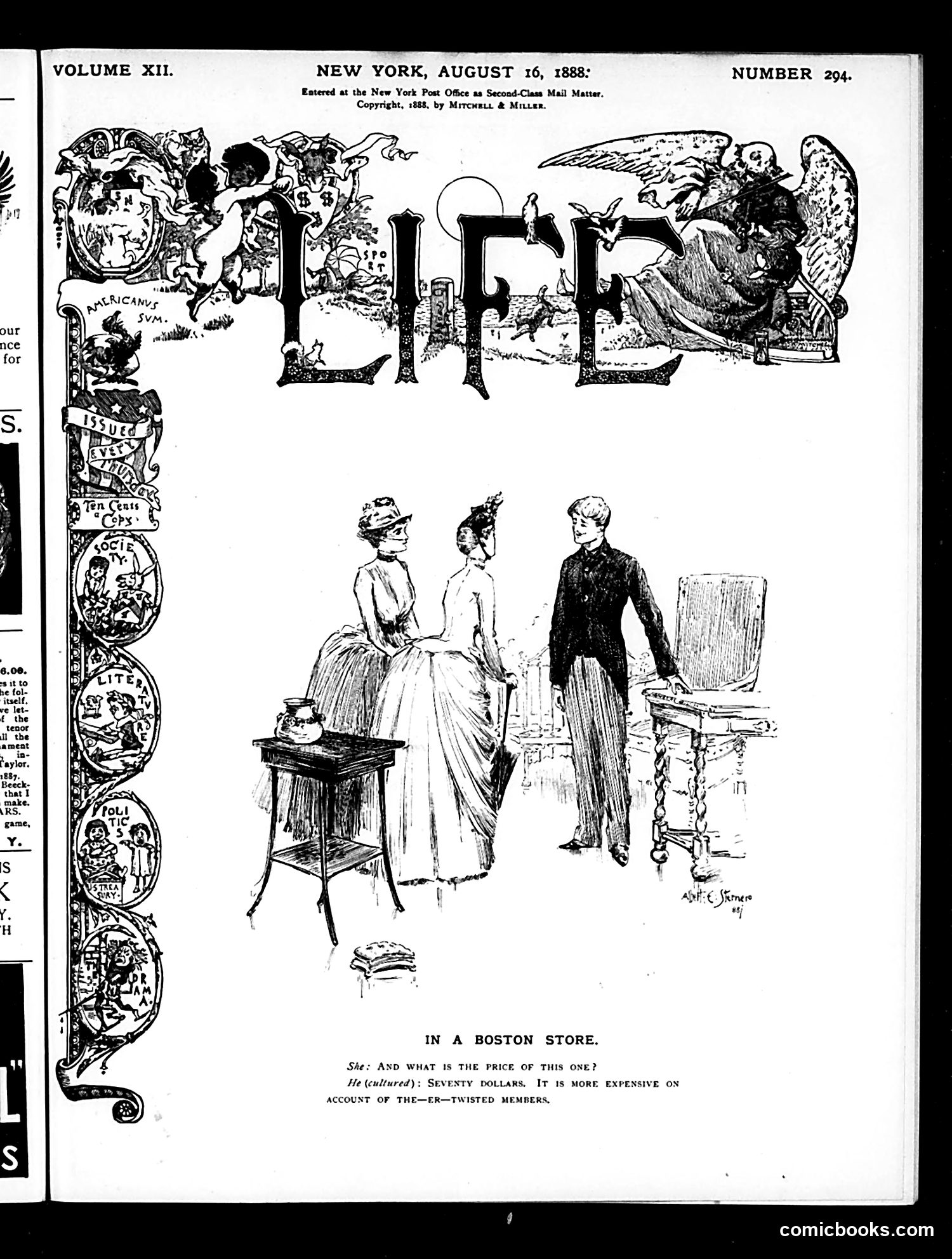
This page contains a single cartoon titled "IN A BOSTON STORE." It depicts three figures examining what appears to be a twisted or contorted piece of fabric or garment. A woman asks about its price; a male salesman responds that it costs "seventy dollars" and is "more expensive on account of the—er—twisted members." The satire likely mocks either: 1. **Excessive pricing** for defective goods, or 2. **Women's fashion** and the absurdity of corsets or twisted garments marketed as desirable luxury items The humor relies on the salesman's awkward euphemism ("twisted members") and the implication that customers will pay premium prices for poor quality. The specific Boston location may reference that city's reputation for commerce or refined taste during this era.
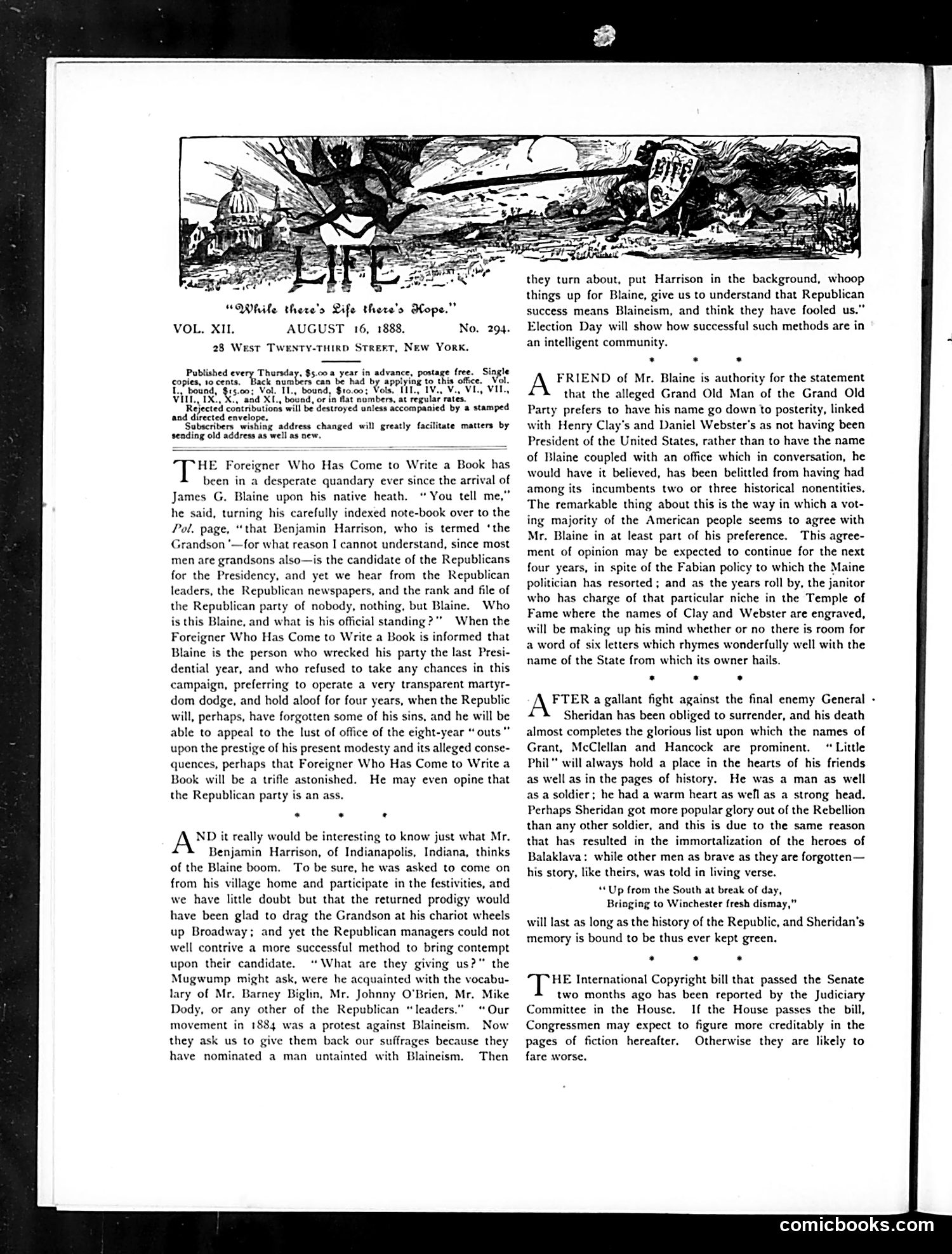
The masthead cartoon depicts a chaotic apocalyptic scene labeled "Behold there's Life there's Hope," satirizing the 1888 presidential election. The articles focus on **James G. Blaine**, the Republican presidential candidate whom the text calls "the Foreigner Who Has Come to Write a Book." The satire mocks Blaine's candidacy, suggesting Republicans are desperate and scrambling. One article notes Blaine "wrecked his party last Presidential year" and references his refusal to operate "transparent martyrdom dodges." The text also discusses **Benjamin Harrison** of Indianapolis as a potential Republican candidate, questioning what Republican "leaders" like Blaine actually offer voters. The overall tone suggests Life magazine viewed the Republican Party's 1888 campaign with contempt and ridicule, portraying it as chaotic and morally compromised.
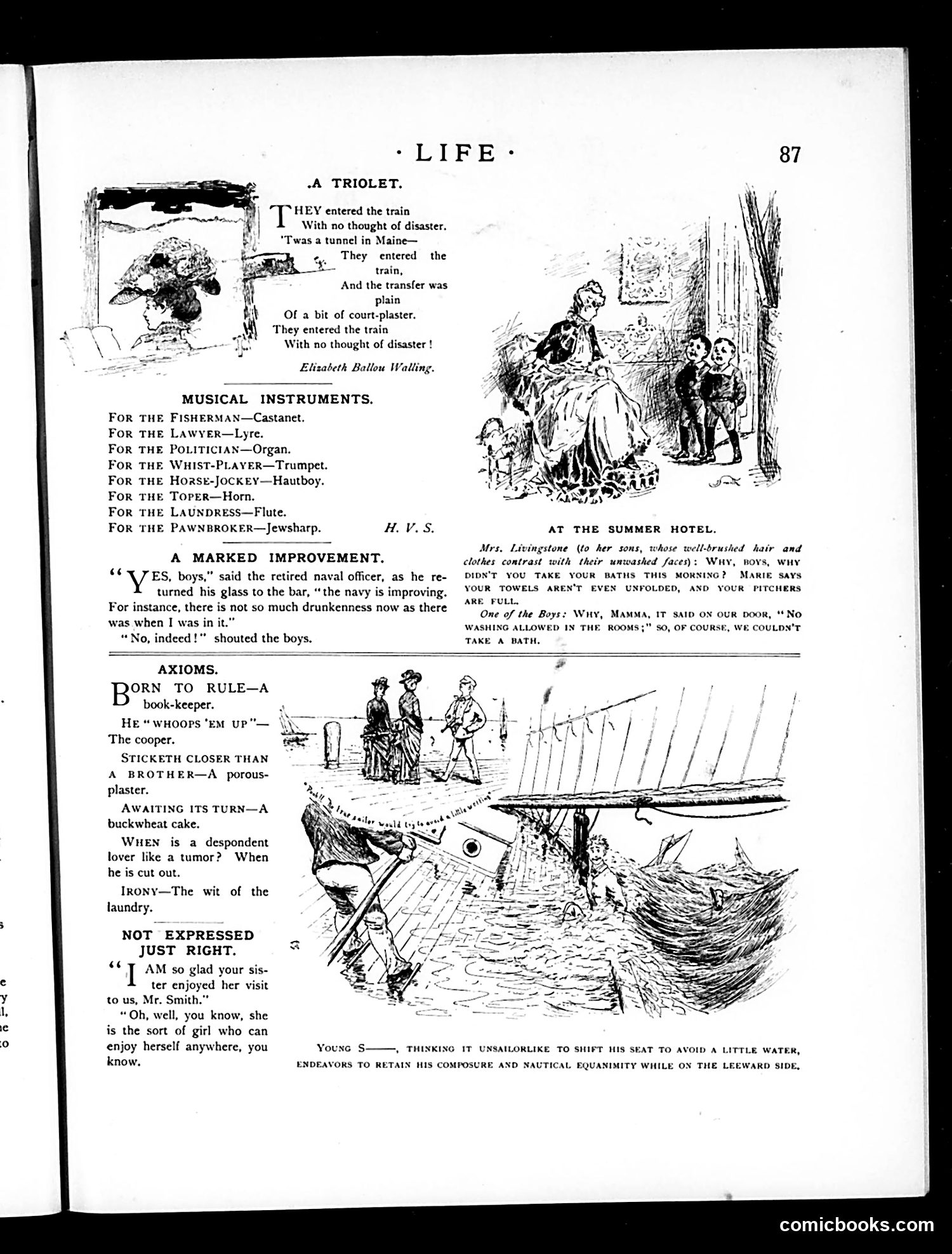
This page contains primarily **humorous observations and satirical quips** rather than political cartooning. The content includes: **"A Triolet"** — a poem by Elizabeth Ballou Walling about train travel, apparently poking fun at the mundane experience of boarding a train in Maine. **"Musical Instruments"** — a satirical list matching professions to instruments (fisherman/castanet, lawyer/lyre, politician/organ), suggesting each profession's characteristic traits through musical association. **"Axioms"** and **"Not Expressed Just Right"** — brief witty observations about social behavior and manners, typical of Life's satirical commentary on everyday life. The **illustrations** show domestic and nautical scenes without clear political figures. The humor targets social conventions, class behaviors, and everyday absurdities rather than specific political events or individuals.
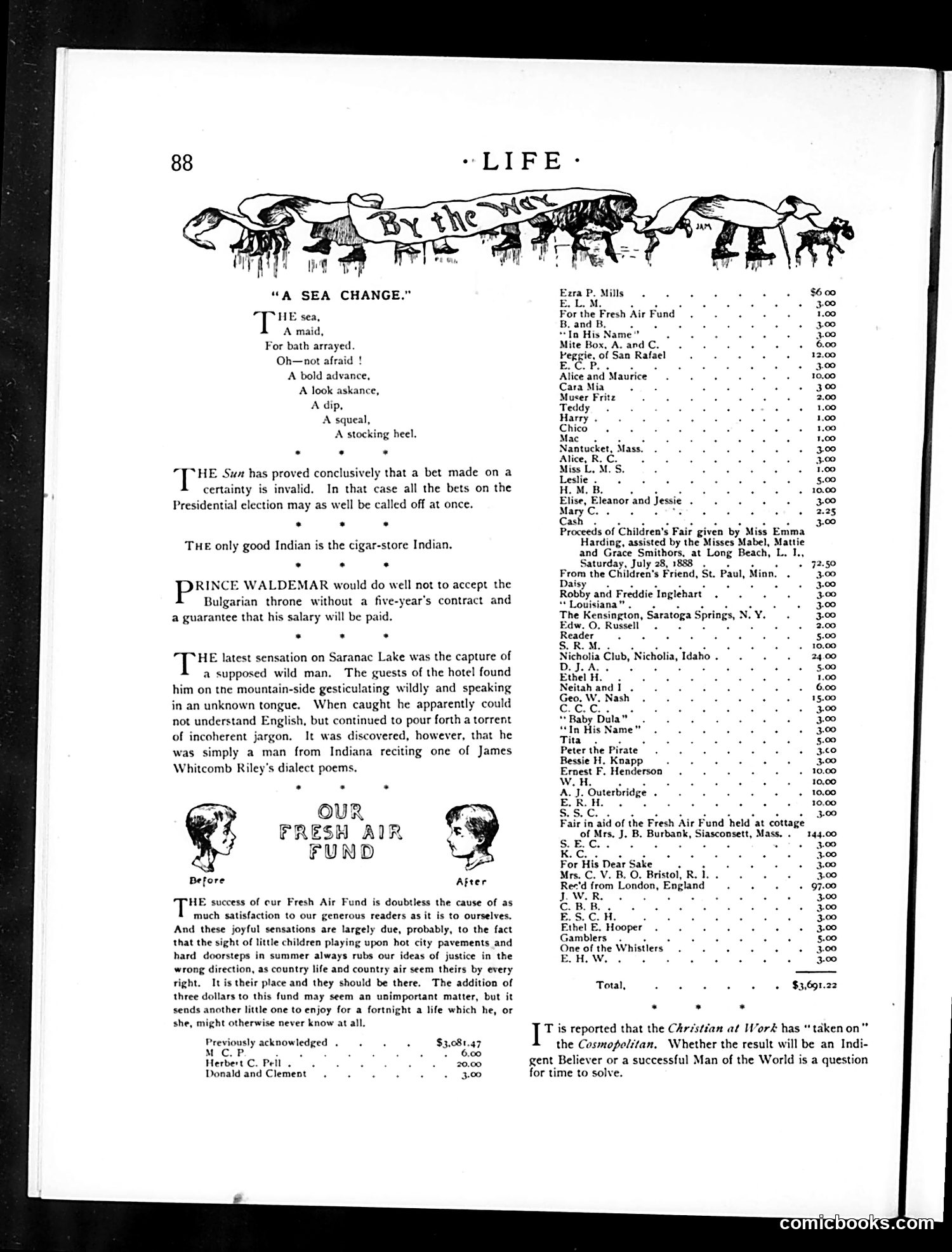
This page contains satirical commentary and a fundraising appeal rather than traditional political cartoons. **"A Sea Change"** is a poem mocking the unpredictability of betting, particularly regarding the 1888 Presidential election—suggesting political outcomes are as uncertain as maritime ventures. **Key satirical passages** include jabs at: - Bulgarian princes (likely Prince Waldemar, referenced directly) - Native Americans ("The only good Indian is the cigar-store Indian") - A hoax about a "wild man" at Saranac Lake who turned out to be someone reciting James Whitcomb Riley's dialect poems **"Our Fresh Air Fund"** section details charitable donations for poor urban children's health—a genuine progressive cause, humorously framed with "Before/After" illustrations showing the transformative effects of outdoor recreation. The page reflects Life's mix of political satire, social commentary, and advocacy journalism typical of late-19th-century American humor magazines.
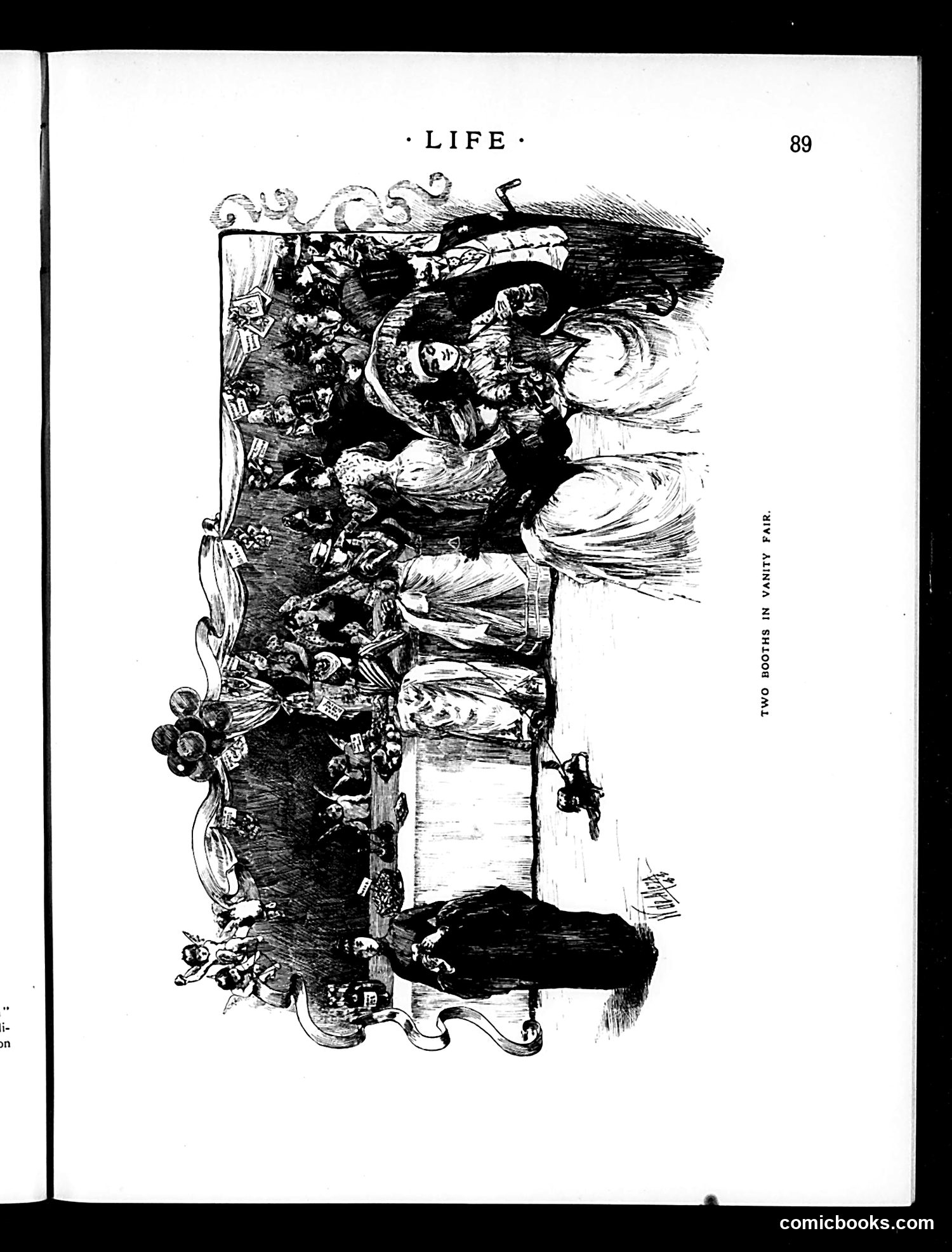
This satirical illustration depicts two figures in an ornate interior setting, rotated 90 degrees on the page. The caption "Two Brooms in Vanity Fair" appears to reference Thackeray's *Vanity Fair*, suggesting commentary on vanity and social pretension. The elaborate decorative frame and the figures' positioning suggest this is social satire, likely mocking contemporary fashionable society or specific public figures. The "two brooms" metaphor is unclear without additional context—it may reference sweeping away pretense or critiquing two particular individuals or groups engaged in frivolous pursuits. The detailed satirical style and *Life* magazine's focus on social commentary suggests this targets recognizable personalities or social trends from the publication's era, though identifying the specific figures or events would require additional historical documentation.
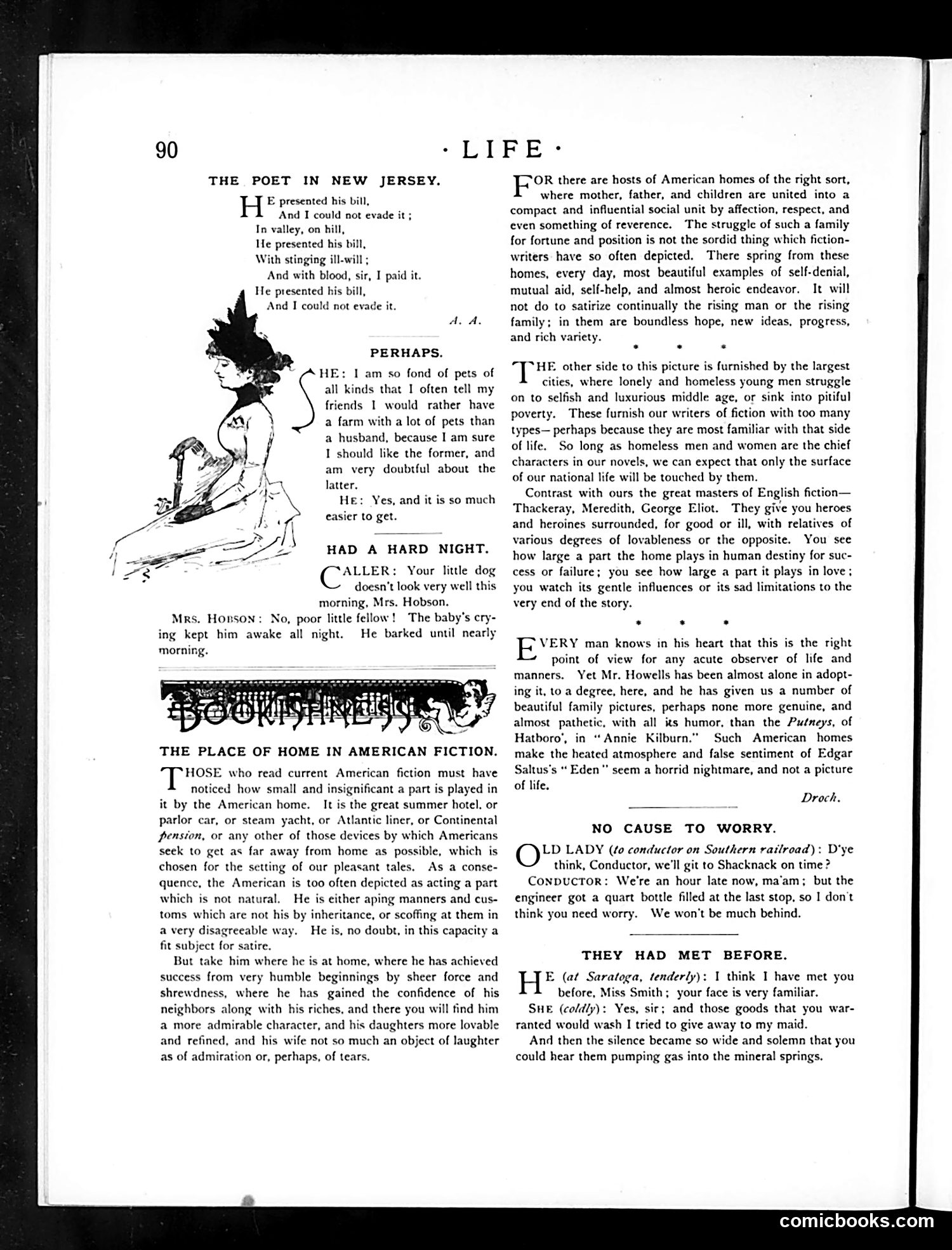
This page contains **short humorous dialogues and literary commentary**, not political cartoons. The illustrated vignette shows a woman with an elaborate hat and a small dog—a typical satirical image of fashionable society. The text "The Poet in New Jersey" presents humorous exchanges about presenting bills, pets on farms, and a sleepless night with a barking dog. The main article, "The Place of Home in American Fiction," discusses how American literature underrepresents domestic life compared to exotic settings like ocean liners and yachts. It contrasts English writers like Thackeray and George Eliot—who depicted home life meaningfully—with American fiction's focus on homeless men or selfish wealthy characters. The remaining brief dialogues are conversational humor about train schedules and recognition between acquaintances. This is **literary criticism and social satire**, not political commentary.
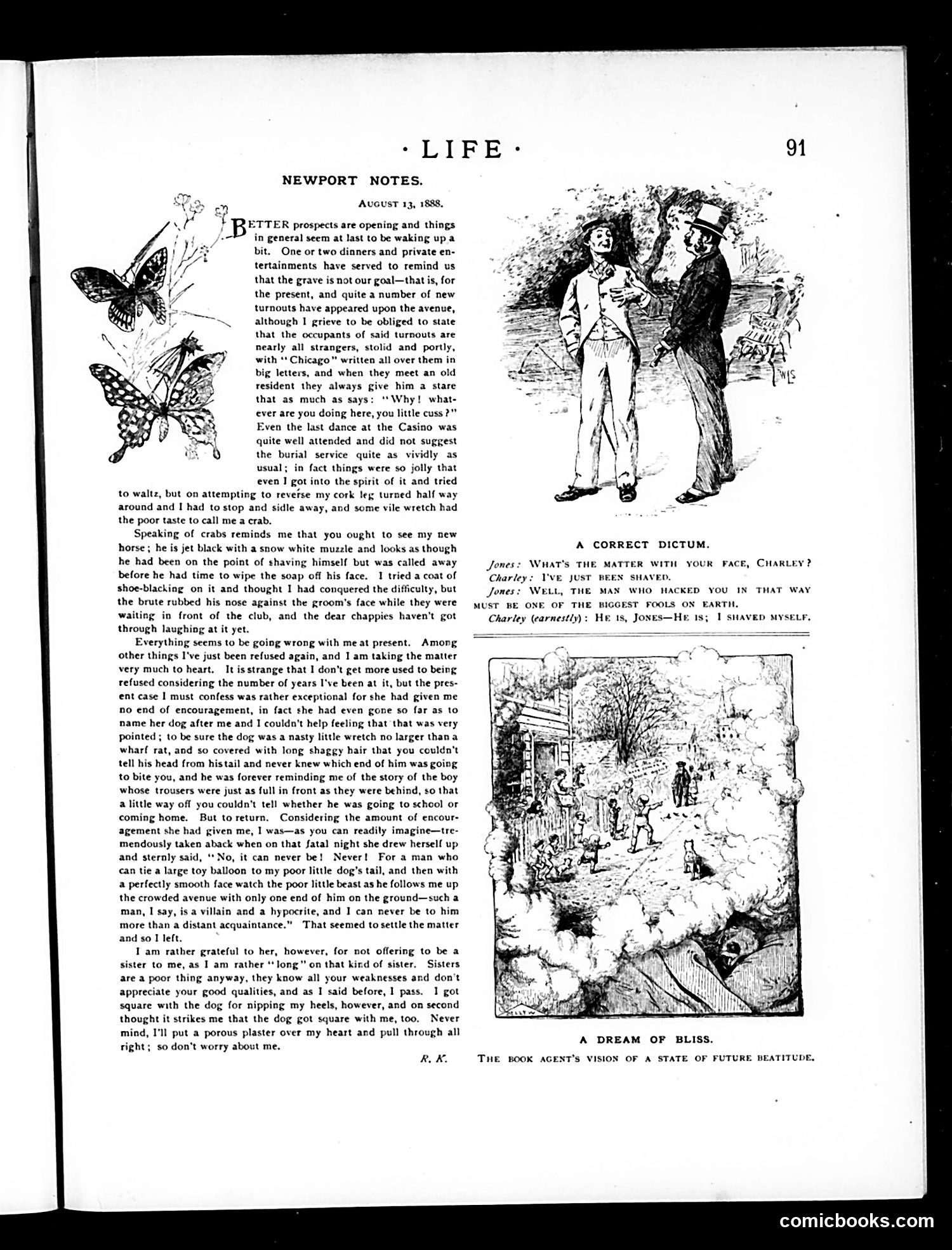
This page contains social commentary about Newport, Rhode Island's elite summer society (August 13, 1888). The main text humorously critiques the pretentious behavior of wealthy Newport residents—how newcomers are coldly received, how old residents give newcomers disapproving stares, and how social conventions feel stiff and awkward. The cartoon titled "A Correct Dictum" depicts two men discussing a third's facial injuries. The joke hinges on self-defense: when asked why his face is bruised, Charley claims he shaved himself, implying the man who "hacked" him must be someone of importance to society—therefore Charley must have done it himself to avoid admitting he was beaten by an ordinary person. The bottom illustration, "A Dream of Bliss," shows an idealized vision of future beauty in what appears to be a park or garden setting.
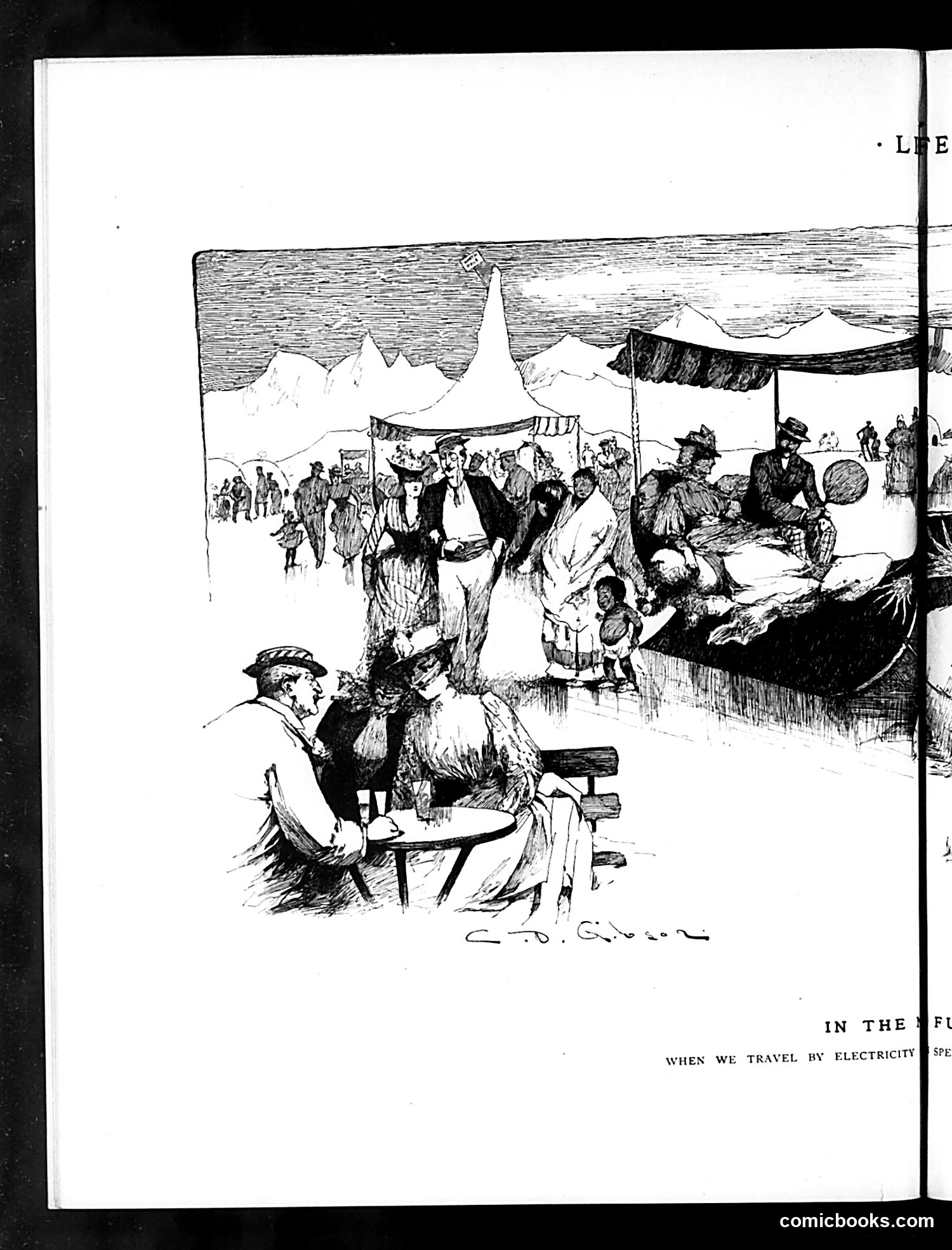
This is a satirical illustration about future transportation technology. The caption reads "WHEN WE TRAVEL BY ELECTRICITY," suggesting this depicts speculative predictions about electric-powered travel. The drawing shows a carnival or fairground scene with large tents. In the foreground, a man operates what appears to be a telescope or viewing device on a bench. The crowded background depicts crowds of people gathered at what looks like an exhibition or demonstration. The satire likely mocks contemporary predictions about electricity's transformative potential—a popular theme in early 20th-century Life magazine. Rather than showing practical electric vehicles or transit, the artist depicts people still gathering at fairs to observe electricity as a novelty attraction, suggesting skepticism about grandiose claims of technological progress or the gap between hype and reality in electric transportation development.
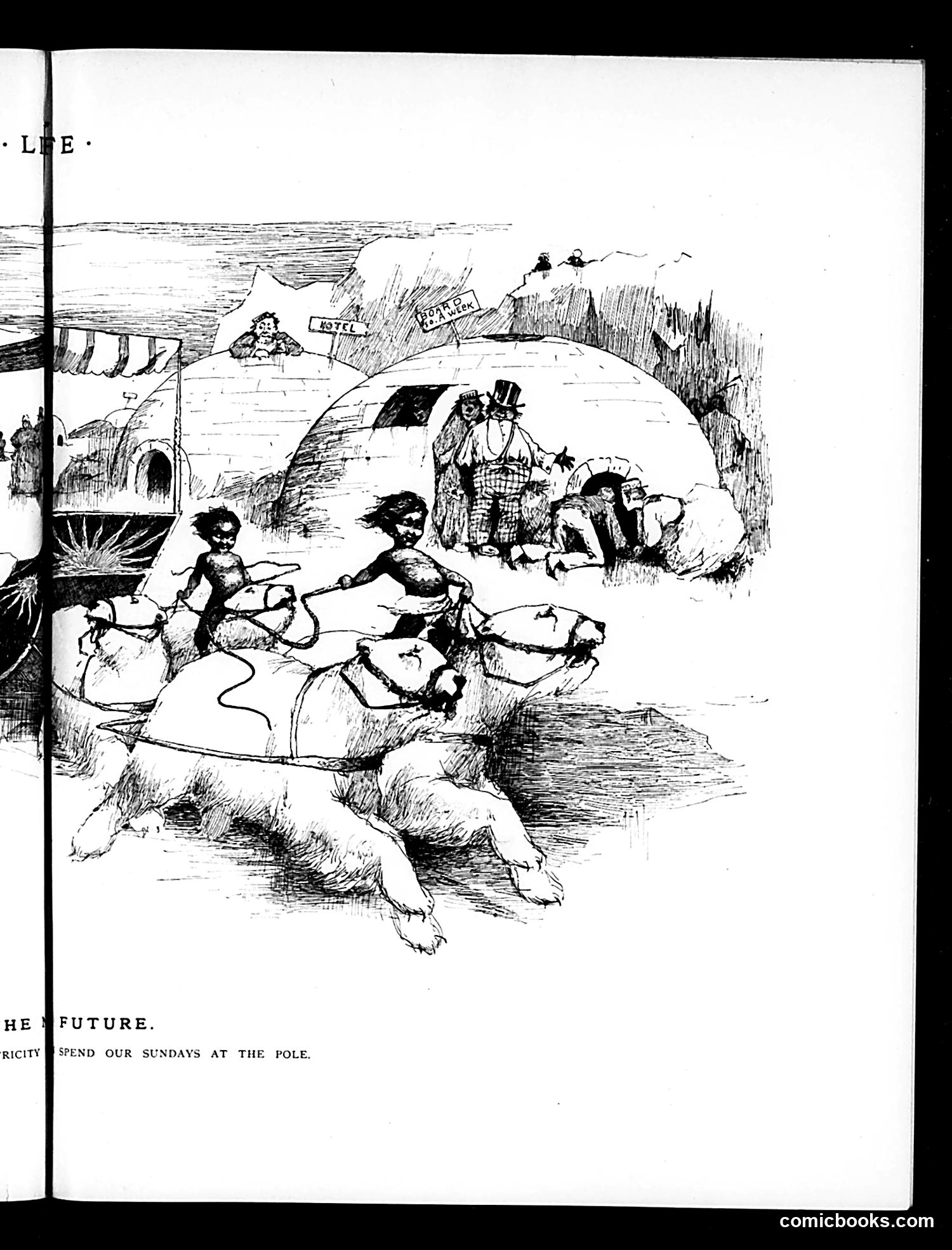
This satirical cartoon depicts an imagined future where Arctic polar exploration has become a leisurely tourist activity. The image shows well-dressed Victorian-era men and women arriving by what appears to be a heated dome structure or igloo resort at the North Pole. Women in fashionable attire ride in dog sleds while gentlemen in top hats oversee the operation. The satire mocks the era's optimism about technological progress—suggesting that advances in transportation and engineering would eventually make even the Arctic accessible for casual Sunday outings by the wealthy. It's a humorous commentary on Victorian faith in industrial progress and the notion that exotic, dangerous frontiers would become commonplace tourist destinations through technological innovation.
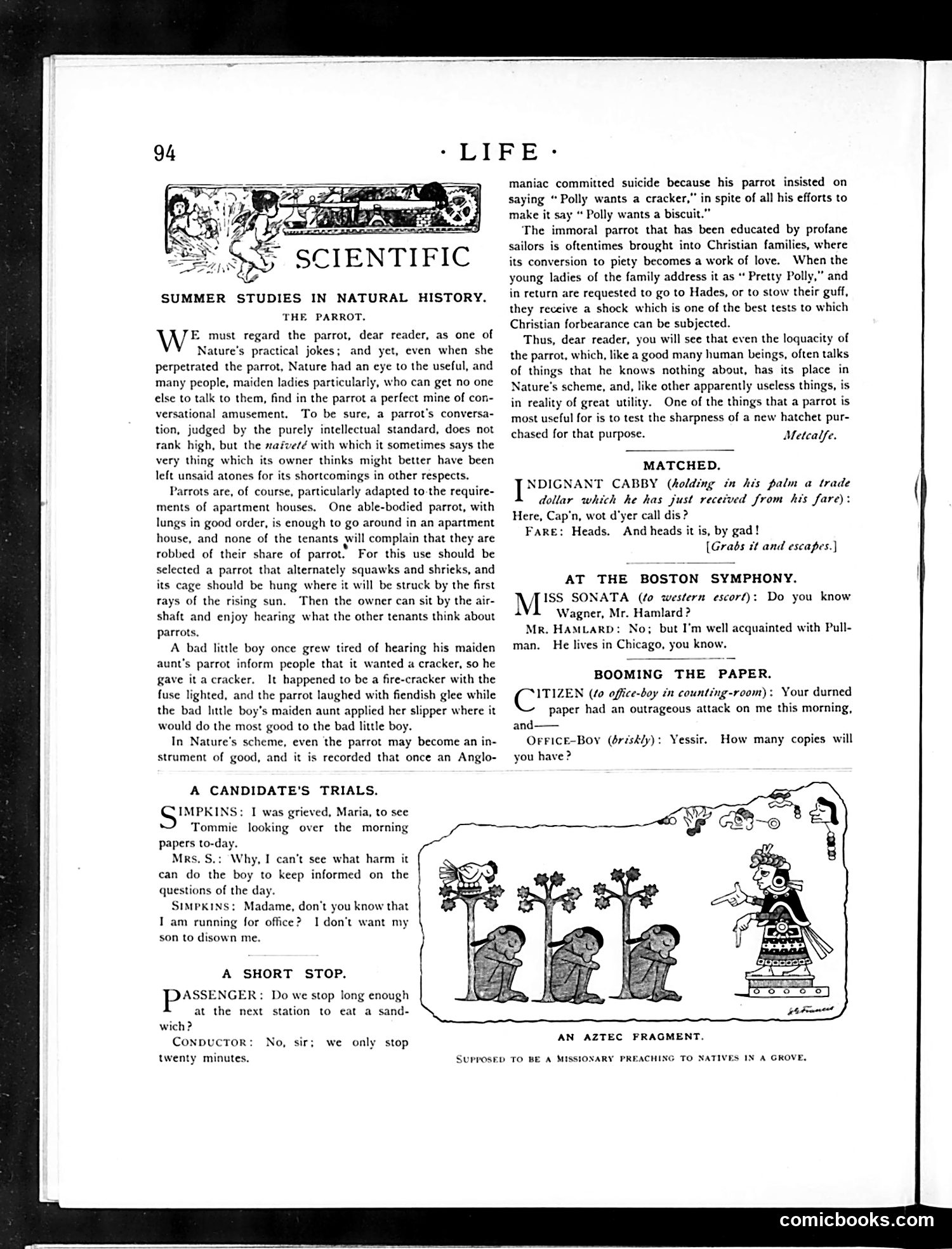
This page contains several humorous sketches rather than a unified political cartoon. The main content includes: **"Scientific Summer Studies in Natural History: The Parrot"** — An essay humorously treating parrots as subjects of serious natural study, noting their ability to mimic human conversation and their adaptation to apartment living. **"Matched," "At the Boston Symphony," "A Candidate's Trials," and "A Short Stop"** — Brief comedic dialogue snippets satirizing everyday situations: a cab driver and passenger, concert-goers discussing Wagner, a political candidate's wife, and a train conductor. **"An Aztec Fragment"** — A cartoon showing what appears to be a missionary preaching to Native Americans in a grove, with the caption suggesting ironic commentary on missionary work. The humor is gentle, observational satire typical of Life magazine's style—mocking social pretensions, domestic situations, and cultural encounters rather than attacking specific political figures or events.
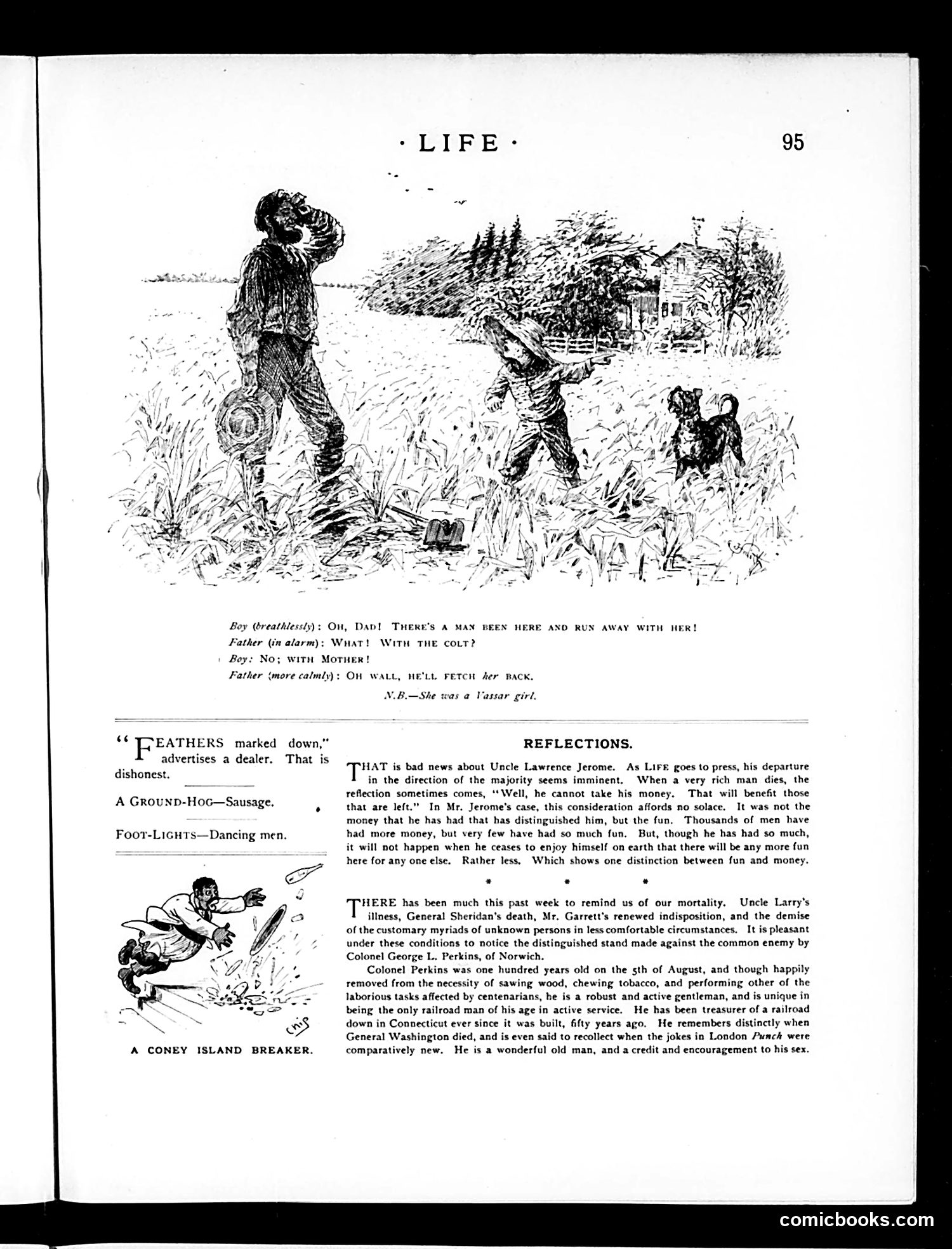
**The Main Cartoon:** A rural domestic comedy. A boy breathlessly reports to his father that "a man" has run away with "her"—implying elopement. The father panics, asking "with the colt?" (the horse). The boy clarifies: "with Mother!" The father then calmly says he'll fetch her back, with a note explaining she was "a Vassar girl"—implying educated women from elite colleges were prone to romantic escapades or running away. **The Joke:** The humor relies on class assumptions: a valuable horse warrants alarm; a wife is retrievable. The Vassar reference suggests satirizing educated, independent-minded women as unpredictable. **The "Reflections" Section:** Discusses recently deceased wealthy figures, particularly "Uncle Lawrence Jerome" (appears to be about financial legacy), and celebrates Colonel George L. Perkins of Norwich, a 100-year-old railroad treasurer still working—framed as an admirable longevity example. **Context:** This reflects Gilded Age attitudes toward women, class, and mortality.
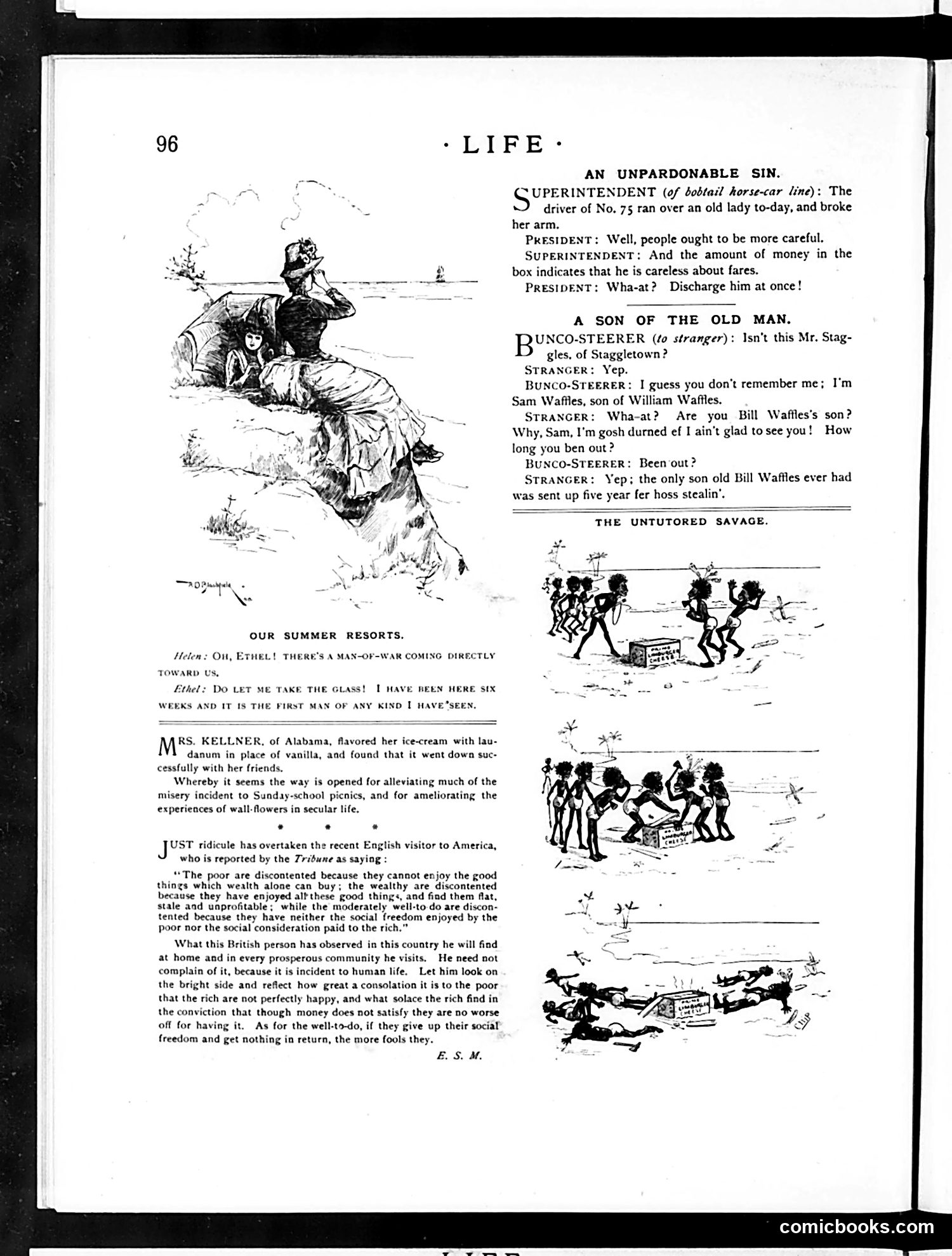
This page contains three distinct satirical pieces typical of 19th-century American humor: **"An Unpardonable Sin"**: Mocks corporate priorities. A streetcar superintendent reports that a driver hit an elderly woman and broke her arm, but the company president only becomes outraged upon learning the driver also failed to collect fares—revealing that theft matters more than injury. **"A Son of the Old Man"**: A con artist ("bunco-steerer") encounters someone who knew his father. The stranger assumes Sam was imprisoned for horse stealing, as that was what happened to Bill Waffles's "only son"—implying Sam is either illegitimate or his criminal past makes him unrecognizable as family. **"The Untutored Savage"** (illustrations): Depicts children at a beach; the caption's title suggests satirizing unsophisticated behavior. The final essay mocks an English visitor's observations about class discontent in America, defending social inequality as universal and inevitable.
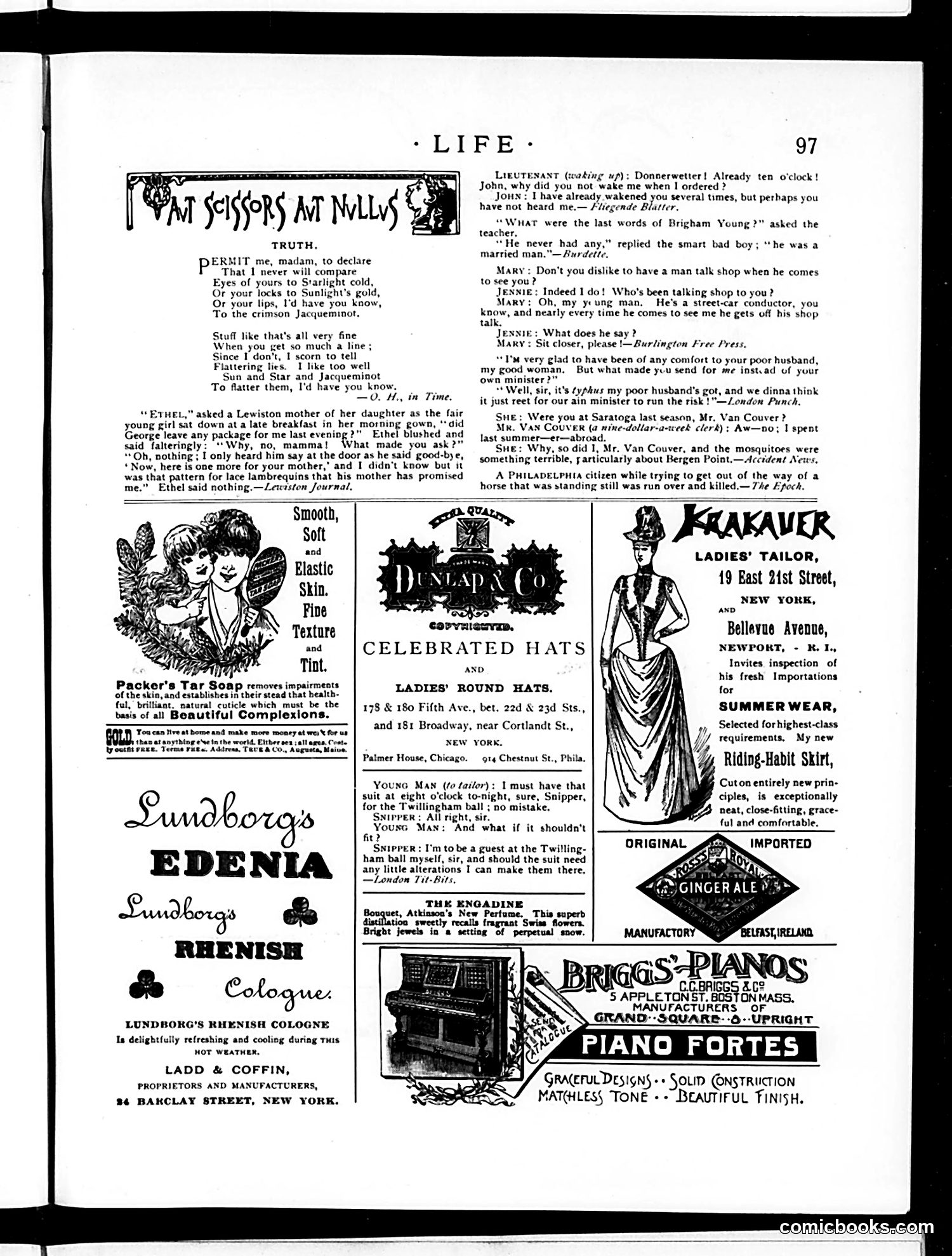
This page contains multiple short humor pieces typical of Life's satirical format, plus period advertisements. **"Truth" (top left):** A poem mocking romantic clichés—the speaker refuses to compare a woman's features to conventional poetic metaphors (starlight, gold, crimson roses), declaring such flattery insincere unless one is paid "a line" (per line of verse). It satirizes the overwrought sentimentality of Victorian courtship literature. **Scattered jokes** target marriage ("Brigham Young" reference mocks polygamy and marital silence), workplace tedium (streetcar conductor's "shop talk"), and social pretension (a clerk claiming to have summered "abroad" when he spent time near mosquito-infested Bergen Point). **One cartoon** shows a German military officer discovering it's already 10 o'clock, having apparently slept through his orderly's repeated wake-up attempts—mocking Prussian military discipline and rigid hierarchy. The page is primarily **commercial space**—advertisements for Packer's Tar Soap, Lundborg's cologne, ladies' clothing, pianos, and ginger ale dominate the layout. The satire serves as filler between advertisements in this weekly magazine.
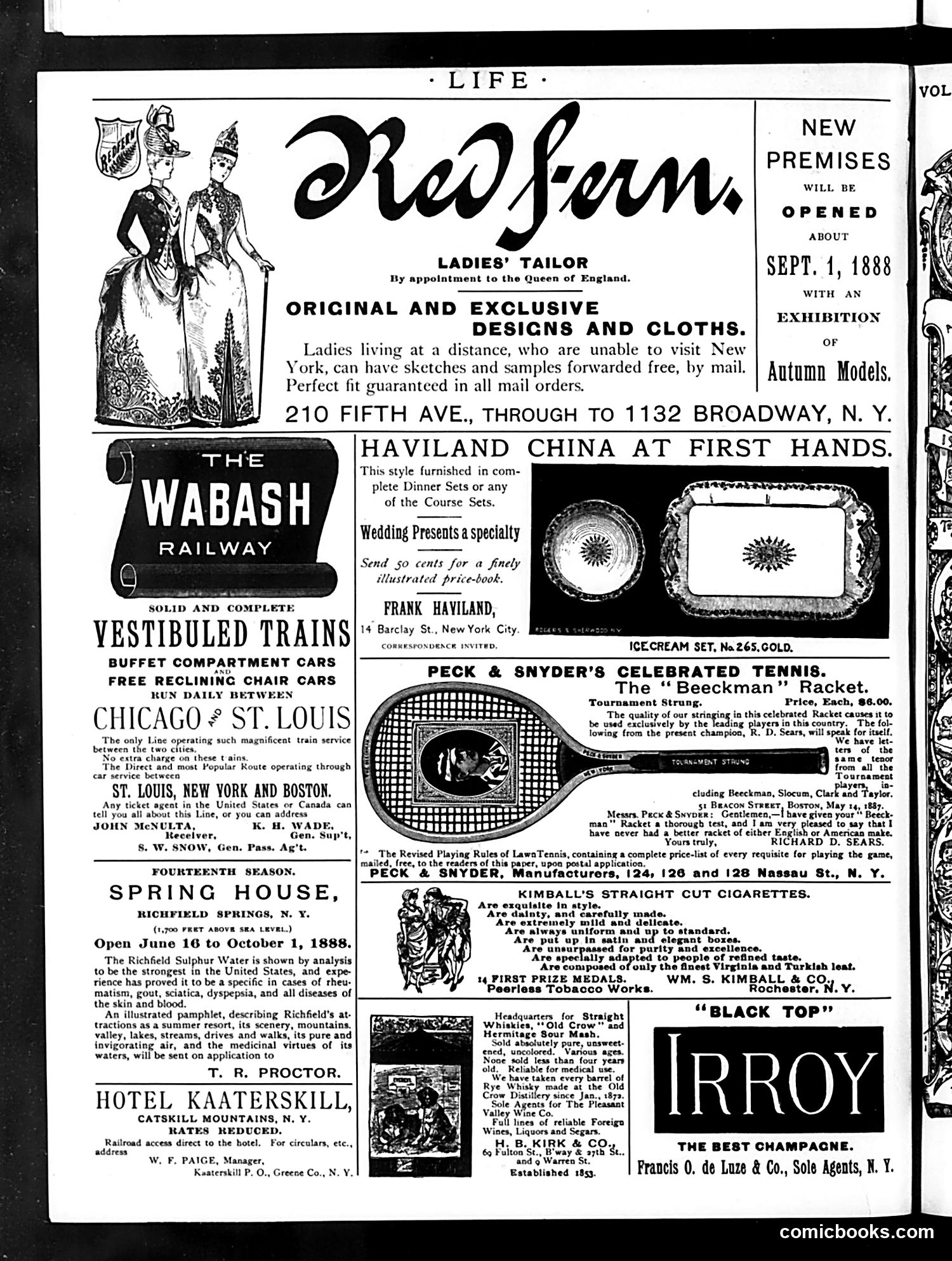
This is primarily an **advertising page** with no political cartoons or satirical content. The page contains commercial advertisements typical of late 19th-century magazines, including: - **Red Fern**: A ladies' tailor shop claiming royal patronage ("By appointment to the Queen of England"), advertising mail-order dress services - **Wabash Railway**: Promoting luxury train service between Chicago, St. Louis, New York, and Boston - **Haviland China**: Fine porcelain dinnerware for weddings - **Peck & Snyder's Tennis Rackets**: Sporting equipment endorsed by champion R.D. Sears - **Kimball's Cigarettes**: Tobacco products marketed for purity and quality - **Hotel and spa advertisements**: Richfield Springs and Kaaterskill Mountain resort promotions The ads reflect 1888 consumer culture: upscale goods, rail travel, sporting equipment, and health tourism. No satire or political commentary is present—this is straightforward commercial promotion.