
Life, 1888-08-16 · page 6 of 14
Life — August 16, 1888 — page 6: what you’re looking at
What you’re looking at
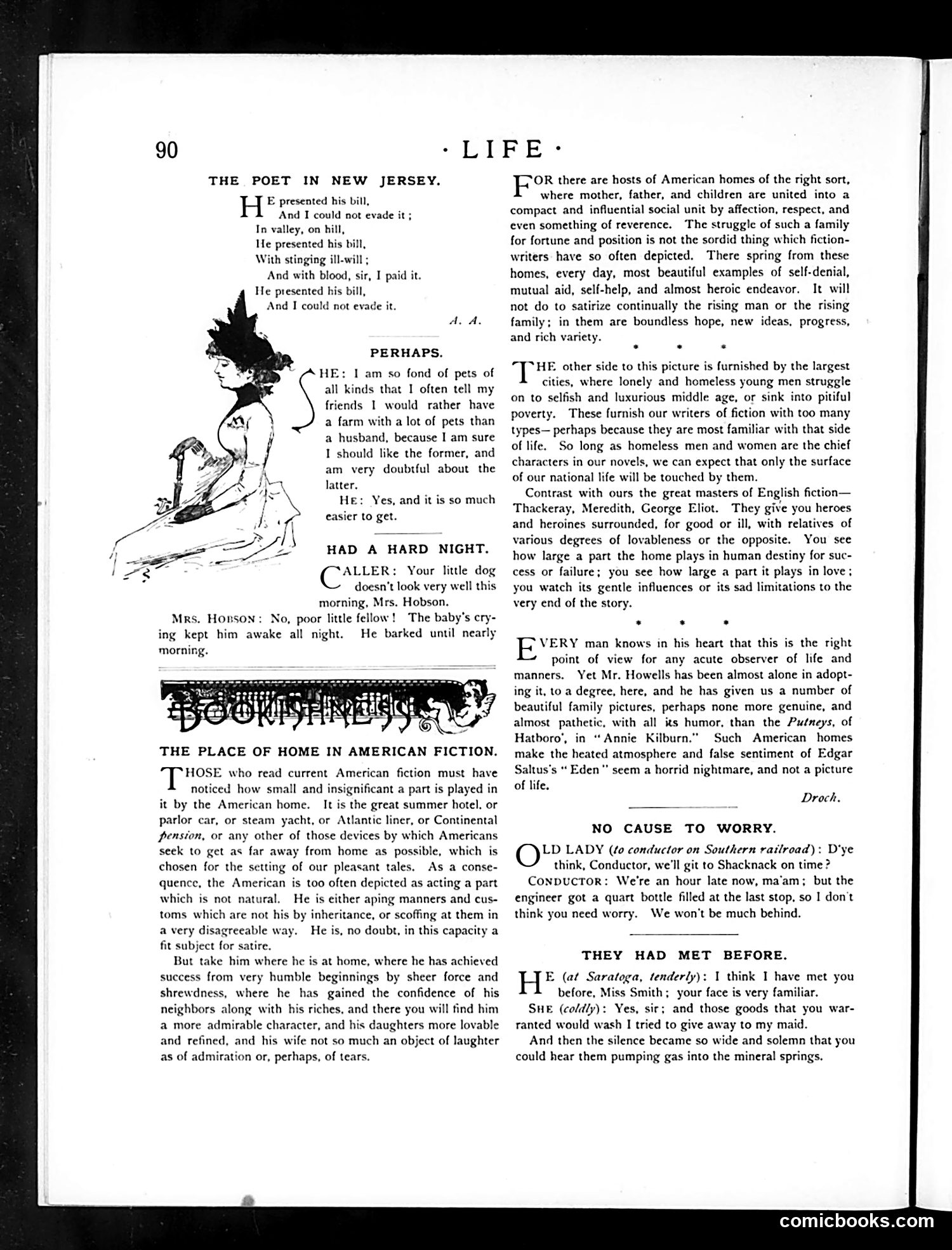
This page contains **short humorous dialogues and literary commentary**, not political cartoons. The illustrated vignette shows a woman with an elaborate hat and a small dog—a typical satirical image of fashionable society. The text "The Poet in New Jersey" presents humorous exchanges about presenting bills, pets on farms, and a sleepless night with a barking dog. The main article, "The Place of Home in American Fiction," discusses how American literature underrepresents domestic life compared to exotic settings like ocean liners and yachts. It contrasts English writers like Thackeray and George Eliot—who depicted home life meaningfully—with American fiction's focus on homeless men or selfish wealthy characters. The remaining brief dialogues are conversational humor about train schedules and recognition between acquaintances. This is **literary criticism and social satire**, not political commentary.
📄 Transcribed text from this page (OCR, searchable)
Machine-transcribed from the original scan — historical spelling and the odd misread are preserved.
90 THE POET IN NEW JERSEY. E presented his bill, And I could not evade it ; In valley, on hill, He presented his bill With stinging ill-wi And with blood, He presented his bill, And I could not evade it. I paid it. PERHAPS. HE: I am so fond of pets of all kinds that 1 often tell my friends 1 would rather have a farm with a lot of pets than a husband, because I am sure I should like the former, and am very doubtful about the latter, He: Yes, and it is so much easier to get. HAD A HARD NIGHT. CATLER: Your little dog doesn’t look very well this morning, Mrs. Hobson. Mrs. Honson: No, poor little fellow! The baby’s cry- ing kept him awake all night. He barked until nearly morning. THE PLACE OF HOME IN AMERICAN FICTION. HOSE who read current American fiction must have noticed how small and insignificant a part is played in it by the American home. It is the great summer hotel. or parlor car, or steam yacht, or Atlantic liner, or Continental pension, ot any other of those devices by which Americans seek to get as far away from home as possible, which is chosen for the setting of our pleasant tales, As a conse- quence, the American is too often depicted as acting a part which is not natural. He is either aping manners and cus- toms which are not his by inheritance, or scoffing at them in a very disagreeable way. He is, no doubt, in this capacity a fit subject for satire. But take him where he is at home, where he has achieved success from very humble beginnings by sheer force and shrewdness, where he has gained the confidence of his neighbors along with his riches, and there you will find him a more admirable character, and his daughters more lovable and refined, and his wife not so much an object of laughter as of admiration or, perhaps, of tears. - LIFE: OR there are hosts of American homes of the right sort, where mother, father, and children are united into a compact and influential social unit by affection, respect, and even something of reverence. The struggle of such a family for fortune and position is not the sordid thing which fiction- writers have so often depicted. There spring from these homes, every day, most beautiful examples of self-denial, mutual aid, self-help, and almost heroic endeavor. It will not do to satirize continually the rising man or the rising family; in them are boundless hope, new ideas, progress, and rich variety. 2 ~HE other side to this picture is furnished by the largest cities, where lonely and homeless young men struggle on to selfish and luxurious middle age, or sink into pitiful poverty. These furnish our writers of fiction with too many types— perhaps because they are most familiar with that side of life. So long as homeless men and women are the chief characters in our novels, we can expect that only the surface of our national life will be touched by them. Contrast with ours the great masters of English fiction— Thackeray, Meredith, George Eliot. They give you heroes and heroines surrounded, for good or ill, with relatives of various degrees of lovableness or the opposite. You see how large a part the home plays in human destiny for suc- cess or failure; you see how large a part it plays in love; you watch its gentle influences or its sad limitations to the very end of the story. . . . VERY man knows in his heart that this is the right point of view for any acute observer of life and manners. Yet Mr. Howells has been almost alone in adopt- ing it, to a degree, here, and he has given us a number of beautiful family pictures, perhaps none more genuine, and almost pathetic, with all its humor, than the Putneys, of Hatboro’, in “Annie Kilburn.” Such American homes make the heated atmosphere and false sentiment of Edgar Saltus’s “ Eden" seem a horrid nightmare, and not a picture of life. Droch. NO CAUSE TO WORRY. LD LADY (¢0 conductor on Southern ratlroad): D'ye think, Conductor, we'll git to Shacknack on time? Conpuctor: We're an hour late now, ma‘am; but the engineer got a quart bottle filled at the last stop, so 1 don't think you need worry. We won't be much behind. THEY HAD MET BEFORE. H E (at Saratoga, tenderly): 1 think I have met you before, Miss Smith; your face is very familiar. SHE (coldly): Y and those goods that you war- ranted would wash I tried to give away to my maid. And then the silence became so wide and solemn that you could hear them pumping gas into the mineral springs. comicbooks.com