
Life, 1888-08-16 · page 2 of 14
Life — August 16, 1888 — page 2: what you’re looking at
What you’re looking at
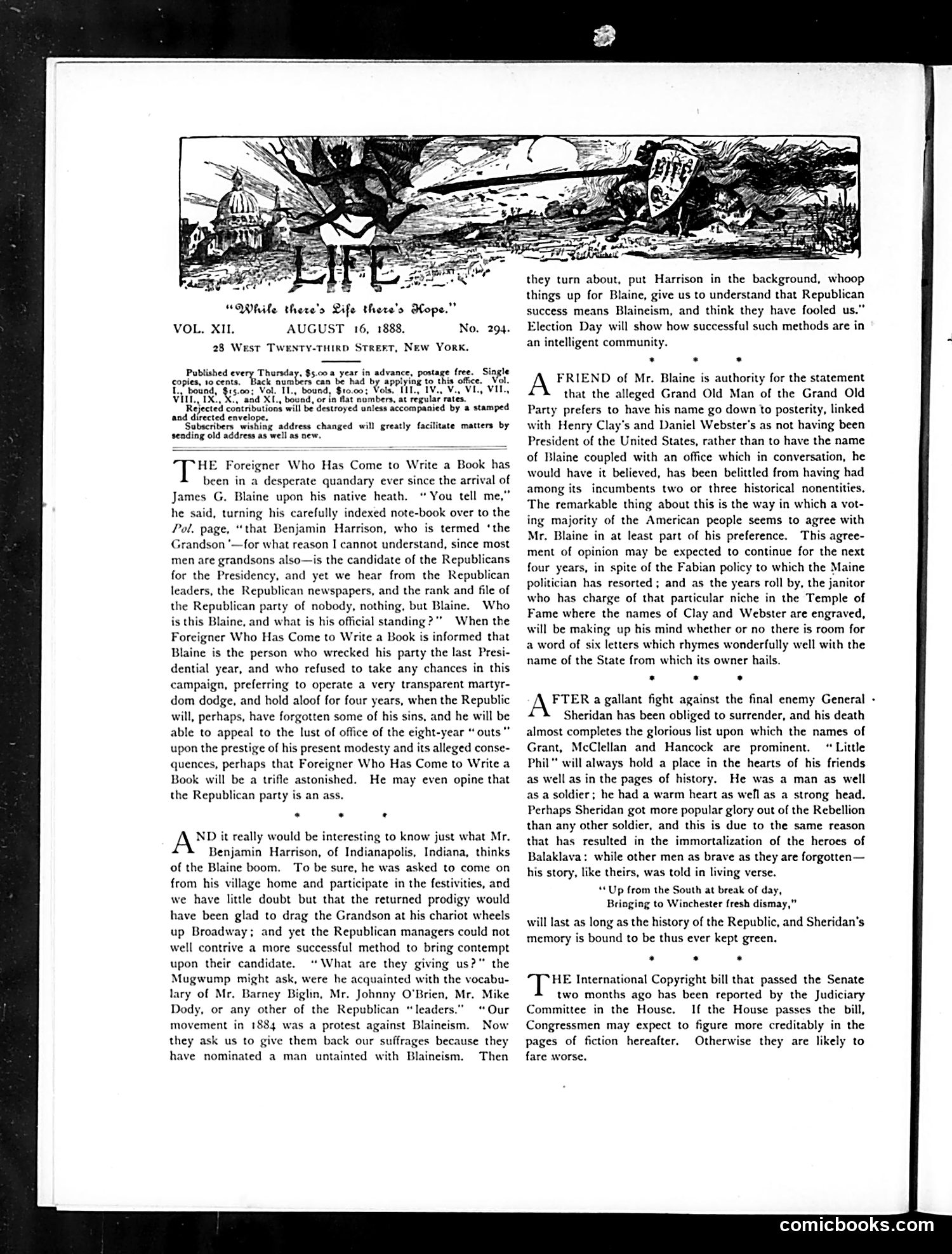
The masthead cartoon depicts a chaotic apocalyptic scene labeled "Behold there's Life there's Hope," satirizing the 1888 presidential election. The articles focus on **James G. Blaine**, the Republican presidential candidate whom the text calls "the Foreigner Who Has Come to Write a Book." The satire mocks Blaine's candidacy, suggesting Republicans are desperate and scrambling. One article notes Blaine "wrecked his party last Presidential year" and references his refusal to operate "transparent martyrdom dodges." The text also discusses **Benjamin Harrison** of Indianapolis as a potential Republican candidate, questioning what Republican "leaders" like Blaine actually offer voters. The overall tone suggests Life magazine viewed the Republican Party's 1888 campaign with contempt and ridicule, portraying it as chaotic and morally compromised.
📄 Transcribed text from this page (OCR, searchable)
Machine-transcribed from the original scan — historical spelling and the odd misread are preserved.
“Wile there's Life there's Hope.” VOL. XII. AUGUST 16, 1888. No. 28 West TWENTY-THIRD STREET, New York. 294. $5.00. year in advance, postage free. Single rs can be had by applying to this office. Vol. ol. II, bos 2 vol Iv.. V., VI, VIL, roe 1, bound or lo lat aumabern, at roputay rate ributions will be destroyed unless accompanied by a stamped and directed envelope. Subscribers wishing address changed will greatly facilitate matters by old address as well as new. Published every Thursday, Goris geet Shack sue sendi “oreigner Who Has Come to Write a Book has been in a desperate quandary ever since the arrival of James G. Blaine upon his native heath. “ You tell me,” he said, turning his carefully indexed note-book over to the Pol. page, “that Benjamin Harrison, who is termed ‘the Grandson '"—for what reason I cannot understand, since most men are grandsons also—is the candidate of the Republicans for the Presidency, and yet we hear from the Republican leaders, the Republican newspapers, and the rank and file of the Republican party of nobody, nothing, but Blaine. Who is this Blaine, and what is his official standing?" When the Foreigner Who Has Come to Write a Book is informed that Blaine is the person who wrecked his party the last Presi- dential year, and who refused to take any chances in this campaign, preferring to operate a very transparent martyr- dom dodge, and hold aloof for four years, when the Republic will, perhaps, have forgotten some of his sins, and he will be able to appeal to the lust of office of the eight-year “ outs” upon the prestige of his present modesty and its alleged conse- quences, perhaps that Foreigner Who Has Come to Write a Book will be a trifle astonished. He may even opine that the Republican party is an ass. . . . Ake it really would be interesting to know just what Mr. Benjamin Harrison, of Indianapolis, Indiana, thinks of the Blaine boom. To be sure, he was asked to come on from his village home and participate in the festivities, and we have little doubt but that the returned prodigy would have been glad to drag the Grandson at his chariot wheels up Broadway; and yet the Republican managers could not well contrive a more successful method to bring contempt upon their candidate. “What are they giving us?” the Mugwump might ask, were he acquainted with the vocabu- lary of Mr. Barney Biglin, Mr. Johnny O'Brien, Mr. Mike Dody, or any other of the Republican “leaders.” “Our movement in 1884 was a protest against Blaineism. Now they ask us to give them back our suffrages because they have nominated a man untainted with Blaineism. Then they turn about, put Harrison in the background, whoop things up for Blaine, give us to understand that Republican success means Blaineism, and think they have fooled us.” Election Day will show how successful such methods are in an intelligent community. . . . FRIEND of Mr. Blaine is authority for the statement that the alleged Grand Old Man of the Grand Old Party prefers to have his name go down to posterity, linked with Henry Clay’s and Daniel Webster's as not having been President of the United States, rather than to have the name of Blaine coupled with an office which in conversation, he would have it believed, has been belittled from having had among its incumbents two or three historical nonentities. The remarkable thing about this is the way in which a vot- ing majority of the American people seems to agree with Mr. Blaine in at least part of his preference. This agree- ment of opinion may be expected to continue for the next four years, in spite of the Fabian policy to which the Maine politician has resorted; and as the years roll by, the janitor who has charge of that particular niche in the Temple of Fame where the names of Clay and Webster are engraved, will be making up his mind whether or no there is room for a word of six letters which rhymes wonderfully well with the name of the State from which its owner hails. . . . FTER a gallant fight against the final enemy General Sheridan has been obliged to surrender, and his death almost completes the glorious list upon which the names of Grant, McClellan and Hancock are prominent. “Little Phil” will always hold a place in the hearts of his friends as well as in the pages of history. He was a man as well as a soldier; he had a warm heart as well as a strong head. Perhaps Sheridan got more popular glory out of the Rebellion than any other soldier, and this is due to the same reason that has resulted in the immortalization of the heroes of Balaklava: while other men as brave as they are forgotten— his story, like theirs, was told in living verse. “Up from the South at break of day, Bringing to Winchester fresh dismay,” will last as long as the history of the Republic, and Sheridan's memory is bound to be thus ever kept green. . . . HE International Copyright bill that passed the Senate two months ago has been reported by the Judiciary Committee in the House. If the House passes the bill, Congressmen may expect to figure more creditably in the pages of fiction hereafter. Otherwise they are likely to fare worse, comicbooks.com