
A complete issue · 14 pages · 1888
Life — July 19, 1888
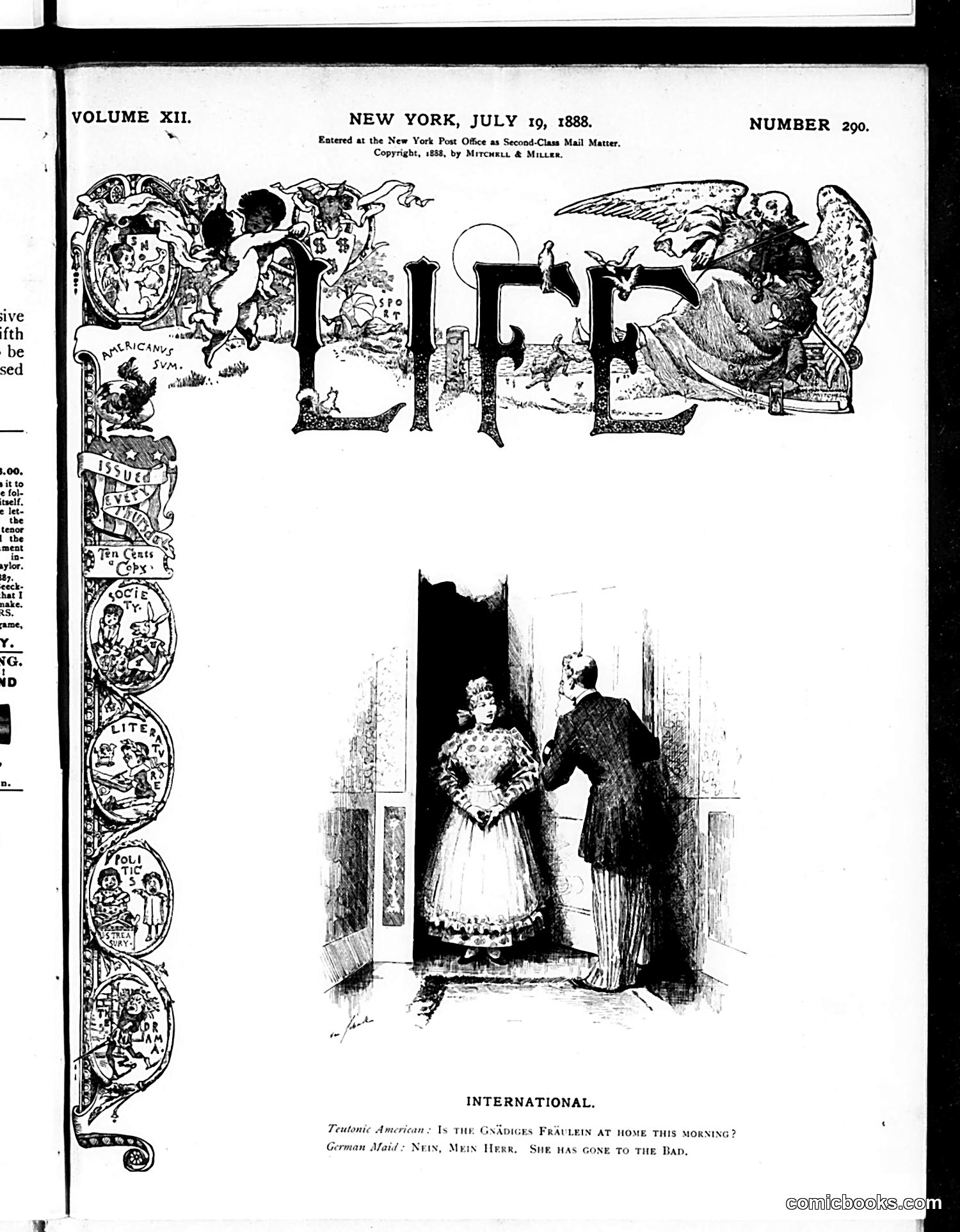
This page contains a single cartoon titled "International" depicting a domestic scene between a man and woman at a doorway. The caption reads: "Teutonic American: Is the Gnadiges Fraulein at home this morning? / German Maid: Nein, Mein Herr. She has gone to the Bad." The humor relies on a play on words: "Bad" in German means "bath," but an English speaker would read it as the English word "bad," suggesting the woman has gone somewhere morally questionable. The joke mocks German-American communication confusion and plays on stereotypes about German immigrants and their language. The elaborate decorative border on the left contains various illustrated vignettes, typical of Life's ornamental design style from this era.
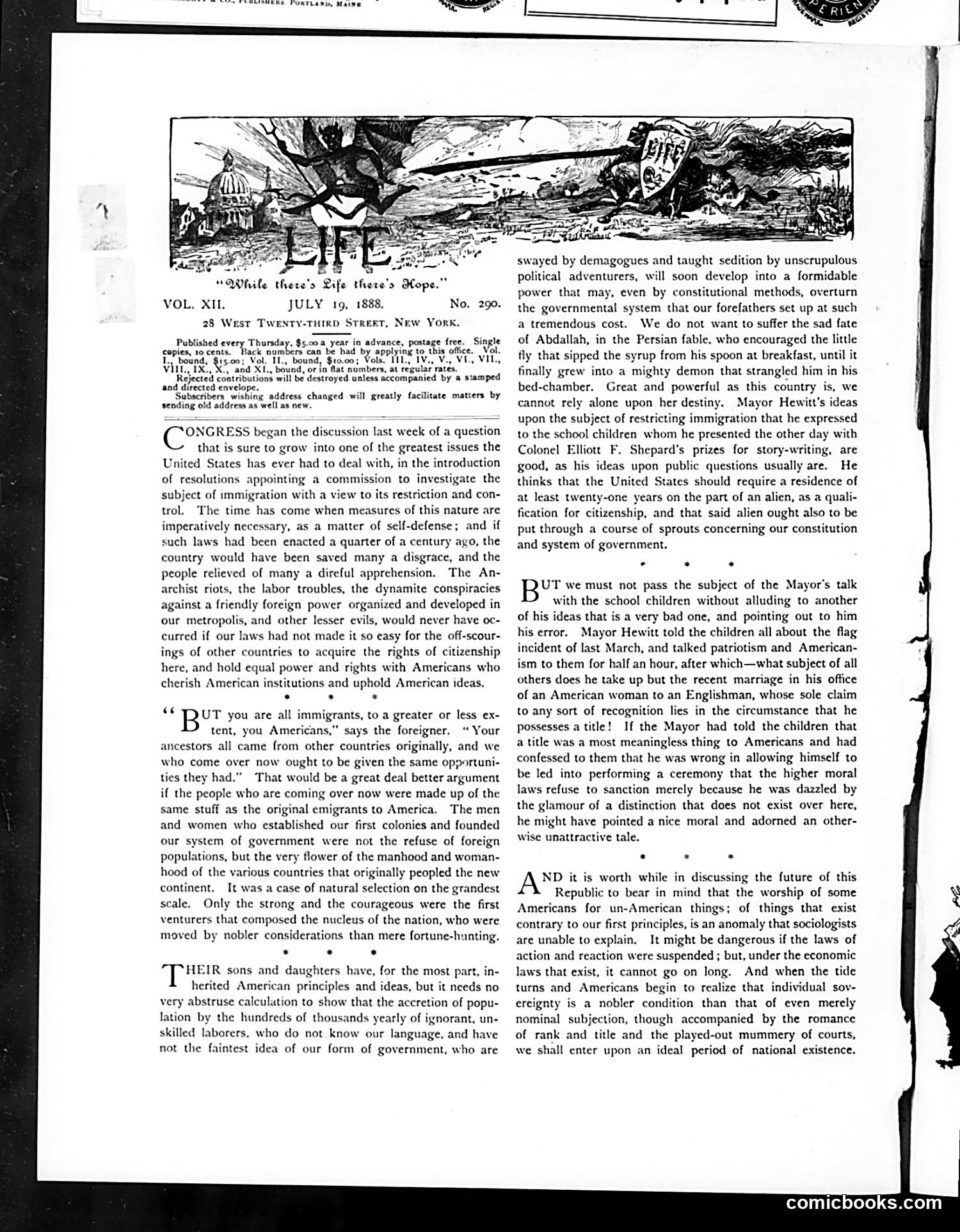
The header illustration depicts a fantastical flying creature labeled "LIFE" soaring over a cityscape, establishing the magazine's satirical identity. The main article criticizes Congressional discussion of immigration restriction and control. The text argues against nativist sentiment, defending immigrants' rights to American citizenship while also criticizing Mayor Hewitt's recent controversial statements to schoolchildren about the American flag and patriotism. The satire targets what appears to be hypocrisy: the author notes that nearly all Americans are themselves descendants of immigrants, yet some advocate restricting newcomers' rights. The piece defends immigrants' capacity to become good Americans while questioning whether Mayor Hewitt's emphasis on titles and ceremonial patriotism represents genuine American values—suggesting superficial nationalism over substantive civic understanding.
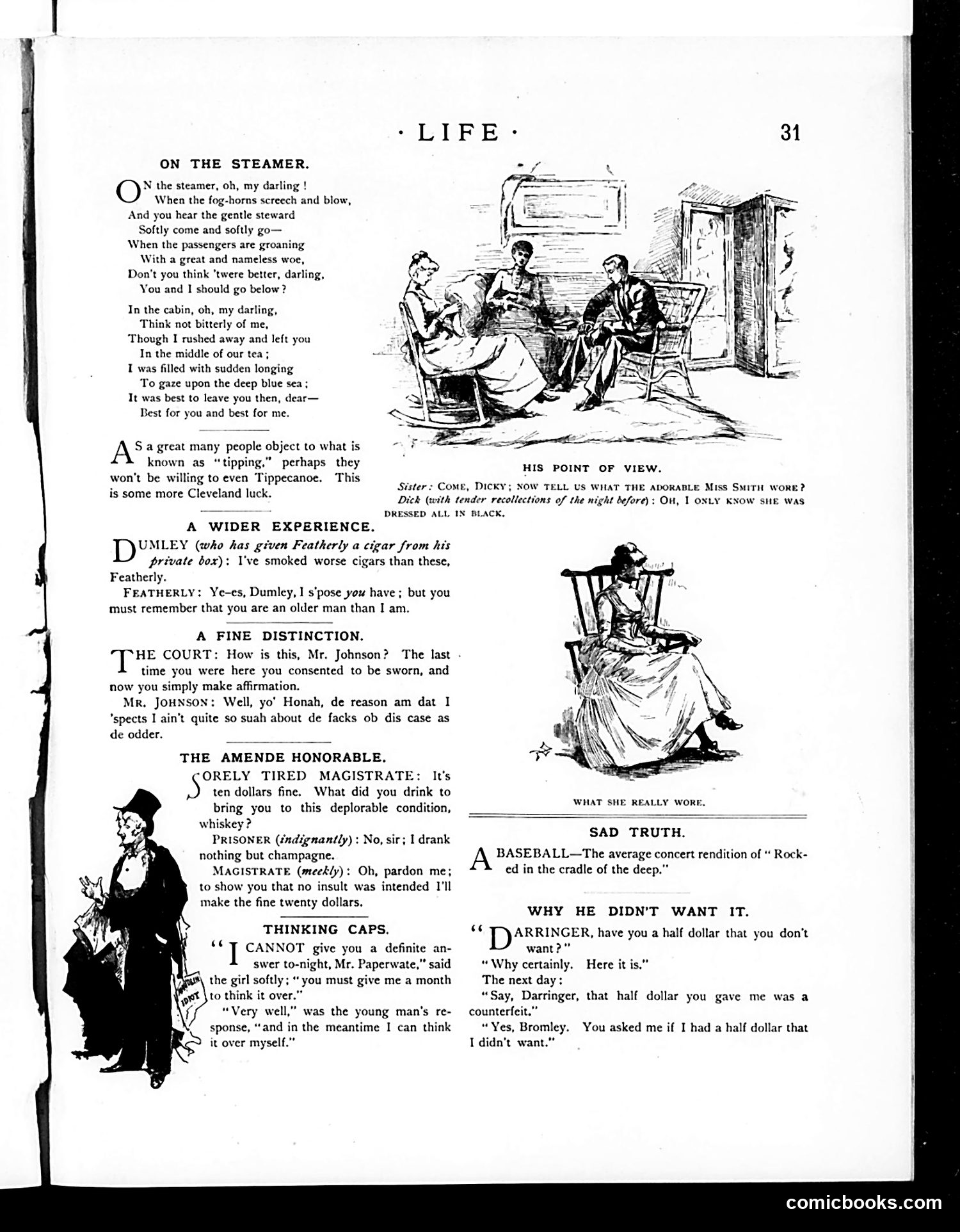
This page collects several short humorous pieces typical of Life's satirical style: **"On the Steamer"** presents a romantic dialogue between passengers, with the female speaker lamenting their separation. **"His Point of View"** depicts a shipboard conversation where a man describes a woman (Miss Smith) he met, noting only that "she was dressed all in black"—a joke about male obliviousness to social details. **"A Wider Experience"** and subsequent sections feature dialogue-based humor between characters like Dumley and Featherly, a Court and Mr. Johnson, and a Magistrate and Prisoner, playing on misunderstandings and social pretension. **"Thinking Caps"** concludes with a young man requesting a month to "think over" a proposal—gentle satire on romantic hesitation. The sketches mock Victorian-era social conventions, male behavior, and courtship customs through quick, punchy dialogue.
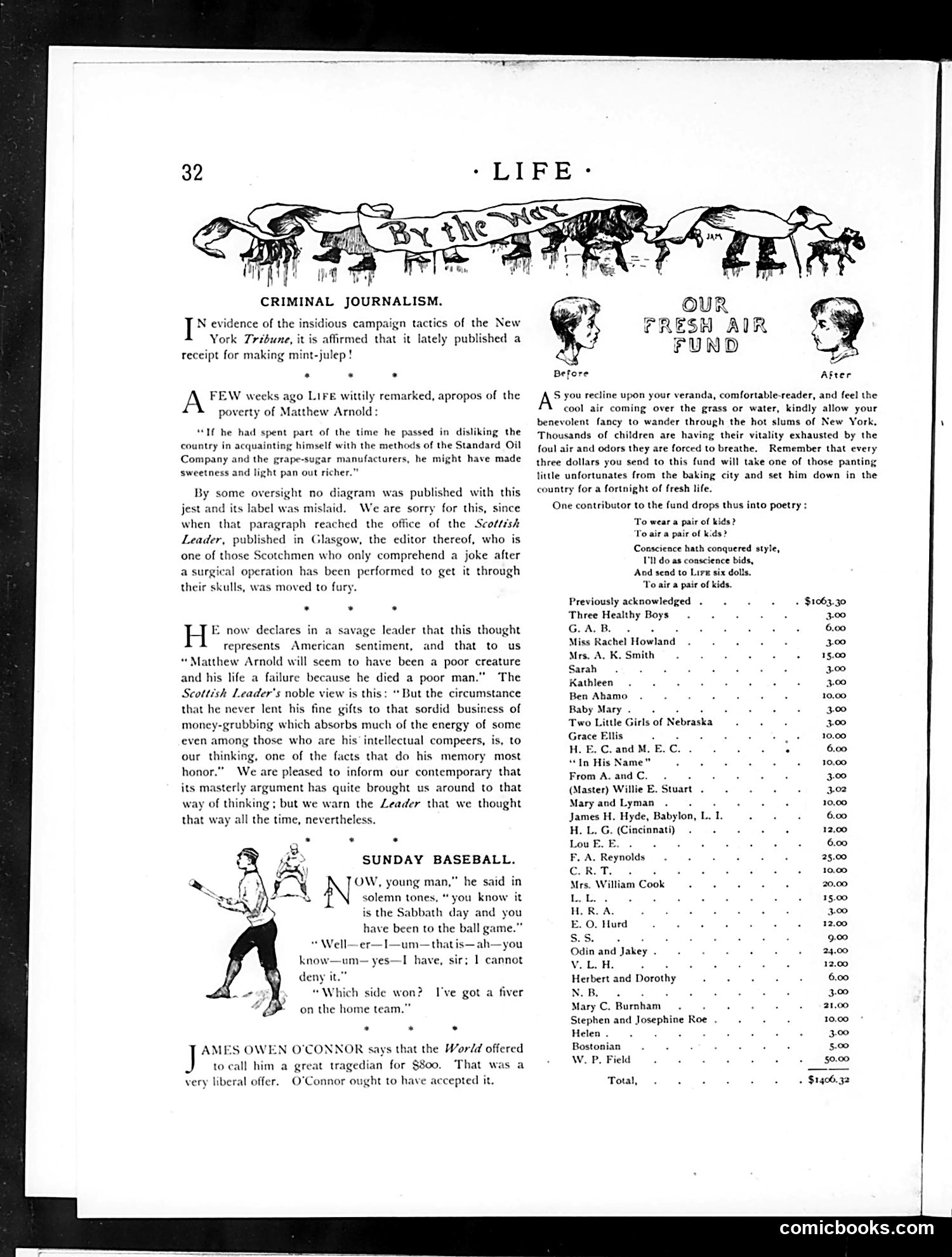
**Criminal Journalism:** This section criticizes the *New York Tribune* for publishing a misleading receipt, suggesting dishonest reporting practices. Life mocks the *Scottish Leader* editor's angry response, comparing his intellectual capacity to someone who needed surgery to comprehend a joke—a cutting insult about his intelligence. **Sunday Baseball:** A brief humorous dialogue where a young man admits he cannot deny attending a ball game on the Sabbath, violating religious observance norms of the era. **O'Connor Offer:** A final jab at actor James Owen O'Connor, noting the *World* newspaper offered him $800 to perform as a tragic actor—Life suggests he should have accepted, implying he lacks talent. The right column lists donations to a "Fresh Air Fund" for poor children's welfare.
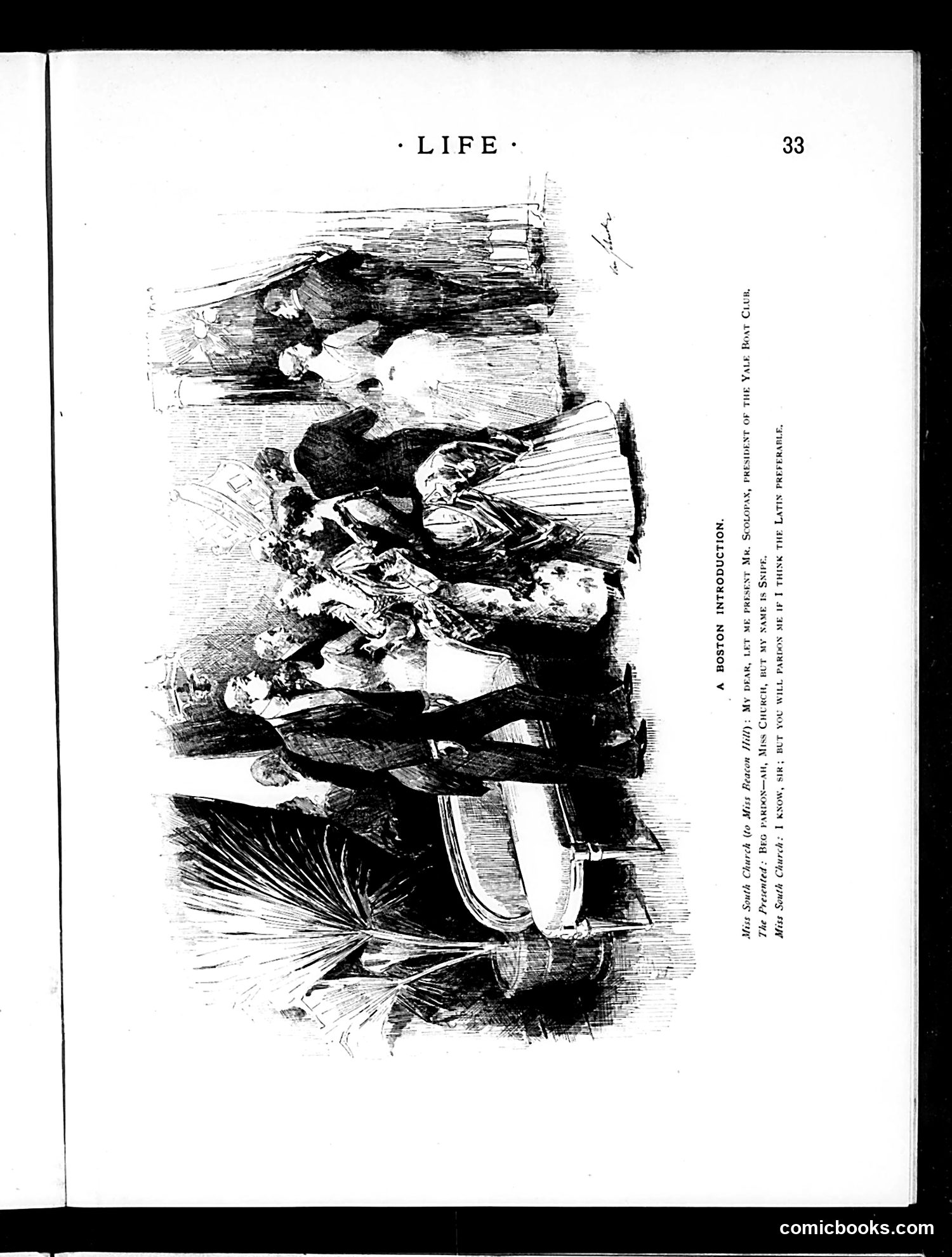
This page features a sketch titled "His Social Card at Mrs. House With A Boston Introduction" showing a woman in Victorian-era dress holding a large fan. The caption text below indicates this is satirizing social etiquette and introductions in Boston society circles. The sketch appears to mock the formality and pretension of upper-class social customs — specifically how people gained entry into elite social circles through proper "introductions." The woman's elaborate dress and prominent fan suggest the importance placed on appearance and social performance among the Boston elite. The satire targets the rigid social gatekeeping of the period, where one's ability to participate in respectable society depended on proper introductions rather than personal merit. This was characteristic of Life magazine's satirical commentary on American social conventions and class pretensions during the late 19th or early 20th century.
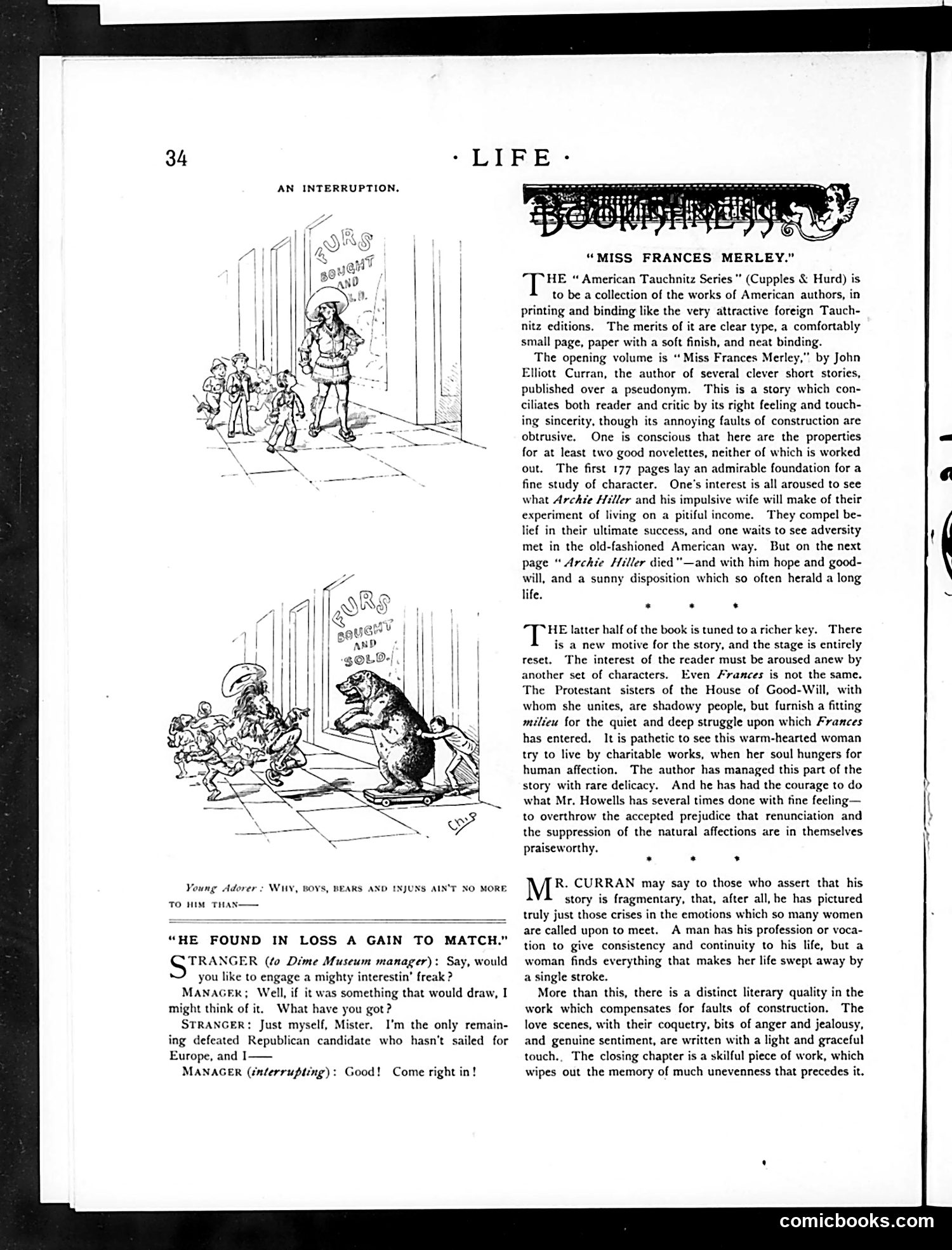
This page features a two-panel cartoon and a literary review. The cartoon depicts a street scene where a well-dressed man encounters children and a dog outside what appears to be a shop or establishment. The caption reads: "Young Adorer: Why, boys, bears and injuns ain't so more to him than—" The humor appears to target adult male vanity and distraction. A fashionably-dressed gentleman, previously engaged with or impressive to children, is now ignored—he's less interesting to them than "boys, bears and injuns" (common children's entertainment). The satire mocks how easily adults lose attention or status when novelty diverts focus. The page also includes a theater dialogue titled "He Found in Loss a Gain to Match" and a book review of "Miss Frances Merley" by John Elliott Curran, discussing character development and literary merit.
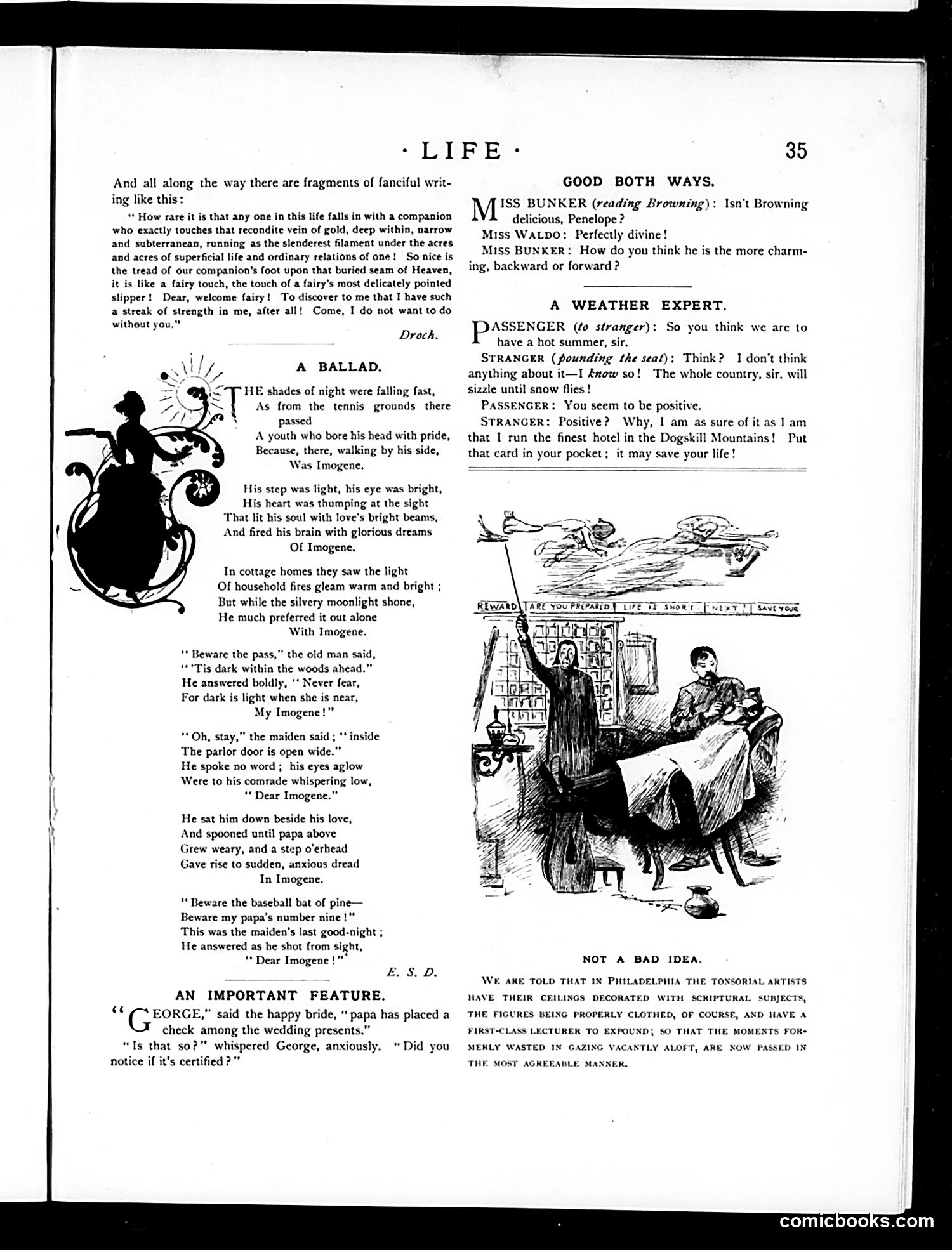
This page contains several short humorous pieces typical of Life's satirical format: **"A Ballad"** is a romantic poem with accompanying silhouette illustration about a youth and maiden meeting at night—standard sentimental Victorian fare that Life likely presents ironically. **"Good Both Ways"** is a brief dialogue joke about Browning (likely poet Robert Browning) that appears to play on ambiguous phrasing. **"A Weather Expert"** satirizes overconfident forecasting, with a stranger insisting he'll predict summer heat based on a Dogskill Mountains hotel card—mocking dubious expertise. **"Not a Bad Idea"** critiques Philadelphia's tonsorial artists for decorating ceilings with "scriptural subjects" and hiring lecturers, suggesting viewers waste time "gazing vacantly aloft" instead of paying attention—social commentary on pretentious self-improvement in public spaces.
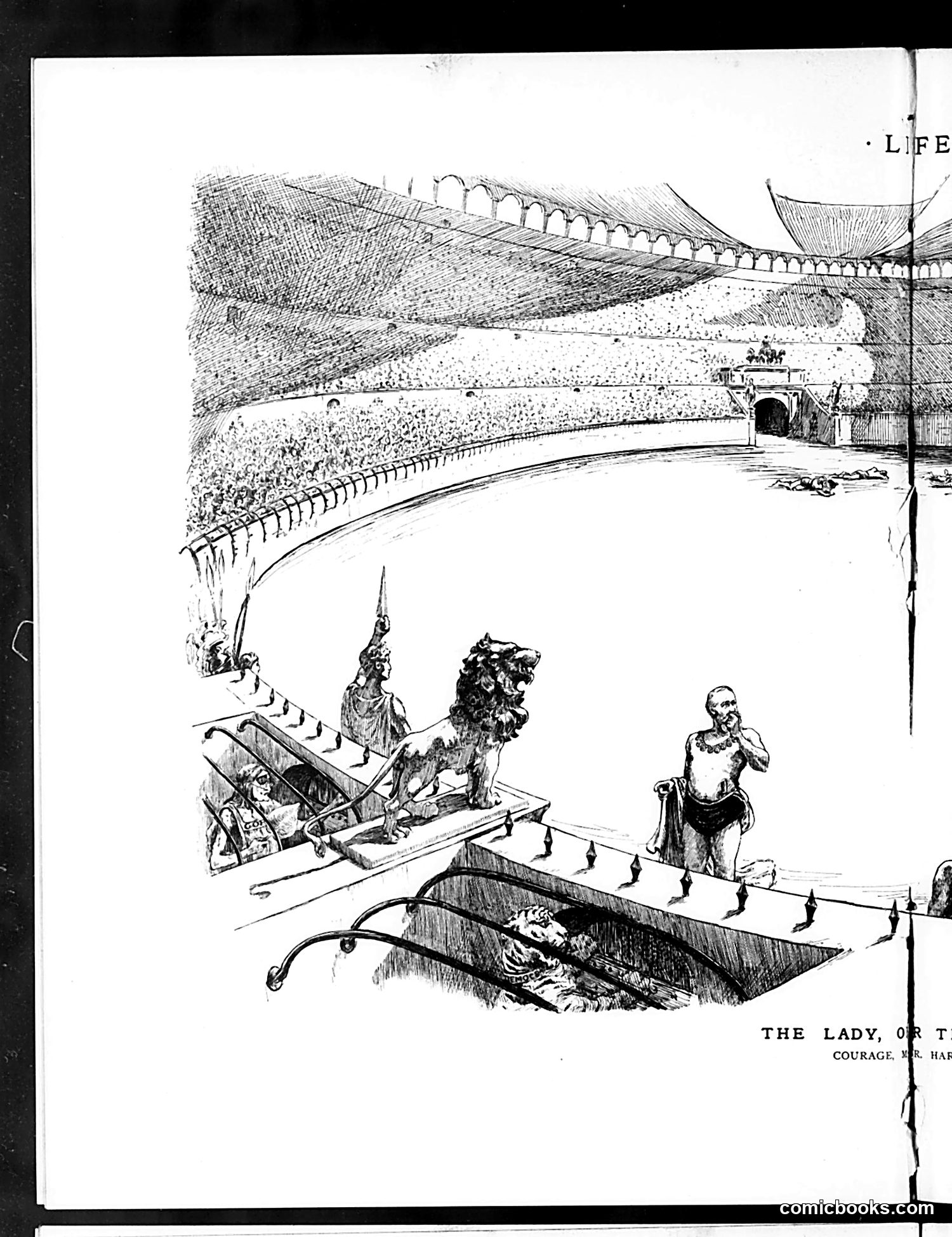
This appears to be a satirical cartoon from Life magazine depicting a Roman gladiatorial arena scene. The visible text fragment reads "THE LADY, OR T..." with partial text "COURAGE, B... HA..." below. The cartoon shows a woman in classical dress standing in an arena amphitheater, facing what appears to be a lion on a platform. A gladiator-type figure stands nearby. The elaborate architectural setting with tiered seating and the crowd in the background suggests this is referencing either classical history or a contemporary theatrical/entertainment production. Without the complete caption or publication date, the specific satirical target is unclear—it could be commenting on women's courage, theatrical spectacle, or possibly a contemporary women's rights or social issue being compared to ancient Roman spectacle. The fragmented title prevents definitive interpretation.
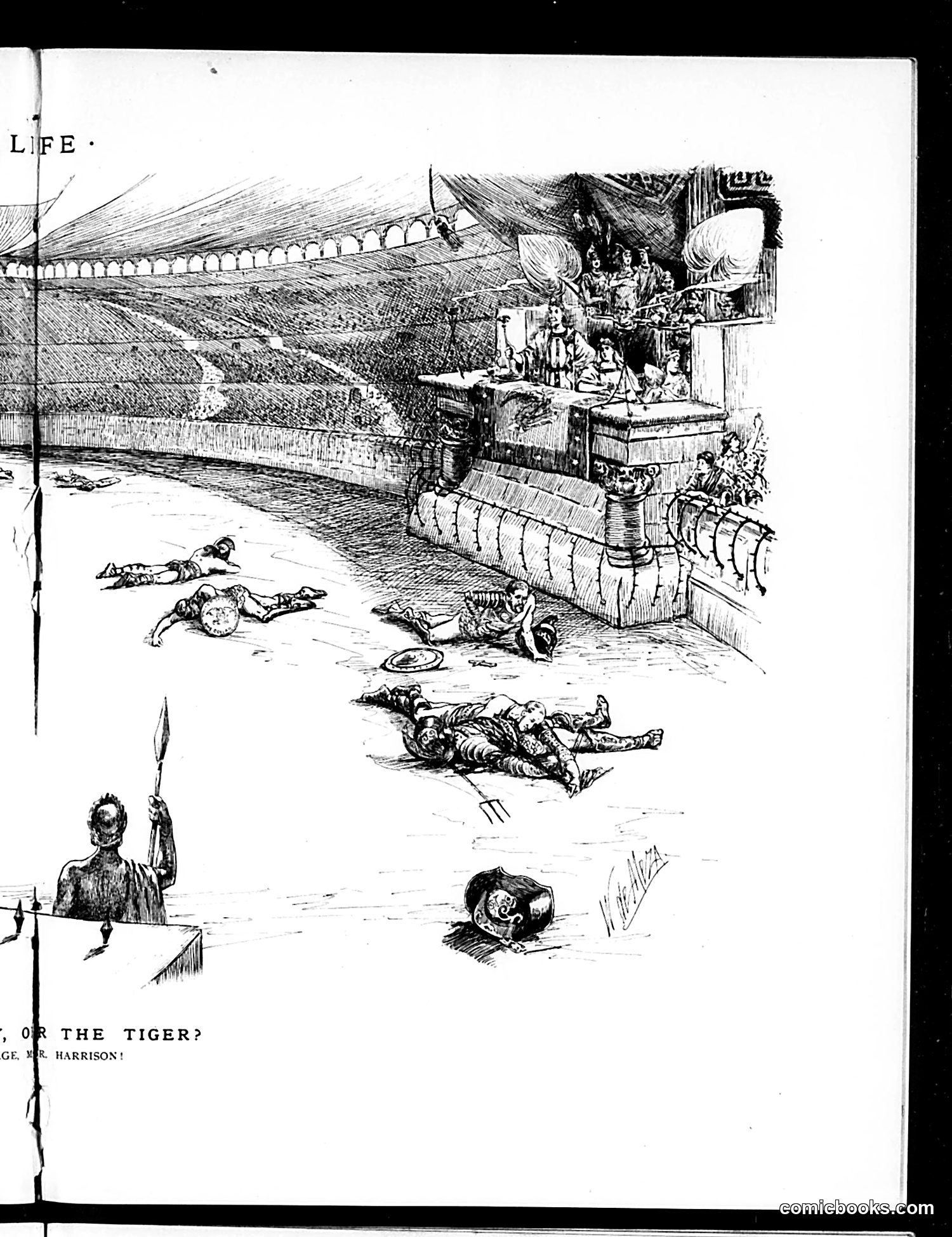
This appears to be a satirical illustration from *Life* magazine titled "OR THE TIGER?" (the full title is cut off, likely reading something like "The Lamb or The Tiger?"). The image depicts a gruesome arena or amphitheater scene with multiple bodies lying dead or injured on the ground, while spectators watch from elevated stands above. The artist is credited as "Harrison" (visible at bottom). The satire appears to critique violent spectator entertainment—possibly Roman gladiatorial games or contemporary blood sports. The stark depiction of casualties contrasts with the casual observation from the crowd above, suggesting social commentary on public appetite for violence or brutality presented as entertainment. Without the complete title text, the specific historical or political reference remains unclear, though the moral critique of normalized violence is evident.
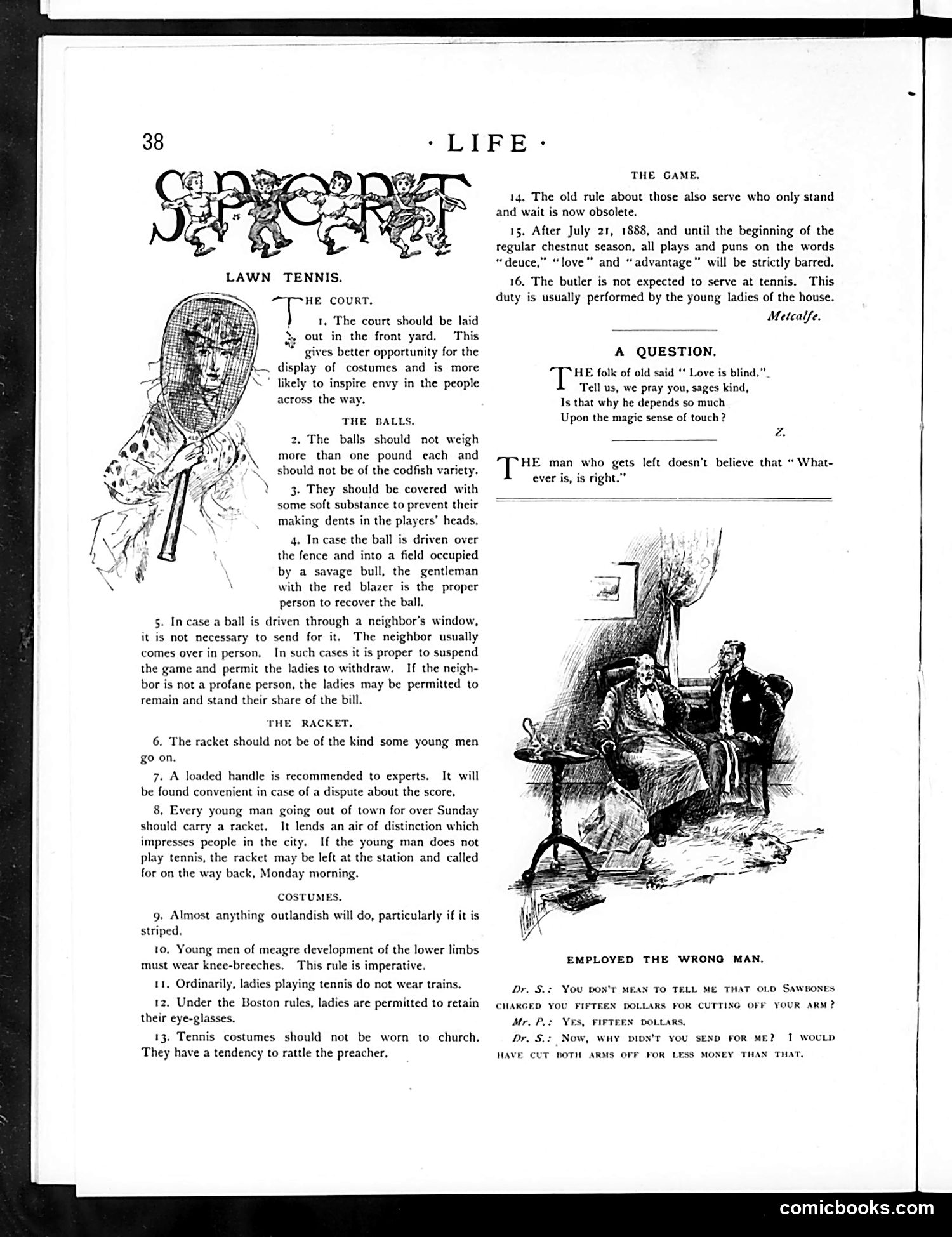
This cartoon satirizes a specific social situation: a man (Dr. S.) has hired someone to perform a task, but chose poorly. The dialogue reveals the humor: Dr. S. accuses "old Sawbones" (a period slang term for a surgeon or doctor) of charging $15 for cutting off his arm. Mr. P. responds that he did it for $15, but suggests Dr. S. should have hired him to cut *both* arms off for less money—implying incompetent surgeons overcharge for botched work, and that getting worse service might have cost less. The cartoon mocks both incompetent medical practitioners and the absurdity of negotiating fees with someone who's already damaged you. The joke assumes readers recognize "Sawbones" as a derisive term for surgeons.
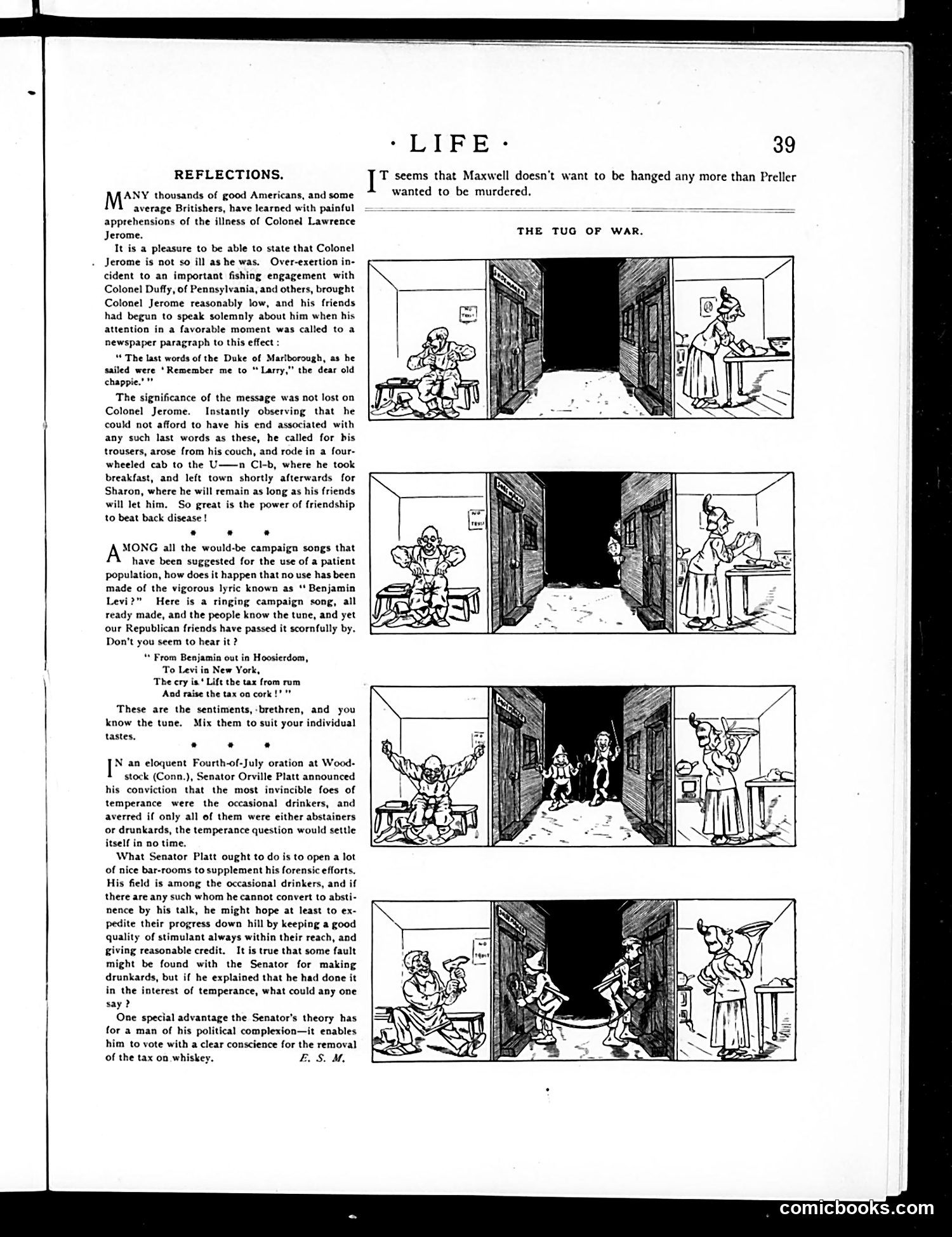
This page contains satirical commentary and a comic strip titled "The Tug of War." **The Reflections Section** discusses: - Colonel Lawrence Jerome's recovery from illness, humorously attributing it to receiving an encouraging message referencing the Duke of Marlborough - A mock campaign song called "Benjamin Levi" (the reference is unclear without broader context, but appears to mock Republican campaign efforts) - Senator Orville Platt's Fourth-of-July temperance speech, where he argued occasional drinkers were temperance's worst enemies. The satire suggests the Senator should simply open bars to convert occasional drinkers into full drunkards—thereby "solving" temperance by eliminating the middle ground **"The Tug of War" Comic Strip** depicts a domestic struggle where a woman and man pull items in opposite directions through a doorway, illustrating marital conflict over possessions or control. The Maxwell/Preller reference at top remains unclear without additional historical context, but suggests contemporary legal proceedings. The overall tone is genteel social satire typical of early 20th-century American humor magazines.
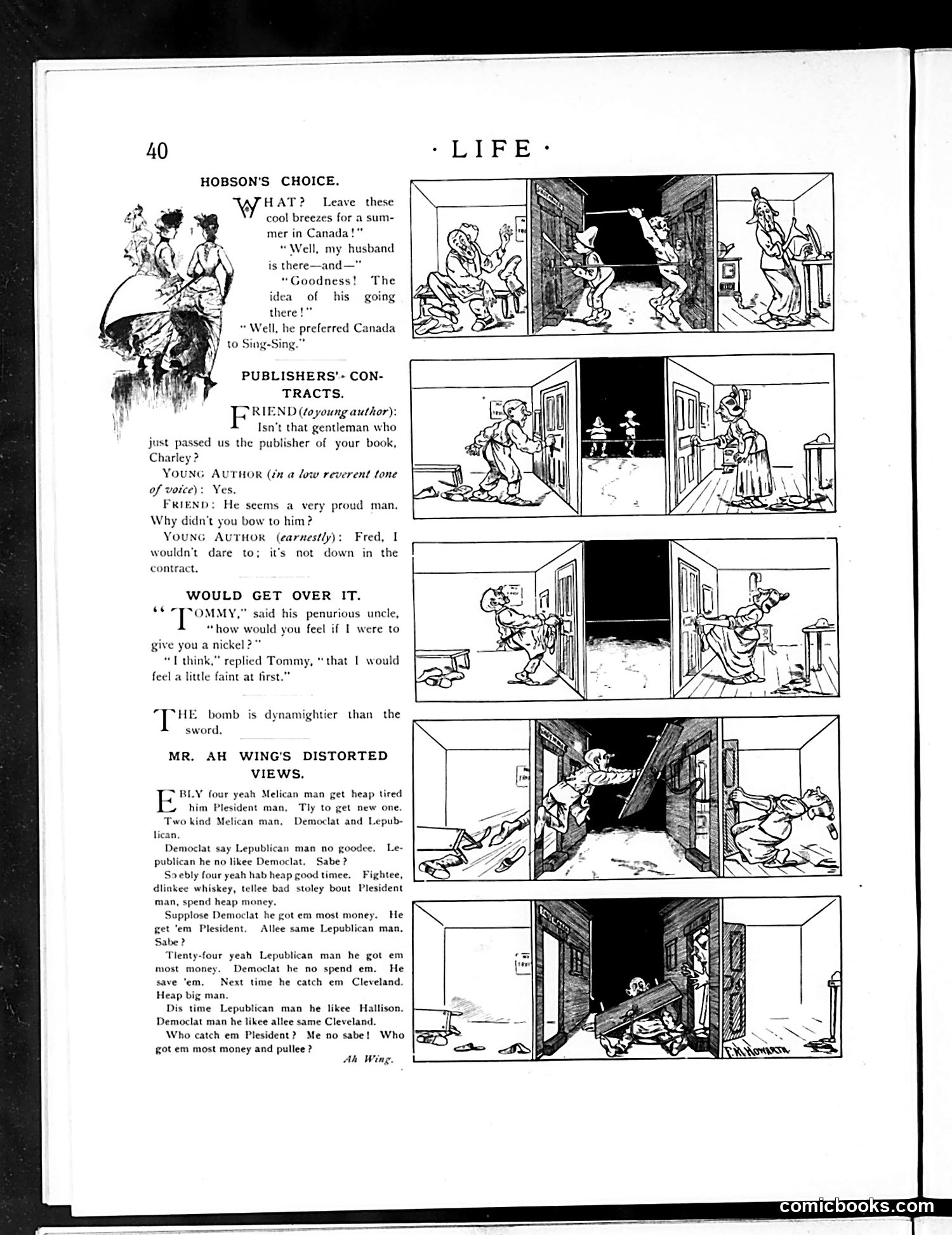
This page contains several short satirical pieces typical of early 20th-century American humor magazines: **"Hobson's Choice"** jokes about a woman choosing between Canadian summers and her husband, who preferred Canada to "Sing-Sing" (a notorious prison), implying he's a criminal. **"Publishers' Contracts"** mocks the powerlessness of young authors: a publisher is so intimidating the author won't even bow to him without explicit permission in the contract—satirizing exploitative publishing deals. **"Would Get Over It"** is a brief joke about a stingy uncle and a poor child's reaction to receiving a nickel. **"Mr. Ah Wing's Distorted Views"** presents Chinese-immigrant perspective (rendered in offensive pidgin English, typical of the era) observing American electoral politics: that whichever party has more money wins the presidency, regardless of ideology—suggesting American democracy is simply purchasable. The cartoons accompanying these pieces use exaggerated illustrations to emphasize the humor.
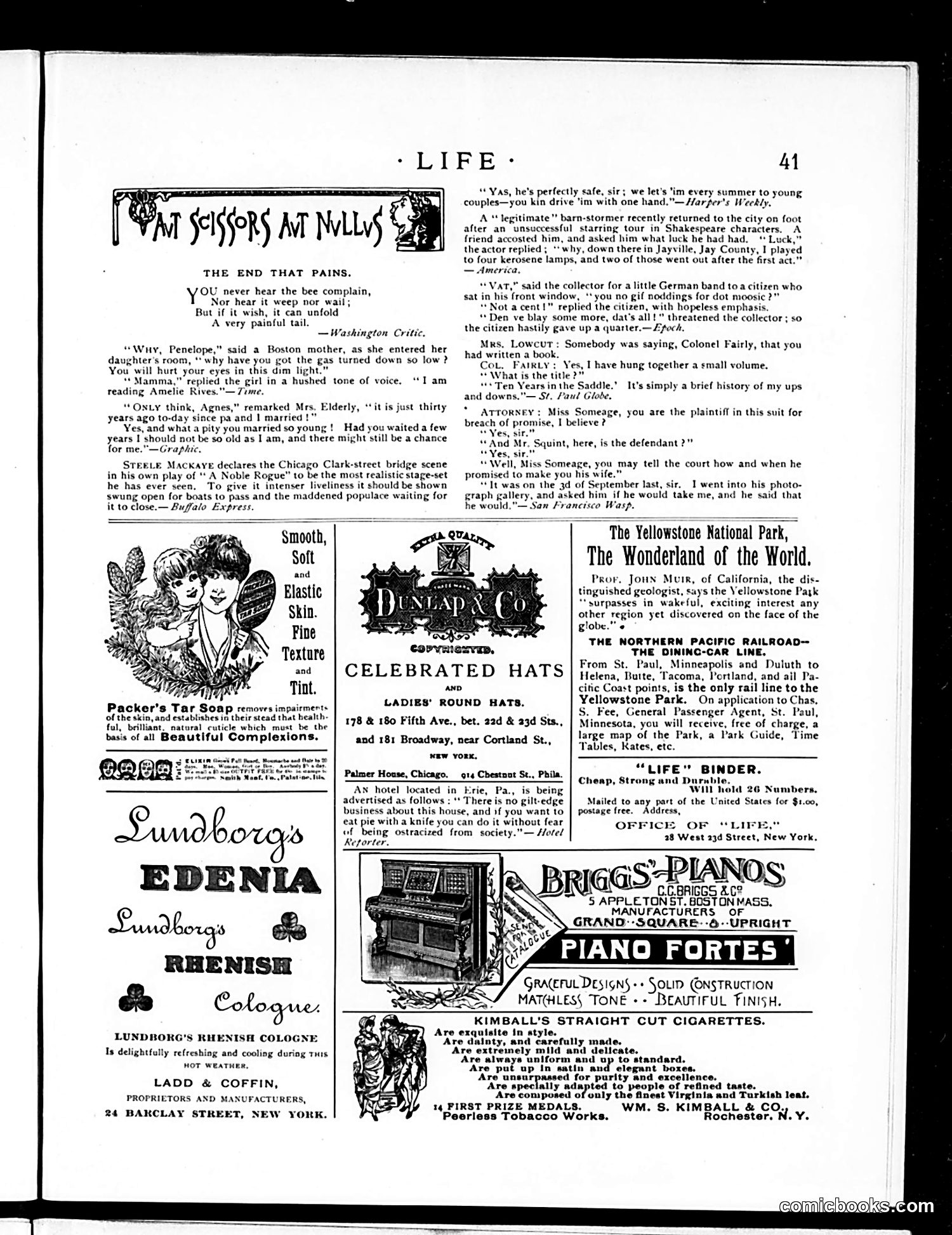
This page is primarily **advertising and humor columns** with no significant political cartoons requiring historical context. The humor pieces are light social satire: jokes about a girl reading in dim light (referencing the popular novelist Amelie Rives), a wife regretting marrying young, and a failed Shakespearean actor who performed for audiences of only four kerosene lamps in rural Indiana. One piece mocks a German street musician's persistence; another plays on a photography gallery owner misinterpreting a woman's request to "take me" as a marriage proposal. The advertisements promote consumer goods (Packer's Tar Soap, Lundborg's cologne, celebrated hats, pianos) and the Northern Pacific Railroad's Yellowstone tourist route, featuring a quote from naturalist John Muir. **No political content or specific historical figures are referenced.** This is typical light-hearted magazine filler from the era, aimed at middle-class readers enjoying gentle domestic humor and period consumer culture.
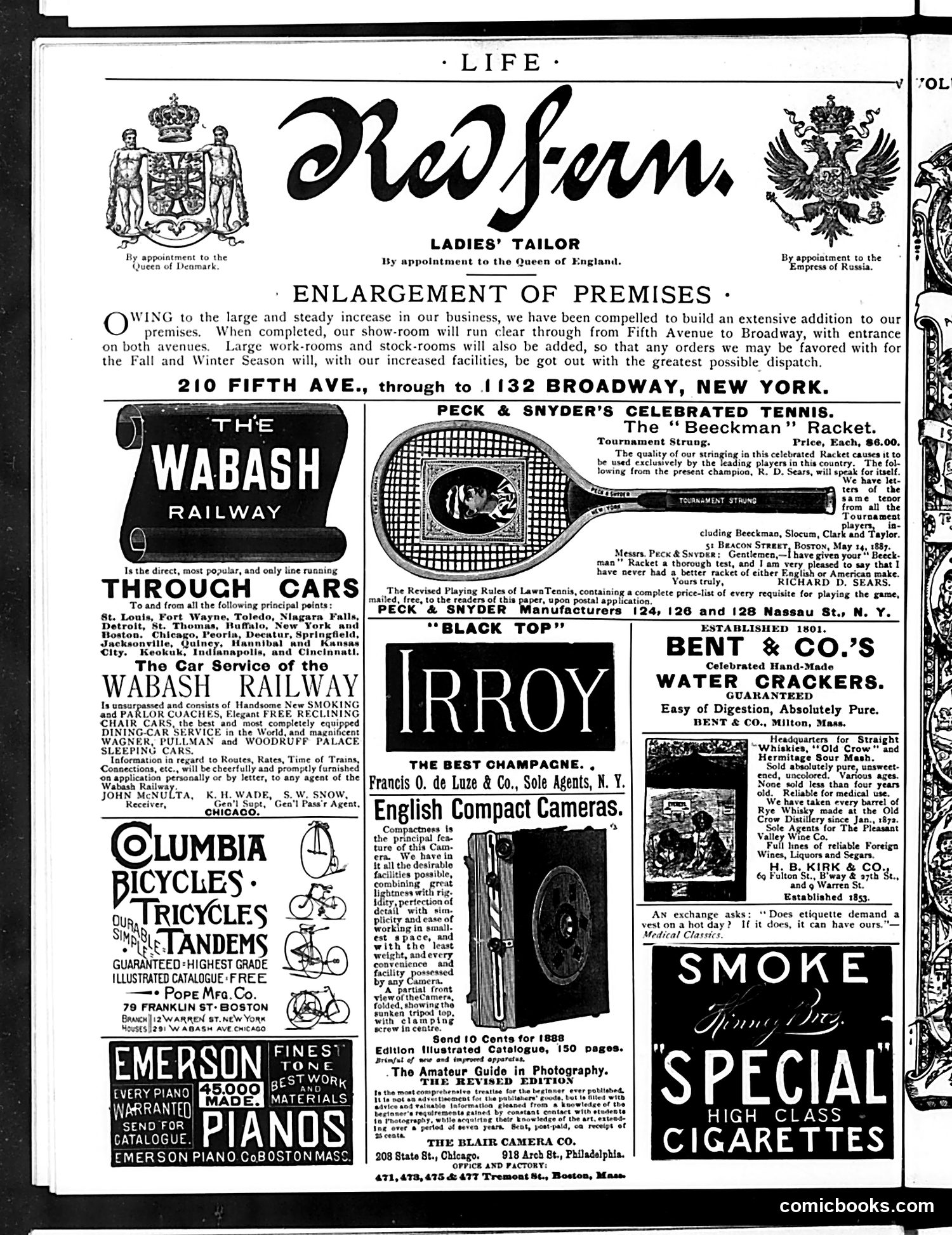
This page is **primarily advertisements**, not political cartoons or satirical editorial content. It's from Life magazine's advertising section, circa 1888 (based on dates visible in ads). The notable content includes: **Red Fern** (top): A ladies' tailor business advertising expansion from Fifth to 132nd Avenue in New York, claiming royal patronage (Queen of Denmark, Queen of England, Empress of Russia). **Wabash Railway**: Advertising through-car service to major American cities. **Columbia Bicycles/Tricycles/Tandems**: Early bicycle manufacturer marketing. **Sports Equipment & Other Goods**: Tennis rackets, champagne, pianos, cameras, water crackers, and cigarettes. The "Red Fern" royal appointment claims appear designed to convey prestige through European royal endorsement—a common marketing tactic of the era for luxury goods. No political satire is evident on this page.