
Life, 1888-07-19 · page 6 of 14
Life — July 19, 1888 — page 6: what you’re looking at
What you’re looking at
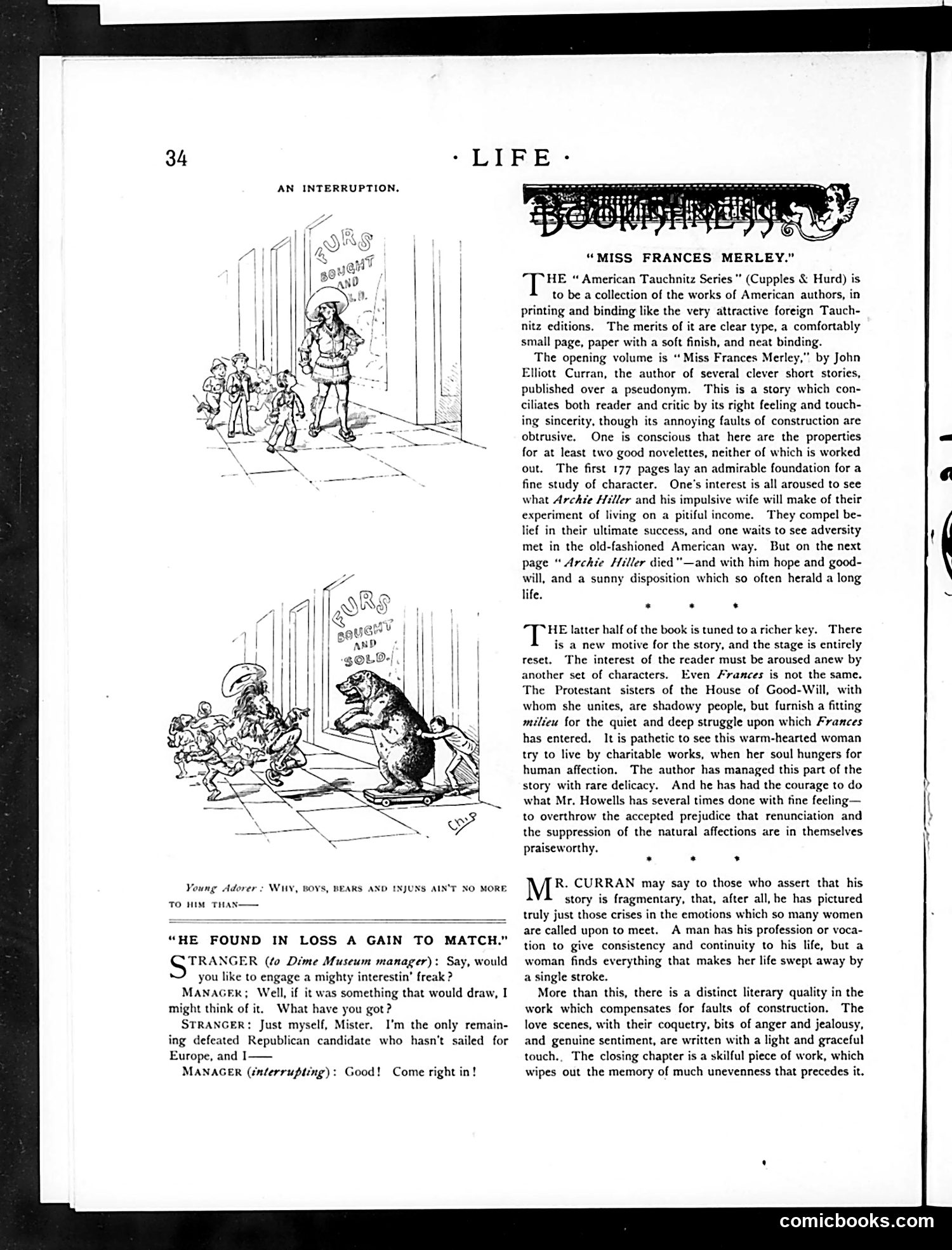
This page features a two-panel cartoon and a literary review. The cartoon depicts a street scene where a well-dressed man encounters children and a dog outside what appears to be a shop or establishment. The caption reads: "Young Adorer: Why, boys, bears and injuns ain't so more to him than—" The humor appears to target adult male vanity and distraction. A fashionably-dressed gentleman, previously engaged with or impressive to children, is now ignored—he's less interesting to them than "boys, bears and injuns" (common children's entertainment). The satire mocks how easily adults lose attention or status when novelty diverts focus. The page also includes a theater dialogue titled "He Found in Loss a Gain to Match" and a book review of "Miss Frances Merley" by John Elliott Curran, discussing character development and literary merit.
📄 Transcribed text from this page (OCR, searchable)
Machine-transcribed from the original scan — historical spelling and the odd misread are preserved.
Young Adorer : WAY, BOYS, BEARS AND INJUNS AIN'T NO MORE To mi THAN— “HE FOUND IN LOSS A GAIN TO MATCH.” TRANGER (to Dime Museum manager): Say, would you like to engage a mighty interestin’ freak ? MANAGER; Well, if it was something that would draw, I might think of it. What have you got? STRANGER: Just myself, Mister. I'm the only remain- ing defeated Republican candidate who hasn't sailed for Europe, and I— MANAGER (énlerrupting): Good! Come right in! “MISS FRANCES MERLEY.” HE “ American Tauchnitz Series " (Cupples & Hurd) is to be a collection of the works of American authors, in printing and binding like the very attractive foreign Tauch- nitz editions. The merits of it are clear type, a comfortably small page, paper with a soft finish, and neat binding. The opening volume is “ Miss Frances Merley,” by John Elliott Curran, the author of several clever short stories, published over a pseudonym. This is a story which con- ciliates both reader and critic by its right feeling and touch- ing sincerity, though its annoying faults of construction are obtrusive. One is conscious that here are the properties for at least two good novelettes, neither of which is worked out. The first 177 pages lay an admirable foundation for a fine study of character. One's interest is all aroused to see what Archie Hiller and his impulsive wife will make of their experiment of living on a pitiful income. They compel be- lief in their ultimate success, and one waits to see adversity met in the old-fashioned American way. But on the next page “ Archie Hiller died ’—and with him hope and good- will, and a sunny disposition which so often herald a long life. . . . HE latter half of the book is tuned toa richer key. There is a new motive for the story, and the stage is entirely reset, The interest of the reader must be aroused anew by another set of characters. Even Frances is not the same. The Protestant sisters of the House of Good-Will, with whom she unites, are shadowy people, but furnish a fitting milieu for the quiet and deep struggle upon which Frances has entered. It is pathetic to see this warm-hearted woman try to live by charitable works, when her soul hungers for human affection. The author has managed this part of the story with rare delicacy. And he has had the courage to do what Mr. Howells has several times done with fine feeling— to overthrow the accepted prejudice that renunciation and the suppression of the natural affections are in themselves praiseworthy. . . * R. CURRAN may say to those who assert that his story is fragmentary, that, after all, he has pictured truly just those crises in the emotions which so many women are called upon to meet. A man has his profession or voca- tion to give consistency and continuity to his life, but a woman finds everything that makes her life swept away by a single stroke. More than this, there is a distinct literary quality in the work which compensates for faults of construction. The love scenes, with their coquetry, bits of anger and jealousy, and genuine sentiment, are written with a light and graceful touch., The closing chapter is a skilful piece of work, which wipes out the memory of much unevenness that precedes it. comicbooks.com