
Life, 1888-07-19 · page 2 of 14
Life — July 19, 1888 — page 2: what you’re looking at
What you’re looking at
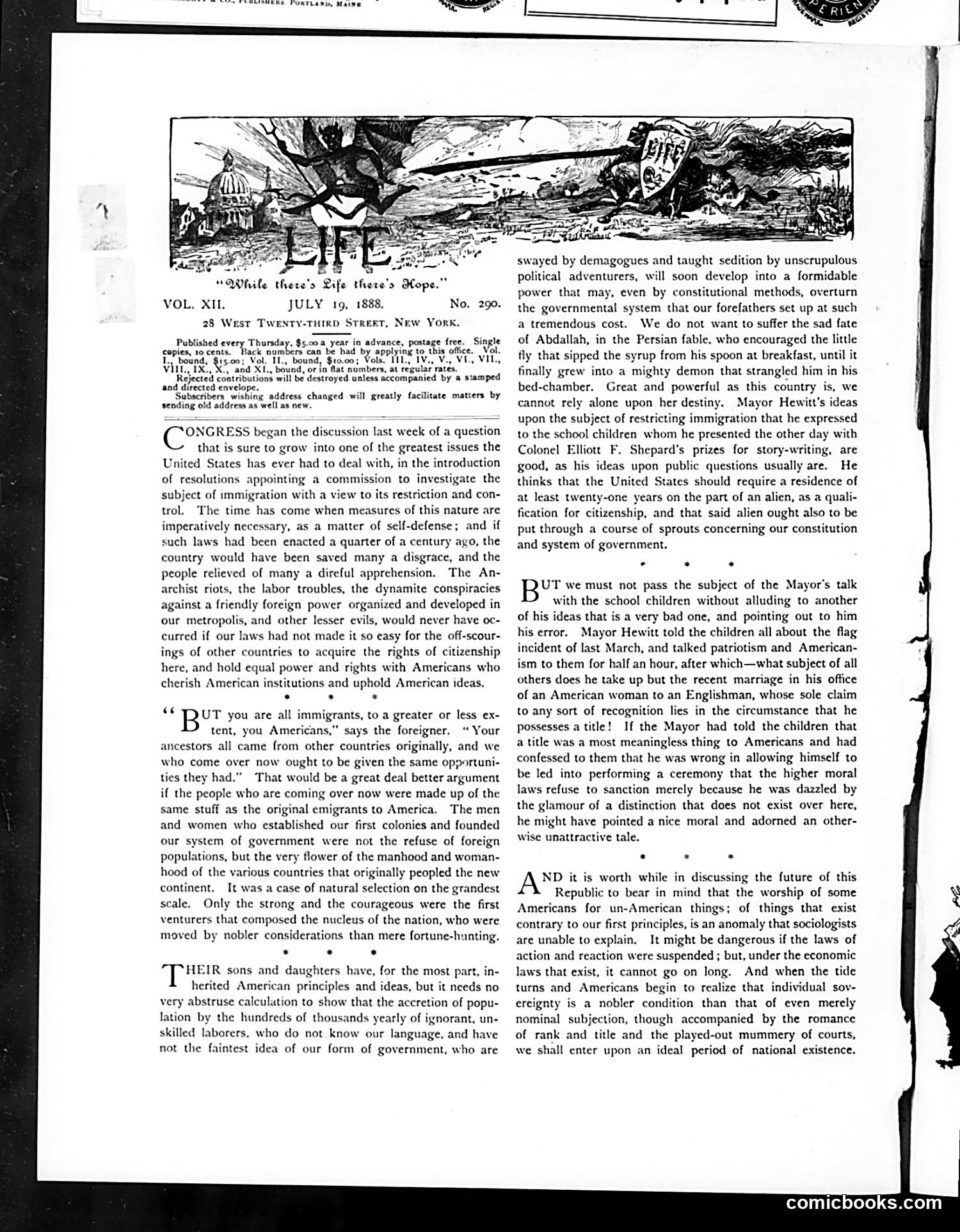
The header illustration depicts a fantastical flying creature labeled "LIFE" soaring over a cityscape, establishing the magazine's satirical identity. The main article criticizes Congressional discussion of immigration restriction and control. The text argues against nativist sentiment, defending immigrants' rights to American citizenship while also criticizing Mayor Hewitt's recent controversial statements to schoolchildren about the American flag and patriotism. The satire targets what appears to be hypocrisy: the author notes that nearly all Americans are themselves descendants of immigrants, yet some advocate restricting newcomers' rights. The piece defends immigrants' capacity to become good Americans while questioning whether Mayor Hewitt's emphasis on titles and ceremonial patriotism represents genuine American values—suggesting superficial nationalism over substantive civic understanding.
📄 Transcribed text from this page (OCR, searchable)
Machine-transcribed from the original scan — historical spelling and the odd misread are preserved.
“While there's Life there's Hope.” VOL. XII. JULY 19, 1888, No. 28 West Twenty-THIRD StReET, New York. Published every Thursday, $5.00 a year in advance, postage free. Single copies, 10 cents. Tack numbers can be had by applying to this office. Vol. 1, bound, $15.00; Vol. I1., bound, $10.00; Vols. III, 1V., V., Vi, VIL, Vint. 1X .. bound, or fa flat numbers, at regular rat Rejected contributions will be destroyed unless accompanied by a siamped and directed envelope. Subscribers wishing address changed will greatly facilitate matters by sending old address as well as new. ONGRESS began the discussion last week of a question that is sure to grow into one of the greatest issues the United States has ever had to deal with, in the introduction of resolutions appointing a commission to investigate the subject of immigration with a view to its restriction and con- trol. The time has come when measures of this nature are imperatively necessary, as a matter of self-defense; and if such laws had been enacted a quarter of a century ago, the country would have been saved many a disgrace, and the people relieved of many a direful apprehension. The An- archist riots, the labor troubles, the dynamite conspiracies against a friendly foreign power organized and developed in our metropolis, and other lesser evils, would never have oc- curred if our laws had not made it so easy for the off-scour- ings of other countries to acquire the rights of citizenship here, and hold equal power and rights with Americans who cherish American institutions and uphold American ideas. . . . ae UT you are all immigrants, to a greater or less ex- tent, you Americans,” says the foreigner. “ Your ancestors all came from other countries originally, and we who come over now ought to be given the same opportuni- ties they had.” That would be a great deal better argument if the people who are coming over now were made up of the same stuff as the original emigrants to America. The men and women who established our first colonies and founded our system of government were not the refuse of foreign populations, but the very flower of the manhood and woman- hood of the various countries that originally peopled the new continent. It was a case of natural selection on the grandest scale. Only the strong and the courageous were the first venturers that composed the nucleus of the nation, who were moved by nobler considerations than mere fortune-hunting. . . . HEIR sons and daughters have, for the most part, in- herited American principles and ideas, but it needs no very abstruse calculation to show that the accretion of popu- lation by the hundreds of thousands yearly of ignorant, un- skilled laborers, who do not know our language, and have not the faintest idea of our form of government, who are swayed by demagogues and taught sedition by unscrupulous political adventurers, will soon develop into a formidable power that may, even by constitutional methods, overturn the governmental system that our forefathers set up at such a tremendous cost. We do not want to suffer the sad fate of Abdallah, in the Persian fable, who encouraged the little fly that sipped the syrup from his spoon at breakfast, until it finally grew into a mighty demon that strangled him in his bed-chamber. Great and powerful as this country is, we cannot rely alone upon her destiny. Mayor Hewitt's ideas upon the subject of restricting immigration that he expressed to the school children whom he presented the other day with Colonel Elliott F. Shepard's prizes for story-writing, are good, as his ideas upon public questions usually are. He thinks that the United States should require a residence of at least twenty-one years on the part of an alien, as a quali- fication for citizenship, and that said alien ought also to be put through a course of sprouts concerning our constitution and system of government. UT we must not pass the subject of the Mayor's talk with the school children without alluding to another of his ideas that is a very bad one, and pointing out to him his error. Mayor Hewitt told the children all about the flag incident of last March, and talked patriotism and American- ism to them for half an hour, after which—what subject of all others does he take up but the recent marriage in his office of an American woman to an Englishman, whose sole claim to any sort of recognition lies in the circumstance that he possesses a title! If the Mayor had told the children that a title was a most meaningless thing to Americans and had confessed to them that he was wrong in allowing himself to be led into performing a ceremony that the higher moral laws refuse to sanction mercly because he was dazzled by the glamour of a distinction that does not exist over here, he might have pointed a nice moral and adorned an other- wise unattractive tale. . * . D it is worth while in discussing the future of this Republic to bear in mind that the worship of some Americans for un-American things; of things that exist contrary to our first principles, is an anomaly that sociologists are unable to explain. It might be dangerous if the laws of action and reaction were suspended ; but, under the economic laws that exist, it cannot go on long. And when the tide turns and Americans begin to realize that individual sov- ereignty is a nobler condition than that of even merely nominal subjection, though accompanied by the romance of rank and title and the played-out mummery of courts, we shall enter upon an ideal period of national existence. comicbooks.com