
A complete issue · 14 pages · 1888
Life — July 12, 1888
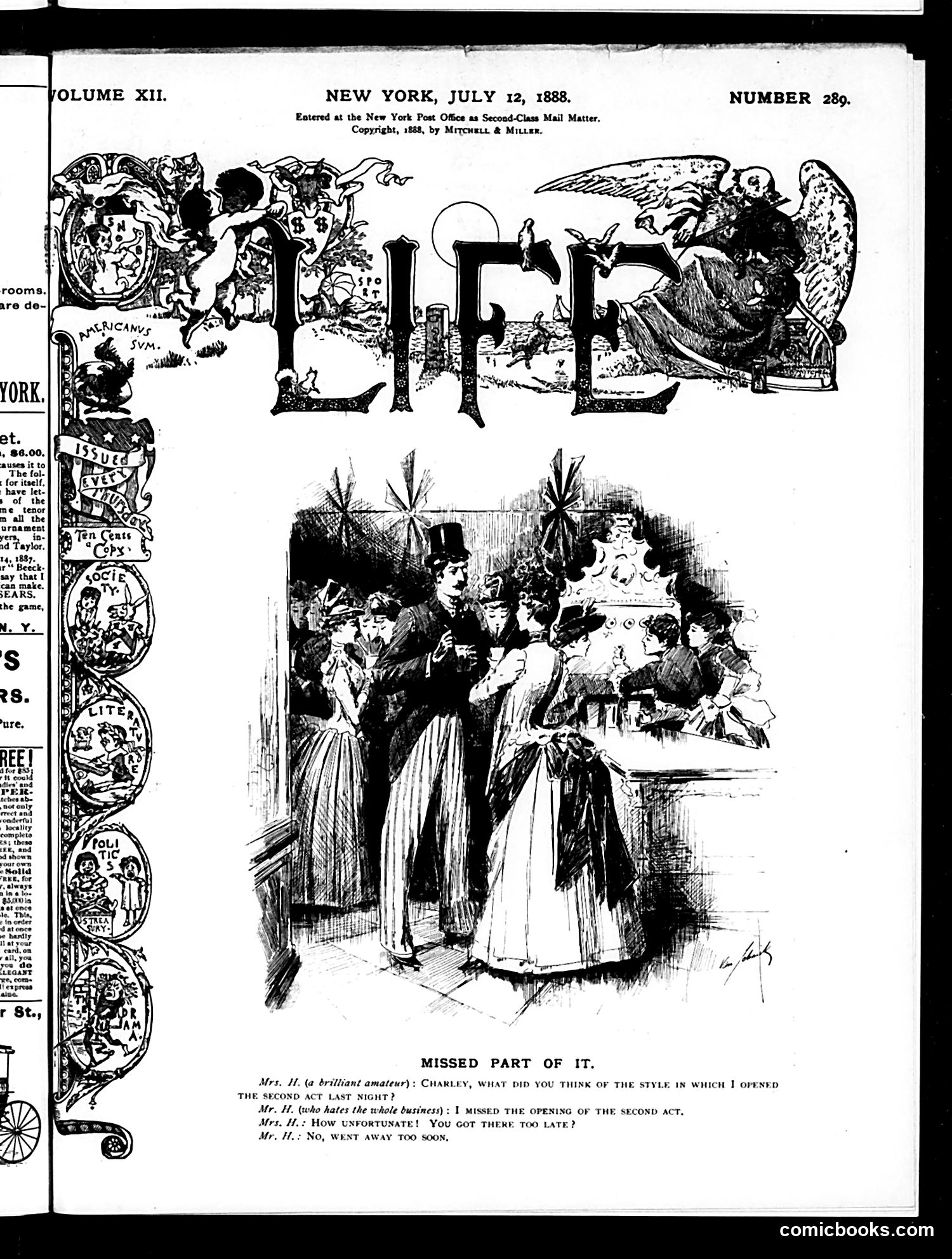
This cartoon satirizes theater-goers who arrive late to performances. The dialogue shows Mrs. H. (a "brilliant amateur") asking Mr. H. what he thought of the second act's opening style, only to learn he missed it entirely by arriving late. When she expresses dismay at his tardiness, he dismissively replies he "went away too soon." The joke targets the social embarrassment and absurdity of attending theater unprepared—arriving after performances have begun, then pretending to have opinions about what one missed. It mocks both the pretentiousness of amateur theater enthusiasts and the carelessness of fashionable society attendees who treated theater as a social event rather than one requiring punctuality and genuine attention.
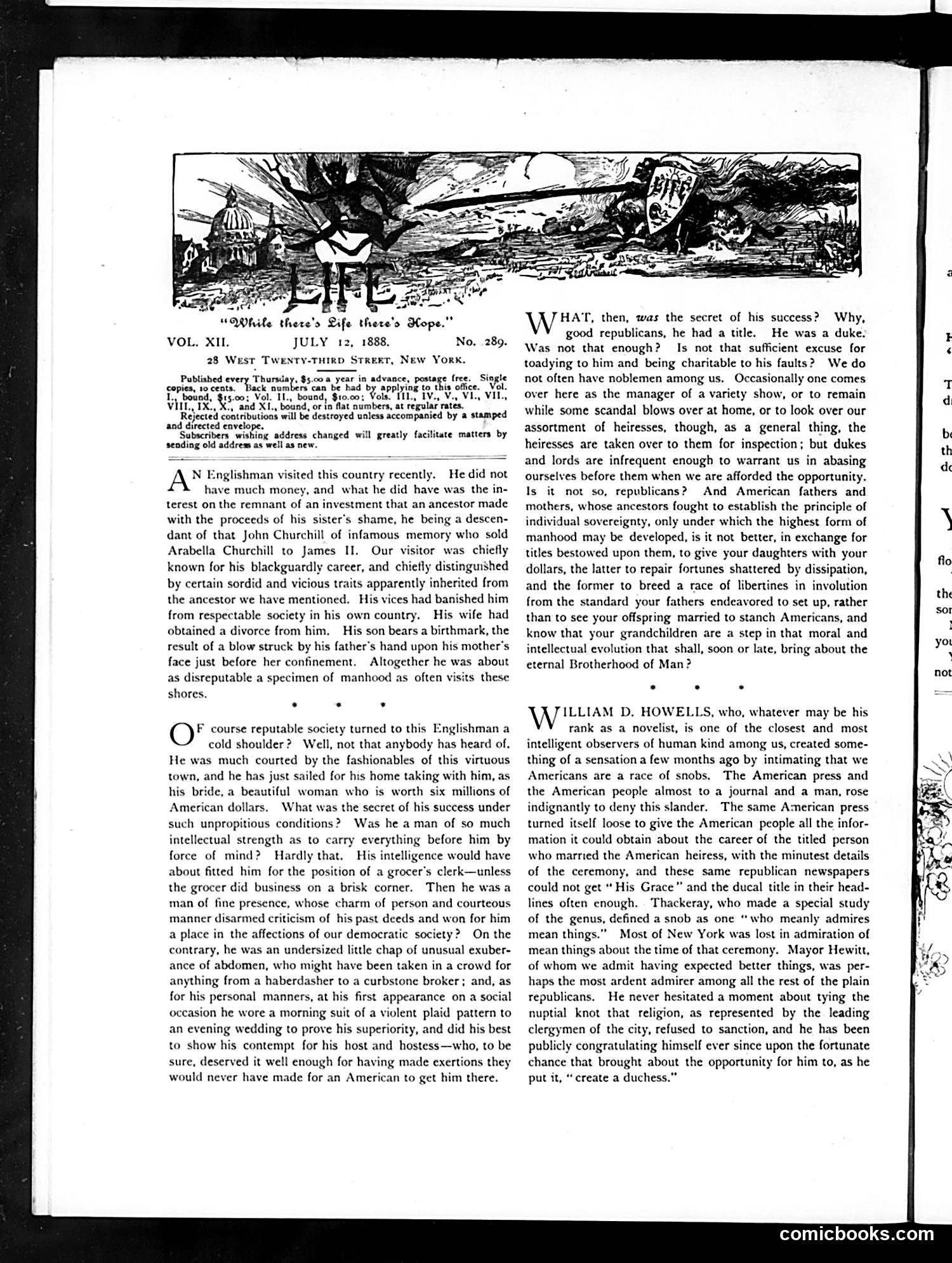
The page's header illustration shows a pastoral landscape with the caption "While there's Life there's Hope"—Life magazine's typical masthead art. The text discusses an Englishman who visited America and failed socially despite wealth and a beautiful wife, becoming a cautionary tale about European aristocratic pretensions. The article then focuses on **William D. Howells**, a prominent American novelist and social observer, and his recent commentary on American marriage customs. The satire targets the American press's excessive coverage of a titled person's marriage ceremony, suggesting American society's contradictory attitudes: republicans claiming to reject aristocracy while obsessively reporting on titles and rank. The piece mocks this hypocrisy—particularly Mayor Hewitt's congratulations for creating "a duchess"—as reflecting deeper American ambivalence about wealth, status, and democratic principles.
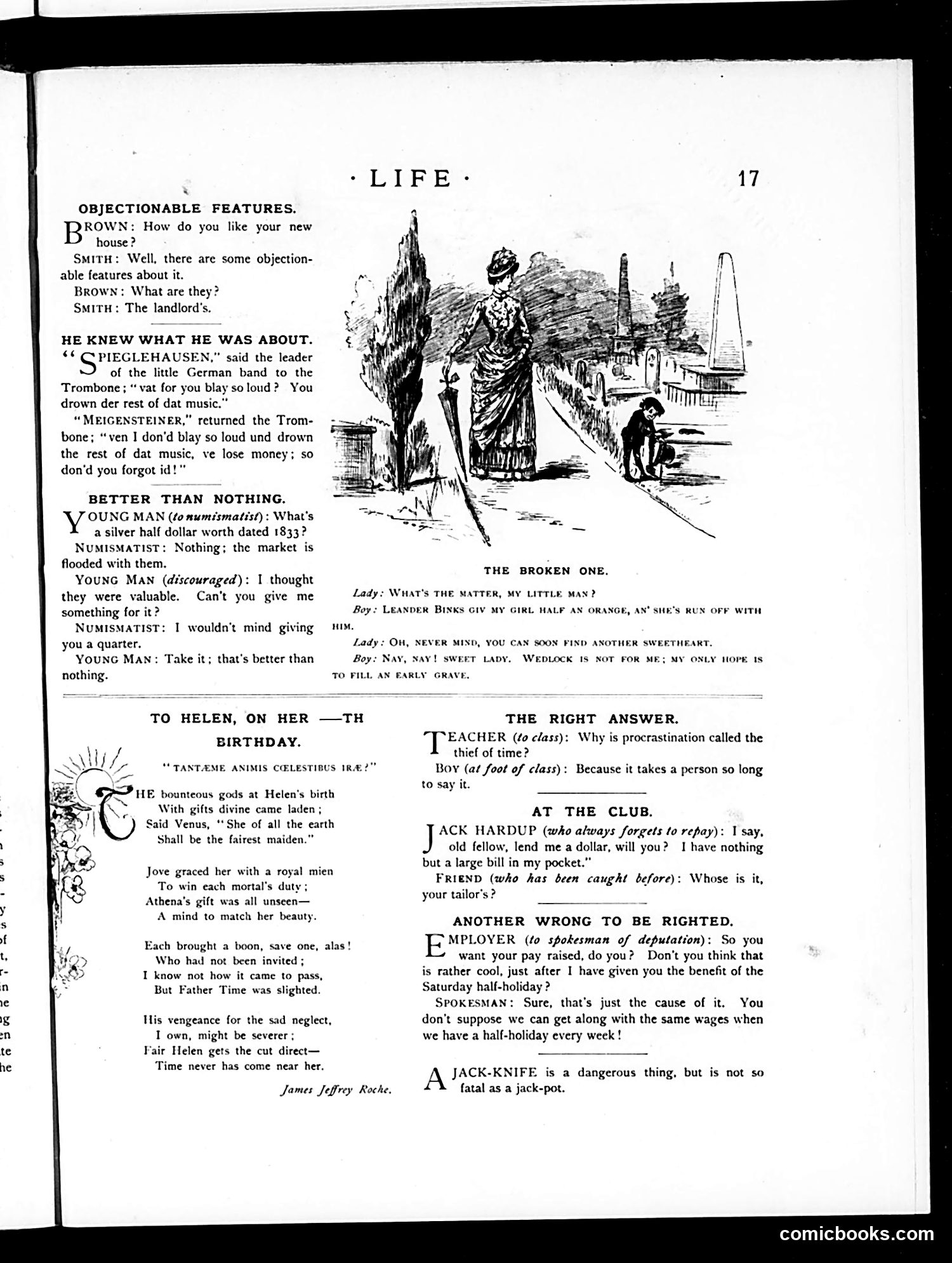
This page contains humorous dialogue and satirical content typical of early 20th-century Life magazine. **"The Broken One"** illustration depicts a street scene where a boy reports to a lady that "Leander Binks giv my girl half an orange, an' she's run off with him." The satire mocks romantic drama over trivial gestures—suggesting a girl would abandon her sweetheart for fruit. Other sections include brief comedic exchanges about housing complaints, numismatic worthlessness, and workplace frustrations. "To Helen, on Her Birthday" is a poem mocking the gods' gifts to Helen of Troy, suggesting Father Time's neglect is her worst curse. The humor relies on everyday social observations—landlord problems, romantic jealousy, labor disputes—making pointed fun at contemporary middle-class anxieties and relationships.
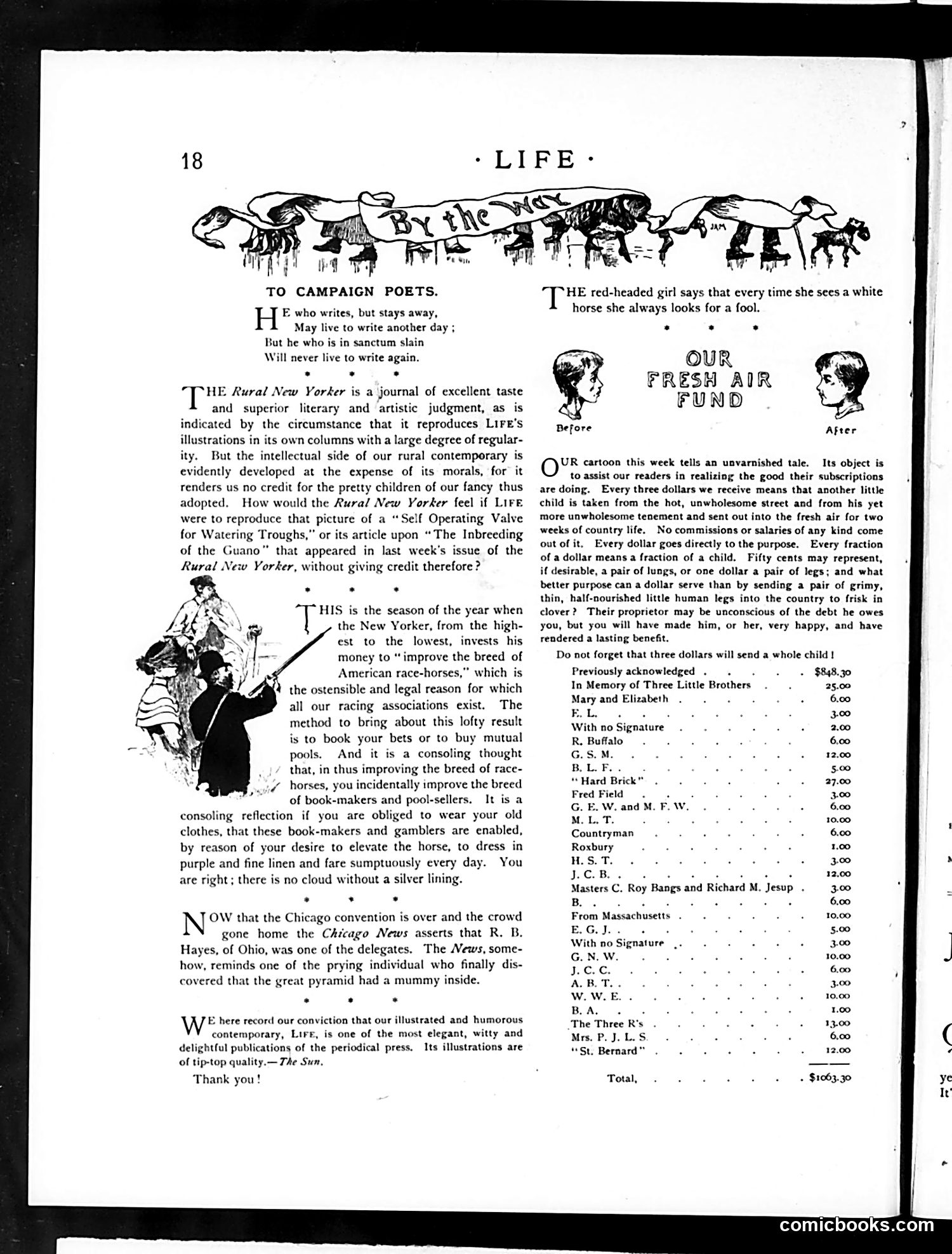
This page contains several distinct sections: **"To Campaign Poets"** criticizes writers who contribute to *Rural New Yorker* without crediting *Life* magazine, which allegedly reproduced their work. The complaint suggests intellectual property theft by a competitor publication. **The cartoon** (lower left) depicts a well-dressed woman on horseback, likely satirizing New York high society's seasonal migration to the countryside for horse racing and social pursuits. **"Our Fresh Air Fund"** announces a charitable campaign collecting donations (total: $1,651.30) to send underprivileged urban children to the countryside for health benefits—a common Progressive-era social welfare initiative. The page reflects early 1900s concerns: journalistic ethics, upper-class leisure activities, and urban child welfare advocacy.
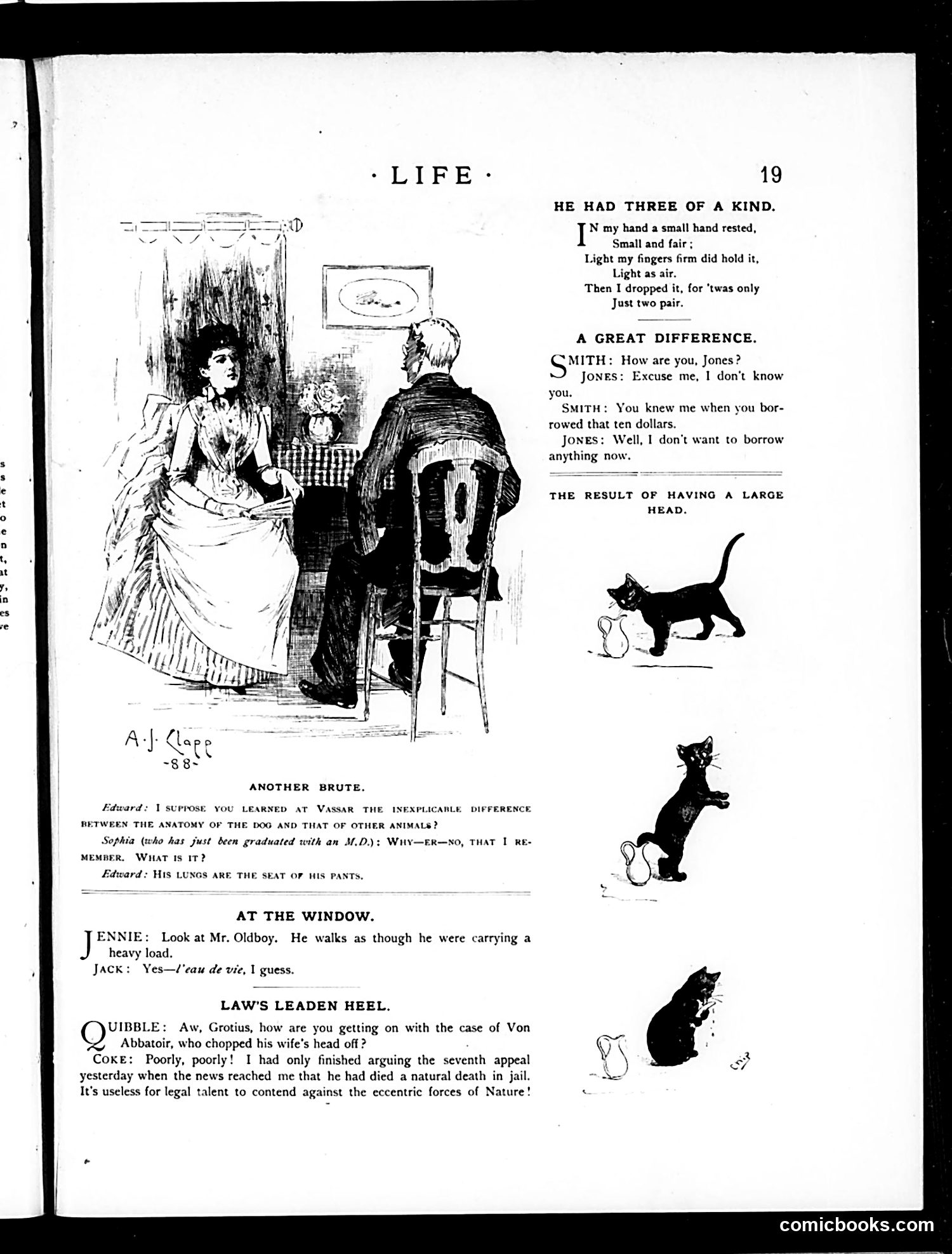
This page contains several brief comic sketches typical of early Life magazine's style: **"He Had Three of a Kind"** - A poem about holding a small hand, then dropping it when realizing there were only two gloves, not three items. **"A Great Difference"** - A dialogue joke contrasting Smith and Jones: Jones won't acknowledge Smith despite having borrowed ten dollars from him previously, claiming he no longer wants to borrow anything—reversing typical social dynamics around debt. **"The Result of Having a Large Head"** - Three cartoon panels showing a cat's exaggerated physical reactions, likely visual humor about disproportionate anatomy. **"Another Brute"** and **"At the Window"** - Brief observational jokes about human behavior and mannerisms. **"Law's Leaden Heel"** - A dialogue about a legal case involving Von Abbatoir, referencing a real or fictional criminal matter (unclear which). The page exemplifies early-20th-century magazine humor mixing wordplay, social observation, and simple line drawings.
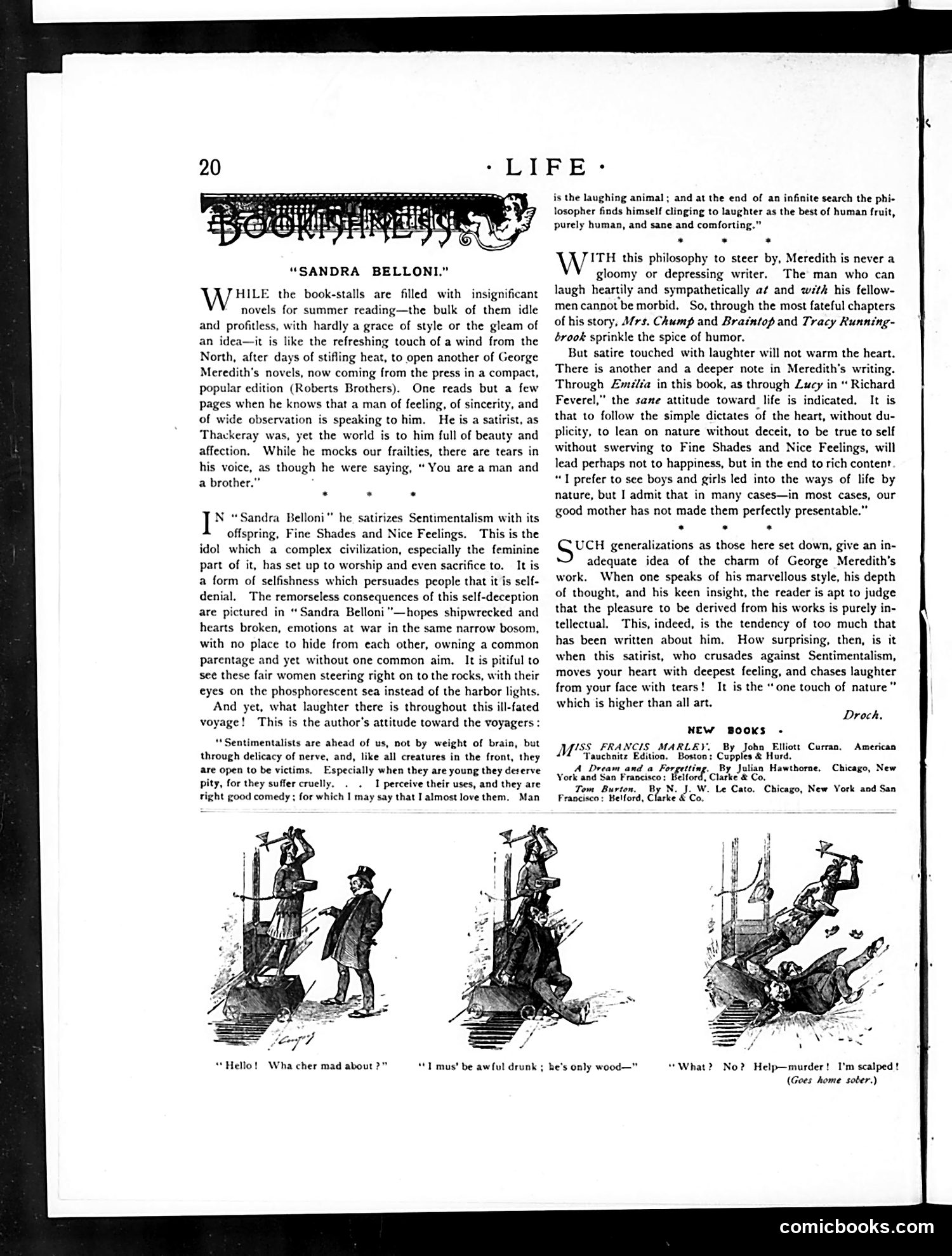
This page reviews George Meredith's novels, particularly "Sandra Belloni." The text praises Meredith as a satirist who uses humor to expose sentimentality and "Fine Shades and Nice Feelings"—likely Victorian affectations about emotion and morality. The three cartoons below illustrate this satire through slapstick comedy: a man encounters what appears to be a woman (or figure in feminine dress) near a pole, leading to escalating physical mishaps—drunkenness, then violence and injury. The captions emphasize the absurdity ("I mus' be awful drunk; he's only wood"). The cartoons mock the exaggerated emotional responses and social pretense Meredith critiques. The page essentially argues that Meredith's satirical approach—deflating pretense through comedy—is more honest and humanizing than sentimental literature of the era.
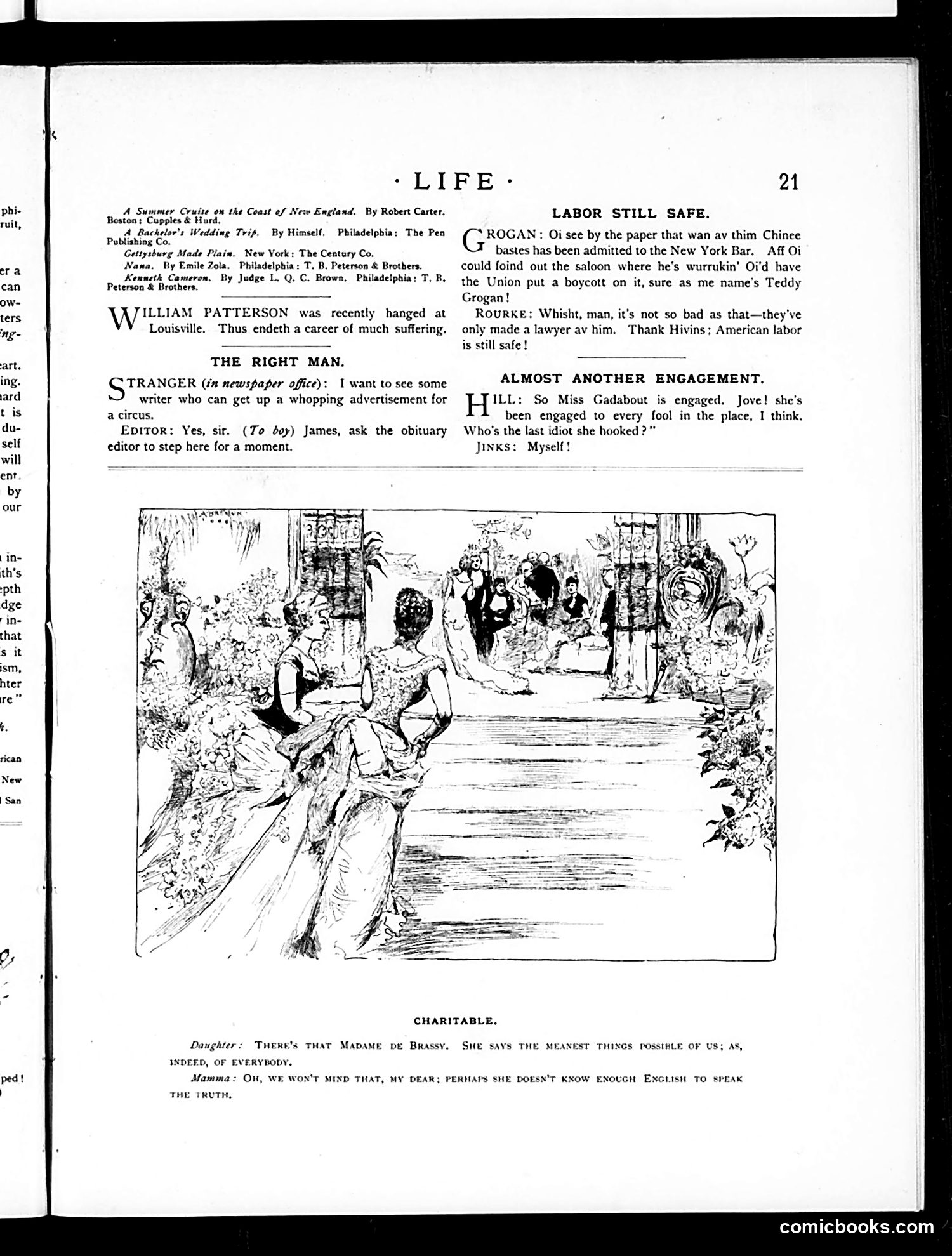
This page contains three separate satirical pieces: 1. **"Labor Still Safe"**: A brief dialogue joke about Chinese laborers being admitted to New York bars and Union boycotts—likely referencing anti-Chinese labor sentiment and immigration restrictions common in early 20th-century America. 2. **"The Right Man"**: A newspaper editor cartoon about advertising copy for a circus. 3. **"Almost Another Engagement"**: A brief joke about Miss Gadabout's repeated engagements, poking fun at serial engagements among wealthy socialites. 4. **"Charitable"**: A dialogue joke mocking a woman (Madame de Brassy) who speaks unkindly of others while claiming charity, with the punchline suggesting language barriers excuse her rudeness. The page primarily features light, gossipy humor targeting social pretensions and contemporary scandals rather than serious political satire.
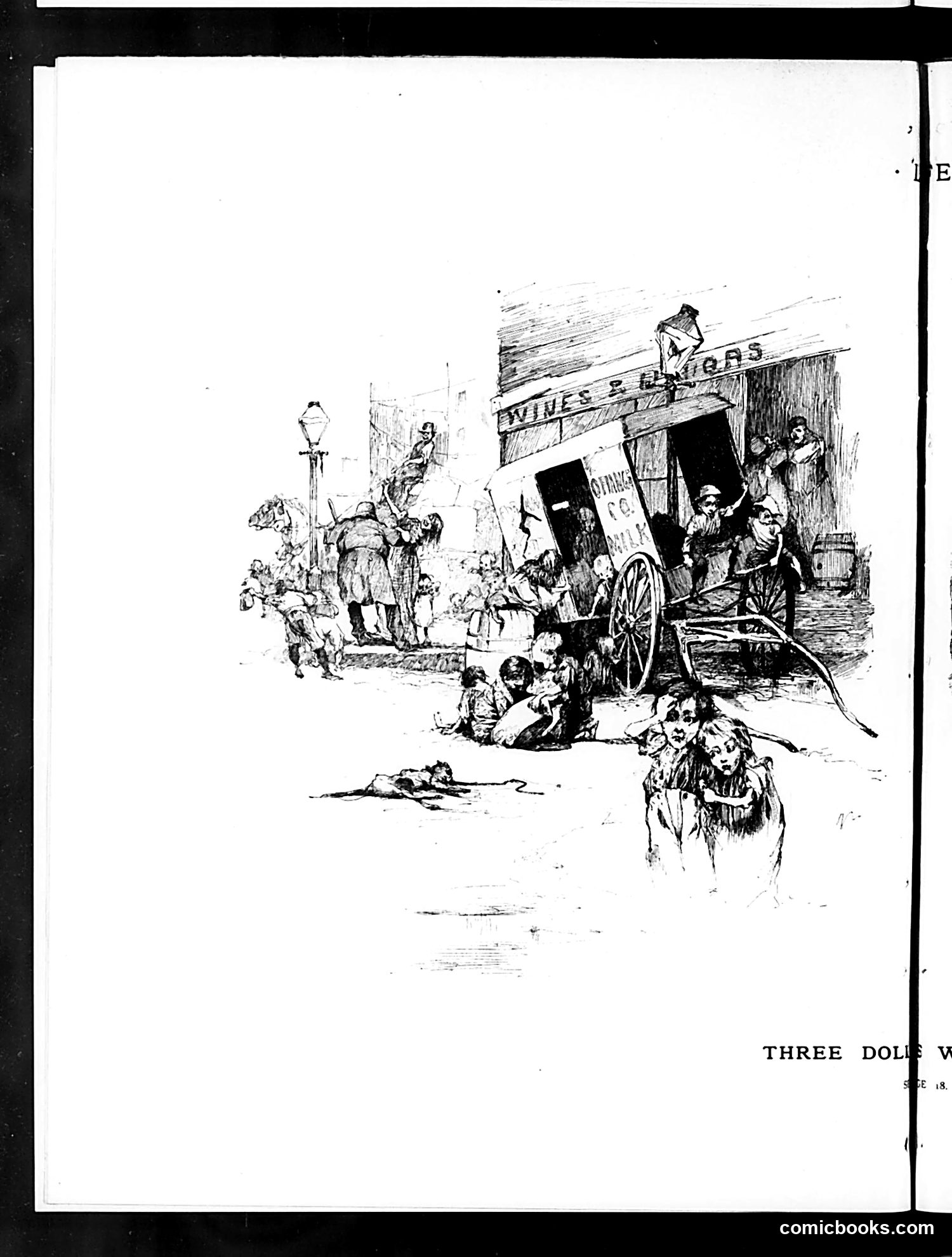
This is an illustration titled "THREE DOLL" (text cut off at bottom). The sketch depicts a street scene with a wine merchant's cart or storefront labeled "WINES & SPIRITS." The drawing shows various figures including well-dressed pedestrians on the left, children and poorer individuals in the foreground and around the cart, and what appears to be merchant or vendor figures near the establishment on the right. The satire likely critiques class disparities and urban poverty of the period, contrasting affluent customers with destitute street children and beggars. The specific reference to wines and spirits may suggest commentary on alcohol consumption across social classes, or possibly on merchants profiting while the poor suffer. Without the complete title and caption, the precise satirical target remains unclear, though the composition emphasizes economic inequality in Victorian-era urban life.
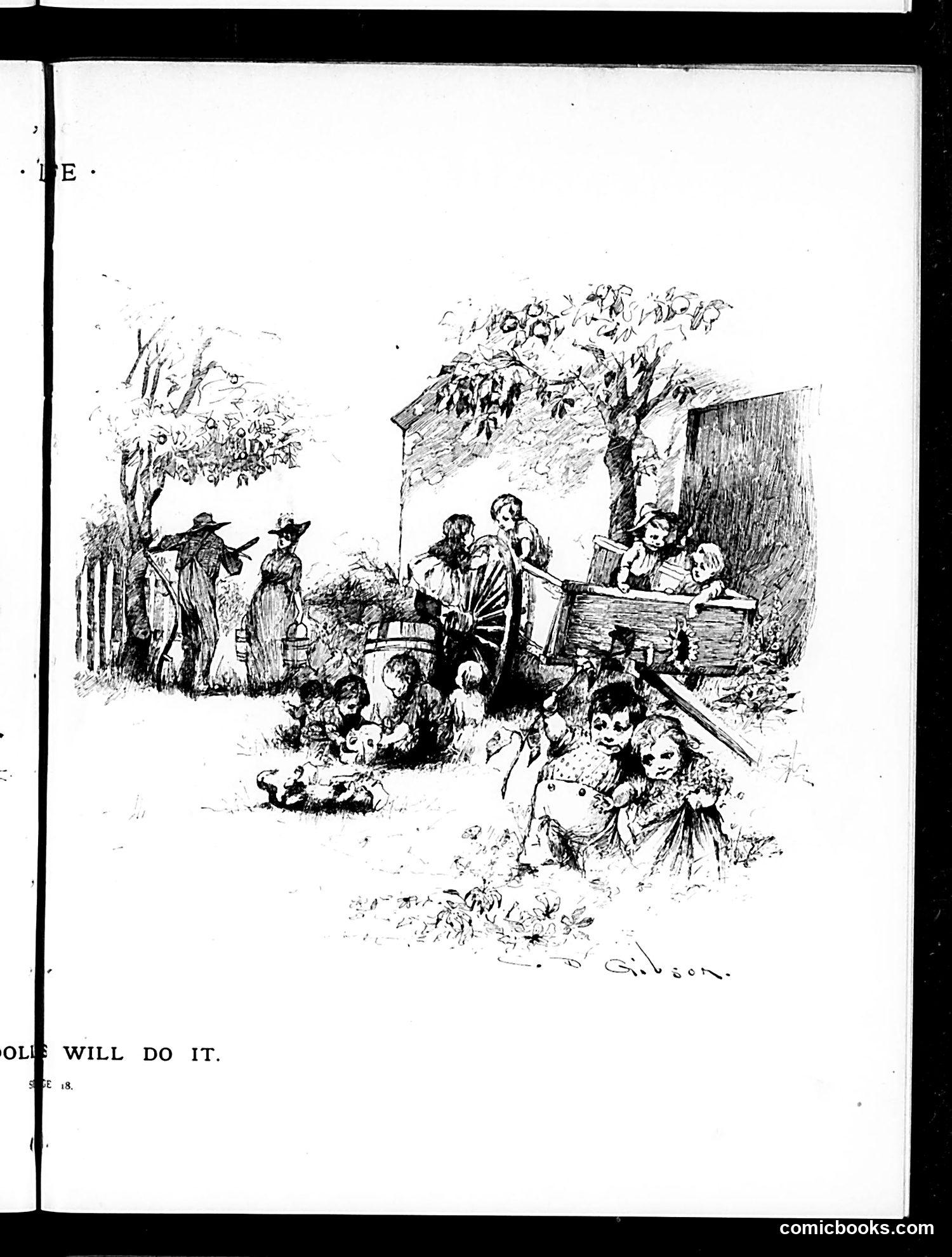
This appears to be an illustration from *Life* magazine showing a rural or pastoral scene with multiple figures gathered outdoors. The caption reads "WILL DO IT" (partially visible as "...OLIS WILL DO IT"). The sketch depicts what seems to be a community gathering or event, with adults and children in period clothing around a wooden structure. Trees and natural setting suggest a countryside location. Without clearer text or additional context, the specific satirical reference is unclear. The phrase "will do it" suggests confidence in accomplishing something, possibly political or social in nature, but the identities of the figures and the exact reference cannot be determined from the image alone. The artist's signature appears present but is not fully legible.
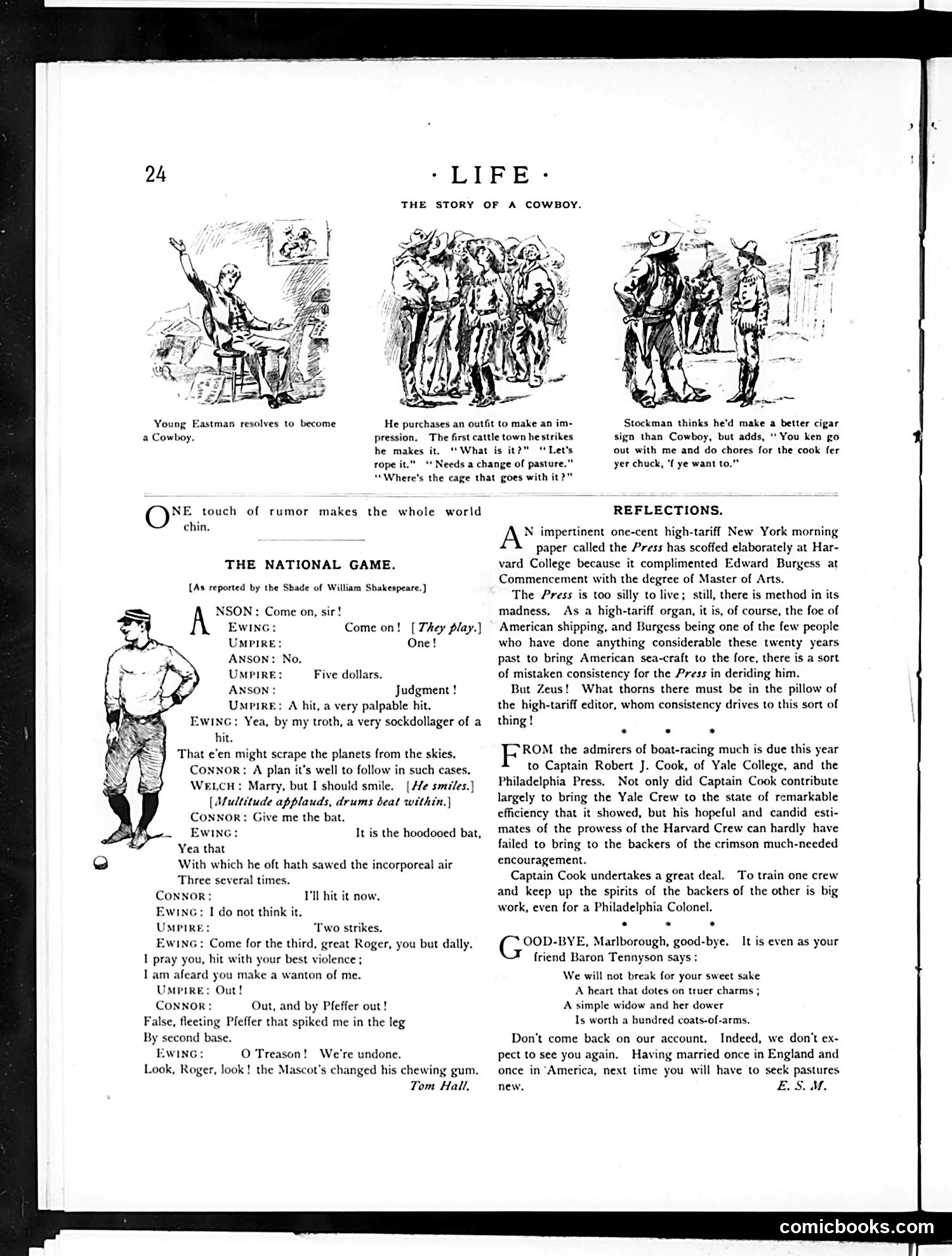
**Top Section - "The Story of a Cowboy":** Three illustrated panels humorously depict an Easterner's failed attempt to become a cowboy. He buys outfit and cattle, but makes poor decisions (keeping a cage with the cattle, suggesting incompetence). A stockman mocks his efforts, offering him domestic chores instead—satirizing naive city people attempting to adopt frontier life without actual skill or experience. **"The National Game":** A baseball dialogue between an umpire and player named Connor and Ewing parodies Shakespeare's language to describe a baseball argument. The humor relies on applying elaborate, formal theatrical speech to a mundane sports dispute—typical of Life's wordplay-based satire. The page emphasizes American humor through incompetence and linguistic incongruity rather than political commentary.
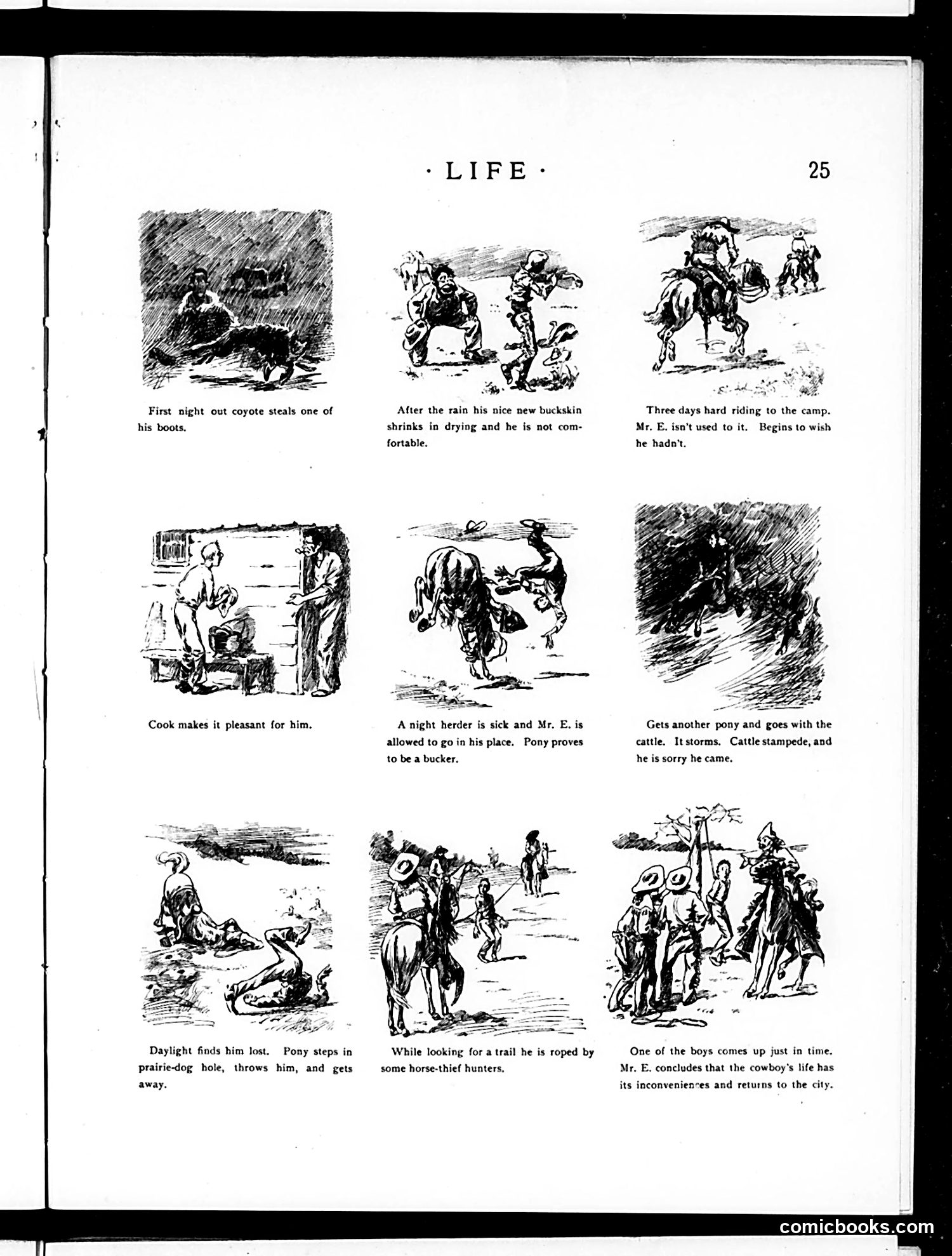
This is a humorous sequential narrative about "Mr. E." (likely representing an urban easterner or tenderfoot), who attempts cowboy life but abandons it after suffering a series of comedic misadventures. The strip satirizes the romantic fantasy of the Old West versus its harsh reality. The joke progresses through escalating disasters: stolen boots, shrunk buckskin clothes, bucking horses, being mistaken for a horse thief, difficult cattle herding, and stampedes. Each panel depicts genuine frontier hardships presented as slapstick comedy. The satire targets city dwellers who idealize cowboy culture without understanding its actual dangers and discomforts. Mr. E's rapid return to urban life—after concluding the cowboy life has "inconveniences"—is the punchline, using dramatic understatement to mock his naive romanticism about the frontier.
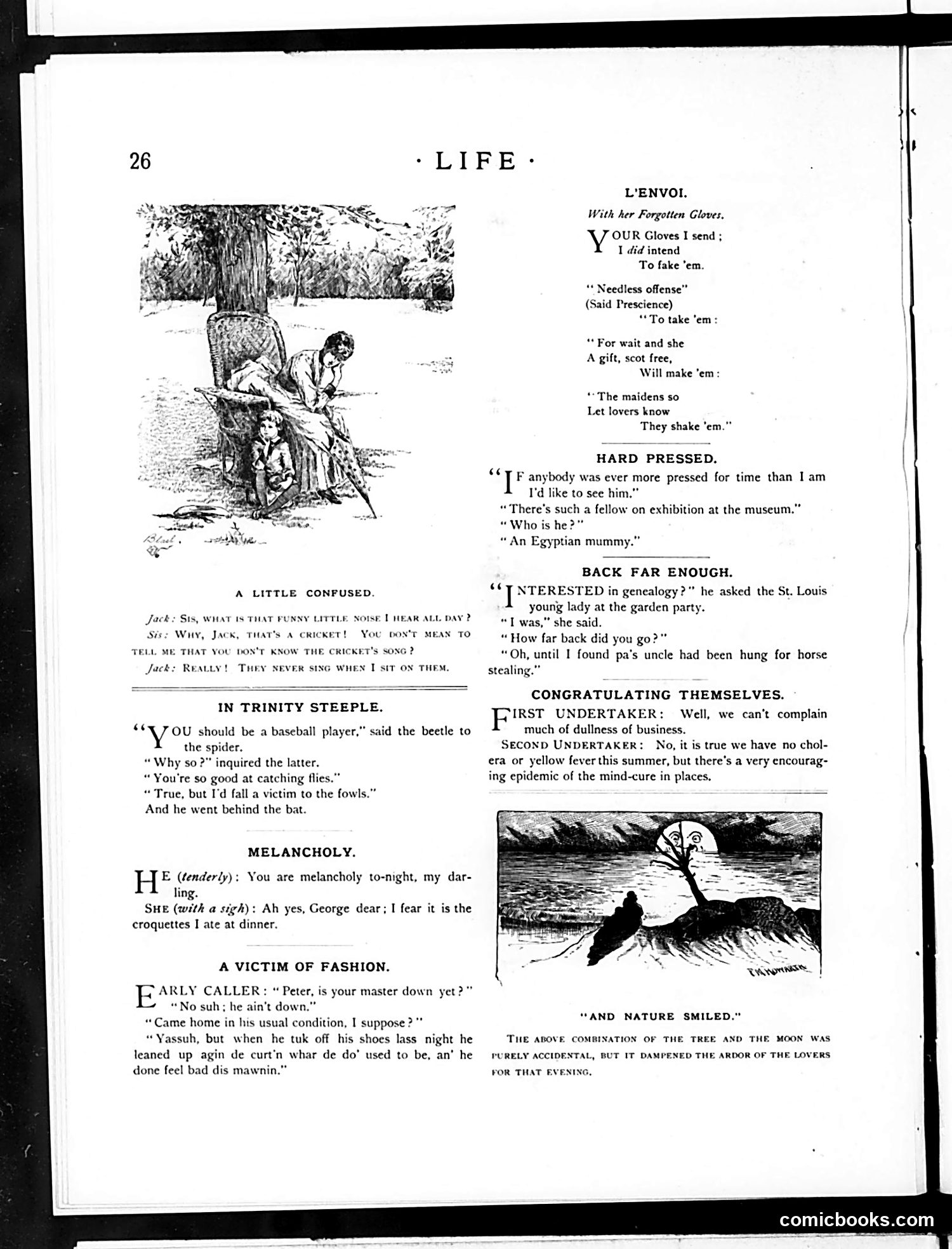
This page from *Life* magazine presents a collection of brief comedic vignettes typical of early 20th-century American humor. The jokes rely on wordplay, situational comedy, and social observation: **Key humor includes:** - **"A Little Confused"**: Sibling misunderstanding about cricket sounds (the insect versus not knowing its song) - **"In Trinity Steeple"**: A beetle-spider exchange pun about "catching flies" (insects vs. the sport) - **"Hard Pressed"**: Time-management joke comparing a busy man to an Egyptian mummy - **"Back Far Enough"**: A woman's genealogy research ends when discovering an ancestor was hanged for horse theft—a joke about social climbing and family secrets - **"Congratulating Themselves"**: Dark humor from undertakers noting an "epidemic of the mind-cure" (likely referring to Christian Science) as good for business The page also includes illustrated vignettes about fashion, melancholy (indigestion), and an accidental romantic moment interrupted by a tree and moon alignment. The humor is gentle, pun-based satire aimed at middle-class readers.
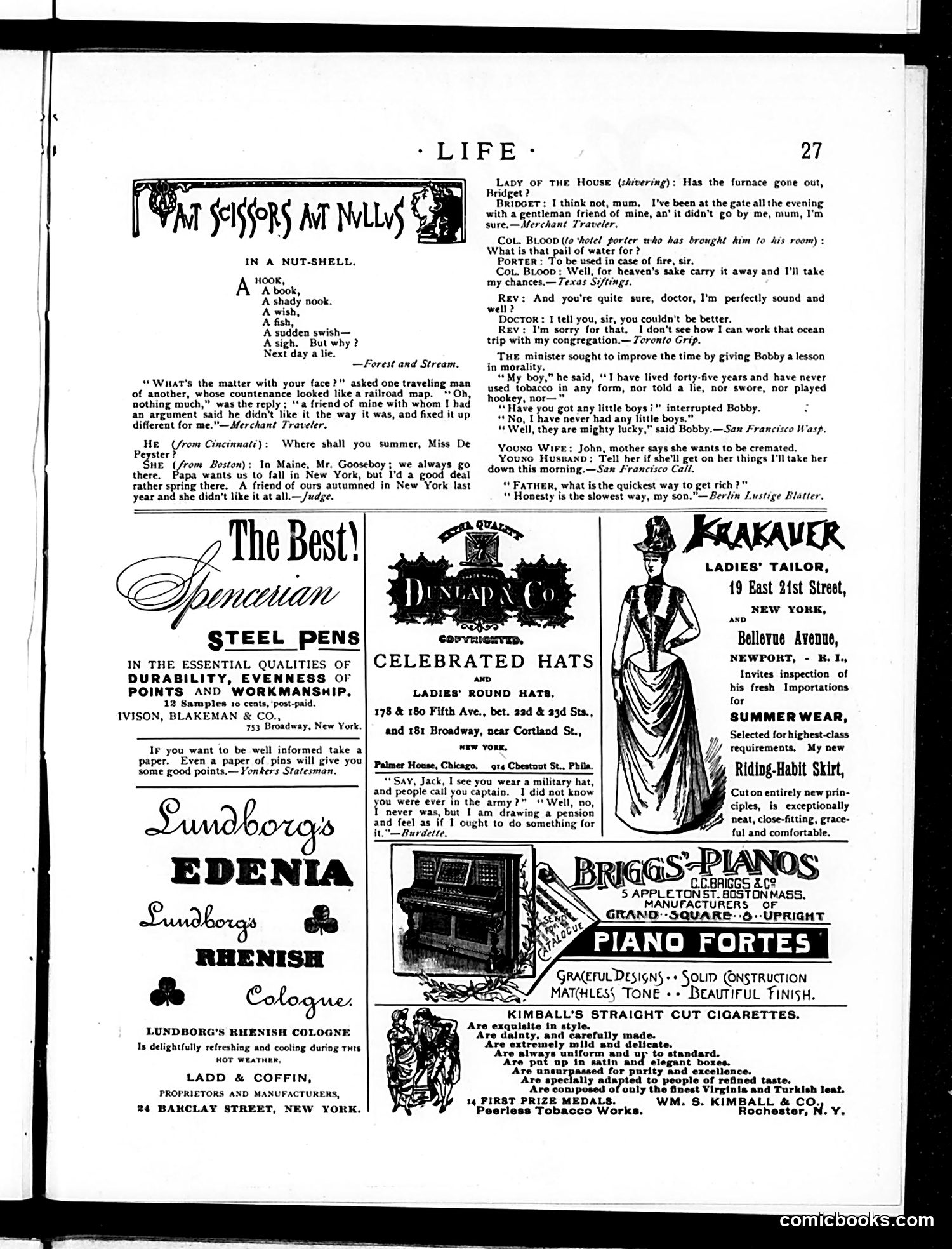
This page contains multiple short humorous anecdotes typical of *Life* magazine's satirical style. The cartoons/jokes mock various social absurdities: **Key sketches:** - A traveling salesman's face resembles "a railroad map" because a friend literally rearranged his features - A housemaid insists the furnace "didn't go by" her at the gate (misunderstanding "furnace" as something that travels) - A clergyman bragging about moral virtue is interrupted by a boy noting that virtuous people apparently don't have children - A young husband offers to take his wife to be cremated, misunderstanding her request **The satire targets:** malapropisms, literal-mindedness, pretentious morality, domestic misunderstandings, and absurd non-sequiturs. The remainder of the page is **advertising** for period products: fountain pens, hats, pianos, cologne, cigars, and tailoring services—typical of late 19th-century magazines.
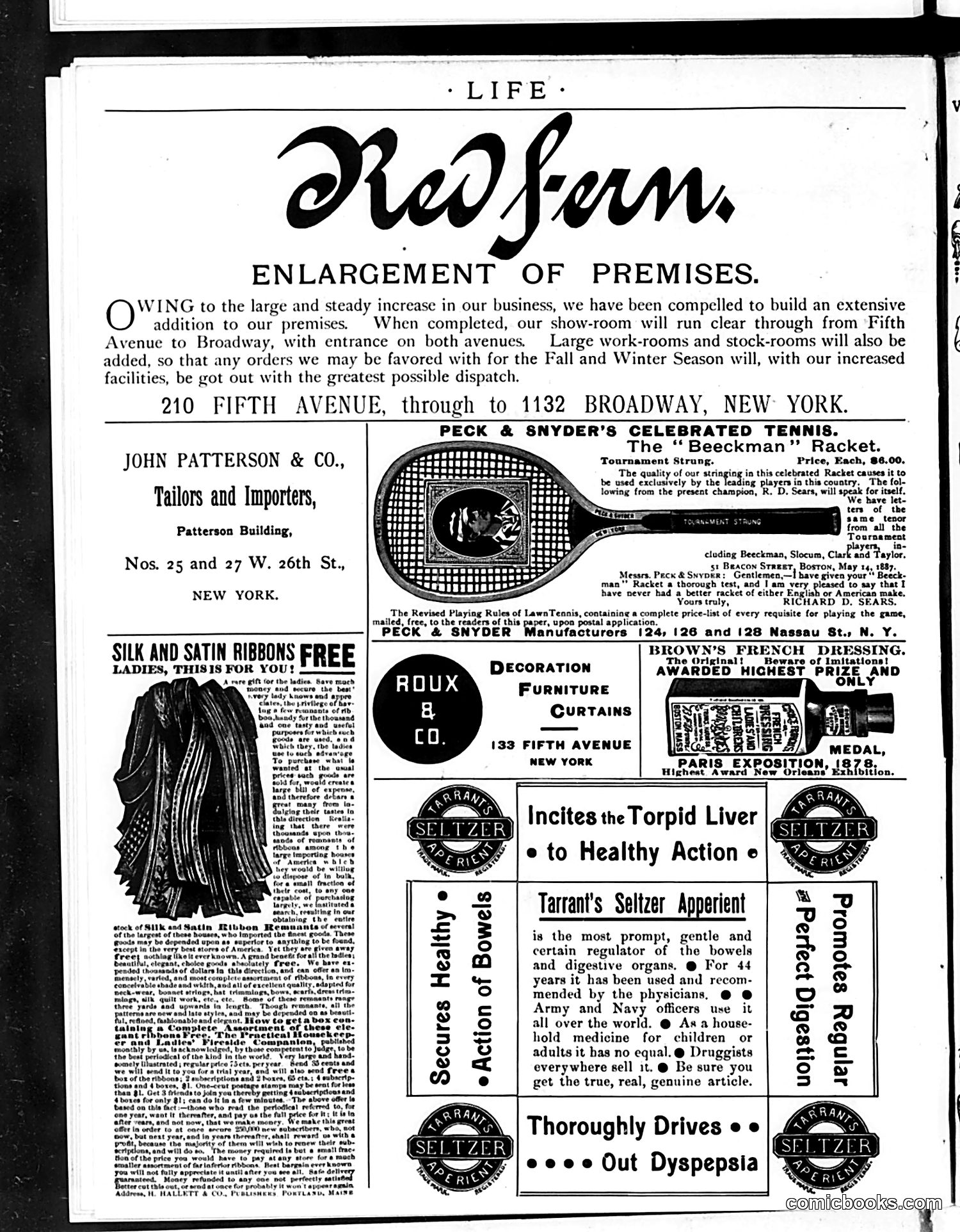
This is **primarily a commercial advertising page**, not a satirical cartoon page. The dominant content consists of business advertisements from the 1880s. The main features include: **"Red Fern" store announcement**: A Fifth Avenue retailer announcing expansion from Fifth Avenue through to Broadway, with enlarged showrooms and stockrooms for fall/winter business. **Sports equipment ad**: Peck & Snyder advertise the "Beeckman" tennis racket, endorsed by R.D. Sears (the championship player), selling for $6.00. **Patent medicines**: Tarrant's Seltzer Apperient advertises as a digestive remedy used by physicians and military officers for bowel regulation and dyspepsia treatment. **Household products**: Advertisements for ribbons, furniture, and Brown's French Dressing (awarded highest prize at Paris Exposition 1878). **Period context**: These ads reflect Gilded Age consumer culture—mass-marketed sporting goods, proprietary medicines (largely unregulated), and department store expansion. The page contains no satire or political commentary; it's a straightforward commercial publication.