
Life, 1888-07-12 · page 2 of 14
Life — July 12, 1888 — page 2: what you’re looking at
What you’re looking at
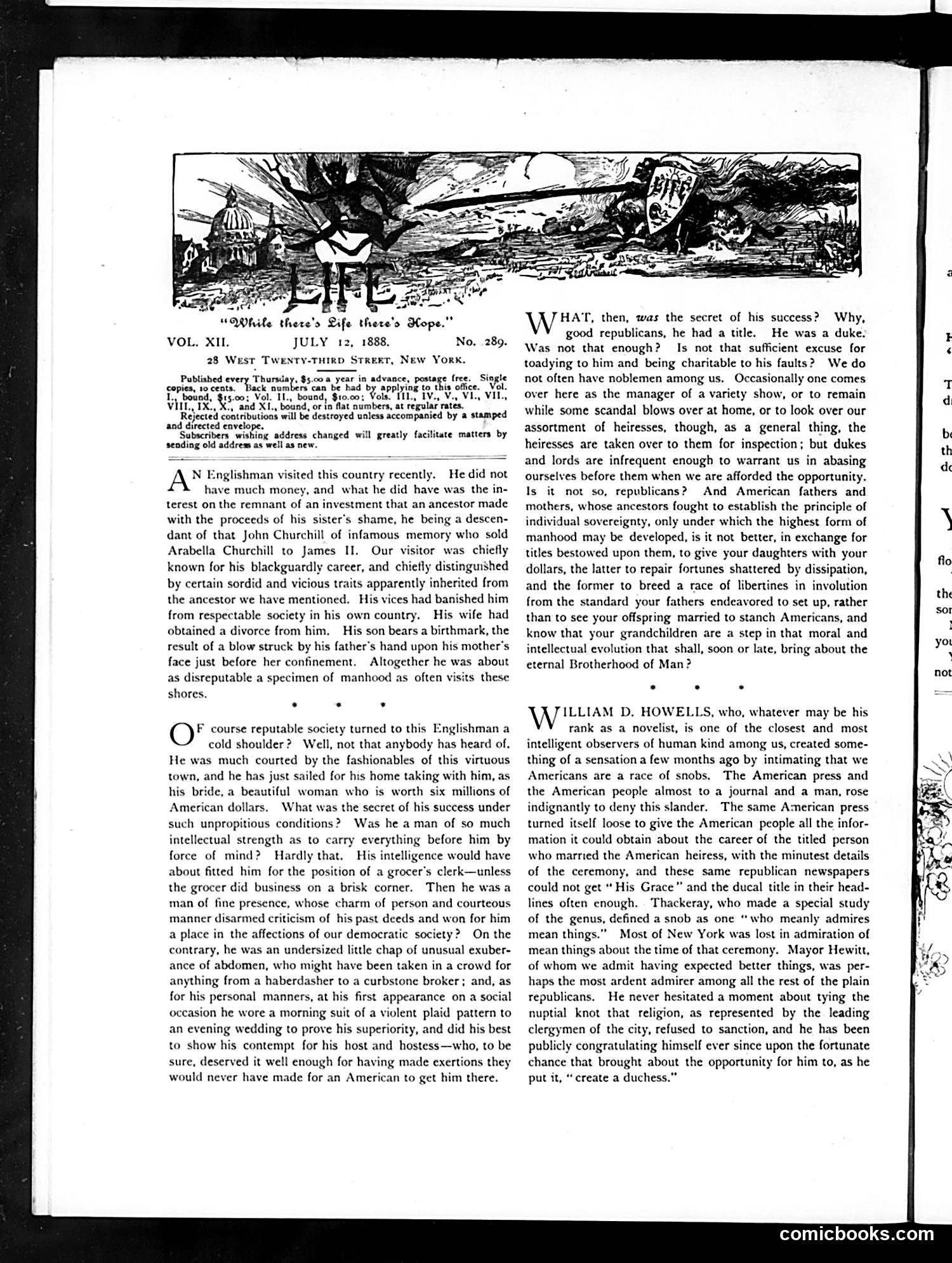
The page's header illustration shows a pastoral landscape with the caption "While there's Life there's Hope"—Life magazine's typical masthead art. The text discusses an Englishman who visited America and failed socially despite wealth and a beautiful wife, becoming a cautionary tale about European aristocratic pretensions. The article then focuses on **William D. Howells**, a prominent American novelist and social observer, and his recent commentary on American marriage customs. The satire targets the American press's excessive coverage of a titled person's marriage ceremony, suggesting American society's contradictory attitudes: republicans claiming to reject aristocracy while obsessively reporting on titles and rank. The piece mocks this hypocrisy—particularly Mayor Hewitt's congratulations for creating "a duchess"—as reflecting deeper American ambivalence about wealth, status, and democratic principles.
📄 Transcribed text from this page (OCR, searchable)
Machine-transcribed from the original scan — historical spelling and the odd misread are preserved.
“Mhile there's "Rife there's Hope.” VOL. XII. JULY 12, 1888, No. 289. 28 West TWeENTy-THIRD STREET, New York. $s.co year in advance, postage free. Single copies, 19 cents fs can be had by applying to this office. Pound, $5 bound, $10.00; Vols. Tile 1V., Vi. Vis ViIL,, 1X, X aad Xi, Noands or in flat numbers, at regular rates. Rejected contributions will be destroyed unless accompanied by a stamped and directed envelope. Subscribers wishing address changed will greatly facilitate matters by sending old address as well as new. Published every Thursday, “Tack oe uml A’ Englishman visited this country recently. He did not have much money, and what he did have was the in- terest on the remnant of an investment that an ancestor made with the proceeds of his sister's shame, he being a descen- dant of that John Churchill of infamous memory who sold Arabella Churchill to James IH. Our itor was chiefly known for his blackguardly career, and chiefly distinguished by certain sordid and vicious traits apparently inherited from the ancestor we have mentioned. His vices had banished him from respectable society in his own country. His wife had obtained a divorce from him. His son bears a birthmark, the result of a blow struck by his father’s hand upon his mother’s face just before her confinement. Altogether he was about as disreputable a specimen of manhood as often visits these shores. . . * F course reputable society turned to this Englishman a cold shoulder? Well, not that anybody has heard of. He was much courted by the fashionables of this virtuous town, and he has just sailed for his home taking with him, as his bride, a beautiful woman who is worth six millions of American dollars. What was the secret of his success under such unpropitious conditions? Was he a man of so much intellectual strength as to carry everything before him by force of mind? Hardly that. His intelligence would have about fitted him for the position of a grocer’s clerk—unless the grocer did business on a brisk corner. Then he was a man of fine presence, whose charm of person and courteous manner disarmed criticism of his past deeds and won for him a place in the affections of our democratic society? On the contrary, he was an undersized little chap of unusual exuber- ance of abdomen, who might have been taken in a crowd for anything from a haberdasher to a curbstone broker; and, as for his personal manners, at his first appearance on a social occasion he wore a morning suit of a violent plaid pattern to an evening wedding to prove his superiority, and did his best to show his contempt for his host and hostess—who, to be sure, deserved it well enough for having made exertions they would never have made for an American to get him there. V HAT, then, was the secret of his success? Why, good republicans, he had a title. He was a duke. Was not that enough? Is not that sufficient excuse for toadying to him and being charitable to his faults? We do not often have noblemen among us. Occasionally one comes over here as the manager of a variety show, or to remain while some scandal blows over at home, or to look over our assortment of heiresses, though, as a general thing, the heiresses are taken over to them for inspection; but dukes and lords are infrequent enough to warrant us in abasing ourselves before them when we are afforded the opportunity. Is it not so, republicans? And American fathers and mothers, whose ancestors fought to establish the principle of individual sovereignty, only under which the highest form of manhood may be developed, is it not better, in exchange for titles bestowed upon them, to give your daughters with your dollars, the latter to repair fortunes shattered by dissipation, and the former to breed a race of libertines in involution from the standard your fathers endeavored to set up, rather than to see your offspring married to stanch Americ: know that your grandchildren are a step in that moral and intellectual evolution that shall, soon or late, bring about the eternal Brotherhood of Man? . . . ILLIAM D. HOWELLS, who, whatever may be his rank as a novelist, is one of the closest and most intelligent observers of human kind among us, created some- thing of a sensation a few months ago by intimating that we Americans are a race of snobs. The American press and the American people almost to a journal and a man, rose indignantly to deny this slander. The same American press turned itself loose to give the American people all the infor- mation it could obtain about the career of the titled person who married the American heiress, with the minutest details of the ceremony, and these same republican newspapers could not get “His Grace” and the ducal title in their head- lines often enough. Thackeray, who made a special study of the genus, defined a snob as one “who meanly admires mean things.” Most of New York was lost in admiration of mean things about the time of that ceremony. Mayor Hewitt, of whom we admit having expected better things, was per- haps the most ardent admirer among all the rest of the plain republicans, He never hesitated a moment about tying the nuptial knot that religion, as represented by the leading clergymen of the city, refused to sanction, and he has been publicly congratulating himself ever since upon the fortunate chance that brought about the opportunity for him to, as he put it, “create a duchess.” comicbooks.com